Feeds:
Posts
Comments

Archive for the ‘18th Century England’ Category

This post features the recollections about a severely cold winter in 1794/95 by three Englishmen: Rutland squire, Thomas Barker, the Rev James Woodforde, a country parson whose diary (1759-1802) provides valuable first hand insights, and an event described by Matthew Flinders, listed in the Lincolnshire Archives. Interestingly, their observations, which read like today’s text messages, will intrigue the modern reader.

The weather in central England during the fall of 1794 started out warmly. Barker recorded:

“The autumn though wet was mild; swallows and martins did not go away till about October 18; the autumnal flowers continued till December, anemones were then in flower; winter and spring flowers were forward, and the leaves of the spring crocus appeared.”

Reverend James Woodforde came to Weston Longville, a small village north of Norwich, in 1775 and remained as rector until his death in 1803. During this time he kept a diary of his life as a country parson. While he mostly focused on parish visits, food, and the people and villages in his surroundings, he concentrated many of his observations on the weather from October to March 1794/95. His descriptions dovetailed nicely with Barker’s notes. In the next two passages Woodforde also mentioned the rains in October and flowers in November:

“The Rain that Fell yesterday [October 6] rose the Water at Foxford & East Mills quite high, Nancy very much alarmed and frightened therewith as it came almost into our little Cart.”

and

“Nov. 30, Sunday …. Mem. a Primrose in my Garden in full bloom, seen by myself and my Niece.”

Thomas Barker then referred to the sudden change in the balmy weather:

“But in the latter half of December the scene altered, and the frost began; it was a mixture of severe and moderate frost, falling and melting snows, and floods, with hard frost and breaks; the beginning of a very severe winter … for a quarter of a year, yet now without a thawing day or two now and then in January…”

Pastor Woodforde wrote a sequence of descriptions on weather events and how they impacted his life. One gains a visceral sense of how the intense and unrelenting cold invaded houses and affected the inhabitants down to their bones.

Dec 25, Thursday, X-mas day….It was very cold indeed this Morning, and the Snow in many Places quite deep, with an E. Wind. About 11. this Morning I walked to Church and read Prayers & administered the Holy Sacrament. Had but few Communicants the Weather was so bad….The Weather being so severely cold, which I could never escape from feeling its effects at all times, affected me so much this Morning, that made me faint away…..Mr Howlett after Service, very kindly offered to drive me home in his Cart, but as I was better I declined it, however hope that I shall not forget his civility….

and

Jan. 15, Thursday….Got up this morning very bad indeed in the Gout in my right foot….The Weather Most piercing, severe frost, with Wind & some Snow, the Wind from the East and very rough…I had my bed warmed to night & a fire in my bed-Room….Obliged to put on my great Shoe, lined with flannel.  The Weather very much against me besides.

and

Jan. 21, Wednesday….The last Night, the most severest yet, extreme cold. So cold that the Poultry kept in the Cart-Shed and obliged to be driven out to be fed….

Jan. 23, Friday….The Weather more severe than ever, it froze apples within doors, tho’ covered with a thick carpet. The cold to day was the severest I ever felt. The Thermometer in my Study, with a fire, down to No. 46….

and

Jan. 25, Sunday….The Ice in the Pond in the Yard which is broke every Morning for the Horses, froze two Inches in thickness last Night, when broke this morning.

The pastor also wrote that a terrible storm took the thatch off the barn and stripped the tiles from his roof. On the 28th he described a “very severe frost indeed. It freezes sharply within doors,” and he related the sad news of two women who “froze to death Saturday last going home from Norwich market to their home.” 

Early February provided a smidgen of hope:

Feb. 8, Sunday…..Weather much altered, very foggy and a cold Thawe, with very small Rain, all the whole day. I hope to God that now We shall no more have any severe Frosts this Year…

Woodforde’s hopes were premature, however. Thomas Barker observed that a thaw for four or five days from February 8 to 12: 

“…took away a great part of the snow, and made a greater flood than any remembered, which did more damage to the bridges all over the kingdom than was ever known yet without taking away all the ice and snow; the frost returned again as hard as before, and with a less break near the end of February …”

The Lincolnshire Archives provides a description from Matthew Flinders, who wrote about the abnormal winter and great flooding as the snow melted. His observations add dimension to Barker’s and Woodforde’s writings, for he referred to the misery that farmers and peasants must have felt. He also mentioned the war raging in the background, which affected all Englishmen during this period.:

“…This has been the severest winter in these climates known in living memory… the snow began at Xmas Eve  – and continued with intervals most of the time. I think I may say more has fallen than in the last 7 years together and several times more on the ground, than has been since the great snow in 1767 when it was a yard deep on the level… very great damage has been done on the breaking up of the frost by the floods – numbers of bridges being broke down, and large tracts of land overflowed – no such flooded known since the memorable year 1764. Great injury done to the farmers – much sowed wheat destroyed & the poor much distressed – tho’ there were very liberal subscriptions in many towns. This added to the distress occasioned by the War – has given the times an alarming aspect w’ch I hope God in his good time will remove.” [Lincolnshire Archives] – Extreme weather events in focus: White Christmases

The flooding was ruinous to the winter crops. Pastor Woodforde also worried that the poor people would suffer from the effects. 

More recently, John Kington from the University of East Anglia states that the cold in January 1795: 

…was exceptionally severe, it was not until Christmas Eve 1794 [as previously related] that the very cold conditions set in The frost then lasted, but without breaks, until late March. The cold was most intense in January, which resulted in the coldest January (-3.1°C) in the Central England Temperatures series (Manley 1974). –  The Severe winter of 1794/95 in England, Climatic Research Unit, University of East Anglia, Norwich

An article in The Guardian dated Jan 01, 2022 provides the following information about the cold’s impact on people:

The coldest January since 1659, when records began in England, was in 1795 when rivers including the Thames and Severn froze over. The temperature barely rose above freezing all month.

and

Country parsons, who fed poor people at Christmas, gave them a shilling each to buy food for January. Grain was in already in short supply because of a dry summer and hunger became so widespread that the following spring there were bread riots. (Read more on this topic later in this post.)

The thaw previously mentioned on February 8 by Parson Woodforde and Thomas Barker resulted in floods that devastated lands in Norwich, near the Pastor’s parish, but also farther west in Shrewsbury. Shrophsire Star.com features a facsimile of the news published on February 13, 1795. The following information are excerpts from that facsimile, which you can read in full at this link to the article

In consequence of the sudden thaw after so long a frost, the Severn has overflowed its banks to a higher degree than ever was known in the memory of man. This town is, therefore now nearly an island; neither the Mail-Coach or any other carriages could get out of town on Wednesday morning, the water being so deep at both the bridges….

and

…Great quantities of timber have been carried away by the violence of the flood; several houses are fell in, and the furniture entirely swept off;…the inhabitants….cannot leave their habitations but by boats; a number of horses, cattle and pigs have been drowned…

and

Great praise is due to several humane Gentleman, who were active in assisting the poor people whose dwellings were inundated. Several boats loaded with fresh meat, bread and cheese, etc. were sent for the relief of such poor persons who could not leave their habitations, and which was given to them thro’ their chamber windows.

The flooding did not reflect the full extent of the damage from the east of central England to the west, for the “thaw” did not last. A cold spell ten days later froze the Severn to such an extent that John Kington wrote: 

On the 23rd [of January], the Severn [river] was frozen and a printing press, after the fashion set on the Thames, was set up on the ice. 

The River Severn, which is the longest river in England, experienced thick frosts during the “mini” ice age of the 16th, 17th, and 18th centuries. By 1795 at least ten frost fairs were held on the Thames River. Communities along the Seven, while not as organized as those along the Thames, held frost fairs in 1620, 1622, 1795, and lastly in 1855. – Wyre Forest Net

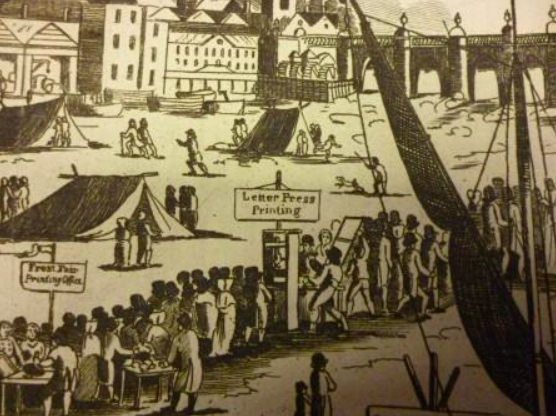
Despite the hardships from the hard freezes, these “frost fairs” provided winter entertainments in the form of food tents, sports, and games. Paper souvenirs were printed on the ice. They all but shouted for posterity — “I was at the Frost Fair at the Severn in 1795!” These mementos could be simple or more elaborate, depending on the amount of money the fair goer could afford to spend. The image below of a Frost Fair on the Thames River shows a long line of revelers waiting at the printing press for their choices. Other images in the links provided below depict simple or more elaborate souvenirs saved by fair goers.

Screen Shot 2023-11-30 at 11.04.26 AM

Close up of a printing press set up on ice on the Thames River.The British Library, Printing on Ice

This link leads to four affordable paper souvenirs printed on a sheet. Click to view. This elaborate Frost Fair souvenir was printed in 1740. Click here.

In his Memoir of that winter, Pastor Woodforde did not mention a Frost Fair, but he continued to observe the weather in his diary. On Feb. 18 he wrote: 

Wednesday….Very hard Frost, with strong Easterly Winds, a black Frost*. Every Vegetable seems affected by it. A cold this day almost, as any this Winter. I felt it before I got up this Morning, pain within me. It froze very sharp within doors all the day long. Dinner to day odds and ends, but very good. Had a fire again in My bedchamber to night, tho’ I had left if off some time, bitter cold to night.

*a dry, non visible killing frost that turns vegetation black (Oxford Languages)

Feb. 20, Friday….This Day is said to be this most cutting this Winter. It snowed the whole Day, but small & very drifting. The cold this day affected us this day so much that it gave us pains all over us, within & without and were even cold tho’ sitting by a good fire….

and

Feb. 22, Sunday….Severe, cold Weather still continues, froze again within doors. In the Afternoon some Snow. I am afraid now that we shall have more of it–The New Moon being now three Days old, and no appearance of a change.

The weather was unrelenting. Pastor Woodforde went on to say that although he meant to make an appearance at church, the weather continued on so severely and with so much snow on the ground that he “sent word to my Parishioners that there would be no service.” 

His journal mentioned only one final entry in my edition of his memoirs regarding these severe winter events:

March 13, Friday….Ground covered with Snow this Morning, having a great deal of Snow in the Night. The Morning was fair but Air very cold. A 4th Winter….

A fourth winter indeed. Thomas Barker picked up the narrative:

… it continued into March. It was in general a calm frost, with vast quantities of snow coming and going, so that though it was pretty thick at times, it never lay so deep as it sometimes does. But perhaps some of the deep pits of snow and beds of ice were not entirely gone at the end of March.”

The effects of this cold weather on the populace did not end with a warming spring. 

“Grain was already scarce thanks to a hot and dry summer in 1794, but Britain was at war with revolutionary France, too, which disrupted imports and raised food prices even higher. The Gentlemen’s Magazine, a popular periodical from the time, warned of “unprecedented inclemency” – How British people weathered exceptionally cold winters, University of Liverpool Research News, 04 January 2021

Some rich landowners feared an uprising due to the scarcity of food, bread, and fuel. 

Land agent William Gould’s diary entry for January 21 1795 notes that he was instructed to give money, coal, beef and bread to the hungry around the Duke of Portland’s Welbeck estate in Nottinghamshire. Elsewhere in the county, Reverend Samuel Hopkinson bought peat turf (a kind of fuel) to distribute to the poor on behalf of Earl Fitzwilliam. – University of Liverpool Research News, 2021

Even with this ‘minimal’ support, the general populace suffered and bread riots ensued the following spring.

More resources:

Read Full Post »

“[They] thrive by sleep, not long but deep”
– Welsh saying*

Recent research shows that until 200 years ago our sleep patterns followed two cycles every night. “Each block of sleep would be around four hours, with most people staying awake for two to four hours in between.” (Sleep in the 1800’s…, 2014).

In many societies interrupted sleep was so common that it was considered normal. The first awakening occurred around midnight, three to four hours after nightfall, when people in Western cultures generally went to bed due to lack of light, for most of the populace did not have the means to afford expensive candles. 

Two decades ago Roger Ekirch, a university distinguished professor in the department of history at Virginia Tech, researched sleep habits in Europe and America. He discovered many references to biphasic sleep in over 500 original sources from centuries past, such as diaries, medical texts, literature, prayer books, and even a crime report: He found descriptions written in English, Italian, French, and Latin. Sleep documentation also existed in Africa, the Middle East, South Asia, and Latin America, with some referring back to Ancient Greece. Ekirch would uncover over 2,000 preindustrial sleep documents in his searches.

According to sources, some individuals took the quiet time of first wakefulness to complete tasks, such as those of housewives or servants, or to write letters, or record their dreams. Others ate a small snack, chatted with a guest or spouse, read, prayed, attended to necessary bathroom needs, or made love. Individuals followed their own nightly rituals, be it alone or with someone else. 

“…it was suggested that fertility among laborers was increased due to the midnight wakefulness; men who came home physically exhausted were more likely to have enjoyment, and successful intercourse, if there was a rest period after the day’s troubles.” – The History of Sleep Before the Industrial Revolution (historycooperative.org)

Although there were many references to segmented sleep in the past, knowledge of this once common phenomenon was largely lost to the modern world. Interrupted or biphasic sleep was not practiced everywhere. The diaries of Samuel Pepys and James Boswell indicate that both men slept uninterrupted. Studies the world over mentioned a variation of sleep patterns and practices. While hunter-gatherers in Tanzania, Namibia, and Bolivia slept through the night, a rural society in Madagascar practiced segmented sleep. – (The Atlantic)

The Industrial Revolution changed sleeping patterns for Western Europeans. In the late 18th and early 19th centuries, lamps filled with whale oil, kerosene, or coal gas lit streets, factories, and homes many hours beyond sunset. This increase in light both outside and inside homes and establishments affected daily habits. 

“Following experiments with coal-gas for lighting in the 1790s, gas lights now illuminate streets, house, factories and commercial properties.” –  P. 42, A Visitor’s Guide to Jane Austen’s England. 

Sue Wilkes, author of the Visitor’s Guide, discussed an 1817 article in Ackermann’s Repository that mentions improved lights in a variety of city settings, including factories. The new brilliantly lit lamps were used

“for lighting Halls, Staircases, Dining-Rooms, Drawing-Rooms, Counting-Houses, Banking-Houses, Public-Offices, Churches, Chapels, Ball-Rooms, Public Places, etc.” – Wilkes, A Visitor’s Guide,  p 42

Lamp-lit city streets (by 1807 in London and 1820 in Paris) promoted increased travel and crowd participation in nightly entertainments, including operas and gambling clubs. 

Not everyone was so affected. People living in the rural countryside and small villages still scheduled nightly events to coincide with the full moon to guide their way along unlit lanes. When visiting friends in an adjoining village, the gentry and pseudo gentry (like the Austens) would remain as overnight guests after a long event like an assembly ball, rather than to return home in the dark of the night. Thus, sleeping habits changed more slowly in areas with far flung villages – but even the people in these regions would change their bedtime behavior by the mid 19th century. 

For many, sleep transformation was sadly a result of economic necessity. Poor country folk, who were displaced from their common lands and denied access to growing their own food and feeding their animals, flocked to cities where factory owners recruited cheap labor. Their employers found no profit in 8 hour work days, and so laborers returned home after working from 10-14 hours a day, 6 days per week. They stumbled into beds for a few hours of sleep before waking and returning to work. The laborers (which included men, women and children) had no choice but to change their sleep habits. 

Yet was one long, uninterrupted sleep period possible in a factory city? The cheaply built houses (tenements) for the poor, described in excruciating detail by Ian Mortimer in his book, The Time Traveller’s Guide to Regency Britain, were located in narrow streets and had thin walls that let in the incessant noise of clattering wagons, loud conversations, and barking dogs. The squalid, overcrowded conditions, overpowering stench of rotting food, putrid effluence of backed up privies, and the constant infestation of lice and bed bugs in uncomfortable beds prevented sound sleep. Most likely these poor factory ‘slaves’ stumbled out of beds still tired. 

Sleep patterns for aristocrats and the very rich varied vastly, for these groups had the luxury of choice. For them, the cost of candles did not factor as a deterrence against staying up at all hours. They could choose to go to bed early or to stay up until dawn and sleep uninterrupted into the afternoon. Their comfortable and very expensive beds and beddings contributed to a sound night’s sleep. Unfortunately, the servants suffered. They remained at their stations to prepare their employers for bed at a moment’s notice, and arose early to anticipate their every need when they awakened. 

According to Ekirch, by the mid-1800s, prolonged uninterrupted sleep and early rising was practiced in England and America. The second leisurely sleep was now reduced to stealing a few extra minutes of shut eye before getting ready for the day. 

Jane Austen fans and scholars know that she and her sister Cassandra were practically inseparable. Anna Lefroy wrote that the two sisters shared a small sitting room that

“Opened into a smaller chamber in which my two aunts slept. I remember a common-looking carpet with its chocolate ground, and painted press with shelves above for books, and Jane’s piano…but the charm of the room…must have been…the flow of native wit, with all the fun and nonsense of a large and clever family.” (W.& R.A. Austen-Leigh, Jane Austen: Her Life and Letters, 1913.

I wonder if in rural Steventon, Jane and Cassandra experienced biphasic sleep. If so, I imagine them awakening at midnight, chatting and giggling, or discussing Jane’s progress in writing, before falling asleep again. In Chawton Cottage, where the Austen women finally settled down after years of moving from house to house after Rev. Austen’s death, the two women shared a cramped bedroom. They must have been happy, for Jane’s writing blossomed. 

There’s something magical about that first awakening in the stillness of the night. At times, when this happens to me, I go to the computer and write a few lines for this blog, or read before dropping off to sleep again. Perhaps our ancestors knew something that we’ve lost over time.

____________

*(‘They’ substituted for ‘men’)

Sources:

Read Full Post »

“If I,” said Mr. Collins, “were so fortunate as to be able to sing, I should have great pleasure, I am sure, in obliging the company with an air; for I consider music as a very innocent diversion, and perfectly compatible with the profession of a clergyman.”–Pride and Prejudice

“In the evening we had the Psalms and Lessons, and a sermon at home”–Jane Austen, Letters, Oct. 24-25, 1808 [“Lessons” were the Bible readings for the day, from the Book of Common Prayer, which also prescribed the Psalms to read or sing for that day.]

When I asked some Facebook friends what gave them joy, the most popular response was “Singing!” There’s nothing like singing to raise your spirits. Even “singing the blues” can be cathartic, getting sadness out and making room for joy. (Of course, in Sense and Sensibility, Marianne Dashwood uses music and singing to increase her sadness, rather than relieve it.)

Early Carols

For centuries people have sung Christmas carols to express their joy at Christmastime. I’ve come across three books of Christmas carols published in the years following Austen’s death (1822, 1833, 1861; details in sources below). Almost all the carols in them were known and sung during Austen’s lifetime. Many are secular, about the holly and ivy used to decorate homes for Christmas or the boar’s head that began ancient Christmas feasts. Some are specifically for wassailing. Wassailing was similar to modern caroling, but wassailers carried with them a large bowl of “wassail,” a mixture of apple cider, spices, sugar, and alcoholic beverages. Wassailers sang to each house they visited, wished them prosperity, and drank to their health; the hosts might give them money, Christmas food, or drinks.

Joy is mentioned repeatedly in these songs. A fourteenth century carol, “The Seven Joys,” describes seven joys that Mary experienced; the last one is “To see her own Son Jesus To wear the crown of heaven.” An early seventeenth-century carol begins, “So now is come our joyful’st [most joyful] feast; Let every man be jolly.”

Many tell the Christmas story, or parts of it. Some also tell the story of Adam and Eve, their creation and their fall into sin. Others include the death and resurrection of Christ. Some older carols narrate legends. In “The Cherry-Tree Carol” a cherry tree bows down to Mary, proving her innocence to the doubting Joseph.

Early carols we still sing include “God Rest Ye Merry Gentlemen,” “The First Noel” (which in some versions was sung “Oh well” rather than “Noel”!), and “I Saw Three Ships Come Sailing In.”

Carols at Home and Charity for Carolers

Would Jane Austen and her family have heard and sung Christmas carols? Many were available as published broadsheets (single pages) or known orally. Since the Austen family loved music and singing, it’s quite possible that they sang carols at home during Christmas celebrations. Jane mentions Christmas gatherings in her novels and letters, and singing was probably part of those celebrations.

Would she have heard carolers going door to door? Also likely. Two country parsons of the time, one in eastern England and the other in the West, kept journals that have survived. Since Austen’s father was also a country parson, her family’s experiences may have been similar to theirs.

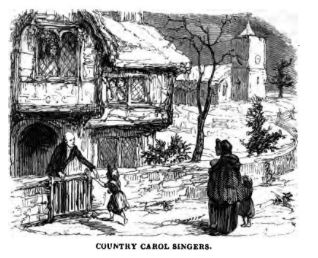
Parson James Woodforde of Norfolk mentions, on Christmas Eve of 1764, that the church’s Singers came to him and sang “a Christmas Carol and an Anthem”; he gives them “cyder as usual” and a gift of money. They also sang to him in 1768 and 1769; it seems to have been a regular practice. In 1781 (when Austen would have been six years old), Woodforde gave money to “Spragg’s lame son for a Christmas carol.” Peter Parley, in his 1838 description of Christmas customs, says groups of ragged children went from door to door singing for alms. Giving money to carolers was part of Woodforde’s extensive Christmas charities; he gave money to more than fifty poor people every St. Thomas’ Day (Dec. 21), and fed Christmas dinner to a number of “poor old men” every Christmas Day.

Poor Children Caroling for Alms, p. 142 in Tales About Christmas, by Peter Parley, 1838

Some years later, Parson William Holland of Somerset also gave charity at Christmastime, including dinners for the Sunday School children (poor children learning reading and religion at the church each Sunday). In 1800 Holland says the poor came “AChristmassing,” which he translates as begging. It seems likely their house to house visits included singing carols. His church Singers came and serenaded his family at the parsonage every Christmas morning, sometimes as early as 5 AM (in 1799) or even 3 AM (in 1809)! Parley calls groups of church musicians, who wandered about playing and singing during the night on Christmas Eve, “the waits.” He says the custom came from earlier times when groups of watchmen wandered the streets at night.

Austen’s family also probably heard and entertained Christmas singers, and gave alms to them and other poor people at Christmas.

“While Shepherds Watched Their Flocks”

In 1792 and 1793, Woodforde says the church Singers sang a Christmas Anthem during the service. In other years he also mentions singing in Christmas services. What would have been sung in Austen’s country churches at Christmas? Most likely, the carol, “While Shepherds Watched Their Flocks by Night.”

In the 1700s in Anglican worship, most congregations only sang Psalms from the Bible, not hymns. In fact, in many small churches there was no singing at all; the Psalms were just read. However, some had groups of “Singers,” like those in Woodforde and Holland’s churches, sometimes with musical instruments. (Holland’s congregation took up money to buy their Singers instruments.) The congregation might sing along with the Singers, but more often just listened.

The Singers generally sang from Tate and Brady’s New Version of the Psalms of David, which was a book of “metrical Psalms.” These are Psalms rewritten in a regular poetic form so they could be sung with standard tunes. In 1700, a Supplement was added which included a few hymns. The only Christmas hymn was “While Shepherds Watched Their Flocks by Night,” which is paraphrased from Luke 2:8-14. It was the only officially approved Christmas carol for churches in the eighteenth century. The words were as we sing them today. It could be sung to any tune in “common meter” (churches had books of tunes with certain meters, patterns of syllables, stress, and rhyme). But it likely was commonly sung to the tune still used in Britain today. (The tune popularly used in the U.S. now is from 1821.)

“Joy to the World”

Anglican country churches in the 1700s were mainly singing Psalms. However, the Dissenters (those outside the Church of England) and the Methodists wrote and sang many hymns during this time, including some Christmas favorites. Isaac Watts, a Dissenter, is considered the Father of English Hymnody. He believed that singing Psalms was not enough, because the Psalms did not express the New Testament experience and the gospel of Christ, or the congregation’s thoughts and feelings as Christians. He rewrote many of the Psalms to express those ideas.

“Joy to the World,” published by Watts in The Psalms of David Imitated in the Language of the New Testament in 1719, was a rewrite of Psalm 98, but it also includes phrases from other Bible verses. Psalm 98:4 (King James Version) says, “Make a joyful noise unto the Lord, all the earth: make a loud noise, and rejoice, and sing praise.” Watts wrote this as “Joy to the World.” Psalm 98:9 says the Lord is coming to judge the earth, which Watts adapted to “The Lord is come; let earth receive her king!” The line “Heaven and nature sing” is from Psalm 96:11, “Let the heavens rejoice, and let the earth be glad.” The third verse of the carol says, “No more let Sins and Sorrows grow, Nor Thorns infest the Ground: He comes to make his Blessings flow Far as the Curse is found.” This is adapted from Genesis 3:17-18, in which God tells Adam that the ground is cursed because of his sin, so Adam will eat from it in sorrow, and it will bring forth thorns and thistles.

As Watts’ songs had been spreading for some years, the Austens may well have sung this one in their home, if not at church. The tune we sing today had not yet been created; it was adapted from Handel in the 1830s.

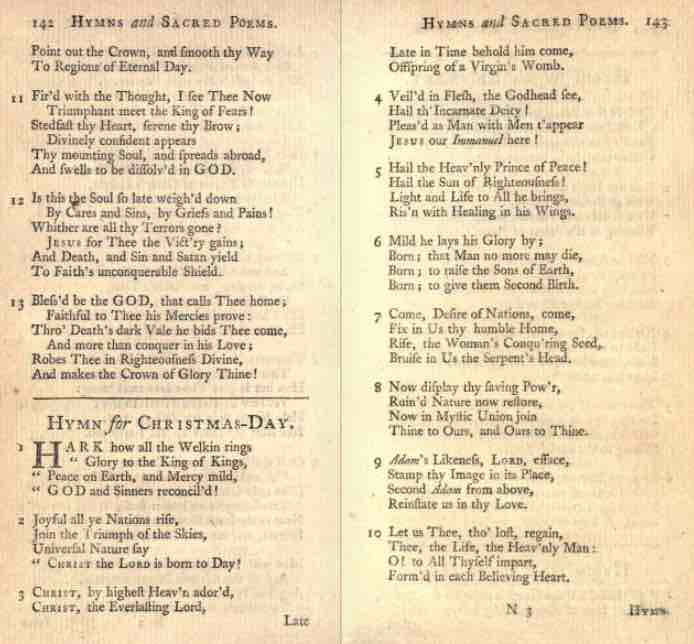
Charles Wesley’s 1739 “Hark how all the Welkin rings” became “Hark the Herald Angels Sing” when George Whitefield modified it in 1753.

“Hark the Herald Angels Sing”

“Hark the Herald Angels Sing” is a Methodist hymn that might also have been sung by the Austens, at home or possibly at church. The Methodists attempted to revive the Church of England, but eventually, on John Wesley’s death, separated and became Dissenters. However Charles Wesley, John’s brother, who wrote thousands of hymns, was strongly committed to the Church of England. His “Hymn for Christmas-Day” was published in Hymns and Sacred Poems in 1739.

It began, “Hark how all the welkin rings!” “Welkin” was an archaic word for the heavens. George Whitefield, another famous Methodist preacher, changed this line and other parts of the song in a collection of hymns he published in 1753. It became “Hark the Herald Angels Sing.” The music we sing it to now was added in the mid-1800s. At that time, Wesley’s four-line stanzas were combined to make our eight-line verses and the chorus was added.

All of these Christmas carols express joy:

“Glad tidings of great joy I bring To you and all mankind.” (“While Shepherds Watched Their Flocks”)

“Joy to the world! The Lord is come. Let earth receive her king!” (“Joy to the World”)

“Joyful all ye nations rise; Join the triumph of the skies!” (“Hark the Herald Angels Sing”)

Wishing you all much joy, whatever holidays you celebrate!

What is your favorite Christmas carol, or other song, that brings you joy?

Brenda S. Cox writes for Jane Austen’s World and for Faith, Science, Joy, and Jane Austen, where this post first appeared. Her recent book, Fashionable Goodness: Christianity in Jane Austen’s England, includes a chapter on “Psalms and Hymns: Singing in Church, Or Not.”

Sources

A Jane Austen Christmas: Regency Christmas Traditions, by Maria Grace

The Diary of a Country Parson 1758-1802, James Woodforde, edited by John Beresford

Paupers & Pig Killers: The Diary of William Holland, A Somerset Parson, 1799-1818, edited by Jack Ayres

Tales About Christmas, by Peter Parley, 1838

“Joy to the World”

Hark the Herald Angels Sing”

“While Shepherds Watched Their Flocks”

Eighteenth-Century Books introducing new Christmas Carols

The Psalms of David Imitated in the Language of the New Testament, Isaac Watts, 1719

Hymns and Sacred Poems by John and Charles Wesley, 4th edition, 1743

A New Version of the Psalms of David, Tate and Brady, 1733. “While Shepherds Watched” on p. 58-59 in the supplement at end.

Nineteenth-Century Christmas Carol Collections

Some Ancient Christmas Carols, with the Tunes to which They Were Formerly Sung in the West of England, 1822

Christmas Carols, 1833

A Garland of Christmas Carols, 1861 and Review

You can check out the history of your favorite carols at The Hymns and Carols of Christmas; scroll down to the alphabetical index.

Read Full Post »

Having just made a big move myself, I was intrigued by the thought that Jane Austen herself—not to mention several of her characters—knew what it took to move an entire household from one place to another.

One of the best resources available to us regarding a big move is the letter Austen wrote to Cassandra on January 3, 1801, prior to their family’s move to Bath from Steventon. From it, and from the details in her novels, we learn many interesting details about what a big move entailed.

If you’ve ever wanted some Regency advice on moving house, this is for you!

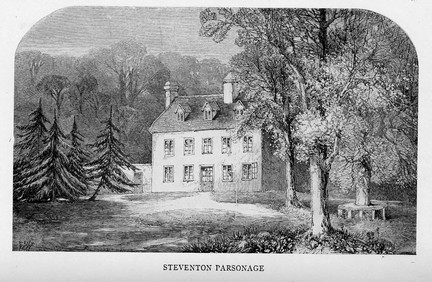
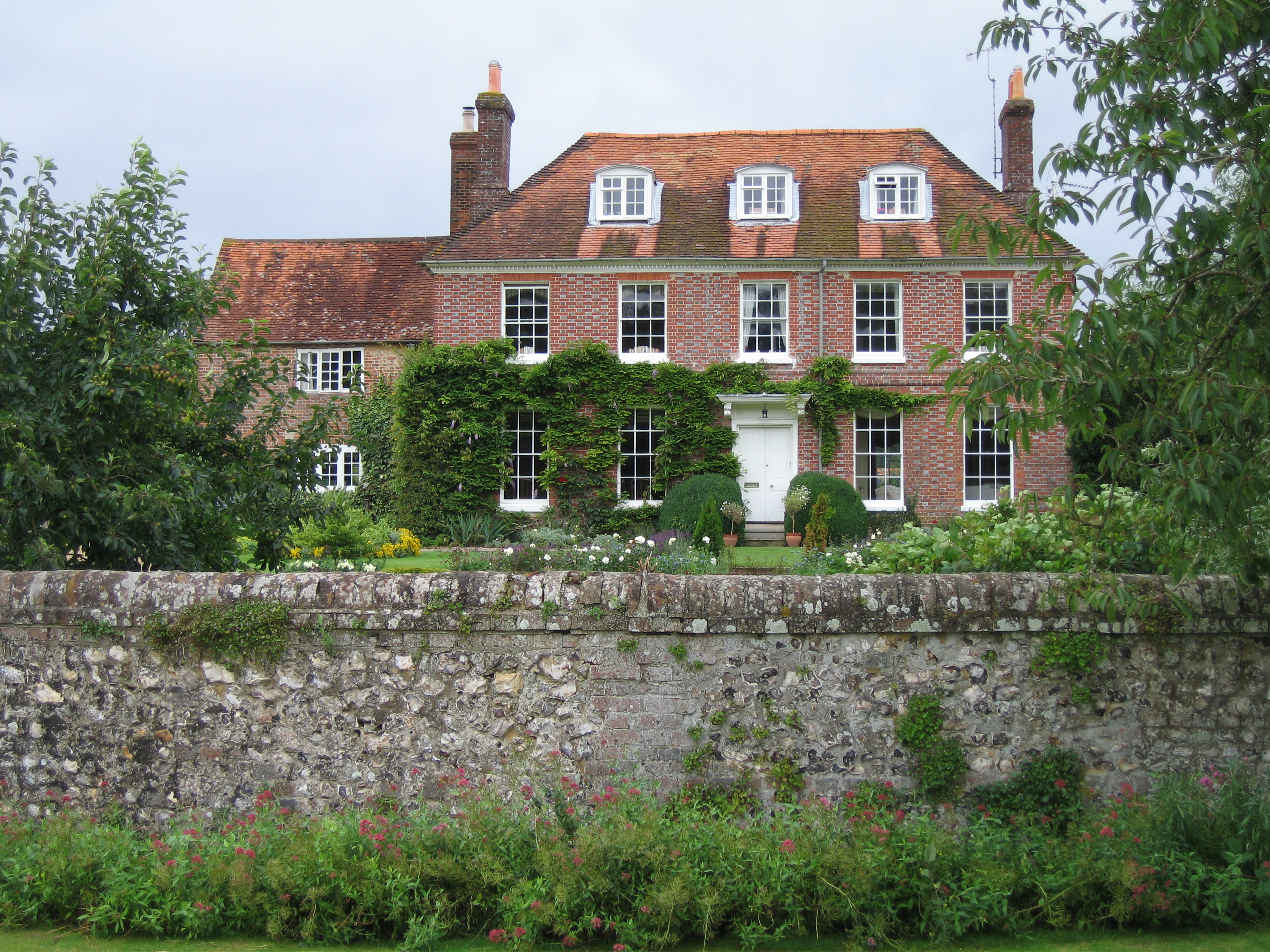
Image of Steventon Rectory, Wikimedia Commons
Steventon Rectory, Wikimedia Commons

Send Your Servants Ahead

In terms of logistics, members of the genteel class usually sent servants ahead of them when they went from one house to another, as we see when Mr. Bingley goes to Netherfield:

Why, my dear, you must know, Mrs. Long says that Netherfield is taken by a young man of large fortune from the north of England; that he came down on Monday in a chaise and four to see the place, and was so much delighted with it that he agreed with Mr. Morris immediately; that he is to take possession before Michaelmas, and some of his servants are to be in the house by the end of next week.

Pride and Prejudice

Similarly, Elinor and Marianne, when arriving in London with Mrs. Jennings after three days of travel, are greeted by “all the luxury of a good fire.” The house is “handsome, and handsomely fitted up.” Elinor writes to her mother before a dinner that will not “be ready in less than two hours from their arrival.” It’s clear that Mrs. Jennings employs servants who clean, cook, shop, and prepare the house for her visits.

Hire Good People

When preparing to move to Bath, Jane Austen’s mother wanted to keep two maids: “My mother looks forward with as much certainty as you can do to our keeping two maids; my father is the only one not in the secret.”

With her typical flair for humor, Austen hoped to engage other servants as well: “We plan having a steady cook and a young, giddy housemaid, with a sedate, middle-aged man, who is to undertake the double office of husband to the former and sweetheart to the latter. No children, of course, to be allowed on either side.”

Do Your Research

In Austen’s letter, she talks about several areas of Bath where they hoped to find a house: Westgate Buildings, Charles Street, and “some of the short streets leading from Laura Place or Pulteney Street.”

About Westgate Buildings, Austen wrote: “though quite in the lower part of the town, are not badly situated themselves. The street is broad, and has rather a good appearance.” Regarding Charles Street, she thought it “preferable”: “The buildings are new, and its nearness to Kingsmead Fields would be a pleasant circumstance.” And concerning the third area: “The houses in the streets near Laura Place I should expect to be above our price. Gay Street would be too high, except only the lower house on the left-hand side as you ascend.”

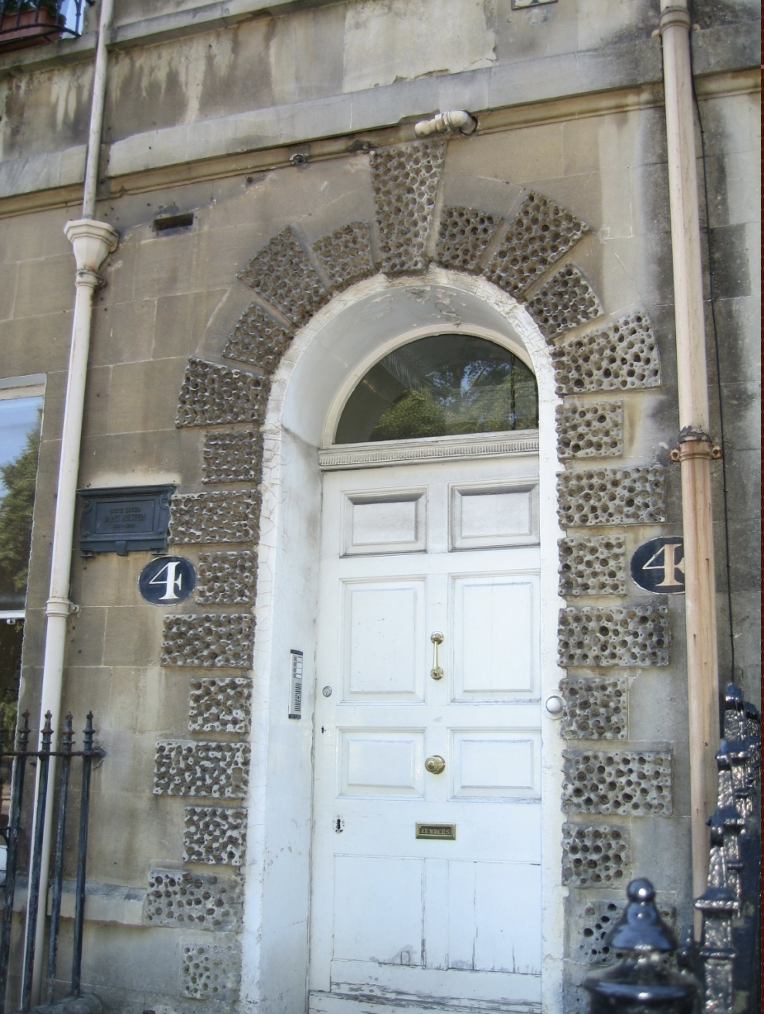
4 Syndey Place, Bath

Mrs. Austen seemed to have a preference: “her wishes are at present fixed on the corner house in Chapel Row, which opens into Prince’s Street. Her knowledge of it, however, is confined only to the outside, and therefore she is equally uncertain of its being really desirable as of its being to be had.”

None of the Austens were in favor of Oxford Buildings: “we all unite in particular dislike of that part of the town, and therefore hope to escape.”

Bring Your Art

We know from Austen’s letter that they planned to take the following pictures and paintings from Steventon to Bath: “[T]he battle-piece, Mr. Nibbs, Sir William East, and all the old heterogeneous miscellany, manuscript, Scriptural pieces dispersed over the house, are to be given to James.”

Good artwork is hard to find.

Of special note, Jane tells Cassandra, “Your own drawings will not cease to be your own, and the two paintings on tin will be at your disposal.”

Good Furniture is Worth Moving

Apparently, Rev. and Mrs. Austen had a very good bed that was irreplaceable: “My father and mother, wisely aware of the difficulty of finding in all Bath such a bed as their own, have resolved on taking it with them…” Austen wrote this about the rest of the household beds: “all the beds, indeed, that we shall want are to be removed — viz., besides theirs, our own two, the best for a spare one, and two for servants; and these necessary articles will probably be the only material ones that it would answer to send down.”

When it came to their dressers, they decided it was time for an upgrade: “I do not think it will be worth while to remove any of our chests of drawers; we shall be able to get some of a much more commodious sort, made of deal, and painted to look very neat…”

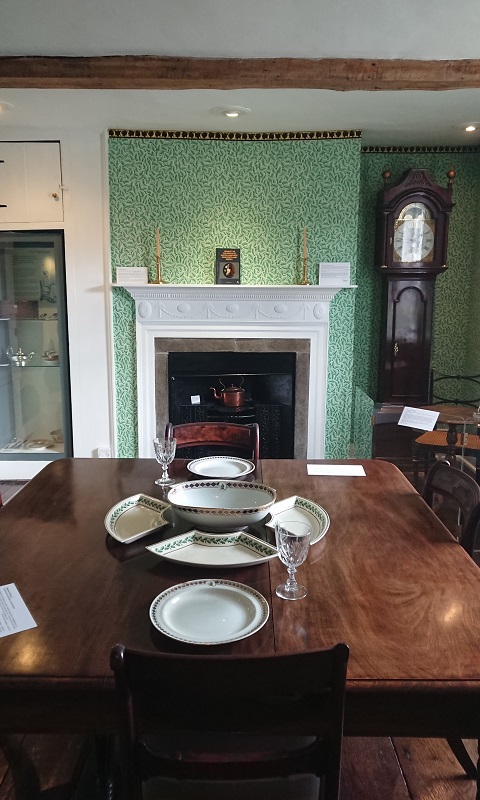
Image of dining room at the Jane Austen House Museum
Jane Austen’s House Museum in Chawton.

As to the rest of their furniture, they decided it would be better to replace most of it in Bath: “We have thought at times of removing the sideboard, or a Pembroke table, or some other piece of furniture, but, upon the whole, it has ended in thinking that the trouble and risk of the removal would be more than the advantage of having them at a place where everything may be purchased. Pray send your opinion.”

Jane’s final comments to Cassandra are amusing as ever: “My mother bargains for having no trouble at all in furnishing our house in Bath, and I have engaged for your willingly undertaking to do it all.”

Visit People on the Way

In Austen’s letter, she explains their family travel plans: “[M]y mother and our two selves are to travel down together, and my father follow us afterwards in about a fortnight or three weeks. We have promised to spend a couple of days at Ibthorp in our way. We must all meet at Bath, you know, before we set out for the sea, and, everything considered, I think the first plan as good as any.”

Ibthorpe, Photo by Rachel Dodge

Not So Different

Moving house in Jane Austen’s day was not quite so different from today. Though the modes of transportation and the methods of research and communication were somewhat different, I was delighted to find that the Austens’ moving plans were surprisingly applicable to mine! (Except for the servants.)


RACHEL DODGE teaches college English classes, gives talks at libraries, teas, and book clubs, and writes for Jane Austen’s World blog. She is the bestselling author of The Little Women DevotionalThe Anne of Green Gables Devotional and Praying with Jane: 31 Days Through the Prayers of Jane Austen. Coming this fall: The Secret Garden Devotional. You can visit Rachel online at www.RachelDodge.com.

Read Full Post »

When visiting Jane Austen’s England today, you can stroll through the gardens at Chawton House and Jane Austen’s House Museum, explore the churches at Steventon and Chawton, and tour the homes and churches where Jane Austen and her relatives lived and worshipped in Bath and other areas of England. But what about Steventon Rectory (or parsonage) where Jane Austen and her family lived for the first 25 years of her life?

At Steventon, you can see the site of the rectory and get an idea of where it used to sit before it was torn down in the 1820s. It’s a beautiful spot in the lovely Hampshire countryside. And there’s more to see than just the fields and lanes where Austen grew up.

The old rectory site where the parsonage once stood. A well is the only visible remnant of that house.

If you drive up the tree-canopied lane further, you come to St. Nicholas Church, where Jane’s father preached and where Jane and her family attended church. The church is usually open for visitors who want to look or sit or reflect.

Road to St. Nicholas Church, Steventon. Photo @ Rachel Dodge.

The Rectory Landscape

Though we can’t take a tour of the gardens and property surrounding the Rectory, we do have detailed descriptions available to help us imagine what it once was like.

Deirdre Le Faye paints a descriptive picture of the Rectory garden in Jane Austen: The World of Her Novels: “Mr. Austen’s study was at the back of the house, on the warm southern side, overlooking the walled garden with its sundial, espaliered fruit trees, vegetable and flower beds and grassy walks.” Green meadows stretched beyond it, dotted with livestock.

In A Memoir of Jane Austen, James Edward Austen-Leigh provides this further description of the landscape surrounding the Rectory:

“[T]he neighbourhood had its beauties of rustic lanes and hidden nooks; and Steventon, from the fall of the ground and the abundance of its timber, was one of the prettiest spots in it… It stood ‘in a shallow valley, surrounded by sloping meadows, well sprinkled with elm-trees, at the end of a small village of cottages, each well provided with a garden, scattered about prettily on either side of the road…”

Parsonage, Steventon

Austen-Leigh continues with this: “North of the house, the road from Deane to Popham Lane ran at a sufficient distance from the front to allow a carriage drive, through turf and trees. On the south side, the ground rose gently and was occupied by one of those old-fashioned gardens in which vegetables and flowers are combined, flanked and protected on the east by one of the thatched mud walls common in that country, and overshadowed by fine elms. Along the upper or southern side of the garden ran a terrace of the finest turf…”

Improvements

In Jane Austen’s England, Maggie Lane provides several details about the changes the Austens made during their residency there. She says one of the “constant themes of discussion at Steventon Rectory was ‘improvement.’ Much had been done even before Jane’s birth, but throughout her twenty-five years’ residence there her parents were enthusiastically planting and landscaping their modest grounds.”

The following are some of the grander changes the Austens made to the landscape:

  • They planted a “screen” of chestnuts and spruce fir to “shut out the view of the farm building.”
  • They cut “an imposing carriage ‘sweep’ through the turf to the front door.”
  • The Church Walk – a “broad hedgerow of mixed timber and shrub, carpeted by wild flowers and wide enough to contain within it a winding footpath for the greater shelter and privacy of the family in their frequent walks to the church.”
  • The Elm Walk (or Wood Walk) – a similar hedgerow walk that skirted the meadows and included the “occasional rustic seat” where “weary stollers” could sit or rest.

In Austen-Leigh’s Memoir, he provides further details about the walks and hedgerows:

“But the chief beauty of Steventon consisted in its hedgerows. A hedgerow in that country does not mean a thin formal line of quickset, but an irregular border of copse-wood and timber, often wide enough to contain within it a winding footpath, or a rough cart-track. Under its shelter the earliest primroses, anemones, and wild hyacinths were to be found; sometimes the first bird’s nest; and, now and then, the unwelcome adder. Two such hedgerows radiated, as it were, from the parsonage garden. One, a continuation of the turf terrace, proceeded westward, forming the southern boundary of the home meadows; and was formed into a rustic shrubbery, with occasional seats, entitled ‘The Wood Walk.’ The other ran straight up the hill, under the name of ‘The Church Walk,’ because it led to the parish church…”

Hampshire is still breathtaking; scenes like these give us a sense of the greenery and vegetation Austen might have known.

In October 1800, Jane wrote to Cassandra about the improvements her parents were undertaking at the time: “Our improvements have advanced very well; the bank along the elm wall is sloped down for the reception of thorns and lilacs, and it is settled that the other side of the path is to continue turfed, and to be planted with beech, ash, and larch.”

In November, she wrote again: “Hacker has been here to-day putting in the fruit trees. A new plan has been suggested concerning the plantation of the new inclosure (sic) of the right-hand side of the elm walk: the doubt is whether it would be better to make a little orchard of it by planting apples, pears, and cherries, or whether it should be larch, mountain ash, and acacia.”

Reading these descriptions, it’s easy to see why Jane Austen included “improvements” to the grounds of the estates featured in so many of her novels.

Food and Livestock

However, the Austens didn’t just improve their land to make it more pleasing to the eye or pleasurable for walking. Lane tells us that “the garden at Steventon Rectory was a happy compromise between fashionable ideas and down-to-earth utility – typical of the balanced Austen approach to life.”

In Mrs. Austen’s garden, “vegetables and flowers [were] combined” to balance beauty and provision. One can imagine how the garden must have looked in the spring, summer, and fall, with its tangled profusion of color.

Today, “companion planting” is popular for many gardeners who include flowers among their vegetables.

Beyond the gardens around the Rectory, the Austens kept livestock and grew crops. Mrs. Austen oversaw the poultry-yard and the dairy: “She supervised making all the butter and cheese, baking all the bread and brewing all the beer and wine required by a large household. With the exception of such commodities as tea, coffee, chocolate and sugar, the Austens were virtually self-sufficient in food.” As for Rev. Austen, he grew “oats, barley and wheat, and reared cattle, pigs and sheep” and was able to “not only feed his family, but to sell the surplus.” (Lane)

“All the fruit, vegetables, and herbs consumed by the family were raised here. The Austens’ strawberry fields were famous, and Mrs. Austen was one of the first people in the neighbourhood to grow potatoes.” Taking this all into account, we get a better idea of the gardens and food Jane Austen enjoyed in her youth.

Today, strawberry crops are still grown and produced in Hampshire.

Reading these descriptions of the land surrounding Steventon Rectory can help us better envision what the gardens and fields looked like when Austen was growing up. It’s lovely to try to imagine where she walked and read and thought and imagined; what foods she ate; and what her parents did.

If there ever was a fundraising campaign I could get behind, it would be to someday see a replica (or a scale model) built of the Steventon Rectory and its surrounding gardens. Wouldn’t that be something? For now, I’ll keep dreaming and imagining, which almost just as nice.

If you’d like to take a deeper dive into the Steventon Rectory and its garden and farm, you can read “Why Was Jane Austen Sent away to School at Seven? An Empirical Look at a Vexing Question” in Persuasions On-Line by Linda Robinson Walker.


RACHEL DODGE teaches college English classes, gives talks at libraries, teas, and book clubs, and writes for Jane Austen’s World blog. She is the bestselling author of The Little Women Devotional, The Anne of Green Gables Devotional and Praying with Jane: 31 Days Through the Prayers of Jane Austen. You can visit Rachel online at www.RachelDodge.com.
Read Full Post »

« Newer Posts - Older Posts »