Feeds:
Posts
Comments

Archive for the ‘18th Century England’ Category

I’ve often wondered what Jane Austen and her sister Cassandra would have looked like as young ladies. This lovely public domain image by Paul Sandby from the Yale Center for British art gives us an idea. In her teens, Jane’s dresses would still have had waists and her hair would have been worn relatively loose and long. I envision the teen on the left with the direct gaze to be Jane – a pretty girl with round cheeks and a twinkle in her eyes, open to life’s possibilities.

 Paul Sandby, 1731-1809, British, The Misses Sandby of Norwich, undated, Graphite and brown wash on medium, slightly textured, cream laid paper, Yale Center for British Art, Paul Mellon Collection


Paul Sandby, 1731-1809, British, The Misses Sandby of Norwich, undated, Graphite and brown wash on medium, slightly textured, cream laid paper, Yale Center for British Art, Paul Mellon Collection

About Paul Sandby

Paul Sandby was celebrated in his day. The innovations and subject-matter that he introduced into the practice of watercolour painting in Britain had a profound influence on artists of successive generations, including Thomas Girtin and J.M.W. Turner RA. However, from the mid-nineteenth century, Sandby’s work slipped into obscurity. – Paul Sandby, Picturing Britain

This former map-maker turned watercolor landscape painter became a founding member of the Royal Academy in 1768.

Read Full Post »

Fabulous Dr. Lucy Worsley discusses the Regency Era in these videos. Wonderful.

drush76's avatarThe Rush Journals

Below are links to a BBC documentary called “ELEGANCE AND DECADENCE – The Age of the Regency”. The documentary is hosted by historian Dr. Lucy Worsley, author of the 2011 book, “If Walls Could Talk, An Intimate History of the Home”.

“ELEGANCE AND DECADENCE – The Age of the Regency”

Here are the links to the documentary hosted by Dr. Worsley:

Part 1 – “Warts and All – Portrait of a Prince”

Part 2 – “Developing the Regency Brand”

Part 3 – “The Many and the Few – A Divided Decade”

View original post

Read Full Post »

Inquiring readers, Every once in a while a writer from another website contributes an article that is custom made for this blog.  Jennifer Vishnevsky, a writer for TopDentists.com, writes about false teeth and dentistry in an era when anesthetics were not yet available.

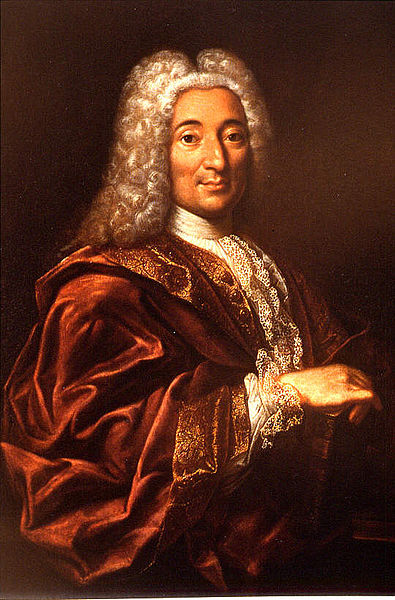
Pierre Fauchard. Image @Wikimedia

Pierre Fauchard. Image @Wikimedia

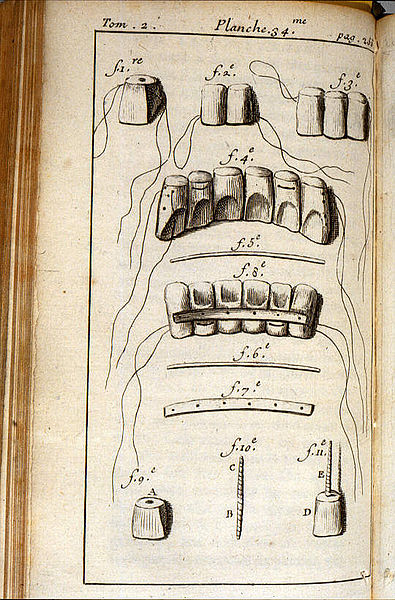
The 18th Century was a major time for advances in dentistry. It is believed that the French physician Pierre Fauchard started dentistry science as we know it today. In 1723, Fauchard published “The Surgeon Dentist, a Treatise on Teeth.” His book was the first to describe a comprehensive system for caring and treating the teeth. Thus, he is considered the father of modern dentistry. Fauchard was responsible for many developments, including the introduction of dental fillings and the use of dental prosthesis.

In 1760, John Baker, the earliest medically-trained dentist to practice in America, emigrated from England and set up practice. In the same decade, Paul Revere placed advertisements in a Boston newspaper offering his services as a dentist.

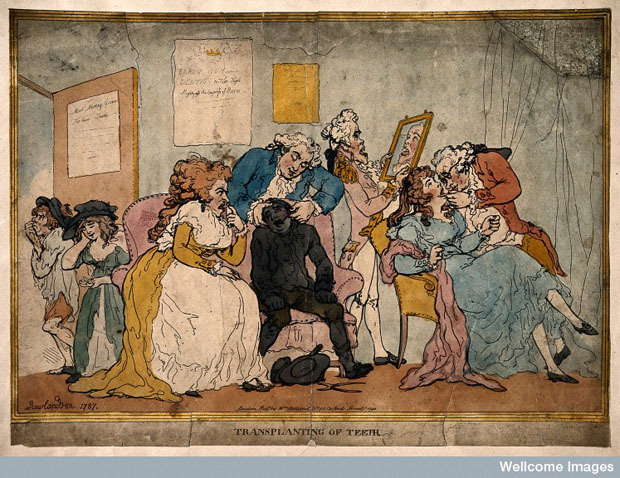
This print is by Thomas Rowlandson (1756-1827) and is dated 1787. It is a satirical comment upon the real practice of rich gentlemen and ladies of the 18th century paying for teeth to be pulled from poor children and transplanted in their gums. Image @Children and Youth in History

This print is by Thomas Rowlandson (1756-1827) and is dated 1787. It is a satirical comment upon the real practice of rich gentlemen and ladies of the 18th century paying for teeth to be pulled from poor children and transplanted in their gums. Image @Children and Youth in History

In 1790, the first dental foot engine was built by John Greenwood, son of Isaac Greenwood and one of George Washington’s dentists. It was made from an adapted foot-powered spinning wheel. This was also the year that the first specialized dental chair was invented by Josiah Flagg, who made a wooden Windsor chair with a headrest attached.

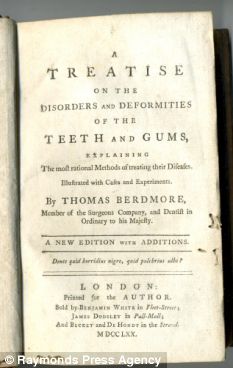
Even those treated by the best dentists were in for an agonizing time. “A Treatise on the Deformities and Disorders of the Teeth and Gums” was written in 1770 by Thomas Berdmore, who was considered to be an outstanding dentist in England. “Pass gold wire from the neighbouring teeth on either side, in such a manner as to press upon what stands out of the line.” The alternative, Berdmore suggested, was to ‘break the teeth into order by means of a strong pair of crooked pliers.”

Fauchard, procedure for teeth restoration. Image @Wikimedia

Fauchard, procedure for teeth restoration. Image @Wikimedia

For those who could afford it, the European diet grew sweeter during the 18th Century as the use of sugar became more widespread. This exposure to sugar meant more instances of tooth decay. These dietary changes were a major factor in the development of dentures. Dentists began to experiment with ivory in order to create a better foundation for dentures. Due to advances in technology, dentists could also add gold springs and plates to the new dentures. False teeth were a novelty that was mostly unheard of in earlier centuries. Previously, problematic teeth were pulled but almost never replaced. Ivory dentures were popular in the 1700s, made from natural materials including walrus, elephant, or hippopotamus. For the wealthy, human teeth were high in demand as the preferred material for the creation of dentures. However, the teeth used in 18th Century dentures eventually rotted. There was a high demand for teeth that were deemed healthy, such as from criminals.

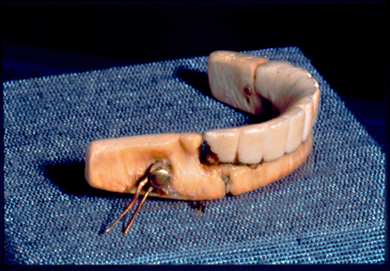
George Washington's dentures. Image @Samuel D. Harris National Museum of Dentistry, Baltimore

George Washington’s dentures. Image @Samuel D. Harris National Museum of Dentistry, Baltimore

One of the most famous early denture wearers was the first U.S. President George Washington. Washington began losing his teeth in his 20s, probably due to a combination of frequent illness and treatment with a medication called calomel that damaged the enamel of the teeth. Contrary to popular belief, however, Washington’s dentures were not made of wood. Washington sported some of the highest quality false teeth of the time, consisting of a denture plate made of carved hippopotamus ivory into which human teeth (along with parts of both horse and donkey teeth) were fitted. He had several other pairs of dentures during his presidency, none of which included wood in their construction.

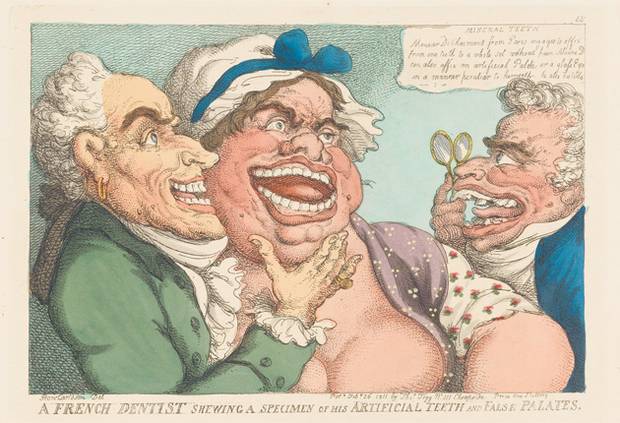
A French Dentist Showing a Specimen of His Artificial Teeth and His False Palates, Thomas Rowlandson, 1811. Image @The Independent

A French Dentist Showing a Specimen of His Artificial Teeth and His False Palates, Thomas Rowlandson, 1811. Image @The Independent

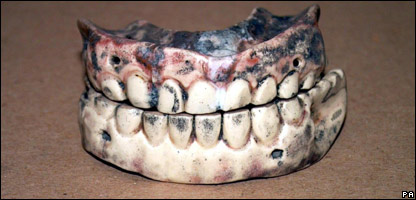
18th century porcelain dentures Image @CBBC

18th century porcelain dentures Image @CBBC

Full or even partial dentures were properly developed only during the course of the 18th Century. Dentists became better at making them fit, coming up with stronger adhesives to keep the teeth attached to them and designing them so as to prevent them from flying out of their patients’ mouths. By the late 18th century, there were yet more developments. Around 1774, Alexis Duchâteau crafted the first porcelain dentures. But these were prone to chip and also tended to appear too white to be convincing. Porcelain shaped teeth were placed onto gold plates. These were the first dentures that look similar to modern dentures. They were very white in color, but could be made in different shades.

Guest contributor Jennifer Vishnevsky is a writer for TopDentists.com, an Everyday Health website on dental health, as well as a freelancer for other lifestyle media sites.

Read Full Post »

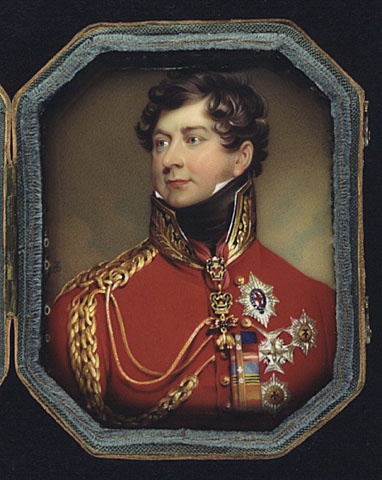
The period between 1811 and 1820 is known in British history as the Regency. In 1811 King George III was deemed unfit to rule and his son, the Prince Regent, ruled in his place. On his father’s death in 1820, the Prince was crowned King George IV. Coincidentally, Jane Austen’s novels were published between 1811 and 1818 and her writing has come to define how we imagine life was lived in the Regency era.

Miniature of the Prince Regent, Courtesy of the library archives of Canada

Yet so successful has Jane Austen been in implanting images in her readers’ minds that there is a danger that we begin to accept fiction as fact, to confuse the lives of her heroines with her own life, to interpret the lives of the few as being the lives of the many. And in that process there is also the risk that we lose sight of her skill and imagination as a writer. She was without doubt a keen observer, but the settings and people she describes, come as much from her imagination as from what she saw or experienced.

Company at play, the Comforts of Bath, Thomas Rowlandson

Jane chose to set two of her novels (Northanger Abbey and Persuasion) in Bath. She lived in the city between 1801 and 1806 and it’s still possible to retrace her footsteps, to see some of what she saw. The pattern of roads is largely unchanged in the older part of the city. Many of the places she would have frequented are still there; The Royal Crescent, The Circus, Queen Square, Milsom Street, Pulteney Bridge, the Upper Assembly Rooms, the Pump Rooms, the Guildhall, and Sydney Gardens, to name but a few.

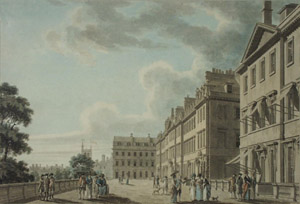
South Parade, Bath, Thomas malton, 1775 (the year of Jane Austen’s birth).

It is easy to imagine these places as she depicts them in her novels, yet it is almost impossible to separate fact from fiction. For example, in “Northanger Abbey” we read;

They arrived in Bath. Catherine was all eager delight; – her eyes were here, there, everywhere, as they approached its fine and striking environs, and afterwards drove through those streets which conducted them to the hotel. She was come to be happy, and she felt happy already.”

Yet Jane also records on moving to Bath, her own “first impression” of the city, in a letter to her sister, Cassandra, on May 5th 1801;

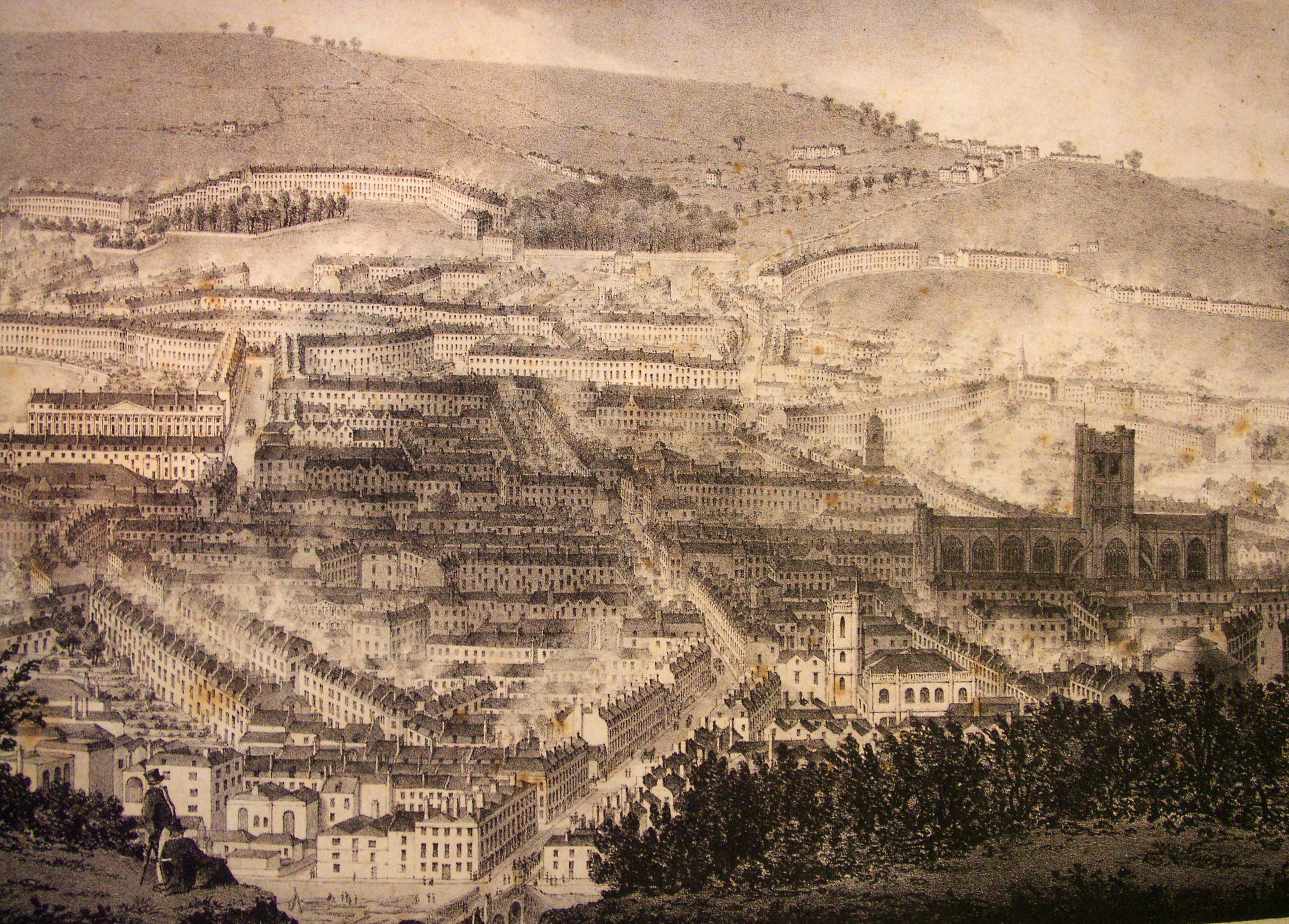
The first view of Bath in fine weather does not answer my expectations; I think I see more distinctly through rain. The sun was got behind everything, and the appearance of the place from the top of Kingsdown was all vapour, shadow, smoke, and confusion.”

Panoramic view of Bath from Beechen Cliff, 1824

Again in “Northanger Abbey” she describes a formal ball held in the Upper Assembly Rooms;

The season was full, the room crowded, and the two ladies squeezed in as well as they could. As for Mr Allen, he repaired directly to the card-room, and left them to enjoy a mob by themselves. With more care for the safety of her new gown than for the comfort of her protégé, Mrs Allen made her way through the throng of men by the door, as swiftly as the necessary caution would allow; Catherine, however, kept close at her side, and linked her arm too firmly within her friend’s to be torn asunder by any common effort of a struggling assembly.”

Fancy Ball at the Upper Rooms, Bath, Thomas Rowlandson

Yet her own experience was somewhat different, as she reports in letter to her sister on May 12th 1801;

By nine o’clock my uncle, aunt, and I entered the rooms, and linked Miss Winstone on to us. Before tea it was rather a dull affair; but then the before tea did not last long, for there was only one dance, danced by four couple. Think of four couple, surrounded by about an hundred people, dancing in the Upper Rooms at Bath.

After tea we cheered up; the breaking up of private parties sent some scores more to the ball, and though it was shockingly and inhumanly thin for this place, there were people enough, I suppose, to have made five or six very pretty Basingstoke assemblies.”

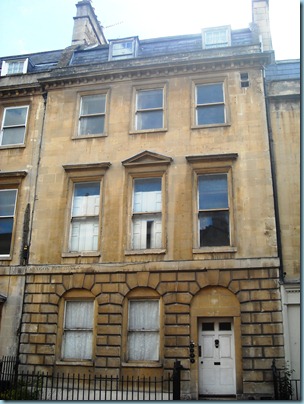
They say you should write about what you know and Jane Austen certainly knew about people, but was her life really comparable to those of her heroines? She attended dinner parties, suppers, formal balls and had some insight into high-society. Yet that society was very stratified with rigid conventions and social etiquette. Those rules defined who was on a level with whom, and Jane was certainly not part of its upper echelons. She was part of that “society” but in truth she was fairly low down in the “pecking order.” Her Uncle and Aunt were wealthy and lived in the Paragon. They might have provided her with opportunities to glimpse their way of life, but they do not seem to have been over-generous to Jane or her family.

Number 1, Paragon, where the Leigh-Perrots lived. Image @Austenised

When Jane’s family moved to Bath they leased a house at 4, Sydney Place. It was a fine house in a good area, near the popular Sydney Gardens, but it was not a prestigious address in comparison with other parts of the city. And when the lease ended they moved to a house in Green Park Buildings. This was an area the family had dismissed when they first moved to the city and it’s easy to see why from Jane’s description;

Our views on G. P. (Green Park) Buildings seem all at an end; the observation of the damps still remaining in the offices of an house which has been only vacated a week, with reports of discontented families and putrid fevers, has given the coup de grace. We have now nothing in view. When you arrive, we will at least have the pleasure of examining some of these putrefying houses again; they are so very desirable in size and situation, that there is some satisfaction in spending ten minutes within them.”

Before leaving Bath the family also lived for a while in 25, Gay Street. (The Jane Austen Centre is nearby at 40 Gay Street). It was a “good address” but by then, after the death of Jane’s father, they were reduced to “taking rooms” as boarders rather than occupying a house as tenants. By then the family were largely dependent on the charity of relatives.

Old Houses. Westgate Street , Bath, Thomas Elliot Rosenberg, 1820. Image @Victoria Art Gallery, Bath

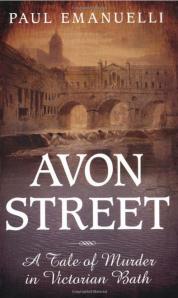
It’s obvious too that Jane was well aware of the plight of the genteel poor. In “Persuasion” Sir Walter Elliot refers to Westgate Buildings as, “Everything that revolts other people, low company, paltry rooms, foul air, disgusting associations.” Westgate Buildings was by no means the worst of streets but it was situated on the border of the Avon Street slum area. My own novel “Avon Street” has an opening scene in Westgate Buildings and explores the darker aspects of the City.

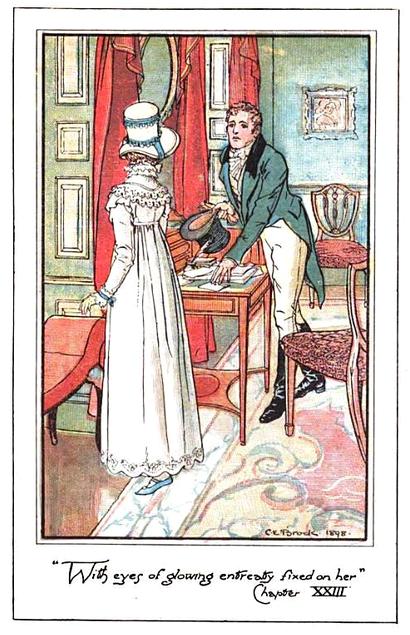
Brock illustration of Captain Wentworth entreating Anne Elliot to read his letter, Persuasion.

Opinion is divided on whether or not Jane Austen actually liked Bath, but she certainly knew how to use it as a setting. Jane Austen created an image of Regency life which still survives today. That is a testament to her imagination and skill as a writer. She chose to depict a way of life in her novels that did not always reflect her own everyday experience. Indeed it was not representative of the lives of most, yet it pleased her readers then and still pleases them today.

Inquiring readers: Paul Emanuelli, author of Avon Street (click here to view the book and order it), has contributed a post for this blog before about the City of Bath as a Character and Law & Order and Jane Austen’s Aunt, and Food – To Die For: Food Preparation in the Georgian EraHe has graciously sent in an article about crime and an incident involving Jane Austen’s aunt, Mrs James Leigh-Perrot. Paul writes about Bath in his own blog, unpublishedwriterblog. It is well worth a visit!

  • Paperback: 320 pages
  • Publisher: The History Press (March 28, 2012)
  • Language: English
  • ISBN-10: 0752465546
  • ISBN-13: 978-0752465548

Read Full Post »

Great landed estates were symbols of the owner’s wealth and status in British society. Everything was put on grand display – from the exquisite architecture of the house itself to the furniture, jewels, silver plate, servants, books, carriages, horses, deer, game, forests, fields, and splendid grounds and gardens.

Longleat House in Wiltshire Image @www.longleat.co.uk

A fine estate certainly elevated a man in a lady’s estimation. Take this passage in Mansfield Park, written from Mary Crawford’s point of view:

Tom Bertram must have been thought pleasant, indeed, at any rate; he was the sort of young man to be generally liked, his agreeableness was of the kind to be oftener found agreeable than some endowments of a higher stamp, for he had easy manners, excellent spirits, a large acquaintance, and a great deal to say; and the reversion of Mansfield Park, and a baronetcy, did no harm to all this. Miss Crawford soon felt that he and his situation might do. She looked about her with due consideration,and found almost everything in his favour, a park, a real park, five miles round, a spacious modern-built house, so well placed and well screened as to deserve to be in any collection of engravings of gentlemen’s seats in the kingdom, and wanting only to be completely new furnished—pleasant sisters, a quiet mother, and an agreeable man himself—with the advantage of being tied up from much gaming at present, by a promise to his father, and of being Sir Thomas hereafter. ” – Mansfield Park, Jane Austen

(It is to Mary’s credit that, after this consideration, she prefered Edmund, the younger son, until she discovered that he intended to become a man of the cloth, and even then she did not give him up so easily.)

Visitors arriving at a landed estate took a circuitous route to the house along winding paths that were designed to show the grounds to their best advantage. They would pass through wooded areas and open fields, past lakes and rivers and herds of deer or cattle, and through a controlled wilderness area.

“The idea with Brownian landscapes is that you effectively go round them,” explains Mowl. “When [Capability] Brown did his landscape designs they would always have drives in them. They were an essential part of what he would do.” – The English Landscape Garden

Witton approach from Norwich, 1801, Humphrey Repton Red Book. Image @University of Florida Rare Book Collection

Groundskeepers of extensive parks that featured winding drives and a variety of formal and ornamental gardens employed several means of keeping grass under control. Grazing sheep and cattle represented the first lines of defense. These herds were allowed to roam over vast expanses of land. Eighteenth-century romantic sensibility required that nothing as obviously artificial as a visible fence be allowed to contain them.

Highclere Castle is surrounded by park land designed by Capability Brown. Grazing sheep in the foreground.

A landscape feature called a Ha-Ha prevented grazing herds from coming too close to the house. The Ha-Ha, which consisted of a deep trench abutting a wall and which was hidden from casual view even at a short distance, allowed for the naturalistic features of romantic landscape gardening to take hold.

The Ha-Ha prevented grazing animals from crossing from one area of the estate to another. Image © John D. Tatter, Birmingham-Southern College

A Ha-Ha was so named because, as the myth goes, this landscape feature was so well hidden that an unsuspecting visitor would blurt out “ha-ha!” before falling into the trench.  This cross section shows how the system worked.

The trenches of a Ha-Ha could sometimes be 8 feet deep.The primary view is from the right and the barrier created by the ha-ha becomes invisible from that direction and sometimes from both directions, unless close to the trench. Image @Wikipedia

Not all Ha-Ha’s prevented deer, sheep, or cattle from grazing up to the front of the house (though considering their droppings, one would thinks that this would be highly preferred.) At Petworth, the Ha-Ha was placed at the side of the house.

Petworth with Ha-Ha on the side of the house. Image @The English Landscape Garden

Built at the edge of a pleasure grounds surrounding a house, the ha-aha made a virtually invisible barrier that kept the cows and sheep in their pastures yet allowed uninterrupted views from house into park of from park into distant countryside. It meant that pleasure grounds, park and landscape could seamlessly become one. It is probably French in origin. Charles Bridgeman is generally credited with it’s introduction, but the first remnants of a ha-ha had already been installed at Levens Hall in Cumbria in 1689. – Architessica: Gardens and Landscapes

The transitional area between the formal gardens and the large park surrounding the house was known as the wilderness. This area was as meticulously planned as the other areas of the estate, but here the plantings were more irregular and included native plants and trees; gravel walkways; a pond, lake or river or all three; waterfalls; lawns that resembled meadows; and areas where the vistas were framed to deliberately look natural. If cottages and villages were required to be moved to achieve this picturesque effect, then so be it. The master’s will was done.

In Pride and Prejudice 1995, Elizabeth Bennet and Lady Catherine de Bourgh conduct their heated discussion in Longbourn’s “wilderness”. No grazing required here.

These wilderness areas were unique to topography and region, for each estate was uniquely different.

Nature in Herefordshire is not like nature in Lancashire and the garden style that tries to emulate the same form everywhere (particularly
one imported from another country entirely) is destroying what Pope had called the genius loci.” – (Wildness in the English Garden Tradition: A Reassessment of the Picturesque from Environmental Philosophy Author(s): Isis Brook Reviewed work(s): Source: Ethics and the Environment, Vol. 13, No. 1 (Spring, 2008), pp. 105-119)

This plan of Paca Garden in Annapolis, MD, shows the formal gardens separated from the park by a wilderness area with pond, bridge, and follies. Image (a) Creating a Period Garden

Walking along a wilderness provided one with an endless variety of aesthetic experiences. Paths wended their way through woods that opened up to vistas. Large trees provided shelter for a bench or revealed moss growing on gnarly roots. Rivers, ponds, follies, and bridges provided natural sources of visual patterns. They were pleasant places to visit:

 A ‘pleasant place’ is supposed to be naturally crafted. It’s a balance between two opposites: wanting to cultivate the land and letting it grow freely.  However landscapers and architects finally accomplish this goal, the product always ends up being a beautiful oxymoron. – Landscape as Amenity

Chawton House grounds. One of the vistas from a gravel path. Image @Tony Grant

The exercise of walking along a wilderness ground was both visually and physically stimulating. These wilderness areas took years to design and arrange, with large trees moved from one area to another, buildings demolished or transported, and hillsides lowered or raised to “improve” the view.

Moving a full grown tree into place, Hayes, 1794

Such improvements, as they were generally known, required meticulous planning and strenuous effort. Master landscape gardeners like Lancelot “Capability” Brown and  Humphry Repton became household names. Jane Austen knew about such efforts and their resulting changes:

Mr. Rushworth, however, though not usually a great talker, had still more to say on the subject next his heart. “Smith has not much above a hundred acres altogether, in his grounds, which is little enough, and makes it more surprising that the place can have been so improved. Now, at Sotherton, we have a good seven hundred, without reckoning the water meadows; so that I think, if so much could be done at Compton, we need not despair. There have been two or three fine old trees cut down that grew too near the house, and it opens the prospect amazingly, which makes me think that Repton, or anybody of that sort, would certainly have the avenue at Sotherton down; the avenue that leads from the west front to the top of the hill, you know,” turning to Miss Bertram particularly as he spoke. But Miss Bertram thought it most becoming to reply—

“The avenue! Oh! I do not recollect it. I really know very little of Sotherton.”

Fanny, who was sitting on the other side of Edmund, exactly opposite Miss Crawford, and who had been attentively listening, now looked at him, and said, in a low voice—

“Cut down an avenue! What a pity! Does it not make you think of Cowper ?’ Ye fallen avenues, once more I mourn your fate unmerited.'”

He smiled as he answered, ” I am afraid the avenue stands a bad chance, Fanny.”

“I should like to see Sotherton before it is cut down, to see the place as it is now, in its old state , but I do not suppose I shall.” – Mansfield Park, Jane Austen

Sir Humphrey Repton, Whiton (Before) Image @British Architecture

Sir Humphry Repton left a valuable legacy with his Red Books. It was his habit to sketch before and after landscapes for his customers and present the drawings to them bound in red covers. His improvements for Whiton are subtle but important. Two parallel streams have been turned into a serpentine lake with a waterfall at one end. The distant fields provide a focal point with artfully arranged trees. If you look closely at the gravel path on the left, you can spy a gardener.

Sir Humphrey Repton, Whiton (After). Image @British Architecture

The samples below of Ferney Hall from The Morgan Library and Museum show the before and after drawing of an improved vista in which, using Jane Austen’s words, ” a prospect was opened”.

Ferney Hall by Repton. Image @The Morgan Library

The after image provides a glimpse of a folly. Instead of acting as a barrier, the woods give way to the scene, which provides a pleasant stopping point for the wanderer to sit and view. While such scenes looked natural, they were not.

Ferney Hall, After, by Repton. Image @The Morgan Library

Though visually the wild and the domestic were one is the same, “these were carefully managed scenes, designed to look natural, but actually contrived on a vast scale” – Landscape as Amenity

The wilderness was designed some distance from the house. Approaching closer, the visitor would see a more formal arrangement of fountains and shrubbery and mazes and flower gardens.

Chawton House: View from the wilderness towards the house and more formal plantings. Image @Tony Grant

The gentlemen who had these gardens designed for them had all been on the Grand Tour and learned the classics,” says Timothy Mowl of the University of Bristol. “It was part of their make-up and they wanted to display their taste and learning within gardens.” – The English Landscape Garden

Wrest Park, Bedfordshire. Image @The Telegraph UK

Landscape designs informed the process of maintaining the grounds. Large estates employed many gardeners to keep cricket and croquet fields in pristine condition, cultivate the ornamental and kitchen gardens, and oversee the orchards and hot houses. The question is: How did they do it?

Extensive gardens surrounding Wrest House in Bedfordshire. Wrest Park Gardens are spread over 150 acres (607,000 m²) near Silsoe, Bedfordshire, and were originally laid out in the early 18th century, probably by George London and Henry Wise for Henry Grey, 1st Duke of Kent, then modified by Capability Brown in a more informal landscape style, without sacrificing the parterres. Image from The Leisure Guide

As mentioned before, the first line of defense was allowing herds of sheep and cattle to graze. However, their by-products left something to be desired. (If anyone has ever walked through a cow pasture, they will know what I mean.)

English Garden at Leeds: Artfully contrived to look both contained and natural. Image @Landscape Into Land

Lawn mowing and ornamental landscaping held no particular interest to 99% of the people who lived during the Georgian era. Cottagers and town dwellers maintained small plots of vegetable gardens and laborers worked in the fields, using scythes to cut wheat and grain for their employers.

18th century method for harvesting grain with scythes. Image @Our Ohio

The laborers wielding scythes in the above image provide a clue to how grass was clipped – using a smooth, well-rehearsed motion, they worked in teams to cover large areas of ground. Their labor was cheap and they followed a system that included working in the morning when the ground was still damp.

Mowing Clover, late 19th c., by Arthur Verey

To prepare the lawn for scything, a gardener would:

“pole” the lawn first (swishing a long whippy stick across the grass to remove wormcasts) and … roll the ground to firm it and set the blades of grass in a uniform direction.” – Notes and Queries, The Guardian UK

19th Century Coalbrookdale Roller. Rolling the lawn tamped down the grass and seed, and promoted growth and strong roots. Image @jardinique.co.uk

The secret to maintaining a close-cropped lawn was to trim it frequently, about once a week. Lawn edges were best trimmed with sheep shearing clippers.

This gardening family is using shears, a rake, and a scythe in their cottage garden.

The grass was kept free of daisies with an instrument named a daisy grubber, which is the long-handled instrument with angled pick in the image below. Daisy grubbers are still sold today, as they apparently do the job well.

Dibbles and daisy grubber. Image @Garden History -Tools the Dibble

Dibbles were used to dig holes in the ground to plant seeds or bulbs, pry up roots, or jab weeds out between bricks and stone.

18th century gardener taking direction from a landscape designer. Note the man pruning the tree.

Even with these instruments, maintaining these large gardens took intensive labor. One can just imagine how much work was involved in protecting tender plants from insects and marauders, early frosts, and dry spells; and forcing exotic fruits and vegetables to grow out of season in hot houses.

Engelbrecht. 18th century German print of gardening – planting.

While improvements were made over the course of the 19th century, some customs remained the same:

“rich people used to show their wealth by the size of their bedding-plant list: 10,000 plants for a squire; 20,000 for a baronet; 30,000 for an earl and 50,000 for a duke. ” – Ernest Fields, Life in the Victorian Country House by Pamela Horn, p. 75.

Engelbrecht’s plate of an 18th century gardener working with flowers

Landed owners showed off their wealth through a variety of means, including the number of servants they employed.

Master and mistress in discussion with the head gardener

It was not unusual for a great estate to employ 60 – 100 gardeners. There was the full-time staff, consisting of a master gardener, who had begun his apprenticeship as a boy, and his assistants.

Pruning

Scottish gardeners were preferred, as it was thought that they had received the best training. Unmarried apprentice gardeners moved from estate to estate in order to gain experience and be promoted.

Dungbarrow

Junior staff worked long hours, around 60 hours a week, for, in addition to their gardening duties, they had to maintain the temperatures in glassed-in conservatories and meticulously care for archery, cricket, bowling and croquet lawns.

Woman using a rake

The master gardener hired local labor seasonally to help during peak times, so the number of laborers fluctuated.

The head gardener at the Thornham estate in Sussex at the end of the 19th century. Image by kitchen915

18th century garden cart and basket

With improvements in gardening equipment, including the invention of the lawn mower in 1830 by Edwin Beard Budding, machines began to take over the hard work of the scythe men.

First lawnmower invented by Edwin Beard Budding. Image @The Chronicle of Andrew Jackson, Wikispaces

I imagined a Regency gentleman pushing one in his regalia, and found this wonderful advertisement. After Budding’s initial invention, a variety of lawn mowers were invented, each improving on the other.

Mowing a lawn in 1832. Credit: Ann Ronan Picture Library / Heritage Images

Needless to say, large areas of lawn needed a more efficient method of keeping the grasses trimmed. As the 19th century progressed, horses were employed to pull large lawn mowing machines.

Horse pulling a lawn mower. Image @The Cultural Landscape Foundation

They wore special leather over shoes to protect fragile lawns, such as those shown in the image below.

This short video on YouTube demonstrates how 18th century gardeners dealt with sudden cold snaps.

More on the topic:

Read Full Post »

« Newer Posts - Older Posts »