Feeds:
Posts
Comments

Archive for the ‘19th century food’ Category

Austen Chat, from the Jane Austen Society of North America, brings you entertaining and informative discussions on Jane Austen each month.

A Review by Brenda S. Cox

The idea suddenly came to Mrs. Breckyn Wood that JASNA needed a podcast. Breckyn says,

“My main goal is to attract a whole new generation of JASNA members–younger Jane Austen fans who maybe have read a book or two or seen one of the adaptations, but who didn’t know there was a whole organization dedicated to Austen. I had already been to a few meetings of my local Georgia Region and was blown away by the talent and intelligence of its members, so I knew JASNA would have a huge pool of potential podcast guests from which to draw.”

Being a young lady of ingenuity and determination, she came up with a plan and presented it to the leaders of JASNA, who gave their complete support for Austen Chat. This delightful podcast began in July, 2023, with new episodes released on the first Thursday of each month. As the Austen Chat website says:

“JASNA’s mission is at the heart of Austen Chat—to further the study, appreciation, and understanding of Jane Austen’s works, life, and genius. There is always more to learn and enjoy about Jane, and we invite you to join us for the ride! Each month we talk with scholars, authors, and subject experts on a wide variety of Austen-related topics. We think you’ll have fun and learn something new from every episode—whether you are a lifelong reader, an Austen newbie, a seasoned Austen scholar, or somewhere in between. Tune in each month to enjoy the company of clever, well-informed guests, who have a great deal of conversation!”

I have listened to the first nine episodes (through March 7, 2024) and loved them all. I learned new things from each expert, despite my years of studying Austen.

In each instalment, Breckyn interviews someone in the Austen world about their specialty. Then we have news for the JASNA community about upcoming events and resources. Finally, a Janeite shares one of his or her favorite quotes from Austen, and tells why they love it. So be sure to listen all the way to the end!

Here’s what we’ve gotten to enjoy so far:

Episode 1, Jane Austen & Her House: A Visit with Lizzie Dunford, brings us right to the Jane Austen House in Chawton. We learn about its background, the changes that have been going on, and the treasures on display in this Mecca for Janeites. 

Episode 2, Jane Austen & Goodness: A Visit with Brenda Cox, is my own discussion with Breckyn about how Austen’s faith and the Church of England are reflected in Austen’s novels, including some hidden “faith words” used with religious meanings, women church leaders of Austen’s time, and the differences between rectors, vicars, and curates. 

Episode 3, Jane Austen & Her Wardrobe: A Visit with Hilary Davidson, is a fun discussion of the clothes Jane Austen is known to have worn. I learned that Austen kept up with the latest fashions. Davidson tells us that in general it was easy to find relevant pictures of the types of clothing Austen mentioned in her letters, since they were what was popularly worn in those years. 

Episode 4, Jane Austen & Her Endings: A Visit with Inger Brodey, gives some surprising insights into the endings of Austen’s books. She talks about whether the novels end happily or not, the different kinds of happiness, and how Austen’s endings were unusual for her time. 

Episode 5, Jane Austen & Divorce: A Visit with James Nagle, tells us some suprising facts about ways people got divorced or separated in Austen’s time, including the practice of selling wives, which he says was often to the wife’s lover. 

Episode 6, Jane Austen & Mr. Wickham, A Visit with Adrian Lukis, explores Lukis’s experiences in portraying Wickham in the 1995 Pride and Prejudice movie, then what led him to write his current hit, Being Mr. Wickham, and his thoughts on Lydia and Wickham’s later lives. 

Episode 7, Jane Austen & Dido Belle, A Visit with Renata Dennis, gives us some insights from the head of JASNA’s Diversity Committee about mixed-race Dido Belle, her life, family, and connections with Jane Austen and Sanditon

Episode 8, Jane Austen & Food: A Visit with Julienne Gehrer, discusses Martha Lloyd, the friend who lived with Jane, Cassandra, and Mrs. Austen, and her Commonplace Book and recipes. 

Episode 9, Jane Austen & Her Genius: A Visit with Juliet McMaster, explores some facets of Austen’s brilliance in each of the novels and the Juvenilia. For example, McMaster compares Henry Tilney to Henry Higgins; both taught the heroine a new “language.” And she considers which heroes learned from the heroines, as well as which heroine learned from the hero. Juliet McMaster, a founding member of JASNA and “grande dame of Austen scholarship,” also talks about the early days of JASNA.

This is a great array of topics, all of which I enjoyed. I don’t know what’s coming next, but I’m sure it will be fun!

Episodes begin with a “desert island” question for the interviewee. Either:

If you were stranded on a desert island and could only have one Austen book, which one would it be?   Or,

If you were stranded on a desert island and could have one penpal from among Austen’s characters, who would it be?

Gentle reader, what is your answer?  And if you want to add your favorite Austen quote, please do!


Brenda S. Cox is the author of Fashionable Goodness: Christianity in Jane Austen’s England. She also blogs at Faith, Science, Joy, and Jane Austen.
Read Full Post »

This week the United States celebrates Thanksgiving, a holiday in honor of families and friendship. For the most part, we lay aside our differences and grievances, and give thanks for what we have. The poor, aged, and lonely are not forgotten. Community soup kitchens are filled with volunteers, and many are turned away because of the sheer volume who want to serve their less fortunate brethren. 

This annual North American feast is reminiscent of the British Christmas dinners celebrated in Jane Austen’s day. In Emma, Mr Elton states:

This is quite the season indeed for friendly meetings. At Christmas, everybody invites their friends about them, and people think little of even the worst weather.” 

If we substitute Christmas for Thanksgiving, Austen’s phrase applies just as well. Foods offered on the Georgian Christmas table and Colonial thanksgiving tables in the U.S. and Canada have been remarkably similar from the 17th century on: Soup, cheese, nuts, turkey, goose, duck, mashed potato, yams, fresh cranberries, dried fruits, pumpkin and mince pies.

Screen Shot 2023-11-20 at 2.43.27 PM

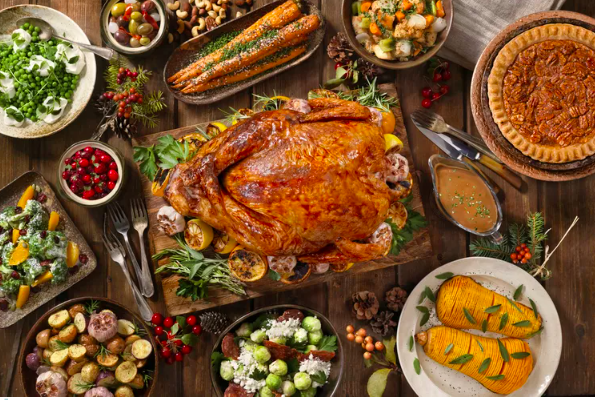
Image of traditional Thanksgiving foods. iStock image, LauriPatterson.

We North Americans have our British ancestors to thank for this tradition, so closely tied to these countries’ respective fall harvests. Earlier ripening explains why Canada’s Thanksgiving falls on the second Monday of October, almost two months before its southern neighbor, the US, celebrates this event. 

Canadian Thanksgiving:

One can only envision the reaction of explorer Martin Frobisher and his men when, in three voyages to Canada to find a northwest passage to Asia, they encountered the immensity, richness, and diversity of flora and fauna, and countless miles of almost untouched forests, lakes, and fields populated by an abundance of wildlife. These natural riches must have overwhelmed their senses, prompting them to give thanks in a tradition still celebrated today. The reality was less than elaborate:

In 1578, … privateer and mariner Sir Martin Frobisher was the first European to celebrate “Thanksgiving” with his crew. The meal was decidedly less glamorous than today’s feasts: mostly salt beef, biscuits and mushy peas. The locale, too, was less inviting. Frobisher and his men celebrated in current-day Nunavut, likely aboard one of the 15 ships that had set sail to discover a northwest passage to Asia’s trading areas. – A Short History of Thanksgiving in Canada, Ottawa Citizen 

Screen Shot 2023-11-20 at 7.31.45 PM

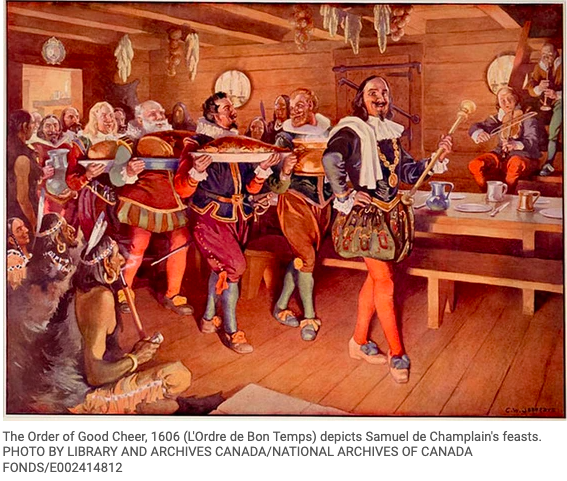
Explorer Samuel de Champlain organized a thanksgiving celebration in the early 17th century which is more reminiscent of today’s ceremonies than Frobisher’s. To prevent scurvy, Champlain introduced a variety of foods that included fresh vegetables and fruits high in vitamin C, such as cranberries. Since the 18th century, Nova Scotia’s Thanksgiving meals have resembled today’s variety of foods. But this is not the full story. Without indigenous Indians, neither the Canadian explorers nor the pilgrims would have survived long enough to present a meal of any great variety. 

U.S. Thanksgiving:

Screen Shot 2023-11-20 at 2.40.04 PM

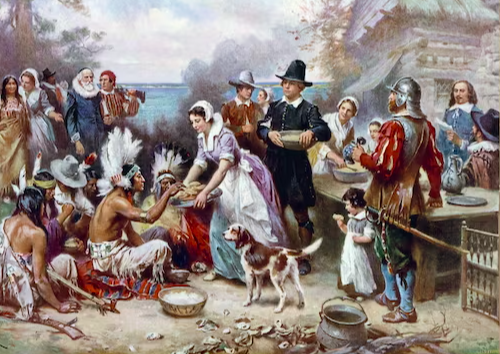
Romantic version of the first Thanksgiving in the U.S. Plymouth Rock Foundation.

In contrast to the happy scene depicted in the storybook image above, settlers and indigenous warriors experienced devastating losses from natural causes – the settlers from starvation and the tribes from the loss of as much as 50 to 90 percent of their population to the epidemics the Europeans brought with them. The pilgrims and Wampanoags joined forces to strengthen their numbers and to fight off possible attacks from other Indian tribes. And so the Wampanoags taught settlers to plant corn and other vegetables and to use herring for fertilizer. Under their tutelage, the pilgrims learned to fish for cod and bass, build housing with the materials at hand, and trade and barter for products they could not produce. 

N.C._Wyeth_-_Thanksgiving_with_Indians_(detail)

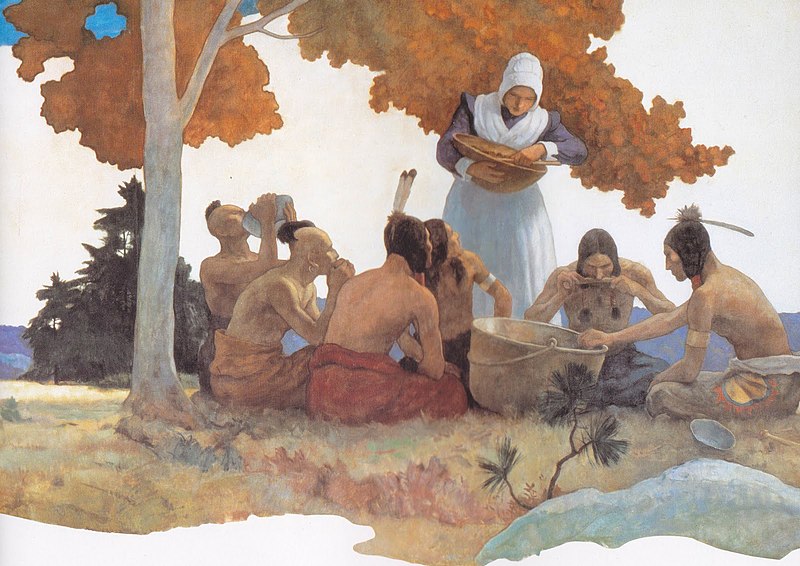
Detail of an NC Wyeth painting, Wikimedia Commons

After the bountiful result of their hard labor, the pilgrims commemorated their success with a series of feasts that featured the riches of their fall harvest. The chief of the Wampanoags, Massasoit, attended the event for three days with 90 men. They brought five deer, which were roasted, and played games in celebration.  According to an article in the National Endowment for the Humanities entitled Who Were the Pilgrims Who Celebrated the First Thanksgiving? | The National Endowment for the Humanities this was the true first American Thanksgiving.

Interestingly, in 1862 President Lincoln declared the turkey to be the official meat for the Thanksgiving dinner table. Before this time, there was no consensus. U.S. dinner tables had featured venison, ham, pheasant, duck, oysters, and other choices preferred regionally, such as bison. Personally, I like turkey once a year. At Christmas, I prefer ham.

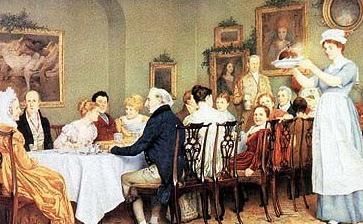
Sketch-of-a-Christmas-Celebration-Republic-of-Pemberley

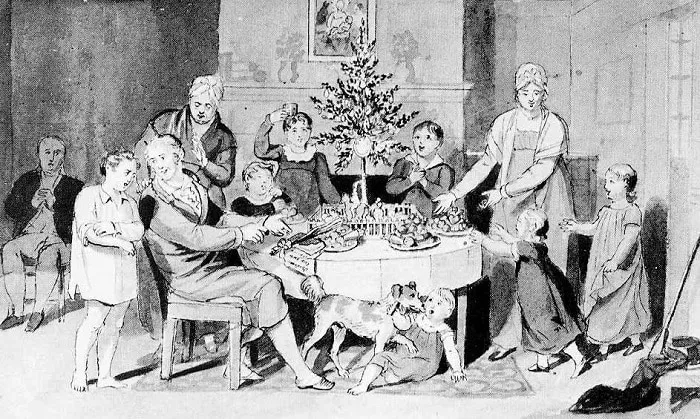
Festive 19th century Christmas goodies for a family. Image: British Food and Travel 

British Christmas Dinner:

When one examines the traditional Traditional Christmas dinner menu featured in this BBC Good Food website, one recognizes how close the three nations still are in their traditional celebratory food offerings. Oh, variations have crept in. Local foods are offered in abundance (in Maryland crab cakes and seafood recipes are heavily featured, and Tex Mex recipes are also making an appearance, especially at the appetizer and dessert tables.) But overall, we U.S. Americans are staying with the traditional holiday feast on the 4th Thursday in November.

Author Syrie James’s Jane Austen quote is apropos for both holiday feasts:

After Jane Austen’s Christmas guests had departed in January 1807, Jane wrote to her sister, Cassandra, “I shall be left to the comfortable disposal of my time, to ease of mind from the torments of rice puddings and apple dumplings, and probably to regret that I did not take more pains to please them all.”  

Read Full Post »

I love the idea of a Regency-style Christmas season, complete with gifts, foods, and traditions that Jane Austen and her heroines might have enjoyed. Though Christmas traditions were different during Jane Austen’s time than they are today, as I share in my article about Regency Christmas Traditions, it’s fun to think of creative ideas that can make for a truly Austen-tatious holiday season.

In Persuasion, Austen paints a Christmas scene. It’s one of my favorite festive scenes, and I love to think of ways to recreate it:

On one side was a table occupied by some chattering girls, cutting up silk and gold paper; and on the other were tressels and trays, bending under the weight of brawn and cold pies, where riotous boys were holding high revel; the whole completed by a roaring Christmas fire, which seemed determined to be heard, in spite of all the noise of the others. […] Charles and Mary also came in, of course, during their visit, and Mr Musgrove made a point of paying his respects to Lady Russell, and sat down close to her for ten minutes, talking with a very raised voice, but from the clamour of the children on his knees, generally in vain. It was a fine family-piece.

Persuasion, Jane Austen

Evergreen Decor:

Create your own holiday decorations the way people did during Jane Austen’s time. Trim your windows and home with holly branches and evergreen trimmings.

On Christmas Eve the children laid out the traditional holly branches on the window ledges…

Jane Austen: A Life, Claire Tomalin, p. 4.

For Regency-inspired holiday decorating ideas, check out this Jane Austen’s World article on Regency Era Christmas Evergreen Decorations.

Craft Table with Silver & Gold Paper:

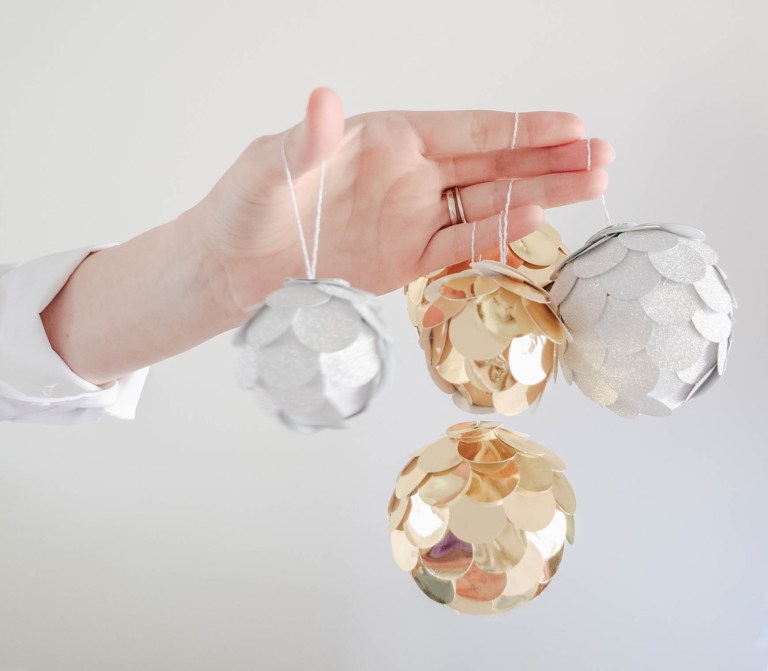
Create a craft station for children and adults to make ornaments or other crafts like these: Christmas Crafts for Kids and Adults from Abbi Kirsten.

On one side was a table occupied by some chattering girls, cutting up silk and gold paper…

Persuasion, Jane Austen

Tressels and Trays:

…on the other were tressels and trays, bending under the weight of brawn and cold pies…

Persuasion, Jane Austen
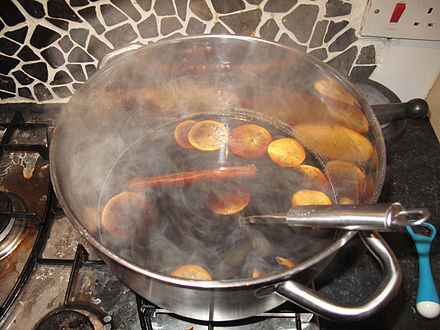
A pot of simmering wassail, infused with citrus fruit slices and cinnamon sticks. (Wikipedia Commons)

Riotous Games:

…riotous boys were holding high revel…

Persuasion, Jane Austen

A Roaring Fire:

…the whole completed by a roaring Christmas fire, which seemed determined to be heard, in spite of all the noise of the others.

Persuasion, Jane Austen

Jane-Inspired Gifts to Buy

This holiday season, add a little “Jane” to your gift giving! Here are a few shops and lists to peruse:

Austenesque Homemade Gifts

Want to make your own gifts? Check out these creative ideas!

Charitable Giving

Finally, charitable gift giving was a large part of the Regency Christmas season. On the day after Christmas, on St. Stephen’s Day (now called Boxing Day), people gave gifts to charities and to those in need.

The gentry gave gifts to the servants who worked in their homes and those hired to help on their land. Read The History of Boxing Day And How To Celebrate It (Lindsay Schlegel – Verity.com) for some modern-day ideas for ways to celebrate Boxing Day.


Now it’s your turn! What do you like to do around the holidays to make your gifts and get-togethers special? Do you have any Jane Austen traditions this time of year? I enjoy attending one of the local Jane Austen Birthday Teas in my area at this time of year. At home, I love to decorate the house with greenery and bake family recipes! -Rachel

RACHEL DODGE teaches college English classes, gives talks at libraries, teas, and book clubs, and writes for Jane Austen’s World blog and Jane Austen’s Regency World magazine. She is the bestselling author of The Anne of Green Gables Devotional: A Chapter-By-Chapter Companion for Kindred Spirits and Praying with Jane: 31 Days Through the Prayers of Jane Austen. Her newest book The Little Women Devotional is coming this January! You can visit Rachel online at www.RachelDodge.com.

Read Full Post »

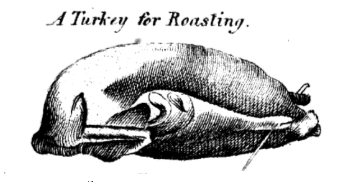
turkey for roasting

Image from The Frugal Housewife, 1796

Every November,  scores of American families sit down to Thanksgiving dinner, a tradition followed for almost 400 years in the New World. The main dish of this celebratory feast is a turkey, stuffed and roasted to perfection.

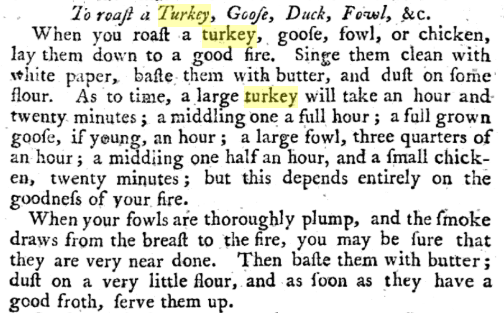
In the 18th century, The Frugal Housewife, or Complete Woman Cook, a cookery book written by Susannah Carter and published first in England and then in Philadelphia in 1796, must have influenced large numbers of colonial cooks, since Mrs. Carter’s books were hugely popular. Recipes back then were not given the precise directions modern cooks are accustomed to, but one can imagine that  Mrs. Carter’s contemporaries would have no trouble following her specifications.

roast turkey-frugal housewife

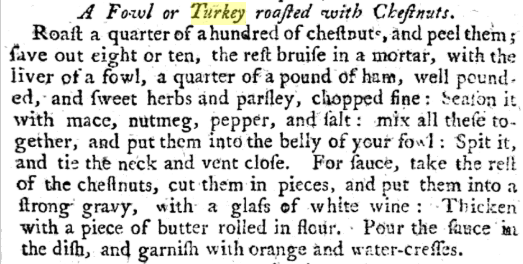
American colonialists most likely used the following Carter recipe, when chestnut trees were abundant in the east and before a fungal blight decimated them. Chestnuts were used in the stuffing, as well as the gravy.

turkey with chestnuts

Dishes accompanying the turkey included fruits and vegetables plentiful in the new world – sweet potatoes, mashed potatoes, turnips, cabbage, tomatoes, corn, cranberry sauce, current jelly, pumpkin and peach pies, stewed apples, and more, such as fowl or fish, or anything seasonal that was at hand.

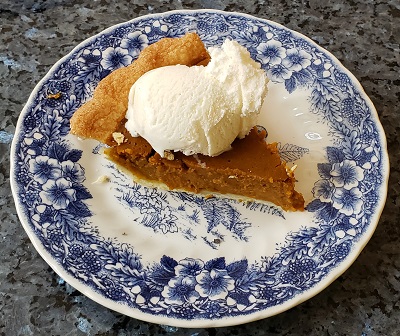
Photo of a slice of pumpkin pie and vanilla ice cream.

Pumpkin pie and vanilla ice cream. Image © Vic Sanborn.

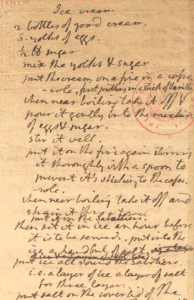
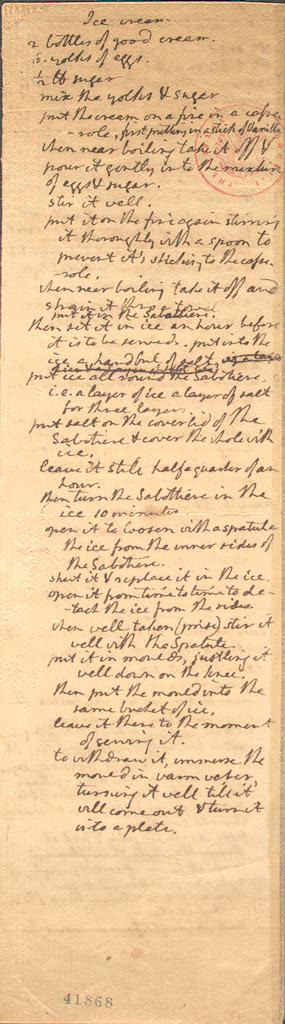
My memory of a hot slice of pumpkin pie and a dollop of cold vanilla ice cream will always be tied to Thanksgiving.  Ices have had a long history in Europe and the New World Thomas Jefferson recorded his recipe for vanilla ice cream by hand. It is well known that he traveled to France, where ice cream recipes appeared in cookery books since the 17th century. While Jefferson did not introduce ice cream to the U.S. (it was consumed in England throughout the Georgian period), he helped to popularize the dessert by serving it during his presidency. (Ice Cream, an article courtesy of the Thomas Jefferson Encyclopedia, downloaded 11/28/2019 at https://www.monticello.org/site/research-and-collections/ice-cream)

Thomas Jefferson’s Vanilla Ice Cream Recipe
(Recipe translation from the Thomas Jefferson Encyclopedia)

2. bottles of good cream.
6. yolks of eggs.
1/2 lb. sugar

mix the yolks & sugar
put the cream on a fire in a casserole, first putting in a stick of Vanilla.
when near boiling take it off & pour it gently into the mixture of eggs & sugar.
stir it well.
put it on the fire again stirring it thoroughly with a spoon to prevent it’s sticking to the casserole.

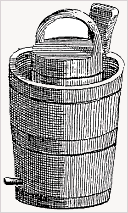
sabottiere

Sabottiere

when near boiling take it off and strain it thro’ a towel.
put it in the Sabottiere14
then set it in ice an hour before it is to be served. put into the ice a handful of salt.
put salt on the coverlid of the Sabotiere & cover the whole with ice.
leave it still half a quarter of an hour.
then turn the Sabottiere in the ice 10 minutes
open it to loosen with a spatula the ice from the inner sides of the Sabotiere.
shut it & replace it in the ice
open it from time to time to detach the ice from the sides
when well taken (prise) stir it well with the Spatula.
put it in moulds, justling it well down on the knee.
then put the mould into the same bucket of ice.
leave it there to the moment of serving it.
to withdraw it, immerse the mould in warm water, turning it well till it will come out & turn it into a plate.15

While at Godmersham (Edward Austen Knight’s estate), Jane Austen wrote:

But in the meantime for Elegance & Ease & Luxury . . . I shall eat Ice & drink French wine, & be above Vulgar Economy. 

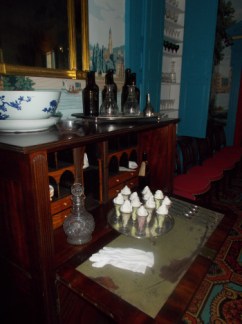
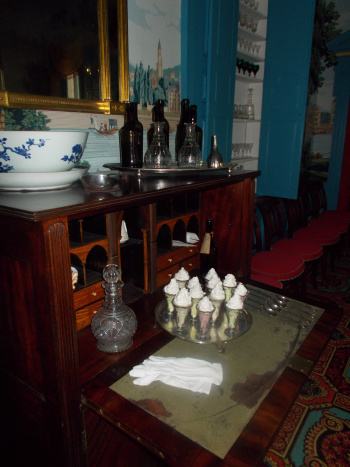
I can’t help but think that the elegance and ease she experienced must have been similar to the scene below, where a side table is set to serve ices and wine to an assembled group. Our family had a lovely time together. We wish the same good time for all.

027

Georgian ices as served in early 19th c. America. Image © Vic Sanborn: Hampton Mansion, MD.

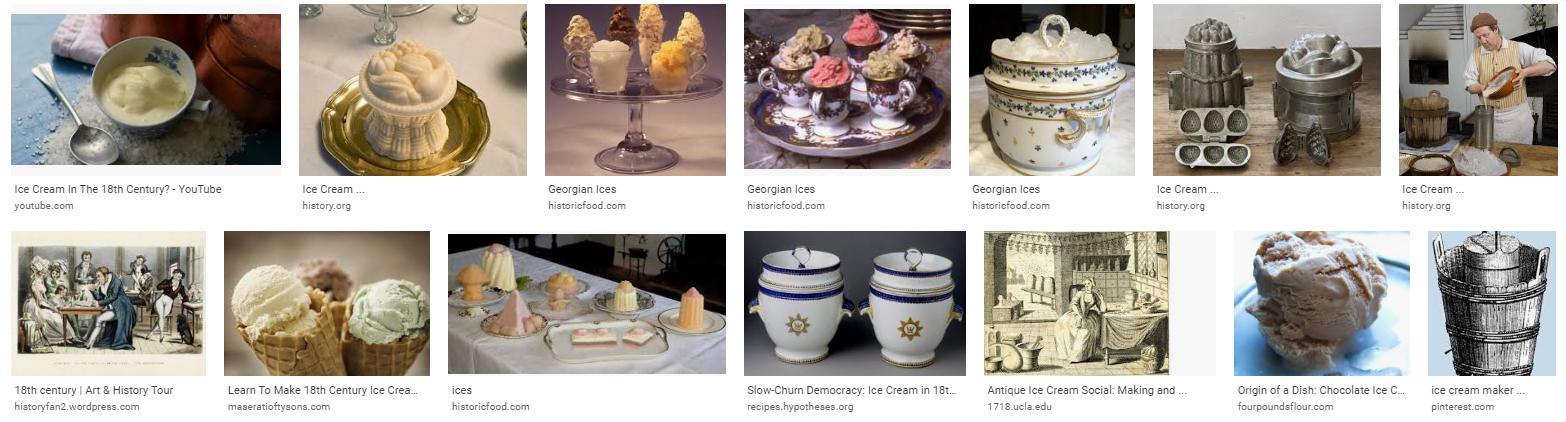
Top 14 images of Georgian ices in Google search.

google search ice cream

This blog’s posts tagged Georgian Ices and ice cream

Read Full Post »

Gentle Reader,

This week marks the July 4th holiday in the U.S., which means family gatherings, outdoor picnics, firework celebrations, and, most of all, ice cream! This delicious treat became more and more common at the turn of the 19th century when the method of transporting and storing great big blocks of ice over long distances became economically feasible. 

On July 1, 1808, Jane Austen wrote to her sister Cassandra from Godmersham:

But in the meantime for Elegance & Ease & Luxury . . . I shall eat Ice & drink French wine, & be above Vulgar Economy.

This statement reveals a number of  interesting details about her stay at her rich brother’s (Edward’s) mansion:

  • Ice cream was expensive (vulgar economy). We know our Miss Jane counted her pennies and did not live a life of extravagance, thus her tart observation.
  • Edward spared no expenses in giving his family this luxurious dessert.
  • Treating guests to ices in July during an era without electricity meant that Edward’s estate must have had an ice house to keep the ice frozen.

027

Georgian ices had to be served immediately before they melted. Image by Vic Sanborn: Hampton Mansion

The ice used for Edward’s ices most likely came via a variety of routes – local frozen ponds, rivers, or lakes in winter, or enormous blocks harvested in Norway or Canada, which were then shipped to the UK and transported by barge up canals to their final destinations – The Sweet Things in Life, Number One London Net.

hampton-002

Mound of the ice house on the grounds of Hampton Mansion. Image@Vic Sanborn

There were many forms of ice houses and ways to keep ice frozen, such as in the one I described in a previous post, 1790 Ice House, Hampton Mansion, and the one at Tapeley Park (see image below). Ice houses provided a dark, cool spot that preserved enough of the precious commodity to last until the next frost or ice block delivery.

Ice_House_-_geograph.org.uk_-_878045

The 18th century ice house at Tapeley Park, U.K. is above ground. Image from Wikimedia Commons.

Unlike modern-day methods of home ice-cream making … the Georgian method of creating a frozen sweet treat was so effective that it could turn liquid solid within 45 minutes. The secret to this 21st-century trouncing wizardry? Two buckets, some ice and a bit of salt. – Would You Eat Ice Cream From 300 Years Ago?, The Telegraph, Alexi Duggin, 2015

After chopping and shaving huge blocks of ice, making ice cream was rather simple:  Use a recipe you love. Fill a bucket with ice. Add ice cream ingredient to a second, smaller bucket and place it inside the larger bucket. Add salt to the ice, and stir regularly. Voila! Liquid is turned solid. Serve immediately before your creation melts.

When I was in my 20’s, my then husband and I used an old-fashioned ice-maker to make the most delicious peach ice cream with the fruit in season. Our ice cream took longer to make, simply because we used more sugar than the Georgian recipes. We cranked and cranked that ice seemingly forever, but it was worth the trouble. When we had company, there was never enough to go around.

Recalling how hot summers were without air conditioning, one can only imagine how refreshing it must have felt to eat something ice cold on a summer’s day in an era with no electricity and when people wore layers and layers of clothing.


uc004810.jpg_TJ Recipe hands

Thomas Jefferson’s handwritten recipe for making vanilla ice cream @ Open Culture.

According to Monticello.org, ice cream began appearing in French cookbooks starting in the late 17th century. 

There “are accounts of ice cream being served in the American colonies as early as 1744.” Jefferson likely tasted his fair share of the dessert while living in France (1784-1789), and it would continue to be served at Monticello upon his return. Open Culture: Thomas Jefferson’s handwritten vanilla ice cream recipe 

Mr. Jefferson’s recipe is a tad hard to read, so I searched for one in an early cookery book and found one from the 1733 edition of Mrs. Mary Eale’s Receipts. It offers this fine recipe, which requires from 16 -18 lbs of ice to be chopped:

To ice CREAM.
Take Tin Ice-Pots, fill them with any Sort of Cream you like, either plain or sweeten’d, or Fruit in it; shut your Pots very close; to six Pots you must allow eighteen or twenty Pound of Ice, breaking the Ice very small; there will be some great Pieces, which lay at the Bottom and Top: You must have a Pail, and lay some Straw at the Bottom; then lay in your Ice, and put in amongst it a Pound of Bay-Salt; set in your Pots of Cream, and lay Ice and Salt between every Pot, that they may not touch; but the Ice must lie round them on every Side; lay a good deal of Ice on the Top, cover the Pail with Straw, set it in a Cellar where no Sun or Light comes, it will be froze in four Hours, but it may stand longer; than take it out just as you use it; hold it in your Hand and it will slip out. When you wou’d freeze any Sort of Fruit, either Cherries, Rasberries, Currants, or Strawberries, fill your Tin-Pots with the Fruit, but as hollow as you can; put to them Lemmonade, made with Spring-Water and Lemmon-Juice sweeten’d; put enough in the Pots to make the Fruit hang together, and put them in Ice as you do Cream


Tomorrow, on July 4th, you can be sure I’ll celebrate with a delicious bowl of ice cream. My favorite is still peach ice cream, followed by vanilla, and peppermint in the winter.

Happy holiday, all! Let me know which flavors you prefer and if you’ve ever hand-cranked your own ices.  Vic

More resources: 


Read Full Post »