Feeds:
Posts
Comments

Archive for the ‘Architecture’ Category

Historic fruit trees were discovered in a National Trust garden in Ickworth House estate, Suffolk.

A notebook packed with unique garden history has been discovered in a filing cabinet in a gardener’s shed at the National Trust’s Ickworth estate in Suffolk. The notebook documents more than 200 varieties of local plum, gage, pear and apple trees, all planted at Ickworth from 1898 to 1930. Some of these varieties, which include Blickling, King of the Pippin, Lady Ludeley, Hoary Morning and Court of Wick, were previously unknown to Ickworth staff. – Country Life

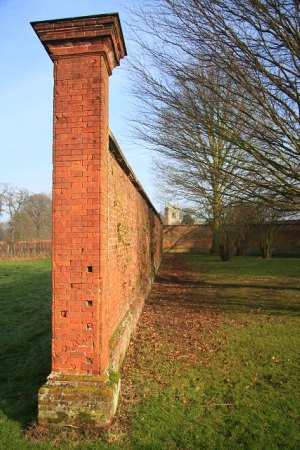
Ickworth garden wall

Re-planting of Ickworth’s historic wall fruit (fruit trees trained against the garden walls) will start in autumn 2010 when research is complete. – History Times.com

Ickworth silver garden

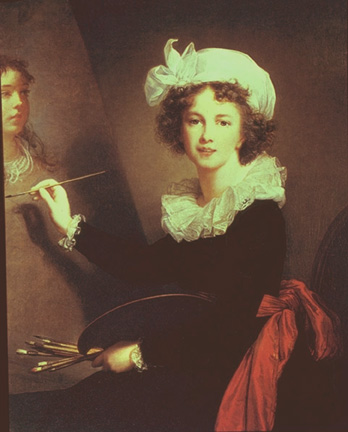
Elizabeth-Louise Vigée Le Brun, with the artist's daughter Julie as subject

Elizabeth-Louise Vigée Le Brun painted three original and authenticated self-portraits, one of which hangs in Ickworth.

Hoary Morning apple

More on the topic:

Read Full Post »

After many parts of Bath disappeared overnight during a German bombing raid in World War II, efforts to restore the city began – efforts to reconstruct the major landmarks like the Assembly Rooms and The Circus, that is.  Smaller Georgian houses were scheduled for demolition.  In 1970, a horrified James Lees-Milne wrote to the Times:
Your readers may be interested to learn that we are getting on quite nicely with the demolition of the centre of Bath. This year alone we have swept away several acres between Lansdown Road and the Circus. The whole southern end of Walcot Street (including the 19th century burial ground and tombstones) has entirely gone. We are just beginning on Northgate Street and have only knocked down two or three houses in Broad Street this month. But New Bond Street’s turn is imminent. All the houses are (or were) Georgian, every one.
Lees-Milne, who joined the National Trust, “played an active part in the campaign to save Bath.” Click here to read the review of Michael Bloch’s book, James Lees-Milne, The Life: Saving what was left to a Georgian city, which goes on to describe the rest of this fascinating story.

Read Full Post »

Georgian town houses in Bath

Georgian town houses in Bath

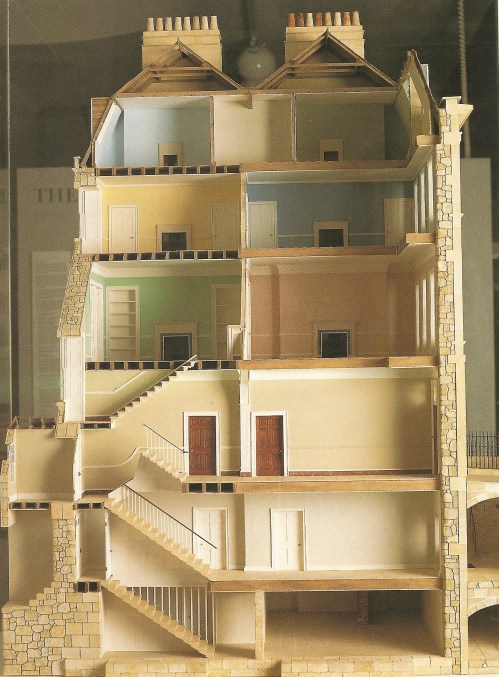
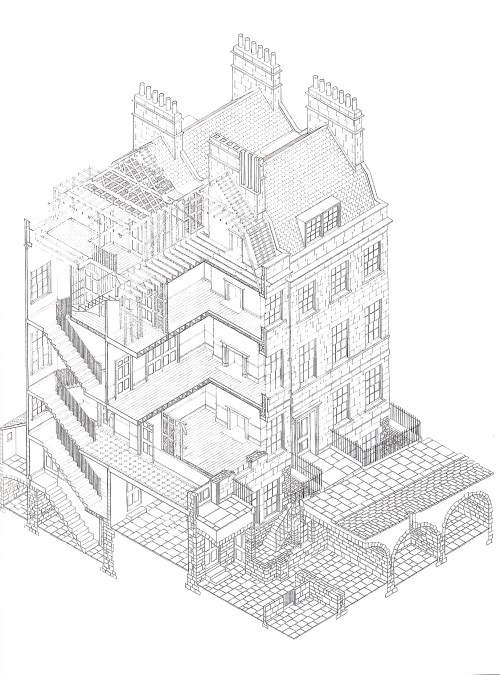
Cutaway of a Bath town house

Cutaway of a Bath town house

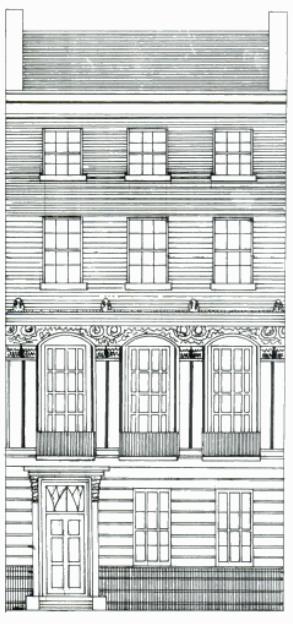
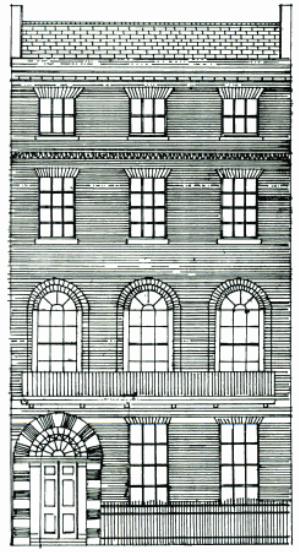
When we think of Regency architecture we think of the beautiful Georgian architecture so popular in Bath and Brighton. While there were subtle variations in design and detail, the basic plan for First Rate houses was similar to Fourth Rate houses*.

Bath Regency town house

Bath Regency town house

  1. The basement, or subterraneans section: All except the poorest houses had basements. They were occupied by the kitchens and other servant offices. The housekeeper and cook might be given rooms in this area away from the maids who slept in the attic.
  2. Ground floor: The drawing room was placed near the front door so that it was easily accessible. Drawing rooms were a place to greet visitors and where the women of the house could retreat. The humbler parlor was generally a private room where the family could retire. Furnishings in the drawing room were generally more feminine than those in the adjacent dining room. Double doors would lead to the dining room, which was more austere and masculine in nature. After dinner the men would remain there to enjoy conversation over port and cigars, while the women retreated to the drawing room. The closer the dining room was located to the kitchens, the warmer the food remained when it arrived at the table.
  3. The first floor: Featured a large room for entertaining on a grand scale, such as dancing, card playing, or other fashionable pastimes. This floor might also hold the principal bedrooms, which were generally placed in front of the house. The bedrooms would be decorated lavishly and in the latest style.
  4. The second floor: Featured bedrooms for children, or perhaps a lodger or guests.  Little expense went into decorating the nursery in comparison to the lower bedrooms. As the levels rose, the complexity of room decorations were simplified since fewer visitors bothered to climb the stairs to the upper levels. In general furnishings, mouldings, and decorations were modest on these floors.
  5. The attic: Reserved for the servants, whose beds were often like murphy beds and let down from the wall.  These rooms were cheaply painted and furnished.
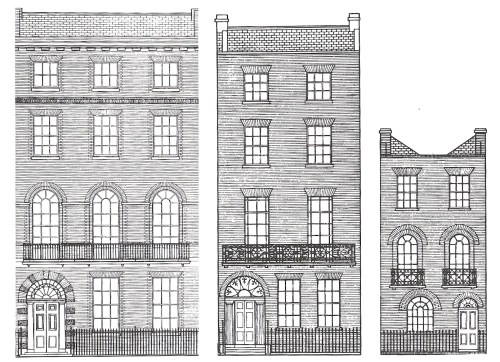
Georgian houses: first rate, second rate, and fourth rate

Georgian houses: first rate, second rate, and fourth rate

Throughout the 17th century, London houses had been susceptible to big fires that swept through narrow, twisting lanes in the city’s center and houses made of timber. A series of Rebuilding Acts specifying building construction followed the Great Fire of 1666 that destroyed over 14,000 houses. A rise in population generated demand for housing, encouraging land owner to develop large tracts of land. The Building Act of 1774 prescribed how houses were to be built. The act specified the use of stone or brick and determined the width of the street, the size of the houses, floor to ceiling heights, and the layout of the houses. It also defined the four types of houses that could be built in London. Each of these types were standardized and followed strict building guidelines:

First Rate House: Worth over £850 per year in ground rent and occupied over 900 square feet of space. These houses faced streets and lanes.

First rate house

First rate house

Second Rate Houses: Worth between £350 and £850 in ground rent and occupied 500-900 square feet of floor space. They faced streets, lanes of note, and the RiverThames.

Second rate house

Second rate house

Third Rate Houses: A smaller house worth around £150-£300 and occupied 350-500 square feet. They faced principal streets.

Fourth Rate House: Worth less than £150 per year in ground rent and occupied less then 350 square feet. These houses stood in their own ground.

About ground rent:
Land owners improved their land by laying out roads and services.  They then charged rent on this land. Housing developers (landlords) would build spec houses on the improved land and generate an income from leaseholders by collecting rent. Sometimes the land owner and the house landlord were the same person. These people were usually owners of great estates, which were better managed and the most sought after. Original leases were for as little as 33 years, but by the end of the Georgian era the length of time for many leases was increased to 99 years.

Curiously, the people who paid rent on large houses belonged to the nobility or gentry or prosperous merchants. While they did not own the houses they lived in, they received enormous incomes from their properties and businesses.

Read Full Post »

rossettis-bed-project-gutenberg

A few days after Jane [Austen’s] birth a blizzard struck and paralyzed all the south of England, making travel almost impossible as snow drifted deeply and blotted out all signs of roads and tracks. On four nights in January the temperatures sank so low that even urine in chamber pots underneath beds became frozen. It was weeks before a thaw occurred, and even then the spring was very cold, so Jane was not taken out to Steventon church for her christening until early April 1776. – Jane Austen: The World of Her Novels, Deirdre Le Faye

In Ways to Keep Warm in the Regency era, Part 1, the post ended with the invention of the Rumford fireplace, a vast improvement over previous fireplaces in which most of the heat from a fire went up the chimney and smoke billowed into the room. Not all people during the Regency period could afford the more efficient new fireplaces. There were ways, however, to capture heat and to prevent feeling ice cold on one side while too hot on the other.

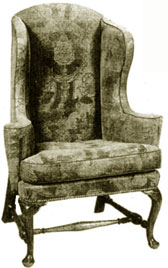
Mid 18th century Wing Back Chair, England

Mid 18th century Wing Back Chair, England

Wing chairs

Arranged in a circle around a cozy fire, wing chairs served a dual purpose, conserving heat and protecting the sitter from draughts. English homes were notorious for chill draughts entering under doors and through ill fitting window frames. The highs backs of these chairs and wings, sometimes known as cheeks, prevented cold air from swirling around the head and upper body, and at the same time prevented heat from escaping past the sitter. High backed wood settees served a similar purpose but were not quite so comfortable.

Room screens

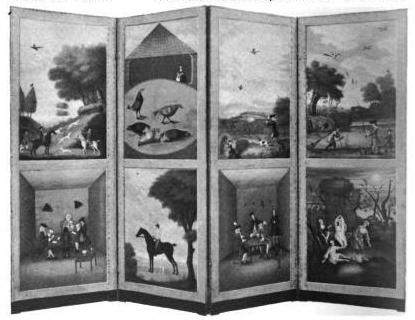
Also known as draught screens, room screens have been used since medieval times as a protection against draughts. Thought of as a necessity, they partitioned off long halls and kept draughts from entering too close to the heated portion of the room. They could also serve as protection against too much sun in the summer in a room that faced west.

Text not available

Family Physician A Manual of Domestic Medicine, 1886

Draught Screen 1744

Draught Screen 1744

Of the tribe of fire screens and draught screens there are so many varieties that it is impossible to mention more than a tithe. The purpose of the former is so apparent as to need little commendation. So long as we are scorched baked or fried at one side of the room and frozen at the other so long shall we require at times a screen between the fire and those nearest it. This screen may take the form of transparent glass or tinted cathedral glass in leaded squares. It may have its panels of brocade, or old leather of rare needlework by skilful fingers, or of painting on panel in oils or in water colour. – The Furniture Gazette 1881

pole-screenPole screens

A beautiful addition to any room, decorative pole screens served an important function in the 18th century: The tall thin screens shielded people’s faces from the direct heat of the fire. In the 17th and 18th centuries both men and women wore makeup to hide blemishes. (It was said that before he turned fifty the Prince Regent’s face had turned waxen and copper colored from make up.)  The cosmetic preparation worn to hide small pox was thick, and made up of wax and white lead. The lead was toxic, especially when warmed, and the heat from a fire could be life threatening. A pole screen protected the face from intense heat and prevented the wax from melting and the cosmetics from interacting with the skin.  Pole screens were fitted with sliding panels that could be enlarged or diminished as needed. The earliest panels were made of wicker, but these were replaced with beautiful needlework or embroidered panels that came in many shapes and sizes – oval, heart-shaped, rectangular, etc. By the late 18th century, skin disfiguration caused by plagues was no longer as prevalent as before, and smaller polescreens became more fashionable.

The Bedroom

The bedroom remained a primary focus for staying warm. Privacy was a luxury only the rich or rising middle classes could afford. Most poor and working class families shared rooms (or lived in a one-room hovel), and children often shared a bed and huddled together. For the privileged, life was vastly different. A half hour before the family retired, a servant would enter the bedrooms and start a fire in each room. They would also warm the bed sheets with bed warmers.

antique-brass-bed-warmer

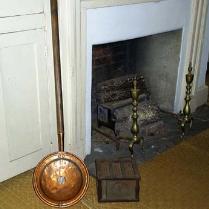
Bed warmers

Brass bed warmer open

Brass bed warmer open

Bed warmers like the one depicted in the image above were made of brass tin or lined copper, and had long wood handles. The round metal pan was hinged so that it could be easily filled with hot coals. The pan would then be moved gently back and forth between the sheets to warm the beds on cold evenings. These bed warmers gradually fell into disuse in the 19th century after hot water bottles made of rubber became affordable and widespread.

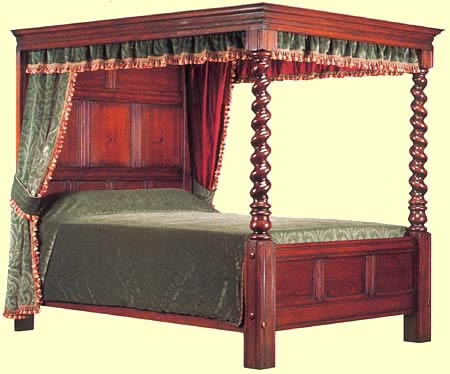
Four poster beds

The thick hangings that surrounded a four poster or tester bed kept cold draughts out and body heat in. Popular since before the Elizabethan age, their design changed with the times: ornate in the 16th century, plain in the 18th century, and a rich but restrained neoclassical style in the 19th century. The bed and bedding materials varied according to wealth. Luxurious hanging made of velvet or brocade were often worth more than the wood bed frame, and in times past the rich would take the hangings with them as they traveled, leaving the wood bed behind. As improvements in insulation and draught exclusion were made, the four poster bed became more decorative than functional.

Four poster bed

Four poster bed

Night caps (also known as jelly-bags in the 19th century).

Knitted wool or silk stocking caps provided warmth while sleeping. This distinctive cap was also used other than for sleeping. From the 14th-19th century it was known as a skullcap and worn indoors by men when they removed their wigs. Women wore a more ornate mob cap during the day, to bed, and outdoors under their hats.

Nightcaps are no protection against snoring

Nightcaps are no protection against snoring

Foot warmers

18th-cent-foot-warmer Foot warmers were small, practical and transportable. Most foot warmers were simple wood, tin, or brass boxes with metal trays that held hot coals. The sides were poked with holes in a patterned design, and a rope or metal handle allowed for easy portability. Women and children would carry footwarmers to church or inside a carriage. They were used in a cold room as well. Women’s long skirts would hang over the warmer, providentially holding the heat around their feet. By the end of the 19th century, footwarmers were primarily used in sleighs and carriages until the advent of the automobile


High-sided Church Pews:

For about 54 shillings a year a family could rent a high sided pew whose tall wooden walls protected worshipers from winter drafts. Family members would sit close together and share the heat from a foot warmer. The pews were often individualized by family members who brought in their own pillows or fabrics, and even furniture. Pews in the galleries were for parishioners who could not afford to rent a box downstairs.

Family Pew, Tichborne

Family Pew, Tichborne

Read more about this topic at these links:

First Image, Rossetti’s Bed

Read Full Post »

Georgian Doorways of Rodney Street, Liverpool

Georgian Doorways of Rodney Street, Liverpool

Memoirs of the Celebrated Mrs. Woffington is a fascinating blog that offers insights about the 18th century. The blog’s author, who lives in England, has been featuring Georgian Liverpool in a series of posts. Click on the following links to read:  Part 1, Part 2 , Part 3, Part 4, and Part 5.

Image of Georgian Doors (Rodney Street, Liverpool) courtesy Andy Marshall of Fotofacade

Read Full Post »

« Newer Posts - Older Posts »