Feeds:
Posts
Comments

Archive for the ‘Austenesque novels’ Category

My Dear Charlotte is a recent novel written in epistolary form by British mystery writer Hazel Holt, who uses Jane Austen’s letters to her sister Cassandra for her inspiration. The main character of the book and the writer of the letters is Elinor Cowper (pronounced Cooper), who lives in Lyme Regis with her parents. She writes faithfully to her older sister Charlotte in Bath. In the letters Ms. Holt includes all the minutia of daily life that Jane wrote down, such as purchasing cloth, refurbishing bonnets, exchanging recipes, and attending balls and assemblies. Jan Ferfus, Professor of English Emerita, Lehigh University writes in the introduction:

“Of course, you don’t have to love Austen to love this book. If you enjoy detective novels, you will find here a completely satisfying murder mystery, coupled with a romance (or more than one, in fact). My Dear Charlotte gives you, in addition to mystery and romance, a portrait of the world of the English gentry at around 1815, immediately after the defeat of Napoleon–its manners and its moral certainty. As in Austen, Napoleon is not directly mentioned, but his shadow is there: one brother of the heroine is a sailor and the other a junior diplomat at the Congress of Vienna. It’s the social world at home that is central, however, with its balls, visits, courtships, gossip, and of course murder, underlining the tensions and rifts within that apparently civilized society.

The book is based on the premise that Jane’s letters make for interesting reading. As the publisher says, “While the story is new, the details having to do with balls, dinners, and other social events are given in the words of Jane Austen herself.”  This excerpt describes events just after Mrs. Woodstock’s murder:

Of course it cannot be denied that Mr Woodstock himself will lead a happier life without his formidable spouse, though I do not believe that he could have summoned up the courage to dispose of her!

Mr Rivers will be glad to be rid of one who would have put obstacles in the way of his plans for the Barbados estate, but I do not think that may be considered a sufficient reason for an honourable man to take a life.

Mrs West, however, seems to me to lack such scruples if they stood in the way of her daughter’s advancement. I do not at present see how she could have brought about Mrs Woodstock’s demise, but no doubt, if I give my mind to it, I may presently think of something.

Poor John coachman also had reason to wish his mistress dead, since his whole happiness (and that of Sarah) depended upon keeping his position at Holcombe and if he had been turned away without a character his case would have been miserable indeed.

So you see, there are a number of people who will be happy at Mrs Woodstock’s death. Perhaps I should add myself to the list for the sake of those hours of tedium and the many irritations she has subjected me to!

Author Hazel Holt

The above passage represents the book at its most exciting because it concentrates on the plot.  As far as I am concerned, Jane Austen’s letters are not all that interesting when taken out of context. The letters to Cassandra are important because they reveal something (anything) about Jane’s life and thoughts. Those that I read from the Brabourne edition seem like watered down pap when compared to the tart and satiric observations of her novels. There were times when I stopped reading My Dear Charlotte, for the book was bogged down by the minutia of daily life instead of clues about the murder. The details were meant to give authenticity, but they should have been used more sparingly. I found the epistolary format also problematic, for it allowed for too much exposition and very little dialogue, and I felt that I was receiving my information third-hand. Instead of getting into Elinor’s head, I was reading about her recipes! In fact, Elinor reveals as little of her thoughts, ideas, and hopes in her letters to Charlotte as Jane did to Cassandra. I would have preferred that Ms. Holt had used the rich dialogue and language in Jane’s books for inspiration, rather than her uneventful life.

Hazel Holt would most likely disagree with my assessment of Jane’s letters. She describes the process of writing My Dear Charlotte in a recent interview, in which she revealed that she found Jane’s letters delightfully chatty:

I thought – holding my breath – that since they are such wonderfully informal, chatty letters, I might just manage to create a sort of facsimile of her world if I wrote my novel in the form of letters, inserting extracts of Austen’s where they would fit in with the story – the perfect, authentic background.

Ms. Holt DOES capture Jane’s ascerbic wit on a few occasions by directly quoting her and weaving these gems into the plot:

“Mrs Holder’s niece, Miss Porter, is recently come into the neighborhood but is not much admired; the good-natured world, as usual, extolled her beauty so highly, that all of Lyme have had the pleasure of being disappointed.”

“I do not remember if I told you that Mrs Heathcote wrote to tell us that Miss Blackford is married, but I have never seen it in the papers, and one may as well be single if the wedding is not in print.”

Perhaps I was expecting too much from the start and didn’t give this book the chance it deserved. As a successful mystery writer, I expected Ms. Holt to wow me from page one. To be fair, as the book progressed and as the characters were introduced and more fully formed, I found myself becoming more involved in the plot. Ms. Holt knows how to write a mystery, though I took a stab in the dark and guessed the murderer early on. Searching the Internet for reviews and comments about My Dear Charlotte, I discovered that many people liked it immensely and gave it rave reviews. As for me, I rate this book two out of three regency fans.

My Dear Charlotte: With the assistance of Jane Austens letters (Paperback), Hazel Holt. ISBN #’s
Standard: 978-1-60381-040-1
Large Print Books: 978-1-60381-041-8
sBook: 978-1-60381-042-5

More on the Topic

Read Full Post »

Inquiring readers: I have no doubt you shall enjoy this post by my good friend, Lady Anne, an expert when it comes to the subject of Georgette Heyer. Lady Anne has read Georgette Heyer’s novels for most of her years upon this earth. Smart, sassy, fabulous, well tressed and well dressed, she has read every GH book backwards and forwards. There is not one tiny detail of Georgette’s novels that escapes Lady Anne’s attention or opinion. As to her review of  These Old Shades- please enjoy.

Set in the Georgian period, about 20 years before the Regency, These Old Shades is considered to be the book that launched Heyer’s career. It features two of Heyer’s most memorable characters: Justin Alastair, the Duke of Avon, and Leonie, whom he rescues from a life of ignomy and comes to love and marry.

The title of the book, These Old Shades, is a subtle allusion to the fact that this book is a far superior reworking of Georgette Heyer’s first book, The Black Moth, a book she wrote for the amusement of her brother who was ill. The characters in The Black Moth are at best two dimensional, but like most of Heyer’s creations, have enough humor and idiosyncrasy to catch our interest. In her case, it was the character of the villain whom she wished to revisit, develop and deepen.

These Old Shades is the first of the Alistair trilogy – she really did like these characters – and is not Regency, nor does it take place primarily in England. Like many of her early books, it falls more accurately into the category of historical romance, and is cast in mid-18th century Paris, with a short idyll at the English county seat of our hero, Justin Alistair, the Duke of Avon. He is known by the soubriquet Satanas, for his cold exactitude and prescient understanding of what his opponent will do next, as well as a certain elasticity in his moral fiber. The Duke has restored his family’s fortune through gambling; he is, as one would expect of one of the first peers of the realm, an arrant snob, careful, although certainly flamboyant, in his dress, and punctilious in manner. The historical background is the court of Louis XV, complete with its intrigues and excesses. It is the perfect backdrop for this story, for which one must be willing to suspend disbelief for pages at a time. It is such fun, and so sparkling in its writing, that one is indeed willing.

We first meet the Duke, dissolute, languid, apparently unaware of his surroundings, when a gamin comes hurtling from a side street and provides Avon with the weapon he has been waiting for to bring about the destruction of the Comte de Saint-Vire, the man who famously insulted Avon beyond courtesy. Avon buys the youngster from his brother, and establishes him as a page dressed in sober black, who attends Avon at parties, assemblies, and the Court at Versailles. The youngster, called Leon, attracts considerable attention, not only for his utter adoration of his master, whom he calls Monseigneur, but also for his startling red hair and dark eyebrows. Such hair and eyebrow combination is evident in the Saint-Vire family. As le tout Paris buzzes, Avon begins laying his plans. Leon is revealed to readers as Leonie, and goes to England in the country to learn how to be a lady. The Duke adopts her and returns to Paris with his ward. His friend Hugh Davenant returns to Paris at the same time and Avon tells him, in a passage that makes clear both the character and performance of this Duke:

“I am becoming something of a patriarch, my dear.”
“Are you? Davenant said, and smiled to himself. “May I compliment
you on your ward?”
“Pray do! You find her to your taste?”
“Infinitely. Paris will be enchanted. She is an original.”
“Something of a rogue,” conceded his Grace.
“Justin, what does Saint-Vire to do with her?”
The thin brows rose.
“I seem to remember, my dear, that your curiosity was one of the
things I deplored in you.”
“I’ve not forgot the tale you told me – in this very room, Justin. Is
Leonie the tool with which you hope to crush Saint-Vire?”
His Grace yawned.
“You fatigue me, Hugh. Do you know, I have ever had a fancy to
play my game — alone.”
Davenant could make nothing of him and gave up the attempt.”

But it is not the plot that carries the reader along; it is the delightful characters. The Duke, the darkest of Heyer’s heroes, has real charm, albeit a little sinister. He is not one you would wish to cross, as we see. Leonie, the heroine, is an effervescent charmer with a ferocious temper and an inherent sense of her own worth that grows through the book. Her character is honest and instinctively noble. She also, like any adorable pet of a large circle, gets away with being outrageous – except when Monseigneur is displeased. The supporting characters have charm and individuality as well. It is no wonder that Heyer comes back to the family twice: once in The Devil’s Cub – to revisit the Duke and his family, with a focus on the Cub, definitely the son of both his parents, and then in what is generally considered her finest novel, in An Infamous Army, where the grandchildren of the second book’s couple play out their roles at Waterloo.

If the story that unfolds is outrageous and unbelievable, the characters develop beautifully, the dialog bubbles delightfully, and we love the rollicking ride.

These Old Shades/Black Moth comparison from Wikipedia

More on the topic:

Read Full Post »

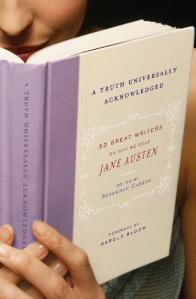
I read these words on the book flab of the excellent new compilation, A Truth Universally Acknowledged: 33 Great Writers on Why We Read Jane Austen, edited by Susannah Carson, foreword by Harold Bloom, “For so many of us a Jane Austen novel is much more than the epitome of a great read. It is a delight and a solace, a challenge and a reward, and perhaps even an obsession.” How true. Susannah Carson has culled essays from the last one hundred years of criticism and juxtaposed a few pieces by today’s essayists and novelists in a book that I found to be more satisfying than attending a master class on Jane Austen. I consider this interview with Susannah to be among the better posts on this blog. Enjoy!

33Q: What were your criteria for choosing the essays? Would you give us an example of a writer whose essay you first considered and then decided not to include in the collection?

A: There have been so many excellent essays written on Jane Austen! Most of them endeavor to clarify some aspect of the novels—the what, when, how, etc.—and these can be extraordinarily helpful. But then there are other essays which tackle what is, in my opinion, the big question: the why. Not, for instance, how can we understand the relationship between Darcy and Elizabeth in terms of gender relations, narrative technique, and cultural institutions, but why does their love continue to move us so?

David Lodge wrote an essay entitled “Jane Austen’s Novels: Form and Structure.” This is perhaps the most acute, elegant account of how the novels work. But it answers the “how” question, and so I chose to include his essay “Reading and Rereading Emma” instead, for there he is after the essential “why”.

Q. Did you have an order in mind when you arranged the essays and why?

A. Some of the essays are about one novel, some are about a couple or a few of her works, and some are about everything she wrote from the juvenilia to her unfinished novels to her letters. In the end, we decided to order them loosely: essays about a single novel appear in a series, and they are separated by two or three more general essays that are united by theme (e.g. morality, films). When I reread them through in this order, I was pleased to discover that the same thoughts would rise and fall in the smaller waves as well as throughout the length of the book. Austen’s vitalism, for instance: towards the beginning, Eudora Welty writes that Jane Austen’s novels are about “Life itself”; in the middle, later, Amy Heckerling notes that everyone is “BUSY” and Eva Brann observes that the heroines are full of “liveliness”; and in the penultimate essay, Virginia Woolf hears “the sound of laughter.”

Q: Do you agree with Benjamin Nugent’s observation that a Jane Austen novel is the “ultimate talky French movie,” because in essence nothing happens except for a series of conversations between characters?

A: I do agree. Austen’s use of dialogue is complex—she uses it to sketch character, but (as Diane Johnson notes in her essay) she rarely uses it to advance plot. And yet, at the same time, most of the climactic scenes are all about words—their use and misuse. In Pride and Prejudice, it’s Darcy’s hilariously misworded proposal; in Mansfield Park, it’s the drama surrounding drama, or the debate over whether or not to perform Lovers’ Vows; in Emma, it’s Emma’s slight of Miss Bates during the picnic at Box Hill; in Persuasion, it’s Wentworth’s letter written in counterpoint with the conversation he overhears between Anne and Harville. So words are at the center of whatever it is that they get wrong or right, whatever it is they need to learn in the course of the novel. Figuring out how words work in a social setting is, as Ben so astutely notes, part of a timeless coming-of-age process.

Q: James Collins made a number of powerful statements, saying that Jane Austen helped him clarify ethical choices and figure out a way to live his life with integrity. One of the reasons that she has credibility in his eyes is her total lack of sentimentality. C. S. Lewis comments on Austen’s hard core morality, and Amy Bloom paints a picture of a woman who sees the world around her through a clear pane of glass. These authors helped me to clarify why I am so drawn to Jane Austen. In your introduction you hope the reader will formulate an answer to the question: why do you read Jane Austen? I will reformulate your question: what was your reason for assembling this book and why are you drawn to Jane Austen?

A: It seems like there’s a whispered suspicion in our culture that Reading is dead—that we hardly ever read anymore and, when we do, we’re still not really reading. Hopefully this isn’t true, but the sublime Robertson Davies was certainly haunted by this fear when he issued his call to arms: “What I call for is a multitude of revolutionary cells, each composed of one intelligent human being and one book of substantial worth, getting down to the immensely serious business of personal exploration through personal pleasure.”

This collection of essays is intended to help people figure out how to really, really, really enjoy reading. There are different kinds of reading. There’s the light reading of a Jane Austen spin-off, and that provides a certain amount of fun. And then there’s the rich reading of a Jane Austen novel, and that provides not just quick delight but insight into how our hearts and minds work. We frequently think of reading as somehow separate from the act of living, but with the best literature—with Austen’s novels—reading becomes just as grand, if not grander, than the other bits and acts of life. So I read, and I read Austen, not only because it teaches me to think, imagine, and relate, but also because it’s a critically important and deeply indulgent pursuit.

Susannah Carson CREDIT Eric C CarterDizzy Pixel Inc SMALLERQ: Tell us a little about yourself! Your short bio on the book flap intrigues me. Unlike provincial Jane, whose life was quite circumscribed, you are truly a woman of the world.
Yes! It’s telling that Austen’s work continues to have something to say to modern women who are so very different from her in all sorts of quotidian details. I started off in much the same place, however; my first memories date from the years my family lived in Hockwold-cum-Wilton, a little village in East Anglia. We moved back to the Napa Valley when I was still small, and I grew up in the country where I could trek across the countryside to visit friends. The scope changed when I went away to college, for I found myself increasingly addicted to books: first philosophy, then literature. While I was writing an M.A. thesis for San Francisco State University on Madame de Lafayette’s La Princesse de Clèves, I fell head-over-heels in love with 17th C French novels. To read these rare novels in all their original mustiness, I moved to France. After a maîtrise at Lyon II, I did a D.E.A. (or M.Phil) at Paris III. In Paris, I lived in an apartment above a chocolaterie on the Ile St. Louis and walked around Notre Dame every day on my way to class at the Sorbonne. I then moved to New Haven to pursue a doctorate at Yale, and I’ve just returned to San Francisco to finish a dissertation on danger in French novels of the Ancien Régime.

What would Jane Austen’s life have been had she lived, read, and written today? Would she have traveled the world for her craft, or would she have been just as content with stationary flights of fancy? Would she have racked up degrees and indulged in “serious” study, or would she have stuck to her depictions of three or four families in a little village? No matter how we live it out, I think it’s inevitable that modern bluestockings somehow associate themselves with Austen: she was such an important pioneer, and it’s hard to say where we would be today had she never written.

Thank you for your insights, Susannah! It has been a pleasure talking to you. For the readers of this blog, I will post my review of the book soon.

More information about Susannah on Random House’s site: Susannah Carson is a doctoral candidate in French at Yale University. Her previous degrees include an M.Phil from the Sorbonne Paris III, as well as MAs from the Université Lyon II and San Francisco State University. She has lectured on various topics of English and French literature at Oxford, the University of Glasgow, Yale, Harvard, Concordia, and Boston University.  Order the book at this link.

Susannah’s site sits at this link:  Why Jane Austen


Read Full Post »

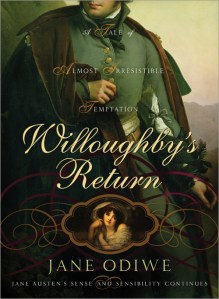
Three years after Miss Marianne Dashwood marries Colonel Brandon, Willoughby returns. She is thrown into a tizzy of painful memories and exquisite feelings of uncertainty, for she is hurt and jealous over the Colonel’s attentions towards Eliza, his ward. Willoughby is as charming, as roguish, and as much in love with Marianne as ever. And the timing couldn’t be worse—with Colonel Brandon away and Willoughby determined to win her back ….

Willoughby's returnJane, I have thoroughly enjoyed ‘Willoughby’s Return’. Your writing style is lovely and has matured since your first book. Was it easier to write a second novel?

Jane: Thank you Vic for inviting me onto your blog, and for your lovely comments; I am so thrilled that you enjoyed my novel. I did find it easier in some ways, yet I feel I still have so much to learn. Writing the first one teaches you so much, and I was able to draw on those experiences. Feeling confident to experiment a bit more was very helpful, I wasn’t so afraid to write the book as I wanted to – I’m always conscious that people are constantly comparing what I write to Jane Austen. It isn’t possible to emulate Jane, of course, but I try to retain the tone and flavour of her books, bearing in mind that I am writing for a modern audience.

How were you inspired to write this book? How did you come up with the plot? It was a stroke of genius to make Margaret Dashwood the heroine of your story and yet retain Marianne. They shared center stage much in the way that Elinor and Marianne did in Sense and Sensibility. Was this done on purpose?

Jane: Like a lot of people who have read Sense and Sensibility, I never felt completely convinced at the end of the book that Marianne would have fallen in love so easily with Colonel Brandon as we are told in the two paragraphs that Jane devotes to their courtship and marriage. I wanted to believe that they were right for one another, and this is what started me thinking about how he might have won her over, and about their relationship in general. Marianne is a passionate romantic, a little self-centred, and a firebrand. I imagined that although she might love the Colonel as much as she had Willoughby, it would have been quite a different courtship, and a complicated relationship, especially as they have both loved and lost in the past. The fact that Brandon is guardian to the daughter of his first love who is also tied to Willoughby as the father of her child, I felt would cause big problems. Marianne thinks only of others in terms of herself, I think she would be very jealous of Brandon’s relationship with his ward and her child. Starting with these ideas as a background, I wondered what might happen if Willoughby returned, and how he could be worked into the plot so that Marianne could not avoid him.

Jane Odiwe and Dracca2

Jane Odiwe, left front, at the Reform Club, London. Dominique Raccah, publisher with Sourcebooks, sits in back looking down, with her husband beside her.

I wanted to introduce an older Margaret, who we are told has a character very similar to her sister. The relationship between the sisters is an important part of the book – would Marianne be able to chaperone Margaret as Elinor might or would she indulge her sister, encouraging her to fall head over heels with the first love that comes along? Would Margaret make the same mistakes as her sister?

Finally, I’ve always wondered about Brandon’s sister that we hear Mrs Jennings mention in S&S. Why was she in France? I decided to bring her and her family back to Whitwell, and this gave me an opportunity to introduce one of the young men central to the story. I love all the twists and turns in the plots of Jane Austen’s books, and I spent a long time thinking about how I could achieve a few of my own. I had a lot of fun with the plot, which changed several times before I got to the end!

Mr. Wickham and Willoughby are central to the plots of your two novels. Do you have a penchant for bad boys? Or do you think they are more complex characters than Edmund Bertram or a Henry Tilney, let’s say?

Jane: I don’t have a penchant for bad boys as such, but I understand how such characters have a certain appeal for most women – I think most of us have probably come across a Willoughby at some stage when we were growing up – I am convinced Jane knew of one or two! Bad boys are central to Austen’s plots also, and what fascinates me is that these characters are always introduced as handsome, dashing young men on first acquaintance. But, I think what’s important about Jane’s writing is that even when it is found that they are far from the good characters they are initially painted, they are not caricatures, never wholly bad. Willoughby, for instance, does realise his mistakes by the end of the book even if he doesn’t suffer forever. The development of a character like Willoughby was something I wanted to bear in mind with my book. I love the fact that Marianne is his ‘secret standard of perfection in woman’ – wouldn’t it be wonderful if all Willoughbys spent the rest of their lives in such secret regret?

Jane Odiwe efford3

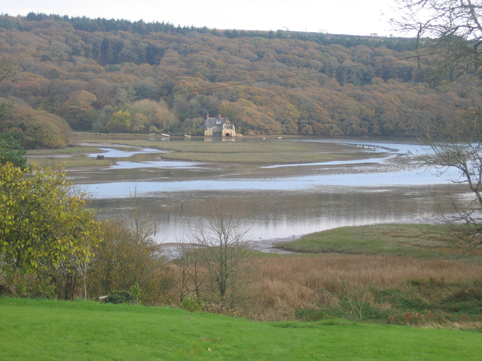
Photograph taken in the area of Efford House on the Flete Estate where Sense and Sensibility (1995) was filmed.

I also enjoyed the historic touches that you managed to weave into your plot. It is evident that you know the countryside well and that you are familiar with Regency customs. Tell me a little about your research. I know you have visited many of the places you describe.

Jane: Research is a favourite part of writing these books – I probably spend far too much time on it, and always end up with more than I need, but England at this time is so interesting. My book starts off in Devon and Dorset, counties I’ve known and enjoyed since I was a little girl. My father used to take cine films of us when we were little – I have film of me in Lyme when I am about seven, and I have very fond memories of holidays taken in the area. I had to include Lyme in the book for these associations and for those that Jane wrote about in Persuasion.

I also spent a lot of time wandering around London finding all the places where the characters spend the season, and deciding where Marianne and her Colonel might have their house. As you know, Vic, there is still so much to see of Georgian London!

Oh, yes! I envy your living so close to the places that I research and your proximity to London. You write, paint, oversee at least three blogs and a twitter account, and have a family. How do you find time for it all? I am curious how you still manage to paint, for I always found that to be the most time consuming of my talents and the easiest to drop when my schedule is hectic.

Jane: The truth is that I find it difficult to find time for it all, but I am an early riser, and get a lot done when everyone is still asleep. We always come together for meals in my family, that’s most important and, we spend time together in the evenings – sometimes we paint together. There are several artists in the family; I love it if we are all working round the table. My own painting has taken a back seat at present, but that’s more to do with the fact that writing has taken me over for the moment.

Jane Odiweefford1

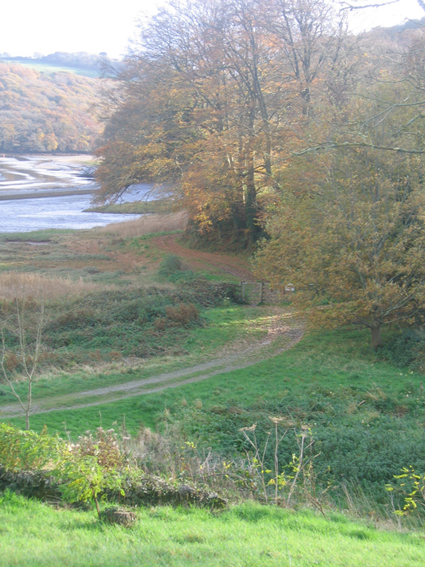
Holbeton is the nearest village to the Flete Estate in South Devon, an area rich in natural beauty.

Any other thoughts about your book that you would like to share with our readers?

Jane: One of the themes in the book concerns that of love, lost and found. Both the Colonel and Marianne have been in love before, and their relationship is a second attachment. I wonder what your readers think of second attachments – and have they ever encountered or suffered at the hands of a Mr Willoughby?

Thank you so much for this interview and for the photos you supplied. I can’t recommend ‘Willoughby’s Return’ highly enough to people who love to read Jane Austen sequels.

Jane: Thank you for inviting me to talk to you about my book and for a fantastic interview with such thought provoking questions!

Want to talk to Jane or Dominique? Join Twitter!

Find other interviews and reviews of Willoughby’s Return at these sites:

Sourcebooks is holding a blog tour for author Jane Odiwe on other blogs. The schedule is as follows:

Follow Jane Odiwe’s adventure as an author on her blog, Jane Austen Sequels. By the way, today is Jane Odiwe’s birthday: Happy Birthday, Jane!

Read Full Post »

happy birthday Jane AustenInquiring readers,

Your visits and loyalty will soon drive this blog’s bean counter over the million mark. My, oh, my! When I began blogging about Jane Austen in 2006, I only meant to provide information for my Jane Austen book group. Over three years later I have had the pleasure of meeting Jane lovers from around the world, and getting to know a few of you closely.

To celebrate, I will be giving away a box of Jane Austen sequels or Regency books (some of which I have reviewed, so they are technically considered “used”.) All you need to do is leave a comment on why you visit this blog and what your favorite topics are. I can only send the box of book to someone who lives in the Continental U.S. I will, however, send one book to anywhere in the world, so ALL are eligible to leave a comment.

Let the celebrations begin! And thank you for visiting. Contest ends the moment this blog’s counter hits a million, which I estimate will be two or three weeks. UPDATE: The Comment section is closed for the contest. The winner is Heather Carrol! Thank you ALL for participating and visiting this blog.

Read Full Post »

« Newer Posts - Older Posts »