Feeds:
Posts
Comments

Archive for the ‘Austenesque novels’ Category

From the desk of Shelley DeWees…An interview with Karen V. Wasylowski, author of Darcy and Fitzwilliam: A Tale of a Gentleman and an Officer

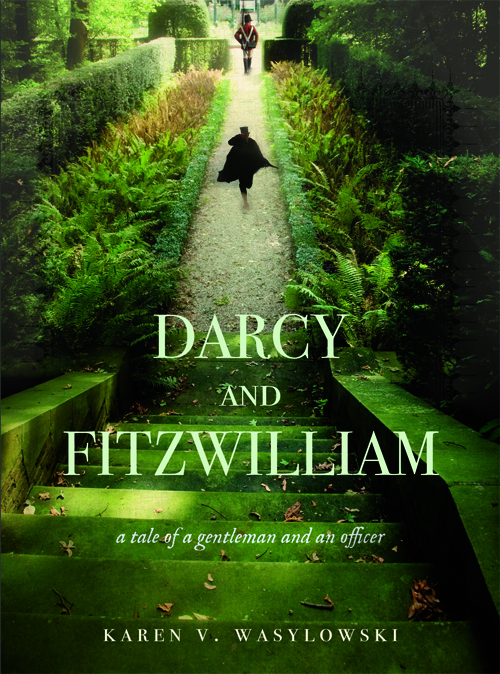
About the book: The first ever Jane Austen BROmance from debut author Karen V. Wasylowski, Darcy and Fitzwilliam: A Tale of a Gentleman and an Officer is a truly original look into the life of Mr. Darcy. Butch Cassidy has the Sundance Kid, Felix has Oscar. Darcy has…Fitzwilliam! Readers of Pride and Prejudice know that Darcy and Fitzwilliam are thick as thieves and each other’s most cherished counsel. But as strong as their bond is, the two are still polar opposites! Darcy is quiet and reserved, while the vivacious Colonel Fitzwilliam is a confirmed bachelor whose military feats have made him a hero. Cousins, best friends, and sparring partners, Darcy and Fitzwilliam have always been there for each other.

To read Shelley de Wees’s refreshing review of this debut novel, click on this link to Jane Austen Today.

1.The problems faced by the characters in Darcy and Fitzwilliam are not quaint trifles by any means. Rather than being consumed by dilemmas of fashion or gossip or health, they’re instead met with huge setbacks and major trials of spirit. They encounter serious issues of social expectations, the solutions of which require lots of thinking and personal toil. What inspired you to write this way, especially in a genre that’s usually overrun with fluffy worlds of happiness and harmony?

First of all, thank you so much for saying that because that was truly what I wanted, to portray these men as real people, not Darcy the perfect romance hero and Fitzwilliam the affable side kick, nor did I want the women to be just caricatures of femininity. Real life is a struggle, very often between men and women, and that is so much more interesting to me than ball gowns and Almacks. There is a saying that life is what happens while we are busy making other plans and that’s the truth. Love and family can bring ecstasy and make you crazy, and sometimes all at once.

2. I really admired the way Lady Catherine De Bourgh was portrayed. Witty and stubborn yet refreshingly aware of her surroundings, your representation of her was one of the more ambitious ones in Austenesque literature. What motivated you to develop her so fully?

I loved writing Lady Catherine. I could say outrageous things that made no sense. As head of the family she feels she has the right, no the obligation, to infuriate these two men and interfere in their lives because, in her eyes, they are still horrid boys. She means well, she really does, and she’s the voice of the older generation that never can quite come to terms with the younger one. In my head Judy Dench starred as Lady Catherine, looking outraged at Fitzwilliam’s filthy boots or explaining procreation to Lizzy. Judy Dench was brilliant in my head.

3. When you’re not writing or volunteering, how else do you spend your time? Do you have any other hobbies?

No, not really. We live in Florida and that’s a pretty laid back lifestyle. Eating out is a hobby here, sleeping late. I love writing but I’m not disciplined in the least and I don’t feel much confidence yet. At any moment I think I’ll never create another scene or another word and that is scary, but exhilarating.

4. Tell us about the process you engage in when you sit down to write. Do you need complete silence, or do you write in the bedroom while throwing wild parties in the livingroom? Do you stick to a schedule? Do you prefer to write barefoot? Any other weirdness you’d like to share for the sake of our fascination?

Most of the time I need silence; anything on the television in the family room will bother me and I sit at my desk and marvel at the amount of female screaming there is on television – very disturbing on many levels. Other times a car could backfire in the family room and I wouldn’t hear it. There is no rhyme or reason. I have no schedule at all, spend a great deal of time ‘getting ready’ which means I play computer chess, and solitaire, I check Facebook, answer e-mails, go into the chat rooms, read the fan fiction sites, see if anyone left a nice compliment for one of my stories there, etc. After about an hour of this I feel ready to start. And then the phone rings – I get angry, grumble that I’m being disturbed, and the whole process begins again. It’s amazing I finished a book at all.

5. Are you working on anything new? Any more beguiling tales of love and intrigue we should know about?

Well, to tell you the truth, I have two books started. One covers the time before Darcy and Fitzwilliam, centering on Lizzy and Darcy and how they coalesce into a single unit as it were. I imagine it was quite a process for him to really understand her family and for her to adjust to his status. Their differences were vast, and I don’t think we, two hundred years later, can truly appreciate how difficult their adjustment must have been. I also want to show the effects of the war on Fitzwilliam and how years of warfare had attacked his spirit, causing his slide into the sort of debauched lifestyle he was living at the beginning of Darcy and Fitzwilliam.

The second book then is the period after Darcy and Fitzwilliam. It involves their children and all the blessings and madness that go with parenthood and getting older. Only heaven knows if either book will see the light of day but it is fun to be with my boys again. I told my husband, “You know it’s like I know what goes on in their heads.” He looked at me like I was crazy and said, “Karen, you are their heads.” I had forgotten. They are that real to me.

6. Finally, is there anything else you’d like to say?

I’d like to thank Deb Werksman and Sourcebooks Landmark for publishing Darcy and Fitzwilliam. No agent would even consider me – I wasn’t a famous name, nor a celebrity. So, I defied all logic and sent my manuscript directly into the publisher who gave me my chance. It proves that if you really love what you are doing and if you have faith in it, anything is possible. Never give up.

Karen Wasylowski

About the author Karen V. Wasylowski: Karen is a retired accountant and CPA. This is her first novel. She and her husband spend much of their free time volunteering with charitable organizations in their community. Karen and her husband live in Bradenton, Florida.

About the interviewer Shelley de Wees: This is Shelley de Wees’s first interview for this blog. She has written five reviews for me – three for Jane Austen’s World and two for my other blog, Jane Austen Today. Shelley also oversees her own blog, The Uprising, which features vegan recipes. Yum. She lives in the northern U.S. I shiver just thinking about the cold at this time of year.
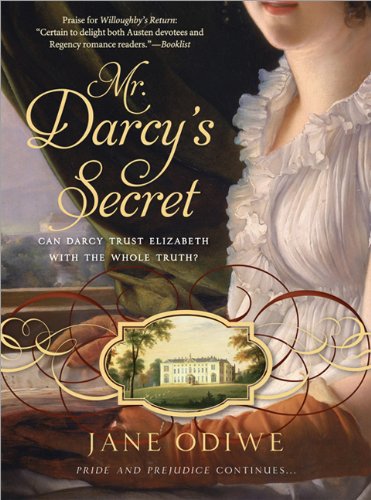
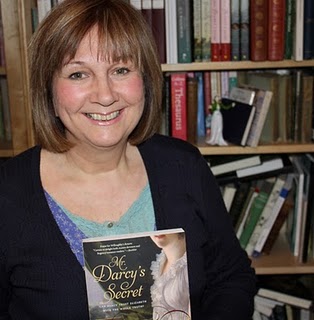
Image of the author taken from My Jane Austen Book Club.

Read Full Post »

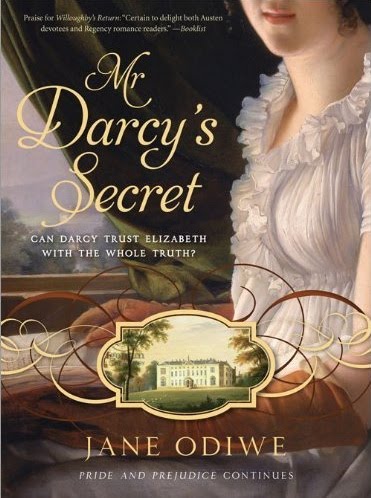
Mr. Darcy’s Secret is Jane Odiwe’s third Jane Austen sequel for Sourcebooks. The story picks up after the Darcys’ marriage and Elizabeth’s introduction as Lady of the Manor. Lizzy is a quick study, for it is not easy for someone to pick up on all the intricacies of managing such a great house as Pemberley, but through her natural grace she quickly gains the respect of the staff and villagers and settles into her new home – where she uncovers a secret, one that places her relationship with Darcy in emotional jeopardy.

The delightful author Jane Odiwe has done it again – created a novel using Jane Austen’s characters that leaves you turning the pages to find out how the story will end. Jane Odiwe lives in Bath and London, and travels extensively all over England. This is obvious, as she is able to single out details as only someone who is intimately acquainted with the regions can. She has also researched Jane Austen and the Regency era for many years, so that the facts ring true and are sometimes surprising, as with the ability for people during that era to marry without posting the banns in one church in Derbyshire, a legacy from the days of King Charles 1.

In so many ways, Ms. Odiwe gets the characters right, which makes reading her books so enjoyable. Take Lady Catherine de Bourgh, for instance:

Lady Catherine de Bourgh looked Mrs Darcy up and donw with such an expression of horror and contempt it was all Lizzy could do to keep her nerve. “Does your husband know that you are running around the countryside dressed as a gypsy riding in a donkey cart, Miss Bennet?” she asked in scolding tones. “What on earth can you mean by disgracing Mr Darcy in such a fashion? Have you no idea of decorum, are you insensible to the honours bestowed on you by him, that fool of a nephew of mine who has singled you out above all other women to bear his name?”

Wickham remains his dastardly self; Lydia is still immature and silly. We learn more about Darcy’s sister, Georgiana, and how she is influenced by Lizzy, with whom she falls in love, and about her backstory with her governess, a most nasty creature named Mrs Younge. Miss Caroline Bingley provides comic relief in a funny story line, as does the ever reliably silly Mrs Bennet. In short, devotees of Jane Austen sequels will not be disappointed with Jane Odiwe’s latest venture in Austen territory. Reading Mr Darcy’s Secret prompted me to ask the author a few questions, and she graciously answered them.

1. Why did you wait until your third book to write about Darcy and Elizabeth?

For me, it was just a natural progression. Initially, I hadn’t wanted to write their story because I really wanted to do something different from the books that were being published. But, after writing Lydia Bennet’s Story, and Willoughby’s Return, I wanted to set myself a real challenge. I felt absolutely compelled to write Darcy and Elizabeth’s story, and also wanted to give Georgiana a happy ending. I’m a great believer in letting things happen organically, and perhaps I wasn’t really ready to write their story until now. I wanted to do justice to the characters, and have the kind of twisting plot with humour, surprises and shocks along the way that Jane Austen liked to write herself, which I hope I’ve achieved.

2. Does living in England give you a different perspective on how Jane Austen’s environment influenced her work?  If so, how does this knowledge affect your own writing about her characters?

Perhaps it does, but if so, I think it is an unconscious perspective. This country is the place of my birth; I am English, and the feelings of connection to its people, landscape and history are very strong. It’s a part of who I am. I was a teacher, and consider myself very lucky and fortunate to have had the joy of teaching pupils from every walk of life, which means I have witnessed the behaviour and customs of a vast cross-section of society from the very poor to the very rich. I’m just an ordinary person, but I have been able to witness first-hand what it’s like to attend high society balls (a long time ago now) and enjoy 20th/21st century equivalents of the kind of experiences that Jane Austen would have done. Rather like Jane too, feeling apart from that world, not really belonging, made the observation of it all the more fun. I’ve seen a world of privilege, I’ve seen the extreme opposite, and everything in between. I think all of life’s experiences and the knowledge gained help to inform your writing, but whether this means that I am successful in writing about Jane’s characters, I will leave my readers to decide.

3. For you, which comes first? The plot or the characters? How long does it take for you to outline your book before you start writing, or do you just dive in and plot as you go along?

Now that is a tricky one, but I think it’s been different for every book. I generally think about what I’m going to write for a long time, several months usually,  before I commit any thoughts to paper, though occasionally I might jot down a few initial ideas or key words. I think the idea for Mr Darcy’s Secret was really started by thinking about what we knew about Mr Darcy, or rather, what Elizabeth did not know. It occurred to me that she really didn’t know him very well at all. Jane Austen gives us no clues about his past, and so that set me thinking.
I used to meticulously write out the plot from start to finish before I commenced writing, but I’ve discovered that for me it doesn’t really work because the characters always do their best to take me away from what I’ve originally planned. So now I have a general idea of where I want to story to go, and have an idea of the ending, but the journey is always an adventure! The characters always want to tell their own story, and I let them.

4. What research  for your book surprised you the most? Did you leave out any material that you found fascinating but couldn’t use? If so, please give an example and tell us why you decided not to use this bit of information.

The research that surprised me most was the fact there was a Gretna Green of Derbyshire. In the village of Peak Forest its church is dedicated to ‘Charles, King & Martyr’ (King Charles 1) and until an Act of Parliament was passed in 1804 its minister was able to perform marriages without having the banns read.

I really enjoyed all the research into Derbyshire which I’ve visited many times from school trips as a child to spending holidays with my sister.
There is a lovely tradition of ‘well-dressing’ which I would have liked to include, but I couldn’t fit it into the timeline or plot – unlike Jane, I decided we’d spend more time in the Lake District.

I remember as a child being disappointed not to see any of the villages we passed in Derbyshire decorated with flowers. The pagan custom started many years ago with blessing the water supply, and there is a history of making clay plaques pressed with flower petals to ornament the wells, which they still carry on today. I would have liked to have included a lot more of the folklore in the book. The area is well known for its stone circles, petrified rocks, witches and ghosts! Maybe next time…

5. Have you plotted your next novel?

I have written another novel, but I’m still tinkering with it…not quite there yet. It’s not a sequel, and it’s a bit off the wall, but I’ve really enjoyed writing it. It’s inspired by Bath, Jane Austen and Persuasion, my great passions after my family.

Oooh, you have me intrigued already! As always, Jane, it is a pleasure talking with you. I wish you much success with this book and the next, and thank you for stopping by .

Read my reviews of Jane Odiwe’s other books and interviews with the author in the following links:

Read Full Post »

Scheduled for this week are:

  • A review of Mr. Darcy’s Secret and interview with author Jane Odiwe on February 7th
  • A post by Tony Grant about the highwayman, Jerry Abershawe
  • And an interview with Darcy and Fitzwilliam author Karen V. Wasylowski on February 10th.

Stay tuned for more!

Read Full Post »

A review of Jane Goes Batty from the desk of Shelley DeWees …

Jane Austen as a protagonist might be one of the most likeable characters in literature.  She’s thoughtful, friendly, and devoted to her art, all of which are qualities you’d probably expect in the real Jane (were you lucky enough to know her).  She’s full of admirable characteristics, yes…accept that one little tiny baby hiccup of a problem…

She wants to suck your blood.

Now, she may not want to kill you unless you piss her off, or happen to be the annoying mother of a guy she’s considering a future with.  She may only want to taste you because, well, she must.  She’s got that little problem.  Not many people know about it, and those her do are among her most trusted confidantes: a lovely friend called Lucy who runs her bookshop in upstate New York and her best buddy Lord Byron, who happens to be a vampire as well.  He provides support, instruction in the ways of vampire art (how to become invisible, how to spot attraction between other people, how to create more undead chums), and is in general a source of inspiration for poor Jane who’s struggling to find meaning in a never-ending life.

The story finds her with a new hit novel, but she knows her old ones are better.  She’s getting lots of money from the new book, but not near as much as she’d be getting if she collected royalties on the others.  She’s happy with her boyfriend Walter, but can never marry him since he doesn’t know about her little problem.  She’s up.  She’s down.  She’s back.  She’s forth.  Jane is getting pulled around by all kinds of forces, many of which are entirely out of her control.  Such is life, Jane.  Such is life.

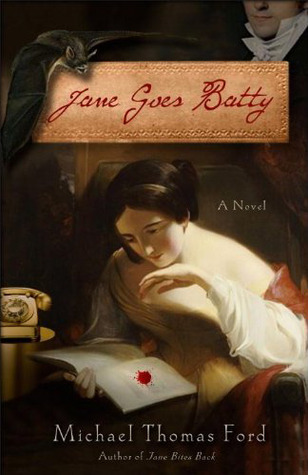
And such is the way of Jane Goes Batty, the second installment of a trilogy of novels by Michael Thomas Ford.  It’s a modern take on the life on Jane Austen, complete with her struggle to find a publisher and her wish to drink as much wine as she wants (as she said, being unmarried allows her to do just that).  The book is fun and inspiring in some senses, and probably worth your time if you’re looking for a bit of a romp through an alternate reality or simply trying to re-awaken your internal Janeite.  The book flows well and thrives on skillful construction, but seems to be saturated with an overabundance of problems.  Poor Jane the Undead has a veritable laundry list of troubles to slog through, not the least of which being an overdue sequel to her bestseller, an intolerable mother-in-law who insists she convert to Judaism, a new editor, an invasive camera crew, and the threat of a visit from another gloomy friend.  What’s a girl to do?

Jane Goes Batty is fun but simple, composed by a seasoned author whose interests are as diverse as the subject matter of his books.  Michael Thomas Ford spins a fairly interesting tale, and even though it’s nothing to write home about, you certainly won’t hate it!  Give it a shot, even if you haven’t read the first portion of the series, and see if you can lose yourself in Jane-love again.

Gentle Readers, this is Shelley de Wees’s fourth review for me and the third for Jane Austen’s World. (She has also reviewed for my other blog, Jane Austen Today.) Shelley also oversees her own blog, The Uprising, which features vegan recipes. Yum. She lives in the northern U.S. I shiver just thinking about the cold.

Read Full Post »

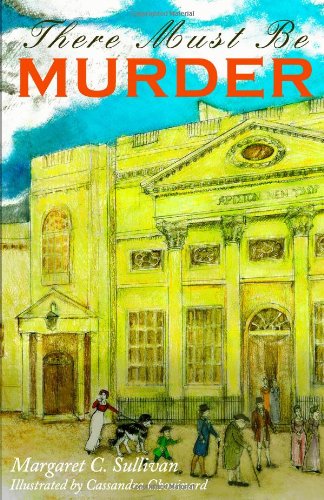
There Must Be Murder, a very nice story by Margaret C. Sullivan,

It is one year after Catherine has married her Henry. She still is sweet and naïve, but she now possesses the womanly knowledge that every bride with an adoring husband soon comes to know. Henry Tilney is as charming as ever and clearly loves his pretty Cat. The couple, only one year married, live in Woodston Parish with a cat named Ruby Begonia and an assortment of dogs, including a Newfoundland named MacGuffin. Catherine has redecorated the pretty parsonage, and the couple has a habit of cozying up together as Henry reads passages from The Mysteries of Udolpho. During one such occasion, Catherine fondly recalls her introduction to Henry in Bath by the Master of Ceremonies, Mr. King, and in no time Henry has arranged for a visit to that ancient city.

“Henry, you know perfectly well that I keep no journal. Besides, I did not know then that you were my future husband.”

“Some husbands would be injured at such an admission, but not I; after all, I did not know that you were my future wife. I remember that I was wandering about the Rooms like a lost soul, having no acquaintance there. The master of ceremonies, Mr. King, took pity upon me and asked if I would like an introduction to a clergyman’s daughter who was in need of a partner. In Christian charity, I could not decline; though from my past experiences of ladies described as ‘clergymen’s daughters,’ I expected to be presented to an elderly spinster with a squint. You may imagine my relief when Miss Morland turned out to be rather a pretty girl, and I considered myself fortunate that no other gentleman had already claimed the honour of dancing with her.”

Catherine’s eyes were shining. “You thought me pretty?”

“Indeed.” Henry reached for her hand and kissed it.

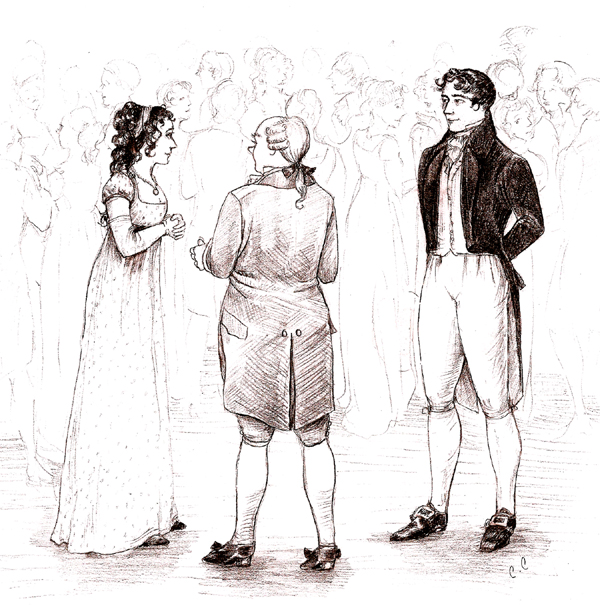
Margaret C. Sullivan, the author of this charming tale, deftly combines old characters (General Tilney and Henry’s sister, Eleanor) with the new – an apothecary named Mr. Shaw, a pretty but calculating woman named Judith Beauclerk, her mother, Lady Beauclerk, and Sir Philip, to name a few. Ms. Sullivan takes us on a sweet journey over familiar territory, paying homage to Jane’s characters while staying true to her own writing style. The book is illustrated with pen and ink drawings by Casandra Chouinard, which certainly enhance one’s enjoyment of the novella.

Catherine, Mr. King, and Henry Tilney. Image @There Must Be Murder

Fans of Jane Austen will recognize Margaret as the editrix of Austenblog, the longest surviving Jane Austen blog on the blogosphere, and as one whose knowledge of Jane and the Regency period is that of an expert. And thus the details set down in this tale are accurate and true to the time, including the use of arsenic in beauty potions. Margaret’s humor also shines through, and I found myself turning page after page until I had finished the story in one sitting.

Here’s her bio, with an example of her humor: Margaret C. Sullivan is the author of numerous Jane Austen sequels and editrix of AustenBlog. Her first book, The Jane Austen Handbook: A Sensible yet Elegant Guide to Her World, will be in bookstores this spring. She likes to think that Henry Tilney would dance with her at the Lower Rooms, although she is an almost-middle-aged spinster with a squint.

If you are intrigued by my short review, you may purchase the book in several ways. Girlebooks, an excellent source of free Ebooks, now offers original eBooks that have never been published, such as There Must be Murder. You have a choice of several platforms in which to download the book or purchase a printed copy. It is available for $9.99 at Amazon paperback and for free at Smashwords at this link .

The novella was first commissioned by the Jane Austen Centre, and you may read the book chapter by chapter in this link.

Enjoy! I certainly did.

Book Giveaway (Closed – congratulations to winner, Cecilia): If you leave a comment, you have a chance to win my hard copy of the book with all its charming illustrations. The drawing (by random number) will be held on February 5th.

Read Full Post »

« Newer Posts - Older Posts »