Feeds:
Posts
Comments

Archive for the ‘Author interview’ Category

Reviewed by Brenda S. Cox

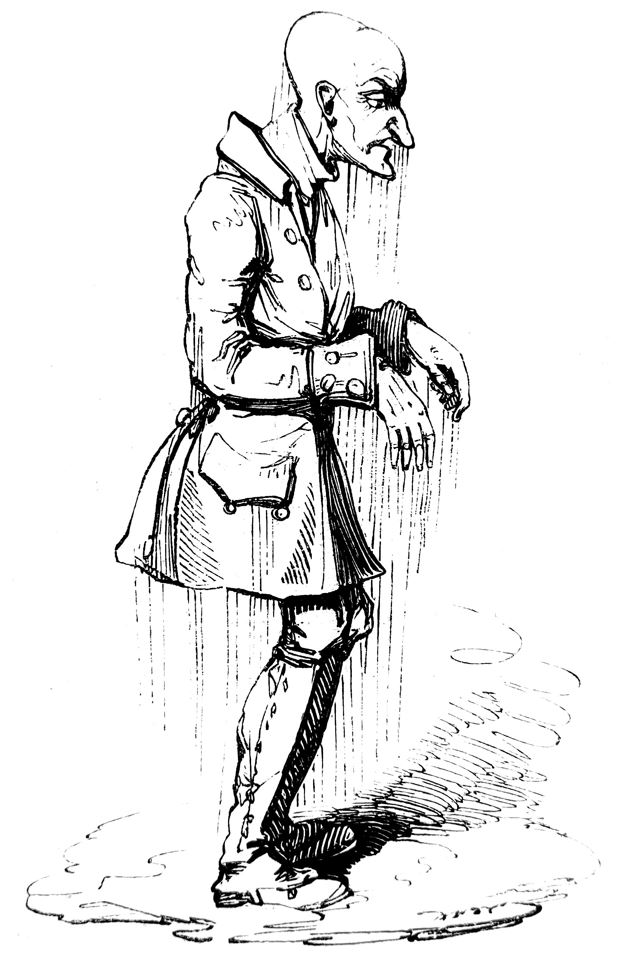
“I have seen nobody in London yet with such a long chin as Dr Syntax” (Jane Austen, March 2, 1814).

I just finished reading, cover to cover, a brand-new book which is over 200 years old. The Tour of Doctor Syntax in Search of the Picturesque, by William Combe, is a classic which Jane Austen herself enjoyed. But it’s out in a new edition, with wonderful illustrations, explanations, and comments.

A fun new annotated version of The Tour of Doctor Syntax, including parallels with Jane Austen’s novels!

The story in verse was first published from 1809-1811 as a series in Ackermann’s Poetical Magazine. Ackermann had a series of prints by the great caricaturist Thomas Rowlandson. They featured a country clergyman with a long pointed chin and a tall white wig traveling through the countryside. Ackermann gave Combe the illustrations for each issue of the magazine, and Combe wrote a section of the story to go with them. He didn’t know ahead of time what the pictures would be for the next issue, but somehow he came up with a coherent story. One interesting facet is that Rowlandson apparently intended to satirize the clergy, but Combe made Syntax into a good, learned man, a little silly, but lovable.

A book version came out in 1812. Dr. Syntax was wildly popular and stayed in print, with multiple printings and editions, well into the 1800s.

This new version of The Tour of Doctor Syntax was edited and annotated by an advanced high school class and their professor, Dr. Ben Wiebracht. Ben actually discovered Dr. Syntax through one of my posts right here at Jane Austen’s World. Recognizing its potential for his class on “Jane Austen and Her World,” he asked Vic Sanborn, owner and primary writer of this website, and myself, to share with his class. Vic owns some lovely Rowlandson prints. We both loved connecting with such bright and interested students, who asked knowledgeable questions.

The Book

They’ve done a brilliant job with the book. It starts with a biography of William Combe and the history of the book itself. Combe’s challenges as a writer in Austen’s age were fascinating to me, as a writer myself. A clear introduction explains “the picturesque,” which is mentioned in Austen’s novels. Parallel to the text are straightforward explanations of difficult terms and phrases. That makes them easy to quickly reference. A glossary in the back gives terms previously defined.

The best part, for me, are comments pointing out parallels with Jane Austen’s work. I can’t even begin to list these, but there are many great insights. Some are about the clergy in Austen’s work, since Syntax is an underpaid country curate like Charles Hayter of Persuasion. Many comments have to do with the “picturesque,” “improvement” and country estates ranging from Sotherton to Pemberley. Others relate to the class system, Gothic novels, and other topics.
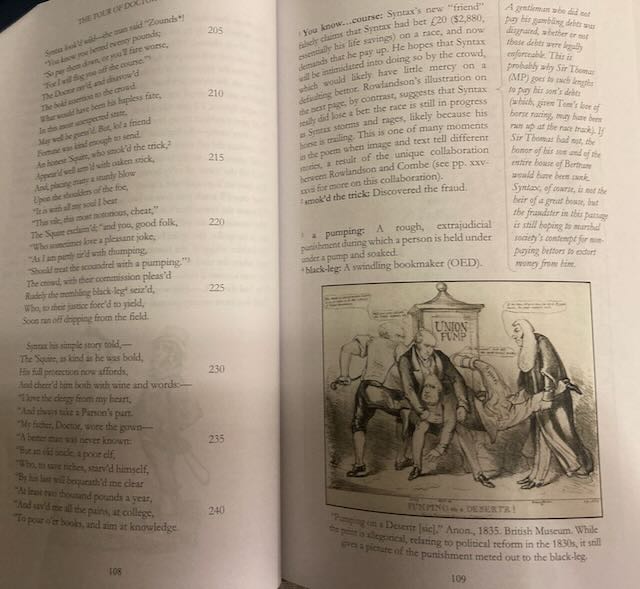
The full text of the poem/story is opposite explanations, comments, and illustrations, making them easy to access. The Tour of Doctor Syntax, 2024.
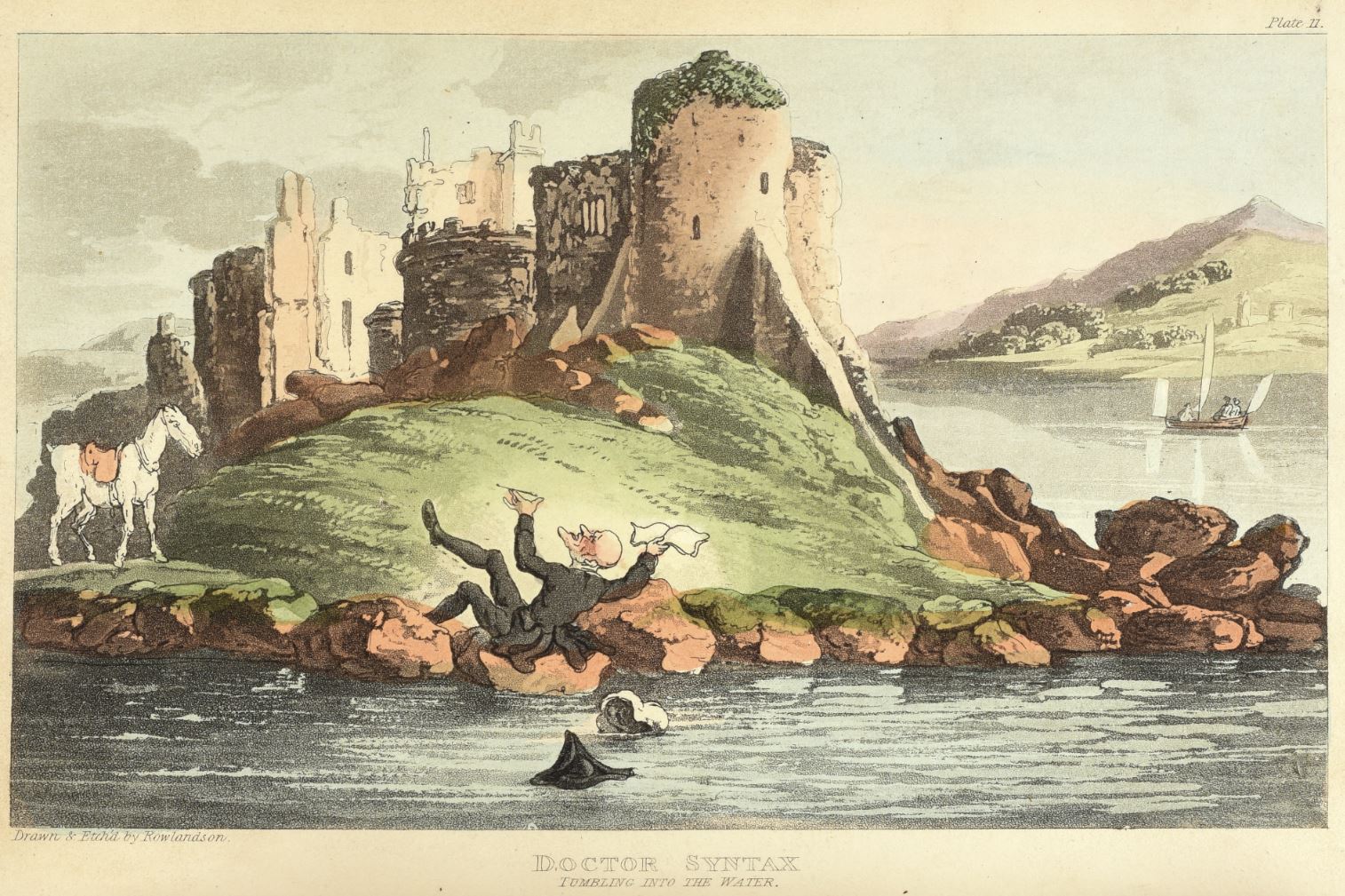
“Doctor Syntax Tumbling into the Lake,” by Thomas Rowlandson. One of the lovely full-page illustrations for this new version of The Tour of Doctor Syntax.
Victorian illustration, 1838, of the same scene, by Alfred Crowquill. The Tour of Doctor Syntax includes both the Rowlandson and Crowquill illustrations.

I also loved the illustrations. The editors chose the best versions they could find of each of the full-page, hand-colored pictures by Rowlandson that were the basis of the book. They added illustrations from a later Victorian version, as well as other entertaining and illuminating cartoons and pictures from the time.

Interview with the Editor

I’ll let Dr. Wiebracht himself tell you more about how this book came about.

Ben, please tell me about your class that produced this book.

The class is called “Jane Austen and Her World” and it’s designed for advanced juniors and seniors. The goal is to see Austen’s novels not as sealed-off masterpieces, floating in a historical vacuum, but as windows into her world. Most class days, our Austen reading is accompanied by shorter texts designed to create a sense of context and show how Austen was in conversation with her contemporaries. For instance:

  • We pair Austen’s account of Bath in Northanger Abbey with a number of late 18th-c. satires of Bath, 18th-c. dance music, and illustrations of the city by Rowlandson and others.
  • We pair Catherine’s pseudo-Gothic adventures in Vol. II with excerpts from The Monk, The Castle of Otranto, and The Mysteries of Udolpho.
  • We pair the private theatricals in Mansfield Park with a viewing of a performance of Lover’s Vows, as well as specimens of anti-theatrical criticism from the period, including a satire on private theatricals by Jane’s brothers!
  • We pair the discussion of landscape gardening in Mansfield Park with images from Humphry Repton’s famous “red books” showing “before and after” estate grounds.

The idea is to understand Austen in a deeper way by developing the practice of “reading outward.” And we incorporate that principle in our work for the class. Instead of the usual school essays, students work with me to create a critical edition of a neglected text from Austen’s time, with annotations and other resources that draw connections between the text and Austen’s life and work.

The class enrolled 16 students (the maximum). They hailed from all over the country and world: Japan, China, and many different U.S. states. This was my first time teaching the course, though I developed the core ideas in an Austen unit for a previous course. In the future, I will probably teach the course every three years. The book project in particular is a heavy lift, and I’m not capable of it every year!           

How did you end up studying Dr. Syntax along with Jane Austen?

I have to back up a bit here. In the course of an Austen unit for a previous class, students and I had created a critical edition of a long-forgotten 1795 poem called Bath: An Adumbration in Rhyme. We used that book to launch a new series called “Forgotten Contemporaries of Jane Austen.” Its goals are:

  • to recover neglected but valuable texts from Austen’s time, and
  • to trace new connections between Austen and her contemporaries.

As I was preparing my Austen class, I settled on Doctor Syntax (first brought to my attention in JAW by one of your articles!) for three reasons.

  • First, the poem had undeniable literary-historical importance – one of the all-out bestsellers of the Regency. A critical edition, I thought, was long overdue.
  • Second, many of its themes – from the plight of poor clergy to the “picturesque” – were major concerns of Austen’s novels, too.
  • Finally, the poem was simply a really good read. Combe’s verses are light, fun, and at times even touching, and Rowlandson’s accompanying illustrations are some of his best work. In every way, the poem deserved to be revived!

What do you hope readers will gain from the book?

There are a lot of things I hope people take away! One would be a deeper appreciation of just how engaged Austen was in the debates and issues of her day. Sometimes Austen is talked about as something of a provincial writer, sealed off from the wider Regency world, modestly toiling away on her “pictures of domestic life in country villages,” as she once put it. But when we keep in mind just how much of a smash hit Doctor Syntax was, and when we consider the many, many parallels between this work and Austen’s novels, which our edition lays out in detail, then we see Austen differently. She now starts looking like a very savvy writer, who understood what the major issues of the day were, what readers were interested in. To be sure, she stuck to her convictions and drew on her own experience and observations, but she did so in a way designed to appeal to a broad, national readership.

I’m also excited for people to meet this poet William Combe, who had one of the most interesting lives of any Regency writer. He was a remarkable literary talent. He doesn’t fit the mold of the “Romantic poet,” which is one reason he might be overlooked. Instead he offers a light, generous humor that shows us that Regency poetry wasn’t all about Byronic heroes and Wordsworthian dreamers. There was a sociable, comic side to the poetry of the period. Combe represents that comic side particularly well.

Finally, I would love it if this book inspired other teacher-scholars to undertake collaborative research with their students – especially at the upper-high-school level. There are so many benefits. For students, it’s a more rewarding and enjoyable approach to literary scholarship than the usual school essays. For teachers, it’s a welcome relief from the role of “judge/grader” – instead you get to teach through co-creation, as is done in most trades through the apprenticeship model. And for the reading public, there’s the benefit of the work produced! I am convinced that student involvement, with the right guidance and leadership from the teacher, leads to better scholarship. It certainly has in my experience.

By the way, while we don’t offer a Kindle edition, we do offer a free etext in the form of a downloadable PDF on our website. We decided from the beginning to be an open-access publisher, in part to make it easier for teachers with low-income students to assign our books. The best way to use the e-text is to enable the 2-page view in your pdf reader – that way the text and notes are neatly parallel, as in the physical book. The etext can also be used as a supplement to the physical book – for instance if you want to do a text search for a particular word.

How did you and the students share the work on this project?

Each student was responsible to annotate one of the poem’s 26 cantos, about ten pages of text. I did the other ten cantos myself. Students also had one or more additional responsibilities, which included:

  • Researching aspects of Combe’s life
  • Researching Gilpin and the picturesque
  • Compiling chronologies
  • Drawing maps
  • Designing the cover
  • Editing the text according to scholarly standards

My job was twofold. First, I offered regular feedback on work in progress, helping students learn how to navigate library databases, write good, concise annotations, etc. I also did the parts of the book that were a bit beyond the reach of high-school students, even excellent ones, which all the students who worked on this book were! For example, I wrote most of the introductory materials, as well as some of the trickier annotations. I helped with the final prose, too, to ensure continuity of voice. That doesn’t mean, though, that the best stuff is mine. Many of the best, most insightful annotations in the book are entirely by students, and every one of my students has some of their own writing, their own voice in the final book – which was a major priority for me. And just as students benefited from my feedback, I benefitted from theirs. They fully earned their editor credits in the final book.

Final Thoughts

Dr. Wiebracht and his class did an amazing job. I highly recommend this book, which is available on Amazon and from Jane Austen Books at a discount. I have not yet read the earlier book in the series, Bath: An Adumbration in Rhyme, but now I want to get hold of that and read it, too!

If you’re at the JASNA AGM this month, you can hear Ben and some of his students speak, and get them to sign your copy of the book. (Unfortunately I’m speaking in a slot opposite theirs, as well as other excellent speakers at that time, so you’ll have to choose! It’s always challenging.) Their talk is also available in the virtual version of the AGM.

The price is very reasonable for a book with color illustrations. I hope you’ll get a chance to enjoy and learn from this lovely book!

Read Full Post »

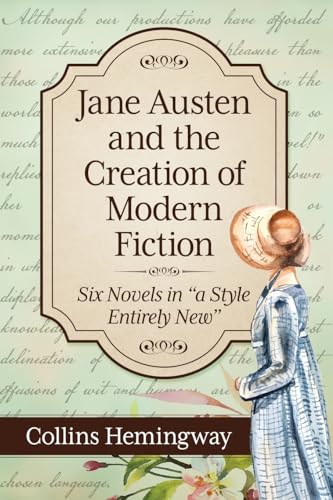
Jane Austen and the Creation of Modern Fiction: Six Novels in “a Style Entirely New,” explores Jane Austen’s development as a fiction writer.

by Brenda S. Cox

A few days ago I reviewed Collins Hemingway’s fascinating new book on the development of Austen’s writing techniques, Jane Austen and the Creation of Modern Fiction: Six Novels in “a Style Entirely New.”  Today we meet with the author to get his perspectives on the book.

Collins Hemingway began his analysis of Jane Austen’s writing techniques as he wrote a fiction trilogy speculating on the “lost years” of Austen’s life, The Marriage of Miss Jane Austen.

I asked Collins Hemingway to tell us more about Jane Austen and the Creation of Modern Fiction.

JAW: What led you to write this book, Collins?

Collins: I’ve read Austen all my life, but I did not read much commentary during my 25-year high-tech career. When I came back to Austen fulltime, I read a ton of Austen scholarship from the last 20 years. I noticed that there wasn’t much about her writing, as writing. Scholars would mention a technique and use it as a launch point for broader criticism. With rare exceptions, they would not analyze the technique itself or how it affected the reader. I saw this as an area in which I could add something new.

JAW: You have, of course, written a fiction series, The Marriage of Miss Jane Austen. How did your experiences writing fiction about Austen feed into your development of Jane Austen and the Creation of Modern Fiction?

Collins: Writing the novels led directly to this book, though it took several years of hard reading, notetaking, and writing to flesh out the meat over the bones. I have shared that story on my blog.

JAW: The book is full of great insights. For you, what was one of the most helpful, something that helped you see Austen’s novels in a new way?

Collins: After completing the fiction trilogy, I went a step further, going through each of Austen’s six novels line by line, noting everything of interest to a writer. I ended up with 20 to 30 pages of handwritten notes on each one. Then I began to consolidate various topics. For instance, I ended up with five pages of notes just on description, collated from all her books, including the juvenilia. Then I examined the patterns in different aspects of writing and tried to understand how the patterns fit within and between each book.

As the patterns began to organize themselves, I realized that there was a distinct trend from early to late. In each book, Austen learned something, then applied it in the succeeding books. Like Virginia Woolf examining the early works and the unfinished works, I began to see the internal structures of each book. (As my wife would caution—in my opinion.) I could see how Austen was feeling her way along in the early works, then painting like a master in the later ones.

JAW: You’ve pointed out the strengths and weaknesses of each of Austen’s novels. It appears that you see Emma as the most “perfect” novel, as other commentators do. But for you personally, which novel do you tend to enjoy re-reading the most, and why?

Collins: Depends on my mood. P&P for its sheer energy, and for Liz bowing to no one, ever. Emma for its magnificence, page by page. Persuasion for the depth of Anne’s feeling. MP, though it is in no way my favorite, when I just want to admire the structural purity and the work she put into it.

JAW: You talk about many techniques of modern fiction that Jane Austen helped to develop and show how they developed in her novels over time. Could you briefly list for us some of those techniques, so readers can see some of the treats they have in store?

Collins: She was a master of dialogue probably from the day she first picked up a quill pen. Description. Behavior. Character motivation and interaction. Complex plots (without castles, brigands, or shipwrecks.) Ever deeper and subtler ways to get into her characters’ minds.

JAW: What is one takeaway that you want readers to have when they finish reading your book?

Collins: What Austen accomplished would make any author proud. But the fact that she learned all that she did on her own, away from other writers, pulling the best from a small number of others (such as Richardson, in a very specific way), building on a few good things from tradition, figuring out the rest on her own—it’s astonishing. And she did it in her too short 41.5 years of life!

JAW: What was the most fun part of the book to write?

Collins: My breakthrough in really understanding the internals came through descriptions. They unlocked the issues in NA and S&S, showed how radically different P&P was from the earlier two, and became miraculously mature in MP. This was the most fun. Especially when I realized the difference in the way Austen treated Lady Russell and Anne as they entered Bath in Persuasion. It took my breath away to see what Austen had done.


You may want to read my review if you missed it earlier. This is a fascinating book if you want to better understand Jane Austen’s modern writing techniques and how she developed them herself. Jane Austen and the Creation of Modern Fiction is available from Amazon and from Jane Austen Books. Jane Austen Books is currently offering it at a substantial discount.


Brenda S. Cox is the author of Fashionable Goodness: Christianity in Jane Austen’s England. She also blogs at Faith, Science, Joy, and Jane Austen.

Read Full Post »

Austen Chat, from the Jane Austen Society of North America, brings you entertaining and informative discussions on Jane Austen each month.

A Review by Brenda S. Cox

The idea suddenly came to Mrs. Breckyn Wood that JASNA needed a podcast. Breckyn says,

“My main goal is to attract a whole new generation of JASNA members–younger Jane Austen fans who maybe have read a book or two or seen one of the adaptations, but who didn’t know there was a whole organization dedicated to Austen. I had already been to a few meetings of my local Georgia Region and was blown away by the talent and intelligence of its members, so I knew JASNA would have a huge pool of potential podcast guests from which to draw.”

Being a young lady of ingenuity and determination, she came up with a plan and presented it to the leaders of JASNA, who gave their complete support for Austen Chat. This delightful podcast began in July, 2023, with new episodes released on the first Thursday of each month. As the Austen Chat website says:

“JASNA’s mission is at the heart of Austen Chat—to further the study, appreciation, and understanding of Jane Austen’s works, life, and genius. There is always more to learn and enjoy about Jane, and we invite you to join us for the ride! Each month we talk with scholars, authors, and subject experts on a wide variety of Austen-related topics. We think you’ll have fun and learn something new from every episode—whether you are a lifelong reader, an Austen newbie, a seasoned Austen scholar, or somewhere in between. Tune in each month to enjoy the company of clever, well-informed guests, who have a great deal of conversation!”

I have listened to the first nine episodes (through March 7, 2024) and loved them all. I learned new things from each expert, despite my years of studying Austen.

In each instalment, Breckyn interviews someone in the Austen world about their specialty. Then we have news for the JASNA community about upcoming events and resources. Finally, a Janeite shares one of his or her favorite quotes from Austen, and tells why they love it. So be sure to listen all the way to the end!

Here’s what we’ve gotten to enjoy so far:

Episode 1, Jane Austen & Her House: A Visit with Lizzie Dunford, brings us right to the Jane Austen House in Chawton. We learn about its background, the changes that have been going on, and the treasures on display in this Mecca for Janeites. 

Episode 2, Jane Austen & Goodness: A Visit with Brenda Cox, is my own discussion with Breckyn about how Austen’s faith and the Church of England are reflected in Austen’s novels, including some hidden “faith words” used with religious meanings, women church leaders of Austen’s time, and the differences between rectors, vicars, and curates. 

Episode 3, Jane Austen & Her Wardrobe: A Visit with Hilary Davidson, is a fun discussion of the clothes Jane Austen is known to have worn. I learned that Austen kept up with the latest fashions. Davidson tells us that in general it was easy to find relevant pictures of the types of clothing Austen mentioned in her letters, since they were what was popularly worn in those years. 

Episode 4, Jane Austen & Her Endings: A Visit with Inger Brodey, gives some surprising insights into the endings of Austen’s books. She talks about whether the novels end happily or not, the different kinds of happiness, and how Austen’s endings were unusual for her time. 

Episode 5, Jane Austen & Divorce: A Visit with James Nagle, tells us some suprising facts about ways people got divorced or separated in Austen’s time, including the practice of selling wives, which he says was often to the wife’s lover. 

Episode 6, Jane Austen & Mr. Wickham, A Visit with Adrian Lukis, explores Lukis’s experiences in portraying Wickham in the 1995 Pride and Prejudice movie, then what led him to write his current hit, Being Mr. Wickham, and his thoughts on Lydia and Wickham’s later lives. 

Episode 7, Jane Austen & Dido Belle, A Visit with Renata Dennis, gives us some insights from the head of JASNA’s Diversity Committee about mixed-race Dido Belle, her life, family, and connections with Jane Austen and Sanditon

Episode 8, Jane Austen & Food: A Visit with Julienne Gehrer, discusses Martha Lloyd, the friend who lived with Jane, Cassandra, and Mrs. Austen, and her Commonplace Book and recipes. 

Episode 9, Jane Austen & Her Genius: A Visit with Juliet McMaster, explores some facets of Austen’s brilliance in each of the novels and the Juvenilia. For example, McMaster compares Henry Tilney to Henry Higgins; both taught the heroine a new “language.” And she considers which heroes learned from the heroines, as well as which heroine learned from the hero. Juliet McMaster, a founding member of JASNA and “grande dame of Austen scholarship,” also talks about the early days of JASNA.

This is a great array of topics, all of which I enjoyed. I don’t know what’s coming next, but I’m sure it will be fun!

Episodes begin with a “desert island” question for the interviewee. Either:

If you were stranded on a desert island and could only have one Austen book, which one would it be?   Or,

If you were stranded on a desert island and could have one penpal from among Austen’s characters, who would it be?

Gentle reader, what is your answer?  And if you want to add your favorite Austen quote, please do!


Brenda S. Cox is the author of Fashionable Goodness: Christianity in Jane Austen’s England. She also blogs at Faith, Science, Joy, and Jane Austen.

Read Full Post »

Book Review by Brenda S. Cox

I am enjoying reading a brand-new book, Jane Austen: A Companion, by Laura Dabundo. I’m finding it easy to read and full of fascinating information and insights.

Jane Austen: A Companion, by Laura Dabundo, is an encyclopedic resource on Austen, her novels, and her world, full of fascinating insights.

The book is essentially an encyclopedia of Austen. Sample topic entries cover agriculture; animals and hunting; the Church of England and Anglicanism; and sensibility and sentimentality. She explores each topic in the context of Austen’s England and shows how it connects to Austen’s writing.

You’ll find people from Austen’s life, both family members and friends. I met a few new ones, including Brook Edward Bridges, who apparently proposed to Jane at one time, though he was “too young and thoughtless” to be an appropriate husband for her. While many books include Austen’s friends and family in her story, it’s helpful to have each one’s story told separately.

Dabundo also explores locations, ranging from Chawton House and Manor to Brighton to Tonbridge. Each is given its place in Austen’s life, novels, and world.

Longer, deeper entries describe Austen’s life and each of her novels and shorter works. Dabundo argues in her Introduction that Austen is quintessentially a Romantic era writer. The novels fit chronologically into the Romantic period of English literature, and explore the feelings and internal lives of individuals.

I’ve interviewed Dr. Dabundo, who is a retired college professor, asking her to tell us more about herself and her book.

Laura, thank you for putting together this great reference on Jane Austen.

How did you first get interested in Jane Austen, and how did your interest grow from there?

From childhood I loved reading Jane Austen. I did not study the works in my academic career, but afterwards I returned to reading for pleasure. I slowly began critically appraising, researching, writing, presenting, teaching, and publishing about Austen. Eventually, besides my personal interest in her, she became one of my principal scholarly interests.

What do you most love about Jane Austen and her novels?  

I can’t pin it down to any one thing, because she was a genius. Her vision of the world was anchored in morality and religion, but represented the great variety of humanity. I don’t mean the diversity of backgrounds our societies seek today, but she included the full range of human behavior, motivations, and actions. And, of course, she was a splendid crafter. She wove eloquence, themes, ideas, complicated characters, and more into her beautifully written works. 

What led you to write Jane Austen: A Companion?  

Such a book was not on my radar at all.  I was not familiar with the publisher (McFarland) or the series (McFarland Companions to 19th Century Literature). However, I had written book chapters and book reviews for the series editor, Larry Mazzeno, who works for different journals and publishers. He wrote me out of the blue to ask if I would be interested in writing this book. Of course, I was thrilled! I had to prepare a long, formal proposal according to the publisher’s specifications, and the editor and publisher asked me to write the book. 

There are other “companions” to Jane Austen available; what is special about yours? 

Thank you for this question! Maybe a dozen books about Austen include the word “companion” in the title. Mine is the only single-authored one, which means it is unified and consistent. I could include extensive cross-references because I knew all the material and how it was related.

Also, most other “companion” books are collections of scholarly and academic essays designed for scholars and graduate students. Mine is specifically aimed at an educated general audience. That may include scholars, students, Janeites, and anyone seeking to know more about Austen and the people, places, events, times, and tropes of her life and work. I also explore what I call the strange “literary-industrial complex” of her afterlife in later adaptations. Of course, I read tons of literary criticism in writing this book. But I wanted my version to be accessible and useful as an introduction, a review, and a resource covering the remarkable cultural phenomenon of Jane. 

I know that your publisher chose your title and cover image to match the rest of the series they are producing. What title and image would you have chosen for your book, and why?

I had hoped to use a beautiful, full-color watercolor of the Cobb at Lyme Regis on the cover. As you know, this artificial breakwater features at a climax of Persuasion. However, the publishers naturally wanted the book to look similar to others in the series. So they used Cassandra’s portrait of Jane, which is probably not very accurate and is certainly overused. The picture of the Cobb I had suggested appears as a black and white version opposite the Table of Contents. (See the original here, The Cobb, Lyme Regis.)

Similarly, I wanted to call the book “Here, There, and Everywhere with Jane Austen.” This quote from Sanditon would have set the book apart from other companions on the market and emphasized Austen’s wide appeal. But the title needed to fit the rest of the series. (In chapter 4 of Sanditon, Sydney Parker’s brother says Sydney is “here, there, and everywhere.”)

What were some interesting things you learned when researching your book?

One thing I hadn’t realized was that Jane Austen’s cousin, Jane Cooper, spent much of her childhood with the Austen family, especially after her mother’s death. So really there were three girls in the house full of boys. Young Jane Austen had, in effect, the experience of two older sisters, not just one.

Also, I knew that her rich Aunt Jane Leigh-Perrot was arrested, jailed, and tried for shoplifting in Bath and then cleared of the charge. I learned that her attorney believed her guilty and that she was later accused again of shoplifting. That time it was settled and hushed up quickly. I felt more sympathy for her when I learned of her background. When she was just six years old, she was dispatched from her home in Barbados to boarding school in England. Imagine what trauma that experience of separation from home and family and the long, lonely trans-Atlantic crossing must have done to her psyche!

I’ll leave you to read the book to find more insights about Austen’s novels and times and those who followed her and tried to keep her alive in their works! 

What parts of your book do you think a serious “Janeite” will find most interesting and illuminating?

It depends on their interests. I tried to be comprehensive as well as open-ended. Someone wanting to know about the times—for example, the Regency, the Napoleonic Wars, the Industrial Revolution, slavery and abolition, or the Church of England—will find useful information. Those looking for coherent interpretations of the works of Austen and her contemporaries will find those. I included biographies of all her family members and a few friends, pulling together into single entries information which is scattered through Austen biographies as those people appear in and disappear from her life.

What part of the book did you most enjoy writing, and why?  

Whatever I was writing at the time! Even the historical stuff! I waited until the end to write about most of the novels, so I would know what I had already said, and because that would be the most fun to do. I believe in delayed gratification!

Tell us about what you have written about Jane Austen in the past, and any projects you have planned for the future.

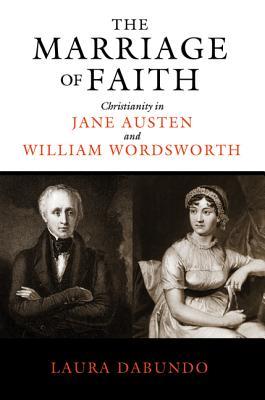
My previous book is The Marriage of Faith: Christianity in Jane Austen and William Wordsworth. I argue that Austen and Wordsworth, the preeminent novelist and poet of English Romanticism, were at heart Christian writers. (That belief seeps into my latest book also, of course.) I examine their works separately and comparatively to make the point. My favorite parts are two essays that began as presentations. In one I compare Lady Catherine de Bourgh to the Tempter/Devil who confronts Jesus in the Wilderness. She comes to scold Elizabeth Bennet out of marriage to Darcy in the “wilderness” of Longbourn. The other was written for a JASNA AGM in Philadelphia, the “City of Brotherly Love,” where I was born. So I wrote about the City of Sisterly Love in Austen, developing the motifs of “city” and of sisters in Austen.

Professor Dabundo’s earlier book on Christianity in Jane Austen and William Wordsworth

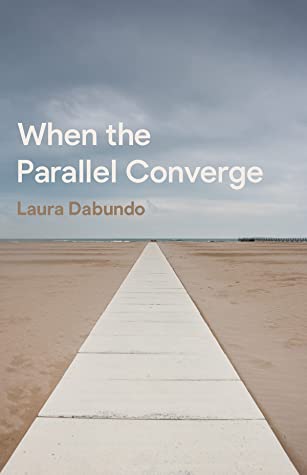
When I sent the Companion manuscript off to the publisher, we were all stuck at home in the first round of Covid. I cast about for something else to write and hit upon three autobiographical prose pieces I had written over the years. I pulled them together into a memoir of my own personal spiritual journey. Wipf and Stock published it, to my delight, as When the Parallel Converge, with a better cover than I imagined. It is very short and not at all like my work on Austen, though I do mention her a couple times. 

Future projects will be more religiously and spiritually based, I think. I did just get an idea for something about Austen, but now I don’t know where I put that piece of paper!

I know you’ll be speaking at the JASNA AGM next month in Chicago, and that the talk will be based on material in this book. What will you be talking about, and why did you choose that topic?

At first I could not think of anything useful on my part to say about the Arts and Austen. But I realized I could write about popular/contemporary arts. That includes what I think is a unique section of my book, though it has been relegated to an Appendix. I have called it “the military-industrial complex” of Austen, though it is really a “literary-industrial complex.” In it I discuss, with examples and criticism, Austen’s “afterlife” of sequels, prequels, works in which Austen or her characters appear, movies, plays, and TV shows. The paper I will be presenting contains some new thoughts on those areas, though the book includes more than the presentation can cover.

I was privileged to hear a trial run of your talk, and I know AGM participants will enjoy it! Thank you for sharing with us, Laura.

Readers of JAW, you can read Jane Austen: A Companion straight through or dip into the parts that interest you. I am appreciating every section. I’ll be glad to have it as a handy reference on my shelf, and I recommend it to you.

Books by Laura Dabundo

Jane Austen: A Companion, by Laura Dabundo. McFarland Companions to 19th Century Literature, 2021. 

The Marriage of Faith: Christianity in Jane Austen and William Wordsworth, by Laura Dabundo. Mercer University Press, 2012. 

When the Parallel Converge, by Laura Dabundo. Wipf and Stock Resource Publications, 2021. 

Laura Dabundo’s spiritual memoir

Read Full Post »

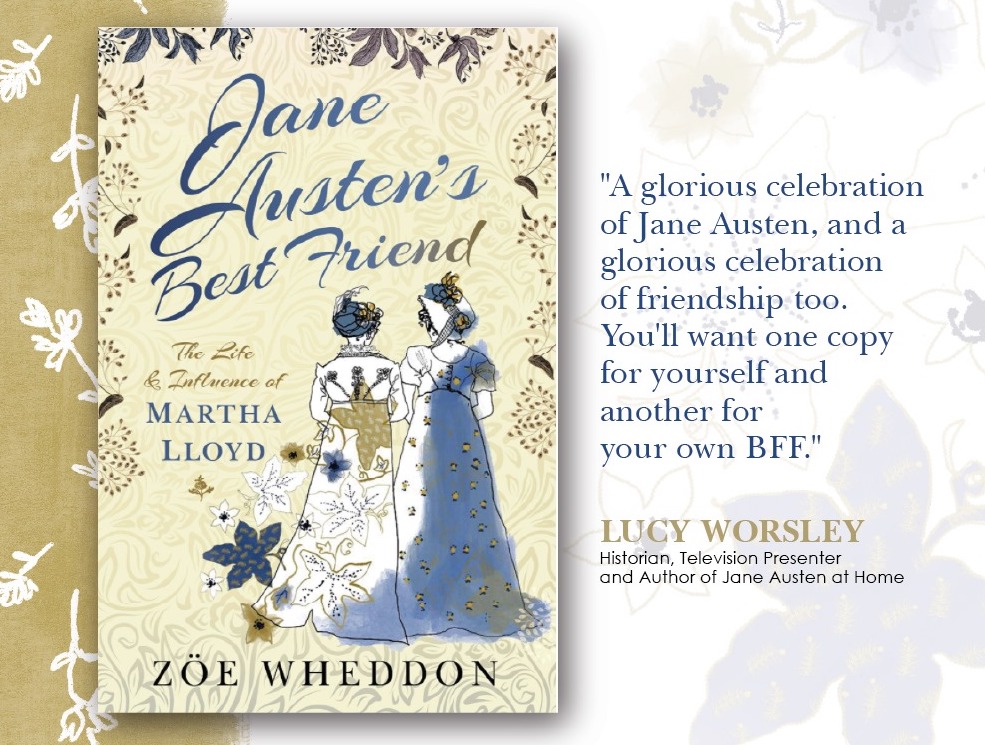
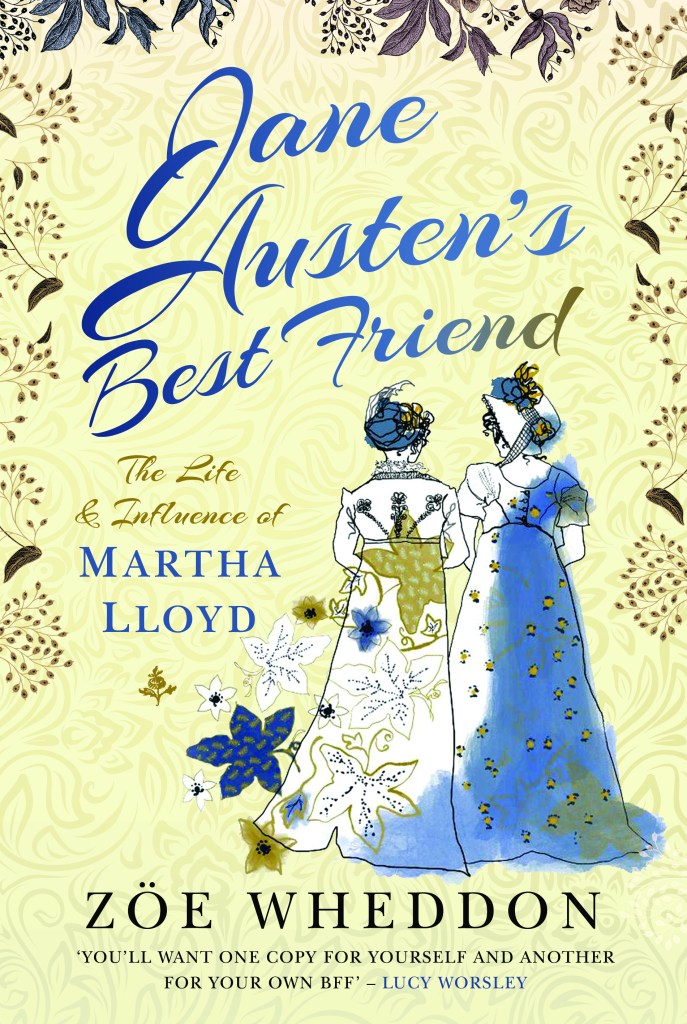
I had the great pleasure of “meeting” Zöe Wheddon, author of Jane Austen’s Best Friend: The Life and Influence of Martha Lloyd, online earlier this year. Her book immediate caught my eye because I’ve always been intrigued by the friendship between Jane Austen and Martha Lloyd. (You can read my book review here.) We started to chat and instantly hit it off. She’s a kindred spirit for sure!

The following is my interview with Zöe about her writing process, her thoughts on friendship, and some of her favorite highlights from her research for Jane Austen’s Best Friend. Zöe grew up and lives in Austen’s Hampshire countryside, and I think you’ll enjoy her unique perspective.

Question: What was it about Jane and Martha’s friendship that intrigued you and what inspired you to write this book?

Answer: I had been reading lots of biographies about Jane Austen following taking part in the Basingstoke Book Bench Art Trail to commemorate the bicentenary of her death and I was volunteering at Jane Austen’s House and Chawton House, at Chawton in Alton. Martha just seemed to pop out of her bedroom one day and say hello to me. I was so compelled to find out more when I discovered that Martha had lived with Jane for such a long long time. It struck me as a rare and poignant position that she held within the household, a quiet yet fundamental person in Janes’ circle, someone very close knit with her but who was not a blood relative. I had to know more about this person – I knew she must have been pretty special for Jane to keep her so close and for so long. I was so surprised to learn that there was nothing much written about Martha and the more I researched the more amazed and intrigued I became.  I was delighted to learn that this lovely lady had been there for Jane and it honestly made me so happy to find out about the different elements of their friendship, I just had to find out more.

Question: Can you tell us about some of the ways Martha impacted Jane’s life as a woman and as a writer? Why did Jane and Martha have such a strong bond?

Answer: Jane met Martha at an important time in her life, she was fresh back from boarding school and turning 13, when Martha moved into the neighbourhood. 10 years older than Jane, she was a breath of fresh air, with that curious mixture of sense and sense of humour and the pair became thick as thieves. I think that Martha and Jane were kindred spirits who brought out the best in one another. The fact that they had so much in common helped, but that they both wanted to explore their talents and creative ideas also drew them closer together. They were the type of best friends that shared that special and unique blend of being able to encourage each other and also, at the same time, to not let each other off the hook. Their strongest bond was their shared Christian faith which meant so much to them both in terms of identity but their sense of humour was the glue that held them together. 

Question: Describe your research process for this book. What were some of your personal highlights?

Answer: I started by reading all of Jane’s letters and looking for any reference to Martha and her family – we don’t have many of Jane’s letters left, for as we know her sister Cassandra burnt them all, which was an Austen family tradition, but we have quite a few either written to Martha or talking about her. I loved the humorous side eye that Jane gave Martha in them – I felt as if I was listening in on one of their private conversations.

I also read lots of family diaries, including the pocket books that belonged to Martha’s sister Mary and family Wills and letters. I truly love being in an archive, as it is thrilling to open up original documents that are hundreds of years old.

I also visited lots of significant places in Martha’s life. I was struck at how the scenery and landscape of their shared Hampshire experiences reflected that of Jane’s novels. It was so incredible to go back to different locations and see what is left too. Sometimes there was a whole building or church, albeit extended and amended, sometimes there was one simple entrance tower, as in the case of the church where Martha married Francis Austen, and sometimes there was a housing estate built right on top – How I would have loved to have seen the real Portsdown Lodge.

I also did lots and lots of reading and spent many hours curled up on the floor in my local library or typing away in a coffee shop. Reading and researching and then heading back out on their trail and discovering different elements that still existed was a huge thrill. Visiting Martha’s grave was very special, to trace her life from start to finish and to marvel at all she had experienced was humbling.

I started out being very envious of Martha, being Jane’s best friend, but by the end of my journey, I was pretty envious of Jane – Martha was one amazing lady.

Question: How have your friendships shaped your life and why do you think close friendships are so important?

Answer: Like Jane Austen, I too have a small circle of friends, and it is a cliché to say it, but my husband, Matt, who I have been married to for 30 years really is my best friend. We have grown up together, having got married quite young at 19 and 21 respectively. There is something so lovely about having so many memories and in jokes and that sort of short hand that best friends have. I have another special friend who goes back years too, and the best thing is that it doesn’t matter if we don’t see each other for a while – we just seem to pick up where we left off, which is lovely. I also have a friend with whom I can keep everything real, we know we can tell each other how we are truly feeling and that we will be understood, without any judgement. I think everyone needs at least one friend that they know they can call in the middle of the night or the middle of an emergency – knowing that they are in your corner helps keep us sane.

Question: What has your experience been growing up and living in Jane Austen’s Hampshire?

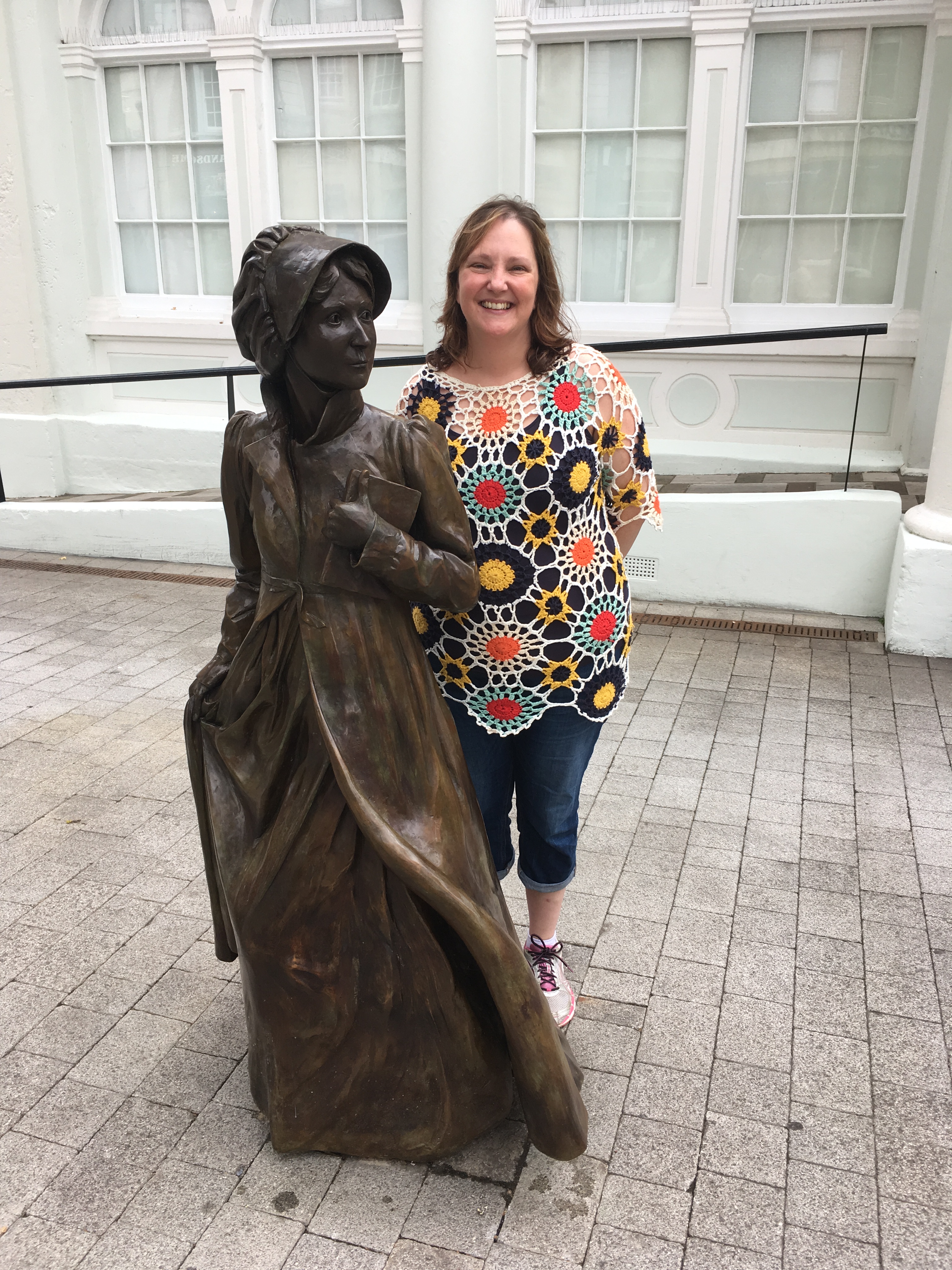
Answer: My grandparents lived in Overton, a village just next door to Jane Austen’s Steventon and I visited often as a child. I feel so lucky to be able to relate to the settings and the countryside in Jane’s novels, as they always seem like another character in themselves to me, and through this shared experience, I have always felt such a personal and profound connection to Jane Austen. Locally we are so proud of Jane. For the bicentenary of her death the town commissioned a statue of her, to be placed in the market square, just outside the Town Hall and opposite where she is believed to have danced at local balls. Knowing that she lived and moved and had her being in the same places as I do has always felt magical.

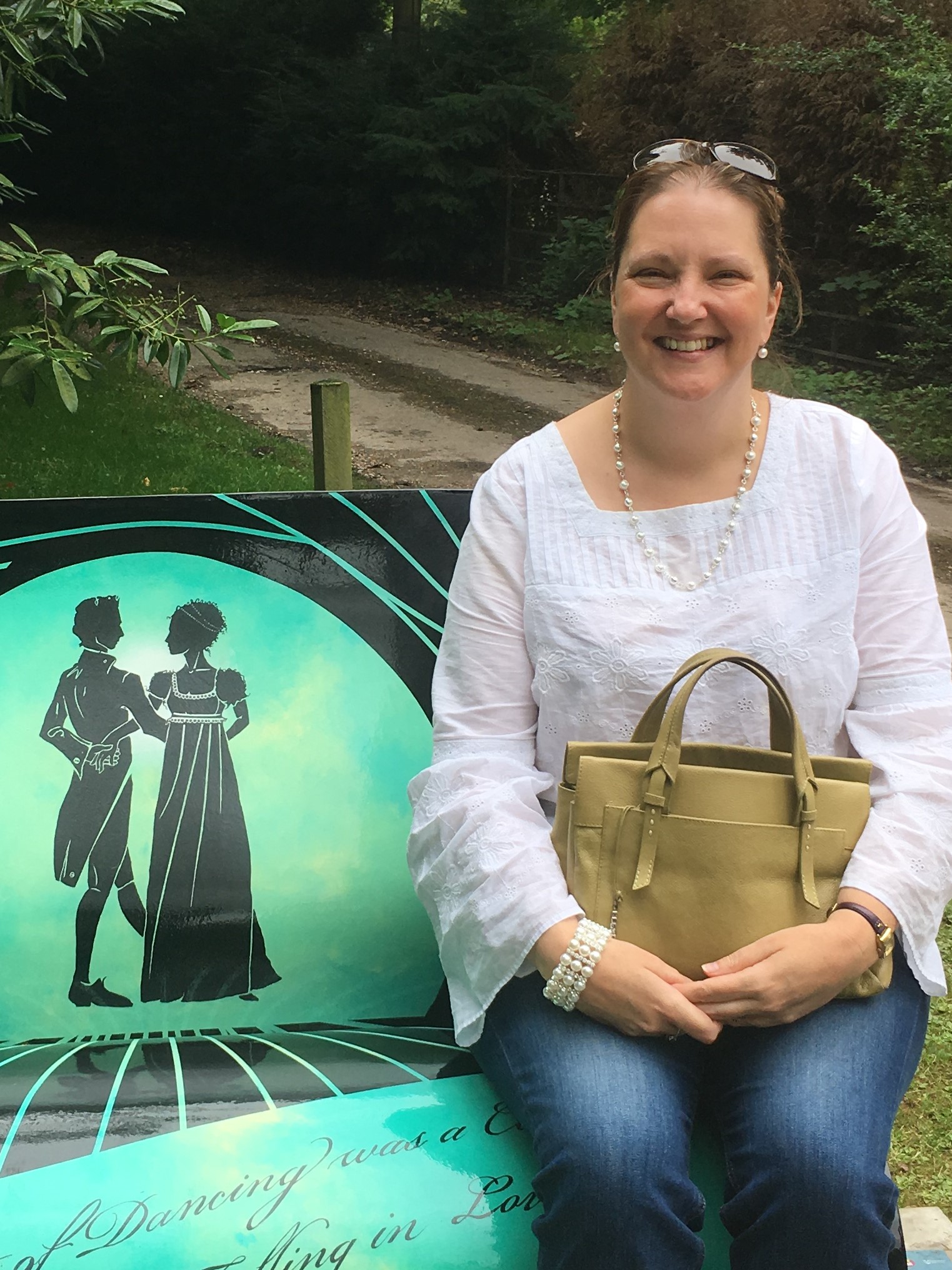
In fact, the reason I started researching Martha Lloyd in the first place was after taking part in an Art Trail of Book Benches scattered across the local Hampshire area; at sites Jane visited, stayed at and lived in. Each bench was designed and painted by a local artist. (See photo below of me sitting on the one outside St. Nicholas’ Church in Steventon.) This experience plunged me into a reading frenzy. I read every biography of Jane that I could get my hands on. As I read more, I started volunteering at Jane Austen’s House and Chawton House and I kept hearing Martha’s name mentioned here and there.  I spotted her in my mind’s eye, on the edge of this special family group. I imagined what that must have felt like, and so I started following her – I had to know more. I felt that Martha might be able to teach me something about Jane that other biographers could not. Thrillingly, I was right.

Question: Do you continue to visit the Jane Austen sites often? 

Answer: I visit Jane Austen’s House and Chawton House on a regular basis, as often as I can and at least twice a year, because they feel like such special places. Truly. With just a short, 45-minute drive I can be walking where Jane walked, taking in the views which are fundamentally unchanged from when she gazed upon the same verdure. I just love it.

Question: When did you start reading Austen?

Answer: I started reading Austen at the age of about 9. I remember being intrigued by a set of books with such long and unusual titles. I loved the alliteration ‘Pride and Prejudice,’ ‘Sense and Sensibility,’ and even though I didn’t really know what they meant, they seemed so enigmatic to me. I wish I still had those copies.

Question: Do you feel as though being a “Hampshire girl” yourself has given you special insight into Austen’s life?

Answer: I have always felt deeply rooted in Hampshire; I love that I have the same feeling of ‘home’ there that Jane and Martha did. Researching the book and venturing out into the local environs, I tangibly felt their strong bond weaved within their shared environment and surroundings. They both adored walking, getting out and about, exploring and enjoying the natural world. To a large extent time stands still when you are out in the countryside and it is a privilege that as a Hampshire girl one can feel closer to them there, out in the fields, than anywhere else. 


Thank you to Zöe for taking the time to answer my questions! I’m sure you can now see why I was interested in this book and in knowing more about Zöe’s life and writing. It’s especially lovely to read a book about our beloved Jane that is written from the viewpoint of an author who is a Hampshire girl herself. -Rachel


ABOUT THE AUTHOR

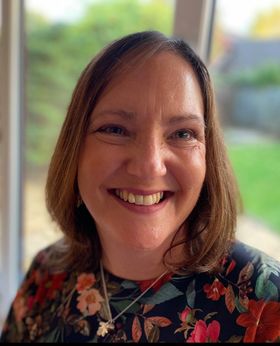
A native of Jane Austen’s beloved county of Hampshire, Zöe Wheddon lives in a North Hampshire village, on the outskirts of the town that she and her husband Matt both grew up in, with their 3 grown up children and their cat Leia. When she is not researching or writing, Zöe can be found in the classroom teaching Spanish and French or singing ABBA songs loudly in her kitchen. People can get to know her better at www.zoewheddon.co.uk.

Zoe Wheddon, Author

SOCIAL MEDIA

Instagram – Zoe_Wheddon
Website – www.zoewheddon.co.uk
Twitter – @ZoeWheddon
Facebook – @authorzoewheddon


ABOUT THE BOOK

JANE AUSTEN’S BEST FRIEND: THE LIFE AND INFLUENCE OF MARTHA LLOYD is a heart-warming examination of the ‘recipe for friendship’ between Jane Austen, (with whom all Janeites are best friends in their imaginations,) and Martha Lloyd. In looking back somewhat longingly at Martha and Jane’s strong and enduring bond we can examine all their interests, including the hits and misses of their romantic love lives, their passion for shopping and fashion, their family histories, their lucky breaks and their girly chats.

Through an examination of the defining moments of their shared lives together, the book gives readers an insight into the inner circle of the famously enigmatic and private authoress and the life changing force of their friendship.

All fans for Jane Austen everywhere believe themselves to be best friends with the beloved author and this book shines a light on what it meant to be exactly that. JANE AUSTEN’S BEST FRIEND: THE LIFE AND INFLUENCE OF MARTHA LLOYD offers a unique insight into Jane’s private inner circle. Each chapter details fascinating facts and friendship forming qualities that tied Jane and Martha together. This book offers a behind the scenes tour of the shared lives of a fascinating pair and the chance to deepen our own bonds in ‘love and friendship’ with them both.

Available in the USA with Pen and Sword/Casemate.


Amazon (US)
Barnes and Noble (US)
Bookshop.org (UK)


RACHEL DODGE teaches college English classes, gives talks at libraries, teas, and book clubs, and writes for Jane Austen’s World blog and Jane Austen’s Regency World magazine. She is the bestselling author of The Anne of Green Gables Devotional: A Chapter-By-Chapter Companion for Kindred Spirits and Praying with Jane: 31 Days Through the Prayers of Jane Austen. Her newest book The Little Women Devotional is now available for pre-order and releases later this year. You can visit Rachel online at www.RachelDodge.com.

Read Full Post »

Older Posts »