Feeds:
Posts
Comments

Archive for the ‘Book review’ Category

Hello, dear readers! This month, I’m featuring this new edition of Pride and Prejudice, a Handwritten Classics edition. This is a luxurious collector’s edition in two volumes, featuring Austen’s complete novel. Inside, you’ll find a collection of characters’ letters and papers, written and folded by hand.

This new collector’s edition offers a luxurious cloth binding, deluxe paper, and new printed ephemera that lend an additional dimension to the reading experience. Examples include a newspaper clipping announcing that Netherfield Park is available to let, an invitation to the ball at Netherfield, an illustrated guide to Pemberley, Darcy and Elizabeth’s marriage license, and so forth.

Order Your Copy Here

About the Book

This collector’s edition invites fans inside the world of Jane Austen’s Elizabeth Bennet. A deluxe, cloth-bound, two-volume set includes gorgeous replicas of the characters’ letters, plus all-new mementos, such as the Darcys’ marriage certificate and an invitation to the ball at Netherfield.

Heller’s specially curated edition, first published in 2020, brought these epistles to life and became a fan favorite. Pockets throughout the novel contain handwritten replicas of nineteen letters, from Mr. Collins’s unctuous letter of introduction to Jane’s urgent missive announcing Lydia’s elopement. Readers can pull out each piece, peruse its contents, and feel transported to the breakfast table at Longbourn.

Heller’s research notes shed fascinating light on how she imbued each letter with the character’s unique personality and recreated historical postage marks. Delve deeper into the history with guest essays by Philip Palmer, curator and department head at the Morgan Library & Museum, and Dr. Juliette Wells, curator of the Morgan’s 2025 exhibition of Austen’s own letters, A Lively Mind: Jane Austen at 250. For anyone who loves Austen, and for anyone who still cherishes the joy of letter writing or collects printed memorabilia, this book offers an immersive experience of a favorite story.

You can revisit Austen’s original text and experience it in a unique way with physical ephemera that links you directly to the world of Elizabeth Bennet and Mr. Darcy. From the masterful calligraphy and the painstaking attention to historical detail to the hand-folding of the letters and other paper memorabilia—this book is an object made by fans for fans.

The novel is presented in two volumes, cloth-bound, foil-stamped, and housed in an elegant slipcase. It offers an exceptional reading experience, stands apart on the shelf, and makes for a truly lovely gift and keepsake. 

Barbara Heller

Barbara Heller is a set decorator for film and television, including The Americans and When They See Us, and a writer and director of award-winning short films that have screened at festivals around the world (Cannes, Berlin, Sundance). She graduated from Brown University with a degree in English Literature. Her previous books include special editions of Pride and PrejudiceLittle WomenPersuasion, and Anne of Green Gables. You can read about her work and visit her online HERE.

How the Series Began

Heller, an avid Austen fan, shares about creating this series of handwritten editions of classic books and how it all started:

“I was re-reading Pride and Prejudice for the gazillionth time, savoring my favorite passages in Mrs. Gardiner’s “long, kind, satisfactory” letter to Elizabeth, when a sudden desire to have that letter in my hand came over me. To hold the very letter that Elizabeth Bennet once received – ink faded, paper yellowed – would be utterly satisfying. In truth, I wanted to possess the originals of all the letters in Pride and Prejudice. A vision of myself at a flea market, happening upon the letters, was so real that I experienced the twin electric thrills of discovery and possession. I became determined to transform reverie into reality.

“[It took] three fascinating years during which I examined hundreds of letters written in early 19th century England; dove deep into their cryptic postal marks; agonized mightily over each character’s handwriting, and met the talented scribes who could write a period hand.

“I was extraordinarily lucky to find a home amongst the Austen lovers at Chronicle Books. In this special edition, each letter is tucked inside a glassine envelope bound at the appropriate place in the novel. I have now read the letters so many times I practically have them memorized; and yet, with every re-read, I still get caught up in the story, discover something new, and marvel at (and feel grateful for) the genius of Jane Austen.”

Jane Austen Book Collecting

I personally think this is an edition for serious book collectors and Jane Austen collectors. The price point is high, but it’s currently on sale right now on Amazon (subject to change). It would make a lovely gift or a fun splurge for yourself. It is truly an immersive experience.

As I thought about how I would use this book, I think it would make a wonderful display at a Jane Austen party, book club, program, or exhibit. I can imagine gathering a group of Austen friends together to dress up, have tea, and read the letters and papers out loud together.

As we step into Fall over the next few months, I look forward to sharing several new books that are releasing this year in celebration of Jane Austen’s 250th! I hope you’ve found a few books to add to your shelves along the way.


RACHEL DODGE teaches writing classes, speaks at libraries, teas, and conferences, and writes for Jane Austen’s World blog. She is the bestselling, award-winning author of The Anne of Green Gables DevotionalThe Little Women DevotionalThe Secret Garden Devotional, and Praying with Jane: 31 Days Through the Prayers of Jane Austen. A true kindred spirit at heart, Rachel loves books, bonnets, and ballgowns. Visit her online at www.RachelDodge.com.

Read Full Post »

A Book Review by Brenda S. Cox

Austen’s Endings

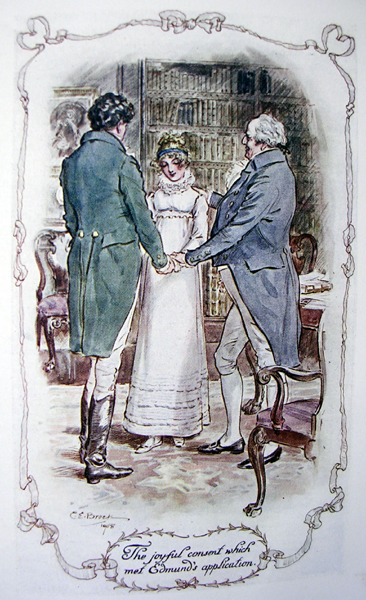
A happy ending, but we don’t see how they got there: Edmund falling in love with Fanny at the end of Mansfield Park disappoints because of the lack of details.

A major complaint that readers have about Austen is her endings. In both Sense and Sensibility and Mansfield Park, we have a sudden romance that is practically a footnote to the last chapter—Marianne marries Colonel Brandon with just, “Marianne found her own happiness in forming his,” and Fanny marries Edmund once he learns “to prefer soft light eyes to sparkling dark ones.” Northanger Abbey introduces a new character, Eleanor’s viscount, to facilitate Henry and Catherine’s marriage.

In Emma and Persuasion we do get some romantic talk (or writing) from the hero. However, in response, Emma says “just what she ought” (which is??), and Anne receives Wentworth’s look “not repulsively.” Then they talk, but we don’t hear their words.

Darcy, of course, simply tells Elizabeth his “affections and wishes are unchanged,” perhaps not willing to risk another disastrous proposal, and Elizabeth “immediately, though not very fluently, gave him to understand that her sentiments had undergone so material a change, since the period to which he alluded, as to make her receive with gratitude and pleasure his present assurances.” But what exactly did she say?

In all cases we have more author commentary than demonstrations, more of what writers call “telling” rather than “showing.”

Movie-makers have had to put words to all these proposals, and fill in some blanks. For example, they show Colonel Brandon rescuing Marianne from the rain, and wooing her with music. But why didn’t Jane Austen, who gave us so many delightful conversations and events, show us all those details herself?

Jane Austen & the Price of Happiness

Jane Austen & the Price of Happiness, by Inger Brodey, explores possible reasons for Austen’s less than romantic endings.

When I listened to Jane Austen and Her Endings: A Visit with Inger Brodey on Austen Chat, I was intrigued by Inger’s thoughts on analyzing those endings of Austen’s novels and trying to figure out why Austen didn’t give us all the details we want. Recently I finally got to buy (at JASP, from Jane Austen Books), and read, Jane Austen & the Price of Happiness by Inger Sigrun Brodkjær Brodey.

It’s a fascinating book, and written quite accessibly. (I found only a couple of unfamiliar academic terms*; in general it’s written in everyday English.) The illustrations are fun, including cartoons, images from movies, and more.

Each chapter analyzes one of the novels, in the order they were written, so we see the development of Austen’s techniques. Brodey looks at various aspect of each novel with new insights and considers the impact of the ending. Then she looks at some popular adaptations of that novel, mostly films plus a few books. She considers how they handle the ending and whether their endings fit Austen’s goals.

Her chapter titles give you some idea of her thoughts:

  • Introduction: “Perfect Felicity”
  • Chapter 1: “Commonplace Happiness” (Northanger Abbey)
  • Chapter 2: “Expecting Literary Justice” (Sense and Sensibility)
  • Chapter 3: “The Limits of Romance” (Pride and Prejudice)
  • Chapter 4: “The Thin Veil of Comedy” (Mansfield Park)
  • Chapter 5: “The Art of English Happiness” (Emma)
  • Chapter 6: “Resources for Solitude” (Persuasion)
  • Conclusion: “Coauthoring Happiness”

Brodey says that, for one thing, Austen is trying to show readers that their expectations of romantic idealism come from the sort of sensibility she satirizes. Austen disrupts those expectations. She shows us that the romantic outcomes we want, expect, and demand are not inevitable: this is fiction. Her stories are realistic, with characters operating in ordinary, everyday life, but the “happily ever afters,” the “perfect happiness,” may or may not happen in real life.

There are other reasons for Austen’s nuanced endings, which I’ll leave you to discover from Inger’s book. However, I’ll share a few highlights from the chapter on Mansfield Park, as an example of some of the many insights in the book.

“The Thin Veil of Comedy” Chapter on Mansfield Park

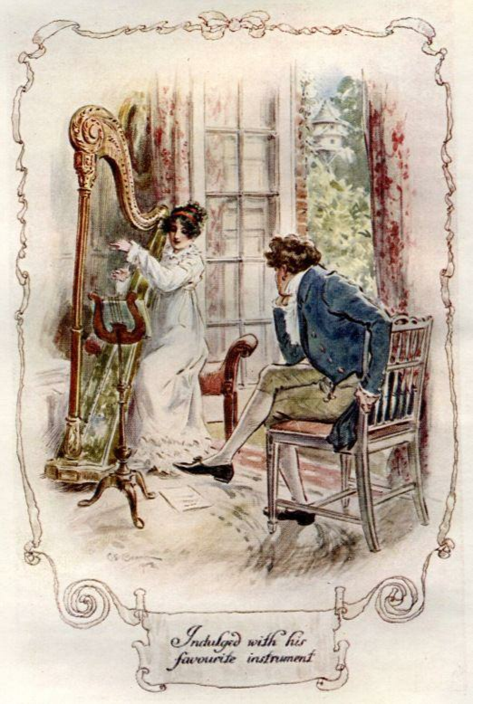
Readers are expected to be attracted by Mary Crawford’s charm, which hides her poor moral values.

Mansfield Park was published after the light, bright, and sparkling Pride and Prejudice. It deals with harder truths. Brodey claims Austen’s “novels alternate between the bright and witty heroines whose primary obstacles are internal, and the more understated, misunderstood, and wiser heroines whose primary obstacles are external” (p. 138). I had to think about this one, but it’s true—Catherine Morland is not witty, but she does face internal obstacles of her own credulousness and illusions; Elinor Dashwood is wise and misunderstood; Elizabeth Bennet, obviously bright and witty, needs to overcome her pride and prejudices; Fanny Price is also wise but understated and faces external challenges; Emma is again bright and witty and needs to overcome her own pride; Anne Elliot is quiet but wise.

Austen shows, especially in Mansfield Park, that charm can be dangerous. Mary Crawford is lively and charming like Elizabeth Bennet. She and her brother Henry charm Edmund, Maria, and Julia, as well as readers, just as Wickham charmed Elizabeth. However, charm without a strong moral foundation leads to disaster. Austen is challenging her readers “to love the less prepossessing characters and see beyond the false power of charm.” 

Henry Crawford might have changed due to his love for Fanny, and might have earned her love, but he did not.

The final chapter of Mansfield Park tells us outcomes for many characters, who are apparently as important as Edmund and Fanny. We see the reformation of some, such as Tom Bertram and Sir Thomas Bertram. Austen reveals the sad but not completely tragic endings of those who were not willing to change, including Henry and Mary Crawford. Henry could even have had an alternate ending, with a happy marriage to Fanny, if he had been willing to persevere in his resolutions of self-improvement. Brodey says, “It somewhat diminishes [Fanny’s] marriage to Edmund to know that a marriage to Henry would not have been disastrous. Once again, Austen surprises the reader out of extravagant expectations of the novel. We get shades of gray where we hope for black and white, realism where we crave romance” (p. 148).

As in other endings, Austen intrudes in the first person, saying “My Fanny indeed at this very time, I have the satisfaction of knowing, must have been happy in spite of everything.” Austen reminds us that this is fiction and that she, as the author, is controlling the ending. She also refers to Fanny as a living human being, though. In showing her own attachment to Fanny (“my Fanny”), she “models the attachment that she believes Fanny deserves” (p. 147).

She challenges our readerly expectations of fantasy endings, including a sense that “second attachments are degrading for romantic heroines” (p. 149); shades of Marianne Dashwood! We believe that Edmund and Fanny will be happy together, even though it is Edmund’s “second attachment.” They do not need some intense eternal passion to experience happiness.

I hope these brief points pulled from one chapter might give you a little more understanding and appreciation of Mansfield Park. I encourage you to read all of Jane Austen & the Price of Happiness. I think you will find it fascinating and illuminating, as I did!


*Here’s one word I learned from this book: apophasis. It means “raising an issue by claiming not to mention it,” or, as Brodey puts it, “tell[ing] the reader what will not be told.” Austen’s endings often use this technique. For example, near the end of Mansfield Park: “But there was happiness elsewhere which no description can reach. Let no one presume to give the feelings of a young woman [Fanny] on receiving the assurance of that affection of which she has scarcely allowed herself to entertain a hope.” As Brodey says, it’s an annoying technique. But Austen has her reasons.


Brenda S. Cox is the author of Fashionable Goodness: Christianity in Jane Austen’s England. She also blogs at Faith, Science, Joy, and Jane Austen.

Read Full Post »

As we continue our tour of new books and media for Jane Austen’s 250th anniversary celebration, my choice this month is the much-anticipated Jane Austen in 41 Objects by Kathryn Sutherland. This extensive new “biography” features the beloved 41 Objects from the Jane Austen Museum, along with beautiful photographs and in-depth information about each item in the collection.

“Jane Austen’s House holds an unparalleled collection of objects relating to Jane Austen’s life and works, her family circle and her legacy. Here you can see some of the treasures of the collection, ranging from books and letters to pieces of furniture, clothing and paintings. Many of these objects can be seen in the House . . .” (Jane Austen’s House)

Book Review

For those who have had the opportunity to visit Jane Austen’s House Museum, many can attest that it’s hard to take everything in during a tour of the house. This book provides a closer look at each object in greater details. I was quite intrigued by the items and information I had missed during my visits over the years and from my searches online. For those who have not yet visited JAHM, this is the perfect book for your shelves! It gives Jane Austen fans a wonderful glimpse into the collection of objects often on display there, collecting them all in on place.

This book provides the perfect “virtual tour” because there’s so much more in the book than you can find online or in person. This book is also much more thorough in its explanation of and historic information about each of the 41 objects than anything I have seen. For instance, reading about the Jane Austen plate was brand-new to me.

What’s more, I believe that this book provides information about objects that may not currently be on view at the museum. I don’t think all 41 objects are always available to the public in one place. If memory serves, some objects move here and there to other exhibits, so again, seeing it all in one place is quite impressive and educational.

Jane Ausen’s Writing Desk

Book Description

Jane Austen in 41 Objects by Kathryn Sutherland is a new kind of biography on Jane Austen examining the objects she encountered during her life alongside newer memorabilia inspired by the life she lived.

More than two hundred years after Jane Austen’s death at the age of just forty-one, we are still looking for clues about this extraordinary writer’s life. What might we learn if we take a glimpse inside the biographies of objects that crossed her path in life and afterward: things that she cherished or cast aside, that furnished the world in which she moved, or that have themselves been inspired by her legacy?

Among objects described in this book are a teenage notebook, a muslin shawl, a wallpaper fragment, a tea caddy, the theatrical poster for a play she attended, and the dining-room grate at Chawton Cottage where she lived. Poignantly, the last manuscript page of her unfinished novel and a lock of hair, kept by her devoted sister, Cassandra, are also featured. Objects contributing to Austen’s rich cultural legacy include a dinner plate decorated by Bloomsbury artists Vanessa Bell and Duncan Grant, Grayson Perry’s commemorative pot from 2009, and even Mr Darcy’s wet shirt, worn by Colin Firth in the 1995 BBC adaptation.

This is a different kind of biography, in which objects with their own histories offer shifting entry points into Jane Austen’s life. Each object, illustrated in color, invites us to meet Austen at a particular moment when her life intersects with theirs, speaking eloquently of past lives and shedding new light on one of our best-loved authors.

Featured Objects

Sutherland provides a tour of all 41 objects with photographs and information about each one. This truly does gives the reader more time to examine and take a thorough look at each object. Though one could find many of these objects online, it’s much easier to study them in a book format.

Marianne Knight’s Dancing Slippers

About the Author

Kathryn Sutherland is a trustee of Jane Austen’s House and Professor of English and Senior Research Fellow, St. Anne’s College, Oxford. Her publications include Jane Austen’s Textual Lives: from Aeschylus to Bollywood (2005), the online edition of Jane Austen’s Fiction Manuscripts (2010), and Jane Austen’s Fiction Manuscripts (5 vols, 2018). Other edited works include: James Edward Austen-Leigh, A Memoir of Jane Austen and Other Family Recollections (2002) and Jane Austen, Teenage Writings (2017).

During the 200th anniversary year of Austen’s death, she curated two major exhibitions: “The Mysterious Miss Austen,” in Winchester, Hampshire, and “Which Jane Austen?” at the Bodleian Library, Oxford. She wrote essays for and edited the accompanying exhibition book, Jane Austen: Writer in the World (2017).

Celebrating 250 Years

This collection is another wonderful product of the 250th anniversary of Jane Austen’s birth and the celebrations happening worldwide all year long. I’m thankful that Kathryn Sutherland, Jane Austen’s House, and Bodleian Library Publishing, Oxford made it possible for Jane Austen fans to have access to these artifacts in book form. If you really want to “geek out,” this is the book for you!


RACHEL DODGE teaches writing classes, speaks at libraries, teas, and conferences, and writes for Jane Austen’s World blog. She is the bestselling, award-winning author of The Anne of Green Gables DevotionalThe Little Women DevotionalThe Secret Garden Devotional, and Praying with Jane: 31 Days Through the Prayers of Jane Austen. A true kindred spirit at heart, Rachel loves books, bonnets, and ballgowns. Visit her online at www.RachelDodge.com.
Read Full Post »

Dear Reader: Two hundred and fifty years ago marked two significant events across two continents – Jane Austen’s birth in Steventon, England, December 16, 1775, and the start of the fight for independence by American colonists in Lexington and Concord on April 19th from Great Britain. And so Jenner’s book, set in GB and the American Colonies comes at a propitious time. The novel’s plot is set in 1865, 48 years after Jane Austen’s death, and just after the Civil War in America ends and followed by the news of Abraham Lincoln’s death, and And so the timing of this novel is timed brilliantly – in honor of the 250th anniversary –  J Austen’s birth and America’s fight for independence from Great Britain.

For this discussion about Natalie Jenner’s latest novel, I listened to an audio version of a book that spans over 300 pages and that the listener takes from 11-12 hours to complete. The author’s complex plot provides numerous characters, and their movements across two nations, often with historical minutia thrown in. One set back as a listener is that, unlike a novel in which one can quickly flip back and forth to check on a detail, an audio book forces one to rewind. Being ham handed, I often missed the stop I needed.

The good news is that once the introductions of the characters are over and the plot truly gets going, it’s hard to stop listening, especially sections 2 and 3. To help listeners keep track of the characters and their settings,, I’ve listed the four main divisions in the novel. They are:

1) Boston: In which the main characters are introduced. (a,b, & c) Sisters Charlotte and Henrietta Stevenson are the spinster daughters of Massachusetts Supreme Court Justice William Stevenson; (d) Constance Davenish is a Boston socialite and suffragette, (e) Thomas Nash, is also a Massachusetts Supreme Court Justice and Justice Stevenson’s friend, and (f) Denham Scott is a mysterious reporter from Great Britain (GB). All these characters, in one way or another, have a keen interest in Jane Austen’s work.

Although he lived in Portsmouth, GB, Sir Admiral Francis Austen, Jane Austen’s brother and the last surviving Austen sibling, is included in this section. Jenner weaves his presence throughout the novel, for he is the engine that propels the plot forward in every section of the novel. 

Also included in this introductory section are the Nelson brothers, Nicholas and Hazlett, who are both Civil War veterans. After the war ends, the bachelor brothers work in Philadelphia as rare book dealers. Philadelphian heiress, Sara-Beth Gleason, daughter of a Pennsylvania state senator, frequently visits the rare book shop, for she has her mind set on one of the Nelson brothers.

In this introductory section, Jenner narrates the details of the characters, their settings, and their connections to each other and their knowledge of J Austen. We know their background mainly through the narrator’s voice, but occasionally  get brief glimpses of their personalities through their letters, particularly between Sir Francis and the Stevenson sisters, as well as his correspondence with the Nelson brothers. Within these letters and the characters’ reactions to them, the plot of the novel unfurls in a more personal way.

2) The Sea. In the second section of the novel, the reader meets  Louisa May Alcott on board the S.S China, a ​​transatlantic mail packet steamer headed from Boston to Portsmouth. Traveling on board are the Stevenson sisters, journalist Denham Scott, the Nelson brothers, Justice Thomas Nash, and Sara-Beth Gleason, who has followed the brothers to England. Remaining in Boston are Justice Stevenson and Constance Davenport. 

By this time, Jenner has largely left narrative exposition in favor of having her characters discuss their thoughts and/or allow the reader to get into their minds via free indirect discourse, the writing method J Austen used inventively in her novels. FID allows Jenner to jump back and forth as the third person narrator as well as enter her characters’ minds. 

The journey on board the S.S. China is lively. Alcott, a spinster, author, and woman’s rights activist bonds with both the women and the men. On board the ship, the passengers find/discuss their common admiration for Jane Austen and her writings. After her death, and as the 19th century progressed, Austen’s reputation had spread to the U.S, whose growing popularity Jenner includes in detail. 

3) Hampshire. The third section of this novel is, frankly, my favorite part of the book. Various threads of  the major plots coalesce and intertwine, in particular, those of Admiral Francis Austen, the Stevenson sisters, and the Nelson brothers. Jenner takes us to Portsmouth Lodge, the admiral’s house, which rises on a point above the harbor. From his perch, Sir Francis looks out to the English Channel with a maritime telescope, watching the ships come and go in the harbor and the activities on the docks. Charlotte and Henrietta Stevenson and Nicholas and Hazlett Nelson visit Sir Frances, who shares important information with them. The group journeys to Chawton House and Chawton Cottage, and follow the paths and roads that J Austen has traveled. In addition, between the group’s conversations with the Admiral and their expanded knowledge of the author from his first-hand accounts, Jenner fully fleshes out the details of her life. Austen has become a living, breathing person in their and our minds.

This section has many twists and turns that lead to a mystery the Admiral holds close to the vest. He also keeps certain plans a secret. These mysteries play an important part in keeping me interested in finding out what they are.


4) The Court. This section, for me, was a let down. Instead of reaching a satisfactory ending that ties loose ends, new twists are introduced. My mind became confused, for I wondered about the reasons for adding additional threads so late in the novel. Of the reviews I read, however, over 90% of the reviewers were satisfied with the ending and praised the novel, giving it from four to five stars. I found only one review in which the reviewer felt that the book was chugging along nicely, until he reached the last section, when he stopped reading because of the muddling of the plot. 

I kept listening until the end, but felt like I had experienced a number of different endings. I thought, much like the endings in the film, ‘Return of the King’, in which the audience sat through Aragorn’s coronation, Sam’s return to the Shire, and Frodo’s departure by ship to the Grey Havens with the Elves, ‘enough is enough.’.

And so I have mixed feelings writing this review, since I like the author’s writing style and her remarkable research. Plus, listening to a novel that is over 300 pages long and has a quite complicated plot that contains numerous characters who live in and travel to different locations can be quite confusing. I’ll eventually read the novel, and am sure that  going at my own pace while leafing through the pages will provide a better ‘reading’ experience.

Links

Read Full Post »

A Book Review by Brenda S. Cox

“Marianne’s ‘excess of sensibility’ almost destroys her reputation, her health and her happiness, wihle Elinor’s more guarded behaviour is rewarded. But that is fiction; what of real life?”—Prologue to Jane and Dorothy, by Marian Veevers

Jane and Dorothy: A True Tale of Sense and Sensibility, The Lives of Jane Austen and Dorothy Wordsworth, by Marian Veevers. The lovely cover attracted my attention as I perused a library book table focused on Jane Austen.

I had read a review of this book some time ago and suggested it to a literary friend, who said there was no connection between Jane Austen and Dorothy Wordsworth, sister of poet William Wordsworth. But I decided to check out the book and find out how the author connects them. I’m glad I did, as it was a fascinating read.

Jane and Dorothy, by Marian Veevers, explores two parallel lives, Jane Austen’s and Dorothy Wordsworth’s. Veevers works for the Wordsworth Trust.

Jane Austen and Dorothy Wordsworth

Jane and Dorothy follows the lives of two women, living at approximately the same time, who never met. Parallel, never intersecting, similar in some ways and contrasting in others. Connections with Austen’s novels are intertwined in their stories. Jane (1775-1817) is compared to Elinor Dashwood, with strong feelings controlled by reason and religion. Dorothy (1771-1855) is more like Marianne, focusing on her emotions. In one teenage letter to a friend who was sympathizing with her misery, Dorothy wrote, “You cannot think how I like the idea of being called poor Dorothy . . . I could cry whenever I think of it.”

Both were writers. Jane Austen, of course, had four novels published during her lifetime, two more shortly after her death, and her Juvenilia and letters published years later.

Dorothy Wordsworth wrote journals, mostly about her ramblings in nature with her brother, who became a famous poet of Romanticism.  William Wordsworth used his sister’s journals as inspiration and a source of details for his poetry. His discussions and experiences with her also inspired him. A few of Dorothy’s own poems were published during her lifetime, but her journals and her travel narrative of a trip to Scotland were only published after her death.

Both Jane and Dorothy were dependent on their brothers later in their lives. Austen and her mother and sister were financially supported by her brothers after her father’s death, and her brother Edward provided Chawton Cottage where she wrote and rewrote her novels.

Dorothy lost her parents early in life and lived with various relatives as a poor relation, similar to Austen’s Fanny Price, until she threw in her lot with her brother William. Dorothy loved William passionately. (The author discusses rumors of sexual involvement and concludes that the rumors were false.) Dorothy devoted the rest of her life to her brother and, eventually, to his wife and children. Their financial situation was much harder than the Austens’, but they survived.

It was interesting to see the similar social and financial restrictions that society placed on both Jane and Dorothy, particularly as unmarried women, and to see how Jane’s life might have played out differently in other circumstances.

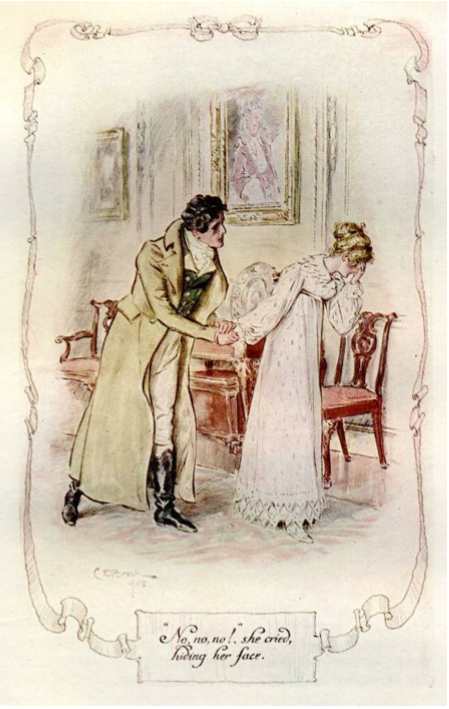
Yates ranting in Mansfield Park. Did Austen love home theatricals, or hate them? Or did she simply see their dangers?
C.E. Brock, public domain.

Austen and Drama

Having read so much about Jane Austen, I wasn’t expecting new insights into her life from this book. However, I found several. I’ll give just one example, from pages 47-50 of Jane and Dorothy.

Veevers discusses Austen’s attitude toward amateur home theatricals in Mansfield Park. Many have commented on the fact that Austen’s family performed such plays when she was growing up, and that she couldn’t really have thought they were wrong. Perhaps it was just the specific circumstances at Mansfield Park that made it wrong, or her attitude had changed due to the growing Evangelical disapproval of drama, or she was attributing disapproval to Fanny and Edmund.

However, Veevers speculates that, first, Jane may not have participated herself in those plays when she was growing up. She says the only evidence we have for that is Jane’s cousin, Phylly Walters, who wrote that “all the young folks” were participating in a performance in 1787—that is rather vague. Or Jane may have participated without enjoying it.

While Austen’s family approved of amateur theatricals, we don’t have to assume that she herself agreed. Instead, those experiences of plays in the Steventon barn may have shown Jane “the dark underbelly” of such practices. Veevers says any “modern-day member of an amateur dramatics company” would recognize these issues. She continues,

“Jane Austen gives an unflinching insider’s view of everything that is worst about amateur acting, from the concealed, but overwhelming self-interest of Julia and Maria Bertram who each hope to have the best part in the play ‘pressed on her by the rest,’ to the self-indulgent over-rehearsal of favourite scenes by some actors, and the insidious, self-gratifying criticisms of others’ performances—‘Mr Yates was in general thought to rant dreadfully . . . Mr Yates was disappointed in Henry Crawford . . .’” etc., etc. “There can be no doubt that this detailed understanding . . . came from real observation. It would seem that brother James’s annual productions in the Steventon barn were riven by jealousy, bad-feeling and unkindness.”—Jane and Dorothy, p. 49

Veevers goes on to speculate that Jane’s opinions may have been influenced by her dear friend Anne Lefroy. Mrs. Lefroy was a clergyman’s wife who apparently disapproved of amateur theatricals, politely declining to participate when a friend invited her. (Also, I would add, it appears those Steventon theatricals were an opportunity for flirtation between Jane’s still-married cousin Eliza and two of her brothers, so perhaps Henry Crawford and Maria Bertram’s fictitious flirtation also had a basis in past experience.)

I don’t think I personally agree with the idea that Austen disapproved of such theatricals, though. Austen certainly enjoyed the professional theatre, “good hardened real acting,” as Edmund Bertram called it, distinguishing that from amateur performances. Austen did, though, write several short, comic plays as a teenager, which may have been acted by her family. On a visit to Godmersham, she and Cassandra acted—most likely by reading aloud— a couple of plays with their nieces and nephews. (The Spoilt Child and Innocence Rewarded, according to Fanny Knight’s diary). Of course, that would have been on a much more limited scale than the play at Mansfield Park, with presumably less objectionable plays.

Whether Austen objected to amateur dramatics in general is questionable, but certainly she had seen enough to very realistically show the pitfalls of such productions in Mansfield Park. So I appreciated this insight from Jane and Dorothy.

Fanny Price loves nature, like both Jane Austen and Dorothy Wordsworth. Both Jane and Dorothy, like Fanny, experienced being marginalized by wealthier relatives.
H.M. Brock, public domain.

Spinsterhood

The book extensively explores attitudes toward “old maids” in Austen’s society. It’s easy to forget that Austen herself probably experienced prejudices against unmarried women. She certainly sometimes felt herself a poor relation at her wealthy brother’s Godmersham estate. She often lacked autonomy: her living situations and travels were dictated by her parents or brothers. Perhaps those feelings helped her create Fanny Price, dependent and marginalized.

Jane and Dorothy points out many illuminating parallels between Sense and Sensibility and Mansfield Park. Fanny is much like Marianne, with strong feelings. However Austen, when she was a more mature writer, made Fanny spiritually stronger, more nuanced, and with greater depth.

Marianne Dashwood gives way to her feelings and nearly dies. Fanny Price turns to religion and reason to keep her feelings under control, as Marianne determines to do at the end of Sense and Sensibility.
C.E. Brock, public domain.

End of Life

Dorothy lived much longer than Jane. Sadly, though, Dorothy’s last twenty years were spent with “her mind completely broken.” She had given her life to taking care of her family; that same family gave her loving care for those long years. It’s been speculated that she may have had some kind of dementia, or possibly severe depression. (She suffered, in fact, similarly to William Cowper in his final years. Cowper’s poetry, by the way, impacted both women.)

Of course we all wish that Jane had lived longer and written more. However, thinking of the many ways a spinster (like Miss Bates, for example, or Dorothy Wordsworth) might end up in Austen’s world, perhaps Jane’s earlier demise from an unknown disease was not the worst possible ending for her. The recent book and series Miss Austen also imagines long-lived Cassandra suffering late in her life.

As Veevers concludes,

“Jane and Dorothy were two unmarried, childless women who had failed to fulfil the destiny that their society prescribed for their sex. But they neither drooped nor withered as [1838 writer] Carlisle expected, nor developed the chagrin and peevishness which Dr. Gregory [1774] believed inseparable from their condition. Instead they forged their own meanings from their lives. . . . Jane and Dorothy were not simply products of their time. They made choices in their lives, and it was those choices which defined them.”

I found it fascinating to trace the choices of these two parallel lives, and the resulting joys and sorrows, during the same time in history. Well-written, easy to read, and compelling, Jane and Dorothy  is worth reading for anyone who wants to get deeper into “Jane Austen’s World.”


Brenda S. Cox is the author of Fashionable Goodness: Christianity in Jane Austen’s England. She also blogs at Faith, Science, Joy, and Jane Austen.

Read Full Post »

« Newer Posts - Older Posts »