Feeds:
Posts
Comments

Archive for the ‘Book review’ Category

Cathleen Myers wrote this fascinating insight about A Lady of Distinction on the PEERS website. A Lady is the author of The Mirror of Graces, my favorite source for regency etiquette.

Who is the author? Possibly a governess or companion in a diplomat’s family. She has seen a number of foreign courts and discourses intelligently on Continental manners, but is too clearly impressed by foreign titles to be real English Society herself and her table of Precedence contains several glaring errors that reveal the gentlewoman on the edge of Society as opposed to the Real Lady. Still, this is valuable First Hand source material from an author who has actually observed and recorded a great deal about the manners and customs of two generations.

Unfortunately, there is no footnote or source material to this comment, which must be taken at face value. Ms. Meyers seems to know her stuff. According to a 2007 article in SF Gate, she is a board member of PEERS (Period Events and Entertainments Re-Creation Society), a San Francisco Bay area nonprofit that “throws a formal ball every first Saturday re-creating the dress, dances and entertainment of a specific time period, film or piece of literature.” Many of the members of this group are “expert or professional costumers and seamstresses who delight in studying the period details of suits and gowns. Others know an exceptional amount about where to purchase the wigs and find the corset that will give you the best silhouette.”

Read Full Post »

Inquiring reader,

Last year I met Jane Odiwe online. We immediately struck up an email friendship discussing all things Jane Austen. She had just written Lydia Bennet’s Story, which came out in the U.K. Sourcebooks will be bringing out the book this month with a new and beautiful cover. Jane not only writes, but she also paints lovely watercolours and maintains several blogs and websites. Below is my interview with Jane. I have also added links of interest at the bottom.

1. Jane, you have such a wonderful light and deft touch with watercolours, a difficult medium at best: Have you always painted? And were you schooled? Where, and for how long?
I have painted as long as I can remember, sitting with my mother at the kitchen table. It was also a love of hers which she passed on to me. I went to art school in Sutton Coldfield, studying at Foundation level and then at Degree level in Birmingham, England, five years all together. Mine was an unusual degree, I was able to indulge my love of History, Art History and Literature whilst specialising in Fine Art. Watercolour and oils are my favourite medium.

2. Have you always been a Jane Austen fan? When did you first encounter her works?
I remember seeing the old black and white version of Pride and Prejudice on television when I was very young and dressing up in my mother’s nightgown. I was very taken with the dancing at the time and all the fashion which I loved. I read the book later but I was inspired to re-read all of Jane’s works after the lovely Pride and Prejudice production starring Jennifer Ehle and Colin Firth. I think Jane and Elizabeth were my mother’s favourites, as my first names are Jane Elizabeth!

3. In order to create these works, you’ve had to combine a working knowledge of anatomy, history, historical places, Jane’s biography, and an intimate knowledge of her writings. That is quite a feat. Why did you decide to embark on such a difficult and exacting project?
I have always enjoyed reading the biographies written about Jane Austen but there never seemed to be enough pictures and of course, one of the reasons is, that they simply don’t exist. There is the little watercolour painting of Jane Austen in the National Portrait Gallery, the silhouette that is said to be of her and Cassandra’s other painting of Jane, sitting with her back to us but they do not give us a real idea of what she looked like. I was intrigued by her letters and her romance with Tom Lefroy and the first painting I did was of them dancing together. I painted it for the sheer pleasure of ‘seeing’ them together; I think it was an attempt to depict her happiness at being with the young man she seemed to like best. All the written descriptions of Jane seem to bear little resemblance to Cassandra’s painting; I wanted to see a younger Jane at the time when she experienced her first love and was starting to enjoy balls and attention from young men. I based Jane Austen’s portrait on Cassandra’s painting but I admit I wanted to see her smile. She had such a wonderful sense of humour, I wanted to try and show a happier Jane. I never thought of my Effusions of Fancy paintings in terms of an exacting project. I didn’t expect anyone else would ever see them and they were a purely personal tribute. However, when I thought about putting the pictures into a book, I did want to try and change people’s idea that Jane was a quiet spinster in a mob cap and I thought one of the ways I could do that was to attempt a painting of a younger woman with her hair dressed as though she is about to go dancing.
4. Regarding this painting of the Austen family, tell me a bit about your working process. I can see that you studied the actual paintings of each family member. How did you incorporate so many likenesses in one composition? Did you sketch each portrait separately first? Or did you work from an overall composition?
Because we only ever see the portraits of the family members by themselves, I wanted to picture the Austens all together around the table, showing them as the close family I believe them to have been. I started with the silhouettes of Mr and Mrs Austen. Silhouettes give us such a tantalising glimpse of a person without revealing the whole; I had no other reference for Mrs Austen but there is a lovely portrait of Jane’s father, with his white hair, which helped enormously. I used my knowledge of figure drawing and many painting references to find bodies for the heads and tried to bear in mind what I had read about their characters. Henry, for example, is depicted in the only portrait that exists of him as being a very sober looking clergyman with receding hair. Everything I have ever read about him illustrates quite a different character; handsome, fun loving, slightly reckless and witty. I painted another portrait of Henry to see if I could find the ‘handsome’ Henry and incorporated this into the painting. Edward’s portraits at Chawton are wonderful and I have studied them many times. I imagine Edward resembled his mother in looks and also has those ruddy cheeks which Jane is supposed to have had. Edward did not really grow up with the other children as he was sent to live with his richer relations and I wanted to indicate this; he is slightly aloof, not sitting with the immediate family but protective of his mother. Lovely Frank, the seafaring brother who took his mother and sisters into his home after Mr Austen died, has his arms around Henry and his sisters. I imagine him to have been very dependable and loving and wanted to portray this aspect of his character. James, the poet, I think was probably quite earnest and serious. I think he looks lost in his own thoughts. Charles, another sailor looks very dashing in the portraits I
have seen of him, I wanted to show him with a bit of a smile, as though he is about to laugh at something his mother has just said. Jane and Cassandra are talking to each other and laughing at some shared amusement. I really wanted to show how close they were, two young girls having fun and chatting, nineteen to the dozen. I used a painting and a silhouette said to be of
Cassandra for my painting, I believe she was a pretty girl. I would like to do another family portrait one of the days which tells another story, perhaps illustrating a well known event in their lives.

5. Do you feel that all your hard work in this area is paying off? If you knew then what you know now, what would you do differently?
I’ve ‘met’ so many lovely people as a result of producing my little book and cards, (many through my web site and from different countries) and for me this is my greatest pleasure. If someone writes to tell me that they have enjoyed my work, that is the biggest payoff for me. Other people’s lives are always interesting to me and I like to keep in touch and hear their news.

I wouldn’t do anything differently, I’ve enjoyed the whole process of creating the paintings but perhaps I would like to add or do different versions of the same ideas. It’s essential to keep striving to improve and continue to study, I think. I would like to do a larger version of Effusions of Fancy with more paintings, perhaps telling the story of all of Jane’s life. More time to accomplish everything I would wish would be lovely, but time has a habit of running away!

6. Is this a full time career? Or are you squeezing this extraordinary passion into an already full schedule?
It is a full time career, but I also work with my husband to help earn our bread and butter! He is a graphic designer and he often needs an illustration to help with his work. At this time of year I am usually to be found drawing Christmas trees, baubles, popping champagne bottles etc. for restaurant menus, Christmas cards and invitations etc. After Christmas, it’s Valentine’s day and so it goes on. I really enjoy this type of work. I am very lucky to be able to work with my husband, doing illustrations that I enjoy working on. I get a huge thrill out of seeing my work out in public.

7. Any advice you would give to budding authors/illustrators?
You need to be passionate about your work and have a tough skin. You will face many rejections and possible hurtful comments as well as enjoy success. Try to remember why you started on this journey in the first place, believe in what you do and don’t give up, which is easy to say but not always easy to put into practice!

8. Aside from Lydia Bennett’s Journal, what other projects are you currently working on?
I’ve just completed a little map for Deirdre Le Faye’s book, Jane Austen’s Steventon, which was a lovely job to do and at present I am putting together menus for the wonderful Scottish Branch Jane Austen Birthday Lunch in December.

I’m having a great time writing a new novel, which of course is another Jane Austen sequel. It is another ‘Story’ of one of Jane’s characters but this time inspired by Sense and Sensibility. I hope this will be ready in the spring. I’m off to Devon soon to do some research. This is one of my favourite reasons for writing, although I often find it takes over!

In addition to all her other plans and activities, Jane wrote, “I’m also very excited to tell you that my Jane Austen illustrations are to be used in a documentary feature on the DVD of The Jane Austen Book Club. They asked to use about 16 of them, so I can’t wait to see what they’ve done with them.” We can’t either, Jane!

Update: Here are Jane’s thoughts about her new Sense and Sensibility sequel, out in 2009:

I am really thrilled to be able to tell you that my second novel, Mrs Brandon’s Invitation will be published by Sourcebooks next year. It will be coming out in September, which seems such a long time to wait to see it in print, but will fit so perfectly within the time frame of the book, that I will just have to learn to be more patient.

As the title suggests, Mrs Brandon’s Invitation is a sequel to Jane Austen’s Sense and Sensibility. The story principally centres around Marianne (nee Dashwood) who has been married to Colonel Brandon for three years and that of her younger sister Margaret, but most of the characters are there, plus a few new ones. I have so enjoyed writing this one, interweaving the stories of two heroines against the backdrops of Delaford in the Autumn, Lyme and London in winter. It was such fun to write the characters of Mrs Jennings and Lucy Ferrars, along with her sister Anne Steele. Colonel Brandon’s sister, husband and son make an appearance at Whitwell and this is where the mischief starts. I am often inspired by a secondary character or mention of one in the original books and I decided to introduce the family. If you remember, Mrs Jennings refers to Colonel Brandon’s sister as residing in Avignon at the time of Sense and Sensibility. With her son Henry coming home from university, it was time to bring the Lawrence family back to Whitwell.

Here is a little taster of what is to come.

No one is more delighted by the appearance of an eligible suitor for her sister Margaret Dashwood than Marianne Brandon, until it becomes clear that not only the happiness of the match, but also that of her own marriage are bound and ensnared by the secrets and lies that belong to the past. First attachments, false impressions, resentments and misconceptions, are the elements that conspire to jeopardise the happiness of the Brandon family at Delaford Park, along with the added predicament of Mrs Brandon’s first love John Willoughby returning to the neighbourhood.

Read Full Post »

My recent Alibris purchases include the following:

Taste: The Story of Britain Through Its Cooking by Kate Culquhoun. This book is a social history of Britain told through the developments of its cooking. It encompasses royal feasts and street food, the skinning of eels, and the making of strawberry jelly. More interestingly,  it mixes the tales of culinary stars with ordinary cooks. The book is filled with tidbits like this:

Soon boilers like the one at Bretton Hall in Yorkshire were being installed at the backs of ranges to supply ready hot water and steam for cooking. Then Joseph Langmead patented a design from which all future closed ranges would develop, using flues to spread a more even though still inefficient heat to the side oven. p235

Hubbub: Filth, Noise & Stench in England, 1660-1770 by Emily Cockayne addresses the noisy, messy, and smelly metropolis that was London in the 18th Century. Using a vast array of sources, from novels to records of urban administration to diaries, Emily Cockayne populates her book with anecdotes from the quirky lives of the famous and the obscure.

Street lamps were high maintenance. The lighters needed to carry ladders and other apparatus. Contractors topped up the reservoirs with oil, trimmed wicks and lit the lamps at specified hours. p 224

From the Ballroom to Hell: Grace and Folly in Nineteenth-Century Dance, by Elizabeth Aldrich. “Dancing and etiquette are inseparable,” wrote one 19th-century dancing master quoted in this scholarly glimpse into ballrooms past. Newly moneyed Americans of that era craved guidance on how to comport themselves, and publishers responded with scores of manuals on etiquette, fashion and dance instruction. As dance historian Aldrich demonstrates through more than 100 excerpts from these guides, balls and dance offer a key to understanding the social aspirations of the period.

Nineteenth-century men and women were preoccupied with learning the proper way of conducting themselves not only in the ballroom but in all social interactions. But it was precisely in the ballroom that ladies and gentlemen best demonstrated their mastery of the rules of etiquette and social intercourse. p xvii

Read Full Post »

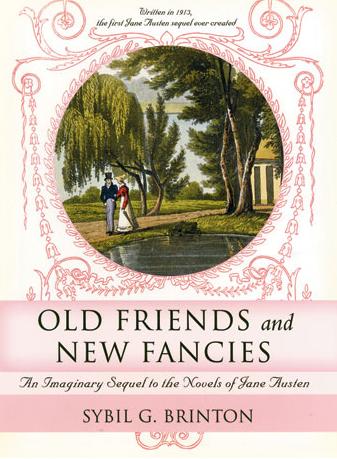
Inquiring Readers, Although SourceBooks came out with Old Friends and New Fancies last summer, we waited to review this first Jane Austen sequel by Sybil Brinton until now. Reviewed by Lady Anne

The only real problem with Jane Austen is that she left us with a paucity of books to read and re-read. Most of us find that our favorites shift and change as we age, and all of us want more to read by our favorite.

Sybil Brinton, an Englishwoman born in the 1870s, was the first to address this problem in her book, Old Friends and New Fancies. First published in 1913, the novel rounds up unmarried characters from Austen’s works and provides cross-novel romantic entanglement. Her main characters are Georgiana Darcy, Colonel Fitzwilliam, and Kitty Bennet, all, of course, from Pride and Prejudice. During the course of several months, living the lifestyle of their class and time, these three meet characters from Austen’s other books. It is great fun to see them in Bath, London, and at the various estates to and from which they all travel. Here’s Lady Catherine de Bourgh, characterizing Persuasion’s Sir Walter Elliot as a “foolish old beau,” (I loved that!) and creating a huge scene in her inimitable style, urged on by Lucy Steele Ferrars and her sister Anne of Sense and Sensibility, still causing trouble by their malicious gossip, aided and abetted by Mr. Yates from Mansfield Park. Well-meaning old Mrs. Jennings, from Sense and Sensibility is still making her tiresome jokes about her young friends’ beaux, and Emma Woodhouse Knightly is still trying to run everyone’s lives for them. She and her husband are now living in London, Highbury being too small a stage for her activities. An inveterate matchmaker (one might have thought she would learn, but we do remember Jane introducing Emma as one who thought very highly of herself), Emma here plays havoc with Kitty Bennet. Kitty is still foolish, mostly interested in balls and clothes, but we have hope that she might mature with grace. She and Georgiana, much the same age and sharing family ties, become confidantes, although certainly they have little in common other than an attractive naval officer, William Price from Mansfield Park. The Darcys are quite concerned about their sister Georgiana, who remains shy and a little withdrawn, but becomes an interesting and thoughtful character as drawn by Brinton, and a more interesting foil for Kitty than Lydia was. Colonel Fitzwilliam, Darcy’s helpful cousin in Pride and Prejudice, meets and falls hard for the enigmatic Mary Crawford of Mansfield Park. Brinton’s Colonel is, perhaps, a little more unsure of himself (being that dreaded phenomenon, a younger son) than I would have made him, but he too gets a thoughtful delineation.

Mother and Child, fashion plate from My Grandmother's Gowns, 1886

Mother and Child, fashion plate from My Grandmother's Gowns, 1886

One of the best things about Old Friends and New Fancies is that Brinton gently maintains the tone of Jane Austen’s voice. The stories unfold in a leisurely pace; these people, generally of the same class and station, would likely meet each other, and the various characters fall in with people with whom they share similar interests. We can recognize that Elizabeth Bennet Darcy and Anne Elliot Wentworth would like each other, and are pleased that Elinor Dashwood Ferrars and her Edward have been given the living near Pemberley. The other characters, in new situations and among their peers, generally act as we would expect them to. We are happy to see Sir Walter get a strong come-uppance and chuckle at Elizabeth Elliot’s latest hope for a wealthy, handsome husband.

Austen is more satiric and sharper in her observations than Brinton; this book is a gentle resolution of several of the unwed finding their happily ever after among characters from the other books. As such, it is a friendly exercise and truer to Jane’s tone and ideals than most of the current Austeniana. While it is not necessary to be knowledgeable about all of Austen’s books to enjoy Old Friends and New Fancies, it does help, and Brinton’s opinions of Austen’s characters can only be understood if you know the originals.

Old Friends and New Fancies, surely a work of love, is the only book written by Sybil Brinton. I enjoyed it thoroughly, and reminded myself that it is long past time that I re-read Mansfield Park.

Little is known about Sybil Grace Brinton herself. The daughter of a wealthy Kidderminster carpet manufacturer, she was born in 1874 at Stourport-on-Severn, Worcestershire, married in 1908, had no children, suffered from poor health all her life, and died in 1928, without writing another book.

John Adey, a genealogist who runs the Stourport-based Family History Research Ltd, could find out little more about her, despite weeks of searching. “There’s no known photograph of her,” he says. “And it’s odd that even now, the family can’t tell you much about her.” – Times Online, Old Friends and New Fancies

About Lady Anne, the reviewer: A confirmed Janeite and co-founder of Janeites on the James (our Jane Austen group), an expert on all things Georgette Heyer and the Regency Era, a lady well read and well bred, Lady Anne is known for her discerning eye for both literature and her breath-taking garments made by a select mantua maker. Cloth’d and coifed, Lady Anne knows few equals, and when she enters a room she is a commanding presence. She is also Ms. Place’s special friend and confidante.

  • Click here to read a review about the second Jane Austen sequel, Pemberley Shades by D.A. Bonavia-Hunt, on Austenprose.

Read Full Post »

On her website, Diana Birchall discusses how she began writing Mrs. Elton in America, originally entitled In Defense of Mrs. Elton.

In Defense of Mrs. Elton had an interesting evolution. It began as an internet serial told on the Janeites online literary list. The group was discussing this obnoxious character from Jane Austen’s Emma, and I undertook to defend her. My defense took the form of a serial story, told in eleven parts over the period of about a month, and the response from the geographically far-flung, but intellectually close-knit Janeites community was startling…All three “Mrs. Elton” stories are collected in the volume, Mrs. Elton in America.

Vic: Diana, I am so pleased to learn that SourceBooks has published your book, Mrs. Elton in America, a comedic novel, in which, as the publisher says, Mrs. Elton crosses the Atlantic Ocean with her caro sposo and children and enjoys high comedic adventures in Boston and New York society. She also visits a Southern slave state, and dwells among the Comanche Indians. Goodness, but Mrs. Elton gets around!

Diana: Thank you! Well, if even a quarter of those things happened, Mrs. Elton would surely be the talk of Highbury, wouldn’t she? It’s not a place where there’s a tremendous amount of action going on. Yet Mrs. Elton is an energetic character. I felt she could use a greater scope for her activity, and it might even be beneficial for her, and improve her faults. (I know more travel would definitely improve mine…)

Vic: I’ve already written about your delight with the book’s cover , which is very lovely AND lively, but I’m sure the readers of this blog are curious to learn more.

Diana: About the cover painting: I was browsing through an online gallery of the luminous, exquisite portraits by 18th century French woman artist Vigee LeBrun – a real pleasure – want to see the site? Here it is: http://www.batguano.com/vigee.html – and one face popped out at me. Remember when Jane Austen was in a gallery and “found” the portrait of Mrs. Bingley? In my less exalted case, I saw a face that said “Mrs. Elton” to me. Sort of a vulgar expression, and an over-gaudy costume. It turned out to be the Duchesse de Berry, but never mind! An earlier version of the book used a cowgirl picture, but that was never right. Now it’s right! (That is, if you think the Duchesse de Berry is Mrs. Elton. Oh well, if I’m deluded, don’t let me wake.)

Vic: Let’s face it, Mrs. Elton, though a memorable character, is not one of Jane Austen’s most beloved creations. Why concentrate on her? Why not write more about Jane Fairfax or Mary Crawford, for example?

Diana: In the first place, Mrs. Elton is funny! A character people love to hate, with a decided and distinct personality. I could never see writing about Jane Fairfax, she’s so…limp and repressed, I’ve never warmed to her. Mary Crawford, yes; a splendid wily witty Lady Susan-esque heroine. However, I identified with Mrs. Elton long ago, and there’s no help for it. She seems to have become my fate. (As Anne Elliot says in Persuasion, “It is not a very enviable one; you need not covet it.”) You know, the first time I read Emma, I couldn’t even see what was so awful about Mrs. Elton, why everyone in Highbury thought she was so dreadful. I grew up in New York and brash pushy behavior was what one saw every day, so Mrs. Elton only seemed normal! Gradually, of course, on successive re-readings, I learned to understand her social crimes, but I also found that her behavior was, in many ways, no more reprehensible than Emma’s own. The difference lies in Jane Austen’s editorial point of view, how she presents the two characters. At every opportunity she signals to us that Mrs. Elton is inappropriate, vulgar, striving for effect in her manipulations, while Emma is only young and mistaken in hers. When I wrote the first Mrs. Elton story, “In Defense of Mrs. Elton,” I came to see her side of things – that it was possible to sympathize with her, as a stranger, an outsider, so roundly and rapidly rejected by Emma, the Queen of Highbury society where she was going to live for the rest of her life.

Vic: Tell me about the impetus to write the book. Why did you decide to take the Elton family to America?

Diana: The impetus was that I’ve always been interested in transatlantic stories. Stories where an American character goes to England (as in some of Frances Hodgson Burnett’s books, for example – The Shuttle, or A Fair Barbarian), or where an English character goes to America. My main inspiration was Frances Trollope’s famous memoir, Domestic Manners of the Americans, which is jaw-droppingly brilliant journalism. Frances Trollope, Anthony Trollope’s mother, an excellent, spirited narrator and vigorous personality, went to America in the 1820s (just when Mrs. Elton would have) and wrote a vividly observed, yet extremely condescending and sarcastic description of the coarse Americans. Her viewpoint of the Americans influenced visiting authors’ attitudes ever since – I believe until this day. And I thought, what if Mrs. Elton traveled to America the way Mrs. Trollope did – what would she think of it, what would the Americans think of her, what sort of adventures would she have, how would she be changed? It just seemed like a funny idea.

Vic: You had researched Mrs. Darcy’s Dilemma extensively and worked hard on finding Jane Austen’s voice in your writing. Was the process easier with Mrs. Elton?

Diana: I’d read Jane Austen thousands of times, poring over each sentence and its beauty and balance and structure, by the time I wrote Mrs. Darcy’s Dilemma. I wanted it to be a beautiful book. I was less concerned with beauty when I started writing (or, let’s face it, “being”) Mrs. Elton. She is comedic and crass and not exquisite. Besides, by then I had developed some facility in writing in pseudo-early 19th century style. I found I could rather alarmingly snap myself into being her, and write *as* her. We are, regrettably, so very alike, after all…

Vic: Tell us a little about your writing process. Up at the crack of dawn, or writing late into the evening? Disciplined, or waiting for inspiration?

Diana: Waiting for inspiration, and when I get an inspiration, then I am driven and determined and disciplined, and just barrel away at a thing until it’s done, using every spare moment of free time. But I don’t get inspirations very often (grin).

Vic: I find your day job of reading scripts for a major movie studio fascinating. Care to share some of the details with the public?

Diana Birchall in Vancouver

Diana Birchall in Vancouver

Diana: It’s always been the ideal job for me and I know I was very lucky to have found what Dorothy L. Sayers calls my “proper job,” early in life. I’ve worked in the movie business since the 1970s, when I moved out to California after graduating from college. I had a B.A. in English, a small child to support, and was doing temp jobs. Then an aunt suggested I look up my grandmother’s old literary agent. My grandmother, Onoto Watanna, was the first Asian American novelist (she was half Chinese; I’m half Jewish; too difficult to explain), and she’d had a career as a Hollywood screenwriter in the 1920s. Her agent, a perky little man with a bow tie, was still alive, though elderly, and he gave me some scripts to read. That’s how I started, and I became what’s called a story analyst – a studio reader. I’ve been at Warner Bros since 1991, where I’m the “book person,” reading novels. Although I’m on staff I work from home, and that, of course, is ideal for a writer. Also, the work is excellent in itself, because I’m forced to work on deadline, be disciplined and professional, and turn out serviceable analytical prose every day. Very good training. As for the job itself, it’s something I have always loved doing – after thirty years I’ve never staled or got tired of it! I’m still excited each time I’m sent a new manuscript (they come via email now, which is fabulous; years ago I had to drive out to Burbank to pick up work). I love to read more than anything else in the world anyway, and even if a book isn’t one I might have chosen to read myself, I love to analyze and dissect them. And most of the books are popular novels of fairly high quality; I actually do enjoy most of them. When I don’t, I get through them quickly but professionally: you do develop the ability to read extremely fast after doing this for three decades. So It’s been a good career for me. Would I recommend it to people starting out? Not really. You see, the business is changing, with all the new technologies, and no one’s really sure which way things are going. I’m not sure it’s possible to make a career as a studio reader anymore; the system is dying out. There’ll be some new way of “covering” material, but it’s not clear yet what that will be.

Vic: Anything else you’d care to share with our readers?

Diana: Just that Jane Austen has been my teacher, my solace, my amuser, my inspiration, and my study. As Cassandra called her, “the sun of my life, the gilder of every pleasure.”

Vic: Thank you, Diana. As always your thoughts are so illuminating. You must be pleased with some of the reviews, like Ellen Moody’s, who called your book “a polished performance,” or Maggie Lane’s, who said, “It’s a delight to meet with old friends in new situations. America, where everything is bigger and better, is just the setting for the obnoxious but hugely entertaining Augusta Elton.”

Diana: Indeed, some most esteemed people have said lovely things, and I have been very pleased! Only one reviewer missed the point, that it was supposed to be, you know, funny – but then, what is fun for some, is not fun for every one. One half of the world, as Emma said, does not understand the pleasures of the other.

Vic: I can only add, good luck with the novel Diana. Two books published in one year! You must be proud.

  • Click here for the archives to Mrs. Elton’s current project, her weekly advice column on Jane Austen Today.

Read Full Post »

« Newer Posts - Older Posts »