Feeds:
Posts
Comments

Archive for the ‘Clergy’ Category

“I had expected to find everything about the place very fine and all that, but I had no idea of its being so beautiful.” –Mrs. Cassandra Leigh Austen, Aug. 13, 1806, on a visit to Stoneleigh Abbey with her daughters Jane and Cassandra

Merry Christmas and Happy Holidays! As my gift to you, let’s take a trip to Stoneleigh Abbey together.

Jane Austen visited Stoneleigh Abbey in 1806. She and her mother and sister were visiting their cousin, Rev. Thomas Leigh, in Adlestrop when his distant cousin, the Honorable Mary Leigh, died. Rev. Thomas inherited the wealthy estate. He took his poorer relations, the Austens, with him to take possession, as a treat for them. They enjoyed it very much, as Mrs. Austen wrote in a letter.  She said the house was so large that they needed signposts to find their way, and that it was not only very “fine,” but more beautiful than she had imagined. Catherine Morland, similarly, when she saw Northanger Abbey, “was struck . . . beyond her expectation, by the grandeur of the abbey.”

Based on income, Stoneleigh Abbey was an even grander place than Pemberley or Sotherton (the Rushworth estate in Mansfield Park) would have been. Austen tells us that Darcy’s income was £10,000 a year and Mr. Rushworth’s was £12,000 a year. But the income of the Leighs of Stoneleigh Abbey, in Jane Austen’s time, was even higher, at £17,000 a year, which Victoria Huxley says was “perhaps the annual equivalent of a million pounds in today’s values” (p. 9). (We were told when touring Chatsworth that the income there in Austen’s time was about £30,000, three times Darcy’s income; I haven’t found confirmation of that number anywhere, though.)

Today, ideally you need a car or a tour bus to get you to Stoneleigh Abbey. It is about an hour’s drive north of Oxford or about 40 minutes southeast from Birmingham. If you want to take public transport, it looks like you’ll have a half-hour’s walk at the end of your journey.

I went with the JASNA Summer Tour. We saw the Adlestrop church the same day; it’s only about an hour’s drive away.

Stoneleigh Abbey, like Austen’s fictional Northanger Abbey, is a mix of older monastic buildings and newer buildings. (Newer in Austen’s time, at least.) Let’s take a trip through it, with some quotes from Austen’s novels.

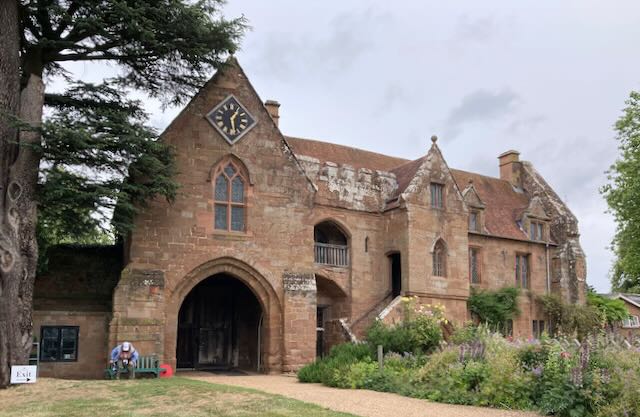
The red sandstone gatehouse, where you buy entry tickets, is from the 14th century, a remnant of the original Cistercian monastery. At this gatehouse, built in 1346 by Abbot Robert de Hoeckle, the poor received alms and travelers found hospitality.

So low did the building stand, that she found herself passing through the great gates of the lodge into the very grounds of Northanger, without having discerned even an antique chimney. . . . To pass between lodges of a modern appearance, to find herself with such ease in the very precincts of the abbey, and driven so rapidly along a smooth, level road of fine gravel, without obstacle, alarm, or solemnity of any kind, struck her as odd and inconsistent.–Catherine Morland, Northanger Abbey

Now we are coming to the lodge-gates; but we have nearly a mile through the park still.–Maria Bertram, Mansfield Park

The tour did not take us into this north wing. But you can still see arches on the walls, from the original monastery church. They are now bricked over. A cloister and medieval stained glass windows remain in the older buildings.
Another building from the old monastery. Stoneleigh Abbey was a small Cistercian monastery from 1155 until Henry VIII dissolved the monasteries in 1536. The Leigh family bought it in 1561. Catherine Morland was disappointed not to stay in such a building at Northanger Abbey.

[Catherine] was hardly more assured than before, of Northanger Abbey having been a richly endowed convent at the time of the Reformation, of its having fallen into the hands of an ancestor of the Tilneys on its dissolution–Northanger Abbey
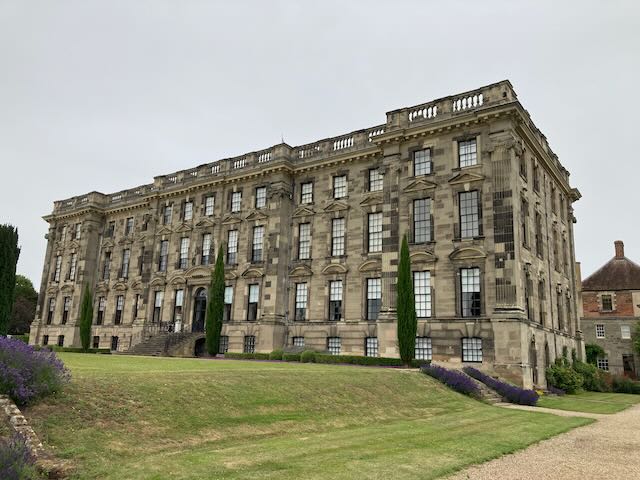
The baroque West Wing is the most impressive building, built in the 1720s by Edward, the third baron Leigh. He married a rich heiress. After his Grand Tour on the continent, he was inspired to create his own Italian-style palace. Mrs. Austen wrote that there are 45 windows in the front.

She was struck, however, beyond her expectation, by the grandeur of the abbey, as she saw it for the first time from the lawn.–Catherine Morland, Northanger Abbey

Even Fanny had something to say in admiration. . . . Her eye was eagerly taking in everything within her reach; . . . being at some pains to get a view of the house, and observing that “it was a sort of building which she could not look at but with respect”–Mansfield Park

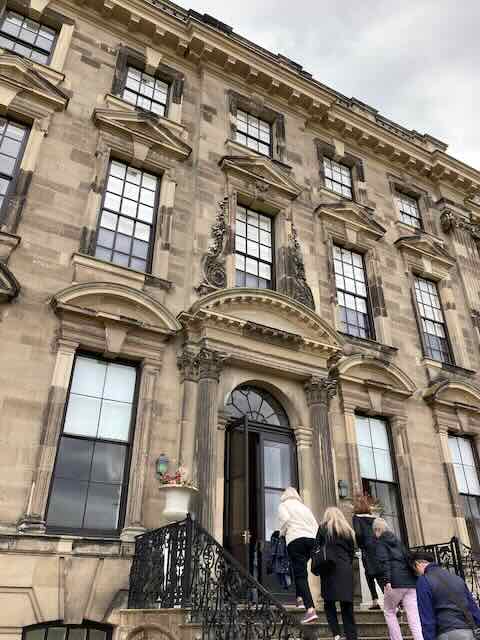
Architect Francis Smith designed the Stoneleigh Abbey West Wing, which cost £3,300. The older abbey buildings became servants’ quarters.
A flight of stairs leads up to the main entry to Stoneleigh Abbey, West wing

Miss Bertram could now speak with decided information of what she had known nothing about when Mr. Rushworth had asked her opinion; and her spirits were in as happy a flutter as vanity and pride could furnish, when they drove up to the spacious stone steps before the principal entrance.–Mansfield Park
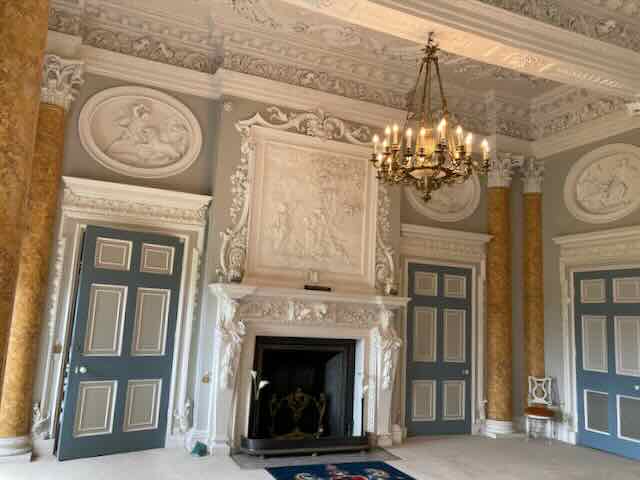
One end of the impressive “saloon” (salon, entry room) of Stoneleigh Abbey. Plaster decorations show myths of the Greek hero Hercules. Edward, the fifth Lord Leigh, decorated this room in the 1760s while doing vast “improvements” to his manor.
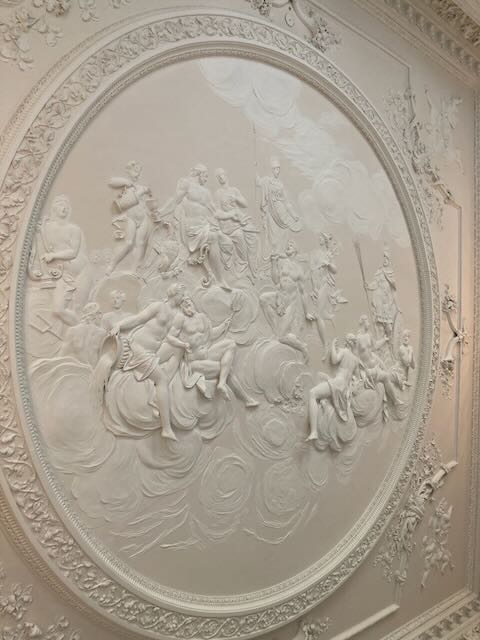
Ceiling plasterwork in the Stoneleigh Abbey saloon showing Hercules joining the gods. Ironically, Hercules suffered from bouts of madness, as did Edward Leigh himself.

An abbey! Yes, it was delightful to be really in an abbey! But she doubted, as she looked round the room, whether anything within her observation would have given her the consciousness. The furniture was in all the profusion and elegance of modern taste.–Catherine Morland, Northanger Abbey

The whole party rose accordingly, and under Mrs. Rushworth’s guidance were shewn through a number of rooms, all lofty, and many large, and amply furnished in the taste of fifty years back, with shining floors, solid mahogany, rich damask, marble, gilding, and carving, each handsome in its way.–Mansfield Park
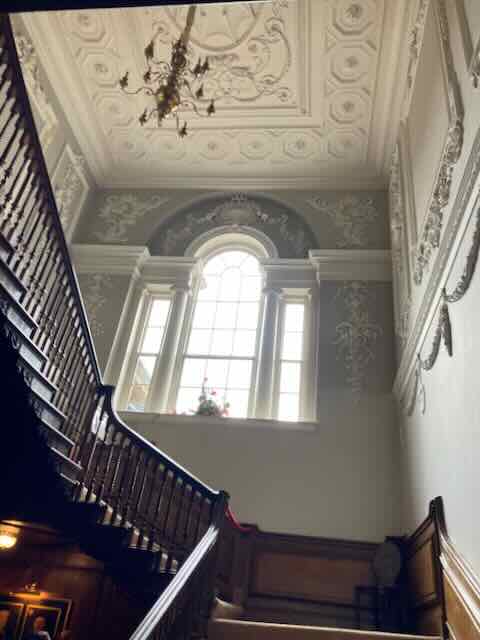
The main staircase of Stoneleigh Abbey, one of three staircases Jane Austen’s mother mentions.

They returned to the hall, that the chief staircase might be ascended, and the beauty of its wood, and ornaments of rich carving might be pointed out.–Northanger Abbey

The lower part of the house had been now entirely shewn, and Mrs. Rushworth, never weary in the cause, would have proceeded towards the principal staircase, and taken them through all the rooms above, if her son had not interposed with a doubt of there being time enough.–Mansfield Park
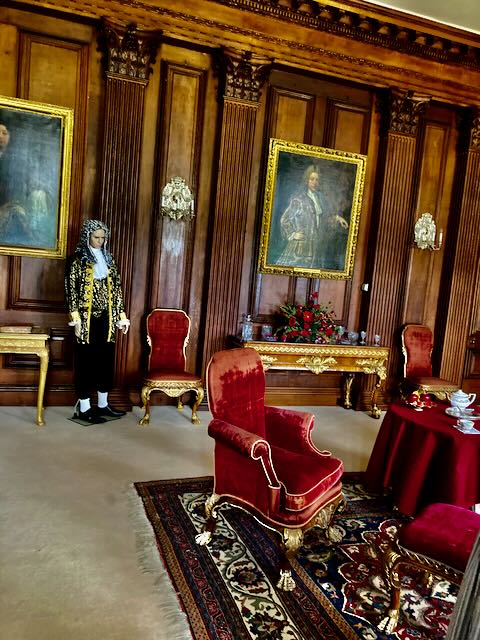
The drawing room of Stoneleigh Abbey. After dinner, the ladies would “withdraw” to the “withdrawing room,” later called the drawing room. The gentlemen would join them after a time.

The general leads Catherine “into a room magnificent both in size and furniture—the real drawing-room, used only with company of consequence. It was very noble—very grand—very charming!—was all that Catherine had to say, for her indiscriminating eye scarcely discerned the colour of the satin; and all minuteness of praise, all praise that had much meaning, was supplied by the general: the costliness or elegance of any room’s fitting-up could be nothing to her; she cared for no furniture of a more modern date than the fifteenth century.”–Northanger Abbey

The drawing room clock, from 1786, plays carillon music on the hour. Stoneleigh Abbey

“Till midnight, she supposed it would be in vain to watch; but then, when the clock had struck twelve, and all was quiet, she would, if not quite appalled by darkness, steal out and look once more. The clock struck twelve—and Catherine had been half an hour asleep.”–Northanger Abbey

Stoneleigh Abbey card room fireplace, with plates of “the prettiest English china,” hand painted by ladies of the family.

The fireplace, where she had expected the ample width and ponderous carving of former times, was contracted to a Rumford, with slabs of plain though handsome marble, and ornaments over it of the prettiest English china.–Northanger Abbey

A Rumford was an invention that made fireplaces more efficient. They are still used today.
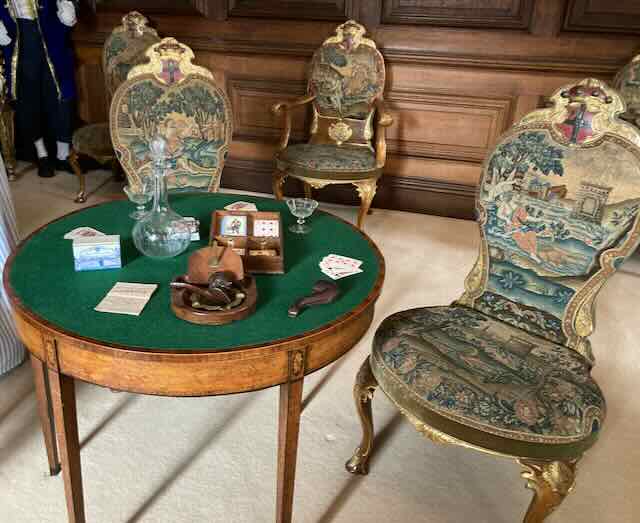
Stoneleigh Abbey card room, set up for a game of cards.

Mr. Elton had retreated into the card-room, looking (Emma trusted) very foolish.–Emma
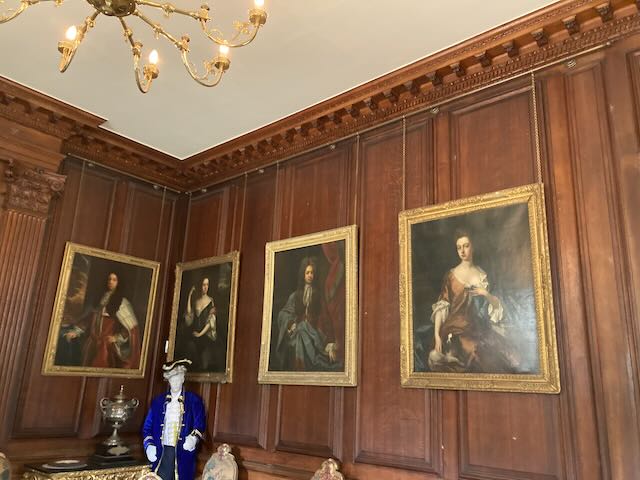
Portraits in the Card Room. All the rooms we saw were lined with family portraits.

Of pictures there were abundance, and some few good, but the larger part were family portraits, no longer anything to anybody but Mrs. Rushworth–Mansfield Park

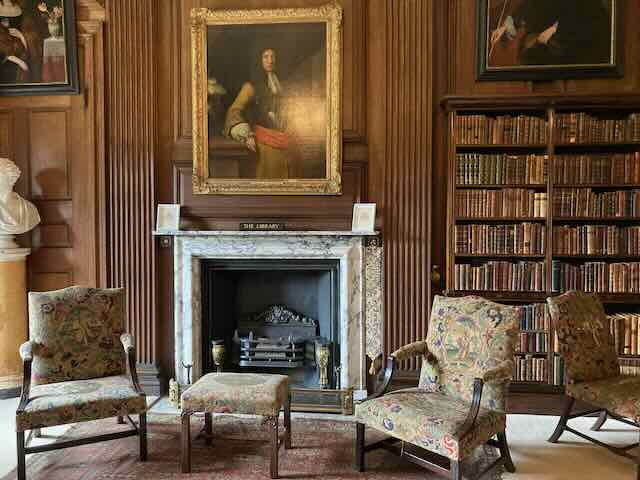
Edward, fifth Lord Leigh, bequeathed most of his extensive library to his alma mater, Oriel College at Oxford. These included “outstanding works on architecture and music, his scientific instruments, maps and prints.” (Jane Austen & Adlestrop, 22).
The library of Stoneleigh Abbey was replenished by later heirs.

Marianne, who had the knack of finding her way in every house to the library, however it might be avoided by the family in general, soon procured herself a book.–Sense and Sensibility

Ready to play chess in the library, Stoneleigh Abbey

“What a delightful library you have at Pemberley, Mr. Darcy!”

“It ought to be good,” he replied, “it has been the work of many generations.”

“And then you have added so much to it yourself, you are always buying books.”

“I cannot comprehend the neglect of a family library in such days as these.”–Miss Bingley and Mr. Darcy, Pride and Prejudice
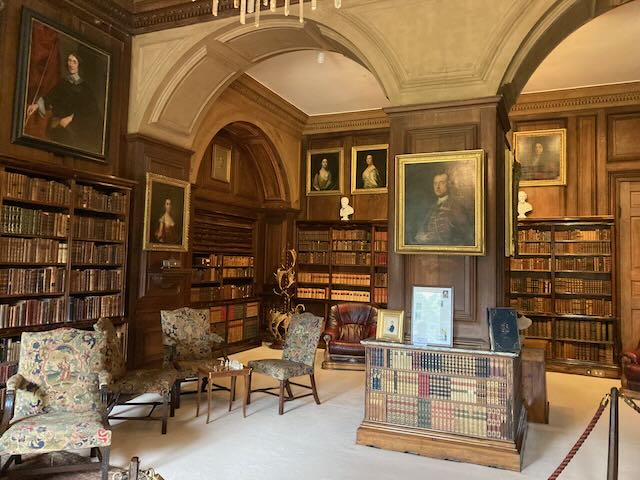
Stoneleigh Abbey library

After tea, Mr. Bennet retired to the library, as was his custom–Pride and Prejudice

Ladies’ dressing table, Stoneleigh Abbey

“My mother is tolerably well, I trust; though her spirits are greatly shaken. She is up stairs and will have great satisfaction in seeing you all. She does not yet leave her dressing-room.”–Jane Bennet, Pride and Prejudice
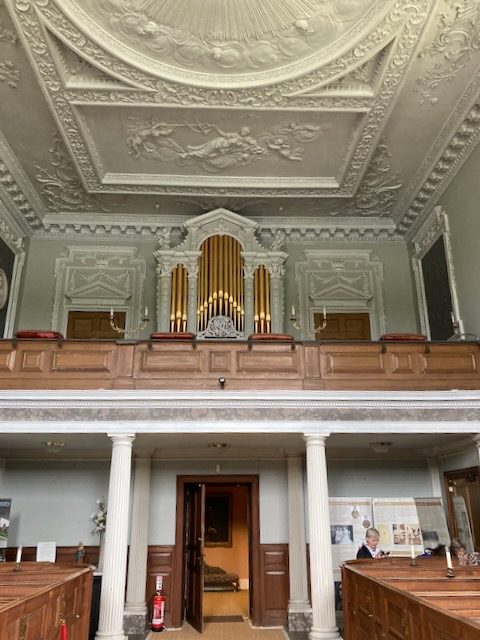
The chapel at Stoneleigh Abbey is considered to be the model for the chapel at Sotherton in Mansfield Park. Crimson cushions appear over the balcony ledge, as in Mansfield Park. Rev. Thomas Leigh read prayers (led a worship service) in the chapel twice a day, with morning prayers at 9 A.M.

Fanny’s imagination had prepared her for something grander than a mere spacious, oblong room, fitted up for the purpose of devotion: with nothing more striking or more solemn than the profusion of mahogany, and the crimson velvet cushions appearing over the ledge of the family gallery above. “I am disappointed,” said she, in a low voice, to Edmund. “This is not my idea of a chapel. There is nothing awful here, nothing melancholy, nothing grand.” . . .

Mrs. Rushworth began her relation. “This chapel was fitted up as you see it, in James the Second’s time. Before that period, as I understand, the pews were only wainscot; and there is some reason to think that the linings and cushions of the pulpit and family seat were only purple cloth; but this is not quite certain. It is a handsome chapel, and was formerly in constant use both morning and evening. Prayers were always read in it by the domestic chaplain, within the memory of many; but the late Mr. Rushworth left it off.” . . .

“It is a pity,” cried Fanny, “that the custom should have been discontinued. It was a valuable part of former times. There is something in a chapel and chaplain so much in character with a great house, with one’s ideas of what such a household should be! A whole family assembling regularly for the purpose of prayer is fine!”–Mansfield Park

See my post on The Stoneleigh Abbey Chapel and Mansfield Park for a visit to the chapel with further quotes from Mansfield Park.

Queen Victoria’s bedroom at Stoneleigh Abbey. In 1858, Queen Victoria stayed for two nights at the Abbey, in a suite of five rooms. The furniture was painted white and gold, according to the Queen’s preference.

In a house so furnished, and so guarded, she could have nothing to explore or to suffer, and might go to her bedroom as securely as if it had been her own chamber at Fullerton.–Catherine Morland, Northanger Abbey
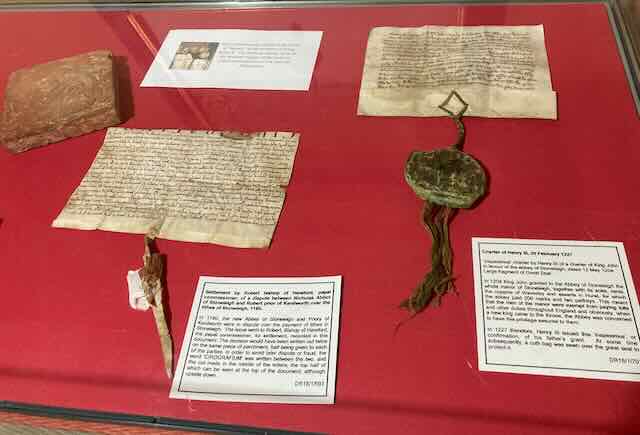
Further rooms at Stoneleigh Abbey display historical relics, such as the monks’ charters and seals.

Northanger turned up an abbey, and she was to be its inhabitant. Its long, damp passages, its narrow cells and ruined chapel, were to be within her daily reach, and she could not entirely subdue the hope of some traditional legends, some awful memorials of an injured and ill-fated nun.–Catherine Morland, Northanger Abbey

Humphry Repton was hired to improve Stoneleigh Abbey and its surroundings. His Red Book, showing before and after pictures, still exists.
Repton moved the river toward Stoneleigh Abbey so you could see the house reflected in the water.

“Smith’s place is the admiration of all the country; and it was a mere nothing before Repton took it in hand. I think I shall have Repton.”–Mr. Rushworth, Mansfield Park

A ha-ha (see below) at Stoneleigh Abbey gives an uninterrupted view across the fields.
From the other side of Stoneleigh Abbey’s hedge of lavender shown above, you can see the wall that kept animals from trespassing to the area around the house. A ha-ha is a walled ditch dug to act as a fence without disrupting the view.

A few steps farther brought them out at the bottom of the very walk they had been talking of; and standing back, well shaded and sheltered, and looking over a ha-ha into the park, was a comfortable-sized bench, on which they all sat down. . . .

“You will hurt yourself, Miss Bertram,” [Fanny Price] cried; “you will certainly hurt yourself against those spikes; you will tear your gown; you will be in danger of slipping into the ha-ha.”–Mansfield Park

In 1946, Stoneleigh Abbey became “one of the first stately homes to open its doors to the public” (Stoneleigh Abbey, 18). A fire destroyed much of it in 1960, though most of the furniture and paintings were rescued. In 1996, a trust was set up to restore it, at a cost of £12 million. They did an amazing job. Restoration was also done on the grounds and the lake. The restoration work sought to improve the habitats of bats, otters, kingfishers, and other species

Restorers also worked on conserving water management structures such as these locks.
We exit back through the Stoneleigh Abbey gatehouse, having enjoyed a beautiful day.

During their visit, the Austens enjoyed extensive walks through the grounds. Rachel Dodge has posted some of those lovely views. The Austens must have also attended the Stoneleigh Church, St. Mary the Virgin, though we didn’t get to visit it this trip. 

I hope you have enjoyed our visit to Stoneleigh Abbey with Jane Austen’s characters, and that you can see it in person some day! This year, the Abbey celebrated Christmas with a Christmas fair and a series of concerts, including carols in the chapel. If you have been to Stoneleigh Abbey, please tell us about your impressions!

Brenda S. Cox is the author of Fashionable Goodness: Christianity in Jane Austen’s England. She also blogs at Faith, Science, Joy, and Jane Austen.

All photos in this post, © Brenda S. Cox, 2023.

Sources and Further Reading

Jane Austen & Adlestrop: Her Other Family, by Victoria Huxley. US Amazon link

Stoneleigh Abbey by Paula Cornwell (obtained from Stoneleigh Abbey)

Jane Austen: A Family Record, 2nd ed., by Deirdre Le Faye

The Stoneleigh Abbey Chapel and Mansfield Park

Jane Austen’s Rich(er) Leigh Family Connections at Adlestrop and Stoneleigh Abbey 

Visiting Stoneleigh Abbey

Cassandra Leigh Austen’s Stay at Stoneleigh Abbey (letter)

Jane Austen’s Leigh Family: Stories Behind the Stories

Jane Austen’s Clergymen and Her Leigh Family

Jane Austen’s Mansfield Park and Stoneleigh Abbey

More pictures of Stoneleigh village, church, and abbey 

Stoneleigh Abbey website

Read Full Post »

By Brenda S. Cox

“Yesterday came a letter to my mother from Edward Cooper to announce, not the birth of a child, but of a living; for Mrs. Leigh has begged his acceptance of the Rectory of Hamstall-Ridware in Staffordshire, vacant by Mr. Johnson’s death. We collect from his letter that he means to reside there, in which he shows his wisdom. Staffordshire is a good way off . . .”—Jane Austen to Cassandra, Jan. 21, 1799

In 1806, Jane Austen and her family made a trip to visit their relatives in the north. They spent five weeks with her first cousin Edward Cooper, rector of Hamstall Ridware (whom I wrote about earlier). They stayed in his rectory, and must have attended the adjacent Church of St. Michael and All Angels and heard Edward Cooper preach there. The church is still much as Austen knew it, inside and out.

The Church of St. Michael and All Angels, Hamstall Ridware, where Jane Austen visited for several weeks in 1806. Photo © Brenda S. Cox, 2023

Hamstall Ridware History

Hamstall Ridware means “homestead,” or “place of the house,” by the “river ford.” It is on the River Blithe. The first word is Anglo-Saxon, the second is Celtic, indicating that the two people groups may have both been living in the area at the time it was named. Three other towns with the name Ridware (Pipe Ridware, Hill Ridware, and Mavesyn Ridware) are nearby.

The de Ridware family were the medieval “lords of the manor” for the area. The church was built, in the Norman style, around 1120 A.D, and expanded in the 14th and 15th centuries.

In the 1370s, the de Ridwares had no male heir, so the land passed to the Cotton family. A Cotton family tomb, from the time of King Henry VIII, still stands in the church. Each shield on the sides commemorates one of the children of John and Joanna Cotton. Half of each shield is their family crest, an eagle on a blue background. For the sons, the other half represents their profession. For the daughters, the other half shows the shield of their husband’s family.

This tomb from the time of King Henry VIII represents all the children of the Cotton family, the lords of the manor at the time. Photo © Brenda S. Cox, 2023

In the 1500s, the Cottons had no male heir, so the manor, Hamstall Hall, and the lands, passed to Sir Anthony Fitzherbert, the husband of the eldest daughter. 

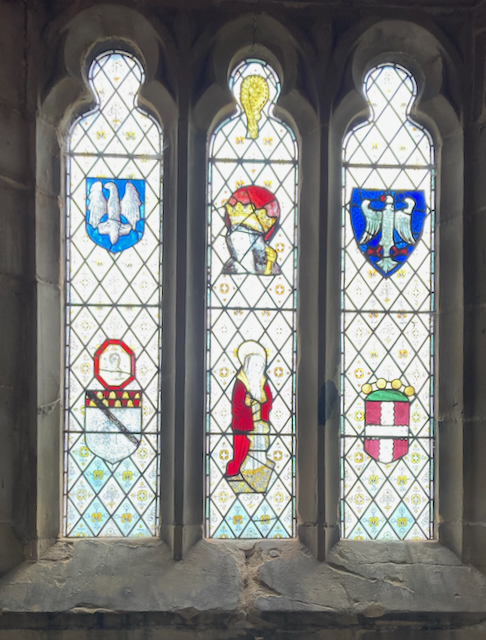
In 1601 the estate went to Sir Thomas Leigh of Stoneleigh, one of Jane Austen’s forebears. This early stained glass window, incorporating 14th century glass, commemorates all these patrons of the Hamstall Ridware church. Each family would have owned the advowson for the Hamstall Ridware church, the right to choose the rector of the church when the previous one died.

Stained glass window in Hamstall Ridware church. This window shows coats of arms of the families who have owned the manor and land of Hamstall Ridware: the de Ridwares of Hamstall on the upper right, the Cotton de Ridwares on the upper left, the Fitzherberts on the lower left, and the Leighs on the lower right. Alice Cotton, wife of Richard Cotton, appears near the top of the middle panel. Photo © Brenda S. Cox, 2023

The Leighs’ main home was at Stoneleigh Abbey (which we’ll “visit” later). The Hon. Mary Leigh of Stoneleigh Abbey was patroness of Hamstall Ridware in 1799.  When the previous rector, Mr. Johnson, died, she gave the living to her relative Edward Cooper. Before that he had been a curate, an assistant or substitute clergyman, probably with a low salary, at Harpsden. Jane and her family had visited the Coopers at Harpsden in August and September of 1799, before the Coopers moved to Hamstall Ridware in October. Edward invited them to visit Hamstall Ridware in 1801, but Jane said in a letter that they preferred to go to the seaside that summer. However, five years later, the Austens did make a long trip to visit their Leigh relations at Adlestrop, then accompanied their cousin, Rev. Thomas Leigh, who had just inherited Stoneleigh Abbey, to the abbey. From Stoneleigh they went to Hamstall Ridware, 38 miles away.

During this time, it’s possible that Jane may have seen the play Lover’s Vows, an important part of Mansfield Park. It was advertised in a village called Cheadle about an hour’s carriage ride away (Gaye King, “Visiting”).

Unfortunately, during Jane’s visit, Edward’s eight children came down with whooping cough, and Jane got it a few weeks later, after she got home (Letters, Jan. 7, 1807).

Displays in the church commemorate Jane Austen, her visit to Hamstall Ridware, the history of the church, and the Leigh family’s connections to the area. Photo © Brenda S. Cox, 2023
The church history board gives fascinating tidbits. For example, the parish register for 1715 lists the death of rector Thomas Allestree, M.A., and the induction of a new rector, Gorstelowe Monck, A.M. (same as M.A., Master of Arts); 7 baptisms (presumably of babies); 5 marriages including two to widows, and two others by license, both with one spouse from another parish; 7 burials, including Rev. Allestree (age 77) in July, his widow in December, and two babies buried shortly after their baptisms. An adjacent news article about Rev. Allestree says he wrote and memorized 500 sermons, and preached them a total of 5,000 times! Photo © Brenda S. Cox, 2023

The Rectory

The rectory (or parsonage, the house provided for the rector of the parish) where the Austens stayed is now a private home. It is now difficult to see even from the outside, but this photo shows the building before a gate was built.

The Hamstall Ridware rectory, before gates were installed. Jane Austen and her family stayed here for five weeks in 1806 with Jane’s cousin Edward Cooper. Photo © Jack Barber, 2017, used by permission.

It has been speculated that this rectory was the pattern for the Delaford rectory, where Edward and Elinor Ferrars settle in Sense and Sensibility. The layout of the Delaford estate, with “stew-ponds” (fish ponds), “a very pretty canal” (perhaps suggested by the nearby river), and “great garden walls,” also corresponds to some features of the Leighs’ estate at Hamstall Ridware.

Gaye King wrote,

“Edward had found the rectory quite large enough to accommodate his growing family. Like the fictional parsonage at Delaford it had ‘five sitting-rooms on the ground floor, and … could make up fifteen beds’ (292). So the young rector could look forward to maintaining the tradition of liberal hospitality such as that he had enjoyed at the Steventon parsonage. When Jane Austen, together with her mother and sister, did eventually spend those five weeks at Hamstall Ridware in 1806 Edward and Caroline had eight children. There were also, living in at the rectory, two maids and a governess, yet there was still ample accommodation for the guests.”

(I have since noticed that the five sitting rooms and fifteen beds were characteristics of the manor house where Col. Brandon lived, not of the parsonage! And I doubt a country parsonage would have so many sitting rooms.)

However, relatives who visited wrote that it was “a beautifully situated parsonage house on a considerable eminence, back’d with fine woods, seen at a distance from the road to this happy village,” and that the church “was a very neat old Spire Building of stone, having two side Ailes [sic] Chancel &c. and makes a magnificent appearance as a Village Church” (quoted in Deirdre Le Faye, Jane Austen: A Family Record, 157).

The Church of St. Michael and All Angels, Hamstall Ridware

The Church of St. Michael and All Angels, Hamstall Ridware, where Jane Austen’s cousin Edward Cooper was rector from 1799-1833. Photo © Brenda S. Cox, 2023

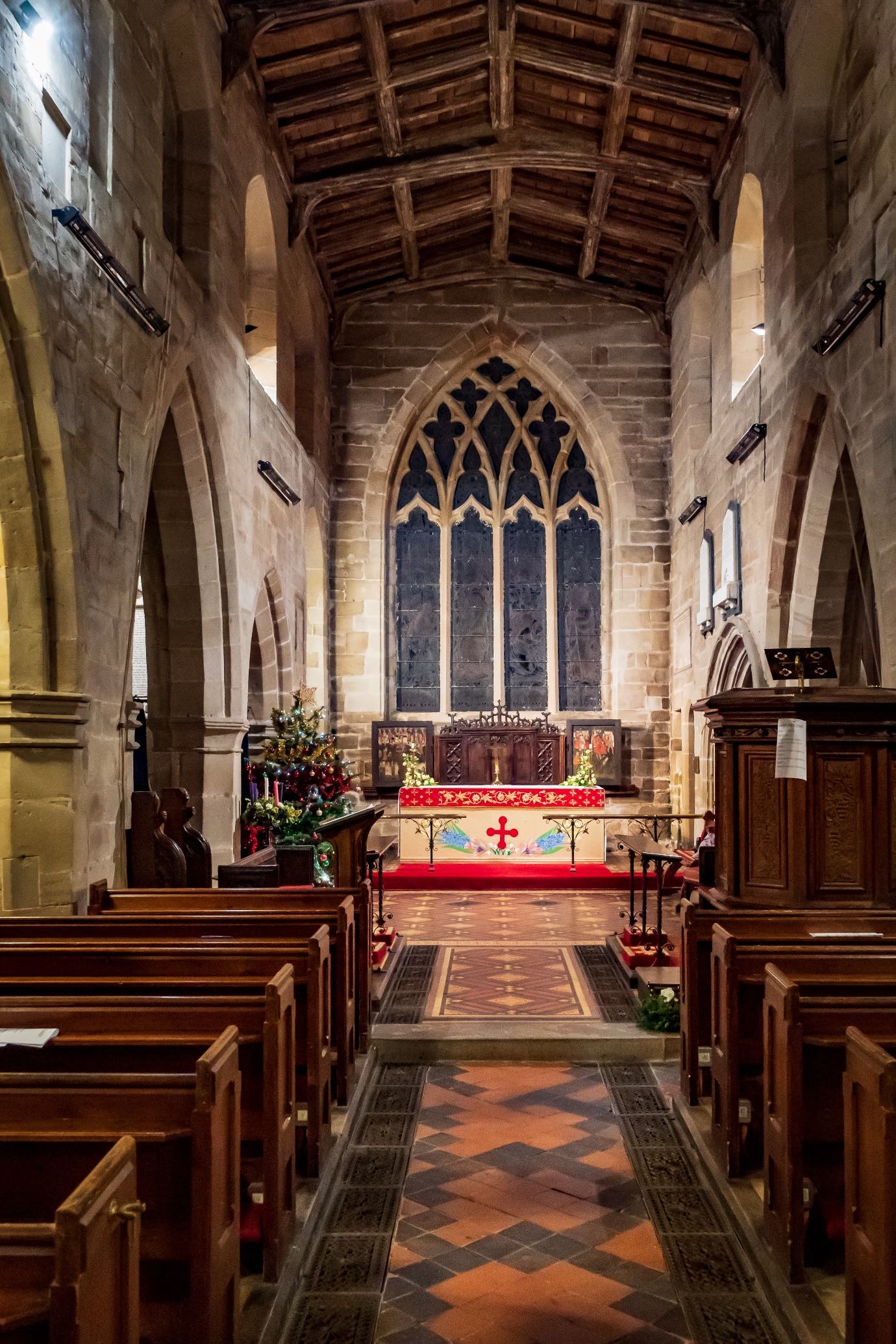
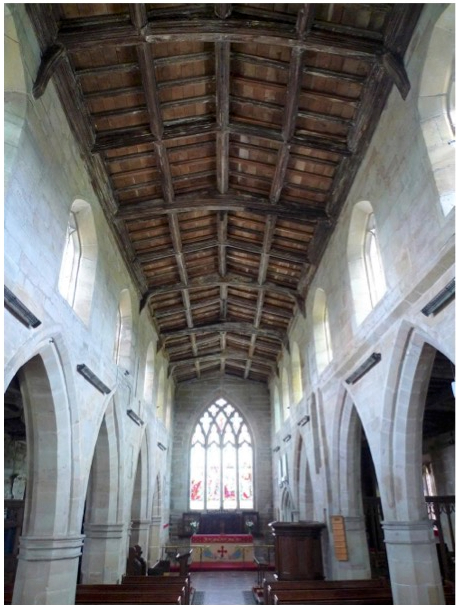
The church is large, seating 200 people, almost three times the size of Jane’s church at Steventon (which seats about 75). It has a long central aisle leading to the chancel, where the altar sits, and two side aisles. Lining both sides is a clerestory, high walls with a series of windows which let in natural light.

Central aisle of the Hamstall Ridware church. Photo courtesy of Hamstall Ridware PCC, used by permission.
Unusually, the upper section of the church has clerestory windows down the whole length of the church, lighting up the whole interior. The aisle roofs are “moulded ridge pieces and tie beams.” Photo courtesy of Hamstall Ridware PCC, used by permission.
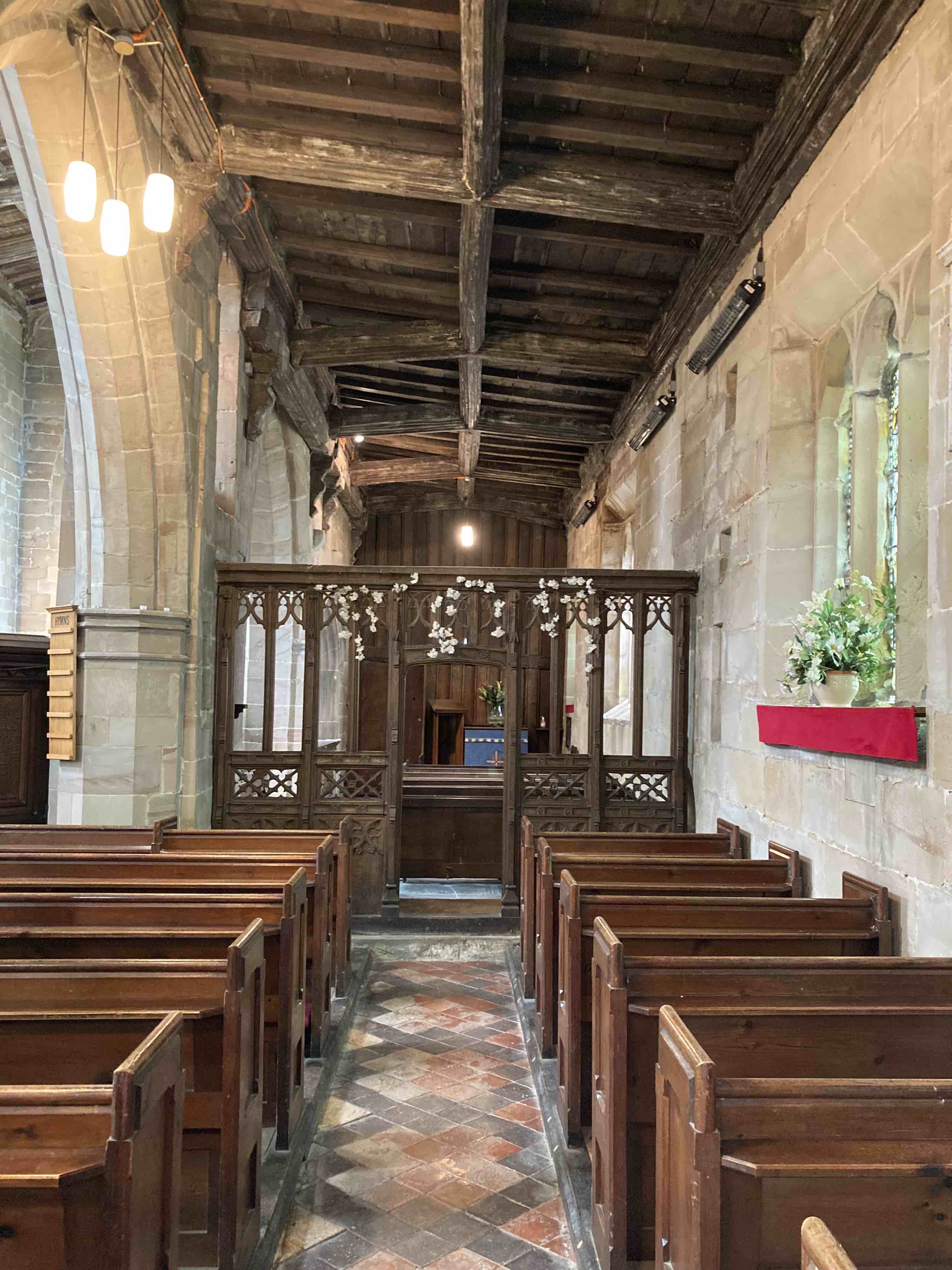
Late 15th century chapel screen on a side aisle. Photo © Brenda S. Cox, 2023

Like many churches in England before the Reformation, this church once had a rood screen separating the chancel from the nave. This was a barrier between the chancel, where the clergy celebrated mass at the altar, and the lay people worshiping in the nave. It was usually topped by a cross; the Anglo-Saxon word for cross is rood. Some churches also had a rood loft, above the screen, from which a choir would sing parts of the service. Many rood screens and lofts were destroyed during or after the Reformation, to symbolize people’s more direct access to God.

A few steps, which once led to the rood loft, still remain in one wall. Two paintings from the rood screen are now behind the main altar in a reredos (reer-ih-dahss is one pronunciation). This means a decorative panel behind the altar. These paintings are from the late 15th century, by an unknown accomplished artist, probably local.

The reredos behind the altar includes two 15th century paintings from the rood screen of the church, which was destroyed during the Reformation. The one on the left is apparently unique in England. It shows times when Christ’s blood was shed: “the circumcision, the agony in the garden, the scourging, the crown of thorns and the crucifixion,” according to the church booklet. “The right-hand panel shows the procession of the cross with St. Mary Magdalene kneeling in front of it. Both panels have been heavily scratched and scored. This was probably done at the time of the Civil War [1642-1651], when everything that had Roman Catholic associations was defaced.” Photo © Brenda S. Cox, 2023

Memorials to the Cooper Family

Edward Cooper and his family left their mark on the church. The memorial to Edward Cooper says:

In a vault near this spot, are deposited the remains of the Rev. EDWARD COOPER, who, for upwards of 30 years was rector of this parish, and for many years of the adjoining parish of Yoxall also: in both which places, (as a faithful minister of Christ, and endeared to all his parishioners,) he discharged, with unremitting zeal, the duties of his sacred office.

He was the only son of the Rev. Edward Cooper, L.L.D. vicar of Sonning Berks, &c. and prebendary of Bath and Wells; and of Jane his wife, grandaughter of Theophilus Leigh, Esq., of Addlestrop, in the county of Gloucester,

He was formerly fellow of All-Souls’ College, Oxford, as was his father also.

He departed this life, the 26th day of February, 1833, in the 63rd year of his age.

“He being dead yet speaketh”

Within the same vault also repose the remains of CAROLINE ISABELLA, his widow, only daughter of Philip Lybbe Powys, Esq. of Hardwick House in the county of Oxford,

She died on the 28th day of August, 1838, in the 63rd year of her age.

This tablet is erected by their eight surviving children, as a tribute of grateful affection, and respect, to the memory of their deeply lamented, and much beloved parents.

Memorial in Hamstall Ridware church to Edward Cooper, rector. Photo © Brenda S. Cox, 2023

As the memorial notes, Edward was also rector of a neighboring parish, Yoxall (from 1809). Like George Austen, he needed the income from two small parishes and was able to serve them both since they were close. Rev. Thomas Gisborne, another Evangelical minister, was from Yoxall. He wrote a book that Cassandra and Jane both liked, An Enquiry into the Duties of the Female Sex (letter of Aug. 30, 1805). Perhaps Edward had recommended it to them. Though we have no record of it, it’s possible Jane could have met Gisborne during her visit. He was a friend of Edward’s, and he and Henry Austen were the godfathers of one of Edward’s sons. Gisborne was also involved with Wilberforce in fighting the slave trade. (Gaye King, “Cousin” article)

On another wall is a memorial to Edward’s son and grandson. His youngest son Warren died in 1844, age 39, and Warren’s son, Edward-Warren, died as an infant in 1840.

Hamstall Ridware memorial to Edward Cooper’s son and grandson. Photo © Brenda S. Cox, 2023

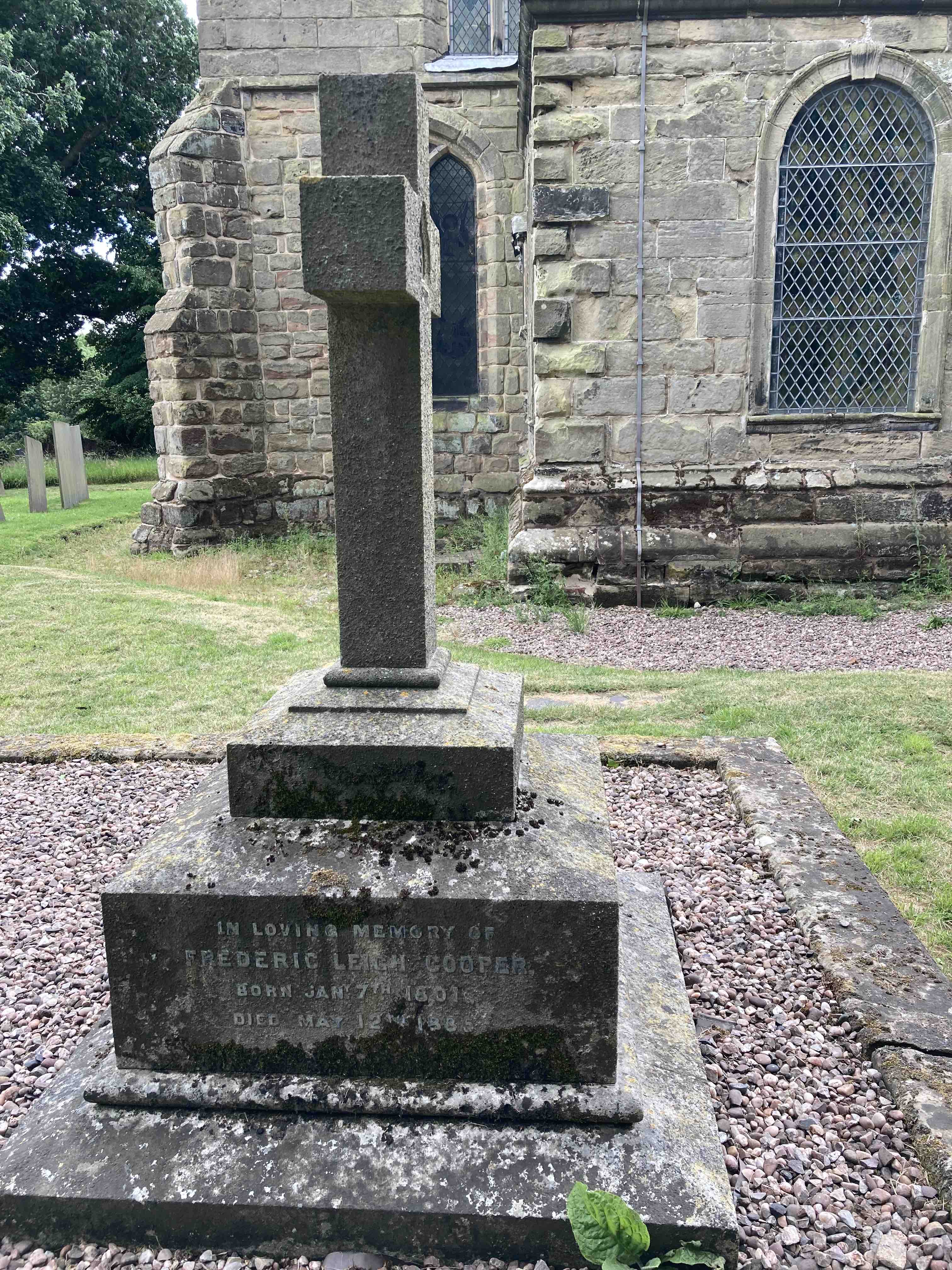
Outside, under a large cross, are the graves of Edward’s third son, Rev. H. C. Cooper, vicar of Barton-under-Needwood (5.6 miles away), who died in 1876, “in the 76th year of his age.” Also Edward’s second daughter, Cassandra Louisa, who died in 1880, “in the 84th year of her age.” The final inscription reads, “Looking for the mercy of our Lord Jesus Christ unto eternal life. Jude, v. 21”

Another side memorializes Frederic Leigh Cooper, born 1801, died 1885. This was Edward’s fifth child

This cross identifies the burial site of several of Edward Cooper’s children in the Hamstall Ridware church burial ground. Photo © Brenda S. Cox, 2023
Side view of cross with inscription to another son. Photo © Brenda S. Cox, 2023

Glebe

Green fields surround the church. Most churches in England had glebe land, farmland that provided income for the clergyman. In 1978, all glebe land was transferred to the dioceses, who administer it now. (A diocese is a group of church parishes overseen by a bishop.) Some modern locations in England still retain the name glebe. Hamstall Ridware is part of the Diocese of Lichfield, and I was told the diocese still receives income from grazing on glebe lands nearby. Glebe income today is used to pay clergy salaries and other expenses.

The Hamstall Ridware church is in the midst of green fields, some of which still provide income to the Church of England today. Photo © Brenda S. Cox, 2023

The Church Today

The Hamstall Ridware church is now part of a benefice including four parishes with one rector. In 1831, the population of the parish was 443. In 2011 it was 313.

Hamstall Hall, previous home of the Leigh family, is now mostly in ruins. But, according to the church booklet, the current Lord Leigh is still “a patron of the United Benefice of King’s Bromley, the Ridwares, and Yoxall jointly with the Bishop of Lichfield and the Dean and Chapter of Lichfield Cathedral.” (In other words, they jointly choose/approve the clergymen for the churches of the benefice.) 

Like Chawton and Steventon, Sunday services are held at the Hamstall Ridware church weekly, usually with only ten or so faithful parishioners attending. The church is large, seating 200 people, but it has little heating, and only a chemical toilet outside. However, they do get big crowds for Harvest, Christmas, and other special services, as well as lectures and concerts. And many visitors come to the church, which is open in the daytime, though apparently the door can be tricky to open.

The Church of St. Michael and All Angels is well worth a visit for Jane Austen enthusiasts. It is just over an hour’s drive, by car, from Stoneleigh Abbey. The Samuel Johnson Birthplace Museum in Lichfield is on the way.

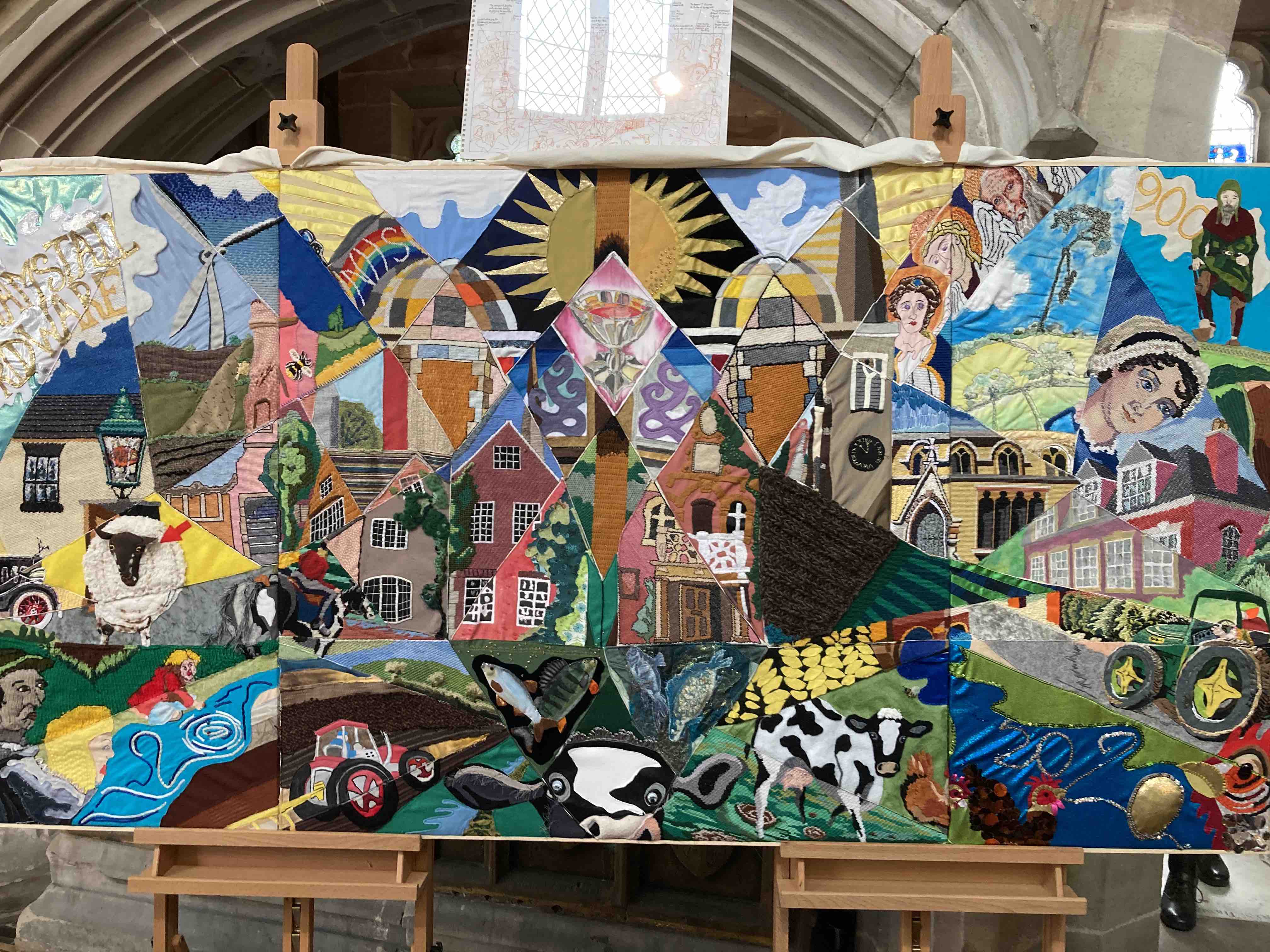
The people of the church created a tapestry depicting Hamstall Ridware through 900 years of history. Jane Austen’s face is prominent on the right side. Photo © Brenda S. Cox, 2023

For Further Exploration

This post from the Ridware Historic Society includes diary entries from Edward’s mother-in-law, during her visits to the family at Hamstall Ridware, as well as more information about the town and its people.

The church website gives some history and a schedule of services.
The historic listing tells more details of the church’s architecture.

A video showing many aspects of the church

Booklet on the church (a slightly older version than the one I used for this article)  

Photos on Flickr of Hamstall Hall, Hamstall Ridware church and Yoxall church  

Gaye King “Jane Austen’s Staffordshire Cousin: Edward Cooper and His Circle,” Persuasions 1993

Gaye King, “Visiting Edward Cooper,” Persuasions 1987

Donald Greene article, “Hamstall Ridware: A Neglected Austen Setting,” Persuasions 1985 

Posts on other Jane Austen Family Churches

Steventon

Chawton

Adlestrop and the Leigh Family

Stoneleigh Abbey Chapel

Great Bookham and Austen’s godfather, Rev. Samuel Cooke

Ashe and Jane’s Friend Mrs. Lefroy 

Deane

Brenda S. Cox is the author of Fashionable Goodness: Christianity in Jane Austen’s England. She also blogs at Faith, Science, Joy, and Jane Austen.

Read Full Post »

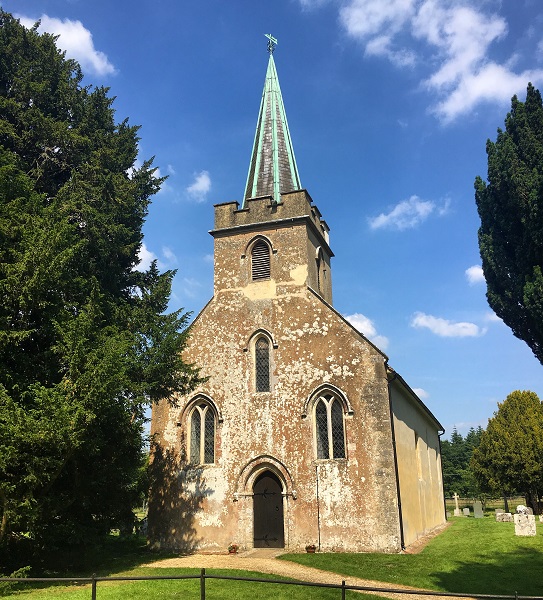
“My father’s old Ministers are already deserting him to pay their court to his Son; the brown Mare, which, as well as the black was to devolve on James at our removal, has not had patience to wait for that, & has settled herself even now at Deane.”—Jane Austen to Cassandra, Jan. 8, 1801, when her brother James was about to take over their father’s place as clergyman at Steventon church (as his father’s curate), and James was taking over much of their property as Jane, Cassandra, and their parents moved to Bath.

Church was an important part of Jane Austen’s life and her family’s lives. Last time we explored the church at Chawton, which Austen attended during the later years of her life. Today we’ll visit Steventon, the church in which she grew up. Both churches are named after St. Nicholas, both are small country churches of the national Church of England, and both are named after St. Nicholas, patron saint of sailors, children, and others. (He is also called, in a more modern incarnation, Santa Claus.)

St. Nicholas’ Church at Steventon, where Jane Austen grew up. Her father was the rector. Photo © Brenda S. Cox 2023

The Rectory

Jane grew up in the rectory at Steventon, which no longer exists. Her father was the rector, the clergyman of St. Nicholas’. The rectory, or parsonage, was the house provided for the rector to live in.  George Austen made repairs and additions to the rectory as his family grew, and as he began to teach boarding students to supplement his church income.

When Jane’s father died in 1805, her brother James became rector of Steventon. After he died, her brother Henry served temporarily for three years (as Charles Hayter gets a temporary living at the end of Persuasion). Both lived in the rectory while serving the church.

However, that rectory was damp and tended to flood. The Knight family were the patrons of the parish, choosing the rectors for the church (as Colonel Brandon was the patron of his parish, giving a church living to Edward Ferrars). In 1823, Edward Knight’s son William Knight (Jane’s nephew) became rector of Steventon. Edward built a new rectory for his son, opposite the church on higher ground. That building still stands, now a private home called Steventon House (put up for sale in 2023).

Jane Austen’s family home, the old rectory, was demolished in the 1820s. In 2011, excavators found bits and pieces at the site: fragments of pottery and crockery, nails, etc.  An old pump sat on the site for a long time; now you can see part of it inside the church.
Behind a grate in the Steventon church lie various treasures: pieces of the original rectory pump, medieval tiles, and metal pattens worn by ladies like Austen to lift their feet out of the mud. The teacup is from the Steventon Methodist Church, built after Austen’s time. Photo © Brenda S. Cox 2023 (Screen partially funded by JASNA, Ohio North Coast region)
The church itself is still standing and, in form at least, is mostly as Jane Austen knew it. She and her family worshiped there most Sundays for the first twenty-five years of her life. They likely attended church on Sunday afternoons or evenings as well as mornings. Services were several hours long, so Jane spent quite a bit of time at that church.

History of St. Nicholas’ Church, Steventon

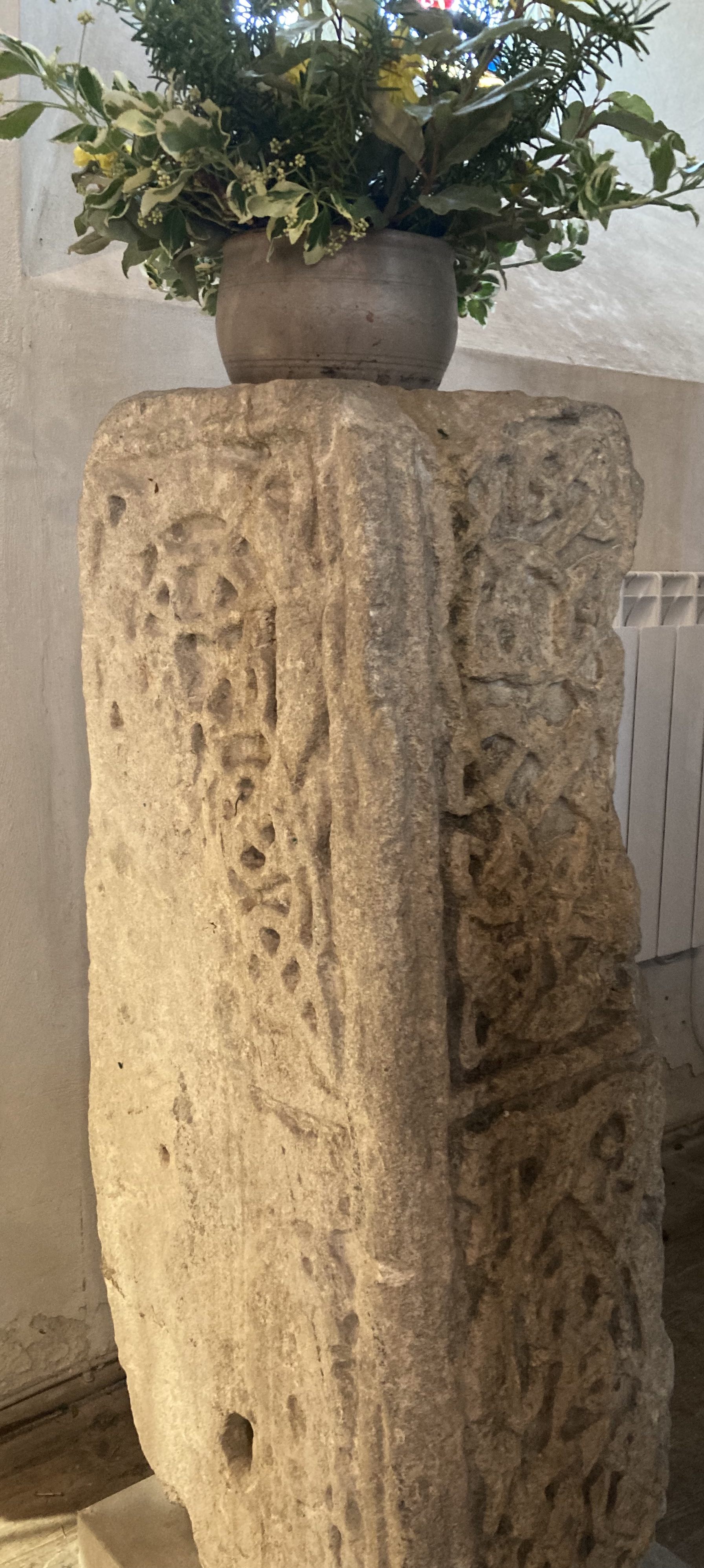
Steventon was apparently a place of Christian worship from a very early date. Part of the shaft of a Saxon Cross, from about the ninth century, was discovered built into the wall of a nearby Tudor manor (now demolished). The cross shaft is displayed in the church.  The cross was likely set up outdoors. Visiting priests would hold services there, before the church was built. Villagers may also have buried their dead near the cross.  Steventon was possibly a stop on the Salisbury to Canterbury pilgrimage route.

Part of an ancient Saxon Cross, around which traveling priests would lead the villagers of Steventon in Christian worship. Photo © Brenda S. Cox 2023

The church building is medieval, built around 1200 A.D. The most obvious change since Jane Austen’s time is the addition of a Victorian steeple (around 1850-1860), a blue and brown structure that looks quite different from the rest.

Jane would have seen the four ancient “scratch dials” or “Mass clocks” on the outside walls of the church. These were sundials with a scratch marking the time when people were to come to worship. She would have also seen the medieval carvings of faces, a man and a woman, on either side of the main door.

Sundial scratched on the church wall (there would need to be a stick in the hole in the middle) to show medieval villagers when to come to church. Photo © Brenda S. Cox 2023
Ancient faces adorn the front of the Steventon church. Photo © Brenda S. Cox 2023

Next to the church is a gigantic yew tree, an estimated 900 years old. It measures at least 25 feet around. Yews were considered sacred in ancient times and also by Christians. They represented regeneration and new life. The church key, 15 inches long and weighing 5 lb., was kept in a hole in this tree during Austen’s time. After the key disappeared, a replacement was made which is kept elsewhere. The church is now always left unlocked for visitors.

Ancient yew tree next to the church, where the key was hidden in earlier times. Photo © Brenda S. Cox 2023
Revd. Canon Michael Kenning, former rector of Steventon, holds the huge key to the church door (a replacement of the ancient key, which disappeared). Photo © Brenda S. Cox 2023

The tower holds three church bells. The oldest was cast in 1470. These bells were restored, through the support of JASNA, in 1995. I got to hear them ringing when the JASNA Summer Tour group visited in July. The bells are rung for church services, weddings, and funerals.

The Church Interior

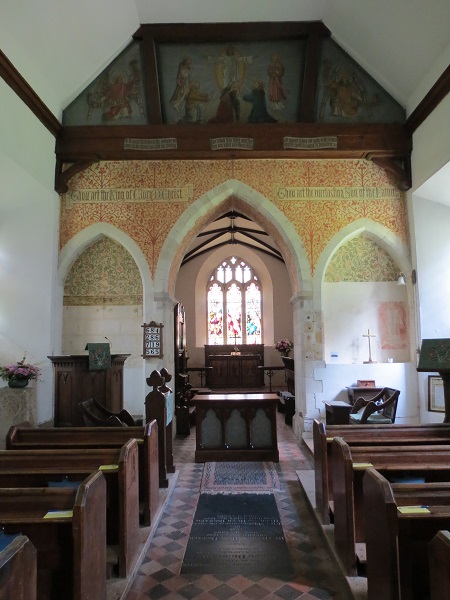
The layout of the church is still much the same as it was in Jane Austen’s time. Three arches separate the nave of the church (where the congregation sits) from the chancel (where the altar is).

Interior of the church at Steventon. The arches were there in Austen’s time. The stained glass windows, orange and green tilework on the arches, Transfiguration painting above the arches, and pews all date from Victorian times (later in the 19th century). Photo © Brenda S. Cox 2023

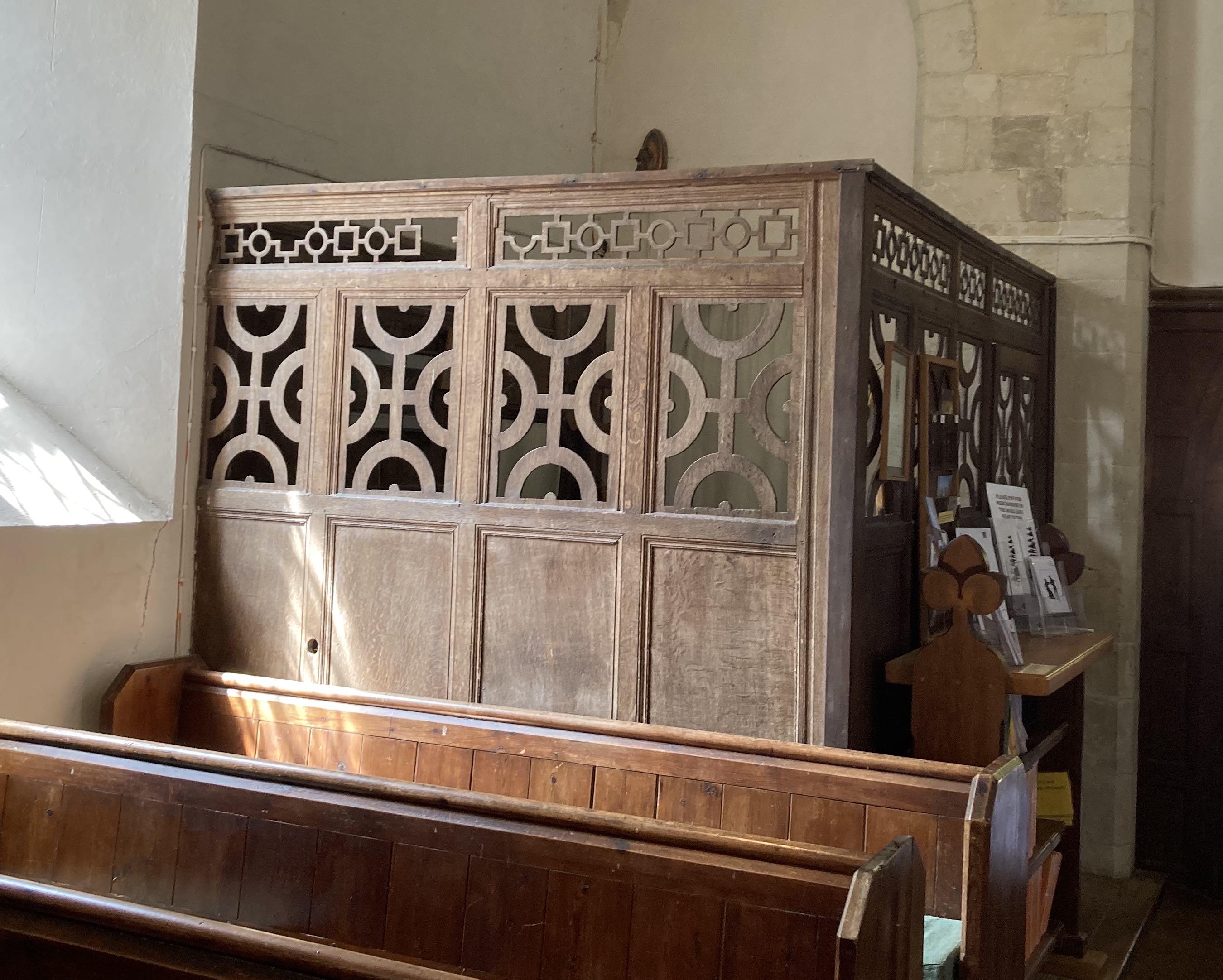
A large box pew, made of oak, was built in the seventeenth century for the lords of the manor. The Digweed family, who rented the manor house from the Knights, used this pew during Austen’s time. It was at the front of the nave, near the pulpit. The box pew is still in the church but has been moved to the back. It is now used as the vestry, the clergyman’s office.

So the Digweed family sat in state, protected from drafts and from curious eyes, at the front. Others, including the Austen family, likely sat on benches. If there weren’t enough benches, servants and the poor would have stood in the aisles and at the back. There was no gallery (balcony) in this church.

Box pew used by the Digweed family, squires of the manor in Austen’s time. It has been moved to the back of the church and is now used as a vestry, office for the clergyman. Photo © Brenda S. Cox 2023
View from inside the box pew. Photo © Brenda S. Cox 2015

Some ancient wall paintings were found during one restoration of the church. These have been left uncovered. They were most likely covered by whitewash during Jane Austen’s time, however.

Medieval wall painting in Steventon church. Probably of a bishop. It would have been covered over during Austen’s time. Photo © Brenda S. Cox, 2023

Other lovely decorations in the church are from Victorian times. The stained glass windows, pews, pulpit, baptismal font, choir stalls, and altar are all from the late 1800s, with the organ from the early 1900s.

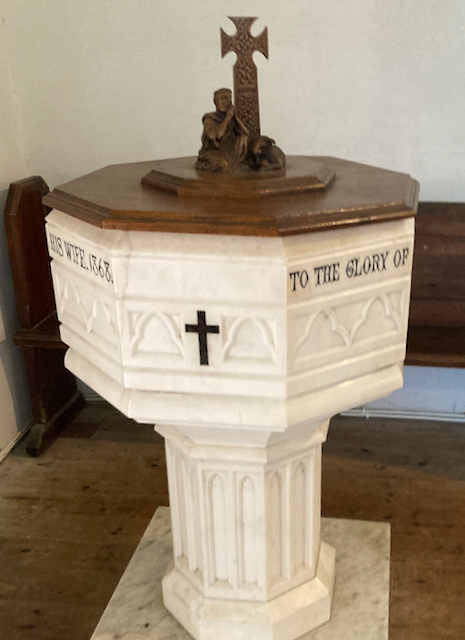
Victorian baptismal font in St. Nicholas’ Church, Steventon. The modern cover represents a shepherd praying at the old Saxon cross, before the church was built. Photo © Brenda S. Cox, 2023 (Font cover partially funded by JASNA Ohio North Coast region)

Austen Documents

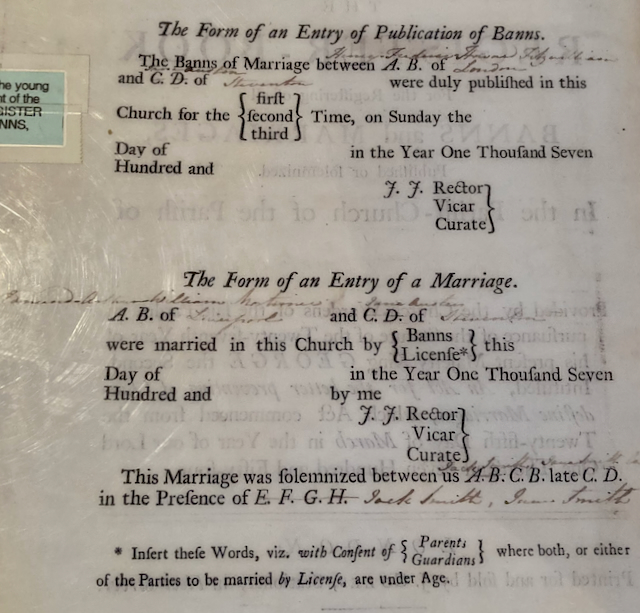
The church has reproductions of several church documents relating to Jane. (The originals are held at the Hampshire County Archives, which unfortunately I did not get a chance to visit.) The parish priest—in this case, Jane’s father, George Austen—kept the parish register for officially recording births, marriages, and deaths. The register included a sample page for marriages, and Jane playfully filled this out with imaginary names for her own future marriage.

In the sample marriage form for the parish register, Jane imagined herself marrying several possible men. Photo © Brenda S. Cox, 2023

Another page of the parish register records Jane’s baptism at home on Dec. 17, 1775, shortly after her birth. She was born in the middle of a very cold winter, so her father christened her at home. She was officially received into the church on April 5, 1776, probably her first excursion.

Parish register record of Jane Austen’s baptism and reception into the church. Photo © Brenda S. Cox, 2023

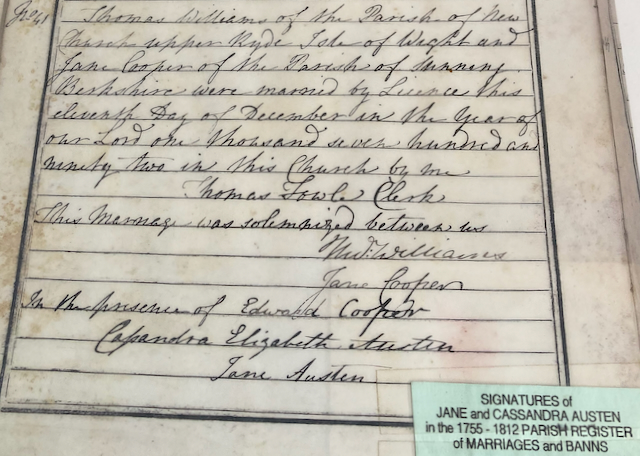
We can also see Jane and Cassandra’s signatures as witnesses to a wedding. Their first cousin Jane Cooper married Thomas Williams. Jane, Cassandra, and Edward Cooper (Jane Cooper’s brother and Jane Austen’s cousin), were the official witnesses.

Signatures of Jane and Cassandra Austen who witnessed the marriage of their cousin Jane Cooper. Photo © Brenda S. Cox 2023

Austen Memorials at Steventon Church

Inside the Steventon church, you can find memorial plaques to Jane’s brother James, James’s first wife Anne, and his second wife Mary. When Anne died in 1795, James was not yet rector of Steventon, so he is listed as vicar of Sherborne St. John.

Memorial in Steventon church to James Austen’s first wife, Anne, 1795. Photo © Brenda S. Cox, 2023

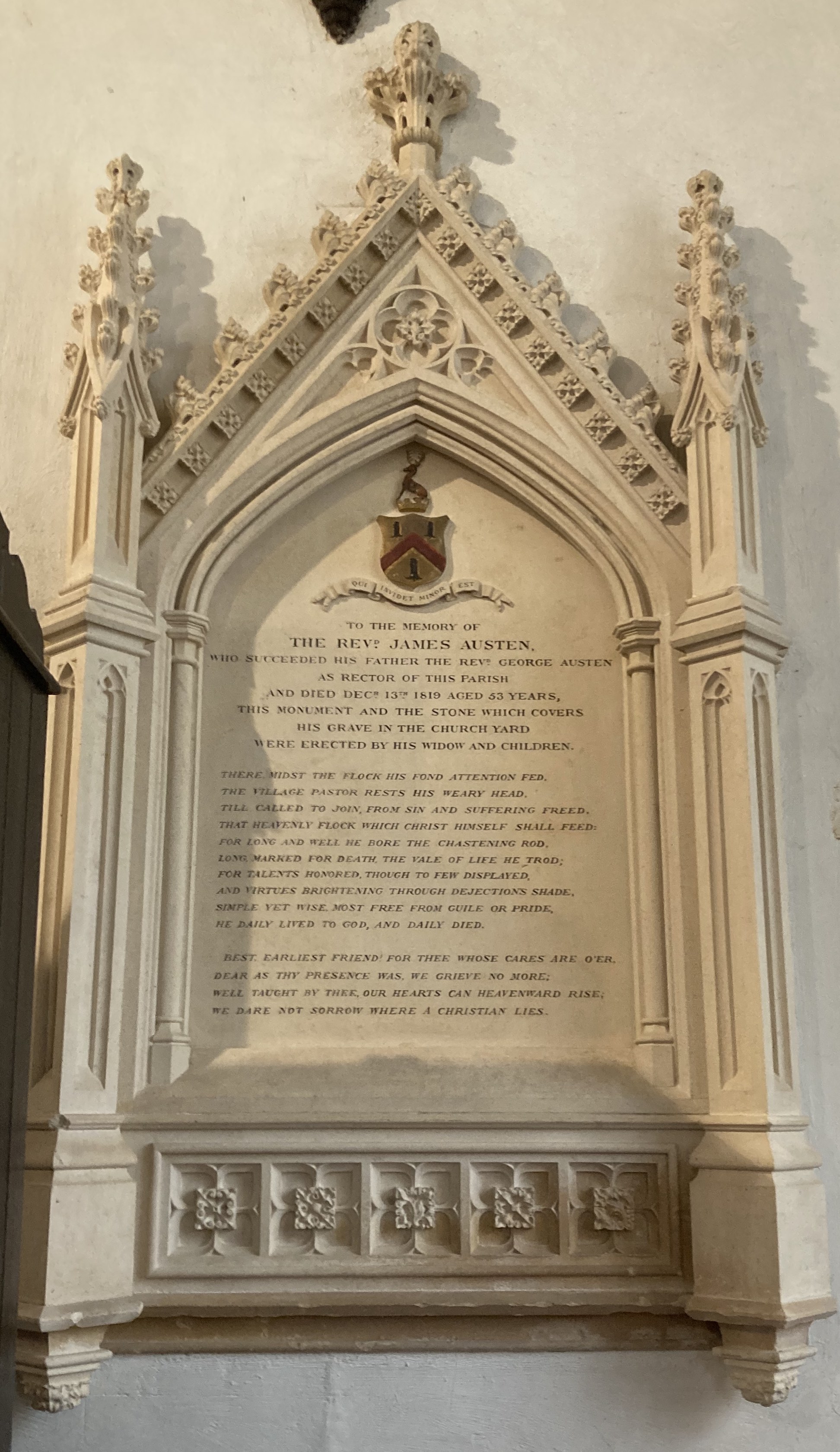
When James died in 1819, the memorial says he “succeeded his father George Austen as rector of this parish.” George, of course, died in Bath and is buried at St. Swithin’s.

Memorial to Jane’s brother James Austen, who followed his father as rector of Steventon. Photo © Brenda S. Cox, 2023

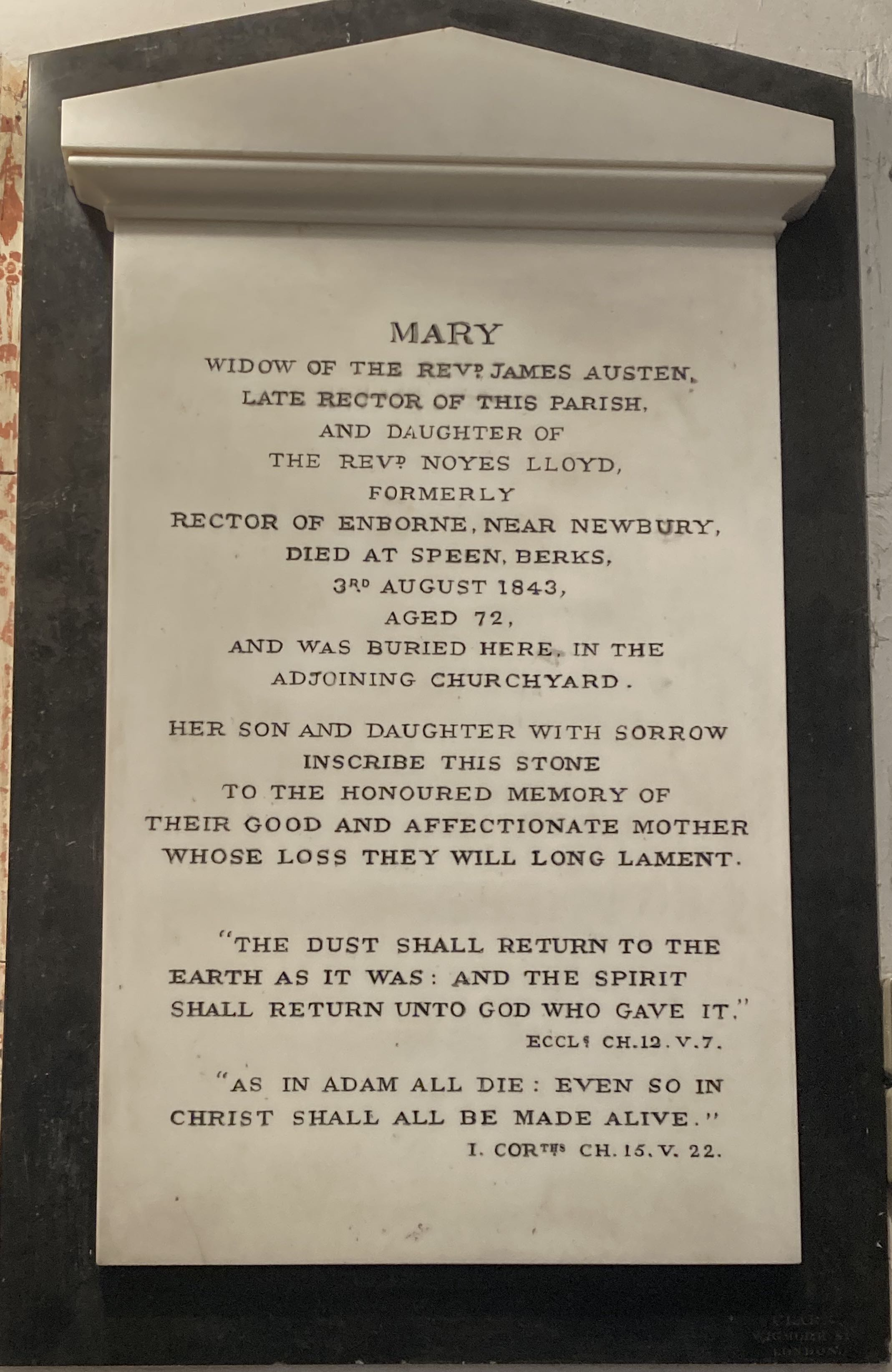
Mary’s memorial says that she died in 1843 at Speens, Berkshire, but was buried in Steventon (about 16 miles away) with her husband. Mary, of course, had left the rectory when her husband died and his brother Henry took over as rector.

Memorial to James Austen’s second wife, Mary, who died in 1843. She was Martha Lloyd’s sister. Photo © Brenda S. Cox, 2023

James and Mary Austen’s grave is in the churchyard.

Grave of James and Mary Austen in Steventon churchyard. Photo © Brenda S. Cox, 2023

Knight and Digweed Memorials at Steventon

The Knight family owned the manor at Steventon from the early 1700s. They rented it to the Digweed family in 1758, and Digweeds lived there until 1877, though the Knights sold the property in 1855. (This was similar to Charles Bingley renting Netherfield and becoming the de facto squire of the parish.) Austen mentions some of the Digweeds in her letters.

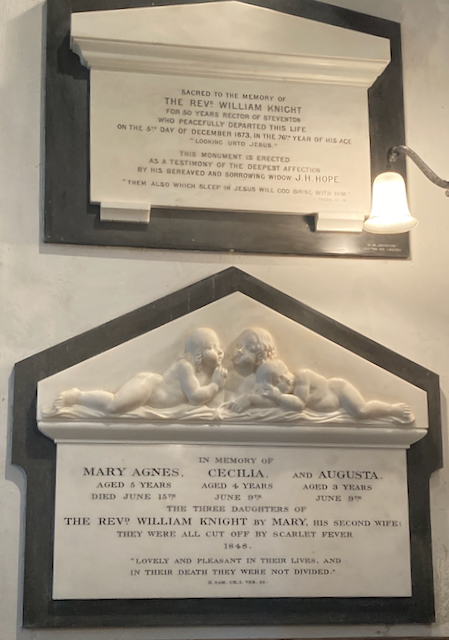
Memorials in the church commemorate Rev. William Knight, “50 years rector of Steventon.” He was Jane’s nephew who became rector after Henry. A sad memorial below his own records the deaths of William’s three daughters, ages 3, 4, and 5 years, who were all “cut off by scarlet fever” in one June week of 1848.

Memorials in St. Nicholas’, Steventon, to Jane’s nephew William Knight, rector of the church for 50 years, and to his three little girls who died tragically of scarlet fever. Photo © Brenda S. Cox, 2023

A ledgerstone on the church floor covers the grave of Hugh and Ruth Digweed, who died while Jane was at living at Steventon, and their daughter who died at age 2 in 1770. Other memorials enshrine later members of the Digweed family.

Some Digweeds, like these, are buried in the church, the most honored place to be buried, presumably since they were the squires of the manor house. Others are buried outside in the churchyard.

This stone on the floor of the Steventon church covers the graves of Hugh and Ruth Digweed, who Jane Austen must have known. Photo © Brenda S. Cox, 2023

Steventon Church Today

Like most small country churches in England, Steventon is now part of a benefice including several churches, served jointly by a few clergy. Steventon belongs to the Overton Benefice, seven parishes all served by one rector, one vicar, and one curate. 

The Steventon parish is still small, rural, and agricultural, as it was in Austen’s time. About 250 people live in the parish. Sunday services are still held at the church twice a month, usually with a dozen or so people in the congregation. One is a Communion service and the other may be matins, evensong, a holiday service, or a Saturday breakfast and talk for the wider community. Much larger crowds, up to 100 or even 200 people, come to events like holiday services, weddings, baptisms, and funerals. The church seats about 75-80 comfortably, so it can be quite crowded!

In Austen’s time, the church would get bitterly cold in the winter. A modern improvement is the addition of heaters under the pews. People in each pew can turn on their own heater, making the church much more comfortable without wasting energy by heating the whole church.

Marilyn Wright, the churchwarden, told me that she loves the peace of the church, and goes in there when she wants to pray and think. She said if her father, who has dementia, ever got lost, they would find him at the church. As I heard over and over in the Austen country churches, the church is still central to community life.

The Revd. Canon Michael Kenning, former rector of Steventon, gave our JASNA tour group a lovely introduction to the church. At the end, he pointed out that there are about 10,000 Church of England churches in the UK, and most do not get any funding from the National Trust, the British government, or the Church of England. Therefore they need outside funding. The Steventon church is currently in need of some major work. Damp has gotten into the walls, causing cracks and other damage. New drainage and other work is needed. After that, interior features of the church will be renovated. 

If you wish to donate to the Steventon church, you can use this link.

JASNA provides support for such special projects at Austen family churches, including this one. If you are a JASNA member, donations to the churches fund for such projects are appreciated. (You can donate when renewing your membership, or sign in to your account and go under the drop-down menu to “Donate to JASNA or English Institutions.”)

For Further Exploration

During Austen’s time, Steventon had a Norman baptismal font. For an idea of what that might have looked like, as well as stories of St. Nicholas, see, The Winchester Type Fonts.

A Guide to St. Nicholas Church Steventon gives more details and pictures of all parts of the church and churchyard (follow links to further pages).

A Drive through Steventon to St Nicholas Church 

More images of the church 

A guide to the Steventon church, Jane Austen’s Steventon by Deirdre LeFaye, and guides to other Austen-related churches are available from Jane Austen Books.

Steventon’s Rectory Garden

Steventon Parsonage 

Rectors and Vicars in Jane Austen

Yews in English Churchyards 

Posts on Other Austen Family Churches

Chawton

Hamstall Ridware

Adlestrop and the Leigh Family

Stoneleigh Abbey Chapel

Great Bookham and Austen’s godfather, Rev. Samuel Cooke

Ashe and Jane’s Friend Mrs. Lefroy 

Deane

Brenda S. Cox is the author of Fashionable Goodness: Christianity in Jane Austen’s England. She also blogs at Faith, Science, Joy, and Jane Austen.

Read Full Post »

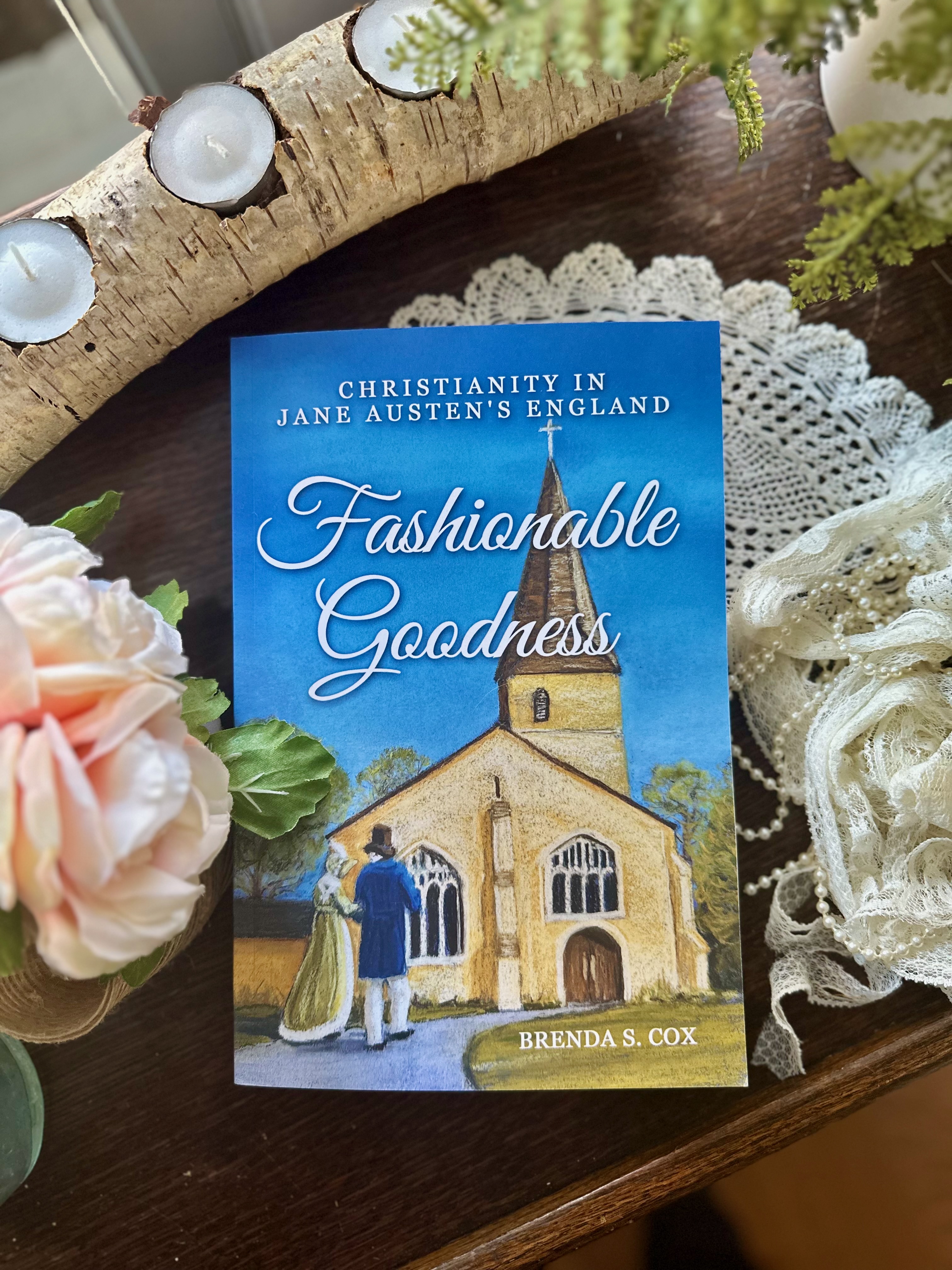
Our very own Brenda S. Cox has just published her new book Fashionable Goodness: Christianity in Jane Austen’s England. It’s already receiving a wonderful reception, and I know it will continue. For those of us who are always expanding our understanding of Jane Austen’s life, and particularly her personal life and faith, this new book is an essential resource.

When I was writing my book Praying with Jane: 31 Days Through the Prayers of Jane Austen, I read every article and book I could find on the topic of religion and faith as it related to Austen and her family. I scoured every available resource on Austen’s personal faith, her family’s daily and weekly religious habits, and the Anglican church at large. I discovered many wonderful details about her religious life, but as I worked, I always felt as though I was putting together a giant puzzle. And when it came to understanding more fully the implications of her religious beliefs and background in her novels, I felt as though the puzzle was missing many important pieces.

In Fashionable Goodness: Christianity in Jane Austen’s England, Brenda has finally put the puzzle pieces in their rightful places and collected all of the information one might want to know about Jane Austen’s religious life in one handy place. This book covers a broad range of topics that any Jane Austen lover can benefit from knowing, especially for those of us who enjoy looking into the varied layers and greater context of her writing.

Of particular interest is the clever manner in which Brenda has organized the information in this book. Each chapter is easy to find, plus she has included many helpful resources at the end of the book, including handy tables with income information, terminology, ranks within the church, and denominations; several appendices; detailed chapter notes; a hefty bibliography; a glossary of terms; and a topical index. You can read this book cover-to-cover or you can pick and choose the topics that interest you most.

I highly recommend this book for any Austen fan or scholar. Without this book, you can only know part of what makes Jane Austen’s characters and plots so intriguing. Thank you Brenda for creating this invaluable resource!

(See below for giveaway details.)

St. Nicholas Church, Steventon
Photo: Rachel Dodge

About the Book:

“Brenda Cox’s Fashionable Goodness is an indispensable guide to all things religious in Jane Austen’s world. . . . a proper understanding of 18th century Christianity is necessary for a full appreciation of Austen’s works. Cox provides this understanding. . . . This work will appeal to novice readers of Austen as well as scholars and specialists.”

Roger E. Moore, Vanderbilt University, Jane Austen and the Reformation

The Church of England was at the heart of Jane Austen’s world of elegance and upheaval. Fashionable Goodness: Christianity in Jane Austen’s England explores the church’s role in her life and novels, the challenges that church faced, and how it changed the world. In one volume, this book brings together resources from many sources to show the church at a pivotal time in history, when English Christians were freeing enslaved people, empowering the poor and oppressed, and challenging society’s moral values and immoral behavior.

Readers will meet Anglicans, Dissenters, Evangelicals, women leaders, poets, social reformers, hymn writers, country parsons, authors, and more. Lovers of Jane Austen or of church history and the long eighteenth century will enjoy discovering all this and much more:

  • Why could Mr. Collins, a rector, afford to marry a poor woman, while Mr. Elton, a vicar, and Charles Hayter, a curate, could not?
  • Why did Mansfield Park‘s early readers (unlike most today) love Fanny Price?
  • What part did people of color, like Miss Lambe of Sanditon, play in English society?
  • Why did Elizabeth Bennet compliment her kind sister Jane on her “candour”?
  • What shirked religious duties caused Anne Elliot to question the integrity of her cousin William Elliot?
  • Which Austen characters exhibited “true honor,” “false honor,” or “no honor”?
  • How did William Wilberforce, Hannah More, and William Cowper (beloved poet of Marianne Dashwood and Jane Austen) bring “goodness” into fashion?
  • How did the French Revolution challenge England’s complacency and draw the upper classes back to church?
  • How did Christians campaigning to abolish the slave trade pioneer modern methods of working for social causes?
Interior of St. Nicholas Church, Steventon
Photo: Rachel Dodge

About the Author, Brenda S. Cox:

Brenda S. Cox has loved Jane Austen since she came across a copy of Emma as a young adult; she went out and bought a whole set of the novels as soon as she finished it! She has spent years researching the church in Austen’s England, visiting English churches and reading hundreds of books and articles, including many written by Austen’s contemporaries. She speaks at Jane Austen Society of North America meetings (including three AGMs) and writes for Persuasions On-Line (JASNA journal) and the websites Jane Austen’s World and her own Faith, Science, Joy, and Jane Austen.

Buy the Book:

You can purchase Fashionable Goodness: Christianity in Jane Austen’s England here:

Amazon and Jane Austen Books
International: Amazon


Book Giveaway:

To enter for a chance to win a copy of Brenda’s book Fashionable Goodness: Christianity in Jane Austen’s England, please leave a comment below with an answer to this question:

What is one question you’ve always had about Jane Austen’s faith or the role religion plays in her novels?

Giveaway Details: This giveaway is for ONE (1) print copy and ONE (1) ebook (Kindle) edition for readers of this blog. The winners will be drawn by random number generator on November 18, 2022.

Note: This giveaway is limited to addresses in the U.S., U.K., Australia, Canada, Germany, Spain, France, or Italy for a print copy of the book. The author can only send a giveaway ebook (Kindle) to a U.S. address. (However, both the ebook and paperback are available for sale to customers from any of these countries, and some others that have Amazon.)


Blog Tour Schedule


RACHEL DODGE teaches college English classes, gives talks at libraries, teas, and book clubs, and writes for Jane Austen’s World blog. She is the bestselling author of The Little Women DevotionalThe Anne of Green Gables Devotional and Praying with Jane: 31 Days Through the Prayers of Jane Austen. Coming soon: The Secret Garden Devotional! You can visit Rachel online at www.RachelDodge.com.

Read Full Post »

« Newer Posts