Feeds:
Posts
Comments

Archive for the ‘Fashions’ Category

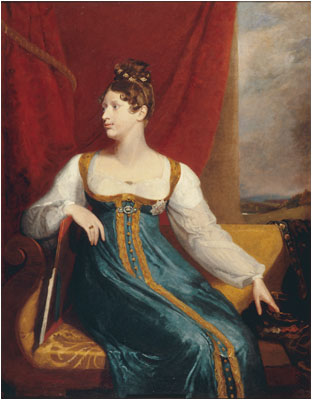
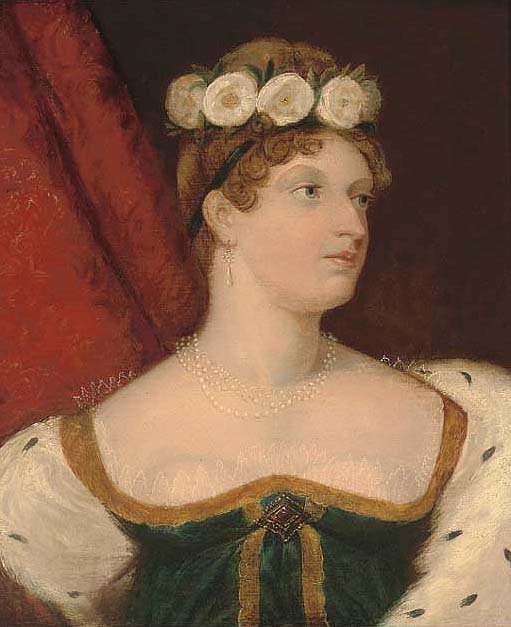
It is a rare occasion when we can compare a gown in a portrait with the actual dress. The painting, after George Daw, of the Prince Regent’s daughter, Princess Charlotte, shows her wearing a charming blue gown in a domestic, albeit royal, setting.

Princess Charlotte in her Russian Dress. Painting after George Daw, 1817. Image @Wikipedia

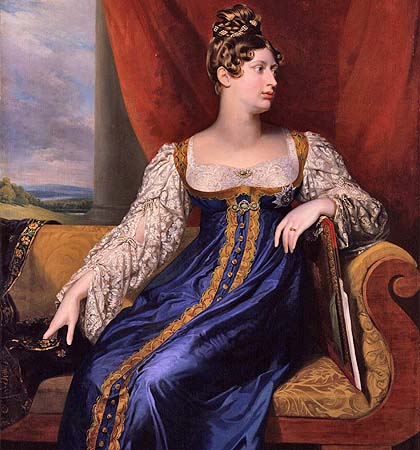
A second portrait depicts the same dress more royally. Princess Charlotte (or the artist) has accessorized the dress with ermine, lace, and pearls.

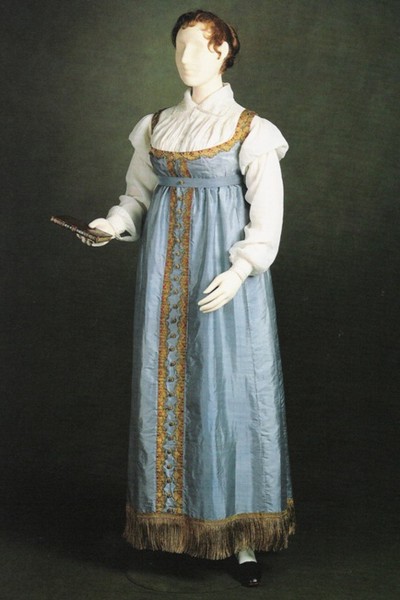
The mannequin from the Museum of London exhibit a few years back is dressed more informally, as if she was in the morning room reading. I found the image on Pinterest, but unfortunately the pin did not state the image’s origin. (A reader wrote that the dress belongs to the Royal Collection.)

As you can see, the dress no longer possesses the rich blue hue as shown in the paintings. So many of the costumes of that era are not only in a fragile state and can rarely be shown, but we cannot trust that the colors have remained the same.

Princess Charlotte's "Russian" outfit as shown at The Museum of London. The gown belongs to The Royal Collection.

Below is the original portrait by George Daw, which shows Princess Charlotte wearing the same dress. Click here for yet another view of Charlotte in a similar gown, but without the trim and wearing a lace cap. My sense is that after her death Princess Charlotte’s image became sought after and that many portrait copies were made (both in oil and in print) to satisfy the mourning public.

Princess Charlotte, George Daw, 1817. Image @National Portrait Gallery

Find more views of the gown at Jenny La Fleur’s site. Images of the gown can be seen in the exhibit catalogue called In Royal Fashion: Clothes of Princess Charlotte of Wales and Queen Victoria, 1796-1901, which can only be obtained second hand.

The exhibit: Princess Charlotte, The Lost Princess, will be on display at the Prince Regent Gallery in the Brighton Pavillion through 10 March, 2013.

My other posts about Princess Charlotte:

Read Full Post »

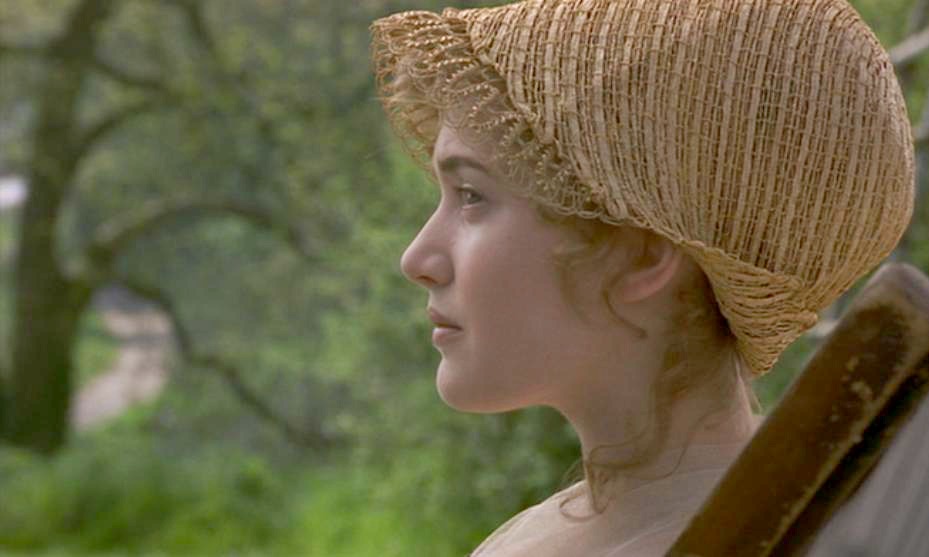
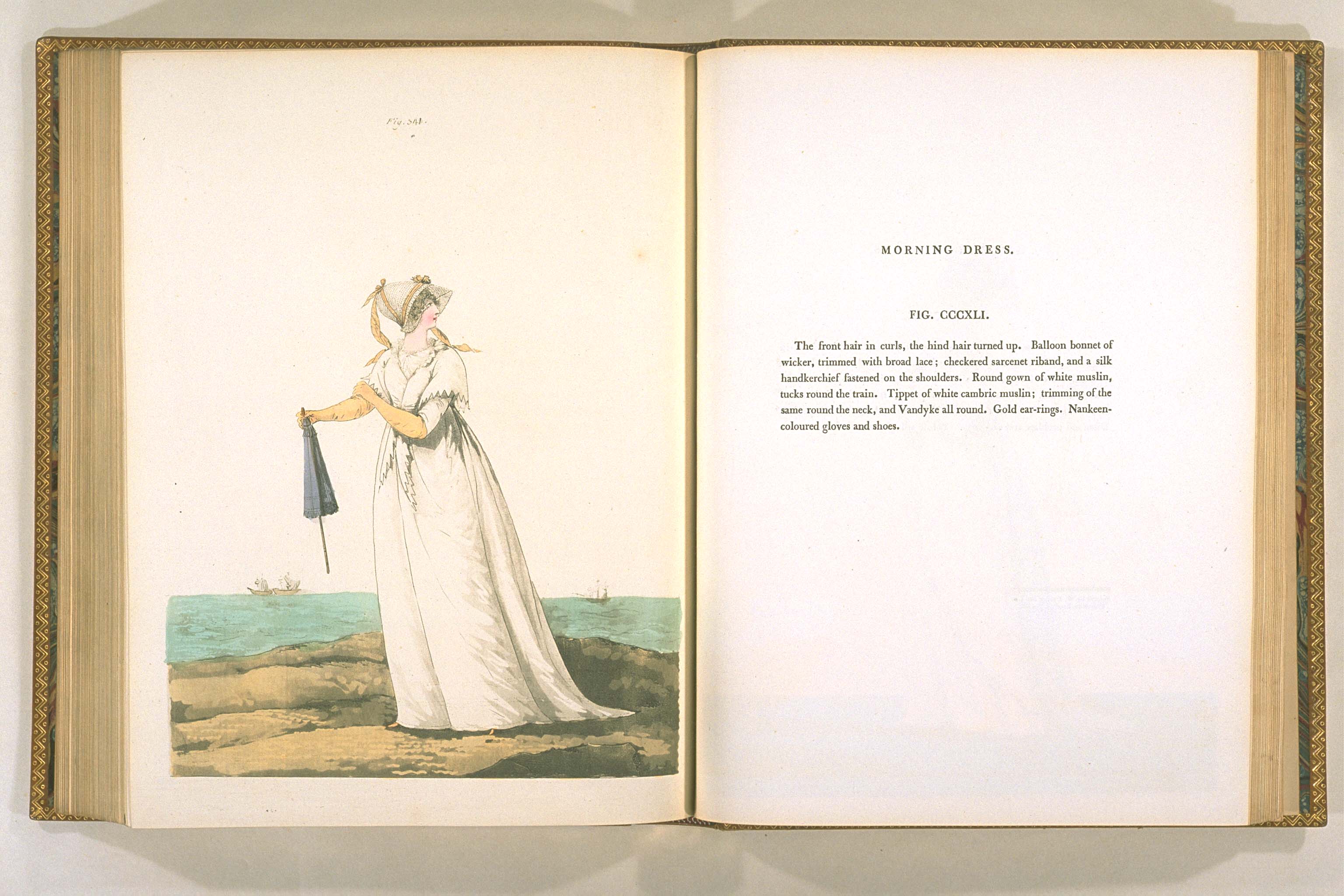
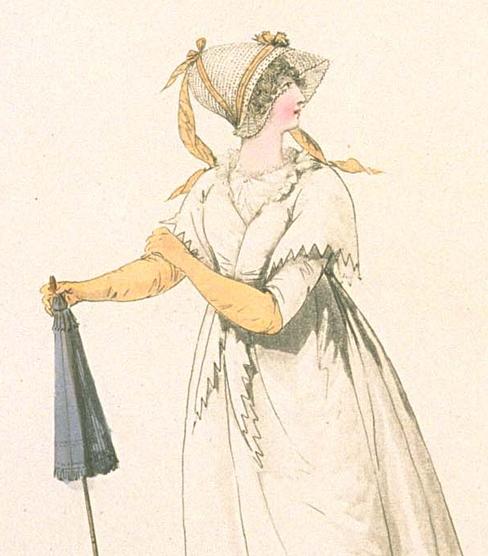
In Sense and Sensibility 1996, Kate Winslet as Marianne wears a charming straw sun bonnet as she recuperates from her illness. When I ran across the fashion plate of a morning dress from The Gallery of Fashion, 1794-1798, I was immediately struck by the similarity, although the brim in the fashion plate is more elaborate.

Detail of a morning gown and balloon bonnet, Heideloff, The Gallery of Fashion

The magazine described the head wear as a “balloon bonnet of wicker, trimmed with broad lace. The front hair is in curls, the hind hair is turned up.”  I suspect that Lydia Bennet would have wrapped ribbons around her capote much as in the above image.

Kate Winslet’s capote is simpler, but equally charming. Capotes, or scoop-shaped bonnets, were popular in the early Regency and first made their appearance in the 1790s. The hats accommodated the modish hair styles of that era, which were short or piled on top of the head.

Bonnet, 1805-1810. Image@The Victoria & Albert Museum

Generally made to be worn outdoors, capotes were also worn as evening headwear early in the 19th century. This evening capote is elaborately trimmed.

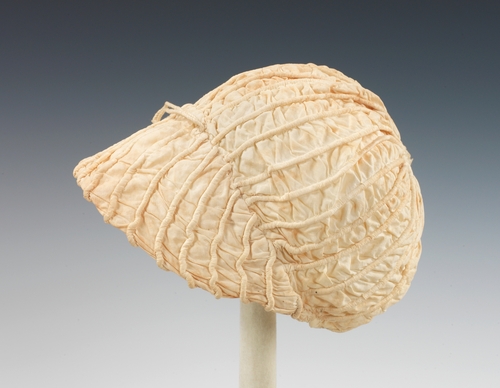
Infant bonnet, 1820. Image @Metropolitan Museum of Art

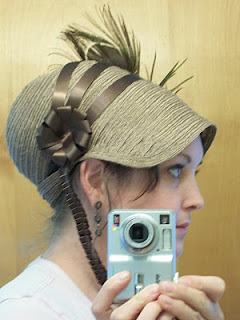
The charming bonnet was made for an infant.  Click here to read the description. The image below shows a modern interpretation of a Regency era capote bonnet. (Living With Jane)

Image @Living With Jane

The shape of the Capote bonnet changed as hairdos changed, and the hat crown shifted to accommodate the increased height of swept up hair. The poke, or brim, also became larger over time. This definition describes the Victorian capote: Close fitting bonnet with rigid brim, either of straw or boned into shape. Soft, shirred crown , ribbon bows tied under the chin, Victorian 19 c. with deep ruffle in back. Also poke bonnet, fanchon, scuttle bonnet, sun bonnet. – Glossary of hats, Village Hat Shop.

View images of the Victorian capote here http://www.metmuseum.org/collections/search-the-collections/80044650 and here http://www.metmuseum.org/collections/search-the-collections/80044657. You can see the vast difference between the two styles, yet they are still capotes.

This link leads to instructions for making a Capote Beguin, or Edwardian Era bonnet.

Make Your Own Regency Bonnet

More on the topic:


Read Full Post »

Fashion is always more than it seems on the surface. Take this charming Regency morning dress from Ackermann’s Repository (April, 1812), for example. Its detailed description in the magazine demonstrates how many historic influences shaped this romantic costume. The lady who wore these garments as a total ensemble would have known about its medieval, Elizabethan and Jacobean associations.

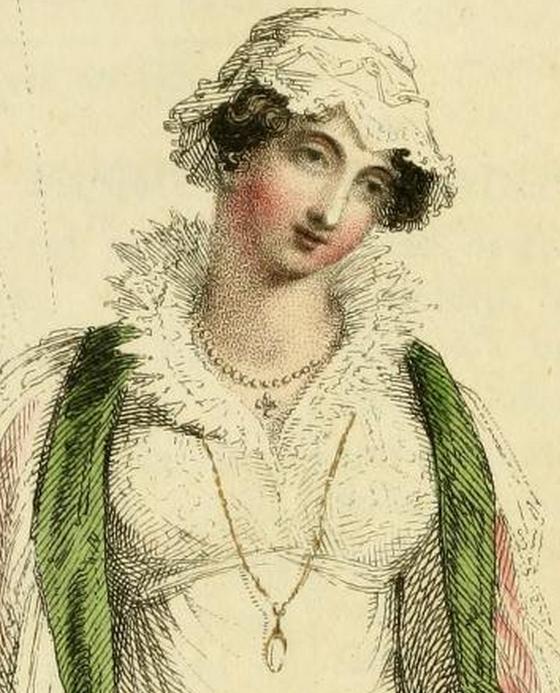
Morning or Domestic Costume: A superfine Scotch or French cambric over a cambric slip, with full long sleeve, and ruff a la Mary Queen of Scots. A neck-chain and sight set in gold; bracelets and necklace of white or red cornelian. A Flora cap, composed of white satin and lace. A capuchin or French cloack of blossom satin, or Pomona green, trimmed with thread lace. Slippers of pale pink or green; and gloves of tan or Limerick kid.

Cambric material, also called batiste and made of bleached linen or cotton, was widely used in the 19th century for handkerchiefs, shirts, bed and table linens, and as fabric for lace. Scotch cambric was actually a fabric made in India. French cambrics were hard to come by after the British banned imports from France during the war.

Detail of cap, ruff, and necklace with quizzing glass, or 'sight'.

The Mary Queen of Scots ruff indicates the influence of the Elizabethan era in fashion and architecture. At this time, British fashion began to diverge from French fashion because of the Napoleonic wars, which effectively blocked normal communication and travel between the two countries. By 1811, fashion designers, who were influenced by the Romantic sensibilities of British poets and philosophers, looked to the Tudors and the Gothic eras for new fashion statements. Ruffles and slashed sleeves began to appear, and gowns began to veer from the elegant simplicity of Grecian designs to more embellished dresses.

Flora McDonald

I found almost no references to the flora cap, which hugs the skull. In this instance, a lace brim frames the face and hair. Historically, Flora McDonald was immortalized through her association with Bonnie Prince Charlie, and in the early 19th century,  Sir Walter Scott symbolized her as the embodiment of romanticized Scottish Jacobitism. One portrait of Flora shows her wearing a lace cap. Interestingly, today’s baseball and American hunting caps pop up when one Googles either Flora cap or Jacobean hats.

Cornelian, primarily found in India, was a popular semi-precious stone used in jewelry. The rust red is more prevalent over the white. Think of the colors of a cameo and you will have an idea of what bracelets and necklaces made of cornelian might look like. In this instance, the fashion plate depicts a white carnelian necklace.

Capuchin cloaks were loose hooded cloaks  whose design origins dated back to the medieval period. Capuchin monks, a 16th century off shoot of the Franciscan monks, wore distinctive pointed hooded cloaks, whose popularity remained strong through the 18th and 19th centuries.

I found this Victorian reference to Limerick kid gloves highly fascinating:

the best foreign glove is not better in any respect than the best Irish glove,—because the best London-made kid glove is rarely imported, or, if imported, cannot be sold as cheap as the best Dublin, Cork, or Limerick kid,—because the majority of imported gloves are made by frame, instead of by hand, and that the stitching by hand is much surer and firmer than sewing by machine; as, if one stitch give in a hand-made glove, that stitch alone goes, while if a stitch give in a machine-made glove, the whole finger is apt to go—and, lastly, because the article that is generally sold, is made of what, in the trade, is called “seconds,” the raw material being what is technically termed ” slink lamb,” and not kid; the difference of which may be better understood when I state that “seconds,” or “slink lamb,” can be bought by the manufacturer at from 1s. 3d. to 2s. per dozen, while kids range from 8s. 6d. to 14s. per dozen. What is usually called French kid, is, in reality, Italian lamb. So that my advice is—stick to the Irish kid, which will give good wear, and look charmingly on the hand.” – The industrial movement in Ireland, as illustrated by the National exhibition of 1852 (Google eBook), John Francis McGuire, 1853, p. 87

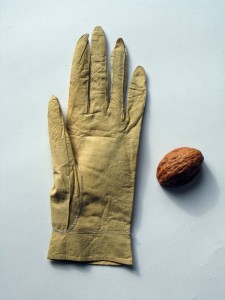
Detail of the Limerick kid gloves.

Although this lady is wearing a household garment meant to be seen only by family and close friends, and which she will keep on until she goes out to shop or visit friends, she is also wearing a cloak and gloves. One of the coldest vacations I ever spent was a week in April in London (the second coldest was a windy weekend in August in San Francisco). I visited a friend who lived in an ill-heated apartment, and I shivered for 7 days during one of the rainiest weeks this Dutch girl ever experienced. I imagine that the domestic outfit  portrayed in this fashion plate was well suited to staving off cold drafts and the shivers.

Several years ago I engaged in an online discussion about whether a lady wore gloves indoors. My “opponent” was adamant in her assertions that ladies did NOT wear gloves inside, saying that Regency portraits indicated that they never would. Never say never. I replied that this made no sense. Ladies tried to look their “Sunday” best for expensive portraits destined to be hung in long galleries, which meant showing off their most beautiful clothes and their milk white, unsullied hands. Besides, I found one or two paintings that portrayed a woman wearing gloves inside the house. I imagine that in some instances, a visitor might keep her gloves on if her visit was short and she was offered nothing to eat or drink.  (Think of Lady Catherine de Bourgh’s imperious visit to the Bennets to confront Elizabeth about her intentions with Mr. Darcy.) The gloves in this print might mean that the woman was sitting in a glassed-in conservatory or in the confines of her private garden.

A lady who lived in a freezing mausoleum of a house would be a fool not to keep her gloves on. This fashion plate shows such a sensible young woman.

Read Full Post »

Jane Austen fans are familiar with the high-waisted muslin dresses popular during her adulthood. How many are aware that machine-made net or gauze became a “hot” item from 1810 and on?
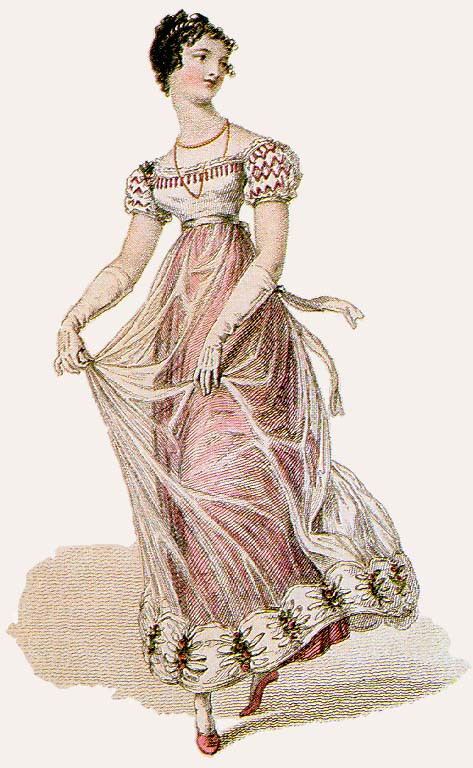
Evening dress with gauze overlay

“Net dresses were very fashionable and their popularity was spurred by new inventions. The development of machine-made net in the late 18th and early 19th centuries meant that gauzy lace effects were increasingly affordable either as trimmings or garments. The bobbin-net machine was patented by the Englishman John Heathcoat in 1808 and produced a superior net identical to the twist-net grounds of hand-made bobbin lace. It was so successful that women in the highest ranks of society, including the Emperor Napoleon’s first wife, Josephine, wore machine-net dresses. Initially, however, all machine nets were plain and had to be embroidered by hand.” – Victoria and Albert
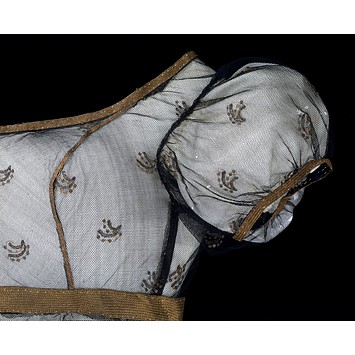
Detail of an evening dress with net lace. Image @Victoria & Albert Collection

Machine-made bobbin net was first made in France in 1818. Until this date, lace as it was made was known as old lace. After that date, lace is categorized as being modern.

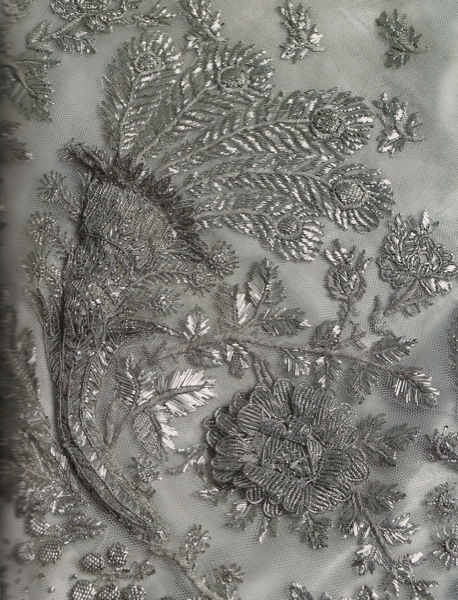
Silver embroidery on net on Empress Josephine's court gown. Image @Madame Guillotine

Machine made lace made an appearance around 1760. The nets and tulles became immediately popular. Their arrival spurred the production of other silk lace cloths, which led to a general rise in popularity of the silk lace trade – until a machine was invented that could produce silk net lace as well.
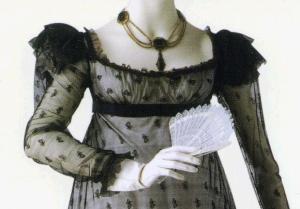
Evening dress with net overlay, 1817-1818, V&A Museum

In the 18th century the hand-made net was very expensive and was made of the finest thread from Antwerp: in 1790 this cost £70 per pound, sometimes more. At that time the mode of payment was decidedly primitive: the lace ground was spread out on the counter and the cottage worker covered it with shillings from the till of the shopman. As many coins as she could place on her work she took away with her as wages for her labour. It is no wonder that a Honiton lace veil before the invention of machine-made net often cost a hundred guineas. Heathcoat’s invention of a machine for making net dealt a crushing blow to the pillow-made net workers. The result is easily guessed. After suffering great depression for twenty years the art of hand-made net became nearly extinct, and when an order for a marriage veil of hand-made net was given, it was with the greatest difficulty that workers could be found to make it. The net alone for such a veil would cost £30. – A history of hand-made lace: Dealing with the origin of lace, the growth of the great lace centres, the mode of manufactures, the methods of distinguishing and the care of various kinds of lace, Emily Jackson, p. 170
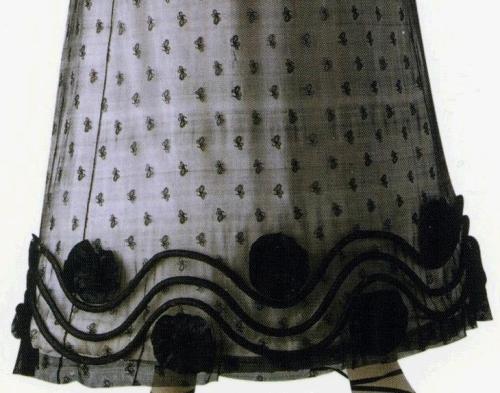
Hem of 1817_1818 Evening Dress with net overlay, V&A Museum

The most popular European centers for lace making were located in France, the region known as Belgium today, Ireland, England,and Italy.

During the French Revolution the French textile industry had suffered and unlike in England, use of textile machinery had been non-existent.  Emperor Napoleon stopped the import of English textiles and he revived the Valenciennes lace industry so that fine fabrics like tulle and batiste could be made there. – Regency Fashion History

Black net over gold gown, 1818. Image @Defunct Fashion

Between 1806-1810, net gowns embroidered with chenille embroidery became popular. Profits rose for the manufacturers as the price for the cloth plummeted.

In 1809 Heathcoat took a patent for his bobbin net machine. But the profits realised by the manufacturers of lace were very great, and the use of the machines rapidly extended; while the price of the article was reduced from five pounds the square yard to about five pence in the course of twenty-five years. – John Heathcoat and the Bobbin Net Machine, Samuel Smiles (1859)

By 1813, the bobbinet machine had been perfected. After 1815, gauze was used over satin evening dresses, with the fabric gathered at the back. By 1816, crepe, net and tulle were worn over evening wear made of satin, silks, velvets, kerseymere, satin, lame, and both plain and shot sarcenet.

La Belle Assemblee Court and Fashionable Magazine contains this description of a lady’s dress in Her Majesty’s Drawing Room in January 1818:

Hon. Lady Codrington.—Net draperies, magnificently embroidered in gold  lama, in bouquets and sprigs, over a petticoat of white satin, with blond lace at the bottom, headed with a rouleau of gold lama; train of crimson velvet, trimmed with gold lama and blond lace. Head-dress gold lama toque, with ostrich plume, and diamonds.
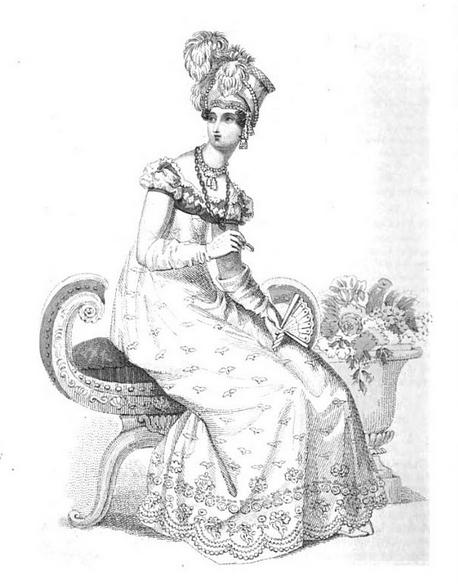
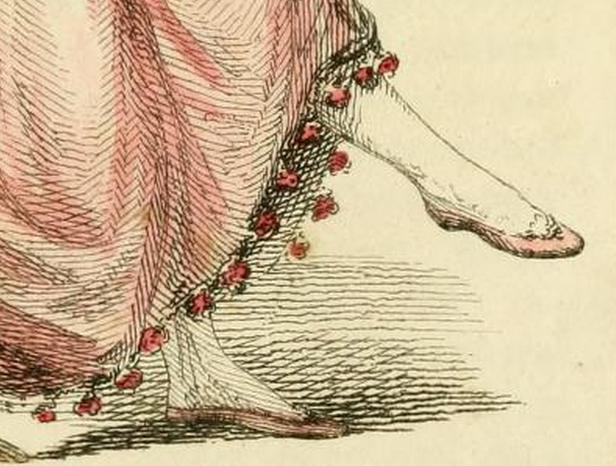
1818 Evening Dress, June. La Belle Assemblée. ENGLISH. No. 1.—Evening Dress. Round dress of embossed gauze over white satin, with coriage of peach-coloured satin, elegantly ornamented with rouleau medallions and palm leaves of white satin. Mary Queen of Scots hat, ornamented with pearls, and surmounted by a full plume of white feathers. Negligé necklace of fine pearls, and gold chain beneath, with an eyeglass suspended. White satin shoes, aud white kid gloves.

Not every lady of that era was obsessed over bobbin net lace or tulle. Many began to publicly and proudly favor the old hand made lace.

…both in England and on the Continent and at Almack’s, the Assembly Rooms at Bath and Tunbridge Well, the chaperons would gossip of their lappets of Alencon or Brussels. Numerous were the anecdotes as to how this treasure or that had turned up having escaped the doom the rag-bag, which alas! was the fate of so much old lace during the muslin and net period. – Emily Jackson, A History of Hand-made Lace, 1900, p 48.

Machine made lace dealt a great blow to the industry of hand-made fabrics. In Tiverton in 1822, where once 2,400 lace makers worked, only 300 lace makers were still employed.
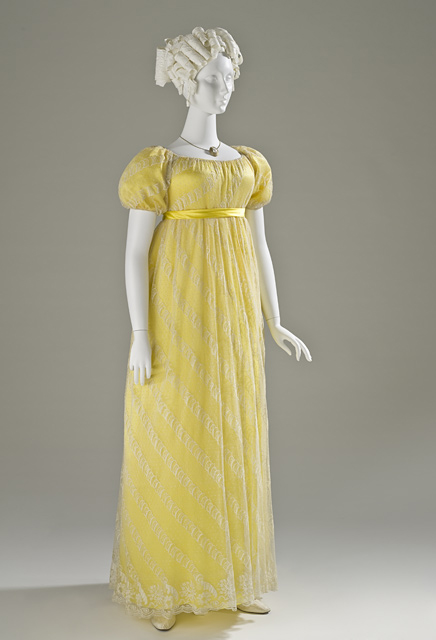
Evening dress with net overlay, 1818. Image @Old Rags

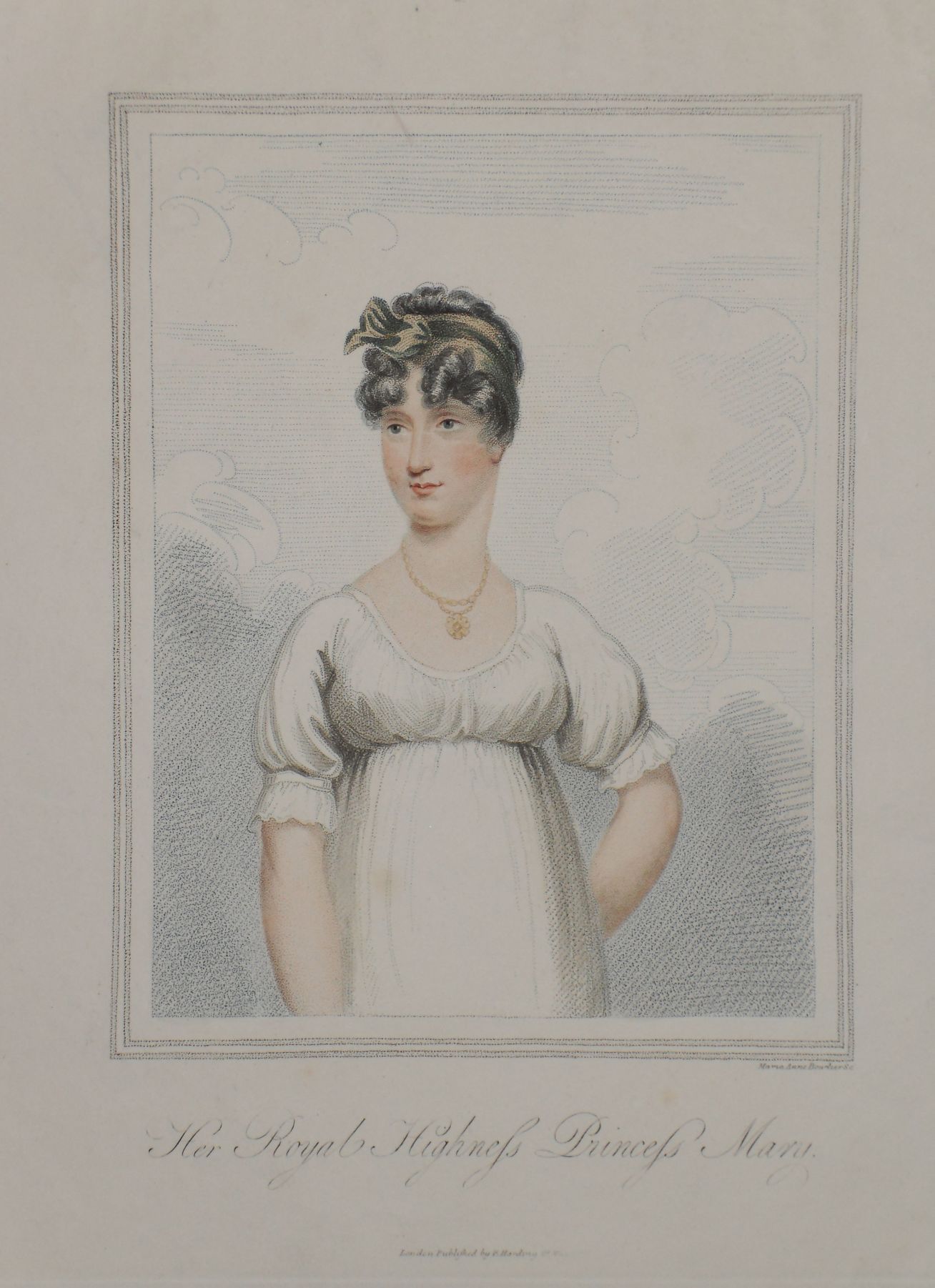
The Duchess of Gloucester was one of the few whose affections never swerved from her love of the old rich points towards blondes and muslins, and her collection was one of the finest in Europe. Lady Blessington, too, loved costly lace, and, at her death, left several huge chests full of it. Gradually lace began to be worn again, but it was as it were ignorantly put on, worn simply because it was again the fashion to wear lace, and lace must therefore be worn; the knowledge of its history, worth, and beauty was lacking…  – Emily Jackson, A History of Hand-made Lace, 1900, p 48.
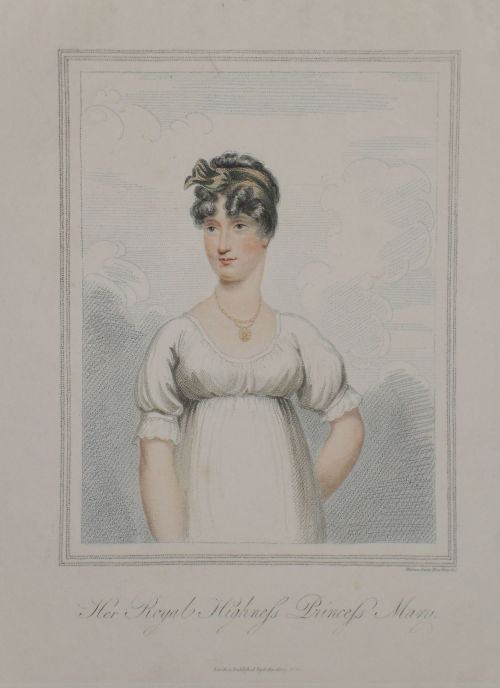
Princess Mary, Duchess of Gloucester (Daughter of King George III) Image @Justin F. Skrebowski

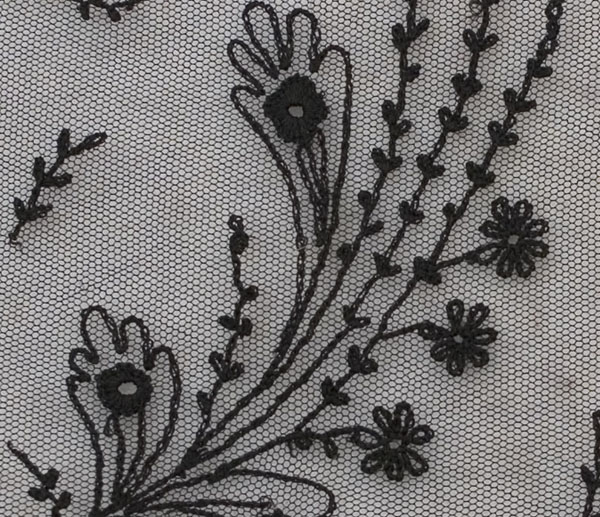
Sprigs beautified the machine-made net. It is said that Queen Charlotte introduced applique on net to support the machine net industry. Honiton appliques consisted of white linen thread sprigs mounted on the net, but black  silk sprigs were applied as well. The black silk cost twice as much as the linen threads and soon went out of fashion.

The trade of lace making remained for several generations in some families, thus in 1871 an old lace maker was discovered at Honiton, whose turn or wheel for winding cotton had the date 1678 rudely carved on its foot –Old lace, a handbook for collectors: an account of the difference styles of lace, their history, characteristics & manufacture, Margaret Jourdain, 1908, p94-95

Detail of early 19th c. tamboured net shawl. Image @Vintage Textiles

Sources:

Read Full Post »
Beauty and Cosmetics 1550-1950 by Sarah Jane Downing was published this month by Shire Library.  Small and compact, as Shire publications tend to be, this wonderfully illustrated book describes the standards of beauty popular in each era, from 1550 when alabaster brows were highly prized, to the black eyebrows that were favored by 18th century women.  As with her best-selling Fashion in the Time of Jane Austen, Ms. Downing provides the reader with a comprehensive overview of the topic. She begins with the Tudor Court and ends with the delightful cosmetic advertisements of the first half of the 20th century.

Marriage à-la-mode: The Countess's Morning Levee, William Hogarth, c. 1745

Because my blog’s theme centers on the Georgian and Regency eras, I will confine much of my recap to those years.

A woman applying beauty patches, Boucher

Mirrors, once only possessed by the rich, became so popular in London in the mid-16th century that British manufacturers petitioned Parliament to ban foreign imports. The ritual of the dressing table became quite elaborate and ladies began to entertain guests as they prepared themselves for the day.

French mop gold boite a mouche patch box with brush, 1730. Images @ Etsy

Decorative patches covered skin blemishes and blotches, sometimes to such an extent that a face could be covered with a variety of dots, half-moon crescents, stars and even a coach and horses! The popularity of using patches began in the mid-17th century and did not wane until the end of the 18th century.

Woman with patches, pale skin and rouged cheeks. Thomas Gainsborough

Porcelain skin was highly prized and created with white lead-based skin cream. Blush was then applied to create a doll-like look. Cosmetics were created in a variety of ways. Here are the ingredients for one recipe for lead face powder that did not come from this book: several thin plates of lead, a big pot of vinegar, a bed of horse manure, water, perfume & tinting agent. Once can only guess how this concoction was put together and at its smell.

Marquise the Pompadour applying face powder with a brush. Boucher, 1758.

Ms. Downing describes in her book:

lead sheets were unrolled and beaten with battledores until all the flakes of white lead came off. These were gathered and ground into a very fine powder… p. 24

Gainsboroughs portrait of Grace Dalrymple Elliot in 1782 shows the craze for dark eyebrows.

For a while during the third quarter of the 18th century, dark eyebrows became all the rage. Lead-based cosmetics, used over time, caused hair-loss at the forehead and over the brows, resulting in a receding hair-line and a bare brow. For those who lost their eyebrows, it became the custom as early as 1703  to trap mice and use their fur for artificial eyebrows. Sadly, the glue did not always adhere well, and a lady could be caught with her brows out of kilter. This hilarious poem was written by Matthew Prior in 1718:

On little things, as sages write,

Depends our human joy or sorrow;

If we don’t catch a mouse to-night,

Alas! no eyebrows for to-morrow. – p.28

Aging beauties staved off the ravages of time with sponge fillers and rouge (sound familiar?), while many women risked poisonous side effects from using their deadly cosmetics. Maria, one of the Gunning sisters who went on to become Lady Coventry, was so addicted to her lead-based paints that she died in 1760 at the age of 27 knowing full well that she was at risk.

Maria, Countess of Coventry

The French Revolution swept away the widespread use of makeup, which was associated with the aristocracy. Defiantly, some aristocratic ladies went to their doom wearing a  full complement of make-up: pale skin, patches, rouged cheeks and rosy lips.

The more natural look of the regency woman. Note that the cheeks are still rouged.

Rousseau influenced the concept of nature and a more natural Romantic look took hold, aided by the blockade of cosmetics during the Napoleonic Wars. The death of many soldiers resulted in widespread melancholia and the affectation of a consumptive look. Ladies, nevertheless, were never far from their rouge pot.

Another Regency portrait with subtle makeup. The flower basket adds to the natural look.

As with all Shire books, Sarah Jane Downing’s trip through time provides us with brilliant insights, in this instance it is via cosmetics and how society viewed beauty in each era. By the 1950s, the success of a marriage was defined by how well a woman took care of herself. This included makeup. Beauty, as Ms. Downing wrote, “was switched from a pleasure to an obligation.”  Oh, my. I give the delightful Beauty and Cosmetics 1550-1950 four out of five Regency tea cups.


Product Details

Paperback: 64 pages
Publisher: Shire (February 21, 2012)
Language: English
ISBN-10: 0747808392
ISBN-13: 978-0747808398
Product Dimensions: 5.8 x 0.2 x 8.2 inches

More on the topic:

Read Full Post »

« Newer Posts - Older Posts »