Feeds:
Posts
Comments

Archive for the ‘Georgian Life’ Category

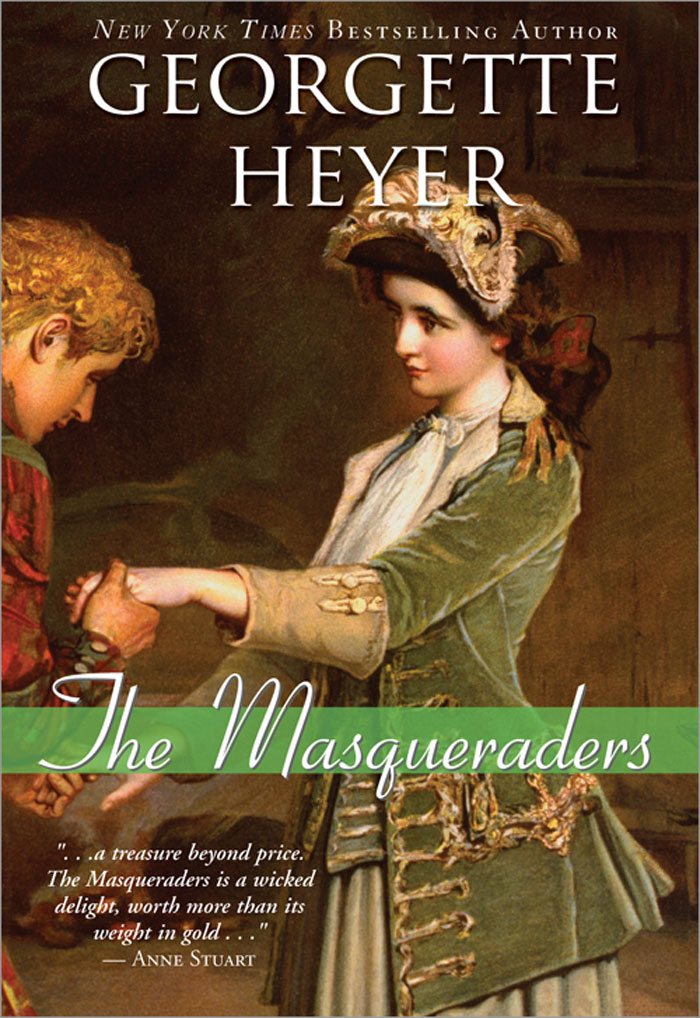
Inquiring readers: I have no doubt you shall enjoy this review of Georgette Heyer’s The Masqueraders by my good friend, Lady Anne, an expert when it comes to the subject of this author. Lady Anne has read Georgette Heyer’s novels for most of her years upon this earth. Smart, sassy, fabulous, well tressed and well dressed, she has read every GH book backwards and forwards. There is not one tiny detail of Georgette’s novels that escapes Lady Anne’s attention or opinion. As to her review of The Masqueraders– please enjoy. For first-time readers: Spoiler alert.

Such a daring escape…

Their infamous adventurer father has taught Prudence Tremaine and her brother Robin to be masters of disguise. Ending up on the wrong side of the Jacobite rebellion, brother and sister flee to London, Prudence pretending to be a dashing young buck, and Robin a lovely young lady…

Although we know her as the queen of the Regency Romance, in fact, many of Georgette Heyer’s books take place a half-century or so earlier in Georgian times, with its gorgeous clothes, stylized social occasions, and convoluted intrigues. The Masqueraders could be set in no other time; it requires both the artifice and the intrigue to work.

We first meet the brother and sister, Robin and Prudence, in their elaborately contrived costumes; Robin disguised as the elegant and enchanting Kate Merriot, and Prudence, appearing as Kate’s equally elegant, if somewhat more retiring, brother Peter. They are on their way to London, to settle with a family friend and await the arrival of their father. The reason for the disguise is simple: Robin and his father backed the Stuarts in the 1745 uprising, and there is a price on each of their heads. But the reason they are indulging in this amazing masquerade of switched genders is due to their father, who has led them a precarious and wildly improper upbringing through most of the major cities of Europe. The old gentleman, as their not entirely dutiful children refer to him, married their mother, a farmer’s daughter, against his family’s wishes and left England without a backwards glance. But there is more mystery here, and the return to England in this fantastical make-believe plays into it.

In the opening chapter, the brother and sister meet an enchanting young lady who had wished for some excitement in her life ,but turned to the wrong person. Kate and Peter rescue her, and shortly after that delightful bit of playacting and sabotage, Sir Anthony Fanshawe, a close friend of Miss Letitia’s father, appears. Letitia becomes great friends with the lovely Kate, who in his real person is on his way to falling in love with the young lady. Sir Anthony also takes a shine to the attractive young man, who is so surprisingly worldly and well traveled, if slightly too smooth of cheek. We watch these circuitous wooings with delight; the young lady is all unaware, but what of Sir Anthony? He is a large man in his mid-30s, said by many to be sleepy, if not altogether dull, and slow to quarrel. But, large as he is, there is more to Tony Fanshawe than meets the eye. For several chapters, we wonder as Heyer walks a careful line; Sir Anthony is clearly interested in the young man, but before we start feeling any discomfort or seeing homoerotic overtones, we become aware that Fanshawe is not so sleepy, and he has ascertained the truth, not only behind Prudence’s masquerade, but also Robin’s, and perhaps as well, the mystery of the old gentleman. He asks if they had thought of what could have happened to Prudence had her identity been discovered by someone not in love with her. Such an occurrence had not been anticipated, and they wonder what had given her away:

“I should find it hard to tell you…some little things and the affection for her I discovered with myself. I wondered when I saw her tip wine down her arm at my card party, I confess.

My lord frowned, “Do you mean my daughter was clumsy?”

“By no means, sir. But I was watching her closer than she knew.”

As the two romances work towards their happy conclusion, the larger story of the old gentleman, who he is really, and the place that he and his children will take in England plays out brilliantly. As is always the case in a Heyer historical novel, the times and the place are carefully laid out. The political fallout, the harsh measures taken against the Jacobites, and the dangers of living in London at that time all play their part in the plot, adding some weight, if not gravitas, to this fine caper. And too, there is great opportunity to enjoy several of Heyer’s delightful young gentlemen and their conversations among themselves. In fact, the stylized society that was so much of the mid-18th Century is what makes this plot work. Only in the elegant velvets and laces, the swordsticks and elaborate hairdos, long full petticoats, boots and full-skirted coats with fine gilt lacings could the brother and sister pull off their amazing disguises and the incredibly intricate plot unwind.

“I contrive,” said the old gentleman, and indeed he does. So too does his creator, in this charming tale of adventurers. The Masqueraders is a delightful romp from beginning to end, with one of the most romantic interludes, a ride in the moonlight, ever penned by this delightful and dependable author.

Other Georgette Heyer Book Reviews on this Site:

Gentle readers: Until Amazon.com stops strong arming publishers like McMillan about the pricing of their ebooks, I will not link to their site for book orders. Rather, I will link straight to the publisher’s site until the bullying tactics are resolved.

Read Full Post »

Inquiring readers: I have no doubt you shall enjoy this post by my good friend, Lady Anne, an expert when it comes to the subject of Georgette Heyer. Lady Anne has read Georgette Heyer’s novels for most of her years upon this earth. Smart, sassy, fabulous, well tressed and well dressed, she has read every GH book backwards and forwards. There is not one tiny detail of Georgette’s novels that escapes Lady Anne’s attention or opinion. As to her review of  These Old Shades- please enjoy.

Set in the Georgian period, about 20 years before the Regency, These Old Shades is considered to be the book that launched Heyer’s career. It features two of Heyer’s most memorable characters: Justin Alastair, the Duke of Avon, and Leonie, whom he rescues from a life of ignomy and comes to love and marry.

The title of the book, These Old Shades, is a subtle allusion to the fact that this book is a far superior reworking of Georgette Heyer’s first book, The Black Moth, a book she wrote for the amusement of her brother who was ill. The characters in The Black Moth are at best two dimensional, but like most of Heyer’s creations, have enough humor and idiosyncrasy to catch our interest. In her case, it was the character of the villain whom she wished to revisit, develop and deepen.

These Old Shades is the first of the Alistair trilogy – she really did like these characters – and is not Regency, nor does it take place primarily in England. Like many of her early books, it falls more accurately into the category of historical romance, and is cast in mid-18th century Paris, with a short idyll at the English county seat of our hero, Justin Alistair, the Duke of Avon. He is known by the soubriquet Satanas, for his cold exactitude and prescient understanding of what his opponent will do next, as well as a certain elasticity in his moral fiber. The Duke has restored his family’s fortune through gambling; he is, as one would expect of one of the first peers of the realm, an arrant snob, careful, although certainly flamboyant, in his dress, and punctilious in manner. The historical background is the court of Louis XV, complete with its intrigues and excesses. It is the perfect backdrop for this story, for which one must be willing to suspend disbelief for pages at a time. It is such fun, and so sparkling in its writing, that one is indeed willing.

We first meet the Duke, dissolute, languid, apparently unaware of his surroundings, when a gamin comes hurtling from a side street and provides Avon with the weapon he has been waiting for to bring about the destruction of the Comte de Saint-Vire, the man who famously insulted Avon beyond courtesy. Avon buys the youngster from his brother, and establishes him as a page dressed in sober black, who attends Avon at parties, assemblies, and the Court at Versailles. The youngster, called Leon, attracts considerable attention, not only for his utter adoration of his master, whom he calls Monseigneur, but also for his startling red hair and dark eyebrows. Such hair and eyebrow combination is evident in the Saint-Vire family. As le tout Paris buzzes, Avon begins laying his plans. Leon is revealed to readers as Leonie, and goes to England in the country to learn how to be a lady. The Duke adopts her and returns to Paris with his ward. His friend Hugh Davenant returns to Paris at the same time and Avon tells him, in a passage that makes clear both the character and performance of this Duke:

“I am becoming something of a patriarch, my dear.”
“Are you? Davenant said, and smiled to himself. “May I compliment
you on your ward?”
“Pray do! You find her to your taste?”
“Infinitely. Paris will be enchanted. She is an original.”
“Something of a rogue,” conceded his Grace.
“Justin, what does Saint-Vire to do with her?”
The thin brows rose.
“I seem to remember, my dear, that your curiosity was one of the
things I deplored in you.”
“I’ve not forgot the tale you told me – in this very room, Justin. Is
Leonie the tool with which you hope to crush Saint-Vire?”
His Grace yawned.
“You fatigue me, Hugh. Do you know, I have ever had a fancy to
play my game — alone.”
Davenant could make nothing of him and gave up the attempt.”

But it is not the plot that carries the reader along; it is the delightful characters. The Duke, the darkest of Heyer’s heroes, has real charm, albeit a little sinister. He is not one you would wish to cross, as we see. Leonie, the heroine, is an effervescent charmer with a ferocious temper and an inherent sense of her own worth that grows through the book. Her character is honest and instinctively noble. She also, like any adorable pet of a large circle, gets away with being outrageous – except when Monseigneur is displeased. The supporting characters have charm and individuality as well. It is no wonder that Heyer comes back to the family twice: once in The Devil’s Cub – to revisit the Duke and his family, with a focus on the Cub, definitely the son of both his parents, and then in what is generally considered her finest novel, in An Infamous Army, where the grandchildren of the second book’s couple play out their roles at Waterloo.

If the story that unfolds is outrageous and unbelievable, the characters develop beautifully, the dialog bubbles delightfully, and we love the rollicking ride.

These Old Shades/Black Moth comparison from Wikipedia

More on the topic:

Read Full Post »

T’is the season to purchase books for a Christmas gift or to curl up with a novel in front of a fire as the cold weather settles in. Without hesitation, I would urge the casual reader to read a Jane Austen novel they have not yet read. Her works are as equally satisfying to read in print as to listen to as a podcast, CD, or tape.  

In addition to Jane’s outstanding novels,  I’d like to suggest several new books this week for your consideration. The first is The Harlot’s Progress: Yorkshire Molly, by Peter Mottley. This is the first in a trilogy and a fictional actualization of Hogarth’s series of etchings called “The Harlot’s Progress”. Each story follows one of three 18th Century harlots who have all been seduced into a life of prostitution at The Bell, a Wood Lane brothel in the City of London run by the notorious bawd, mother Wickham. Underlying each story is the tale of a young woman’s struggle against overwhelming misfortune.

The Harlot’s Progress: Yorkshire Molly by Peter Mottley
This excellent book is for the history buff whose image of years past is NOT colored by sweet nostalgia. Tough, gritty, more realistic than the Hogarth prints on which the story is based, Peter Mottley portrays a harsh, predatory world in which a maid from the country steps down from a wagon on Wood Street to meet her fiance, and is swiftly seduced and turned into a harlot. Sweet 17-year old Molly Huckerby, her head filled with fancies about her new life as a dressmaker in London, can think of nothing but meeting her cousin Tom, who has prepared a room in his lodgings for her visit. But it is Mother Wickham, looking down from an upper window of The Bell, a seedy Ale-house, who intercepts her and introduces her to Colonel Charnell. He plies the young maid with bread, and brandy, and honey. And more bread, more brandy and honey…until she wakes up choking with despair, too ashamed to weep, and realizing with a start that “Instead of saving herself for Cousin Tom, she’d allowed herself to be taken to market by Mother Wickham. And she’d been bought.”  And so Miz Molly’s career as a Cheapside Whore had begun.

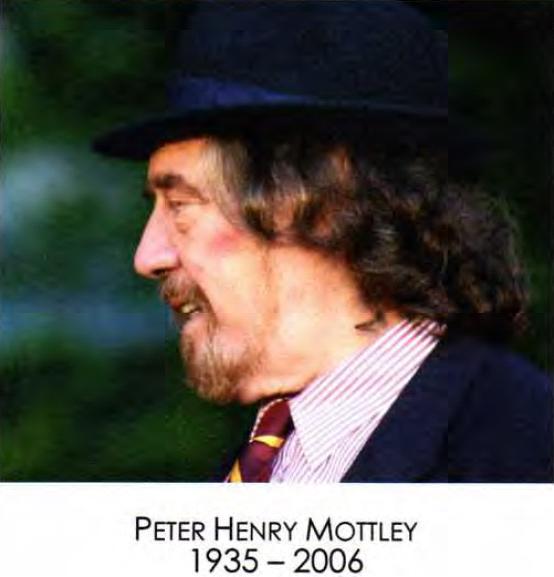
Author and playwright Peter Mottley died in 2006, before this book was published. He was an actor, writer, and director and an active member of the Oxford Theatre Guild. One of his radio plays had been performed on radio by Bob Hoskins. Once gets a sense of his colorful personality in this obituary: “Peter Mottley (1935-2006), for many years a cheery presence at Pangbourne pub gatherings, died on 16 July; he was 71. Martin Hoare writes: ‘He had been a novelist, playwright, actor, producer and philosopher as well as having a career in advertising. His contribution to sf was the comic novel The Sex Bar (1972), about an aphrodisiac and contraceptive chocolate bar. His best known play was After Agincourt (BBC Radio 3, 1988).’ Goodbye, Peter, and thanks for all the birthday parties.”

Mr. Mottley’s sense of stage and scene are apparent in his writing:

The York Wagon. A canvas-covered bone-shaker full of hopefuls who had travelled two hundred miled to The great City, two hundred miles to escape the cattle and sheep of Yorkshire, two hundred miles to fall prey to the wolves of Wood Street. Out of the rat-holes crept the cutpurses, the bawds, the pimps, the harlots, all the Cheapside predators who might earn a shilling or steal a florin or gull a fledgling or find a fresh piece of meat to peddle.

To get a stronger flavor of the book, watch the excerpt below of the author’s daughter, Josselyn, reading a portion of his book. She performs it marvelously well, capturing the grittiness of the writing. Unfortunately, the book is only available in the UK at present. Many of us who have had the privilege to read it will keep you apprised of its U.S. publication date when it arrives.

I give this book my highest rating and strongest recommendation. Again, it is not for the faint of heart. For those with a keen interest in reading about London in the early 18th century, this book is a must have.

More on the topic:

Read Full Post »

Gentle readers, I am taking a short hiatus from this blog for Thanksgiving week. Meanwhile, enjoy these images of people dining in days of yore…

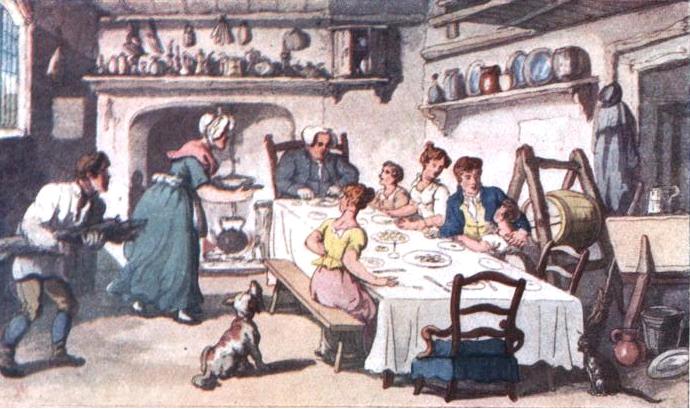
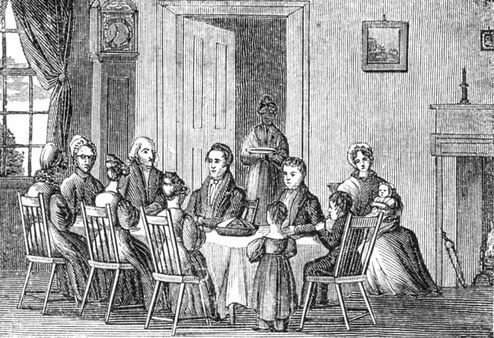
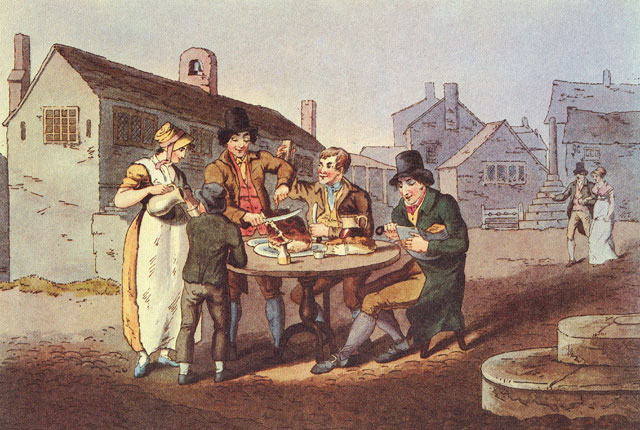
Dining for most people was a simple affair and food was taken from the land. Many families, unless their house was large enough to accommodate a dining room, ate in the kitchen.

Notice in this image of a family sharing a meal by Thomas Rowlandson (from The Vicar of Wakefield by Oliver Goldsmith), that the meal is eaten during the day and near the fire.

The rich could afford to eat by candlelight, as in this early 20th C. image of a Georgian dinner scene.

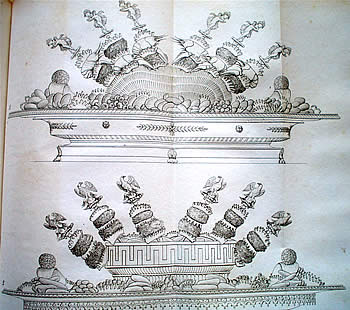
For some, like the Prince Regent, dinners were elaborate affairs.

For other families the meal was more basic and simple.

Family Meal

The hours in which people ate meals were changing:

In the beginning of the sixteenth century in England, dinner, the main meal of the day, used to begin at 11:00AM. Meals tended over time to be eaten later and later in the day: by the eighteenth century, dinner was eaten at about 3:00PM…By the early nineteenth century, lunch, what Palmer in Moveable Feasts calls “the furtive snack,” had become a sit-down meal at the dning table in the middle of the day. Upper-class people were eating breakfast earlier, and dinner later, than they had formerly done…in 1808…dinner was now a late meal and supper a snack taken at the very end of the day before people retired to bed. For a long time luncheon was a very upper-class habit; ordinarily working people dined in the early evening, and contented themselves as they had done for centuries with a mid-day snack…Supper now means a light evening meal that replaces dinner; such a meal is especially popular if people have eaten a heavy lunch – The Rituals of Dinner, Margaret Visser [Penguid:New York] 1991 (p. 159-160) – Food Timeline

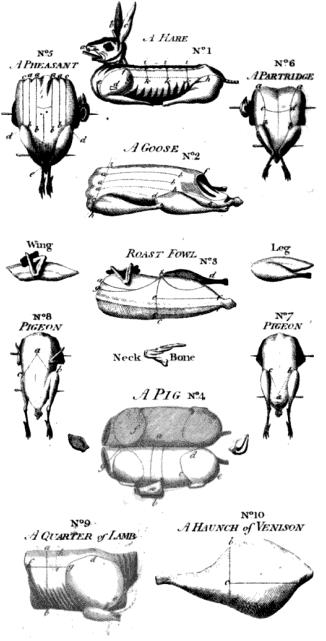
Image source: The Universal Cook: And City and Country Housekeeper, John Francis Collingwood and John Woollams, Principal Cooks at The Crown and Anchor Tavern in the Strand, 1792

Meat made up a large part of the Regency diet, even for the middle class. For most people living in London, the animals had to be brought a long way to market. Due to the length of the journey, the quality of meat was often poor. In contrast, venison and game procured from country estates and served fresh was often considered prize meat.

The Breedwell Family, Thomas Rowlandson

Families tended to be large and extended. In this boisterous family scene by Rowlandson, the Breedwells obviously bred beyond “the heir and the spare.”

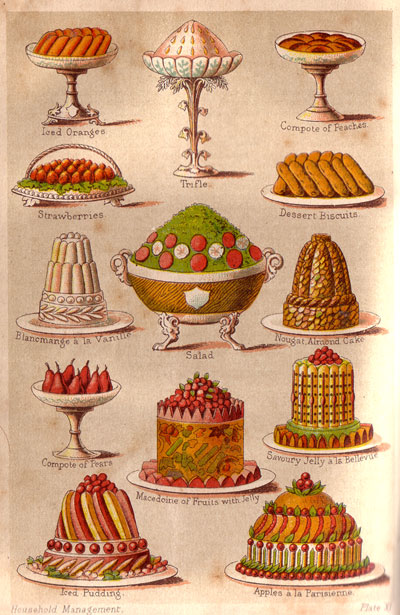
Desserts, Isabella Beaton

Desserts made up the last course of the meal. Even for the middle class this course was elaborate and plentiful, but for the rich it was spectacular.

Walled kitchen garden

Kitchen gardens provided fresh produce during the growing season. The very rich grew fruits and vegetables in hot houses, but most people ate meat, soups, or bread throughout the year. Fruit and vegetables were preserved, or, as in the case of apples and root vegetables, stored through the winter.

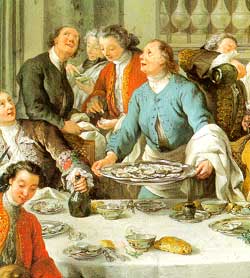
Seafood had to be served fresh and within hours of its harvest. Chances were that this tavern, where oysters were served on a platter, sits in a geographic area by the sea.

Life in Yorkshire

Elegant, or simple, the family meal meant togetherness.

Happy Thanksgiving everyone

More on the topic:

Read Full Post »

Gentle reader: This is the second of a series of three posts about the postal service in 18th century Britain. The first, Letters and the Penny-Post, can be read at this link. These posts are written in conjunction with Austenprose’s discussion of Lady Susan, an epistolary novel written in the form of letters, and thus are the inspiration for these posts.
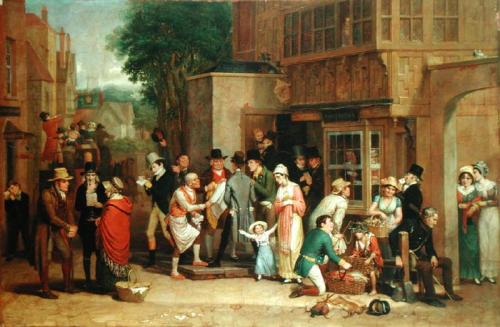
The Post Office, Edward Villiers Rippingille, 1820

The Post Office, Edward Villiers Rippingille, 1820

As early as the 16th century horses were used to carry the royal mail. Sir Brian Tuke, appointed by Henry VIII, oversaw a system of riders on routes from London to Edinburgh, Scotland, Holyhead, Falmouth, Dover, and Dublin. Each stage, or post, was about 20 miles in length. After this distance, tired horses were exchanged for fresh replacements. From 1574, each ‘Post Master’ had to have at least three horses available for use. At the sound of the approaching Post-Boy’s horn, his own Post-Boy was made ready to start the next stage of the journey. Post Boys & Mail Coaches, The British Postal Museum archive

A public postal service was introduced in 1635. Riders on horseback carried the mail, but due to the poor condition of the roads the Royal Mail system was slow and hard on the men and the horses they rode. The riders, or post-boys, wore scarlet livery, and barely traveled more than three miles per hour in those early years. They could manage a faster four miles per hour for an express delivery. Dirt roads were in notoriously poor condition and the journey was challenging for even fresh horses. Only six post roads led from London. Letters were carried from post to post by post-boys and delivered to the local postmaster (or postmistres), who removed the letters for the area and had them picked up or delivered. The post-boy would then continue to the next post, carrying the rest of the letters. The Mail Coach Service
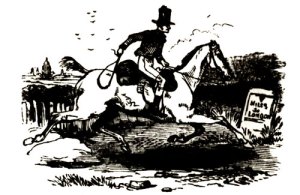
Post-Boy En Route to London, 1800

Post-Boy En Route to London, 1800

Before 1765, sending a letter a short distance outside London cost 3d. and sending a letter halfway across the country cost one shilling, or a week’s wages for most people. To cut costs, business concerns preferred to ship their goods down a river or up a canal, rather than chance a slow and dangerous journey by road, for highwaymen and robbers lay in wait, and post-boys were easy prey. Horace Wallpole wrote about a trip from Tonbridge to Penhurst: “The roads grew bad, beyond all badness, the night dark, beyond all darkness, the guide frightened beyond all frightfulness.” In Sussex the roads were generally so impassable in winter that the judges on circuit refused to hold the assizes at Lewes, the county town. Roads, Tolls, and Highwaymen
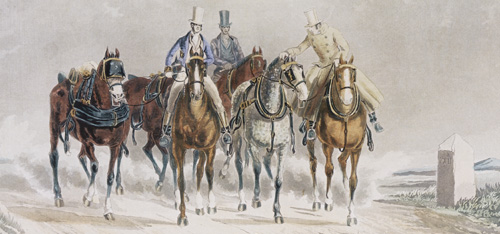
Post-Boys and their ponies, I Henderson, 1834. Although this image depicts a scene later than the era described in this post, and the ponies are harnessed to pull carriages, not deliver the mail, I chose the image because it is reminded me of a description of post-boys setting out with several ponies. This image is from the British Postal Museum Archive.

Post-Boys and their ponies, I Henderson, 1834. Although this image depicts a scene later than the era described in this post, and the ponies are harnessed to pull carriages, not deliver the mail, I chose the image because it is reminded me of a description of post-boys setting out with several ponies. This image is from the British Postal Museum Archive.

The following impressions by Arthur Young, a traveler in the 18th century are reminders of the economic consequences of poor roads. Poor linkages meant that postal carriers could not travel around the country easily:

To Luton; the cross-road execrable.
To Dunstable; a cross-road, very indifferent.
To Bedford; turnpike: a vile, narrow, cut-up lane.
To Kimbolton; very shabby.
To Thrapstone; a cross-road, but so so, much cut up.
To Grimsthorpe; cross-road; very bad; at one part of it over a common, with roads pointing nine ways at once, and no direction-post.
To Colsterworth; most execrably vile; a narrow causeway, cut into ruts, that threaten to swallow us up.
To Wakefield; indifferent; through the town of Wakefield so bad that it ought to be indicted. Most of the Yorkshire roads are favourably spoken of, but there are some exceptions that
To Medley; a cross-road, being a line of vile deep ruts cut into the clay.
To Temple Newsham; the road is a disgrace to the whole country.
To Castle Howard; infamous. I was near being swallowed up in a slough.
To Morpeth; a pavement a mile or two out of Newcastle: all the rest vile.
To Carlisle; cut up by innumerable little paltry one-horse carts.

“From Newton to Stokesley in Cleveland,” says Young, “is execrably bad. You are obliged to cross the moors they call Black Hambledon, over which the road runs in narrow hollows, that admit a south-country chaise with such difficulty that I reckon this part of the journey made at the hazard of my neck. The going down into Cleveland is beyond all description terrible, for you go through such steep, rough, narrow, rocky precipices, that I would sincerely advise any friend to go a hundred miles to escape it. The name of this pass is very judicious; Scarthneck, that is, Scare nick, or frighten the devil.

From Richmond to Darlington; part of the great north road; execrably broke into holes like an old pavement; sufficient to dislocate one’s bones. Her Majesty’s mails: a history of the post-office, and an industrial account …, 1865, p 126-127.

Post-Boys and Horses, 1794, George Morland

Post-Boys and Horses, 1794, George Morland

Many areas of the country didn’t have easy access to the postal system because few of the mail routes came near them. In the early 18th century, Ralph Allen, an entrepeneur who lived in Bath, added a system of crossroads, which connected two post roads, thus covering more of the country. By-posts ran between a post road and a town some distance from it. A way-letter went between two towns on the same post road. Instructions were put on the bottom left corner of letters, hence early covers often arrived with ‘Cross post’ or ‘X-post’ written on them. (History of the Postal Service .)

Allen – who later became the model for Squire Allworthy in Fielding’s Tom Jones – immediately began to stamp out corrupt practices. He had postmasters send him quarterly returns and swear an oath that their figures were accurate. All by- and cross-letters were to be stamped, and tallies kept of all the unstamped mail that came into the postmasters’ hands. As a result of these measures, income from the mail service increased dramatically.

Apart from stamping out bad practice, Allen expanded the routes used by the postal service. During his tenure, he established posts from London to Bristol, Bath, Cambridge, Norwich and Yarmouth, and also increased the number of deliveries that were made. By the time Allen died in 1764, by- and cross-letters were a profitable source of revenue and the department was soon incorporated within the Inland section of the Post Office.- Potted History by Ben Locker

By the middle of the 18th century, road improvements changed to the point where a contributor to the Gentleman’s Magazine wrote in 1754: “Were the same persons, who made a full tour of England thirty years ago, to make a fresh one now, they would find themselves in a land of enchantment England is no more like to what England was than it resembles Borneo or Madagascar.” (Road, Tolls, and Highwaymen.) Road improvements included toll roads, or private roads which the public paid to use but which were maintained and kept in decent condition. The effects of these turnpikes in 18th-century England contributed to lower freight charges of goods and travel times, and better economic conditions. – POSTAL CENSORSHIP IN ENGLAND 1635-1844 BY SUSAN E. WHYMAN

Though notoriously inefficient, post-boys continued to deliver the mail for over 150 years. They took two days to deliver mail from Bath to London, or 4-5 miles per hour, while the stagecoach took only seventeen hours. They also reputedly took forty-eight hours to carry a letter from Bath to London – (Great Britain). Post-boys were vulnerable to adverse weather conditions and highwaymen. “Attacks from robbers were so common in the late 18th century that the Post Office advised customers sending banknotes ‘to cut all such Notes and Draughts in Half in the following Form, to send them at two different Times, and to wait for the return of the Post, till the receipt of one Half is acknowledged before the other is sent’.”

In addition to losing much of their profits to robbers, post-boys had a poor reputation, much of it deserved. Although postage could be prepaid, a major reason that the recipient paid for the delivery of a letter was to ensure that it would be delivered in the first place. Post-boys often failed to place by-letters and cross-letters with the official mail, and they managed to lose or miscarry a great deal of their baggage.
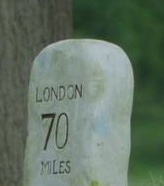
Mile post on the way to London

Mile post on the way to London

Inquiring reader, I decided to end this post with a series of vignettes culled from different sources. While they add to our knowledge of Post Roads, Post-Boys, and Post-Offices, I could find no smooth way to fit the information into the narrative. I end with a poem by Cowper, Jane Austen’s favorite poet, whose poem about a Post Man seems a most fitting way to end this topic.

The boy who carried the mail dismounted at Hammersmith, about three miles from Hyde Park Corner, and called for beer, when some thieves took the opportunity to cut the mail-bags from off the horse’s crupper, and got away undiscovered.” Conditions of the Road P. 125

It must be added, however, that there was little help for raw, unarmed post-boys, when carriages were stopped in broad daylight in Hyde Park, and even in Piccadilly, and pistols pointed at the breasts of the nobility and gentry living close at hand! (Conditions of the roads: pp 126-127)

Rumors of their drunkenness and irresponsibility were rife. At one point it was claimed that “the gentry doe give much money to the riders, whereby they he very subject to get in liquor, which stopes the mails”. Paying the messenger after a letter was delivered was probably the most effective way to ensure it didn’t get lost.- Potted History by Ben Locker

Fell Pony
The late 18th century saw the Fell as the pack animal of choice, carrying loads of lead ore to coastal smelters. Fells were often driven in pack trains of ten animals each, carrying a ton of lead ore between them. The loads were just heavy enough so that two men could lift up the pack saddles while a boy led the Fell out from under. The active, long strides of the Fell Pony meant the pack train could travel over 30 miles a day, over 230 miles a week, for seven days a week, year-after-year, with no breaks for the animals.
The Fell became the mount of choice for the Post Office to carry the mail in Cumberland and Westmorland. In the northern towns, the Fell was also a driving animal, crucial to tradesmen. In the 1800’s, the breed gained renown as a premier trotter, frequently winning against all breeds. – Mustahevonen Farm

Posting in England, about the time of the Tudors, and for some long time afterwards, was carried on by riders on horseback. These persons, who were generally young lads, were termed Post-boys. Their only livery was a scarlet jacket and waistcoat, given to them on the birthday of the reigning sovereign. They might often be seen loitering on the way, and rarely travelled quicker than three miles an hour; or, if sent on express business, managed to accomplish four miles in that time. Campbell writes:
Near Inverary we regained a spot of comparative civilization, and came up with the postboy, whose horse was quietly grazing at some distance, whilst redjacket himself was immersed in play with other lads.
“You rascal! I said to him, “are you the post-boy, and thus spending your time?”
“Na, na, Sir, he answered, “I m no the post, I m only an express!”
But these postboys became the special prey of the highway robbers, who often stopped them and ransacked their bags. In February, 1779, an advertisement appeared, stating that the boy carrying the mail for Liverpool, Manchester, Chester, aiid thirty other towns, besides the Irish niail, had been robbed of the whol – Victorian London – Communications – Post – Postal System http://www.victorianlondon.org/communications/postal.htm

Post Boys

Posting in England, about the time of the Tudors, and for some long time afterwards, was carried on by riders on horseback. These persons, who were generally young lads, were termed Post-boys. Their only livery was a scarlet jacket and waistcoat, given to them on the birthday of the reigning sovereign. They might often be seen loitering on the way, and rarely travelled quicker than three miles an hour; or, if sent on express business, managed to accomplish four miles in that time. Campbell writes:  ”

Near Inverary we regained a spot of comparative civilization, and came up with the postboy, whose horse was quietly grazing at some distance, whilst redjacket himself was immersed in play with other lads.
“You rascal! I said to him, “are you the post-boy, and thus spending your time?”
“Na, na, Sir, he answered, “I m no the post, I m only an express!”
But these postboys became the special prey of the highway robbers, who often stopped them and ransacked their bags. In February, 1779, an advertisement appeared, stating that the boy carrying the mail for Liverpool, Manchester, Chester, aiid thirty other towns, besides the Irish niail, had been robbed of the whole – Victorian London – Communications – Post – Postal System

Post Master

During the 17th and 18th centuries, postmasters had also been innkeepers due to the fact that they were responsible for finding post boys and horses, providing stabling, etc. Once recognized mails came into being, this was no longer necessary and it was felt that inns provided little security for the mailbags. By March 1836, only one post town in the entire country had an innkeeper as postmaster. More common were post offices run by druggists, stationers, grocers and booksellers. Kristine Hughes, Rakehell, 19th Century Mail

The Post Man, William Cowper

HARK ! ’tis the twanging horn o’er yonder bridge,
That with its wearisome but needful length
Bestrides the wintry flood, in which the moon
Sees her unwrinkled face reflected bright ;
He comes, the herald of a noisy world,
With spatter’d boots, strapp’d waist, and frozen
locks ;

News from all nations lumbering at his back.
True to his charge, the close-pack’d load behind,
Yet careless what he brings, his one concern
Is to conduct it to the destined inn:
And, having dropt the expected bag, pass on.
He whistles as he goes, light-hearted wretch,
Cold and yet cheerful: messenger of grief

Perhaps to thousands, and of joy to som ;
To him indifferent whether grief or joy.
Houses in ashes, and the fall of stocks,
Births, deaths, and marriages, epistles wet
With tears, that trickled down the writer’s cheeks
Fast as the periods from his fluent quill,
Or charged with amorous sighs of absent swains,
Or nymphs responsive, equally affect
His horse and him, unconscious of them all.
But oh the important budget! usher’d in
With such heart-shaking music, who can say
What are its tidings? have our troops awaked?
Or do they still, as if with opium drugg’d,
Snore to the murmurs of the Atlantic wave?
Is India free? and does she wear her plumed
And jewell’d turban with a smile of peace,
Or do we grind her still? The grand debate,
The popular harangue, the tart reply,
The logic, and the wisdom, and the wit,
And the loud laugh I long to know them all;
I burn to set the imprison’d wranglers free,
And give them voice and utterance once again.

More on the topic

This post was updated 29, September.

Read Full Post »

« Newer Posts - Older Posts »