Feeds:
Posts
Comments

Archive for the ‘Jane Austen Novels’ Category

I know I am late in reviewing this Jane Austen undead novel, which came out in August. My initial reaction to Emma and the Vampires was “Meh!” and “Oh, no, not another one of those deadfuls.” But as I read Wayne Josephson’s book further, its sweet and gentle quality and its quiet humor began to grow on me. Then I became confused.

If this book was meant to be a vampire mashup, then it failed miserably, for aren’t vampires ravenous for human blood? Aren’t they irresistibly drawn to the smell of humans to the point where they are sexually attracted to their victims and MUST have them at all cost? Aren’t vampires generally fearful of daylight and aren’t decent, law-abiding humans frightened to associate with them?

Emma, while highly skilled at driving stakes through the hearts of the rag tag vampires that attack humans, is unaware that a number of her social group have already gone over to the other side, including Miss Taylor upon her marriage to the vampire, Mr. Weston, Mr. Knightley and his brother George, Mr. Elton, who is attracted to her long neck, and Mr. Martin. These vampires live normally among humans, abstaining from feasting on their human acquaintances and friends, and concentrating on hunting wild animals. They are able to emerge on overcast or rainy days to go about human-like business, but they do not sleep or eat.

Then there are the horrible vampires, who bare their fangs, wear rags, and thrash and drool. These are the vampires that must be dealt with by both the citizens of Highbury and the aristocratic vampires, who are not of their class. In one scene, as the party leaves Randall’s because of the snow, the bad vampires attack the Knightley family and Mr. Woodhouse as they exit the door. As Mrs. Westos screams and Mr. Woodhouse faints, Mr. George Knightley dashes back into the house to return “with two sabres, one of which he tossed to Mr. Weston, who expertly caught it…Emma deftly retrieved her wooden stake from beneath her bombazines, having practiced the the exercise repeatedly at home.” John Knightley joins in the fray, and the fighters, half of them human, half of them aristocratic vampires, then quickly dispatch the drooling, murderous undead. These vampire wars and the dangers in the countryside feed Mr. Woodhouse’s paranoia and general sense of fear, a nice twist on his hypochondria. He is also clueless:

Yes, but the children never sleep—nor does John. They are up all the night long, running everywhere while John paces. And they keep disappearing into the forest, for what reason I haven’t the slightest notion. It worries me exceedingly, with so many wild vampires about.”

As with all vampire books, there are gaping gaps in logic. Why the humans of Highbury don’t seem to connect the dots – that the good vampires among them are never seen eating, that the majority of their activities are done at night, that their eyes are bright red – is beyond me, and one must suspend all logic when entering into the spirit of this novel. As my mom would say, the reader will simply have to go with the flow.

This Emma is Jane Austen light. The book’s tone and style are quite accessible to the modern reader. I had read somewhere that Mr. Josephson had written this novel for his young teenage daughter. If that is the case, then its sweet tone, its epic tale of benevolent vampires fighting evil ones, and its accessible introduction of the Emma character are appropriate.

I enjoyed this novel for what it was. This book certainly has a different take on vampires. If it is true that it is geared toward a younger audience, then it has found its niche. While it would not appeal to die-hard fans of True Blood and Ann Rice novels, it does have a charm of its own.

I give Emma and the Vampires two out of three regency fans.

My Other Mashup Reviews:
Read Full Post »

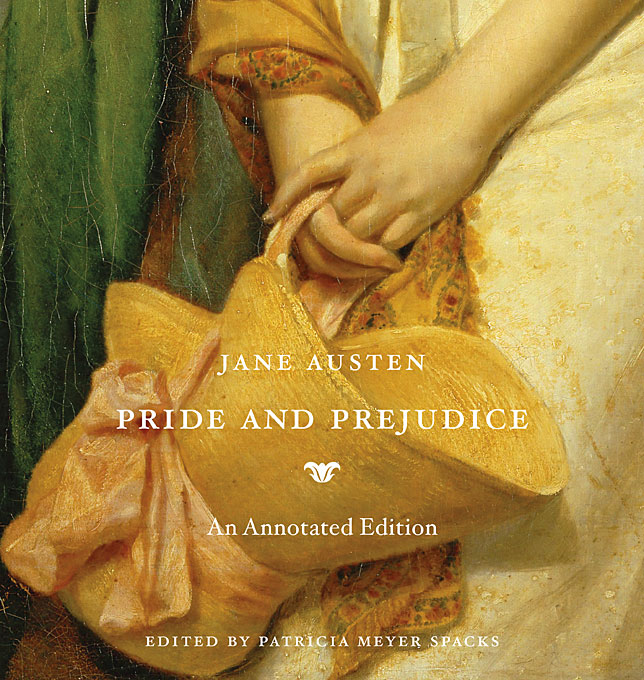
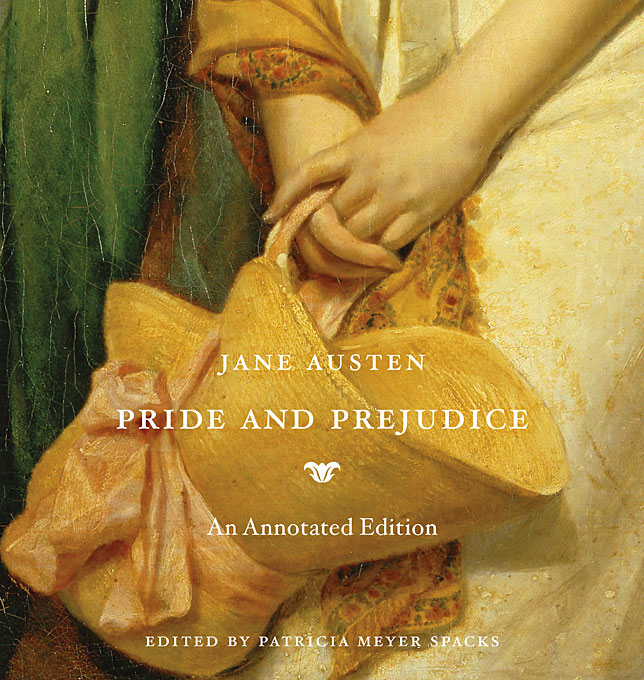
Coming in October is the new annotated edition of Pride and Prejudice by Patricia Myer Spacks. Here’s a peek I took for you of this beautifully illustrated and informative book.

Click here to view this blog listed at Harvard University Press. I’m chuffed!

Read Full Post »

Jane Austen fans tend to read her books repeatedly throughout their lives.  In an article in the Guardian UK, Charlotte Higgins describes how her identity with a Jane Austen character changes with age. Here are some of her thoughts:

If you read Jane Austen more or less annually, as I have done since my late teens, you end up marking yourself against the characters. Oh reader, when I first read Pride and Prejudice I was Lydia’s age. I am about to become older than the delightful Mrs Croft in Persuasion. I still hang on to Anne Elliot, though. A tender 27 she may be, but in modern money I reckon you can give her another 10 years.

This is so true. I am starting to identify more with Mrs. Croft and Lady Russell than Anne Elliot. Charlotte Higgins goes on to say:

Persuasion is a very middle-aged novel, with its melancholic flavour and its acknowledgement that yes, you can make a grotesque mess of your life (the romance part I find much less satisfactory than the bleakly comic first three quarters of the book, essentially before one reaches Bath). It is true, however, that you can tell you are middle-aged when you start to empathise with P&P’s Mrs Bennet: with what Sir Walter Elliot would call “the rapid increase of the crow’s foot” comes a sense of sympathy with this character, written off as absurd in one’s heedless youth. At least she is trying to save her daughters from a future of poverty. And she’s certainly not getting any help from that husband of hers.

So true again. Only in recent years have I become impatient with Mr. Bennet and more sympathetic with his silly wife. I have also become more observant of Mrs. Jennings in Sense and Sensibility, of how hospitable she is, how she tries to become a matchmaker to all the unmarried ladies, and how her house is open to guest seemingly all the time. Yes, she is a silly and irritating woman, traits I could not stand when I was young (thus I could not appreciate her other than as a comic relief character), but now I rather like her positive qualities, as I do Mrs. Palmer’s. Elinor Dashwood is aware of Mrs. Palmer’s good nature and would tolerate her better if she weren’t such an unflaggingly cheerful airhead all the time.

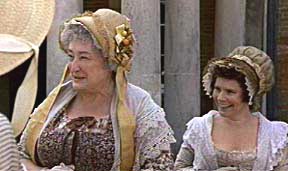
Mrs. Jennings and Mrs. Palmer, Sense and Sensibility

As I get older I see that Lady Catherine de Bourgh is all bluster, and that her authority over Elizabeth Bennet is precisely zero. Young Lizzie is smart enough to know that, but as a 19 year-old reader, I was in awe of Lizzie’s stubborn attitude towards that lady when she stormed to Longbourn to demand Lizzie promise never to marry Mr. Darcy.

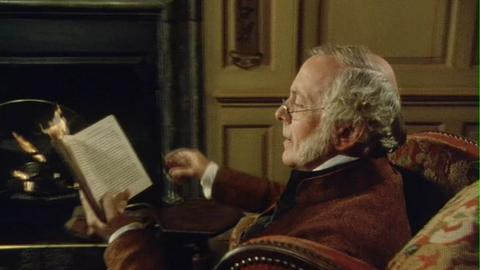
Mr. Bennet reading. Image from Jim and Ellen Moody

There are other ways that my attitude towards Jane Austen’s novels is changing. I notice how few happy marriages are portrayed. Right off the bat I can think of only the Crofts, the Gardiners, the John Knightleys, and the Musgroves. These days, I am more on the side of a pragmatic Charlotte Lucas, who has learned long ago not to look at the world through rose colored glasses, than Elizabeth, who waits for love. To be sure, she snagged her Mr. Darcy, but would Charlotte have had such an opportunity? I think not. I also see that Fanny Price’s strength of character and resolve in the face of so much bullying is a trait to admire; and that Mr. Bennet’s extensive library and unwillingness to compromise a cushy lifestyle were acquired at the expense of his family’s future financial security.

As the years roll by, my tastes and preferences for Jane’s novels are changing. Persuasion and Pride and Prejudice are running neck and neck in my favorite category. P&P used to have the field all to itself. While I loathed Mansfield Park the first time I read it, I don’t mind it so much now, and I find Emma less and less interesting and much too long . Perhaps I should lay the book aside for a few years.

Are your tastes and preferences changing towards Jane Austen’s books and characters as time goes on? How? Curious minds want to know.

Read Full Post »

The new annotated edition of Pride and Prejudice by Patricia Meyer Spacks, a professor of English, Emerita, at the University of Virginia, is so beautiful a book, so lush to the touch and rich with beautiful color images and scholarly insights, that I cannot wait to spend the weekend reading it.

Pride and Prejudice: An Annotated Edition is substantially different from the 2007 Annotated Pride and Prejudice by David Shapard, a trade paperback. At $35, this hard cover book will make the perfect gift for the Jane Austen lover in your life. Click here to read more about it. Look for my review soon.

Read Full Post »

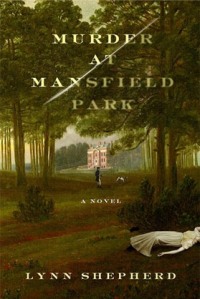
Consider this recipe for a modern Austenesque mystery: Take a familiar and beloved novel, Mansfield Park, with characters whose motives and actions we know intimately, and tear the book up. Throw the pages inside a bag, shake vigorously, and let the characters and plot fall where they may. Add a writer who has cooked up a complex plot for a delicious murder (or two or more, who knows?), and you have Murder at Mansfield Park, a truly hearty and satisfying new mystery novel.

Lynn Shepherd, the chef of this roman à clef, has by dint of her imagination turned  Jane Austen’s classic novel topsy turvy. The characters’ names are familiar, the setting is the same, some of the action as originally described by Jane Austen has been retained, and yet Ms. Shepherd has managed to create something new, refreshing and different.

I must admit to disliking mysteries in general, as many regular readers of my blog know. And I tend not to review Jane Austen sequels. But this novel is different. Oh, I was skeptical at first, slogging through the first chapter, trying to wrap my mind around the changes in the characters. And then I got caught up in the plot and became absorbed to the point where I could not put the book down.

Some red herrings are thrown into the mix, but not so many as to make the reader angry. The plot’s denouement was more than satisfactory and made logical sense. I suppose a true mystery fan might have guessed the killer sooner. Truth be told I held off guessing, for I wanted to be surprised, and so I was.

That Murder at Mansfield Park is Lynn Shepherd’s first novel is most surprising. Her writing style is lovely and effortless as she weaves several plot elements into a seamless whole. Rather than copy Jane Austen, Ms. Shepherd uses Mansfield Park as a take-off point. This novel is intelligently written and assumes that the reader has some command of the English language and enough background knowledge in history, Jane Austen, and other subtle historical and social references to understand the numerous references that crop up.

I give Murder at Mansfield Park six regency fans, my highest rating ever.

Post script: Gentle reader – If you are curious to learn more about Lynn’s novel after reading my review, be forewarned. Many reviewers have spoiled the plot by giving away too much of Lynn’s changes while gushing about them. Honestly, does no one take Review a Novel 101 any more? One irresponsible reviewer of a major online news publication even gave away who was murdered, ignoring the fact that half the fun of this mystery is guessing who the victim will be. So be careful, wary reader, of careless reviewers who do not even bother to place *Spoiler Alert* at the top of their reviews.

Read Full Post »

« Newer Posts - Older Posts »