Feeds:
Posts
Comments

Archive for the ‘jane austen’ Category

Portrait of Maria Edgeworth by John Downman (1807). Is it just wishful thinking on my part or does Jane Austen somewhat resemble this pretty, genteel author?

I’m sure others have been struck by this paragraph from Pride and Prejudice (see quote below), and wondered if perhaps it gives us a clue about how Cassandra was able to locate the many letters from Jane that she would destroy, for the majority of those that survived are innocuous and mundane. They reveal very little about the author’s observations and feelings about her family and friends, politics, and religion.

Cassandra, who outlived Jane by 26 years, kept her sister’s letters to reread during her lifetime. This gave her enough time to decide what to do with them. She burned most of Jane’s letters shortly before her death, redistributing the remaining few among friends and family.

Of the approximately 160 letters that survive from Jane, 95 were written to Cassandra. None of the letters Jane wrote to her parents survive, and very few to her brothers (none to Henry, her favorite brother). To be fair to Cassandra, who has been vilified by many for burning so many of Jane’s letters, it was the custom in those days to destroy such casual correspondence (much like we delete emails today).

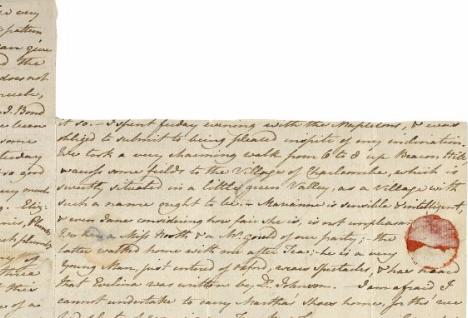
A portion of Jane’s letter has been cut out. Image@Morgan Library

When they read their missives out loud to the family, the Austen sisters had a habit of censoring each other’s letters and leaving out sections that were meant to remain private.  Jane might have given us a clue in Pride and Prejudice on how Cassandra was able to go through thousands of letters and locate information that she was unwilling to pass down for posterity. In some instances Cassandra cut out the offending sentence, but generally she destroyed the entire letter. How did she know where to cut out only one sentence or passage?

This scene, in which Lydia has joined Colonel and Mrs. Foster in Brighton, gives us a clue:

When Lydia went away she promised to write very often and very minutely to her mother and Kitty, but her letters were always long expected and always very short. Those to her mother contained little else than that they were just returned from the library, where such and such officers had attended them, and where she had seen such beautiful ornaments as made her quite wild; that she had a new gown or a new parasol, which she would have described more fully, but was obliged to leave off in a violent hurry, as Mrs Forster called her and they were going to the camp; and from her correspondence with her sister there was still less to be learned, for her letters to Kitty, though rather longer, were much too full of lines under the words to be made public.

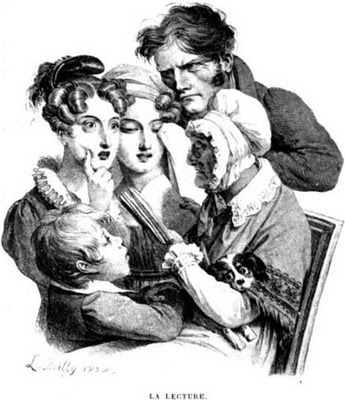
Reading out loud

Note how Kitty could not reveal the words and sentences that Lydia had underscored with lines, even to the family. Did Jane use such a system with Cassandra to keep her private thoughts only for her sister?  I’m curious to know.

Read Full Post »

Jane Austen loved games and a good laugh. Had she lived today in the U.S.A., she would most likely have been a listener of NPR’s “Wait Wait … Don’t Tell Me!” a talk show in which the weekly news is rehashed in a humorous format. Each week the radio show features a segment called Bluff the Listener, in which guest callers must guess which of three choices read to them is true. In this one the caller was told:

“The wisdom of the ages are found in the classic books of Western Civilization. The problem is, though, most of those important books are super boring. This week, we heard about an exciting adaptation of classic literature to a 21st Century form. Our panelists are going to tell you three stories. Guess that true story …”

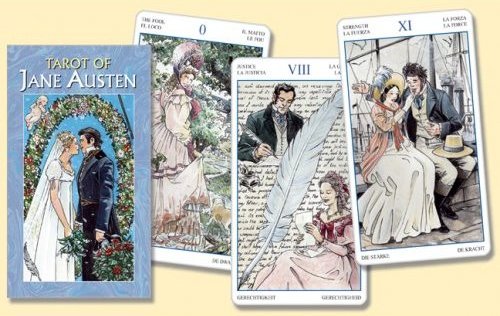
Jane Austen tarot cards

The first story was about a deck building card game, featuring characters from classic literature:

CHARLIE PIERCE: The people behind “Magic: The Gathering” have spent a few years trying to find new frontiers of nerdery to which they can bring the youth of America, and they’ve come up with an idea for all dweebs, an adventure card game, starring the heroes of classic literature.

Each character, in what is going to be called The Dark Library, will be possessed of all the qualities developed for them by their original creators, plus a character-specific superpower bestowed by the makers of the game.

For example: Queequeg, Tashtego and Daggoo, the three harpooners from “Moby Dick” will each get you 125 marksmanship points. While Montresor, the dark villain of Edgar Allen Poe’s, “The Cask of Amontillado,” will carry with him 50 brooding points, capable of being overcome only by a greater number of optimism prime points, such as the combined one thousand OP points possessed by the Bennet sisters from “Pride and Prejudice.”

(SOUNDBITE OF LAUGHTER)

PIERCE: There will also be a special gold edged Mr. Darcy card, of which on five hundred will be made, that trumps every Jane Austen character, except Emma Woodhouse, whose archery skills will lay him low.

(SOUNDBITE OF LAUGHTER)

PIERCE: “This is a field we’ve been itching to get into,” said Martha Willows Gausman, the company’s director of marketing. “The number of possibilities are absolutely limitless. And now that zombies have made Jane Austen cool again, the youth market is wide open.”

Alas, this card game was completely made up and was not the correct choice. To hear the entire Bluff the Listener game or to read the transcript, click on this link.

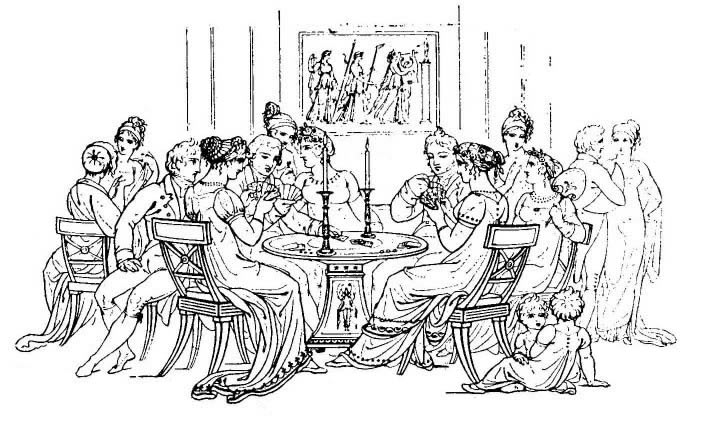
Regency card party

Read Full Post »

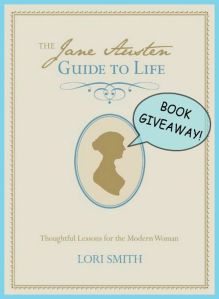
The contest is open until May 15th. You have two chances of winning this book by leaving a comment. Click on image to enter.

Nearly 200 years after her death, Jane Austen is more popular than ever with publishers and readers. Many of her fans are attracted to her era, which they identify as one filled with grace, gentility, and good manners. In The Jane Austen Guide to Life: Thoughtful Lessons for the Modern Woman, author Lori Smith examines Jane Austen’s novels, letters, and life for insights that can help guide today’s woman through life’s passages. There is much good material to digest.

The most important thing is family. Jane was blessed with a large, supportive tribe. They encouraged her talents, reveling in her tales, giving her time to write, and enjoying her books as she was writing them. With much love and support she was able to pursue and develop her talent in an age when such a career was not easily open to women. When she began to write as a girl, Jane had no idea that she would ever make money from her talent, much less find the time to pursue her career.  Some lessons to extract from her persistence in writing are: Do what you would be willing to be poor for; temper your expectations; and share your gifts with the world.  Lucky for us Jane never gave up and weathered the dry giving for posterity six incomparable novels.

Lori Smith’s Guide moves from the essential to the romantic. Let me explain. It is hard to find true love if you don’t know what you want. So, Jane’s advice via Lori is: Be accepting of yourself. Be self-aware. And be sensible. If you’re never satisfied with yourself, then you can’t please others. It’s an axiom that Jane and her heroines followed:

Not only do Austen’s characters find love, they find themselves, and they improve themselves. They see their faults in ways they haven’t before. They realize what kinds of things they are capable of — and that at times they are capable of doing things badly — and this awareness spurs them to change.

Regarding romance, once a woman is open to changing her mind, she is receptive to so many possibilities – of the fact that she was wrong, of opening her eyes to others, of finding the right man. In Jane Austen’s era, a sense of community and belonging helped to guide a woman in the right direction. Jane’s characters (and the author herself) lived in a small, connected society, where friends and relatives knew many details about each other. This situation no longer exists for many of us today:

I think [Jane’s] greatest advice to us would be to keep our eyes open and watch carefully, to not commit too quickly before we really understand a guy’s character.

Spoken like our wise mothers. The Guide continues to cover such topics as saving and spending, gratitude and enduring hardships. In the end, Jane shows us to live life to the fullest and to enjoy every moment. She was capable of making fun of herself and laugh even when things were not going her way.

Even the smaller things, that for most of us would only annoy us and lead to complaint, Jane approached with humor. She told Cassandra, “I will not say that your Mulberry trees are dead, but I am afraid they are not alive.”

In the end, no one can live our lives but ourselves. We can only follow our inner guide and the principles we have chosen to live by.

Lori Smith’s  The Jane Austen Guide to Life: Thoughtful Lessons for the Modern Woman continues to inform us about our lives through the lessons that Jane Austen and her characters can teach us. Like her first book. A Walk with Jane Austen, Lori’s clear writing style is a delight to read. One can almost hear Jane speaking through her words. This book is a wonderful gift for mother’s day, for mothers to give to their daughters, and for men to understand the mind of a fine woman. It is also delightfully illustrated.

I give it 4.5 out of 5 regency tea cups.

Book Giveaway: To enter the book giveaway, click on this link. Contest is open until May 15th. Sadly, only those living in the US and Canada are eligible. Please leave a way to contact you in your comment.

Order the book in both hard cover and eBook format:

  • Hardcover: 224 pages
  • Publisher: skirt! (May 1, 2012)
  • Language: English
  • ISBN-10: 0762773812
  • ISBN-13: 978-0762773817

Read Full Post »

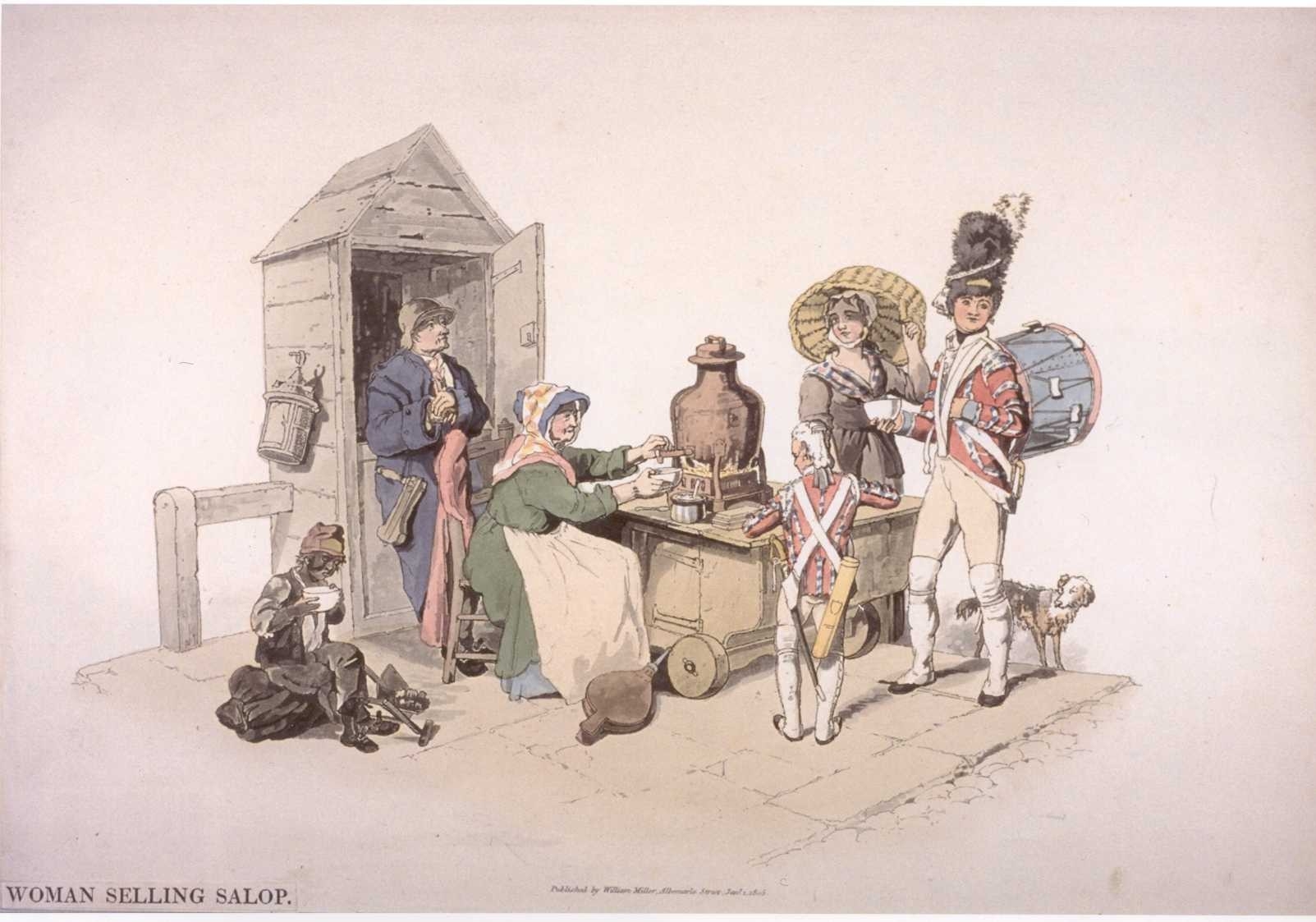
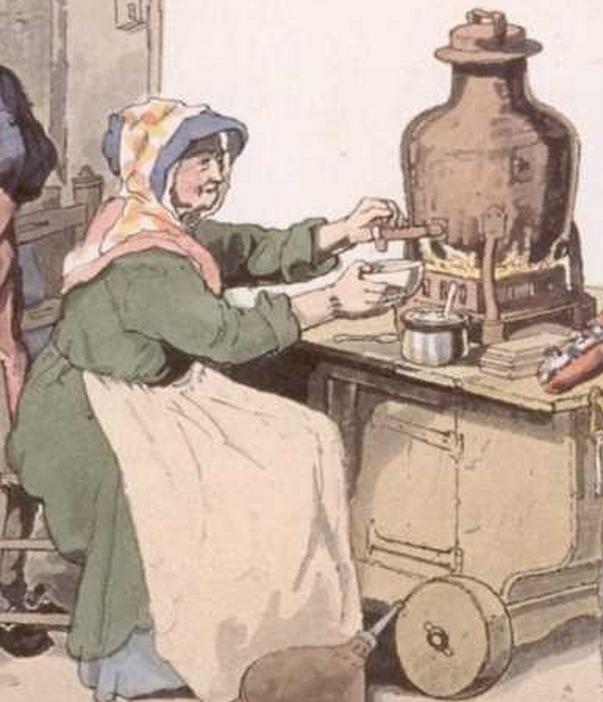
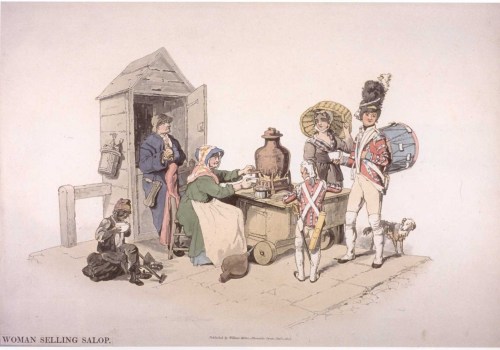
This 1808 image of an old vendor woman selling salop in London seems simple at first glance. Created by William H Pyne for The Costumes of Great Britain (one of 60 beautifully produced hand-colored drawings), the image shows the vendor surrounded by customers waiting for a warm drink, which she pours fresh and hot into white bowls from a samovar (still). One wonders if the sight was common enough for Jane Austen to have observed it during her visits to her brother Henry in London, or if she purchased the drink or had tasted it. This description shows how even a whiff of  salop caused the writer to wax eloquently about the drink, which he had liked long ago:

Suddenly we came upon a still, whence arose the steam of Early Purl, or Salop, flattering our senses. Ye Gods ! what a breakfast ! In vain a cautious scepticism suggests that the liquid was one which my palate would now shudderingly reject; perhaps so; I did not reject it then; and in memory the flavour is beatified. I feel its diffusive warmth stealing through me. I taste its unaccustomed and exquisite flavour. Tea is great, coffee greater ; chocolate, properly made, is for epicures; but these are thin and characterless compared with the salop swallowed in 1826. That was nectar, and the Hebe who poured it out was not a blear-eyed old woman, though to vulgar vision she may have presented some such aspect. – Unctuous Memories, The Cornhill Magazine, 1863 p. 613-617

The problem is not with the drawing; it is with the definition of salop, which is variously spelled salop, salep, saloop, and even sahlib. Experts have offered several explanations and recipes of the drink. I examined three sources, all of which offer different ingredients. Even dictionaries from the 19th century cannot agree with the precise meaning of the drink that was commonly served in coffee houses and stalls and on the streets of London. We can, however, agree on a few observations. A night watchman stands behind the vendor and her mobile table. Thus, salop was a typical nightly drink of Londoners.

Sold between midnight and 6-7 o’clock in the morning for some it was the probate cure of a hang-over while the early birds drank it for invigoration and warming up. (Luder H. Niemeyer)

Detail of the chimney sweep drinking salop

Salop was definitely popular during the first part of the 19th century.

Charles Lamb, in his essay upon Chimney Sweeps, mentions the public house of Mr. Reed, on Fleet street in London, as a place where Sassafras tea (and Salop) were still served daily to customers in his time, about 1823.

The hot mixture was affordable even for the lowly chimney sweep, who is seen drinking from a bowl. But how was the drink made? The Hobson-Jobson: The Anglo-Indian Dictionary, first published in 1886,  says that salop was derived from the tubers of various species of orchis found around Europe. It had the reputation of being a restorative and highly nutritious, and a decoction of the substance, spiced and sweetened, was thought to make an agreeable drink for invalids. – p. 784.
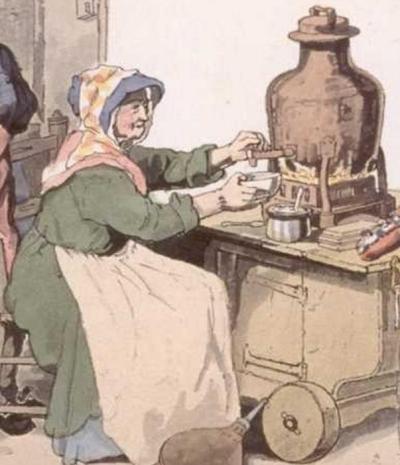
The tea woman sitting behind her street booth – a mobile table with samovar – amidst varied customers, just filling another cup of her much demanded herb-tea. Aquatint printed in color and colored by hand for William Miller in London. 1805.

Hobson-Jobson went on to say that in 1889 a correspondent wrote that the term could also be applied to an infusion of the sassafras bark or wood. Sassafras was imported from the colonies; it did not grow in Europe.

There is also the question of what time of day people preferred to drink salop.  In 1850, a source stated that sassafras tea, flavoured with milk and sugar, was sold at daybreak in the streets of London as saloop. In 1882, The St. James’s Gazette said:

Here we knock against an ambulant salep-shop (a kind of tea that people drink on winter mornings); there against roaming oil, salt, or water-vendors, bakers carrying brown bread on wooden trays, pedlars with cakes, fellows offering dainty little bits of meat to the knowing purchaser.”

From the description, one gets the true flavor of an early morning street scene – its sights, smells, and sounds . One also gains the sense that salop was sold much like coffee today – that there was a preferred time to drink it, but that it could be obtained at all hours. But what about the recipe? Was it made with Sassafras bark or with orchis root?

Gourmet Britain says it was made with orchis root, and provides the reader with a history and recipe.  Soupabooks mentions that it was made of dried sassafras bark and offers this recipe:

To make Salop

Put a Tea spoonfull of  Salop to a Pint of Water, with 3 or 4 Blades of Mace, & some Lemmon Peel cut very thin. Boyl it, & Mill it as you do Chocolate, Sweeten it to your Taste; add some grated Nutmeg, & juice of Lemon to make it Palateable. — Mrs. B.P. Benet, Lathrop Lodge, Swindon, Wilts. From her Book of Recipes from about 1796.

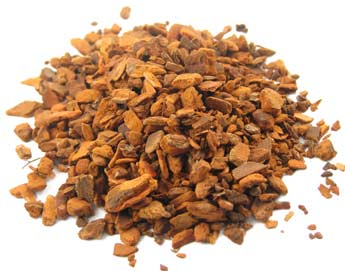
Note that Mrs. B.P. Benet does not describe the Salop, but simply assumes that the reader will know what ingredient to purchase. The salop made with sassafras bark would have a slight taste of licorice.

Early American settlers learned from American Indians how to brew sassafras tea from the root bark and drank it has an herbal remedy. Later they made sassafras the original root in root beer and used it as an important ingredient in Sasparilla, a different but related beverage. Those first Sassafras supporters didn’t know how or why it tasted so good, but a few hundred years later, we do. Sassafras root contains an essential oil called safrole which imparts that characteristic licorice flavor.
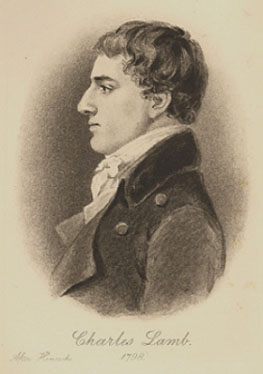
Charles Lamb. Image @NNDB

Charles Lamb in his essay about Chimney Sweeps corroborates the sassafras root ingredient:

There is a composition, the groundwork of which I have understood to be the sweet wood yclept sassafras. This wood boiled down to a kind of tea, and tempered with an infusion of milk and sugar, hath to some tastes a delicacy beyond the China luxury. I know not how thy palate may relish it, I have never ventured to dip my own particular lip in a basin, a cautious premonition to the olfactories constantly whispering to me, that my stomach must infallibly, with all due courtesy, decline it. Yet I have seen palates otherwise not uninstructed in dietetical elegancies, sup it up with avidity. This is salop—the precocious herbwoman’s darling—the delight of the early gardener who transports his smoking cabbages from Hammersmith to Covent Garden’s famed piazzas—the delight, and oh ! I fear too often the envy of the unpennied sweep.” – Unctuous Memories, The Cornhill Magazine, 1863 p. 613-617

To complicate matters even more, I found this description of salop:  “The tea produced from the male root of the Ragged Robin, so-called salop, was the typical nightly drink of Londoners.” (Luder H. Niemeyer) Ragged Robin seems to be the common name for the cuckooflower lychnis, which is a perennial that has very hardy, fibrous roots. Since Ragged Robin was not mentioned in other encyclopedias, descriptions, or dictionaries that I consulted, I will discount this ingredient from the discussion.

Sassafras root bark. Image @ Vermont Fiddle Heads

The following is a sampling of definitions of Salop, Salep, or Saloop from various dictionaries:

  • an aromatic drink prepared from sassafras bark and other ingredients. – Online Encyclopedia
  •  salop (or saloop, a hot starchy drink made with an infusion of dried salep, or orchid tubers) – Science and Society Picture Library
  • An aromatic drink prepared from sassafras bark and other ingredients , at one time much used in London . – – J . Smith ( Dict . Econ . “Saloop” is a common misspelling or typo for: Salop. – Webster’s Online Dictionary
  • saloop/seuh loohp”/, n.: a hot drink prepared originally from salep but later from sassafras, together with milk and sugar. [1705-15; var. of SALEP] – Collaborative International Dictionary
  • Salep, sal′ep, n. the dried tubers of Orchis mascula: the food prepared from it.—Also Sal′op. [Ar.Salep from Arabic: سحلب saḥlab‎, is a flour made from grinding the dried tubers of the orchid genus Orchis (including species Orchis mascula and Orchis militaris). These tubers contain a nutritious starch-like polysaccharide called glucomannan. Salep flour is consumed today in beverages and desserts, in places that were formerly part of the Ottoman Turkish Empire. The term salep may also refer to any beverage made with the salep flour. – Wikipedia

So which ingredient did Pyne’s old female vendor use to make her salop? Orchis tubers, which were found in Europe, or dried Sassafras bark,which had to be imported? In any case, one shudders at the thought of the bowls that the vendor used to pour the drink in for her customers. I see no water jug near at hand to rinse the bowls after each use. Heaven knows how many germs were spread around via these used dishes, which could not be tossed aside or washed easily.

About The Costumes of Great Britain: Between 1800 and 1818, London publishers William Miller, T. M’Lean, and William Bulmer published a series of color plate books, including one that featured 60 color plates of Britain’s working classes just as the Industrial Revolution began to take off.  William H Pyne (1769-1843) was commissioned to write and illustrate the book by the publisher, William Miller. The first edition was printed in 1804, but the edition from which this coloured plate was taken was published in 1808. – Science and Society

More on the topic:

Read Full Post »

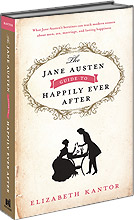
In The Jane Austen Guide to Happily Ever After, Elizabeth Kantor asks in a section about “Taking Relationships Seriously”: Can we have Jane Austen-style elegance, dignity, and happy love only with no cost to modern freedom and equality? The answer is an unqualified yes if, like Austen’s heroines, we approach romance with a rational balance to sex and love and work hard on all our relationships, not just the romantic ones. The Guide is filled with clear-eyed information and advice gleaned from Jane Austen’s novels. Sprinkled throughout the book are selected tips for Janeites. They include:
  • Don’t wait to pursue happiness in love until “some time or other” in the future.
  • If you think about “settling” — think again.
  • The very highest standards for yourself are perfectly compatible with the highest degree of respect and compassion for other people — in fact, they tend to go together.
  • In Jane Austen (and in life), when it comes to human beings, past performance is an excellent predictor of future results.
  • You are the only person you have a right to control.
There are many more kernels of truth in The Guide. Case studies of major male characters, like John Willoughby,  examine their commitment phobias, and close scrutiny of Jane’s clear-eyed heroines reveals how they get love exactly right. The pursuit of rational and permanent happiness is what sets Jane Austen heroines apart. Regard the conversation in Pride and Prejudice between Elizabeth Bennet and her sister Jane about Mr. Bingley’s sisters:

Jane: “You persist, then, in supposing his sisters influence him?”

Elizabeth: “Yes, in conjunction with his friend.”

“I cannot believe it. Why should they try to influence him? They can only wish his happiness; and if he is attached to me, no other woman can secure it.”

“Your first position is false. They may wish many things besides his happiness; they may wish his increase of wealth and consequence; they may wish him to marry a girl who has all the importance of money, great connections and pride.”

With this example, the author points out that Jane Austen’s heroines don’t get an automatic win in love. They have to negotiate their way through competing desires to earn their happiness. Austen creates heroines who are able to do this, but she also shows us women who fail. These women don’t find happiness, for they were looking for love in all the wrong places and for other qualities besides those that would make them happy in love. Thinking about young and impulsive Lydia Bennet, the reader instantly recognizes that she stands no chance of finding happiness with Mr. Wickham after the excitement of their marriage dies down and their money runs out.
Jane Austen’s heroines don’t settle, like Charlotte Lucas  did with Mr. Collins. Fanny Price, who many readers find boring, remains steadfast in her convictions about Mr. Crawford, despite a great deal of pressure from family and friends. Cynical Mary Crawford was in the market for a man with status and money, which is why she first set her sights on Tom Bertram. When Tom leaves with his father for the West Indies, Mary falls for his younger brother Edmund’s charm and sincerity, but the worldly Mary remains blind to the values that Edmund truly cares about, and she is even flippant in her observations about his desires to become a clergyman. While Edmund was willing to overlook many of her faults, in the end their values were too different for their relationship to work. As Elizabeth Kantor observes:
Jane Austen didn’t think we could make it all better by becoming cynics about love – by trying to isolate sex with all its complications from our serious hopes for our lives because we’ve given up on the bliss love promises. She wouldn’t see the point of trying to limit romance to a recreation, instead of a chance for ‘permanent happiness.’
This book is packed with similar discussions that had me thinking about Jane Austen’s novels in a new light. The chapter titles are very descriptive: “He Had No Intentions at All: How to Recognize Men Who Are ‘Just Not That into You'”  or “Don’t Fall for a False Idea of Love.” At the end of each chapter you will find a series of callouts: “Adopt an Austen Attitude;” What Would Jane Do?” and “If we REALLY Want to Bring Back Jane Austen …

If you are tempted to pick up a copy of The Jane Austen Guide to Happily Ever After one thing is for certain – you will gain a new perspective on how to approach modern romance from the advice from one of the world’s most famous regency spinsters.  I give the book 4 1/2 out of five regency teacups. For a sneak peek, go to Amazon and   read the introduction.

About the author: Elizabeth Kantor is the author of The Politically Incorrect Guide to English and American Literature and an editor for Regnery Publishing. She earned her Ph.D. in English from the University of North Carolina at Chapel Hill and an M.A. in philosophy from the Catholic University of America. She is an avid Jane Austen fan.

Order the book at Amazon.
Hardcover: 304 pages
Publisher: Regnery Publishing (April 2, 2012)
Language: English
ISBN-10: 1596987847
ISBN-13: 978-1596987845

Read Full Post »

« Newer Posts - Older Posts »