Feeds:
Posts
Comments

Archive for the ‘jane austen’ Category

Note: The dress on the cover of this book is made with the machine-made net overlay that I described in an earlier post on this blog. Click here to read it.

Emma, Jane Austen’s longest novel, is the only one of her books named after her heroine. Yet, as Jane Austen herself put it, “I am going to take a heroine whom no one but myself will much like.” I rather agree with Miss Austen’s assessment of her own creation, for I have never quite liked the novel because of the main character. The Annotated Emma by Jane Austen, edited and annotated by David M. Shapard might well change my mind about this privileged young woman.

In the preface to The Annotated Emma, David M. Shapard addresses Emma’s unique place in the pantheon of Austen heroines – she’s independent, in charge of her household, and flawed. It is her bossy and ultimately clueless nature that drives the plot, which has very little action to speak of. The first half of the book is influenced by Emma’s behavior and choices as she moves towards growth and self-awareness, but the second half of the plot is taken over by secondary characters and a mystery.

There are no true villains in this rather gentle, bucolic tale. While Frank Churchill is unscrupulous, he is not vile, and Mrs. Elton merely represents an irritating exaggeration (and vulgar mirror) of Emma’s worst traits. Life in Highbury is placid. It revolves around its characters, and Jane Austen is at her comic best introducing their follies with humor. The book, with its inevitable happy ending, is not sappy, for it leaves the reader with the sense that Emma will never quite become as perfect on the inside as she is on the outside, and that her snobby ways remain intact. Sadly, with her marriage to Mr. Martin, Harriet Smith has removed herself from Emma’s social sphere, which was quite understood by both women and the men they married. One also gets the sense that, as her husband, Mr. Knightley will swiftly act as a brake on Emma’s machinations as the “grande dame” of the neighborhood should any of her impulses lead the object of her interest astray.

Dr. Shaphard’s annotated edition explains almost every detail and minutia in Emma that one can think of. Filled with black and white images (as a visual person, I loved these!), notations, citations, definitions, and explanations, this book is a must-have for Jane Austen fans. Readers who have never quite warmed up to Emma will rediscover her and all the denizens of Highbury in its pages. For example, as much as I like to look up information about the Regency era, I missed Mr. Woodhouse’s reference to the South End, which he regards an unhealthy place. In David Shaphard’s annotation the South End, now called the Southend-on-Sea, developed as a seaside resort in the 1790’s. Spurred by its proximity to London,  it never rivaled the leading resorts: “One reason was the mud found on its shore at low tides; which may have inspired the opinion of Mr. Woodhouse.”

Mrs. Elton is not only a comical foil, but she represents something more:

The figure of Mrs. Elton also corresponds to one seen frequently in the literature of the time, that of the vulgar parvenu. Many writers offered satirical depictions of newly rich merchants and their families, who aspired to rise into genteel society and to emulate the manners and ways of those above them. But, while full of self-assurance and a belief that they knew what was correct and fashionable, their manners, speech, and behavior continually betrayed their true ignorance.”

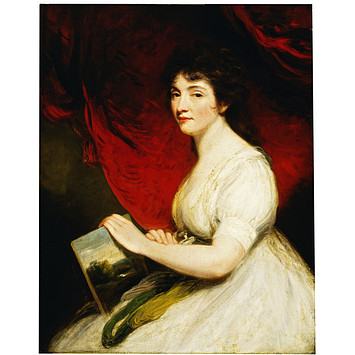
A black and white illustration of this painting @The Victoria and Albert Museum is included in this edition. Miss Mary Linwood holds a painting in her left hand and needlework wool in her lap. Both are symbols of a refined young lady's talents. Mary mastered the craft of needlework paintings and is known for her intricate and detailed works. Click here to read my post about her.

On first reading Emma, new readers are unaware that the book also offers a subplot in the form of a mystery. Upon close scrutiny a second time, these clues start to emerge, giving the reader an “Ah Ha! I should have seen that” moment. Throughout this edition, Dr. Shaphard offers his observations of these clues, preceding them with an unmistakable warning, {CAUTION: PLOT SPOILER} to ward off the newbie reader.

This new addition to the Jane Austen collection of annotated works is quite thick and filled with useful, well-researched information. Random House’s website describes its contents:

  • Explanations of historical context
  • Citations from Austen’s life, letters, and other writings
  • Definitions and clarifications
  • Literary comments and analysis
  • Maps of places in the novel
  • An introduction, bibliography, and detailed chronology of events
  • Nearly 200 informative illustrations

My rating: 5 out of 5 Regency teacups

The maps are quite as informative as the clarifications and illustrations. I recommend this annotated edition to anyone who loves Jane Austen. I even recommend it to the student who publicly announced on Amazon that she “went into a coma” because she found Emma so BORING. My rating for The Annotated Emma by Jane Austen, Edited and Annoted by David M. Shapard is 5 out of 5 Regency tea cups. This book will definitely be a great edition on my shelves, along with Mr. Shapard’s other annotated editions of Pride and Prejudice, Persuasion, and Sense and Sensibility.

On Sale: March 20, 2012
Pages: 928 | ISBN: 978-0-307-39077-6

Published by: Anchor

Please note that the ad placed at the bottom of this post is a WordPress feature.

My blog has no commercial purpose and I do not make money from it.

Read Full Post »

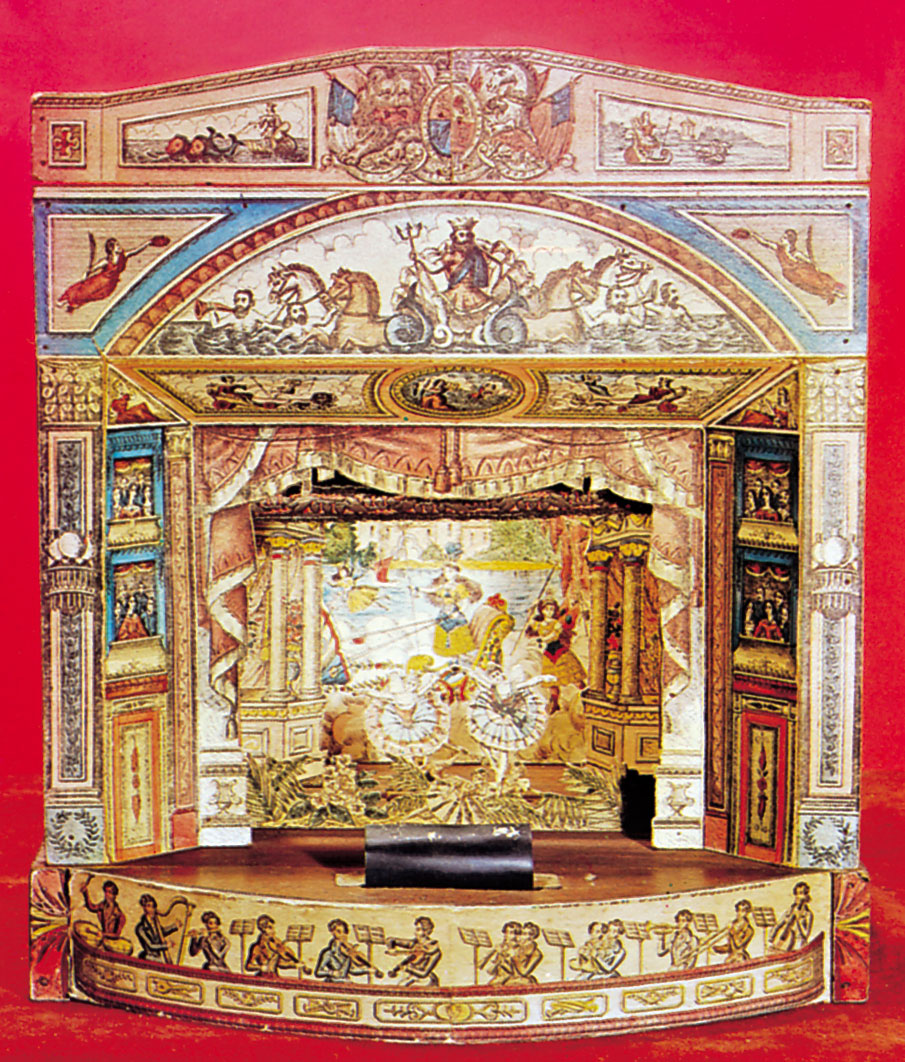
It is hard to imagine what entertainment was like in the days before the 21st century, yet people have always devised ways to spend their leisure time in pleasant company doing amusing things. In the evening, Jane Austen and her family spent many hours entertaining each other. One popular form of entertainment that the older Austen siblings would have known about was the Toy Theatre, or a juvenile form of miniature theater.

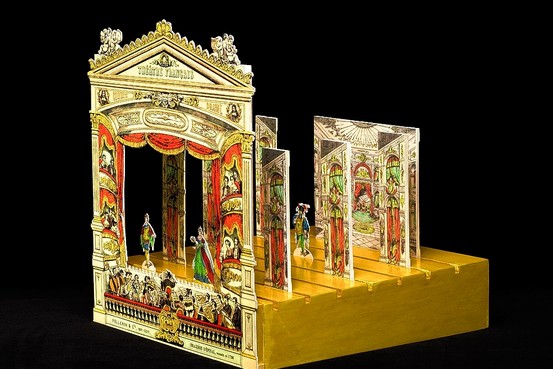
Toy Theatre. Image @Tea at Triannon

This entertainment appeared in the early 1800s, and coincided with the popularity of theater and the rise of the print trade. One can imagine that Aunt Jane was well aware of toy theatres when she spent time with her nephews, for this new toy largely attracted boys.

By 1811 William West of London was printing sheets of stage characters for purchasers to colour, paste on cardboard and cut out, though others treasured them as individual portraits. Single prints in black ink on white paper were called “penny plains” while those with color added by the seller were the “twopence coloured.” West’s first subject was Joseph Grimaldi in “Mother Goose,” a role that brought him fame and lifelong success on the stage. – NYPL Digital Gallery

Miniature theaters became fashionable all over Europe, and their tiny elaborate sets mimicked the grand theaters of London, Paris and other world stages. The sets remained popular throughout the 19th century and into the early 20th century, offering children an opportunity to exercise their imaginations and their acting chops. Some children, I imagine, concentrated on honing their acting skills, while others probably enjoyed their roles as directors or scene designers more. New plays were published in the first half of the 19th century.

After the 1860’s no new plays were published but much of the old repertoire was kept in print by a dwindling number of theatrical print publishers and the tradition continued unbroken until 1944 when Miss Louisa Pollock,shut up her father’s famous shop in Hoxton for ever and sold the contents as a going concern. – Toy Theatre Gallery: History

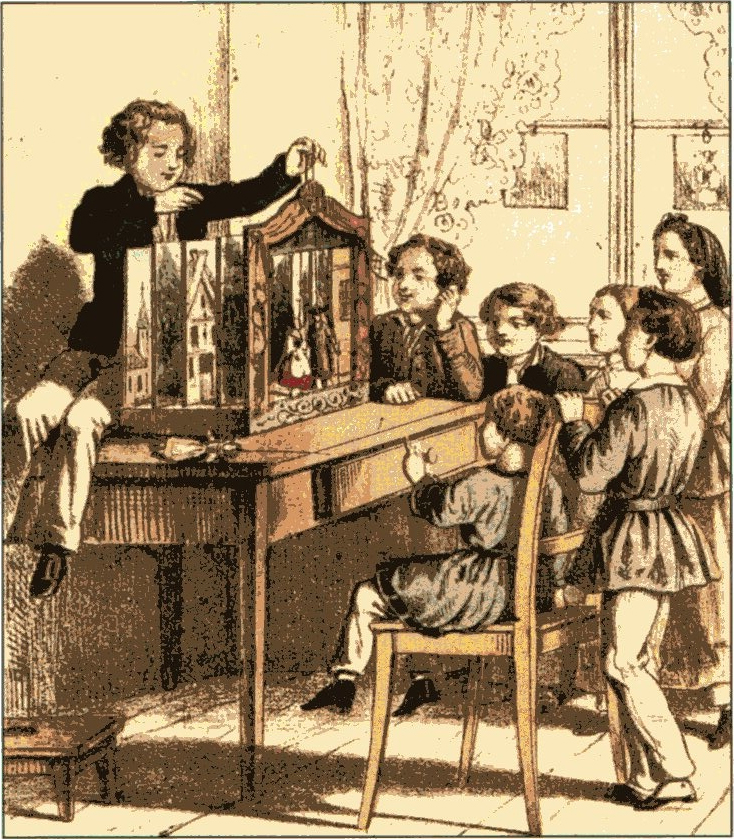
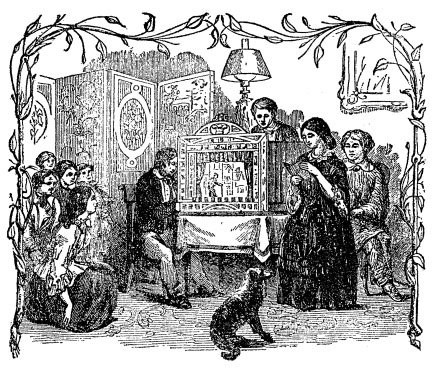
From Mansfield Park the reader gains a sense of how seriously family theatricals were regarded. In the novel, the men were definitely in control of the enterprise, with the women acquiescing to their direction (the only exception being Fanny). While Jane Austen described a real play, Lover’s Vows, with large, almost life-like sets in Sir Thomas Bertram’s study, wood toy theatres that sat on a tabletop would be taken equally seriously. The children must have spent hours preparing for a performance, arranging sets, learning lines, and dressing and moving their characters before they felt comfortable opening a new play in front of an indulgent and forgiving family.

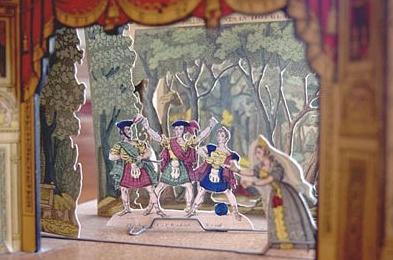
English Toy Theatre, 1850. Pollock's Museum. Image @Brittanica

Created from printed paper glued to cardboard and then mounted on wooden frames, these theaters could be quite intricate in design. They offered a proscenium, scenery, cut-out characters with codified attitudes and gestures, and a booklet that contained stage and scene directions and dialogue for the actors. Almost all of them depict an orchestra: The clothes worn by the musicians give a good indication of when the theatre was designed.

Early toy theatre prints were made from engraved copper plates, the engravings often from sketches made at the theatre on the night. Sets, costumes, and even the actors’ likenesses were copied, and could often be recognised. – Miniature Theatre: Curator’s Choice

Image @Victoriana

The plays were not necessarily derived from children’s stories: They were adapted from operas, melodramas, history, novels, and pantomimes. Works from Shakespeare, Cervantes, Mozart, and Beethoven were included. Hans Christian Anderson was also an inspiration.

Children could choose “Three-Fingered Jack, the Terror of Jamaica” or “Hamlet” or another of the nearly 300 “juvenile dramas” printed in England between 1811 and 1860. – Dramas to Cut, Color, and Produce

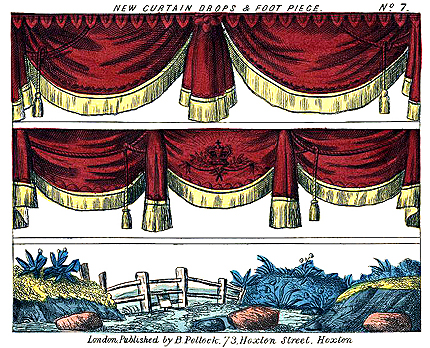
The involvement of publishers was enormous, but Pollock’s toy theatres were probably the most famous in Great Britain.

England had over 50 publishers, Germany 54, Spain 14, France 13, Denmark 10, Austria 9, and the United States 5. All of these versions to some degree were derived from the ability to mass produce the printed image, initially from engraved copper plates, followed by color lithography in the mid-19th century. – A Child’s View: 19th Century Paper Theaters

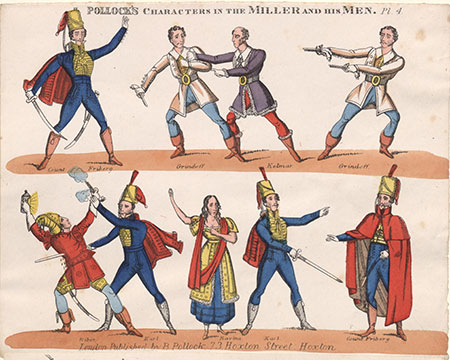
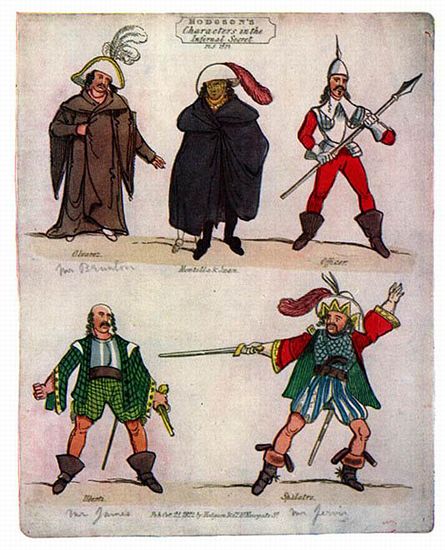
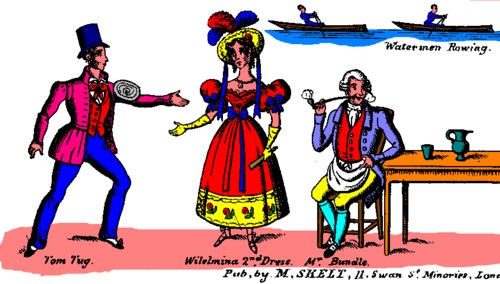
Many printed sheets of cut- out characters survive to this day, both colored and in black and white.

In 1811 William West produces a sheet of the principal characters from the first production on the London stage of ‘Mother Goose’, with Joseph Grimaldi in one of his most celebrated roles of Clown. The popularity of this role led to the publication of sets of sheets of characters, scenery and props, also elaborate prosceniums, the designs based on those of popular London theatres. Books of words, abridged versions of the most popular melodramas and pantomimes to be seen on the London stage.

From this time the popularity of the toy theatre, also known as the ‘Juvenile Drama’, saw the rapid growth in the number of publishers producing versions of plays, with the drawings for the engravings made by such leading artists as Georg e Cruickshank and William Blake. The legacy of the 19th century toy theatre is that of the most complete documentation of the costumes, scenery, and the performance style of the actors of the London Theatres of the period. – The World Through Wooden Eyes: A Penny Plain and Two Pence Coloured

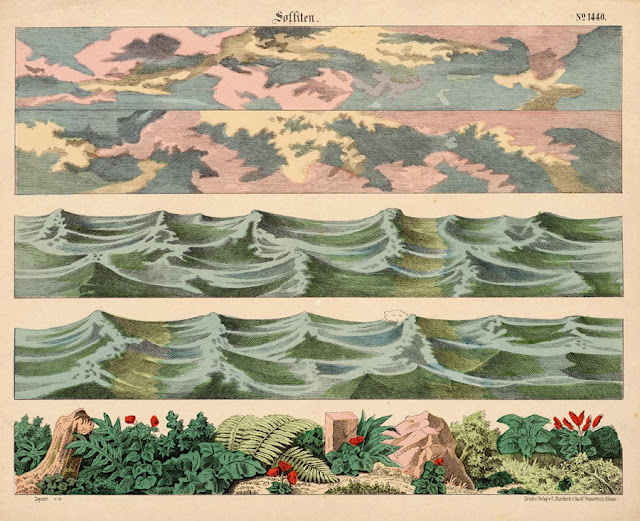
Paper backdrops image @Birds of Ohio

These backdrops for miniature theaters on Birds of Ohio show how much detail the sets provided.

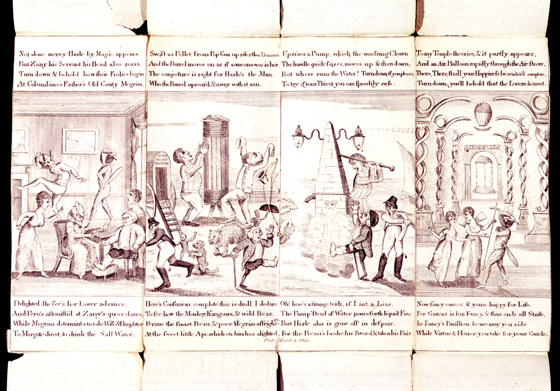
Below is a very rare example from the V&A shows a souvenir from a play  first performed at the Theatre Royal, Covent Garden  in 1800 called Harlequin’s Tour or the Dominion of  Fancy. While the souvenir survives, the dialogue for the play does not.

Souvenir, 1800. Image @Victoria & Albert Museum

In a June 2011 The Telegraph article, Sir Roy Strong, former director of the V&A museum and National Portrait Gallery, recalls his toy theatre with great affection:

Image @The Telegraph

This toy theatre … reminds me of one enormously happy period of my childhood. It was given to me after the war and purchased at Benjamin Pollock’s Toyshop, originally in the East End of London [now in Covent Garden]. I played with all the cut–out cardboard figures and scenery, and still have all my toy theatre plays, which are 19th–century dramas, romances and pantomimes. The theatre sits in the archive room and I love it. It’s been with me everywhere.

More on the topic:

Modern characters for The Waterman.

Read Full Post »

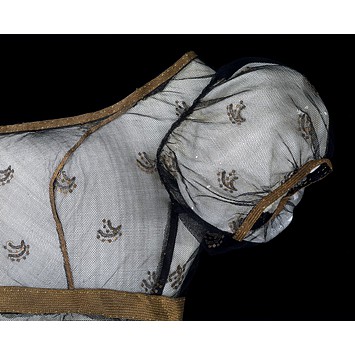
Jane Austen fans are familiar with the high-waisted muslin dresses popular during her adulthood. How many are aware that machine-made net or gauze became a “hot” item from 1810 and on?

Evening dress with gauze overlay

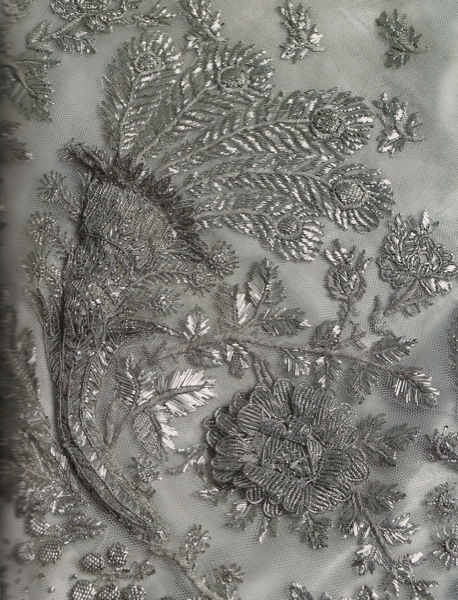
“Net dresses were very fashionable and their popularity was spurred by new inventions. The development of machine-made net in the late 18th and early 19th centuries meant that gauzy lace effects were increasingly affordable either as trimmings or garments. The bobbin-net machine was patented by the Englishman John Heathcoat in 1808 and produced a superior net identical to the twist-net grounds of hand-made bobbin lace. It was so successful that women in the highest ranks of society, including the Emperor Napoleon’s first wife, Josephine, wore machine-net dresses. Initially, however, all machine nets were plain and had to be embroidered by hand.” – Victoria and Albert

Detail of an evening dress with net lace. Image @Victoria & Albert Collection

Machine-made bobbin net was first made in France in 1818. Until this date, lace as it was made was known as old lace. After that date, lace is categorized as being modern.

Silver embroidery on net on Empress Josephine's court gown. Image @Madame Guillotine

Machine made lace made an appearance around 1760. The nets and tulles became immediately popular. Their arrival spurred the production of other silk lace cloths, which led to a general rise in popularity of the silk lace trade – until a machine was invented that could produce silk net lace as well.

Evening dress with net overlay, 1817-1818, V&A Museum

In the 18th century the hand-made net was very expensive and was made of the finest thread from Antwerp: in 1790 this cost £70 per pound, sometimes more. At that time the mode of payment was decidedly primitive: the lace ground was spread out on the counter and the cottage worker covered it with shillings from the till of the shopman. As many coins as she could place on her work she took away with her as wages for her labour. It is no wonder that a Honiton lace veil before the invention of machine-made net often cost a hundred guineas. Heathcoat’s invention of a machine for making net dealt a crushing blow to the pillow-made net workers. The result is easily guessed. After suffering great depression for twenty years the art of hand-made net became nearly extinct, and when an order for a marriage veil of hand-made net was given, it was with the greatest difficulty that workers could be found to make it. The net alone for such a veil would cost £30. – A history of hand-made lace: Dealing with the origin of lace, the growth of the great lace centres, the mode of manufactures, the methods of distinguishing and the care of various kinds of lace, Emily Jackson, p. 170

Hem of 1817_1818 Evening Dress with net overlay, V&A Museum

The most popular European centers for lace making were located in France, the region known as Belgium today, Ireland, England,and Italy.

During the French Revolution the French textile industry had suffered and unlike in England, use of textile machinery had been non-existent.  Emperor Napoleon stopped the import of English textiles and he revived the Valenciennes lace industry so that fine fabrics like tulle and batiste could be made there. – Regency Fashion History

Black net over gold gown, 1818. Image @Defunct Fashion

Between 1806-1810, net gowns embroidered with chenille embroidery became popular. Profits rose for the manufacturers as the price for the cloth plummeted.

In 1809 Heathcoat took a patent for his bobbin net machine. But the profits realised by the manufacturers of lace were very great, and the use of the machines rapidly extended; while the price of the article was reduced from five pounds the square yard to about five pence in the course of twenty-five years. – John Heathcoat and the Bobbin Net Machine, Samuel Smiles (1859)

By 1813, the bobbinet machine had been perfected. After 1815, gauze was used over satin evening dresses, with the fabric gathered at the back. By 1816, crepe, net and tulle were worn over evening wear made of satin, silks, velvets, kerseymere, satin, lame, and both plain and shot sarcenet.

La Belle Assemblee Court and Fashionable Magazine contains this description of a lady’s dress in Her Majesty’s Drawing Room in January 1818:

Hon. Lady Codrington.—Net draperies, magnificently embroidered in gold  lama, in bouquets and sprigs, over a petticoat of white satin, with blond lace at the bottom, headed with a rouleau of gold lama; train of crimson velvet, trimmed with gold lama and blond lace. Head-dress gold lama toque, with ostrich plume, and diamonds.

1818 Evening Dress, June. La Belle Assemblée. ENGLISH. No. 1.—Evening Dress. Round dress of embossed gauze over white satin, with coriage of peach-coloured satin, elegantly ornamented with rouleau medallions and palm leaves of white satin. Mary Queen of Scots hat, ornamented with pearls, and surmounted by a full plume of white feathers. Negligé necklace of fine pearls, and gold chain beneath, with an eyeglass suspended. White satin shoes, aud white kid gloves.

Not every lady of that era was obsessed over bobbin net lace or tulle. Many began to publicly and proudly favor the old hand made lace.

…both in England and on the Continent and at Almack’s, the Assembly Rooms at Bath and Tunbridge Well, the chaperons would gossip of their lappets of Alencon or Brussels. Numerous were the anecdotes as to how this treasure or that had turned up having escaped the doom the rag-bag, which alas! was the fate of so much old lace during the muslin and net period. – Emily Jackson, A History of Hand-made Lace, 1900, p 48.

Machine made lace dealt a great blow to the industry of hand-made fabrics. In Tiverton in 1822, where once 2,400 lace makers worked, only 300 lace makers were still employed.

Evening dress with net overlay, 1818. Image @Old Rags

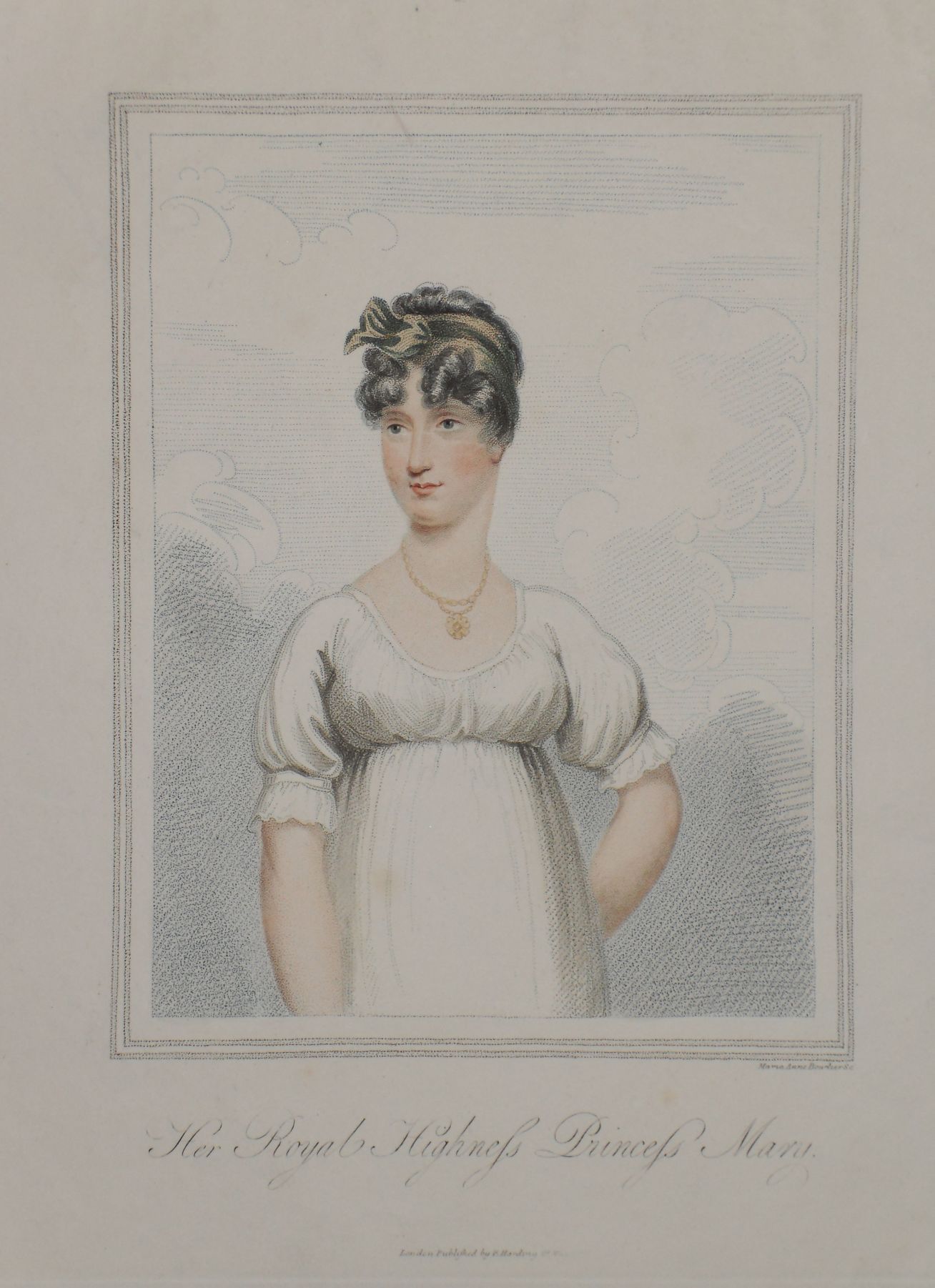
The Duchess of Gloucester was one of the few whose affections never swerved from her love of the old rich points towards blondes and muslins, and her collection was one of the finest in Europe. Lady Blessington, too, loved costly lace, and, at her death, left several huge chests full of it. Gradually lace began to be worn again, but it was as it were ignorantly put on, worn simply because it was again the fashion to wear lace, and lace must therefore be worn; the knowledge of its history, worth, and beauty was lacking…  – Emily Jackson, A History of Hand-made Lace, 1900, p 48.

Princess Mary, Duchess of Gloucester (Daughter of King George III) Image @Justin F. Skrebowski

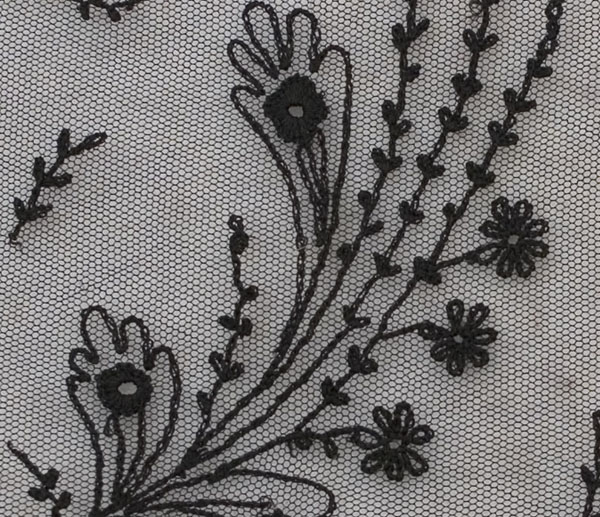
Sprigs beautified the machine-made net. It is said that Queen Charlotte introduced applique on net to support the machine net industry. Honiton appliques consisted of white linen thread sprigs mounted on the net, but black  silk sprigs were applied as well. The black silk cost twice as much as the linen threads and soon went out of fashion.

The trade of lace making remained for several generations in some families, thus in 1871 an old lace maker was discovered at Honiton, whose turn or wheel for winding cotton had the date 1678 rudely carved on its foot –Old lace, a handbook for collectors: an account of the difference styles of lace, their history, characteristics & manufacture, Margaret Jourdain, 1908, p94-95

Detail of early 19th c. tamboured net shawl. Image @Vintage Textiles

Sources:

Read Full Post »

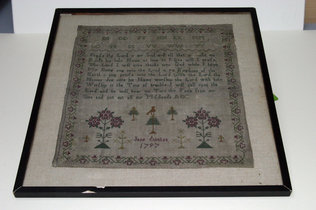
The Bodleian Library in Oxford recently exhibited a sampler (along with other items) for one day to celebrate World Book Day on March 1. This linen cross stitch sampler, purportedly made by a 12-year-old Jane Austen in 1787, was displayed for the very first time. The stitching has become frayed and undone, so that the sampler appears to have been made in 1797. A stylized border with flowering trees surround the words to the psalm, “Praise the Lord O my soul.”

The sampler was purchased in 1996 for over £2000. According to the sale catalogue, the “present owner, who lives in Gloucestershire, received the sampler as a present, folded inside a tobacco tin.” A note on the back of the frame states that an early owner was “related to Jane Austen the novelist” and that she had “received it as a memento” of Austen’s life. (Such a practice was very common after a person died. Letters and personal items were given to close friends and family members as a remembrance.)

I must add that this sampler’s provenance is doubtful. The provenance cannot be directly traced to Jane Austen, and “an early owner related to Jane Austen” simply does not provide enough reliable information.

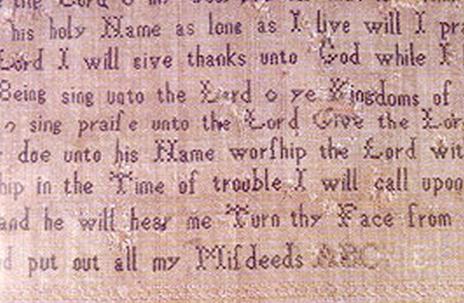
Sampler detail. Image @Jane Austen Centre Gift Shop*

Jane Austen prided herself on her precise sewing skills. This sampler shows a more inexperienced hand than a seamstress in her later years. (I must add that a sampler I made at a similar age does not look nearly half as good.)

Jane mentions a young needlewoman in Northanger Abbey. Henry Tilney remarks upon the age difference between Catherine Morland and himself:

“I had entered on my studies at Oxford, while you were a good little girl working your sampler at home!”

To which she responds:  “Not very good I am afraid.”

More on the topic

Read Full Post »

Oak cask for making vinegar. Image @Taste of Croatia

Vinegar has had a long and noble history of uses for mankind. Since ancient times it has been used as a preservative. Delicate fruits and berries were ripe for such a short season that vinegar, with its acetic acid content, was used to to preserve them. (Blackberry vinegar recipe)

Add sugar and water, to the mixture and one had created a tart and pleasing beverage. Mix it with alcohol, and this sweet concoction became a tasty mixer! Vinegar Cocktails Are Making the Rounds 

As vinegar is so necessary an article in a family, and one on which so great a profit is made, a barrel or two might always be kept preparing, according to what suited.” – A new system of domestic cookery: formed upon principles of economy, and adapted to the use of private families (Google eBook), Maria Eliza Ketelby Rundell, Printed by Norris & Sawyer, 1808.
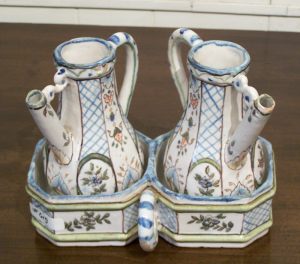
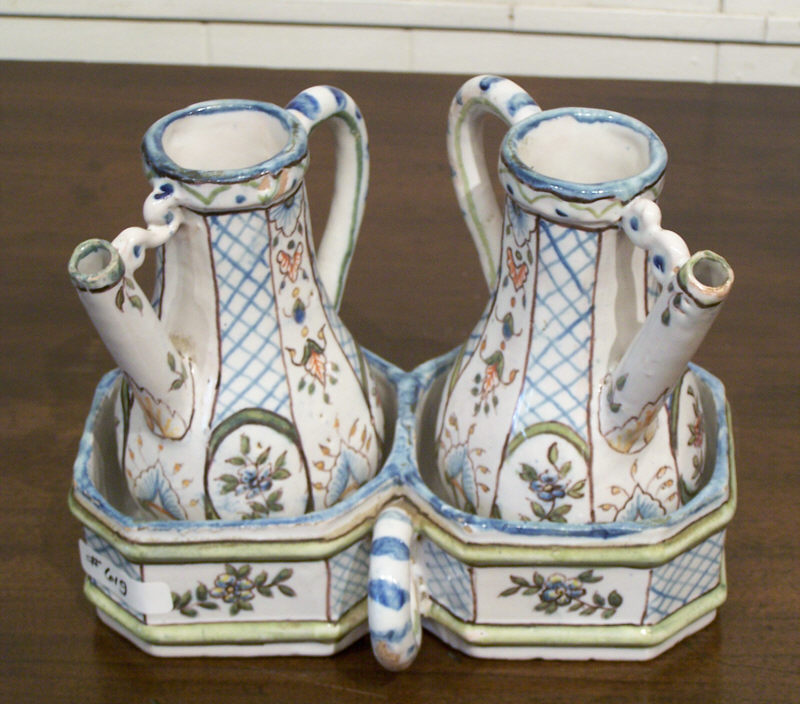
18th century French faience oil and vinegar set

Vinegar is made from many sources: grapes, apples, sugar cane, or malted barley or oats.

In foods it is used for its antibacterial properties, as an acidity stabiliser, diluting colourings, as a flavouring agent and for inhibiting mould growth in bread. In brewing it is used to reduce excess losses of carbohydrate from the germinated barley and to compensate for production variations, so producing a consistent quality beer.

It can be found in beer, bread, cheese, chutney, horseradish cream, pickles, salad cream, brown sauce, fruit sauce, mint sauce and jelly and tinned baby food, sardines and tomatoes.” – La Leva di Archimede

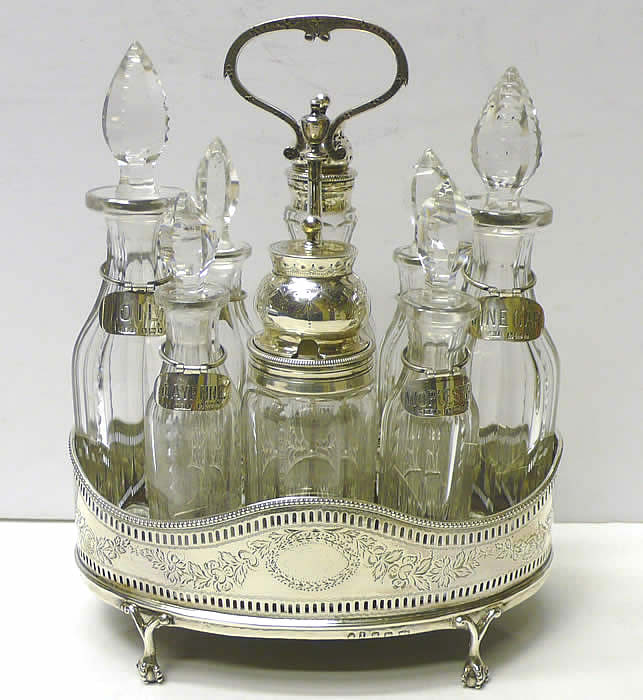
George III condiment set, silver 1782 Sheffield

Herbs, fruits and spices have long been added to vinegar for flavor, and recipes for infused vinegars were handed down for generations. ‘Sugars of lead,’ a sweet tasting substance, was made by pouring vinegar over lead. This liquid would be used to sweeten harsh cider, but as every self-respecting 21st century reader knows, this substance was quite poisonous. One can only conclude that sugars of lead must have been quite deadly to Europeans addicted to drinking cider. – Enzyme facts, vinegar history 

Recipes for vinegar are found as early as the 17th century. In the Delightes for Ladies (1602), Sir Hugh Plats offers this recipe for distilling and purifying vinegar. Notice his caution of the use of lead.

How to distill wine vinegar or good Aligar that it may be both cleare and sharpe

I Know it is an usuall manner among the Novices of our time to put a quart or two of good vinegar into an ordinay leaden stil, and so to distill it as they doe all other waters. But this way I do utterly dislike, both for that heere is no separation made at all, and also because I feare that the Vinegar doth carry an ill touch with it, either fro the leaden botto or the pewter head or both. And therefore I could wish rather that the same were distilledin a large bodie of glasse with a head or receiver, the same beeing placed in sand or ashes. Note that the best part of the vinegar is the middle part that ariseth, for the first is fainte and phlegmatick, and the last will taste of adustion, because it groweth heavie toward the latter end, and must be urged up with a great fire, and therefore you must now and then taste of that which commeth both in the beginning & towardes the latter end, that you may receive the best by it selfe.
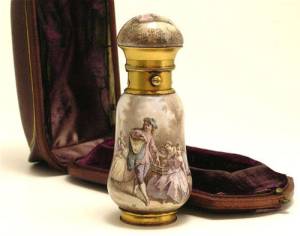
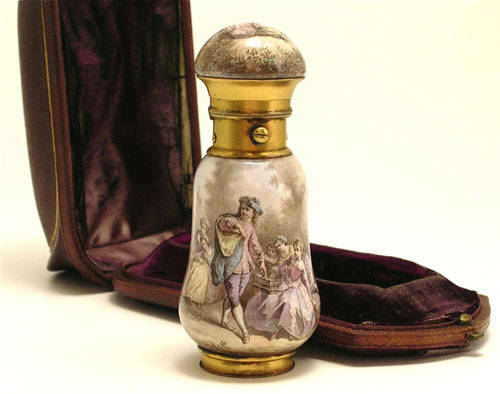
18th C. French vinaigrette bottle

Aromatic vinegar in the minds of 17th-19th century users had many medicinal purposes for preventing infections and megrims (headaches), reviving a fainting person, and covering bad odors. It was used to treat dropsy, croup, stomach aches, as well as sore throats. Vinegar teas were consumed by diabetics, and the liquid was used to heal wounds and fight infections. (Bragg, Health Information.) Vinegar was also a well-known cleaning agent and furniture polish, although it was not recommended for polishing marble, since the acid would eat into the smooth surface, leaving it pockmarked over time.

Vinegar was considered an indispensable item in the 18th century for arousing a fainting person or masking foul odors. When the sponge was soaked only in vinegar, its original use, it could help prevent the wearer from fainting. A person stepping outside a crowded London street might carry aromatic soaked sponges to hold close to the nose to mask the odor of raw sewage and rotting garbage.
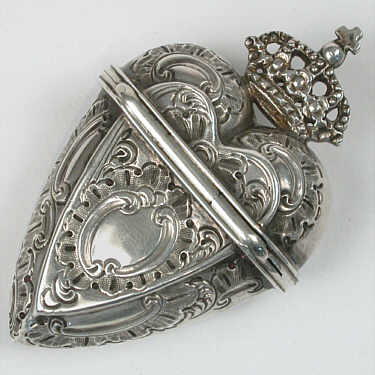
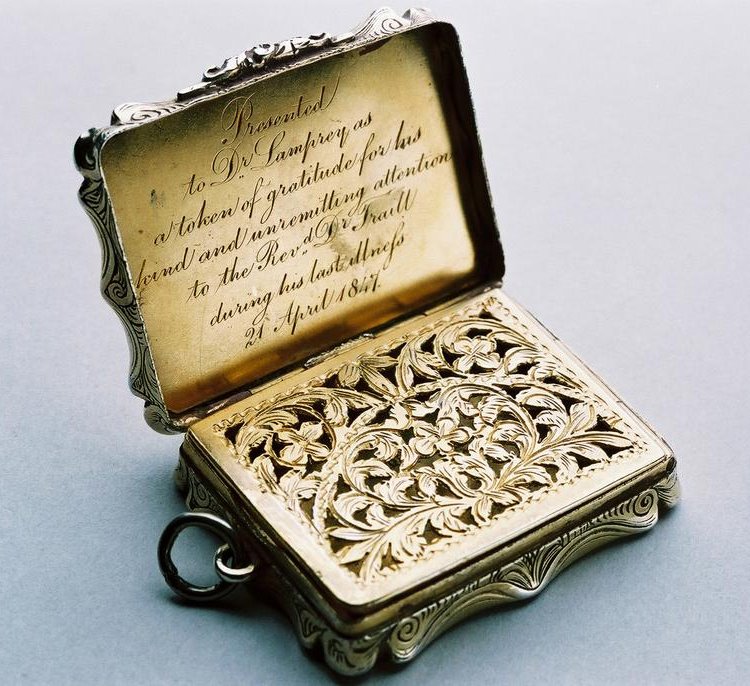
19th c. Victorian silver vinaigrette

In the early 19th century, there wasn’t garbage men that carted away the trash. People threw the stuff out the window. Slop pails went out the window in the 18th century. And when you left your house, you would encounter odors that made you just choke. So they invented a device called the vinaigrette. And it was a box or a little trinket carried to revive oneself if one felt faint.

So now they can’t breathe, they go outside, they smell the rotten garbage and the sewage, and they think they’re going to faint. They opened up their vinaigrette, which they held in their hand, and inside is a gold-pierced grill with beautiful decoration. But underneath the grill is a sponge. They would soak that sponge in an aromatic solution, sort of a mixture of perfume and ammonia, like smelling salts.” – Barry Weber, Antiques Road Show 
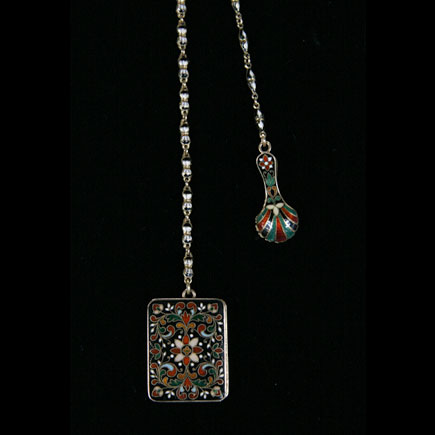
Vinaigrette and train holder. Image @Antiques Road Show

That was the concept of the vinaigrette. But the other end of this, you seldom see these all together. This is called a train holder. And this is shaped like a shell. When you squeeze it, it opens. The train was the long part of the ball gown. And they didn’t want it to drag in the dirt and be soiled. So they would hook the train holder onto the edge of the train, and then they would hold the vinaigrette in their hand, and this kept the train from dragging behind them.” Barry Weber, Antiques Road Show 

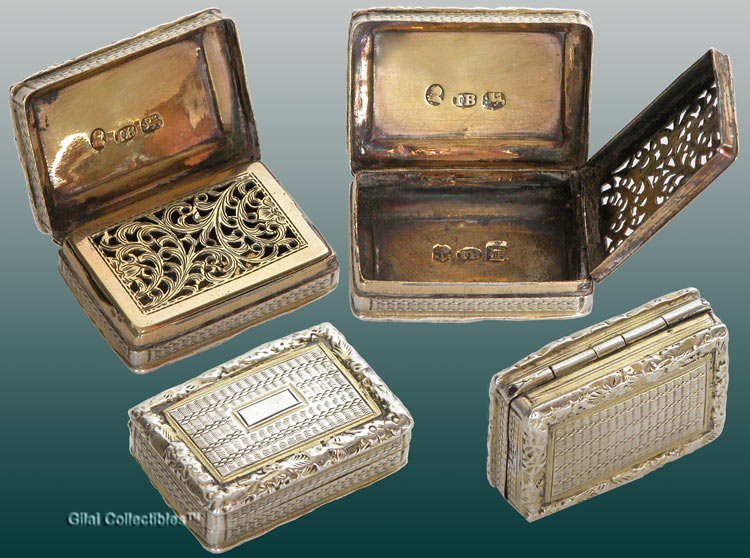
Vinaigrettes were small decorative containers that held the vinegar-soaked sponges. The inside of the vinaigrette would be gilded to protect the silver from staining.

Used by both men and women, vinaigrettes were suspended from chatelaines, placed in pockets, hung from long chains, bracelets or finger rings. Often designed in the shape of a rectangular box, the more spectacular vinaigrettes took on the look of a vase of flowers, a purse, an urn, almost any contemporary theme. Made from multicolored gold or silver and sometimes silver-gilt, many were decorated with Italian mosaics, mother-of-pearl or other gem materials. – Antique Jewelry University
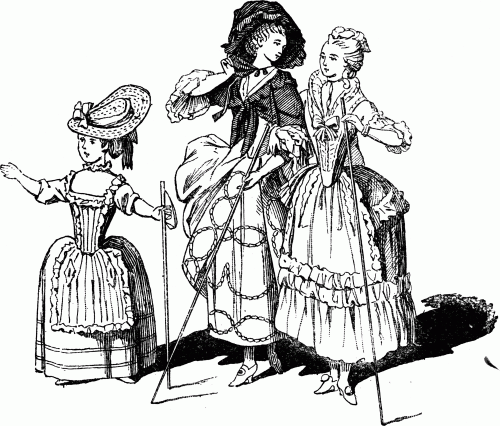
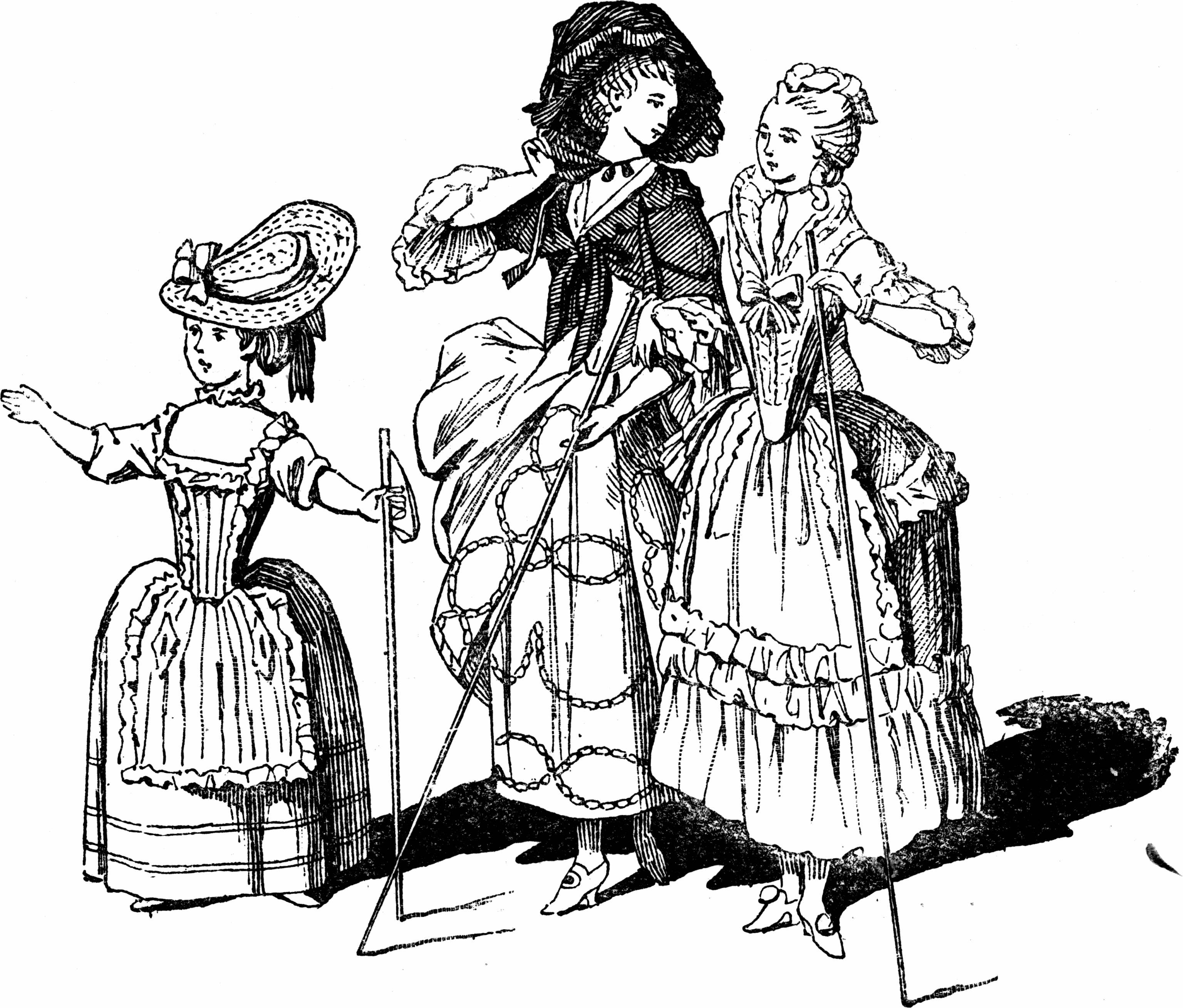
18th century French ladies carrying canes

The soaked sponges were also carried in a compartment in the head of walking canes.

…many ladies of the 18th and 19th centuries carried a “vinaigrette” cane to protect them from a variety of ailments. Throughout history, vinegar has been heralded for its medicinal qualities. A sponge soaked in the healing liquid was placed in a small container with holes in it on the handle of the cane. Should a lady’s tight corset cause her to faint or should she encounter someone with a dreaded illness, her vinaigrette tucked into her cane was close at hand to protect her.” – Collecting Antique Walking Sticks or Canes 

Vinaigrette, Nathaniel Mills. Image @Leopard Antiques

Often spices such as cinnamon, lavender, roses, or orange were added to sweeten the smell.

The vinaigrette was a most necessary adjunct to the toilette in the late eighteenth and early nineteenth centuries, when it was considered the correct thing for a lady to show symptoms of fainting on occasion. The little boxes with a grating inside—through which the essence contained in a saturated sponge could be inhaled— are of all sorts and conditions. Some are quite plain, others have delicately chased or monogrammed tops, or views engraved on the lids; others, again, are of fantastic shapes. The vinaigrette was the descendant of the old pomander, and the forerunner of the midVictorian smelling bottle; but whereas the vinaigrette is accessible to the most modest purse for a very small sum, the real old genuine pomander is very scarce indeed, and it means a lot of money to come by one at all. The pomander was round, and often of china, and contained a wonderfully strong-smelling ball, compounded of spices and pungent scents which could hardly fail to bring round the most upset of ladies. – Byways of Collecting, 1908, Ethel Deane, Pp 170-172.

The small containers known as vinaigrettes were actually an English invention. The French called them “boite de perfum”. They came in many shapes and sizes, and eventually became decorative items that lovers exchanged as tokens of affection. (Limoges Boxes: A Complete Guide)
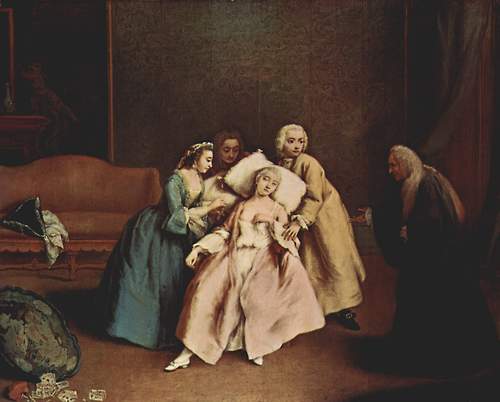
The vapours from a vinaigrette caused the person to inhale sharply and then breathe more rapidly. Restoratives carried different names and were made from various recipes, not just with vinegar: In addition to vinaigrettes, there are smelling-salts, hartshorn, and Hungary water or lavender water. Ladies prone to fainting would also keep a bottle of laudanum nearby. Laudanum, a painkiller, was an alcoholic herbal preparation that containing approximately 10% powdered opium. Smelling-salts were an infusion made with ammonium carbonate and alcohol and scented with lemon or lavender oil. Hartshorn (aqueous ammonia)was made from carbonate of ammonia distilled from the shaved or powdered horns of a male deer. Hartshorn and smelling salts or sal volatile could be mixed with water and drunk as a restorative. Hungary water was a perfumed restorative made with distilled water and sweet-smelling herbs and flowers. This was dabbed on the skin of a person suffering from “nerves.”- Jennifer Kloester, Georgette Heyer’s Regency World, 157-58

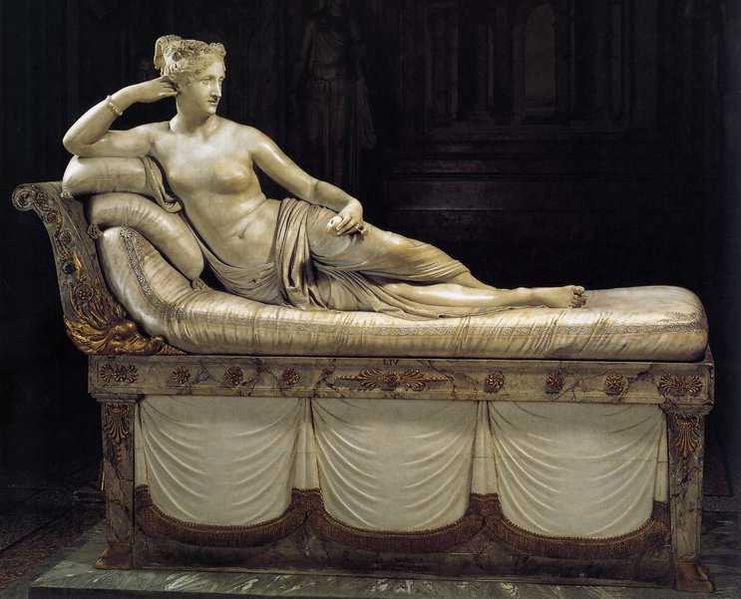
Pauline Bonaparte transformed into a goddes of antiquity on her day couch. Neoclassical statue by Canova, 1805-1808, @ Borghese Gallery

And so we finally come to the fainting couch or a chaise longue, or a reclining chair with a long seat that supported the legs of the fainting person. These couches were placed in drawing rooms and dressing rooms, and were used for relaxation as well.
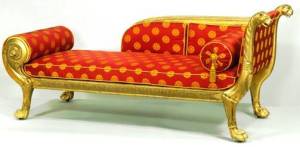
Early 19th century Recamier day bed. Image @Victoria & Albert Museum

This post will not go into the myriad reasons why women of this era fainted with such regularity. Tightly laced corsets certainly had something to do with the condition, but with so few rights and options open to them in their life’s choices, one cannot blame women of that time for reacting to the child-like treatment their husbands and fathers accorded them with fits, vapours, nerves, and fainting spells.
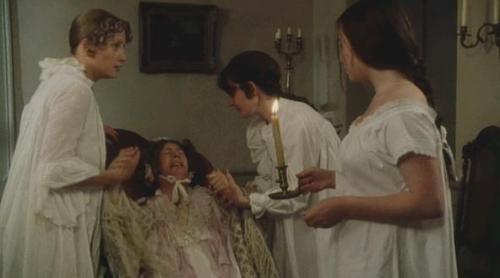
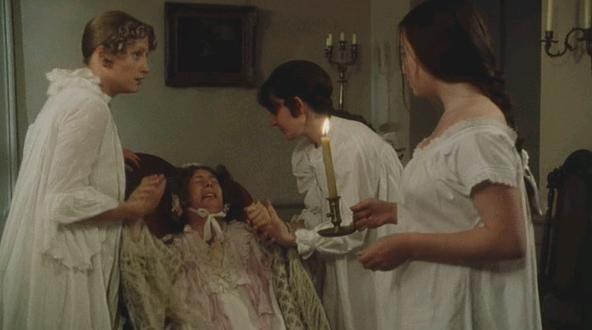
The Bennet family is well acquainted with Mrs. Bennet's nerves. Pride and Prejudice 1995

A character like Mrs. Bennet, who had her origins in Jane Austen’s real life observations, did not have many opportunities for maturing or turning into a well-educated and sensible woman. Mr. Bennet had given up on her and her childish behavior was enabled by her caring daughters and siblings.
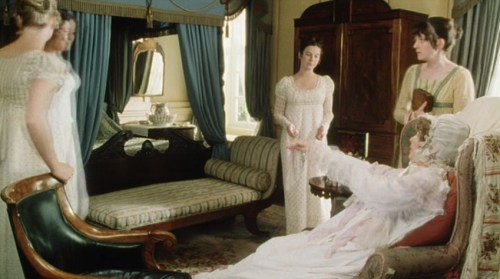
Scene from 1995 Pride and Prejudice. Mrs. Bennet is overcome from the thought of Lydia's elopement. Note that she is not using the day bed but has a chair propped under her feet.

Vinegar had many other uses:

A recipe for black dye

Let one pound of chopped logwood remain all night in one gallon of vinegar. Then boil them, and put in a piece of copperas, as large as a hen’s egg. Wet the articles in warm water, and put them in the dye, boiling and stirring them for fifteen minutes. Dry them, then wet them in warm water, and dip them again. Repeat the process, till the articles are black enough. Wash them in suds, and rinse them till the water comes off clear. Iron nails, boiled in vinegar, make a black dye, which is good for restoring rusty black silks. – A Treatise on domestic economy for the use of young ladies at home and at school, by Catharine Esther Beecher, 1849, p. 299-303

For whitening scorched articles of  clothing

Scorched articles can often be whitened again by laying them in the sun wet with suds. Where this does not answer, put a pound of white soap in a gallon of milk and boil the article in it. Another method is to chop and extract the juice from two onions and boil this with half a pint of vinegar, an ounce of white soap, and two ounces of fuller’s earth. Spread this when cool on the scorched part, and when dry, wash it off in fair water. Mildew may be removed by dipping the article in sour buttermilk, laying it in the sun, and after it is white, rinsing it in fair water. Soap and chalk are also good, also soap and starch, adding half as much salt as there is starch, together with the juice of a lemon. Stains in linen can often be removed by rubbing on soft soap, then putting on a starch paste, and drying in the sun, renewing it several times. Wash off all the soap and starch in cold fair water. – A Treatise on domestic economy for the use of young ladies at home and at school, by Catharine Esther Beecher, 1849  p 296.

Reviving a person overcome with fumes:

In case of stupefaction from the fumes of charcoal or from entering a well, limekiln, or coal mine, expose the person to cold air; lying on his back, dash cold water on the head and breast, and rub the body with spirits of camphor vinegar or Cologne water. Apply mustard paste to the pit of the stomach, and use friction on the hands feet and whole length of the back bone. Give some acid drink, and when the person revives, place him in a warm bed in fresh air. Be prompt and persevering. – A Treatise on domestic economy for the use of young ladies at home and at school, by Catharine Esther Beecher, 1849 p. 243.

This late 19th century poem by Edith Willis Linn talks nostalgically about vinaigrettes as a thing of the past. At this time, lovers gave each other these small decorative items as tokens of affection:

AN OLD VINAIGRETTE – Poem by  Edith Willis Linn, C. W. Moulton, 1892.

LITTLE gleaming box of silver

Wrought in flowery design;

Drifted down the silent ages

To this humble hand of mine;

From the days of kingly France,

From the days of minuet dance,

From the days of stately graces,

Powdered hair and painted faces;

Bring a shining thread of story

To this all-prosaic hour;

From those castles proud and olden,

Those salons of wit and power.

You have known the love and woe

Of fair dames of long ago;

Round you like a love-tale wreathing

Is the perfume of their breathing.

Silent! Not a word to give me!

See, I raise your flowery lid;

Whisper in your heart my secret

Knowing you will keep it hid.

An Old Vinaigrette.

One more life now leaves its trace;

One more love has lent its grace;

Keep it sacred down the ages

On your shining silver pages.

Now my imprint I have given

Though you never bear my name:

Graven with your silver roses

Are all lives of praise or blame.

All things that we touch or wear

Must the spirit’s impress bear.

Every hand that ever won you

Left a fadeless mark upon you.

Love and hate and jealous passion,—

All I feel have been your own;

Shall my life not breathe about you

Purer love than you have known?

Nobler grows this life with years,

Grander grow earth’s hopes and fears;

May the traces of my living

Make this heirloom worthier giving.

Whence and Whither.

Read Full Post »
« Newer Posts - Older Posts »