Feeds:
Posts
Comments

Archive for the ‘jane austen’ Category

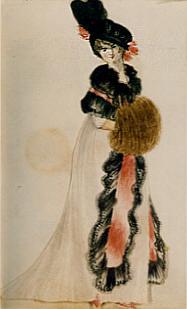
Watercolor, James Stanier Clarke. Portrait of Jane Austen?, 1816

For those who mistakenly think that Jane Austen wrote frothy romances, let her words speak for her. Jane had been invited to view the Prince’s library in Carlton House just before the publication of Emma and had been “encouraged” to dedicate her book to the Prince, which she did reluctantly, for she was no great admirer of his. She had written about the Prince’s long-suffering wife, Caroline: “Poor woman, I shall support her as long as I can, because she is a Woman and because I hate her Husband.”

While visiting Carlton House, she was escorted by Rev. James Stanier Clarke, the Prince’s librarian, who was so struck by her that he painted her watercolor image from memory and kept up a correspondence afterwards. Eventually, Rev. Clarke had the audacity to suggest how Jane might proceed in her next novel. In March 1816, he wrote: “Perhaps when you again appear in print … chuse to dedicate your Volumes to Prince Leopold: any Historical Romance illustrative of the History of the august house of Cobourg, would just now be very interesting.”

Jane penned this terse reply 195 years ago on April 1st:

MY DEAR SIR, — I am honoured by the Prince’s thanks and very much obliged to yourself for the kind manner in which you mention the work. I have also to acknowledge a former letter forwarded to me from Hans Place. I assure you I felt very grateful for the friendly tenor of it, and hope my silence will have been considered, as it was truly meant, to proceed only from an unwillingness to tax your time with idle thanks. Under every interesting circumstance which your own talents and literary labours have placed you in, or the favour of the Regent bestowed, you have my best wishes. Your recent appointments I hope are a step to something still better. In my opinion, the service of a court can hardly be too well paid, for immense must be the sacrifice of time and feeling required by it.

You are very kind in your hints as to the sort of composition which might recommend me at present, and I am fully sensible that an historical romance, founded on the House of Saxe-Cobourg, might be much more to the purpose of profit or popularity than such pictures of domestic life in country villages as I deal in. But I could no more write a romance than an epic poem. I could not sit seriously down to write a serious romance under any other motive than to save my life; and if it were indispensable for me to keep it up and never relax into laughing at myself or at other people, I am sure I should be hung before I had finished the first chapter. No, I must keep to my own style and go on in my own way; and though I may never succeed again in that, I am convinced that I should totally fail in any other.

I remain, my dear Sir,
Your very much obliged, and sincere friend,
J. AUSTEN.

Chawton, near Alton, April 1, 1816.

It is so very telling (is it not?), that Jane did not characterize her own novels as serious romance. To whit, I must agree with her self-assessment.

Gentle reader: My April Fool’s joke is subtle. Those who came over after reading my tweet and compared it to the date of the letter will see that I made the announcement five years off.

More on the Topic:

Read Full Post »

Copyright @ Jane Austen’s World.  Looking back 200 years (the precise date that the formal Regency era began was 1811) we tend to view Jane Austen’s Regency world wearing rose-tinted glasses.

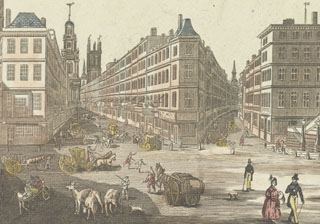
Early 19th century London street scene

Imagine the traffic in London back then:

In July 1811,

it appears that there passed over Blackfriars bridge in one day: 61,069 foot passengers, 533 waggons, 1,502 carts and drays, 990 coaches, 500 gigs and taxed carts, and 822 horses. On the same day, July 1811, there passed over London bridge: 89,640 foot passengers, 1,240 coaches, 485 gigs and taxed carts, 769 waggons, 2,924 carts and drays, and 764 horses.  – Leigh’s new picture of London: or A view of the political, religious, medical, literary, municipal, commercial, and moral state of the British metropolis (Google eBook), 1827, p. 251

Then imagine the animal droppings. I have not the mathematical wherewithal to calculate how much manure and urine these vast numbers of animals traversing London’s streets would generate on an average day, but I do know this: when a horse feels the need to relieve itself, it does so on the spot, releasing the end result of its digestion in a most spectacular fashion.

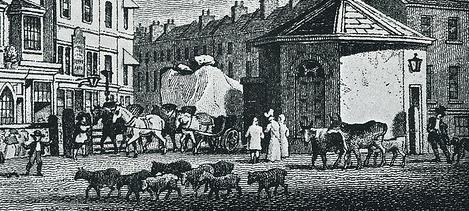
London, detail of Islington toll gate

And thus London’s streets were littered with dung. Not only did horses generously contribute their feces to London’s throroughfares, but so did the vast number of feral dogs and cats roaming the streets, and the cattle, goats, sheep, pigs, and fowl that were driven to London’s markets. Add on a hot summer’s day the smell of slops that were carelessly tossed out of windows, and the stench of contaminated water, backed-up sewers, over-filled privies, and rotting garbage, and you get the drift. The assault on one’s olfactory nerves must have been overpowering.

The rich had a choice – they left London in droves at the end of the Season to wile away the summer on their country estates. But those who were left behind had to suffer the fetid stench of thousands of evacuations that cooked in the heat and turned into gaseous rot. (I traveled through a similar malodorous area when driving past the slums of Jakarta one summer.)

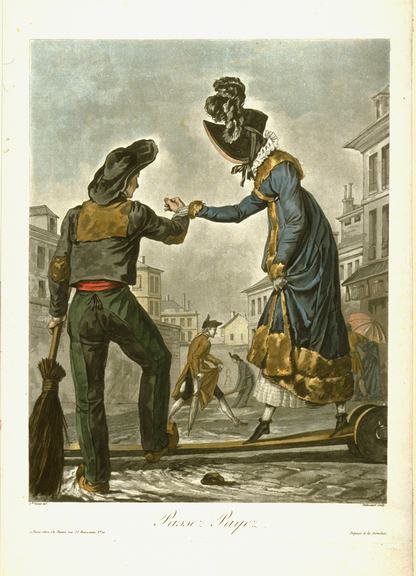
Streetsweeper assists a lady crossing the street, 1818, after Vernet. Image @Wikimedia.

Rain showers did not help much to relieve the situation. By 1841, when the metropolis was vastly larger, Henry Mayhew calculated that the refuse from butchers that washed into rain water approximated 24,000,000,000 gallons per annum. As for dung, let’s face it, wet poo sticks like glue, and once the offending substance adhered to boots and shoes, the unfortunate wearer would trod the vile stuff into carriages and on door stoops, which is why boot scrapers were essential.

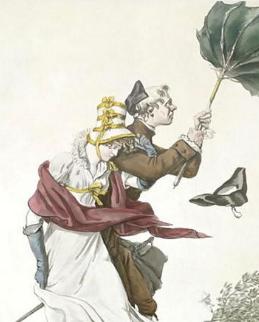
Sunny weather was not much more helpful, for when poo baked and dried on dusty streets, it tended to crumble and turn into dust. A brisk wind would blow odiforous grit under door crevaces and through open windows, landing on furniture, floors, curtains, rugs, and hanging laundry. A person walking along the streets on a blustery day, would have it blown onto their clothes and in their hair. (Let’s not even imagine how much of these offensive granules landed on their faces and inside their mouths and noses! Achoo!)

Carle Vernet, detail of a gust of wind

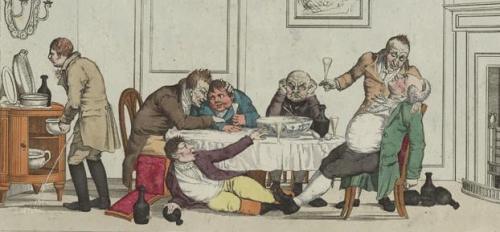
As for hygienic habits, if English Regency gentlemen felt comfortable urinating in chamberpots in the diningroom after dinner in full view of their companions, one can imagine that they thought nothing of relieving themselves in back alleys. And where were the poor urchins who lived on the streets supposed to “go”? Or the individuals crammed into overcrowded tenements who shared a common privy with hundreds of others and who, due to pressing circumstances, could NOT wait?

If peeing in front of others (left) near food stuffs inside one's home was permissable, one can only imagine the habits of this gentleman outside of a tavern.

There were attempts to combat these continual eliminations and excretions by animals and humans, which will be discussed in the next Fawlty Regency London post. Until next time, gentle reader, I am signing off. I hope I have not offended your tender sensibilities (or activated your gag reflexes) too much. Part 2 of this fascinating series will discuss The Removers, or those who worked tirelessly to keep London smelling as fresh as a daisy (well, at least like day old cat litter).

For those who are equally as fascinated with topics of an earthy nature as I am, here’s another post: Urea, a 17th & 18th Spot Remover, or Pee as a Cleansing Agent

Read Full Post »

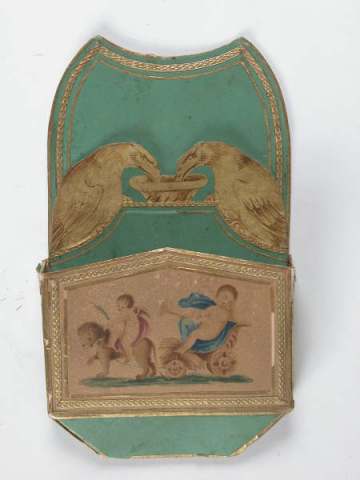
One of a pair of card racks made of decorated cardboard, French, c. 1820, at Attingham. ©National Trust/Claire Reeves

About two weeks ago, The National Trust asked a question about card racks: How were they used? The organization had acquired a number of beautiful examples of 1820’s card racks from Attingham, an estate in Shropshire.  Laurel Ann from Austenprose referred me to the site and to Emile de Bruijn, who had asked the question. I jumped right in, only to discover how little I (or anyone, really) knew about the topic. There was much lively speculation about these beautiful items.

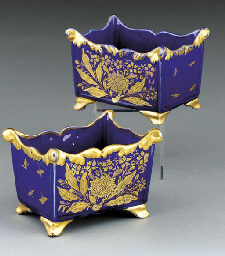
Card racks are small, only large enough to hold visiting cards or small notes. They were designed to be hung somewhere, perhaps on a wall, or over a fireplace mantle. Many were made from cardboard, yet sturdier porcelain examples exist. Their true purpose is now obscure and has faded from memory.

These facts came out as I researched the topic:

It seems that young ladies decorated these card racks from the turn of the 19th c. until at least 1830. Mary Russel Mitford wrote in Our village: sketches of rural character and scenery, Volume 4, 1830:

With regard to accomplishments she knew what was commonly taught in a country school above twenty years ago, and nothing more: played a little, sang a little, talked a little, indifferent French, painted shells; and roses, not particularly like nature, on card-racks and hand screens; danced admirably; and was the best player at battledore, and shuttlecock, hunt the slipper, and blind man’s buff in the county.” p. 131

French emigres made card racks to earn a living:

During the period when the French emigres were so numerous in this country, he (Rudolph Ackermann) was one of the first to relieve their distress by liberal employment. He had seldom less than fifty nobles priests and ladies engaged in manufacturing screens, card racks, flower stands, and other ornaments.” – English coloured books, 1906, Martin Hardie

Rudolph Ackermann kept on hand in his Repository the supplies ladies needed for making hand made items:

No. 3 is a new embossed gold seed-paper. It is used, in a variety of ways, for ladies’ fancy work — in card-racks, hand and fire-screens, chimney ornaments, boxes, watch–stands and cases, &c. It is manufactured by Mr. S. Solomon, and sold, wholesale and retail, at R. Ackermann’s Repository, No., 101, Strand.” – From The Repository of arts, literature, commerce, manufactures, fashions and politics (1809)

And of course I found a Jane Austen connection. In Persuasion, Mrs. Smith makes pin money by creating hand made items:

One might argue that perhaps Nurse Rooke’s patients themselves are practicing charity by buying the thread-cases, pin-cushions, and card-racks. One finds, however, that they do not do so willingly. Nurse Rooke is skilled not only in invalid care, but also in sales. In the case of Mrs. Wallis, Nurse Rooke’s current invalid, Mrs. Smith says, “‘I mean to make my profit of Mrs. Wallis . . . . She has plenty of money, and I intend she shall buy all the high-priced things I have in hand now’” Thread-cases, Pin-cushions, and Card-racks: Women’s Work in the City in Jane Austen’s Persuasion, Susan E. Jones, Persuasions Online

Ironstone ware card rack. Image @Christie's

More speculation and information about card racks can be found in the comment section of the National Trust post. (I have included only my own findings.) It is fascinating to learn how quickly a once popular pasttime has lost its meaning. If anyone can help the staff at The National Trust, do go over and leave a comment.

Read Full Post »

A Review From the desk of Shelley DeWees…of The Uprising.

I am thinking of enlisting. One of my acquaintances happened to recommend his regiment to me this morning, and as I have nothing better to do I believe I will join. It will get me away from London, where my creditors are once again pressing me, and take me into Hertfordshire, a place where I am not known. Then I can begin again, and at the very least, run up some new bills. And at the most…There will be impressionable young women in Meryton, no doubt, and they will all be susceptible to a charming and handsome young man in a red coat.”

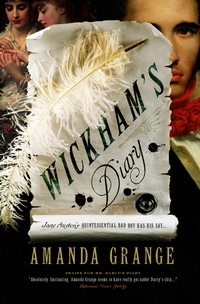
So says that feisty George Wickham, with such a feisty future ahead of him, in the quazi-coming-of-age tale Wickham’s Diary by Amanda Grange. Although you may think this little novella is going to give a sneaky glimpse into the wooing of Lydia Bennet or perhaps a strange view of Wickham’s wicked scheming, alas, it doesn’t. In fact, Wickham’s Diary has next to zero connection the Bennet tale (you know the one I mean) and can be more easily likened to the history of George Wickham and his family.

The introduction on the back of the book explains, “He wasn’t always this cold-hearted.” But…um…well, according to this, he actually was. He grows up, as you, a learned reader, already know, in the shadow of Darcy and his sweet sister Georgiana, as the son of the steward with nearly nothing to his own name. Childhood almost-friendship with Darcy withers away in favor of rabid jealously, and Wickham decides at a young age that the situation just isn’t fair. “Why should I be beneath him?” he asks. “I am just as handsome as he is; I am just as intelligent, even though he works harder at his books; and I am just as amusing; in fact, I dare say I am a great deal more amusing, for Fitzwilliam is so proud and he will not take the trouble to entertain other people. Yet altogether he is no better than me, when he grows up he will inherit Pemberley and I will inherit nothing.” Tough break Georgie, but hey, that’s life. Regency life. Now of course he could take what he’s been given, which is truly not a bad situation, and apply himself toward a worthy, amiable path and a generally secure future. But as we know, he’s the villain and must therefore take the lowest possible road: planning, scheming, and plotting against everyone and everything, never blaming himself when things go awry. He looks around every corner for someone to exploit, usually while still experiencing success with his last victim, pocketing their money and breaking their hearts with no qualms. He’s conniving and rude. He’s spoiled and foolhardy. He is, naturally, a scoundrel.

I’d say that’s pretty cold-hearted behavior.

The reader is briefly shown the world of George Wickham as he works his way up the “Biggest Jerk in the Universe” ladder, tossing people aside who stand in the way of his ultimate goal to marry an heiress and be done with it. Darcy has long taken his own path, only reappearing to pay Wickham the value of the living he’s denounced and then quickly evaporating out of the picture, never to be seen again. Though I enjoyed the interesting and albeit unhealthy relationship Wickham has with his mother, I found myself disappointed that this teeny weeny 12-dollar novel ended without exploring Wickham’s character in any in-depth sense. The reader learns a bit about his motivations for villainy, yes, but nothing much about him as a person. No one commits a crime against humanity without some measure of mental back-and-forth…didn’t he ever have second thoughts? Blank pages abound in the book itself, and the type is shamefully over-sized.

The phrase that comes to mind with Wickham’s Diary is “hastily-written.” It’s a fair read and represents some of the author’s good attributes. But considering the 2 hours you’ll spend with it, you might want to save your 12 dollars.

Read Full Post »

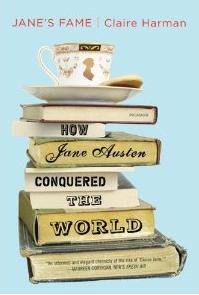
It is not often that a much-hyped book or film lives up to its reputation, as with The King’s Speech and Jane’s Fame: How Jane Austen conquered the world , the book by Claire Harman and the subject of this review. I’ll admit to being a wee bit partial to any book that mentions my blogs – Jane Austen’s World and Jane Austen Today – but this is not the sole reasons for my gushing over Ms. Harman’s lucid and accessible account of the slow rise of Jane’s Austen’s literary fame in the 19th century to her near rock-star status as a popular cultural icon today.

Jane’s Fame was published in 2009 amidst much controversy. Accusations of heavy borrowing and plagiarism flew from the mouth and pen of Ms. Harman’s former friend,  Kathryn Sutherland, who had published Jane Austen’s Textual Lives, from Aeschylus to Bollywood in 2005. Ms. Harman countered the accusations with equally strong words, saying she had followed the standard practice of sourcing all quotes and citing the earliest sources for her information. With this controversy in mind, I read Jane’s Fame with the same morbid curiosity that Two and a Half Men fans are reading articles about Charlie Sheen’s downward spiraling career today. I am delighted to announce that I think Jane’s Fame stands on its own, paying due homage to Jane Austen’s Textual Lives, but making what could have been a dry tale into an exciting read  for the modern audience.

Laurie Kaplan, who reviewed Sutherland’s book for the Jane Austen Society of Northern America, wrote:

Through an examination of biographies, portraits, manuscripts, films, and editions of the novels, Sutherland tracks the creation of Jane Austen as “a special cultural commodity.” From James Edward Austen- Leigh’s Memoir of Jane Austen (1870), which presents a “family-managed” biography of his relation, to the films, which sometimes bear only a passing relation to the novels, biographers, editors, and directors have “marketed” their own versions of “Jane Austen” to the public.”

I agree with this assessment of Sutherland’s book. Several years back I had read portions of Jane Austen’s Textual Lives and from it learned much about Jane’s slow rise in literary reputation and in the estimation of her peers. However, in my opinion Dr. Kathryn Sutherland’s revelations were not entirely new. Any Janeite who has read a number of Jane Austen biographies would have known that Jane’s literary reputation stagnated in the years after her death. The facts were scattered in a number of sources and Dr. Sutherland was astute enough to pull them together. She chronicled Jane’s rise in academic order, and had her efforts rewarded with the publication of her book by Oxford University Press. While her richly footnoted tome is perfectly suited for the shelves of a university library, her professorial writing style would in no way appeal to Mr & Mrs John Q Public.

Enter Ms. Harman.

One cardinal rule of copyright laws is that facts and historical events belong to the public domain. One cannot patent the dates of a person’s life or historic events. Ms. Harman, with her easy and accessible writing style and her academic knowledge, pounced on the Jane Austen bandwagon and came up with a runaway hit. In fact, Ms. Harman makes the rise of Jane’s fame seem exciting. Here is an excerpt of her description of James Edward Austen-Leigh’s attempt to take a look at Fanny Knatchbull’s letters from her Aunt Jane:

In 1869 Fanny’s sister Elizabeth Rice warned him not to wait for a sight of the letters, as there was virtually no chance of it. Lady Knatchbull, she said, was prone to giddiness and confusion, an impression of advancing senility confirmed by fanny’s daughter Louisa, who protested that her mother would have been only too delighted to assist James Edward ten years earlier, but it was too late now.”

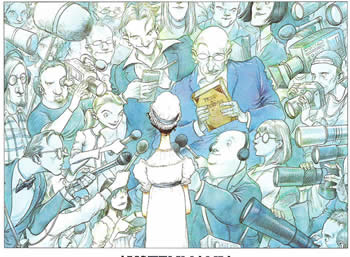
Chris Riddell's cover from the April 2009 issue of The Literary Review

It is universally acknowledged that Edward Austen-Leigh’s Memoirs of his aunt in 1869 (and quickly again in 1871) piqued the Victorian public’s curiosity, and that his biography prompted the buying public to purchase Jane’s novels in droves. In the first half of the 20th century, academics and the public alike discovered the rich literary minefield that Jane’s novels represented. Film adaptations only served to boost her reputation, and by 1995, when A&E presented a 6-part series of Pride and Prejudice and the Internet began to be embraced by non-geek users, the stage had been set for world-wide Austen adoration.

My major complaint about Jane’s Fame is that I suspect this book was written to meet a publisher’s deadline. The first 2/3 of its pages are rich with facts and anecdotes, with fully developed topics that satisfied my curiosity about Jane’s rise in popularity. But then the book’s pace speeds up and the last few chapters seemed rushed and thin. The most recent years of Jane’s popularity are barely covered, as if the author (and publisher) lost focus. Be that as it may, I read Jane’s Fame in two or three sittings and recommended it to my Janeite book club. They LOVED it. I am confident that you will too.

Please note: the ads at the end of this blog are a feature from WordPress. I do not make money from them.

Read Full Post »

« Newer Posts - Older Posts »