Feeds:
Posts
Comments

Archive for the ‘jane austen’ Category

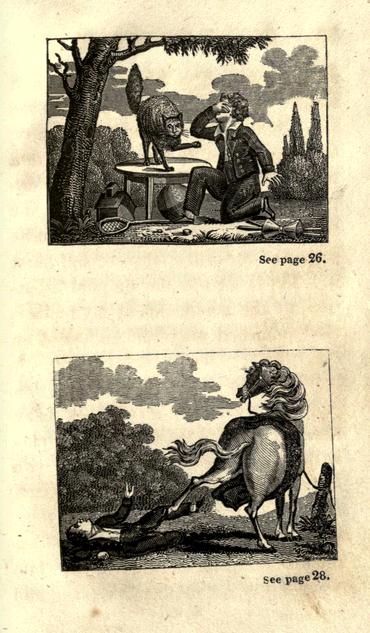
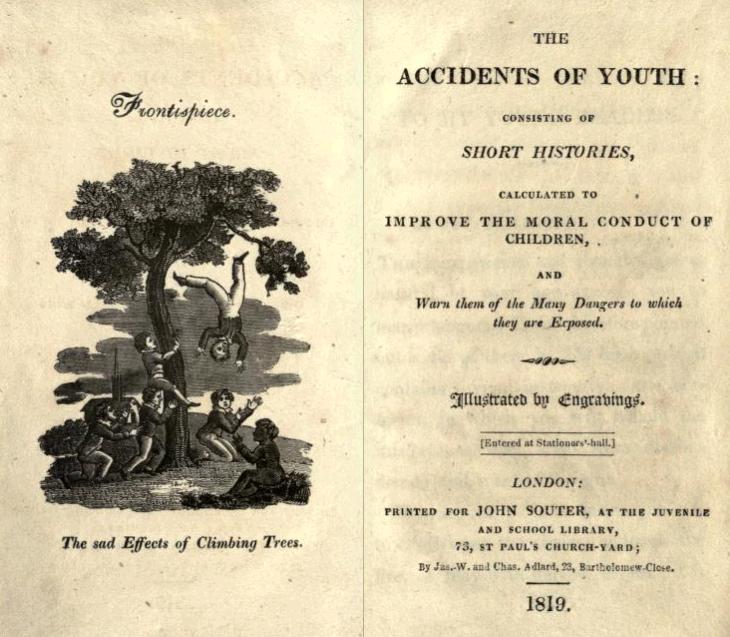
The History of Goody Little Two Shoes was one of the moral lesson books that Jane Austen owned as a child. These seem to have been popular in the Georgian era. Another book with moral lessons came out two years after her death. Entitled The Accidents of Youth, its tales were meant to warn children of risky behaviors and improve their moral conduct. The tales would have been scary enough to make me think twice as a child. I love the Internet Archive, which allows you to read the books virtually intact, with illustrations and original font type. The only thing you can’t do is hold the book or feel the thickness of the pages.

Fronticepiece of The Accidents of Youth, 1819

Fronticepiece of The Accidents of Youth, 1819

accidents of youth2

accidents of youth3

Interestingly, these accidents beset children today, especially those left to their own devices in the countryside.

accidents of youth4

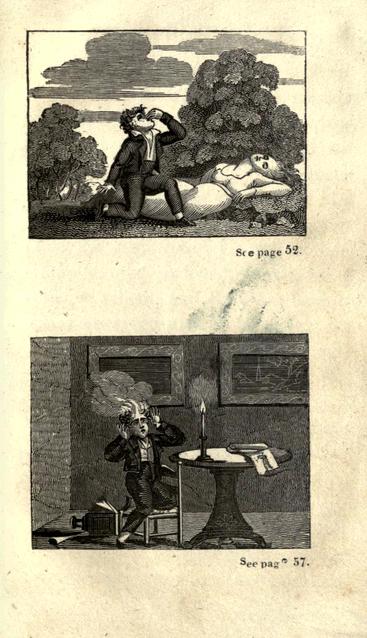
One young man aims at a bird with a slingshot and kills his mother, a horrific tale. Another’s hair is set on fire by a candle.

accidents of youth5

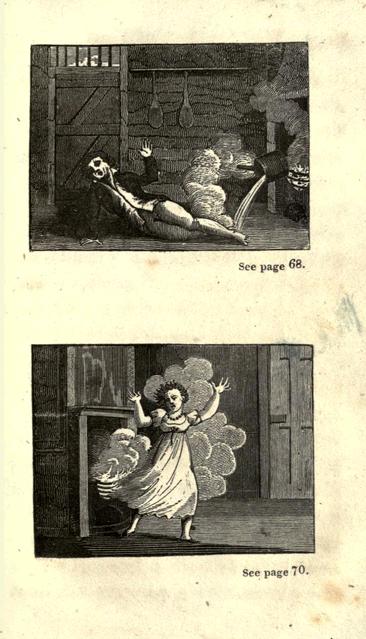
Kitchen accidents were quite common. After death from childbirth, kitchen fires killed more women than other accidents combined. In these stories children are warned of the dangers of hot kettles and catching one’s clothes on fire from coming too close to a fireplace. In the first image, a cast iron pot, hanging directly over the fire on an iron hook tips over, burning the child. Billowing skirts caught fire in fireplaces, as the second image attests.

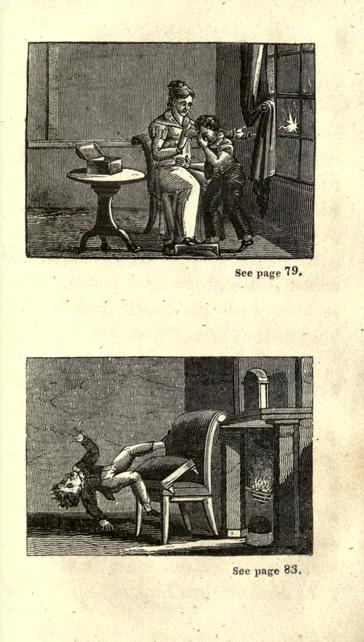
accidents of youth6The final image in this post shows the danger of a broken glass window and a young boy falling from furniture that he had rearranged at play. Another, earlier book entitled The Blossoms of Morality and published in 1806, concentrates on the instruction of young ladies and gentlemen”. The stories include “Juvenile tyranny conquered” and “The melancholy effects of pride”.  One can imagine that, after reading Fordyce’s Sermons to his young children, Mr. Collins would have picked up these books to read to his children.

I wonder how long the concentration of today’s youth would have lasted when listening to these morality tales. One nanosecond? I think not.

Read Full Post »

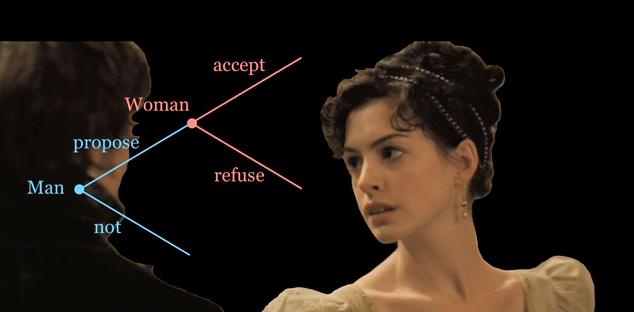
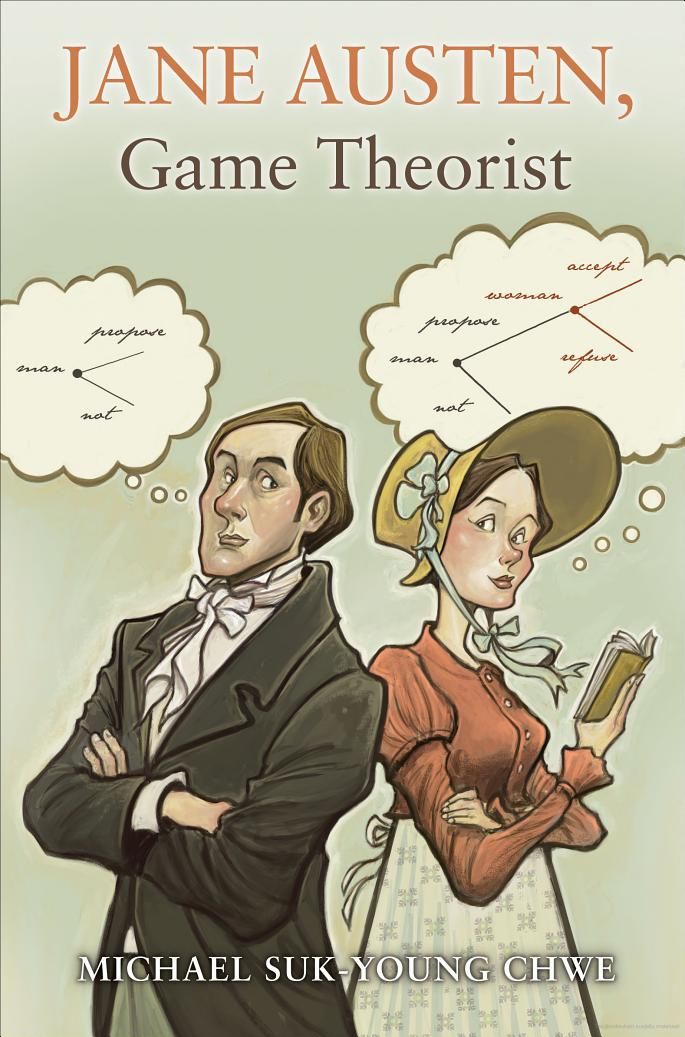
Michael Chwe is an associate professor of political science at UCLA whose research centers on game theory and “its applications to social movements and macroeconomics and violence. He has written a book entitled Jane Austen: Game Theorist, which asserts that Austen is one of our best social theorists.

game theory austen

Steve Levitt of the University of Chicago, Economics Department uses the following definition of game theory:  “The study of the strategic interactions between a small number of adversaries, usually two or three competitors”. This application is usually applied to sports and gambling.

In his introduction to the podcast between Levitt and Chew, Stephen J. Dubner, co-author of the pop-economics book Freakonomics, writes that Levitt loves Clueless, a movie based on Emma, and has watched it repeatedly. The film is about a young woman who constantly schemes to set up others romantically and continually meddles in their lives. Levitt sees that Jane Austen does this intentionally and uses strategic thinking explicitly in her novels.

game theorist jane austen

In the podcast Levitt interviews Michael Chwe about his interesting take on Jane Austen:

[T]here are lots of little parables, or little asides, in the novels which don’t have anything really much to do with the plot or anything. You could just take them out and no one would care, but they do seem to be little explicit discussions of aspects of choice and aspects of strategic thinking. So, for example, in Pride And Prejudice, the very first manipulation is kind of what gets the whole novel started. The Bingleys come into town and so the Bennet family has five unmarried daughters, and that’s kind of a huge problem. So Mrs. Bennet is super-focused on getting her daughters married and for obvious reasons. It’s not like they can get jobs or anything. If that is the main way, you could become either a governess or you could get married. That’s basically it. So the very first manipulation is Mr. Bingley shows up with his sister and they rent out Netherfield which is this estate nearby. And so Mr. Bingley’s sister invites Jane to come for dinner. And the first manipulation is Mrs. Bennet says, “Well you’ve got to go on horseback.” … The daughters say, “Why horseback? Shouldn’t she take the carriage?” And Mrs. Bennet says, “Well, it’s going to rain and if she goes on horseback it is very likely that they will invite her to stay the night, and hence she’ll get to spend more time.” [I]t seems kind of silly but you have to play for keeps. This is a big deal. If you know, if somebody marriageable is nearby and you have a chance to spend 20 more minutes with that person, you’ve got to go for it. … And so in Pride And Prejudice, Mrs. Bennet is not a very sympathetic character, and she seems to be very foolish, but if you look at what she accomplishes, it is pretty good. Jane marries and she incentivizes Lydia, who runs off with Wickham without being married, which is a scandal. But maybe she realizes that by creating this crisis situation the members in her family will solve he problem for her.

Here’s another interesting observation that Chwe makes: in Jane Austen’s novels, high status people have difficulty understanding that low status people are capable of strategic thinking.

Click here to see a short YouTube video on the topic.

The podcast from Freakonomics lasts another 17 minutes after the discussion quoted in the text above. Click here to enjoy the discussion!

game theory austen

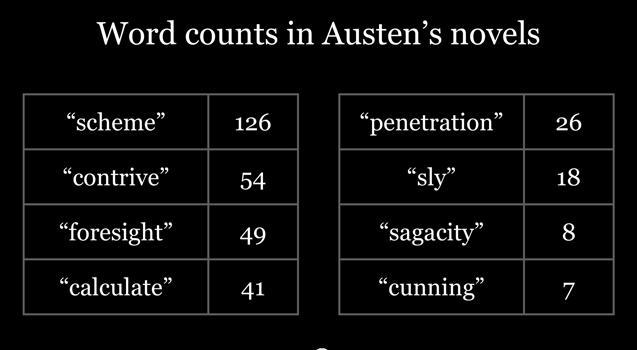
Analysis of the strategic words Jane Austen uses in her novels.

My thanks to Christine Stewart for sending the link to the podcast!

Read Full Post »

Nobody could catch cold by the sea; nobody wanted appetite by the sea; nobody wanted spirits; nobody wanted strength. Sea air was healing, softening, relaxing — fortifying and bracing — seemingly just as was wanted — sometimes one, sometimes the other. If the sea breeze failed, the seabath was the certain corrective; and where bathing disagreed, the sea air alone was evidently designed by nature for the cure.” ― Jane Austen, Sanditon

Inquiring readers, I have spent this week at the seaside with my extended family, an unusual occurrence for us, but one that a Regency traveler would have easily understood. The great grandparents are resting in a cool spot, while grandparents and parents have taken the grandchildren and great grandchildren to the beach. A lady’s companion and an auntie (me) are also in attendance, doing what is required to maintain family unity, feed the masses, and provide comfort and mobility for the elders.

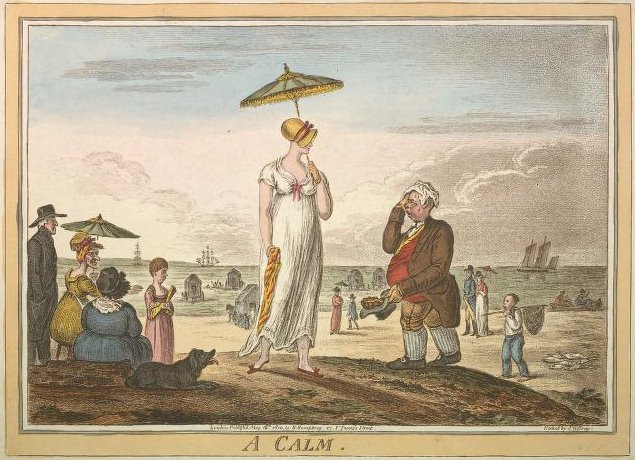
A Calm, 1810, Gillray

A Calm, James Gillray, 1810

Life near the sea shore today is different than depicted in this 19th century image by James Gillray. Or is it really?  We still come to the beach to relax and holiday with friends and family, and to enjoy the bracing sea air and the entertainments that are available for the entire family. While modern sea-goers are more scantily dressed, we still enjoy sitting on the beach, swimming in the sea, walking along the seashore, watching ships or dolphins pass by, eating fresh seafood, reading the latest best sellers, and ogling others.

While we no longer swim behind bathing machines that have been pulled into the waters by sturdy horses, we use other equipment to make our swims more enjoyable – floats and surf boards or paddle boards. Like the women in the image, many of us wear hats for protection from the sun and sit under beach umbrellas. We comb the sands for shells and the waters for clams and crabs.

My family frequently vacations at Bethany Beach in Delaware, where my brother owns a vacation house. Each year, new vacation resorts seem to spring up on what once were cornfields and farmlands. If it weren’t for my GPS system, I would get lost, for so many of the landmarks I once knew are disappearing. It was much the same in Jane Austen’s day, when fashionable sea resorts also sprang up to satisfy the masses.  London became a convenient day’s ride from the coast as roads improved, and the benefits of fresh air and sea water were appreciated for invalids and healthy alike. In this passage from Sanditon, Mr. Parker’s and Mr. Heywood’s topic of discussion is similar to the one I had with my family as we lamented the increasingly crowded conditions and traffic jams, even as we confessed our addiction to the sea:

“Yes, I have heard of Sanditon,” replied Mr. Heywood. “Every five years, one hears of some new place or other starting up by the sea and growing the fashion. How they can half of them be filled is the wonder! Where people can be found with money and time to go to them! Bad things for a country, sure to raise the price of provisions and make the poor good for nothing, as I daresay you find, Sir.”

“Not at all, Sir, not at all,” cried Mr. Parker eagerly. “Quite the contrary, I assure you. A common idea, but a mistaken one. It may apply to your large, overgrown places like Brighton or Worthing or Eastbourne, but not to a small village like Sanditon, precluded by its size from experiencing any of the veils of civilization; while the growth of the place, the buildings, the nursery grounds, the demand for everything, and the sure resort of the very best company, those regular, steady, private families of thorough gentility and character who are a blessing everywhere, excite the industry of the poor and diffuse comfort and improvement among them of every sort. No, Sir, I assure you, Sanditon is not a place …”

“I do not mean to take exception to any place in particular,” answered Mr. Heywood. “I only think our coast is too full of them altogether. But we had not better try to get you …”

“Our coast is abundant enough. It demands no more. Everybody’s taste and everybody’s finances may be suited. And those good people who are trying to add to the number are, in my opinion, excessively absurd and must soon find themselves the dupes of their own fallacious calculations. Such a place as Sanditon, Sir, I may say, was wanted, was called for. Nature had marked it out , had spoken in most intelligible characters. The finest, purest sea breeze on the coast, acknowledged to be so, excellent bathing, fine hard sand, deep water ten yards from the shore, no mud, no weeds, no slimy rocks. Never was there a place more palpably designed by nature for the resort of the invalid, the very spot that thousands seemed in need of! The most desirable distance from London! One complete, measured mile nearer than Eastbourne, Only conceive, Sir, the advantage of saving a whole mile in a long journey. But Brinshore , Sir, which I daresay you have in your eye, the attempts of two or three speculating people about Brinshore this last year to raise that paltry hamlet, lying as it does between a stagnant march, a bleak moor, and the constant effluvia of a ridge of putrefying seaweed, can end in nothing but their own disappointment. “

Alas, our sojourn at the beach has ended. We must pack up our belongings and return to our daily routines. Would that vacation had lasted a week longer!

Read Full Post »

Part One of this four-part series left me salivating to meet Darcy’s aunt, for up to now we have experienced her only through Mr. Collins’s observations, which, the astute reader has come to surmise, MUST be suspect. After Lady Catherine de Bourgh’s daughter Anne stops by to visit Hunsford in her carriage, Charlotte announces to the group that they are invited to dine at Rosings. Even if Mrs. Collins hadn’t opened her mouth, Lizzy would have realized that something was up, what with an ecstatic Mr. Collins performing cartwheels and Irish jigs in the background and his chest puffed up with so much consequence and triumph that he nearly topples over from imbalance.

He cannot stop gloating about Lady CdeBs graciousness and affability, and pops up here and there like a Regency era whack-a-mole as the ladies and Sir William Lucas prepare for their walk to Rosings, constantly admonishing them with  – “Lady CdeB wants this” – ” Lady CdeB expects that” – ” Lady CdeB says” — until he has Sir William and his daughter Maria quaking in their boots and practically passed out from fear.

Only Lizzy remains unperturbed. Mere stateliness of money or rank do not overly impress her, and this is one of the many reasons why this heroine, conceived in the late 18th century, retains her appeal over two hundred years after her conception. Her attitude is so modern that we readily understand the motives of this educated, independent-minded woman, who, despite having some serious socio-economic cards stacked against her (she has no legal rights under British law and her dowry is but a mere pittance), refuses to buckle under pressure or kowtow to Society’s dictates. Unlike many fictional heroines of her day, she will chance fate and wait for a man she can respect AND love. You go girl!

Much to our chagrin, Jane Austen continues to delay that first meeting between Lizzy and Mr. Collins’s benefactress. Jane first takes us over hill and dale to enjoy the beautiful vistas and prospects and forces us to listen to more of Mr. Collins’s blathering until we readers begin to skim-read with impatience. Then Rosings comes into view and Jane swiftly takes us inside the manse’s impressive entrance hall and to the room where Lady CdeB receives her visitors (the Hunsford party and us). Our hostess rises to greet us with great condescension and for a second we wonder if she might not be all that Mr. Collins promised. Much to our delight, the lady is MORE than was advertised. (Thank you, thank you, Ms. Austen.). Lizzy calmly  takes in the scene and inspects Lady CdeB.

Lady Catherine was a tall, large woman, with strongly-marked features, which might once have been handsome. Her air was not conciliating, nor was her manner of receiving them such as  to make her visitors forget their inferior rank.”
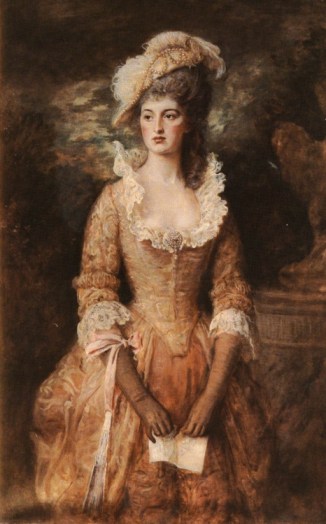
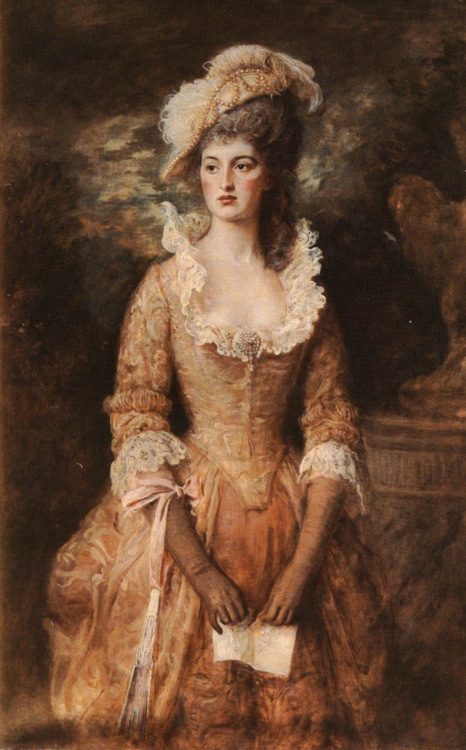
Lady CdeB much as I envision her in her younger years. Painting by Gainsborough.

Lady CdeB much as I envision her in her younger years: Haughty and Handsome. Painting by Gainsborough.

In fact, the lady’s demeanor brought everything Mr. Wickham had said about her to Lizzy’s mind. Undaunted, Lizzy turns her inquisitive gaze upon the daughter, in whose pale, sickly, Gollum-like features and timid presence she finds nothing remarkable. Her inner bad-girl is immensely satisfied that such a mousy specimen is destined to become Mr. Darcy’s bride.

While Lizzy scarcely bats an eye at the sight of Lady CdeB, Sir William  is unable to speak, his tongue cleaving  to the dry roof of his mouth, while Maria is seriously considering rolling over and playing dead. Lady CdeB is more than happy to show off her silver and fine plate and chef’s talents to this humble group, for “the dinner was exceedingly handsome. ” This is about as detailed a description of outer appearances as Jane Austen ever gives. We have no idea of what the guests wore, what dishes were served, and how many servants were in attendance. Such details are unimportant in the grand scheme of Jane’s masterful study of the human character.

Mr. Collins is completely in his element, scraping and bowing and prattling while carving the meat, an honor he finds so great that  it has eliminated any vestige of restraint. As he babbles nonstop, Sir William, having recovered his severe case of nerves, echoes the unfiltered stream of utterances. Lady CdeB laps up their compliments without a sense of irony.  No Mr. Bennet she!

Lizzy, meanwhile, sits unnoticed on the side and twiddles her thumbs, waiting for an opening in the conversation. This fails to come, for Lady CdeB is too busy relating the opinions of “Me, Myself, and I”, an overpowering and determined trio intent on delivering their viewpoint on every subject.

In the drawing room Lady CdeB continues her one-sided discussions, giving Charlotte advice on all matters pertaining to  household management, including the care of her poultry and cows, of all things. Then, just before poor Lizzy falls asleep from boredom, the Lady zeroes in on our heroine, firing off a series of questions.

  • How many sisters do you have?
  • Are they younger or older?
  • Are they handsome?
  • Any chance of them marrying soon?
  • Are they educated as a young lady ought to be?
  • What is your mother’s maiden name?
  • What year and make is your father’s carriage?

Lizzy hides her outrage but feels all the impertinence of this inquiry. Lady CdeB attempts to rattle her again. “Your father’s estate is entailed on Mr. Collins,” she drops, before abruptly switching the topic. Seasoned interrogators use this technique to catch their subjects off guard, but our Lizzy remains unflappable:

“Do you play and sing, Miss Bennet?”

“A little.”

“Do your sisters play and sing?”

“One of them does.” (Mary. Hah!)

Undeterred, Lady CdeB keeps  the chandeliers spotlighted over Lizzy’s head and continues her inquisition:

You ought all to have learned, the Miss Webbs all play.”

Still trying to rattle Lizzy’s chain, she resorts to insulting Mrs. Bennet’s mothering skills. The reader guffaws from the irony of it all.

“What, you don’t draw? Strange, but your mother should have taken you to town for the benefit of masters.”

“No Governess! How is that possible. You must have been neglected.”

And on and on she goes. Elizabeth plasters a polite smile on her face and refuses to cower. I recall reading this passage with the speed of a Ferrari on an open road  racing to the finish. I so enjoyed the heady ride Jane Austen was taking us on that I had to read how it ended as swiftly as possible! (In fact, I finished my first reading of P&P in one sitting, then reread it a short time later, slowly savoring each word.)

Lady CdeB asks one more question —

Are any of your younger sisters OUT, Miss Bennet?”

“Yes, ma’am, ALL.”

“ALL?!!” You could have thrown the feathers on top of Lady CdeB’s aristocratic head for a loop when Lizzy calmly explains the fairness of her mother’s decision.  “You give your opinion decidedly for so young a person, ” she sniffs, but the reader already knows the score:

Miss Elizabeth Bennet of Longbourn, One

Lady Catherine de Bourgh of Rosings, Zilch

GO TEAM LIZZY!”

After this scene one can only conclude that Lost in Austen got it right when the series transported Elizabeth Bennet to the future and had her land on her feet,  embracing smart phones, automated teller machines, and iPads as if to the Internet born. In this time travel fantasy series the viewer can readily imagine Jane’s prototype of a modern heroine wanting to free herself from the restraints of her era. In my estimation, Lost in Austen lost its way when it followed the story line of boring Amanda Price discovering life in the past in favor of Lizzy’s more interesting journey into the future.

As for Lady CdeB, I will next examine her as a Proficient. Read Part One of the Lady CdeB series here.

Read Full Post »
The blog, Carla-at-Home features an interesting post on the progression of Regency fashion. The images were taken from John Peacock’s book: Costume 1066 – 1966, A Complete Guide to English Costume Design and History (copyrighted 1986). Mr. Peacock was the senior costume designer for BBC Television when the book was printed. Here is one of the images. Click on the link above to visit the site and see the rest of them. You can see that over time the hemlines raised to show the ankle and how increasingly intricate the hems became. Also, the English bosom tended to be covered up during the day, but at night even shy ladies showed their assets.

Image @Carla-at-Home. Click on image to view a larger version.

1800- 1811. Image @Carla-at-Home. Click on image to view a larger version.

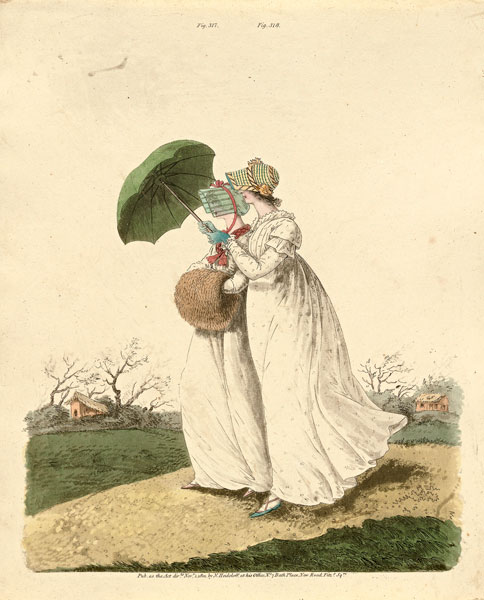
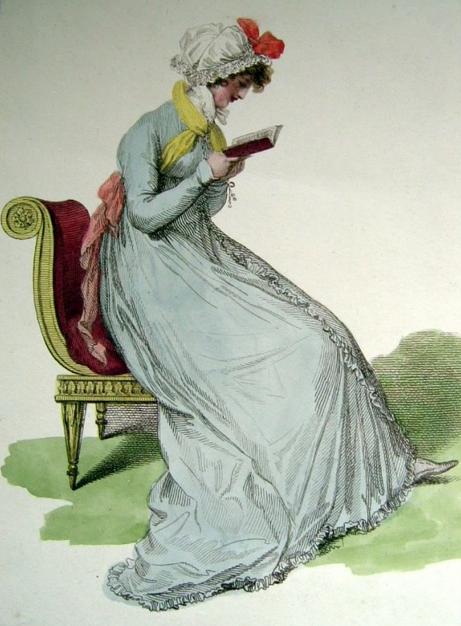
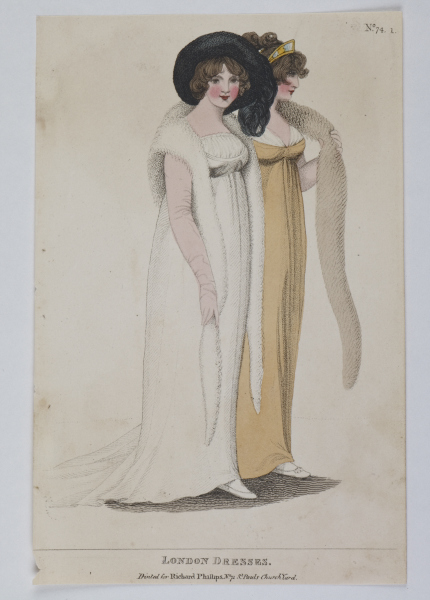
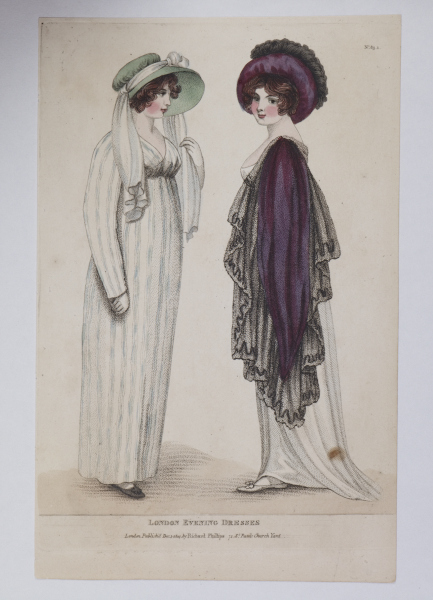
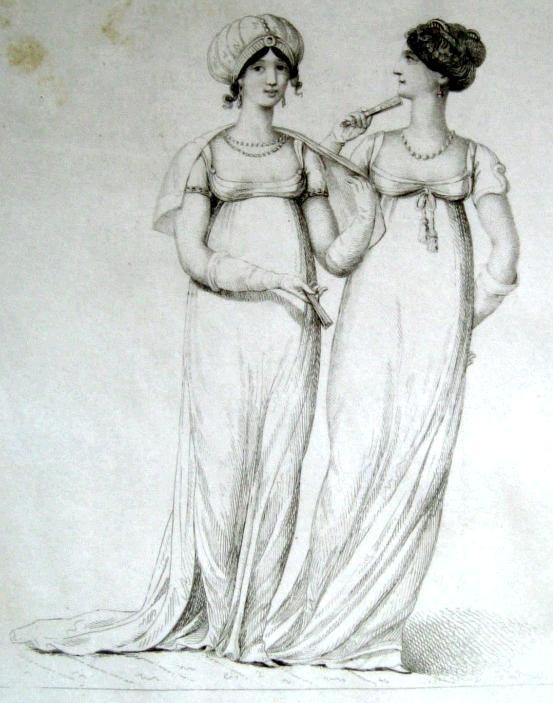
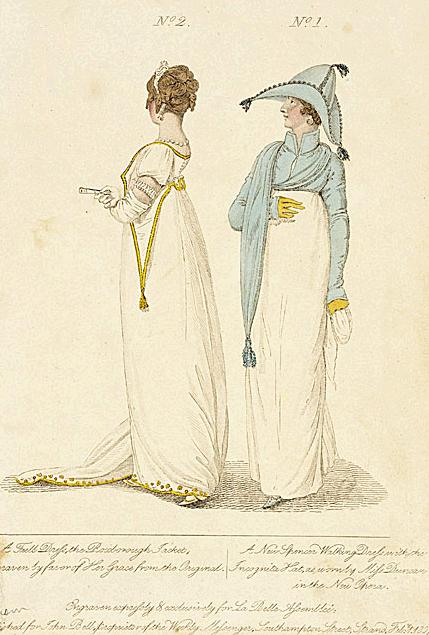
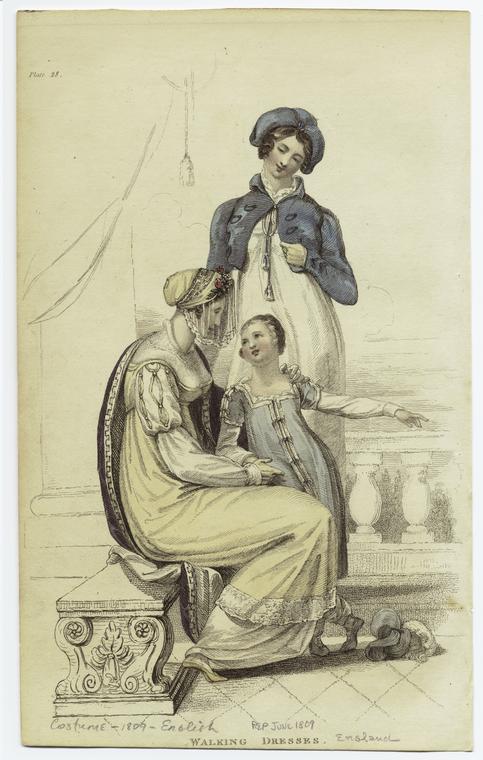
Below are images of some dresses that were prevalent between 1800-1811. The gowns are classic and tend to be free of frills. The hems in the fashion plates below are longer than in the modern image above. Earlier in the century even the day gowns still sported trains. Hats were embellished with ribbons and feathers, but not with many fruits or flowers.  In these fashion images, bosoms are covered during the day and exposed in the evening. The waist rises until it can go no higher, as in the 1806 image. In the 1810 image, you see that waists start to lower again. Gloves are often made of kid, but can also be fashioned from fabric.

Ladies Monthly Museum, afternoon dress, 1800

Ladies Monthly Museum, afternoon dress, 1800

The fashion plates of 1800 and 1801 show round gowns with skirts that are fuller than later fashions that sported a more columnar silhouette. (See 1804, 1805).

Nicholas Heidelof, morning gowns. 1801

Nicholas Heidelof, morning gowns. 1801

The period between 1800 and 1811 was a time of turmoil for Jane Austen. She was 25 in 1800, perilously close to sitting on the shelf, and a confirmed spinster at 36 when her brother, Edward, gave the Chawton Cottage to his mother and sisters and their friend, Martha Lloyd, to live in, providing them with some stability and security. During these 11 years, Jane was to live in all the places she was ever to call home, except for the last one in Winchester, where she died in 1817. During her prime adulthood, she and her sister Cassandra would have worn fashions that were similar to (but remarkably plainer and less costly than) the fashions depicted in the fashion plates below.  The Austen family lived in Steventon until 1801 and then moved to Sydney Place in Bath until 1804. In 1802, Harris Bigg-Wither proposed to Jane (then 27), who accepted him in the evening and rejected his suit the following morning.

1802 Ladies Monthly Museum

1802 Ladies Monthly Museum

1803 must have brought Jane some joy, for her novel, Susan, was sold to the publisher Crosby for £10. She was to be a published author. Sadly, the novel (to be renamed Northanger Abbey after Jane’s death) languished on Crosby’s shelves for 10 years.

Mirroir de la Mode, undress, 1803

Mirroir de la Mode, morning gown, 1803

Fashions of London and Paris, 1804. @Museum of London

Fashions of London and Paris, 1804. @Museum of London

After the lease in Sydney Place ran out in 1804,  the Austens moved to Green Park buildings. A few months later,  Rev. George Austen died suddenly in January 1805.

Fashions of London and Paris, evening dresses, 1805. @Museum of London

Fashions of London and Paris, evening dresses, 1805. @Museum of London

Their income severely reduced, the women found lodging in Gay Street, Bath from 1805 to 1806. The Jane Austen Centre is located at this building today. During this sad time, I can’t quite imagine Jane attending a ball in the Bath Assembly Rooms wearing an evening gown with an exposed bosom, such as the dresses worn by the women below.

La Belle Assemblee, opera and drawing room gowns, 1806

La Belle Assemblee, opera and drawing room gowns, 1806

In the first half of 1806, the Austen women lived for a short time in Trim Street, then lived a peripatetic life from 1806 through 1807, visiting friends and family, and always on the move.

John Bell, full dress, roxborough jacket, 1807

John Bell, full dress, roxborough jacket, 1807

They landed in Southampton in March of 1807 at the invitation of Frank Austen, who was newly married. Jane, Cassandra, their mother and friend Martha Lloyd, and new sister-in-law, Mary Austen (nee Gibson),  lived there until July, 1809. With money in short supply, the womens’ gowns must have been simple and largely refashioned from older gowns that were still wearable and sturdy.

La Belle Assemblee, walking dresses, 1808

La Belle Assemblee, walking dresses, 1808

Fabric was quite expensive in an era before easy mass production, which is why clothes were recycled. There were occasions when the Austen women needed to purchase cloth for new clothes, but the quality wasn’t always guaranteed. In this letter to Cassandra, written while she lived in Southampton, Jane complains about a tradesman in that city:

As for Mr Floor, he is at present rather low in our estimation; how is your blue gown? – Mine is all to peices. – I think there must have been something wrong in the dye, for in places it divided with a Touch. – There is four shillings thrown away.”

Sadly, the Austen women were in no position to fritter away their money, and this poorly made cloth must have been a low blow for Jane’s finances.

Ackermann, walking dresses, 1809

Ackermann, walking dresses, 1809. The overdress with lace edging at the hem is lovely.

In 1809, Edward Austen invited his mother, sisters, and Martha to live in  Chawton Cottage, which began an era of fruitful creativity for Jane and her writing.

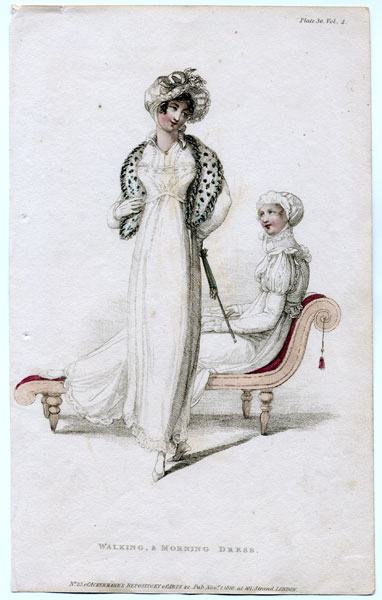
Ackermann, walking and morning dresses, 1810

Ackermann, walking and morning dresses, 1810

As you can see, the classically simple fashions depicted in these fashion plates were popular during a time when Jane Austen’s life was in a state of constant uprooting and confusion. She did not regain her equilibrium as a writer until she was settled in Chawton Cottage. When Sense and Sensibility was published in 1811, Jane might well have worn a more simple version of the elegant gowns depicted in this last Ackermann plate.

Read Full Post »

« Newer Posts - Older Posts »