Feeds:
Posts
Comments

Archive for the ‘Jane Austen’s religion’ Category

By Brenda S. Cox

“Now we are come from church . . .” (Jane to Cassandra, London, March 5, 1814)

In Jane Austen’s letters and novels, she often mentions church. A quick search of my Complete Works of Jane Austen shows 119 uses of the word “church” plus 31 uses of “chapel.” The church was an important part of Jane’s life.

A number of different churches are associated with Austen and her family, and this past summer in England I had the privilege of visiting many of them. In the coming months, I will share photos with you of some of these special places.

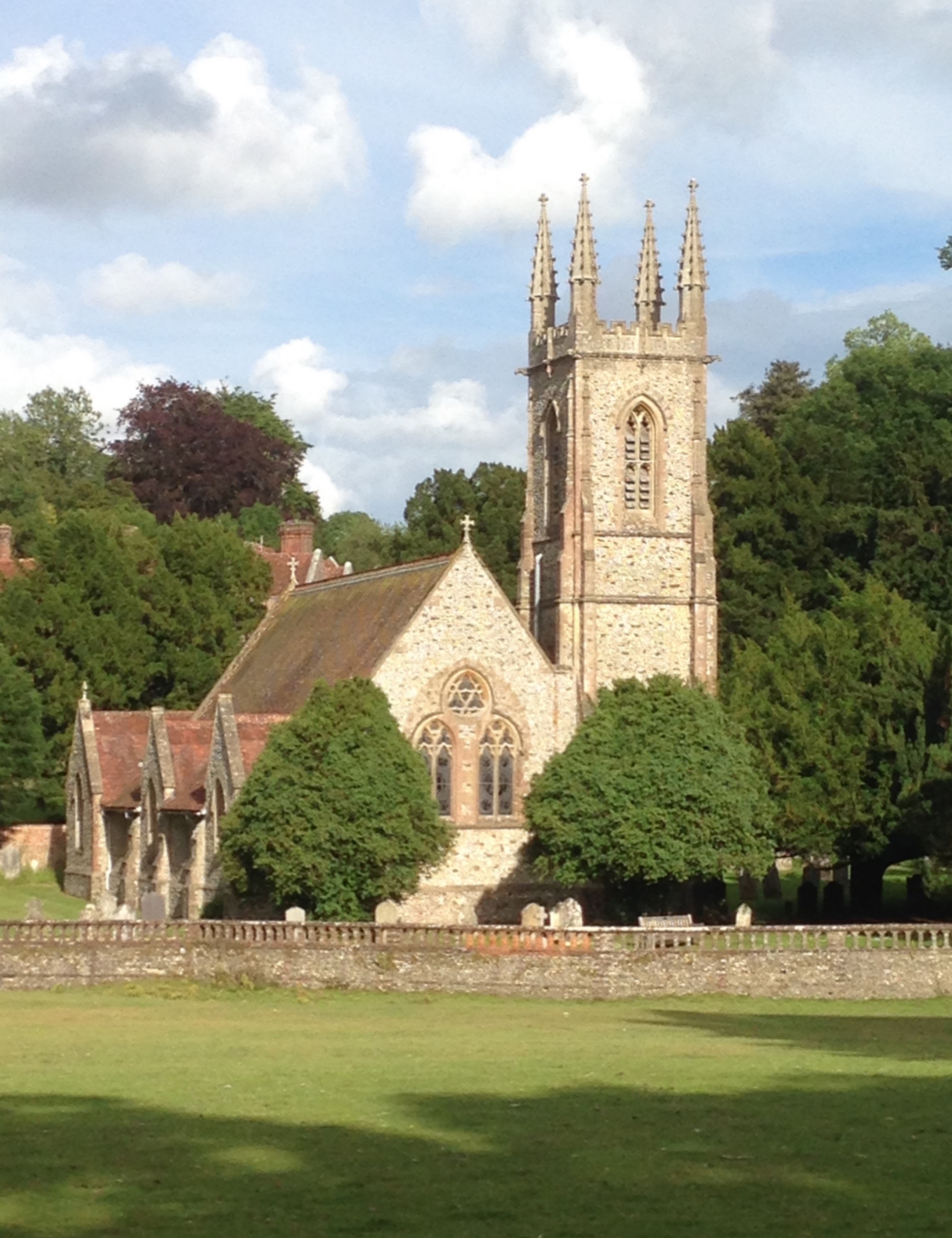
St. Nicholas’s Church, Chawton, where Jane Austen worshiped from 1809 to 1817. You can see the chimneys of Chawton House in the background; Chawton Cottage is a few minutes’ walk away. Photo © Brenda S. Cox, 2023.

Country Churches in Austen’s England

Most of the Austen family churches are small country churches, like the churches the Bennets, Darcys, Tilneys, Dashwoods, Woodhouses, and others would have mostly attended.

Most country churches at that time were simple, whitewashed inside, with perhaps the Ten Commandments hung on the wall somewhere, along with monuments (usually plaques on the walls) commemorating people from the squire’s family or previous rectors. A simple Communion table at the front, with a railing in front of it, would have served as the altar. The part of the church around the altar is called the chancel.

Chancel of the Chawton church. This part of the church escaped the fire in the late 1870s, but was mostly redecorated later. The Communion railing, however, is from the 18th century; Jane Austen would have received Communion at that railing. Photo ©Brenda S. Cox, 2023.
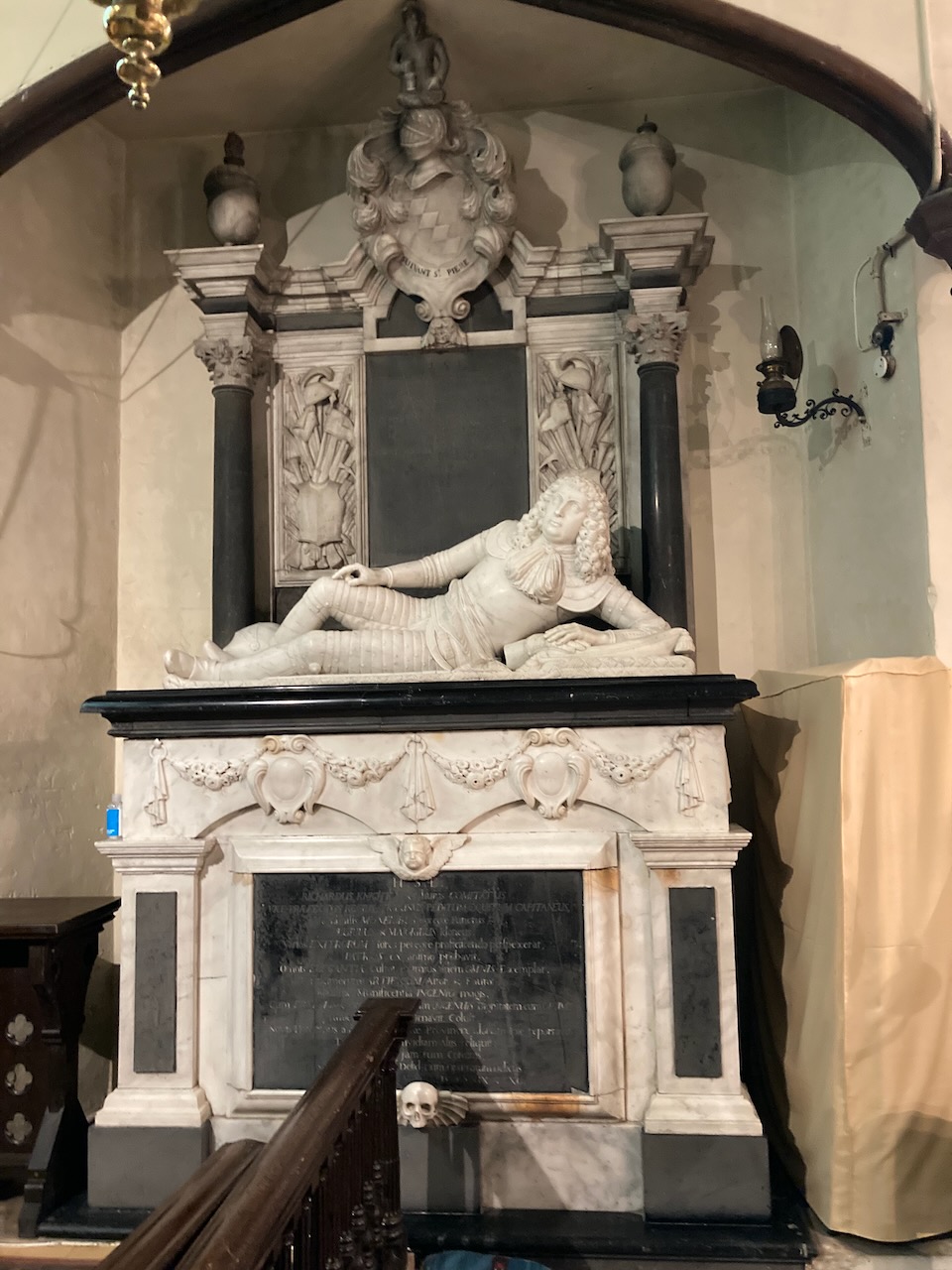
By far the most elaborate memorial in the Chawton Church, this one commemorates Sir Richard Knight, who lived from 1638-1679. Photos above and below © Brenda S. Cox, 2023.
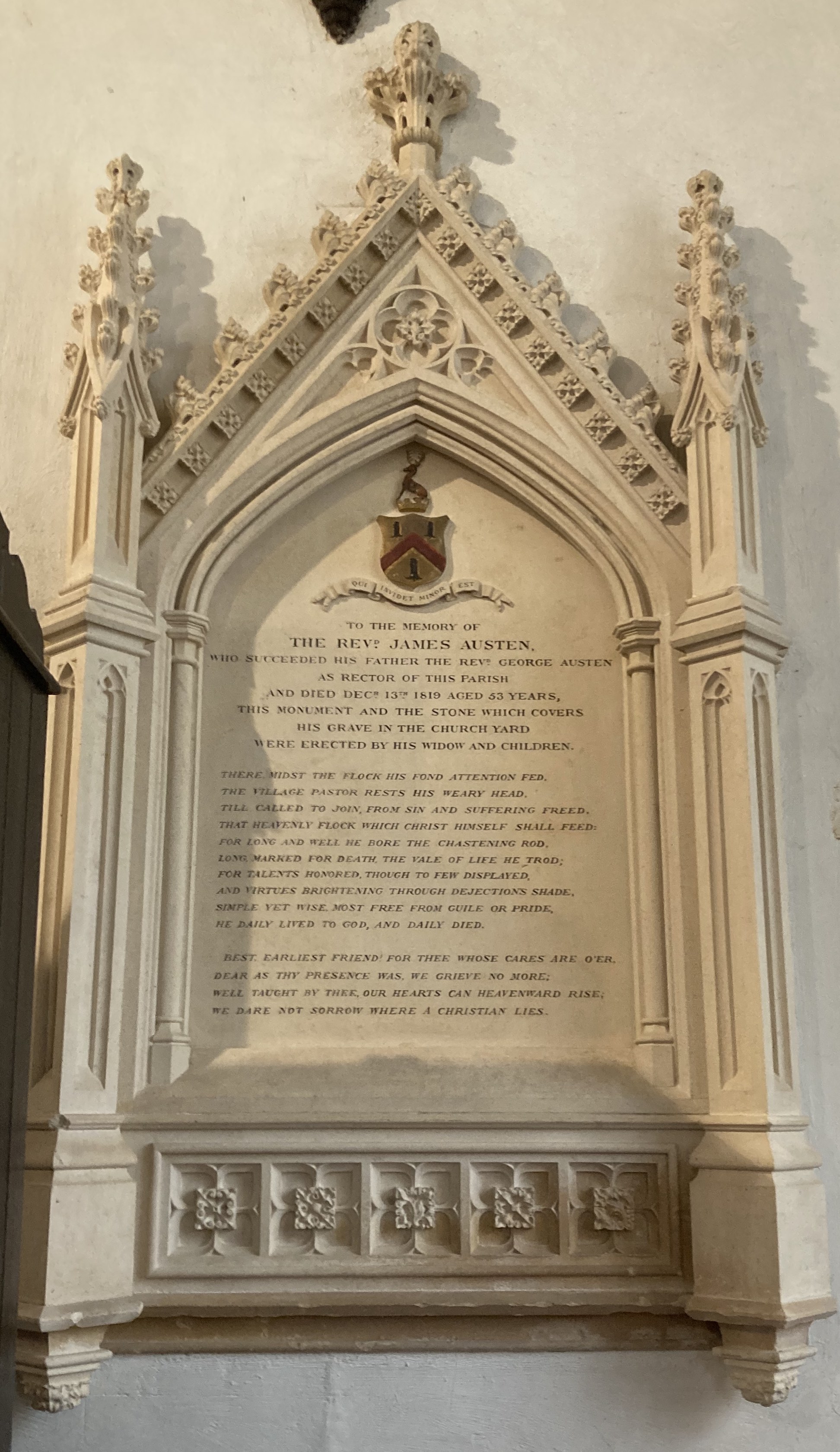
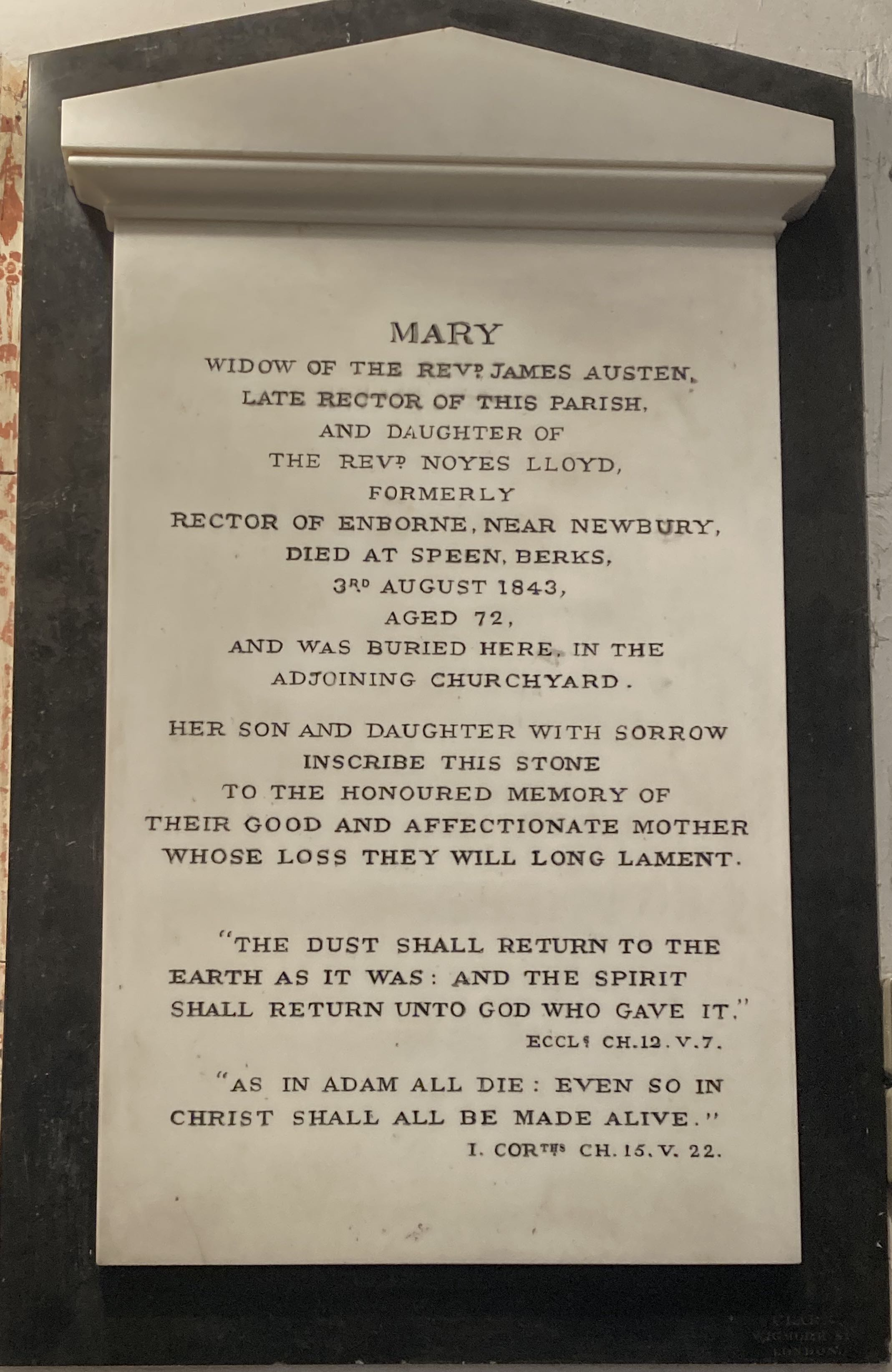
Memorials to Jane’s mother and sister inside the church.

Preaching was an important part of each service, and the pulpit might have been one, two, or three levels high. Many churches had a gallery, a balcony where the choir, called the Singers, would sit, if they had music. From the top level of the pulpit, the clergyman could preach to those in the gallery, as well as see down into the box pews, pews surrounded by walls. These box pews were generally owned by the local gentry, who could listen in privacy and be protected from drafts of cold air. Others sat on benches.

Country families visiting Bath or London would have attended larger churches. I’ve speculated previously about where Jane herself (and Catherine Morland) might have worshiped in Bath.

Country Churches Today

The country churches we visited this summer now have small congregations for regular services; perhaps a dozen or so people on a Sunday morning. However, they occasionally host baptisms, weddings, and funerals, with much larger attendance. Those events also provide income to the churches. These small churches may gather one to two hundred people for holiday services such as Harvest, Christmas, or Easter. They sometimes also host local school events, concerts, and community events.

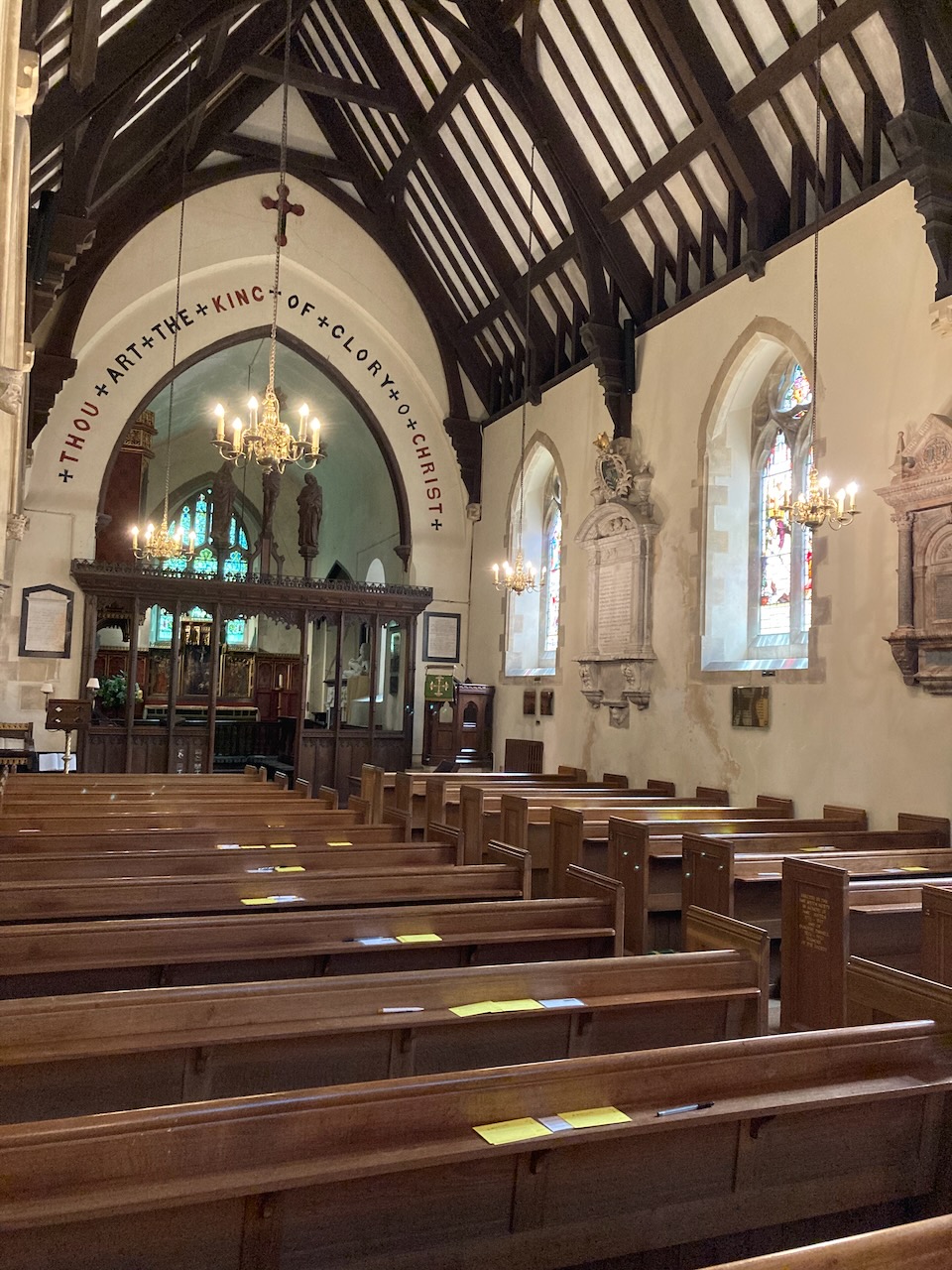
Interior of Chawton Church. The stained glass windows are all from Victorian times or later. Photo © Brenda S. Cox, 2023.

St. Nicholas’ Church, Chawton, Today

Let’s start with the Chawton church. This is the one Jane Austen fans can most easily visit, since it is next to Chawton House and a short walk from Jane Austen’s House. Jane Austen attended this church from 1809 to 1817, while she and her mother, sister, and friend were living in Chawton Cottage (now Jane Austen’s House, a museum). During that time, she wrote or rewrote all her novels, and four of them were published. (The other two were published shortly after her death.)

The church is named after St. Nicholas, like the church in Steventon where Austen grew up; that’s a little confusing.

This Victorian stained glass window in Chawton Church honors St. Nicholas, patron saint of children and others, to whom the church is dedicated, and St. Swithin, patron saint of Winchester Cathedral where Jane Austen is buried. The window is a memorial to Marianne Knight, daughter of Jane’s brother Edward Knight. Marianne died unmarried in 1896, and the window appears to have been commissioned by her great-nephews and great-nieces (if I am deciphering the Latin correctly).  Photo © Brenda S. Cox, 2023.

Nowadays a small team of clergy usually serve a group of country parishes. The Chawton church is now part of the Northanger Benefice, which includes eight small rural parishes, each with its own church.

While services are offered somewhere in the area every Sunday, most small churches do not have services every week. At the church in Chawton, three Sunday services are held per month.

One is led by a layperson (not an ordained clergyman or clergywoman). In the hour-long lay service I attended during Regency Week, a woman from the congregation led the service, reading from the Book of Common Prayer, while the congregation read the responses. The congregation sang hymns: “Lord of All Hopefulness,” a lovely traditional hymn, as well as “Kum Ba Yah” and “Morning Has Broken,” perhaps chosen because they were familiar and easy to sing. There was no sermon.

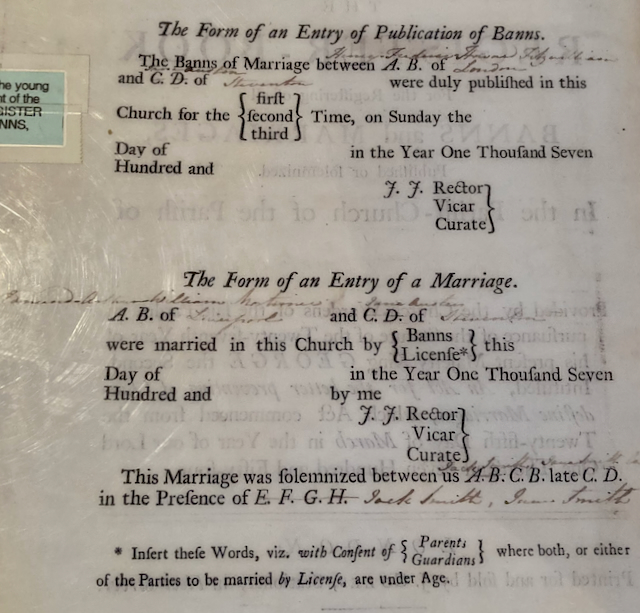
The leader read the banns for two couples who plan to get married in the church. I was told that, in order to be married there, a couple had to attend the church at least six times before the wedding, and they needed some connection with the parish or benefice.

The congregation was welcoming and kind to my friend and myself as visitors. We enjoyed the fellowship before and after the service.

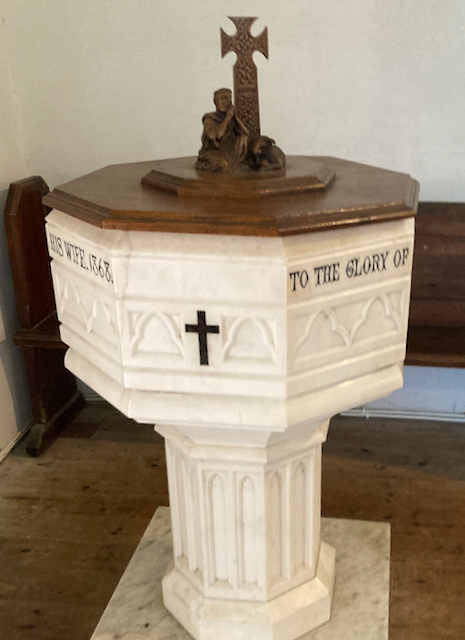
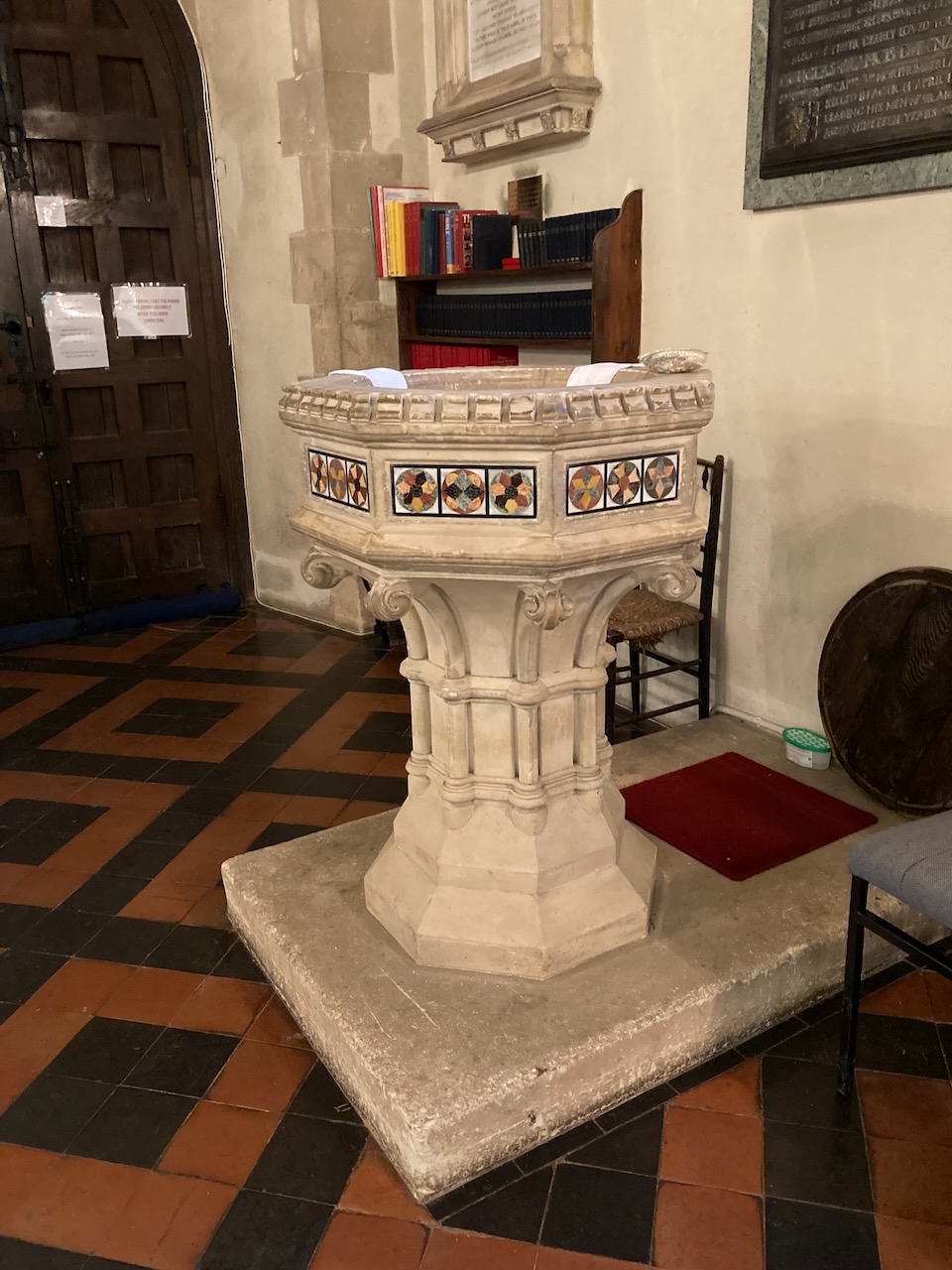
Baptisms (Christenings) are performed at this Victorian font near the door of the Chawton church. Photo © Brenda S. Cox, 2023.

The service I attended the following Sunday included the baptism of a nine-month-old boy. About forty or fifty people attended. (I was told anyone could be baptized in the church, with the payment of a small fee.) The rector in charge of the benefice, Rev. Carrie Walshaw, officiated. (The Church of England has ordained women since 1994.) The baby was dedicated with his parents, two godfathers, and one godmother (a baby girl would have two godmothers and one godfather), and baptized at the Victorian font at the back of the church. A candle was lit and given to the parents as a symbolic remembrance. Rev. Walshaw preached a sermon about baptism and salvation, and we sang hymns with organ music. Rev. Walshaw’s husband was the organist; the organ is an electronic one that sounds like a real pipe organ (to me, at least). It is hidden behind the pipes of the old organ which is now too expensive to maintain.

Victorian organ pipes at Chawton Church. A newer electronic organ is behind the panels. Photo © Brenda S. Cox, 2023.

History of St. Nicholas’ Church, Chawton

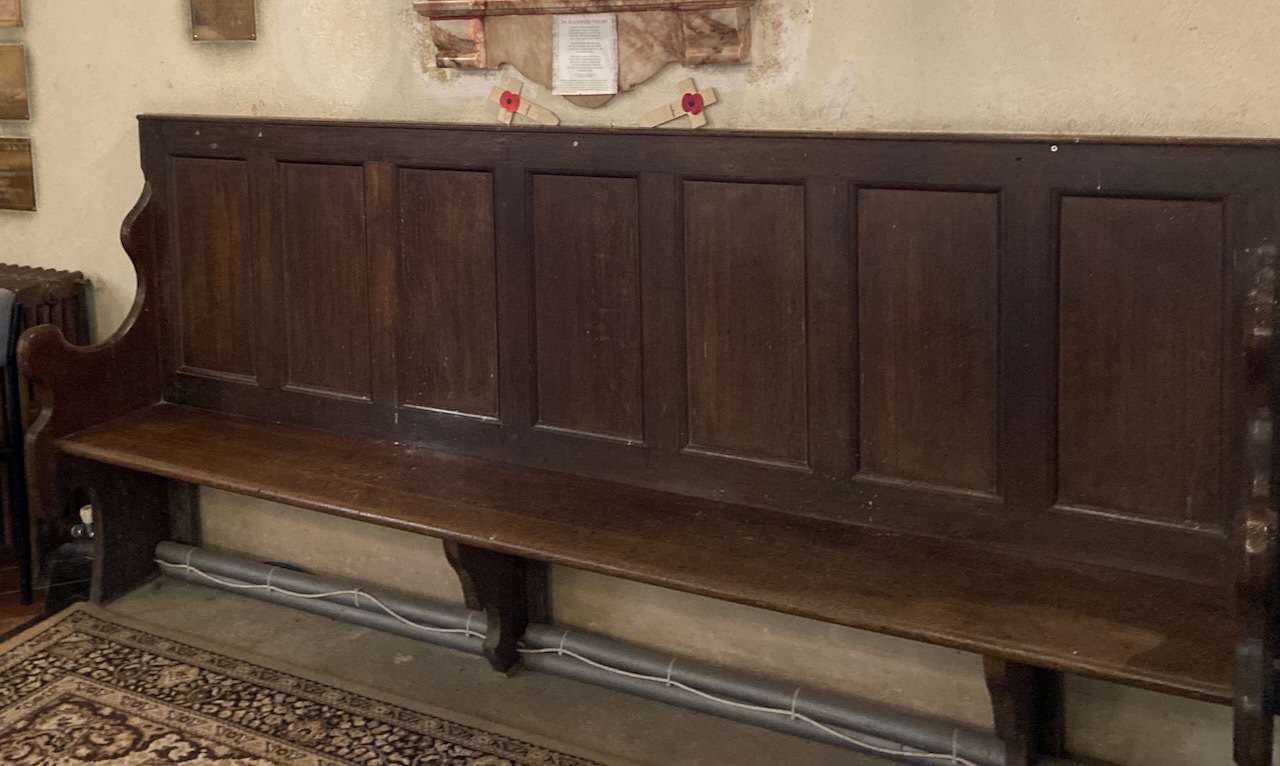
There has been a church at Chawton since at leat 1270 AD. The current church building, however, is not the same one Austen worshiped in. A fire in 1871 destroyed most of that church. The chancel (the area around the altar at the front of the church) remains, and most of the memorials were preserved, along with one original pew sitting against the back wall. So those are still as Jane Austen would have seen them, though the chancel has been extensively redecorated.

The only original pew, from 1733, to survive the fire; it is now attached to the back wall of the Chawton church. Photo © Brenda S. Cox, 2023.

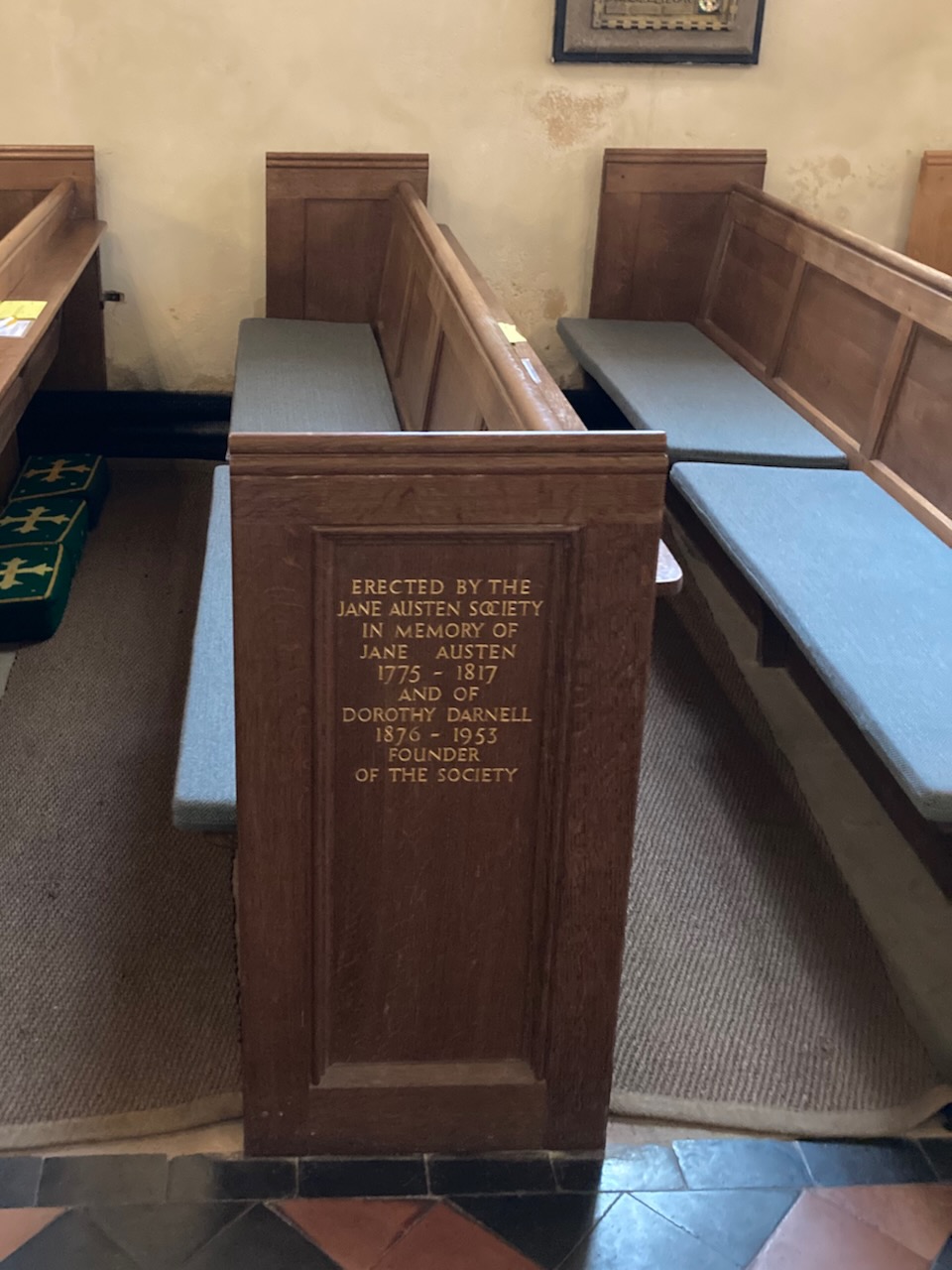
The rest of the church, including the tower, was rebuilt in 1872 and 1873 in a Victorian style. Several of the pews are marked as memorials to various people, including one for Jane Austen, though these pews are all modern.

This modern pew in the Chawton Church is dedicated to Jane Austen and to Dorothy Darnell, founder of the Jane Austen Society. Photo © Brenda S. Cox, 2023.

Clergy

For each parish church in England, someone owns the advowson, the right to appoint the next clergyman. The Knight family (who adopted Jane’s brother Edward) owned the advowson for Chawton from 1578 until 1953. At that point, they gave it to the Bishop of Winchester, when Chawton became part of a benefice with nearby Farringdon.

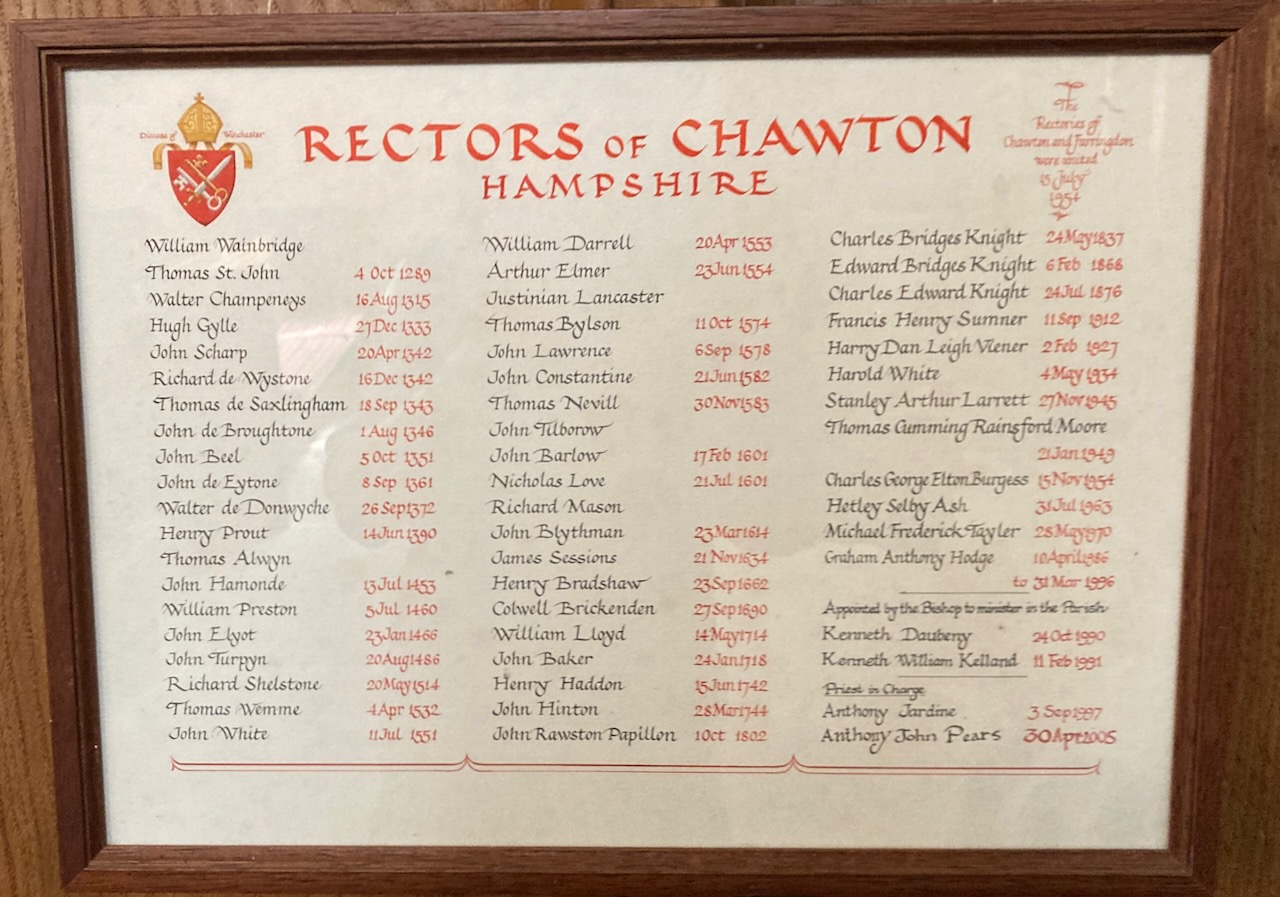
During Austen’s time, the Knights chose Rev. John Papillon as rector of Chawton. In one of her letters, Jane refers to a family joke that she was supposed to marry Rev. Papillon, regardless of how either of them felt about it (Dec. 9, 1808).

This list of Chawton rectors, posted on the wall of the church, includes Rev. Papillon, who was rector while Jane Austen lived there. He is mentioned in her letters. Two of her nephews and a great-nephew follow. Photo © Brenda S. Cox, 2023.

In 1817, Jane’s brother Henry Austen served briefly as curate at Chawton and at St. Lawrence the Martyr’s, parish church of the nearby market town of Alton. In 1837, Edward Knight installed his son, Charles Bridges Knight, as rector of Chawton. The rectory is the white house at the end of the lane leading to the church and Chawton house, just across the street. It is now a private home.

The former rectory of Chawton Church is now a private home, just across the road from the church and Chawton House. Photo © Brenda S. Cox, 2023.

Updating the Church

A guidebook to Chawton Church tells us, “The parish has increased little in population since the 19th century and still only has about 300 adults living in it so that the shortage of money which is the lot of most churches in tiny parishes is likely to continue in this, the 21st century.” The building is a grade 2 listed building in the UK, meaning it is “of special interest, warranting every effort to preserve it.” 

The church therefore has to get permission to make any changes. Recent changes are the addition of two restrooms and a small kitchen in the back of the church. The kitchen is made of oak matching the pews, with a cover to hide the sink. These amenities make the church more appealing as a site for weddings and other community events. Income from such events helps keep the church running. The Chawton church has hosted five weddings this year so far.

The church also has a children’s area toward the back, with toys. This helps keep children occupied, especially during the regular services geared for families.

A children’s area and basic kitchen facilities have been added to the back of the Chawton church. Photo © Brenda S. Cox, 2023.

Ring the Bells

The church has a peal of six bells, which were ringing during the baptism service I attended. Three of them would have been heard by Jane Austen; they are dated 1420, 1621, and 1748. Another original bell was re-cast and re-hung as one of the newer bells. During Austen’s time, the church had a West Gallery, a balcony which may have been used by a choir or musicians, but the rebuilt church has no gallery.

Bell tower of the Chawton church. Photo © Brenda S. Cox, 2023.
Chawton’s current six bells, three of which would have been heard by Austen, were dedicated/re-dedicated in 2009. Photo © Brenda S. Cox, 2023.

Lych Gates and Graveyard

Outside, the church can be approached from two traditional lych gates, one in front, one in the back. The word lych (pronounced litch) is from an Anglo-Saxon word for corpse. The lych gate was the entrance to the church yard, which was a cemetery. When a person died in the parish, their body might be set in the lych gate for a time, until the funeral was held.

The lych gates of the Chawton church date from about 1871. There is a similar one behind the church. Photo © Brenda S. Cox, 2023.

The Chawton churchyard includes many headstones for people buried there, some of which are so ancient they are illegible.

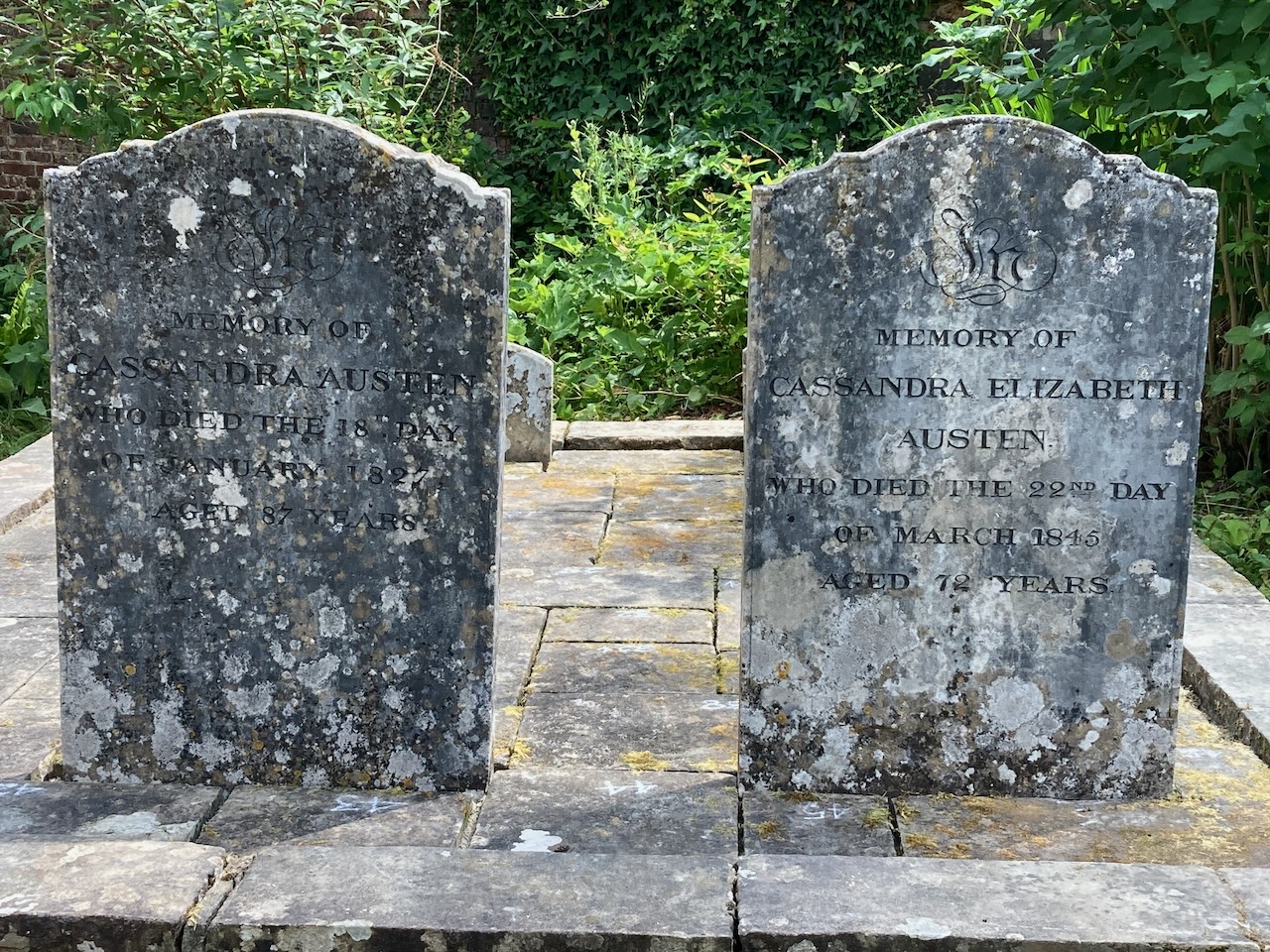
Jane Austen’s mother and sister are buried in the churchyard. Their graves were recently cleared of huge, deep weeds. But the lettering on the stones is still difficult to read.

Jane Austen’s mother and sister, both named Cassandra, are buried in the Chawton churchyard. Photo © Brenda S. Cox, 2023
The gravestones were easier to read in 2013, when I took this photo. Photo © Brenda S. Cox, 2013.

Honoring Jane

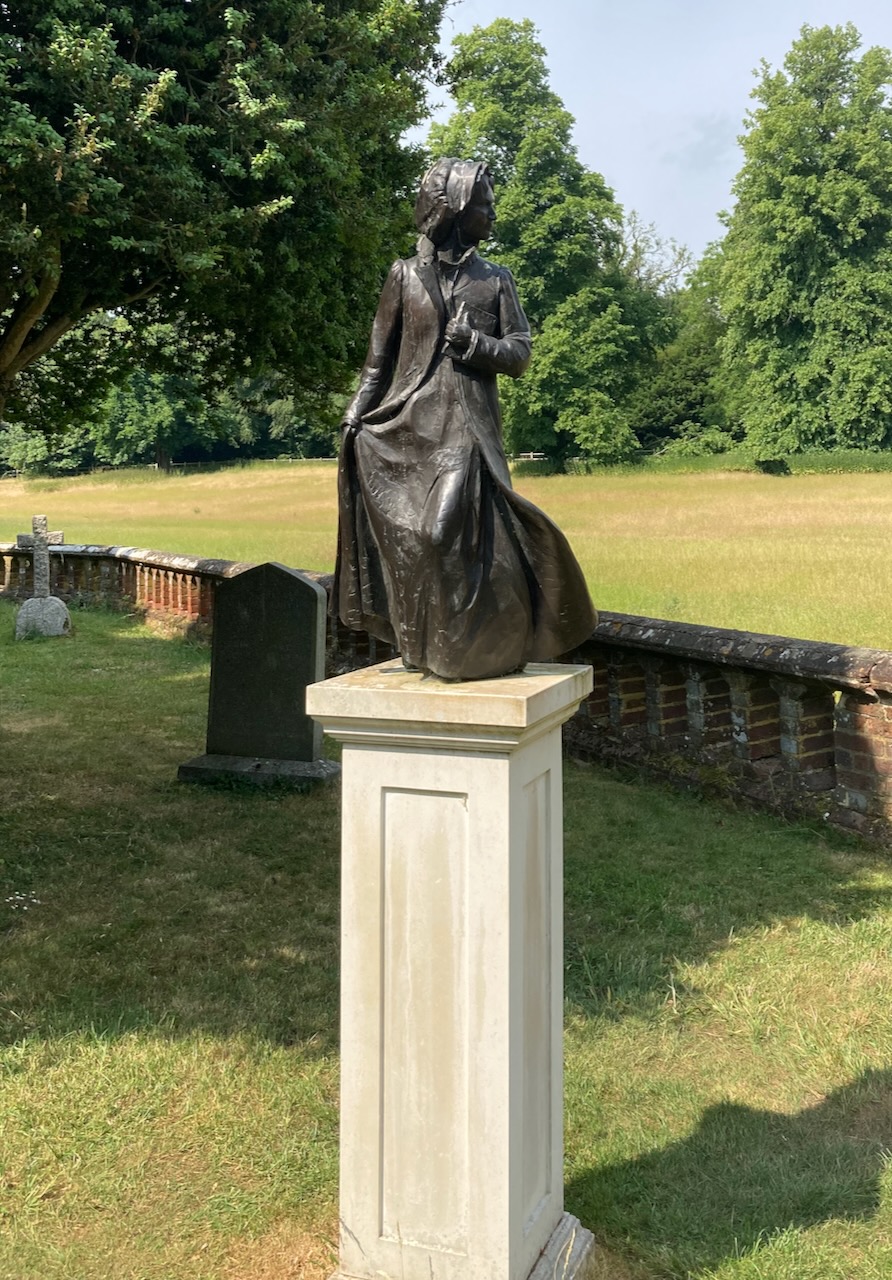
A small statue of Jane Austen now stands in front of the church, erected in 2018. The statue is the maquette, the prototype, for the life-size statue in Basingstoke. It shows Austen walking, carrying a book.

A statue of Jane Austen now greets visitors to the Chawton church. Photo © Brenda S. Cox, 2023.

I hope you can visit the Chawton church and enjoy its peace and beauty.

Resources

Guides to Chawton church and other Austen-related churches are available from Jane Austen Books, or you can buy them at the church if you visit it.

A Walk Through Chawton will give you a wider view of Austen-related places to visit in the area. 

Donations

The Chawton church is always open to visitors like yourself. According to a sign in the church, however, it costs over £75 a day to keep the church operating. If you should wish to make a donation directly to the church, churchwarden Sandra Martin has set up this site, which Rev. Lesley Leon of the Northanger Benefice shared with us: Chawton church donations.

JASNA provides support for special projects in some Austen family churches, including this one. If you are a JASNA member, donations to the churches fund for such projects are appreciated. (You can donate when renewing your membership, or sign in to your account and go under the drop-down menu to “Donate to JASNA or English Institutions.”)

Posts on other Jane Austen Family Churches

Steventon

Hamstall Ridware

Adlestrop and the Leigh Family

Stoneleigh Abbey Chapel

Great Bookham and Austen’s godfather, Rev. Samuel Cooke

Ashe and Jane’s Friend Mrs. Lefroy 

Deane

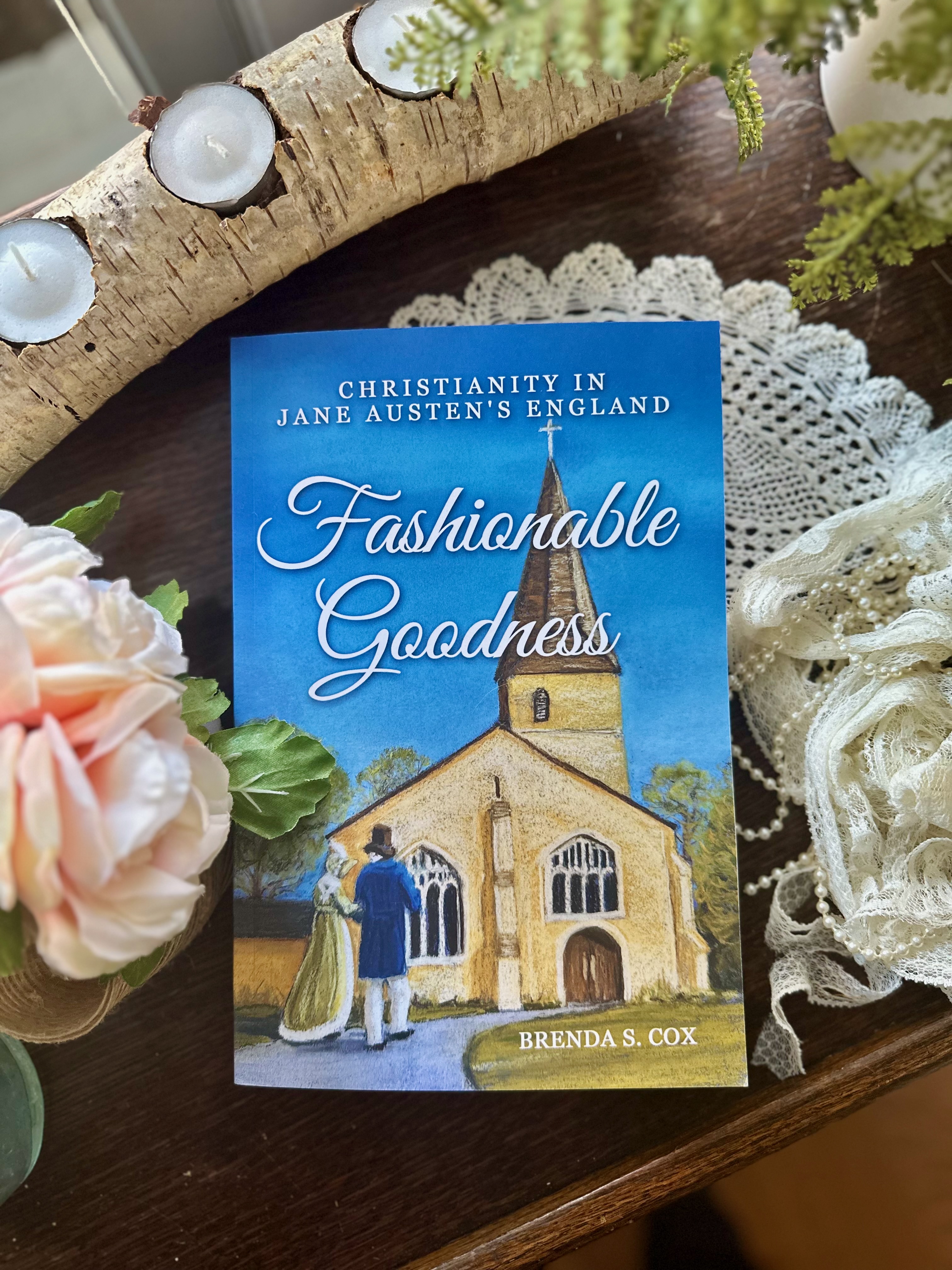
Brenda S. Cox is the author of Fashionable Goodness: Christianity in Jane Austen’s England. She also blogs at Faith, Science, Joy, and Jane Austen.
Read Full Post »

Our very own Brenda S. Cox has just published her new book Fashionable Goodness: Christianity in Jane Austen’s England. It’s already receiving a wonderful reception, and I know it will continue. For those of us who are always expanding our understanding of Jane Austen’s life, and particularly her personal life and faith, this new book is an essential resource.

When I was writing my book Praying with Jane: 31 Days Through the Prayers of Jane Austen, I read every article and book I could find on the topic of religion and faith as it related to Austen and her family. I scoured every available resource on Austen’s personal faith, her family’s daily and weekly religious habits, and the Anglican church at large. I discovered many wonderful details about her religious life, but as I worked, I always felt as though I was putting together a giant puzzle. And when it came to understanding more fully the implications of her religious beliefs and background in her novels, I felt as though the puzzle was missing many important pieces.

In Fashionable Goodness: Christianity in Jane Austen’s England, Brenda has finally put the puzzle pieces in their rightful places and collected all of the information one might want to know about Jane Austen’s religious life in one handy place. This book covers a broad range of topics that any Jane Austen lover can benefit from knowing, especially for those of us who enjoy looking into the varied layers and greater context of her writing.

Of particular interest is the clever manner in which Brenda has organized the information in this book. Each chapter is easy to find, plus she has included many helpful resources at the end of the book, including handy tables with income information, terminology, ranks within the church, and denominations; several appendices; detailed chapter notes; a hefty bibliography; a glossary of terms; and a topical index. You can read this book cover-to-cover or you can pick and choose the topics that interest you most.

I highly recommend this book for any Austen fan or scholar. Without this book, you can only know part of what makes Jane Austen’s characters and plots so intriguing. Thank you Brenda for creating this invaluable resource!

(See below for giveaway details.)

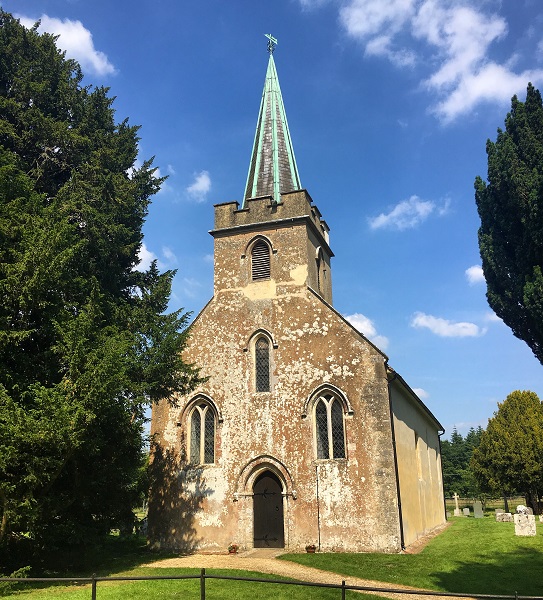
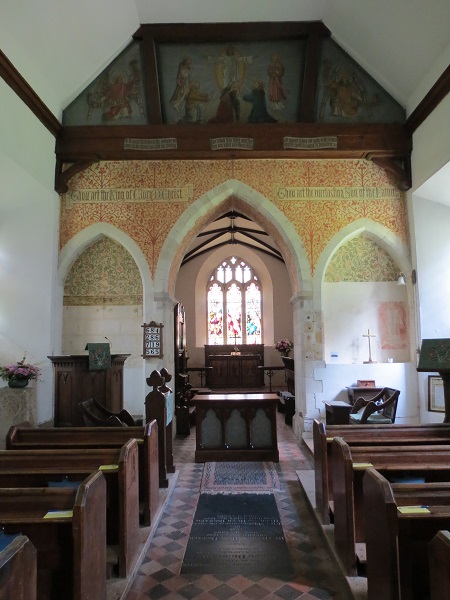
St. Nicholas Church, Steventon
Photo: Rachel Dodge

About the Book:

“Brenda Cox’s Fashionable Goodness is an indispensable guide to all things religious in Jane Austen’s world. . . . a proper understanding of 18th century Christianity is necessary for a full appreciation of Austen’s works. Cox provides this understanding. . . . This work will appeal to novice readers of Austen as well as scholars and specialists.”

Roger E. Moore, Vanderbilt University, Jane Austen and the Reformation

The Church of England was at the heart of Jane Austen’s world of elegance and upheaval. Fashionable Goodness: Christianity in Jane Austen’s England explores the church’s role in her life and novels, the challenges that church faced, and how it changed the world. In one volume, this book brings together resources from many sources to show the church at a pivotal time in history, when English Christians were freeing enslaved people, empowering the poor and oppressed, and challenging society’s moral values and immoral behavior.

Readers will meet Anglicans, Dissenters, Evangelicals, women leaders, poets, social reformers, hymn writers, country parsons, authors, and more. Lovers of Jane Austen or of church history and the long eighteenth century will enjoy discovering all this and much more:

  • Why could Mr. Collins, a rector, afford to marry a poor woman, while Mr. Elton, a vicar, and Charles Hayter, a curate, could not?
  • Why did Mansfield Park‘s early readers (unlike most today) love Fanny Price?
  • What part did people of color, like Miss Lambe of Sanditon, play in English society?
  • Why did Elizabeth Bennet compliment her kind sister Jane on her “candour”?
  • What shirked religious duties caused Anne Elliot to question the integrity of her cousin William Elliot?
  • Which Austen characters exhibited “true honor,” “false honor,” or “no honor”?
  • How did William Wilberforce, Hannah More, and William Cowper (beloved poet of Marianne Dashwood and Jane Austen) bring “goodness” into fashion?
  • How did the French Revolution challenge England’s complacency and draw the upper classes back to church?
  • How did Christians campaigning to abolish the slave trade pioneer modern methods of working for social causes?
Interior of St. Nicholas Church, Steventon
Photo: Rachel Dodge

About the Author, Brenda S. Cox:

Brenda S. Cox has loved Jane Austen since she came across a copy of Emma as a young adult; she went out and bought a whole set of the novels as soon as she finished it! She has spent years researching the church in Austen’s England, visiting English churches and reading hundreds of books and articles, including many written by Austen’s contemporaries. She speaks at Jane Austen Society of North America meetings (including three AGMs) and writes for Persuasions On-Line (JASNA journal) and the websites Jane Austen’s World and her own Faith, Science, Joy, and Jane Austen.
Buy the Book:

You can purchase Fashionable Goodness: Christianity in Jane Austen’s England here:

Amazon and Jane Austen Books
International: Amazon


Book Giveaway:

To enter for a chance to win a copy of Brenda’s book Fashionable Goodness: Christianity in Jane Austen’s England, please leave a comment below with an answer to this question:

What is one question you’ve always had about Jane Austen’s faith or the role religion plays in her novels?

Giveaway Details: This giveaway is for ONE (1) print copy and ONE (1) ebook (Kindle) edition for readers of this blog. The winners will be drawn by random number generator on November 18, 2022.

Note: This giveaway is limited to addresses in the U.S., U.K., Australia, Canada, Germany, Spain, France, or Italy for a print copy of the book. The author can only send a giveaway ebook (Kindle) to a U.S. address. (However, both the ebook and paperback are available for sale to customers from any of these countries, and some others that have Amazon.)


Blog Tour Schedule


RACHEL DODGE teaches college English classes, gives talks at libraries, teas, and book clubs, and writes for Jane Austen’s World blog. She is the bestselling author of The Little Women DevotionalThe Anne of Green Gables Devotional and Praying with Jane: 31 Days Through the Prayers of Jane Austen. Coming soon: The Secret Garden Devotional! You can visit Rachel online at www.RachelDodge.com.

Read Full Post »

By Brenda S. Cox

“We do not much like Mr. Cooper’s new sermons;–they are fuller of Regeneration & Conversion than ever–with the addition of his zeal in the cause of the Bible Society” –Jane Austen, letter to Cassandra Austen, Sept. 8, 1816

Last month we talked about Austen’s first cousins, particularly Edward Cooper, son of Jane’s mother’s sister. He became a clergyman like Jane’s father and Edward’s father. Edward was a strong Evangelical, and he and Jane did not always see eye to eye.

Evangelicals in the Church of England

The Evangelical* movement in the Church of England started early in the 1700s. While some evangelicals left the Church of England, others stayed within it. (We use a capital “E” for this movement within the Church of England at that time.) In general, evangelicals stress the centrality of the Bible and of Christ’s death on the cross to redeem sinful people, the need for a personal conversion experience, and Christians’ responsibility to actively lead others toward Christ and do good in the world. These are the messages Edward Cooper and other Evangelicals preached. 

The most famous Evangelical of Austen’s time was William Wilberforce. Wilberforce and other Christians, especially Evangelicals, led the fight against the slave trade, supported campaigns to educate the poor in England, and much more. (While modern evangelicals may be associated with certain political stances, evangelicals in Austen’s England were associated with these issues instead: education for the poor, the campaign against the slave trade and slavery, and others.)

Cooper’s Sermons and Jane Austen’s Responses

In Jane Austen’s time, many clergymen published their sermons. Sermons were popular reading, as well as providing preaching material for other clergymen. Austen enjoyed reading books of sermons. Cooper published a number of volumes of his sermons. Apparently, though, Jane and Cassandra didn’t like them much. In 1809 (Jan. 17), she commented,

“Miss M. conveys to us a third volume of sermons, from Hamstall, just published, and which we are to like better than the two others; they are professedly practical, and for the use of country congregations.”

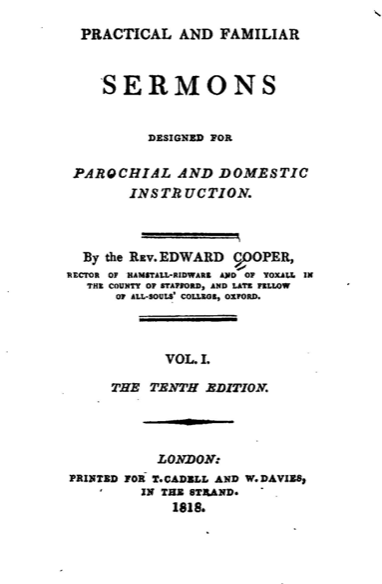
This was Edward Cooper’s Practical and Familiar Sermons Designed for Parochial and Domestic Instruction (meaning for reading at home and for preaching to churches), first published in 1809. The earlier volumes were one in 1803 criticizing the practice of the militia drilling on Sundays (a day of rest), and then Sermons, Chiefly Designed to Elucidate Some of the Leading Doctrines of the Gospel (1804).

Where did Jane differ from those “leading doctrines” of Evangelical preaching? Evangelicals taught that people needed a conscious, personal conversion experience, a regeneration or rebirth, to become true Christians. Other Anglicans believed that growth in faith was gradual through life, beginning with a person’s baptism as an infant; this was probably Austen’s belief.  Both groups believed that throughout life the person needed to trust in Christ, repent when they sinned, and ask God’s help to live a good life. Edward Cooper’s hymn, “Father of Heaven,” which is still sung today, asks God for His “pardoning love.”

Cover of Edward Cooper’s Practical and Familiar Sermons, which Jane Austen was to “like better than the two others.”

This theological disagreement partly explains Jane’s reaction to a later book which includes two of Edward’s sermons. It’s been speculated that the “we” here might refer to the rest of her family, perhaps to her mother and brother’s opinion more than to her own. But still she does include herself:

“We do not much like Mr. Cooper’s new sermons;–they are fuller of Regeneration & Conversion than ever–with the addition of his zeal in the cause of the Bible Society” (Sept. 8, 1816).

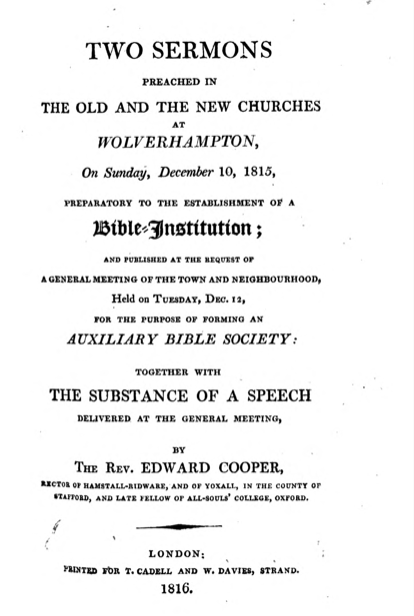
This refers to Two Sermons Preached . . . at Wolverhampton Preparatory to the Establishment of a Bible Institution (1816). I was surprised to find that these sermons do not use the word regeneration, and conversion is used only once (with convert used two further times). However, the concepts are implied.

Cooper does talk about the world’s need for the gospel and for the Bible. Jane Austen apparently did not disagree with these goals. In her third prayer, she wrote,

“May thy [God’s] mercy be extended over all Mankind, bringing the Ignorant to the knowledge of thy Truth, awakening the Impenitent, touching the Hardened.”

Cover of Edward Cooper’s sermons for the Bible Society, which Austen found too full of “regeneration and conversion.”

The SPCK and the Bible Society

So, why would Austen object to Cooper’s supporting the Bible Society? She and her family supported a different institution that distributed the Bible, the SPCK. In fact, Jane herself contributed half a guinea, a substantial amount of her income, to this organization in 1813.

The SPCK, or Society for Promoting Christian Knowledge, is a Church of England organization that published and sold Christian literature at that time. However, many felt that they were not supplying enough Bibles in different languages (specifically Welsh, at the beginning), and so the British and Foreign Bible Society was formed.

The Bible Society included both Anglicans and Dissenters (people in other denominations). Because of this, they published and distributed only Bibles, with no commentary (which might support one set of doctrines over another). The SPCK produced the Book of Common Prayer and other materials explaining the Bible from an Anglican perspective. There was some tension or competition between these two groups.

Both societies formed auxiliary groups in various areas to support their work. According to Irene Collins, in 1813, both organizations set up branches in Basingstoke, in the Austens’ part of the country. James Austen, Jane’s brother, organized and spoke at the initial meeting of the SPCK. The Lefroy family, old friends of the Austens’, were leaders of the rival Bible Society auxiliary started at almost the same time.

A copy of James’s speech for the SPCK has been preserved. He said that the SPCK was better than the Bible Society, because along with the Bible it distributed commentaries and the Book of Common Prayer (the “Liturgy”). He explained,

“It [the SPCK] not only puts the Bible in a poor man’s hand, but provides him with the best means of understanding it.”

However, he also said that those supporting the Bible Society did so from “the purest and best of motives,” and encouraged them to support both organizations. He complimented the Bible Society, saying its “exertions” had produced “extreme good.” He called for a spirit of unity in the area and a spirit of “candour”—which meant assuming the best of one another. The speech is gentle and conciliatory; a good model for today’s controversies.

Jane Austen and the Evangelicals

So, Jane Austen had some disagreements with her Evangelical cousin Edward Cooper, and didn’t much like his sermons. However, Cooper had an Evangelical friend in neighbouring Yoxall, Rev. Thomas Gisborne. Both Cooper and Gisborne were involved with Wilberforce in working for the abolition of the slave trade. 

Austen did enjoy Gisborne’s work. In 1805, she told Cassandra,

“I am glad you recommended ‘Gisborne,’ for having begun, I am pleased with it, and I had quite determined not to read it” (Aug. 30, 1805).

The book was probably An Enquiry into the Duties of the Female Sex

In Austen’s letters, she made two specific mentions of the Evangelicals. On Jan. 24, 1809, she wrote, “I do not like the Evangelicals.” She was telling her sister that she did not want to read a new book by Hannah More, a popular Evangelical author. She went on to say, “Of course I shall be delighted when I read it, like other people,” so she doesn’t seem to be very serious. My guess is that she did not like More’s style, which is didactic, clearly teaching lessons through her story. Austen preferred to tell a good story and let readers come to their own conclusions.

Later, on Nov. 18, 1814, she had a serious discussion with her niece Fanny Knight about marrying a man who was leaning toward Evangelicalism. She wrote, “I am by no means convinced that we ought not all to be Evangelicals, & am at least persuaded that they who are so from Reason and Feeling must be happiest & safest. . . . don’t be frightened by the idea of his acting more strictly up to the precepts of the New Testament than others.” So at that point, though she was not Evangelical herself, she admired them.

Austen’s beloved brother Henry later became an Evangelical preacher himself. But he still wrote about his sister, in the introduction to Northanger Abbey and Persuasion:

“She was thoroughly religious and devout . . . On serious [religious] subjects she was well-instructed, both by reading and meditation, and her opinions accorded strictly with those of our Established Church.”

While some have claimed that he was exaggerating here, at the time being “religious” was not necessarily popular. Jane Austen did not always agree with her cousin Edward’s theology or style of writing, but it seems to me that she was serious about her faith, as he was.


Brenda S. Cox blogs on Faith, Science, Joy, and Jane Austen. She has written a book called Fashionable Goodness: Faith in Jane Austen’s England, which she hopes will be available by the end of this year.

*Note that “Evangelical” and “evangelism” are two different things, though people sometimes get them confused. Evangelicals, the focus of the article above, were and are groups of Christians with certain common beliefs. Evangelism  means people sharing their religious beliefs with other people.

For Further Reading

Edward Cooper, Jane Austen’s Evangelical Cousin, Part 1

Edward Cooper, Wolverhampton Sermons, Jan. 1, 1816. You can also find seven volumes of his Practical and Familiar Sermons, in various editions, online.

Jocelyn Harris, “Jane Austen and the Society for Promoting Christian Knowledge,” Persuasions 34: 134-139. 

Irene Collins, “’Too Much Zeal for the Bible Society: Jane Austen, Her Family, and the Religious Quarrels of Her Time,” Jane Austen Society Reports, Collected Reports Vol. 6 (2001-2005): 21-38. This article explains the rivalry and cooperation between the Bible Society and the S.P.C.K. in Austen’s community, and Jane’s theological differences with her cousin Edward Cooper. 

Gaye King, “Jane Austen’s Staffordshire Cousin: Edward Cooper and His Circle,” Persuasions 1993 

Gaye King, “Visiting Edward Cooper,” Persuasions 1987 

Donald Greene, “Hamstall Ridware: A Neglected Austen Setting,” Persuasions 1985 (Includes a photo of the rectory where Jane and her family visited Edward and his family)

Come and Visit Edward Cooper, Jane Austen’s Evangelical Cousin,” Jane Austen House Museum blog, Sept. 17, 2012, Edward’s portrait 

Edward Cooper as a hymn writer 

Edward Cooper’s letter to Jane April 6, 1817 (article also includes commentary on the letter)

Jane Austen in the Midlands,” scroll down for a section on Cooper. 

’Cruel Comfort’: A Reading of the Theological Critique in Sense and Sensibility,” Kathleen James-Cavan (springboards from Jane’s comment on Edward Cooper into the ideas in S&S) Persuasions On-Line 32.2 (2012) 

Other Sources

Deirdre Le Faye, Jane Austen: A Family Record, 2nd ed. (p. 262 says Henry Austen became an Evangelical clergyman)

Deirdre Le Faye, ed., Jane Austen’s Letters, 4th ed.

Laura Dabundo, Jane Austen: A Companion

Irene Collins, “Displeasing Pictures of Clergymen,” Persuasions 18 (1996): 110.

Irene Collins, Jane Austen and the Clergy

Read Full Post »

By Brenda S. Cox

“I like first Cousins to be first Cousins, & interested about each other.”—Jane Austen, letter to Anna Lefroy, Nov. 29, 1814

Austen’s First Cousins

Jane Austen was closely connected to her three first cousins: Eliza, Edward, and Jane. (She had additional cousins from her father’s half-brother, William Hampson Walter, though she doesn’t seem to have been as close to them.)

Eliza: Her father’s sister Philadelphia had one daughter, lively Eliza Hancock de Feuillide. Eliza, whose first husband was guillotined in the French Revolution, later married Jane’s brother Henry.

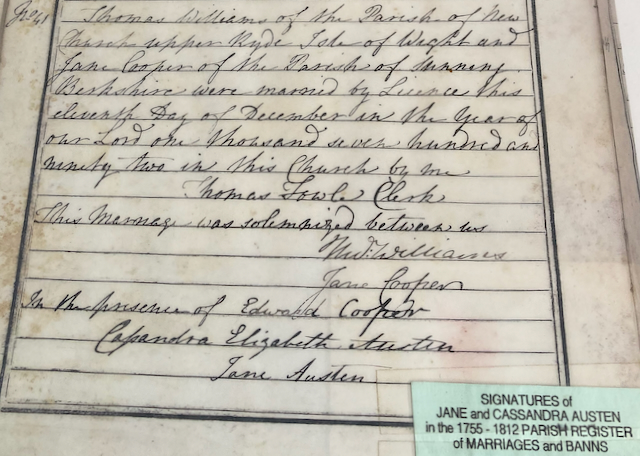
Jane: Jane’s mother’s sister (also named Jane) married a clergyman, the Reverend Dr. Edward Cooper. They had two children, Edward and another Jane. That Jane, Jane Leigh Cooper, went away to school for a time with Jane and Cassandra Austen. Her letter home from Southampton told their parents that the girls were seriously ill with typhus. Mrs. Austen and Mrs. Cooper came and took them home. The girls all survived, but, sadly, Mrs. Cooper caught the illness and died. Jane and Edward Cooper spent a lot of time with the Austen family. Jane was even married at Steventon, to a naval captain, Captain Williams, who was later knighted. Charles Austen served under him in the Navy. Tragically, Jane Cooper, by then called Lady Williams, died in a carriage accident in 1798.

Edward: Edward Cooper, Jane Cooper’s brother, became a clergyman like his father. He is mentioned frequently in Jane Austen’s letters. In her first two existing letters (Jan. 9 and 14, 1796), she talks about his visit to Steventon with his young son and daughter.

Edward Cooper, Clergyman

Many of Jane Austen’s friends and relatives were clergymen (estimated at over a hundred, including of course her father and two of her brothers). She held strong opinions on church livings. When Edward got his living, she wrote (Jan. 21, 1799):

Yesterday came a letter to my mother from Edward Cooper to announce, not the birth of a child, but of a living; for Mrs. Leigh [a relative, the Hon. Mary Leigh, of Stoneleigh] has begged his acceptance of the Rectory of Hamstall-Ridware in Staffordshire, vacant by Mr. Johnson’s death. We collect from his letter that he means to reside there, in which he shows his wisdom.

Staffordshire is a good way off [about 140 miles]; so we shall see nothing more of them till, some fifteen years hence, the Miss Coopers are presented to us, fine, jolly, handsome, ignorant girls. The living is valued at £140 a year, but perhaps it may be improvable. How will they be able to convey the furniture of the dressing-room so far in safety?

Our first cousins seem all dropping off very fast. One is incorporated into the family [Eliza de Feuillide], another dies [Jane Cooper, Lady Williams], and a third [Edward Cooper] goes into Staffordshire.  [Brackets added.]

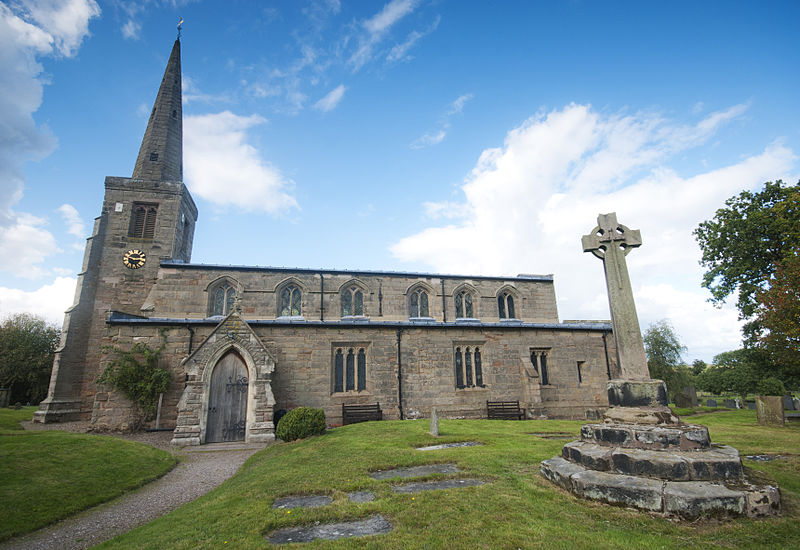
Church of St. Michael and All Angels, Hamstall Ridware, where Jane Austen’s cousin Edward Cooper served as rector.
Bs0u10e01, CC BY-SA 3.0 via Wikimedia Commons

Jane commented that Edward intended “to reside” at his living, which showed “his wisdom.” At this time, many clergy hired curates to serve their livings rather than residing in them and doing the work themselves. In Mansfield Park, Sir Thomas Bertram makes a strong statement about residing at one’s living:

“A parish has wants and claims which can be known only by a clergyman constantly resident, and which no proxy can be capable of satisfying to the same extent. Edmund might, in the common phrase, do the duty of Thornton, that is, he might read prayers and preach, without giving up Mansfield Park: he might ride over every Sunday, to a house nominally inhabited, and go through divine service; he might be the clergyman of Thornton Lacey every seventh day, for three or four hours, if that would content him. But it will not. He knows that human nature needs more lessons than a weekly sermon can convey; and that if he does not live among his parishioners, and prove himself, by constant attention, their well-wisher and friend, he does very little either for their good or his own.”–Mansfield Park, ch. 25

Austen also mentioned that Edward might be able to “improve” his living. That means he might increase his income by negotiating for higher tithe payments from the farmers or leasing extra farmland, as Austen’s father did. Edward Ferrars’s living in Sense and Sensibility is also “capable of improvement” (ch. 39). Cooper added to his income later by becoming rector of nearby Yoxall (much like George Austen, who served two adjacent parishes).

In 1801 Austen said Edward wrote to her after his wife Caroline had a baby.

I have heard twice from Edward on the occasion, & his letters have each been exactly what they ought to be–chearful & amusing.–He dares not write otherwise to me, but perhaps he might be obliged to purge himself from the guilt of writing Nonsense by filling his shoes with whole pease for a week afterwards.–Mrs. G. [Mrs. Girle, Caroline Cooper’s grandmother] has left him £100–his Wife and son £500 each. (Jan. 21, 1801)

It appears that while Jane thought of Edward as too serious, he was willing to write “Nonsense” to her.

Later that month, Edward invited the Austens to come visit his family at the parsonage in Hamstall Ridware. However, Jane says, “at present we greatly prefer the sea to all our relations” (Jan. 25, 1801). Her family had already visited Edward in 1799, when he was a curate at Harpsden. The Austens did visit the Coopers at Hamstall Ridware for five weeks in the summer of 1806, after going to Stoneleigh Abbey. 

Interior of Edward Cooper’s Hamstall Ridware church;
John Salmon via Wikimedia commons CC BY-SA 2.0

Jane seemed to have trouble keeping track of Edward’s children. Some of them died quite young. In 1811 she wrote, “It was a mistake of mine, my dear Cassandra, to talk of a tenth child at Hamstall. I had forgot there were but eight already” (May 29).

In 1808, when Jane’s sister-in-law, Elizabeth Knight, died, Jane wrote, “I have written to Edward Cooper, & hope he will not send one of his Letters of cruel comfort to my poor Brother” (Oct. 15). We don’t know what sort of “cruel comfort” Edward had written in the past. The one still-existing letter from Edward to Jane was written in 1817 and sounds heartfelt and kind. His friend and neighbor John Gisborne wrote that Edward was a great comfort to him in his son’s final illness. But perhaps Edward had taken the opportunity to preach some of his Evangelical ideas in a letter, and Jane and her family did not agree.

Edward Cooper believed and preached an Evangelical interpretation of the Bible. Many of his sermons were published in books, which were reprinted and read for many years, in a long series of editions. So even if Jane didn’t care much for them, others did!

Next month in Part 2, we’ll look at what Edward’s Evangelical ideas were, what Jane Austen thought of his sermons, and why.

Brenda S. Cox writes on Faith, Science, Joy, and Jane Austen. She has written a book called Fashionable Goodness: Faith in Jane Austen’s England, which she hopes will be available by the end of this year.

For Further Reading

Edward Cooper: Jane Austen’s Evangelical Cousin, Part 2

Visiting Edward Cooper,” Gaye King, Persuasions 1987

Hamstall Ridware: A Neglected Austen Setting,” Donald Greene, Persuasions 1985 (Includes a photo of the rectory where Jane and her family visited Edward and his family)

Come and Visit Edward Cooper, Jane Austen’s Evangelical Cousin,” Jane Austen House Museum blog, Sept. 17, 2012 (includes Edward Cooper’s portrait)

Edward Cooper’s letter to Jane April 6, 1817 (article also includes commentary on the letter) 

Jane Austen in the Midlands,” scroll down for a section on Cooper.

Other Sources

Deirdre Le Faye, Jane Austen: A Family Record, 2nd ed.

Deirdre Le Faye, ed., Jane Austen’s Letters, 4th ed.

Laura Dabundo, Jane Austen: A Companion

Irene Collins, “Displeasing Pictures of Clergymen,” Persuasions 18 (1996): 110. Collins says Austen’s correspondence refers to at least 90 clergymen, and her biographers could add many more. 

Irene Collins, Jane Austen and the Clergy

John Gisborne and his daughter E. N. A., Brief Memoir of the Life of John Gisborne, Esq., to which are added, Extracts from his Diary (London: Whittaker, 1852), 114-115, 128, 227. 

Read Full Post »

by Brenda S. Cox

“I have seen nobody in London yet with such a long chin as Dr Syntax”—Jane Austen, Letters, to Cassandra, March 2-3, 1814. (p. 267 in LeFaye’s 4th edition)

Frontispiece, The Tour of Doctor Syntax in Search of the Picturesque (1812), by William Combe and Thomas Rowlandson. Notice the chin! All of these images: Thomas Rowlandson, Public domain, via Wikimedia Commons

Jane Austen and her sister apparently enjoyed the adventures of Dr. Syntax, hero of a series of popular illustrated books. Usually, the text of a book is written, then the illustrator adds pictures. However, Dr. Syntax was created the other way around.

One of the most popular cartoonists of the day, Thomas Rowlandson, drew a series of pictures of Dr. Syntax on a journey “in search of the picturesque.” A publisher commissioned William Combe to write the text of the story, in narrative poetry, and the text and pictures were published together.

Austen could only have been familiar with the first book, published in 1812, Dr. Syntax: In Search of the Picturesque. In 1820 and 1821 sequels were published, The Second Tour of Dr. Syntax: In Search of Consolation, and The Third Tour of Dr. Syntax: In Search of a Wife.

Encyclopedia Britannica tells us, “All the Dr. Syntax books satirize the many 18th- and early 19th-century writers whose ‘Tours,’ ‘Travels,’ and ‘Journeys’ were vehicles for sententious moralizing, uninspired raptures, and sentimental accounts of amorous adventures.”  Satire: right up Austen’s alley!

I’ve read the first Dr. Syntax book and it’s a delight. You can find it on archive.org. (Which, by the way, is a great source for many old books.)

Doctor Syntax Tumbling into the Water. One of Dr. Syntax’s many adventures: Trying to get a good view, in order to sketch a castle, he falls into mucky water (Canto IX).

Dr. Syntax is a downtrodden, overlooked country curate, like Charles Hayter in Persuasion. Hayter, though, has connections to move him up in the church hierarchy. Poor Dr. Syntax does not. As a curate, he performs all the duties of a rector (like Mr. Collins and Henry Tilney) or a vicar (like Mr. Elton), but receives only a small portion of the income from the parish. An absentee rector elsewhere gets most of the money. On the first page, we see his responsibilities:

Of Church-preferment he had none,

Nay, all his hope of that was gone:

He felt that he content must be

With drudging in a Curacy,

Indeed, on ev’ry Sabbath-day,

Through eight long miles he took his way,

To preach, to grumble, and to pray;

To cheer the good, to warn the sinner,

And, if he got it,–eat a dinner:

To bury these, to christen those,

And marry such fond folks as chose

To change the tenor of their life,

And risk the matrimonial strife.

His income from these “weekly journeys” is only thirty pounds a year. (To get an idea of what this means, Mrs. Jennings thinks Edward Ferrars and his wife will have to live on a curacy of fifty pounds a year. She says, “Lord help ‘em! How poor they will be!”) Syntax complains that “that thankless parent, Mother Church” has overlooked his learning, giving jobs, as rectors and deans, to “fools.” The curate “feeds the flock, while others eat, the mutton’s nice, delicious meat.” Those others take the tithe income, while the curate serves the people of his parish.

Dr. Syntax also runs a school, to supplement his income, just as Jane Austen’s father did. Syntax laments rising expenses, though, saying the boys “delighted less in books than meat.” Even birch wood, used for caning disobedient boys, had gotten so expensive that often “To save the rod, he spar’d the child.” He did not punish them because he couldn’t afford to. (This is an inversion of the biblical advice in Proverbs 13:24, saying those who love their children will discipline them. It is often summarized as “spare the rod and spoil the child.”)

Dr. Syntax, Setting out on His Tour of the Lakes. His wife calls out “Good luck!” as his horse Grizzle awaits. The church that gives him a minimal income as a country curate is in the background (Canto I).

However, Dr. Syntax has a brilliant idea. He will go on a trip in search of the picturesque, drawing what he sees, and then write a book, making a lot of money–he hopes. His wife, dreaming of “silks and muslins fine,” happily sends him off on his faithful nag Grizzle.

Dreaming of “future treasure,” he finds himself lost on an empty plain, with only a defaced, useless signpost. However, he sits down to draw a picture of it, totally revising the landscape to make it look “picturesque.” He says, “I’ll do as other sketchers do, Put anything into the view.” He is proud that finally he has “made a Landscape of a Post.”

Dr. Syntax, Losing His Way. He finds a post from which to create a landscape picture of the “picturesque.”

The book parodies the “picturesque,” just as Austen parodied it in Sense and Sensibility. Edward Ferrars says,

I like a fine prospect, but not on picturesque principles. I do not like crooked, twisted, blasted trees. I admire them much more if they are tall, straight, and flourishing. I do not like ruined, tattered cottages. I am not fond of nettles or thistles, or heath blossoms. I have more pleasure in a snug farm-house than a watch-tower,—and a troop of tidy, happy villages please me better than the finest banditti in the world.

Marianne, of course, is shocked.

Dr. Syntax, Stop’t by Highwaymen (Canto II). They leave him tied to a tree. Fortunately, his wife has sewn most of his money into his coat so they don’t get it.

Dr. Syntax, after creating his picturesque scene of a post, is attacked by robbers and tied to a tree—the first of his many adventures. Two passing women (whom he compares to Don Quixote’s Dulcinea) free him and give him a meal. While his horse roams, a jokester cuts off half its tail and ears, making it “a fit sight for country-fair.”

At an inn, Dr. Syntax copies down quotes from books (to use in his own book), while a dog runs off with half his breakfast. He has kissed the maid (by her invitation), but her jealous boyfriend pours boiling water into his shoes.

His adventures continue. He makes new friends along the way, one of which gives him a church living in the end. He draws many pictures, writes his story, and his book is published.

Dr. Syntax, Taking Possession of His Living. A friend met on his travels provides the connection he needs to get a good church living.

At the end, Syntax, now appreciated and with a good position,

“enjoy’d his hours of learned ease;

Nor did he fail to preach and pray,

To brighter worlds to point the way . . .

Thus the good Parson, Horse, and Wife,

Led a most comfortable life.”

Dr. Syntax Preaching. Doctor Syntax gets the opportunity to show off his skills along the way.

I can imagine Jane Austen reading this book, laughing at the absurdities of Dr. Syntax’s trials and tribulations. She may have enjoyed, as I did, his more serious poetical sermon about man being “born to trouble,” which prepares us for “better worlds and brighter skies” (Canto XXI). The satirical language throughout the book is great fun. And she probably appreciated the delightful Rowlandson illustrations. You will find many entertaining passages in the book, if you get a chance to read it.

Dr. Syntax’s long, sharp chin certainly made an impression on Austen, so that she even looked for someone with such a chin in London!

Brenda S. Cox blogs on Faith, Science, Joy, and Jane Austen. She spoke on “Satirical Cartoons and Jane Austen’s Church of England” at the 2021 JASNA AGM. 
Read Full Post »

« Newer Posts - Older Posts »