Feeds:
Posts
Comments

Archive for the ‘Jane Austen’s World’ Category

Inquiring readers,

I recently purchased a book entitled The Grand Tour of Europe (*1). The tour was a rite of passage from the 17th through 19th centuries for the sons (and in a few cases, the daughters) of aristocrats, the wealthy gentry, and rising merchant classes. Some of the travelers were accompanied by their tutors for serious study, others led merry, somewhat debauched lives with friends. Most returned to their homeland 3 – 5 years later with a sense of continental sophistication. Perfecting their French was an accomplishment absolutely expected of the sophisticated, well-traveled Englishman or woman.

In her review of Masculinity and Danger on the Eighteenth-Century Grand Tour (2*), Michele Cohen mentions Stephen Conway’s reasoning – that the tour:

“Encouraged a ‘specifically European outlook’, which included polish and refinement, appreciation of classical art and architecture, theatre, and music as well as continental cuisine, wine and fashion.”

Austen’s connection to the grand tour was her brother Edward Austen Knight, who took several extended journeys. He wrote his memories in private journals. (The Grand Tour in the 18th & 19th Century | Jane Austen’s World.)

Copies and molds of ancient gems that visitors collected and brought back:

Throughout history, the marvelous gems and cameos cut in Ancient Greece and Rome were admired by collectors for their beauty and perfection. Many visitors who returned from their Grand Tour brought back fabulous paintings, sculptures, and a collection of impressions and casts made from those gems. Others, who were not as flush in the pocket, returned with more modest, portable souvenirs, such as trinkets, fans, and a few impressions and casts.

Tourists in Italy commissioned intaglios and cameos from numerous workshops as souvenirs of their travels: 

“…the demand was chiefly for technically accomplished, accurate copies, often difficult to distinguish from the originals, a feat made possible because the engravers had at hand collections of casts from well-known gems which made copying easy. Such casts, produced in quantity by moulding in materials such as wax and plaster of various kinds, had been circulating among connoisseurs and collectors for centuries in mid-i8th century Rome. Their manufacture in hard-wearing, red-dyed sulphur or white gesso became a major industry…” – The Grand Tourist’s favourite souvenirs: cameos and intaglios, Gertrud Seidmann (*3).
Screen Shot 2024-07-03 at 8.31.09 PM

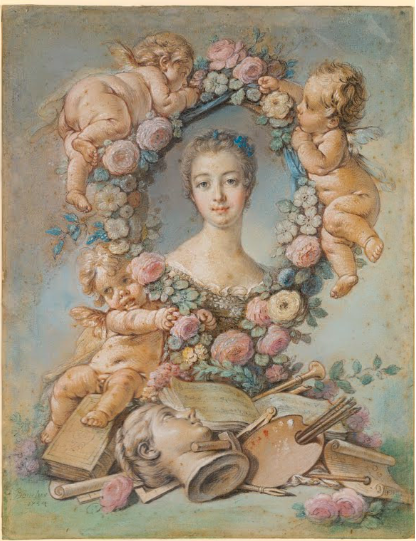
Madame de Pomadour, 1754, François Boucher

Madame de Pompadour, the mistress of King Louis XV of France, was an influential patron of the arts and helped revive the ancient art of gem carving. She hired the best gem carver to live at Versailles and provided him with the finest tools. Then she asked him to teach her how to carve gems. (National Galleries Scotland.) In this portrait she “is depicted surrounded by a garland of flowers supported by three putti. Scattered at the base of the design are the symbolic attributes of the arts she so enthusiastically supported – painting, drawing, sculpture, architecture, writing and music.” Google Arts and Culture

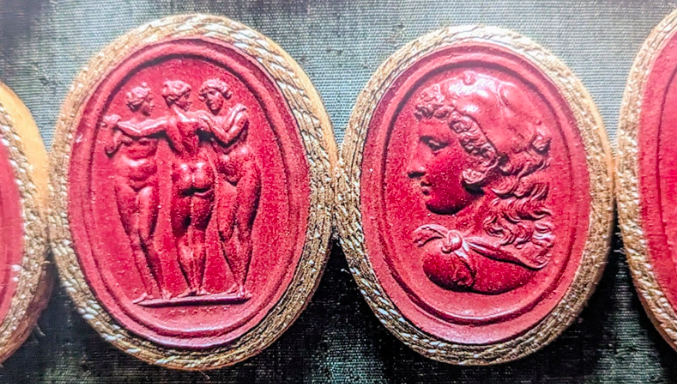
The following pair of casts are made in sulfur and sealing wax and are from a private 19th C collection. They are part of a much larger collection. (*1)
Screen Shot 2024-07-02 at 2.56.10 PM

 “During the sixteenth century, ancient gems and cameos circulated widely among collectors, directly or by means of impressions and metal casts.” (*1, p120.)

Shared Knowledge 

Ancient Carved Art Gems in 18th-Century Europe:

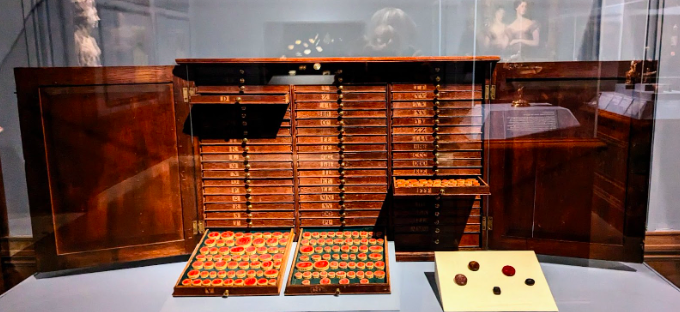
“During the 18th century, the arts of Rome and Greece were discovered anew. With their simple linear grace, ancient carved gems in particular inspired artists, scholars, and collectors. Long part of royal or aristocratic collections, these tiny but enduring fragments of the distant past now sparked a popular craze…” – From an explanation near an art display of an Oak Cabinet, at the Walters Art Museum in Baltimore, Maryland.

“The 18th century saw the standardization and sharing of all kinds of knowledge…This oak cabinet is part of the same movement. Its carefully lettered drawers contain thousands of numbered red sulphur wax impressions or casts of ancient and modern carved gems created in the London shop of Scotsman James Tassie (1735-99)…[and] copied from collections around Europe, was the most comprehensive of its kind, numbering about 20,000 casts at the time of his death.” –  From a wall plaque near an oak cabinet displaying James Tassie impressions and casts at the Walters Art Museum.
Screen Shot 2024-07-03 at 7.20.31 PM

Oak Cabinet, – Photo @ Vic Sanborn, February 2024

Click on this link to see a Drawer of Gem Impressions and read a description about it. Their arrangement is typical of the thousands of gems that rest inside the drawers.

[The] carved gems fall into two categories: intaglios and cameos. With intaglios, the design is carved down into the selected material, whereas with cameos, material is carved away so that the design projects upward from the surface. Glass paste copies of carved gems made by Tassie could be used as costume jewelry, seals, or mounted into frames to create innovative window displays.
Screen Shot 2024-07-02 at 3.58.20 PM

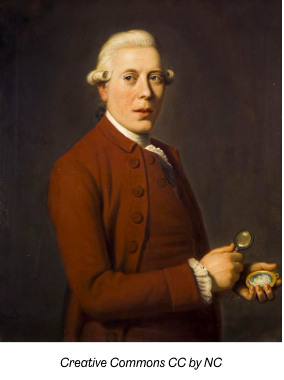
James Tassie holds one of his cameos. Portrait by David Allen.

James Tassie, 1735 – 1799. Sculptor and gem engraver | National Galleries of Scotland. Interestingly, Tassie and Allen went to art school together and later shared a house in London. Tassie then invented vitreous glass paste and used it to create small portrait medallions and reproductions of antique gems and cameos. His fame spread, and Catherine the Great became his most important patron. Listen to the Talk | by Liz Louis – The life and work of James Tassie on the National Galleries of Scotland site. 

Smaller collections in smaller cabinets

Not all of the copies were made for large and elaborate collections, as shown in this Portrait of a Lady, painted in oil. (Walters Art Museum, 37.394, Acquired by Henry Walters.)

“On the table in this portrait is a smaller cabinet of impressions of ancient carved gems than the larger cabinet. The unknown woman seems lost in thought…and is presented as scholarly (literate and interested in the Classical past), but also ladylike (fashionably dressed and bonded to a male relative or lover-shown by the miniature portrait pinned to her dress). The portrait can be dated to after 1793, as this is the year that saw the publication of the sheet music, seen rolled on the table, for Peter von Winter’s duet “Con quell occhietto languido non mi” (“With that little languid eye, not to me”). 

The objects included in this portrait tell a story about the interests of the woman portrayed…” 

– Plaque near the portrait in the North Flanking Gallery, Walters Museum of Art. 

About the exhibit at the Walters Art Museum described in this post:

This exhibit in the north flanking galleries was taken down on July 3rd, 2024, and is no longer in view. In its place, a new installation, entitled Art of the Americas, will open in 2025. Some galleries featuring 19th C. art objects, mostly the Walter’s sevres porecelain collection, will still be available . 

Fortuitously, I had made photos of the art objects and the wall signs, which are now taken down but are quoted in full. I’ve also linked directly to the museum’s website for a different description to provide you with a more rounded story. 

In conclusion:

“Returning with a gem on one’s finger or with a precious collection, shipping back cabinets of casts – the later collections often miscellanies of Roman monuments, sculptures and paintings intermingled with gems, almost equivalent to modern photograph albums – was an inevitable part of the scene for the grandest as well as humbler visitors to Italy.” – (*3.)

Sources:

*1 – The Grand Tour of Europe, (2023) Editor Franco Maria Ricci, 167 p. Van Cleef & Arpels  

*2 – Professor Michèle Cohen, review of “Masculinity and Danger on the Eighteenth-Century Grand Tour,” (review no. 2451) 10.14296/RiH/2014/2451 Date accessed: 04 July 2024

*3 – “The Grand Tourist’s favourite souvenirs: cameos and intaglios”, Gertrud Seidmann,  Research Associate, University of Oxford Institute of Archaeology, Delivered to the Society’s History Study Group on 18 November, 1996. JSTOR

*4 – “Madame de Pompadour’s Legacy as a Patron of Arts Is Often Overlooked: A new exhibit explores the creative works of one of history’s most famous mistresses”, Maris Fessenden, Former correspondent, May 12, 2016, The Smithsonian Magazine.

Additional Sources:

James Tassie, Cast Collection, Victoria & Albert (V&A) Museum, London

The Grand Tour: Souvenir Project:  An exploration of culture and memory.

‘Making an Impression’ exhibit highlights ancient engraved gemstones

Also see Artworks by James Tassie at the Walters Art Museum website.
Read Full Post »

By Brenda S. Cox

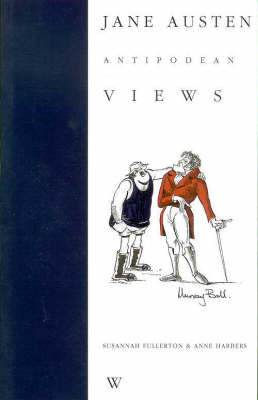
“In 1775, Cassandra Austen gave birth to her second daughter whom she named Jane. The same year Captain James Cook was made a Fellow of the Royal Society, in recognition of his achievements in reaching Botany Bay, claiming New South Wales for the British Government and landing on the islands of New Zealand. Cassandra and George Austen, gazing fondly at their new baby, could never have dreamed that one day their little girl’s name would be familiar and admired in those new British territories on the other side of the world.”—Jane Austen: Antipodean Views, by Susannah Fullerton and Anne Harbers Amazon UK link

Antipodean Views goes on to tell us that Jane Austen certainly knew about Australia. Her brother mentioned Botany Bay in one of his published articles, and her aunt almost got transported there when she was accused of theft. The Exeter Exchange in London had a kangaroo, which Jane’s sister Cassandra probably saw. Austen never mentions Australia in her novels, but many “down under” love Jane today.

Jane Austen: Antipodean Views, by Susannah Fullerton and Anne Harbers, quotes many Australians and New Zealanders telling why they love Jane Austen (or don’t).

When Susannah Fullerton, president of the Jane Austen Society of Australia, invited me to come speak to the JASA in Sydney, I thought, “It’s just too far!” From where I live in the eastern United States, it is quite a distance. Traveling from Atlanta to Sydney takes at least 20 hours, and can be more than 40 hours, depending on stops and layovers. The time change is 14 hours. (So noon on Monday in Atlanta is 2 AM on Tuesday in Sydney.) You cross the international dateline both going and coming back, so you lose a day going, and get it back when you return. So it’s a big commitment to go that far.

I met Susannah at the 2022 AGM in Victoria, Canada, where she gave a wonderful talk on “The Many Duels of Sense and Sensibility,” even after she had traveled halfway around the world. (My favorite part was her discussion of Elinor and Lucy’s verbal duels.) Susannah also leads literary tours, taking groups from Australia (and elsewhere) to England, Europe, and North America. So I thought if she could do all that travel and still talk coherently, I could attempt it as well. I decided to take this wonderful opportunity to see a new part of the world.

Jane Austen enthusiasts down under are part of a network of Janeites stretching around the world. The JASNA (US and Canada) website lists Jane Austen Societies in the U.K., Australia (including groups in Adelaide and Melbourne as well as the main JASA), Argentina, Austria, Brazil, Chile, the Czech Republic, Denmark, India, Italy, Japan, Mexico, the Netherlands, New Zealand, Pakistan, and Spain. That list touches on five of the seven continents. (Any Jane Austen societies in Africa or Antarctica? Or other countries not listed here? Tell us!)

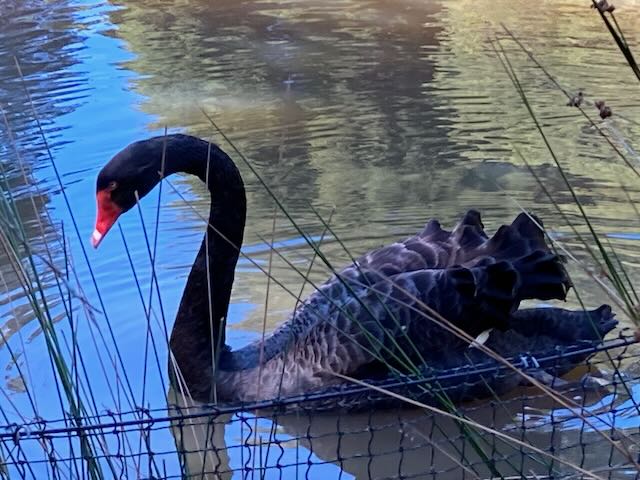
Black swan at the Melbourne Zoo.
Does a trip to the other side of the world sound impossible to you? The black swan, in ancient times, was a symbol of the impossible–until European explorers discovered them in Australia! The term black swan “subsequently metamorphosed to connote the idea that a perceived impossibility might later be disproved.” (Wikipedia) Photo © Brenda S. Cox, 2024

Travels in Australia: Melbourne

On my recent trip, I got to meet with delightful Jane Austen lovers in both Australia and New Zealand. It was complicated coordinating with all their schedules. But in the end I had opportunities to share my talk, “Why Mr Collins?: The Church and Clergy in Jane Austen’s Novels,” with enthusiastic groups in five cities.

My husband and I started in Melbourne, where Dr. Alida Sewell and her husband kindly hosted us in their home for a week, giving us a chance to start getting over jetlag. Alida edits the bimonthly Newsletter of the Jane Austen Society of Melbourne, which includes book reviews and Austen-related news from around the world. Alida and I got in contact when she reviewed my book, Fashionable Goodness: Christianity in Jane Austen’s England, back in February of 2023, and she also encouraged me to visit.

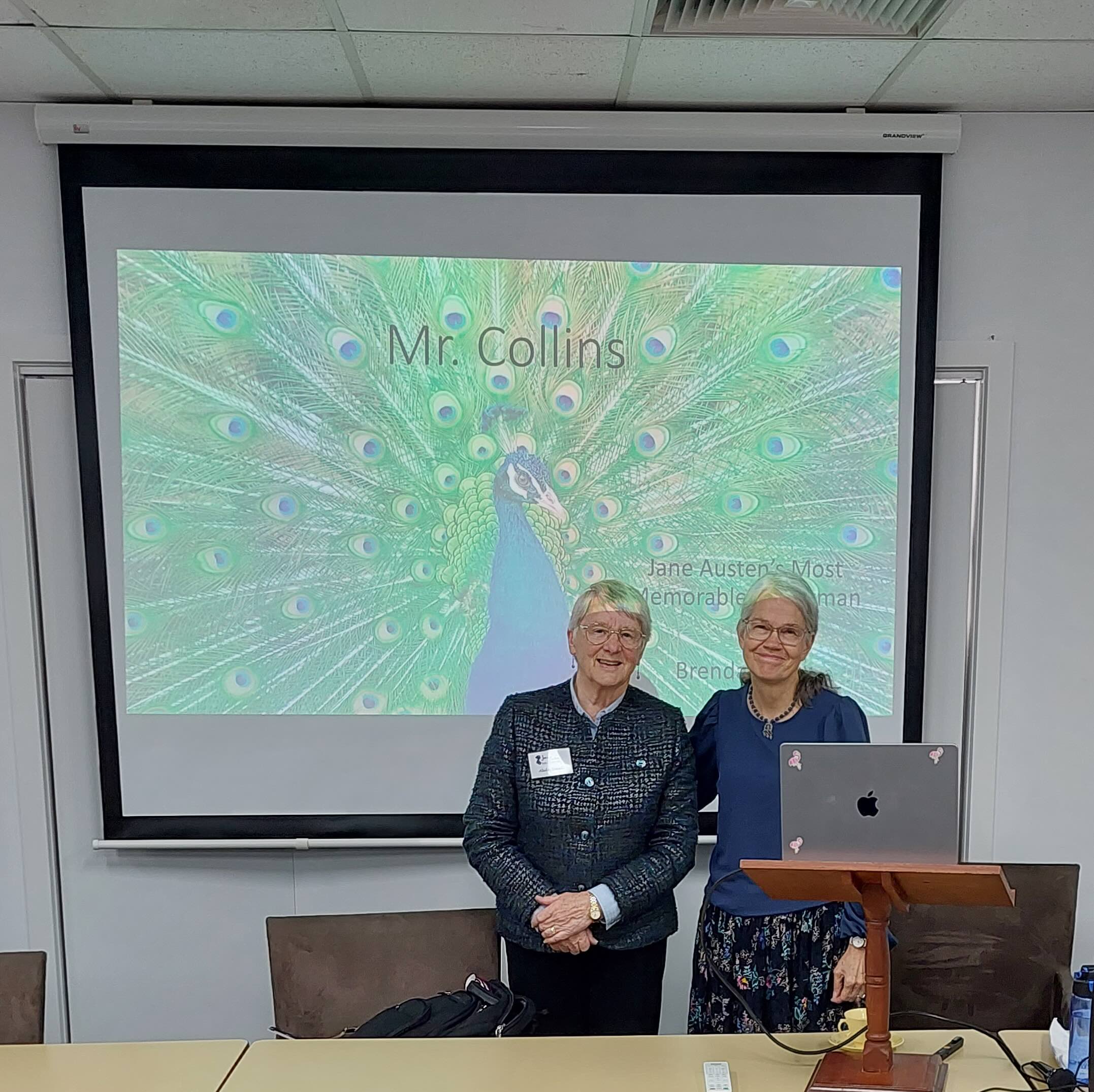
The Jane Austen Society of Melbourne was founded more than thirty years ago, in 1993. On the day I spoke to the Melbourne group, we had a lovely lunch with the committee members before I got to share with 25 or so participants about Mr. Collins. After a lively discussion, some members took home signed copies of my book. 

Dr. Alida Sewell, editor of the Jane Austen Society of Melbourne Newsletter, with Brenda S. Cox, who spoke on “Why Mr. Collins”
Photo © Brenda S. Cox, 2024

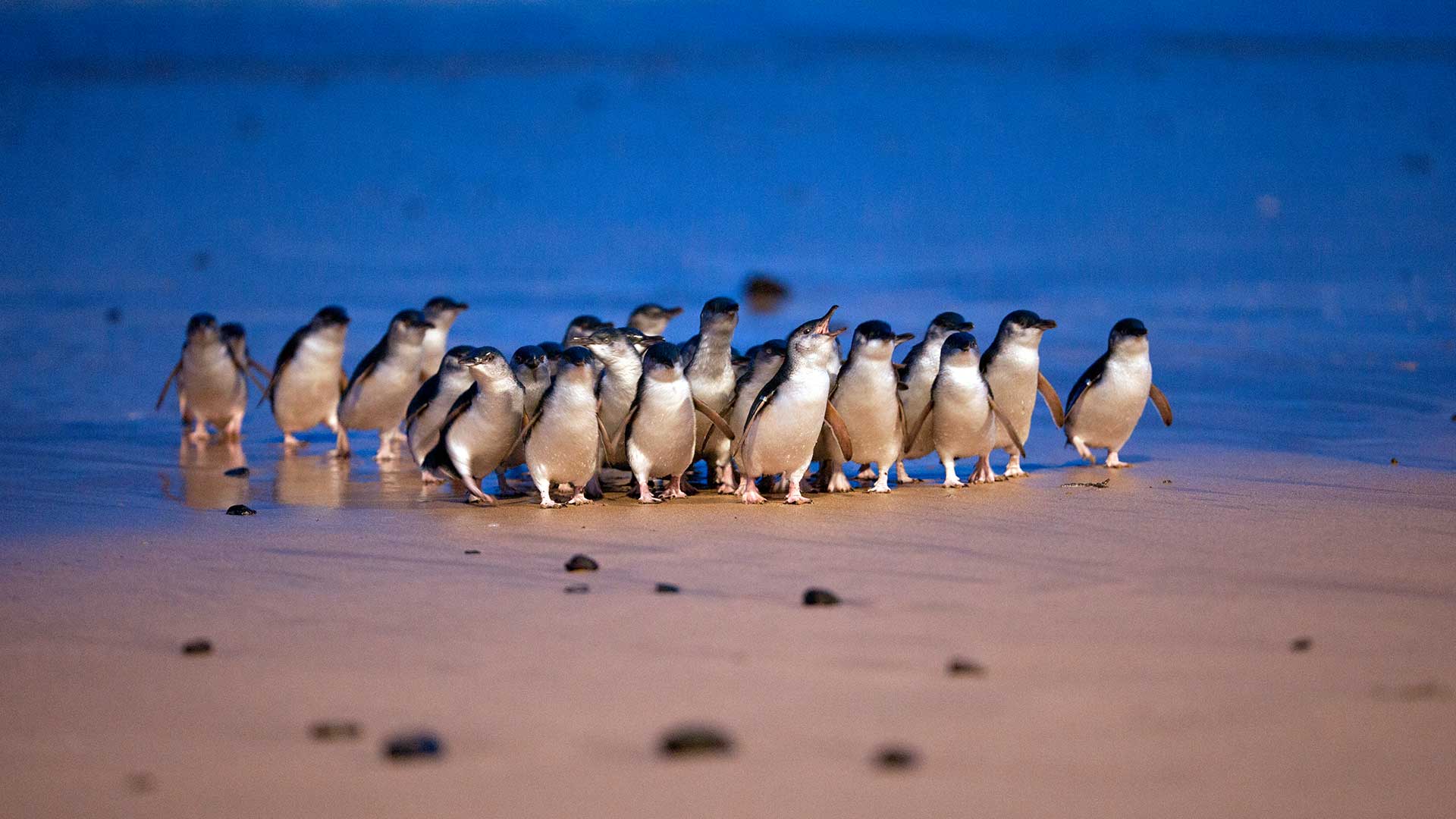
In every place we visited, my husband I went to see some of the unique wildlife of the country. Near Melbourne, we had the delightful experience of seeing hundreds of little penguins, blue and white penguins only 16 inches tall, waddling in from the sea in the evening. Alida also took us to the Moonlit Animal Sanctuary, where we could pet wallabies and kangaroos. We also met gorgeous Australian birds like the pink cockatoo, with its sunset colored crest , and the well-camouflaged tawny frogmouth.

Adorable “little penguins” at Philip Island. Photo courtesy of the Philip Island Penguin Parade website.

Travels in Australia: Brisbane

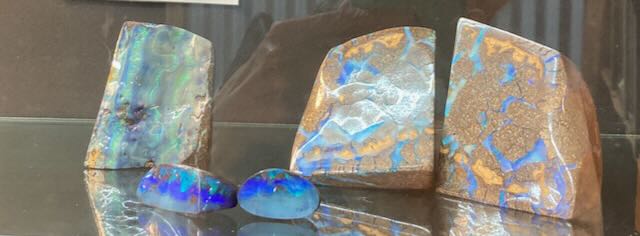
From Melbourne we headed to Brisbane, where Barbara O’Rourke, a member of the local Jane Austen Society committee, generously ferried us around. I got to pet a koala bear at the Lone Pine Koala Sanctuary. We also saw lovely opals, the national gemstone of Australia, at the Brisbane Opal Museum. Australia still produces 95% of the world’s precious opals.

Stunning Queensland Boulder Opals at the Opal Museum in Brisbane,
Photo © Brenda S. Cox, 2024

I spoke to around 70 keen Janeites in Brisbane, and got to order extra books for them beyond the ones I had brought to sell (as I also did in Sydney and Wellington later on! I loved their enthusiasm). This is the twenty-second year of the Brisbane group, which has around a hundred members total. A committee of seven people lead them, each of those seven “doing what they do best,” so that all roles are covered.

At meetings the Brisbane branch of the Jane Austen Society of Australia offers a Regency Fair table. I saw a wide range of interesting-looking materials there. Members bring in Austen-related books and magazines they are finished reading. These are offered for sale at a low, nominal price, which goes to benefit the Society. Books may be donated back later, making it similar to a rotating library, but without anyone needing to keep track of loans and returns. Conversations often start up around the table, giving members opportunities to interact. I love this idea: recycling, networking, and giving everyone a chance to learn and enjoy more of Jane Austen!

The next week we visited friends on the “Sunshine Coast” north of Brisbane, enjoying more birds and wildlife, as well as a ginger factory where we learned about the production of ginger and honey. 

Travels in Australia: Sydney and Southern Highlands

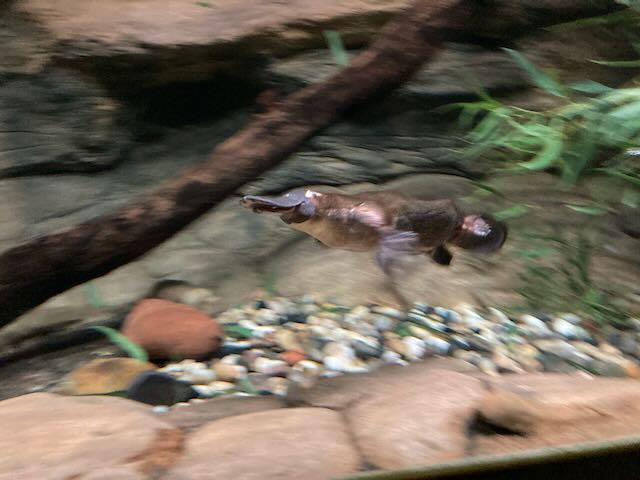
Finally we made it to Sydney, where the Taronga Zoo gave us a fantastic final look at Australia’s very special animals and birds, ranging from platypus and potoroo to giant emus and bright honeyeaters.

An amazing platypus, a mammal that lays eggs and has a duck’s bill, zipping through the water at an Australian zoo. Photo © Brenda S. Cox, 2024

From Sydney, Susannah Fullerton took us out to the Southern Highlands, where we saw a bit of Australia’s frontier culture, then met with another keen group of about twenty Janeites for lunch and my talk.

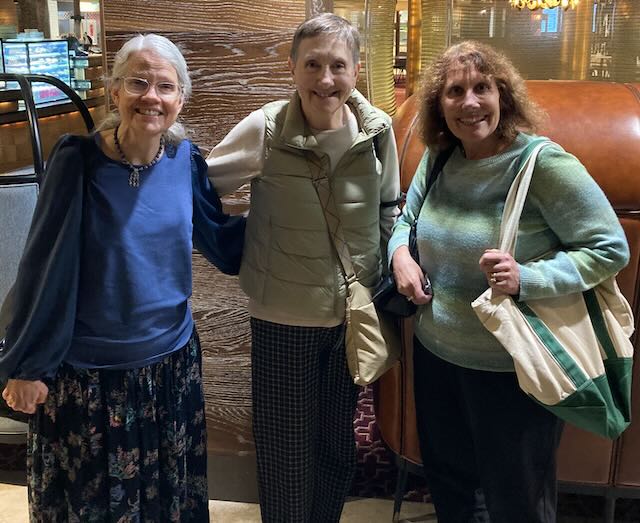
At the Southern Highlands Jane Austen meeting, Brenda Cox, Jan Merriman (coordinator for Southern Highlands), and JASA President Susannah Fullerton. Photo © Brenda S. Cox, 2024
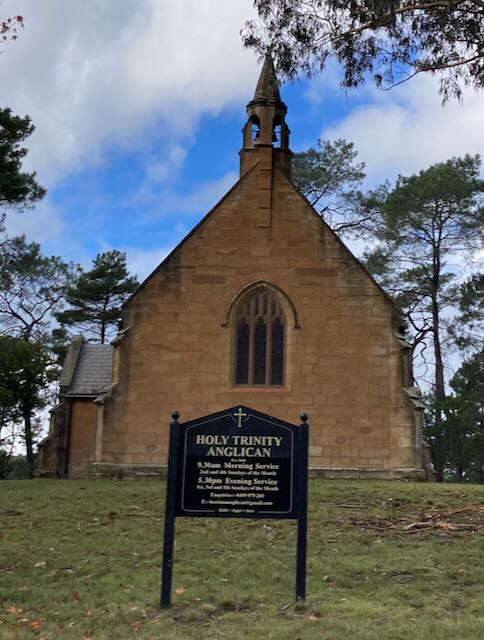
Holy Trinity Anglican Church, Berrima, established in 1849.
Photo © Brenda S. Cox, 2024

Jane Austen Society of Australia Day Conference on Jane Austen and the Church

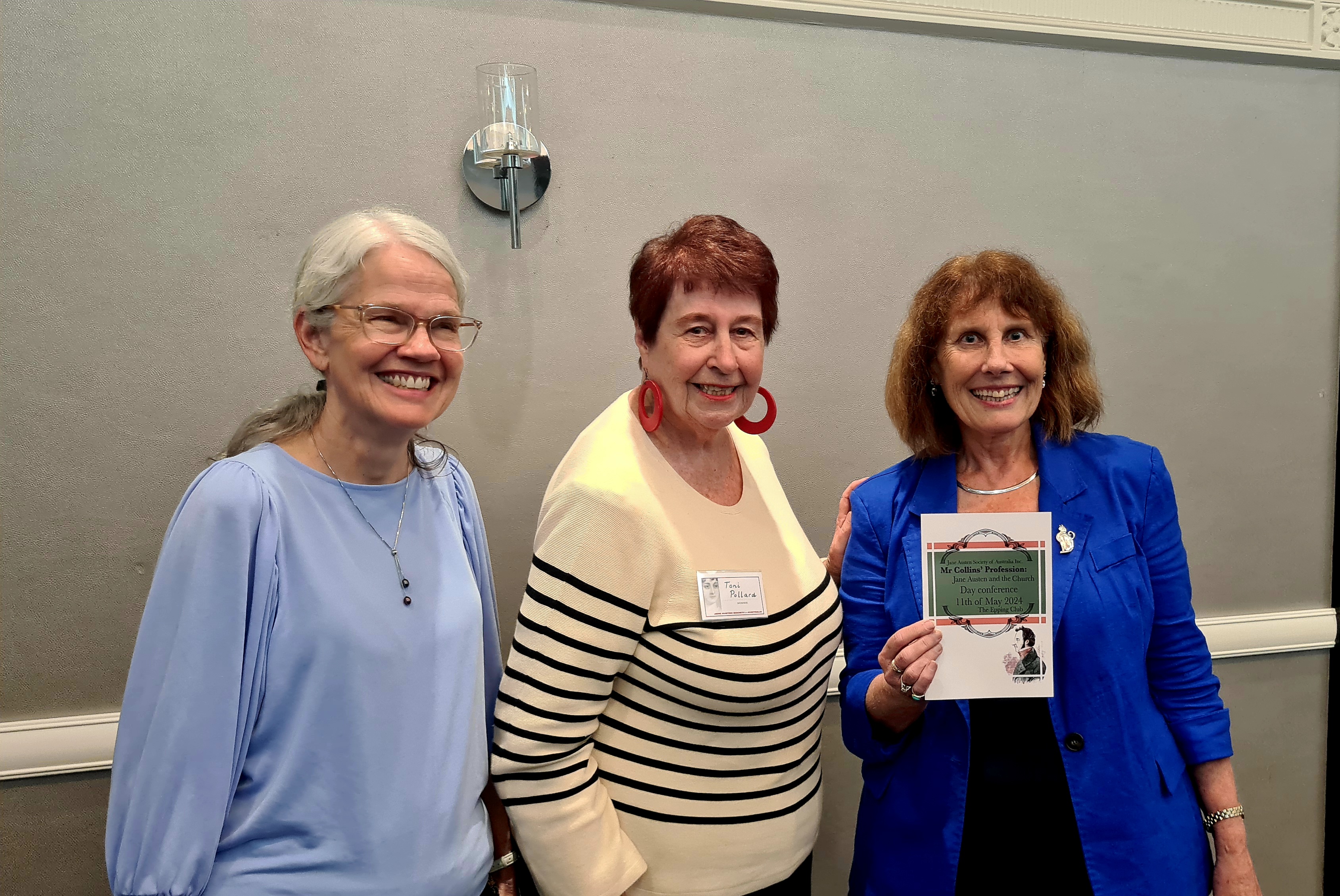
That Saturday the JASA hosted an all-day conference on “Mr. Collins’ Profession: Jane Austen and the Church.” We began with my talk on Mr. Collins, which explores why Austen, a devout Anglican Christian, chose to portray Mr. Collins as she did, and what his life and challenges were as a clergyman at this time. Then we got to hear about other aspects of the church in Austen’s time, from excellent speakers.

Brenda S. Cox (speaker), Toni Pollard, and Susannah Fullerton (president), holding the conference brochure, at the JASA conference on Jane Austen and the Church, Photo courtesy of JASA

Anne Harbers, writer and art historian, showed us images of clergy from the time, and explained what those images show us. One that fascinated me was Rev. Humphry Gainsborough, the artist Gainsborough’s brother. He was the pastor of an Independent Chapel as well as an engineer and inventor. You may have one of his inventions on your front door—a lock with a chain, that allows the door to be partially opened. Rev. Gainsborough invented that type of lock for the gate of his parsonage in Henley, England.

Roslyn Russell then told us about sermons and devotional literature in Austen’s novels, contrasting her perspective with later authors Anthony Trollope and Barbara Pym. I especially enjoyed meeting Roslyn since I enjoyed her novel, Maria Returns: Barbados to Mansfield Park, which gives Maria Bertram her own happy ending. 

We got even deeper with Scott Stephens’ fascinating talk, “‘How could you be so unfeeling?’: Moral Encounter and its Counterfeits in Jane Austen’s Later Fiction.” He talked about moral encounters, and where deep ones occur in Austen’s novels (for example, on the tops of hills, or in letters), and where shallow counterfeits occur (such as in Bath).

I had the privilege of finishing off a great day by giving a brief talk on “‘Her Parish and Her Poultry’: The Lives of Clergymen’s Wives in Austen’s World.” We explored the similarities and differences between the lives of clergymen’s wives and of gentry wives in the English countryside of Austen’s time.

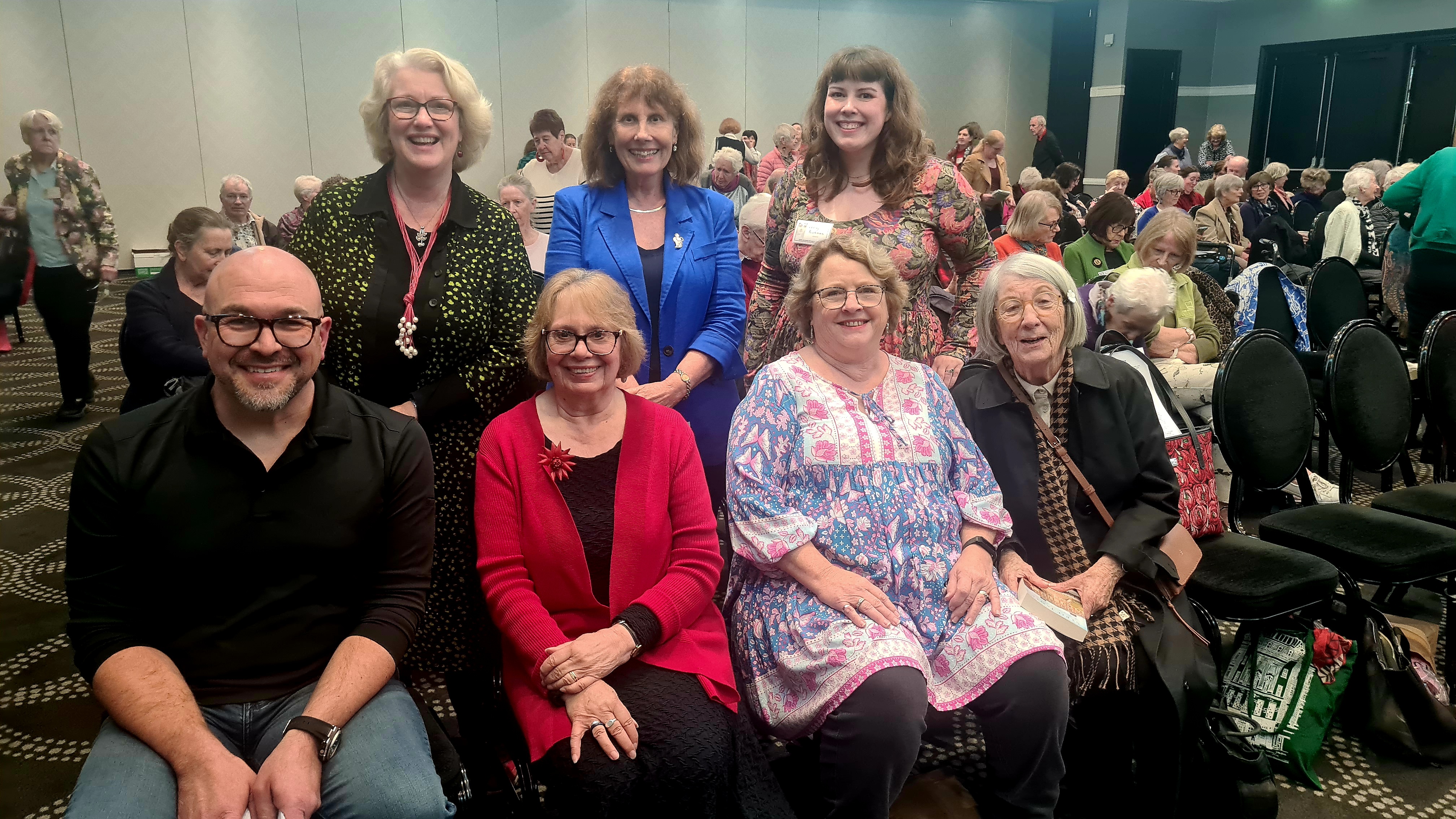
At the JASA Day Conference on Jane Austen and the Church: L-R Back Row: Anne Harbers (speaker), Susannah Fullerton (JASA President), Lesley Rickman (graphic artist who designed the program and other JASA material)
Front Row: Scott Stephens (ABC Australia Journalist and speaker), Dr Roslyn Russell (speaker), Cheryl Hill (JASA Membership Secretary & AV operator), Dr Ruth Wilson (JASA Patron and author of The Jane Austen Remedy).
Photo courtesy of JASA.

The Jane Austen Society of Australia, founded in 1989, has over 500 members. Its regular meetings (not AGMs) are the largest of any Jane Austen Society in the world, averaging around 130 people per meeting. Participants at the Day Conference came from Sydney (where the meeting was held), Melbourne, Canberra, Queensland, and all over New South Wales.

JASA publishes a yearly Chronicle of news and reports, twice-yearly newsheets called Practicalities, and a yearly journal of scholarly papers called Sensibilities. This year’s Sensibilities will include articles based on the talks at the Day Conference, among others. I look forward to reading them, since there’s so much more I could glean! 

On Sunday we got to see a bit of Sydney, worshiping at lovely St. Andrew’s Anglican Cathedral, founded in 1819, soon after Austen’s death. Building on its long history, the church seems to be vibrant and lively today. Placards around the church gave summaries of the Christian message in many languages, for this multicultural city.

After lunch and birdwatching in the park, we visited the Hyde Park Barracks,  which originally held transported convicts, then women immigrants. The museum gave us impressions of some of Australia’s tumultuous history, including the tragic impact on Aboriginal communities.

Travels in New Zealand: Wellington and Beyond

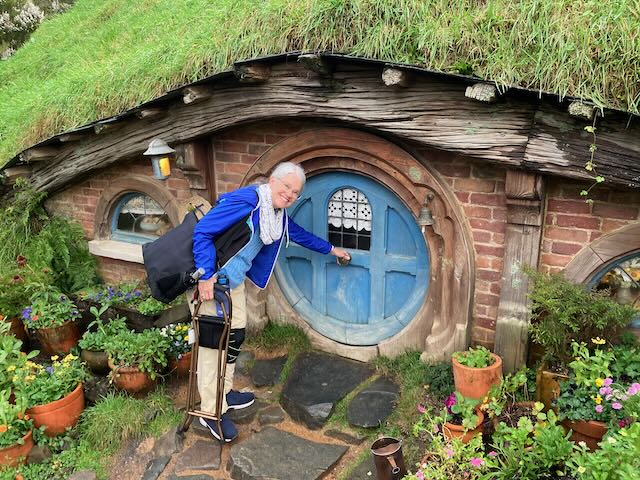
The next day we flew to New Zealand, which is not as close as one might imagine! We saw yellow-eyed penguins, a blue whale, and royal albatrosses in Dunedin, a city with a Scottish flavor on New Zealand’s South Island. On the North Island we visited hobbit homes in Hobbiton (definitely a highlight of the trip); saw amazing geothermal formations and baby kiwis in Rotorua, and toured a Maori village; and marveled at a cave full of glowworms in Waitomo.

Brenda Cox visiting a hobbit house in Hobbiton, New Zealand. Photo © Brenda S. Cox, 2024

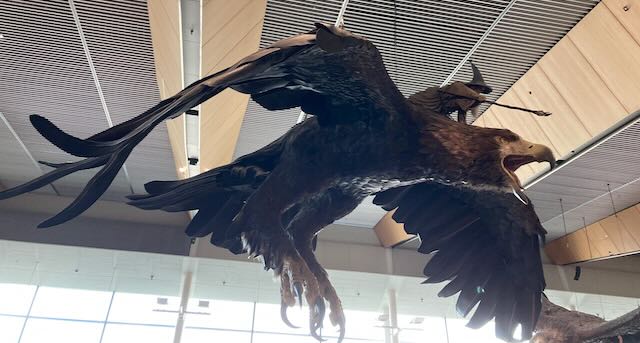
Our Jane Austen encounter was in Wellington, New Zealand. We could see Wellington’s literary and cultural associations immediately. The airport has statues of Gandalf on an eagle, a dragon, and a Doctor Who police box! Frances Duncan, who founded and runs the Jane Austen Society of New Zealand, met us at the airport with Sian Farr, who kindly hosted us in her home and showed us some sights.

Gandalf rides an eagle in the Wellington, New Zealand airport. The Hobbit and The Lord of the Rings movies were filmed in beautiful New Zealand. Photo © Brenda S. Cox, 2024

In Wellington, an eager group of Janeites met with me to discuss Mr. Collins, Jane Austen, and the church. We had a delicious tea, and afterwards they asked great questions. Frances Duncan started the Jane Austen Society of Aotearoa New Zealand just ten years ago, and it has been growing. About 25 people attended the meeting. I hope it spreads to many corners of the beautiful country of New Zealand, across the mountains and along the sea. Contact Frances through their website if you want to start up a Jane Austen group elsewhere in the country.

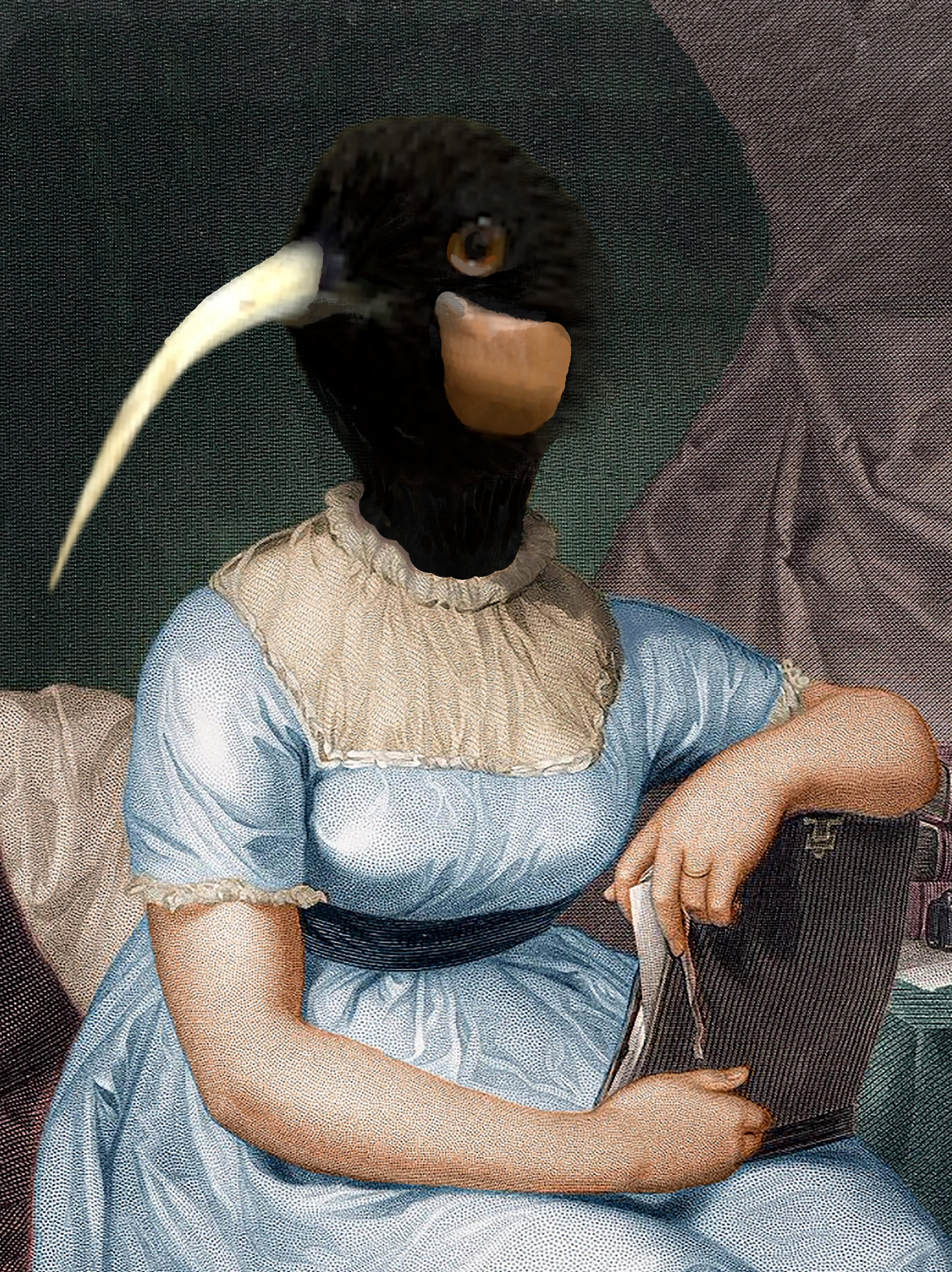
The Jane Austen Society of Aotearoa New Zealand sells humorous merchandise, including this picture of Jane Austen as a huia, a now-extinct New Zealand songbird, described as the bird with the most beautiful song. It was hunted for its feathers, a symbol of leadership and power. They chose it since it is an easily recognizable symbol of New Zealand, and it is extinct—as is Austen. A bit of kiwi humor, says Frances Duncan.
Photo courtesy of Frances Duncan

We enjoyed many of the fascinating birds of New Zealand. My favorite place in Wellington was Zealandia. This nature preserve in the city has specially designed fences to keep out the many non-native predators which have decimated the country’s unique native birds. Now kiwi and other birds are thriving in the preserve and surrounding areas.

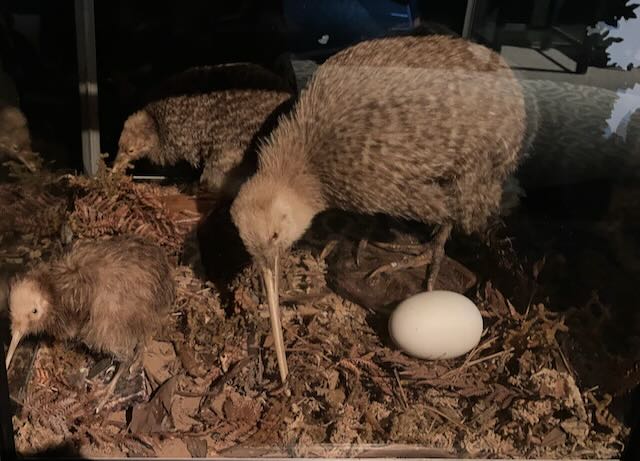
Kiwi exhibit in New Zealand. (The live ones we saw were in nocturnal houses, with red lighting.) Kiwi are adorable endangered birds of New Zealand. (Technically, four species are currently “vulnerable” and one is “near threatened.”) The kiwi fruit, which is small, fuzzy, and round, like the bird, and New Zealanders (“kiwis”), are both called after this bird.
Photo © Brenda S. Cox, 2024

I was impressed by the extensive environmental efforts in both Australia and New Zealand, and the strides they are making toward preserving their incomparable native creatures.

What would Jane Austen have thought about bird and animal conservation, if she lived today? We don’t know, of course. But she does mention animals in her novels, and, as a country clergyman’s daughter, she essentially lived on a farm. Her brother James wrote a poem praising clergyman Gilbert White, who lived near Chawton. White is considered the father of modern ecology because of his book, The Natural History of Selborne.

So I’d like to think Jane Austen would have enjoyed a journey like ours, enjoying the natural world. And I hope our great discussions of her novels and the church in her world would have met her approval as well! I certainly loved meeting so many wonderful people who love Jane Austen as I do.

One highlight of our trip was visiting Hobbiton in New Zealand. For an account of that visit, and lots of great photos, see JRR Tolkien’s Hobbiton, in New Zealand.

Are you a Janeite living “down under”? Tell us where you live, and how you celebrate Jane Austen! And if you are looking for kindred spirits, contact the JASA to find other regional groups.

Brenda S. Cox is the author of Fashionable Goodness: Christianity in Jane Austen’s England. She also blogs at Faith, Science, Joy, and Jane Austen.

Read Full Post »

As spring turns to summer on our month-by-month exploration of Jane Austen’s life, letters, and novels, we turn our attention to June in Jane Austen’s world. If you’re new to the series, you can find previous articles in this “A Year in Jane Austen’s World” series here: JanuaryFebruaryMarch, April, and May.

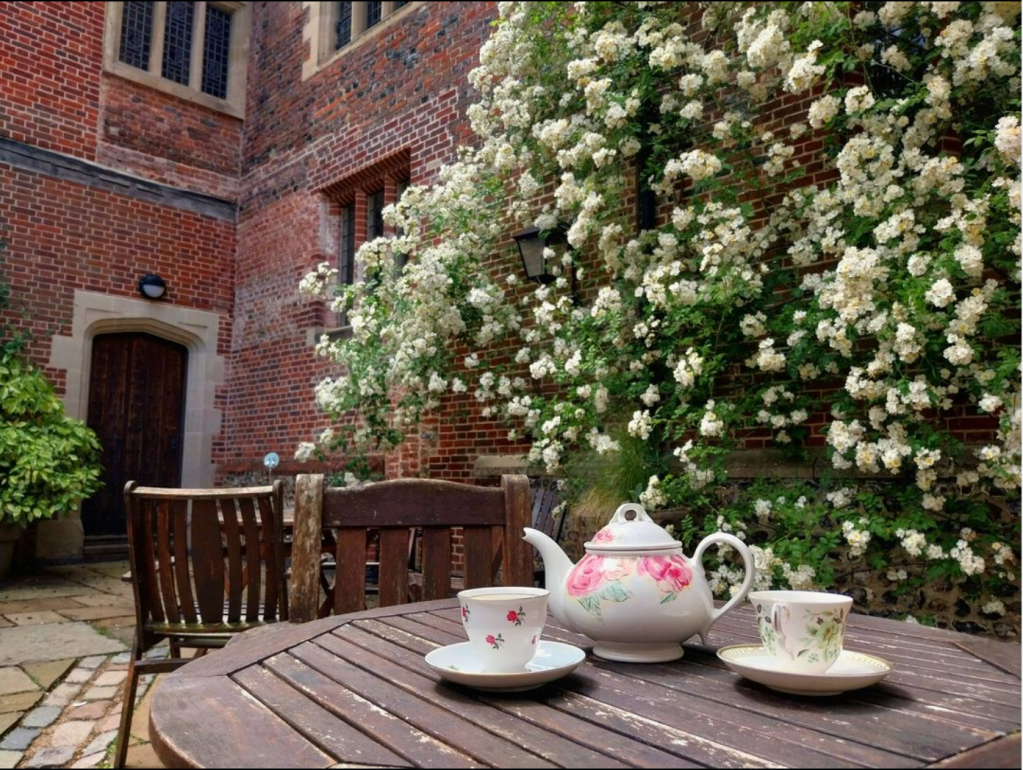
Last month, we enjoyed the beauty of springtime coming to Chawton, along with the beautiful blooms of May. Let’s take a look at our monthly view of Chawton House Gardens. Many visitors will come tour the gardens over the next few months to enjoy the garden walks, see the house, and perhaps stay for tea.

Chawton House in June: Photo @ChawtonHouse.

June in Hampshire

June is the time of year when England turns into a beautiful garden of scenic greenery, lush fields, and lovely flowers. Hampshire is one of the prettiest places you can visit. I’ve been to Hampshire in the spring and early summer several times, and I highly recommend a summer trip if the opportunity ever presents itself. It’s also time for berries!

“Yesterday I had the agreable (sic) surprise of finding several scarlet strawberries quite ripe;- had you been at home, this would have been a pleasure lost. There are more Gooseberries & fewer Currants than I thought at first.- We must buy currants for our Wine.-” (Jane Austen writing to Cassandra from Chawton Cottage in June 1811)

Here is Jane Austen’s House Museum and the roses that frame the front door this time of year:

Jane Austen’s House in June, Photo: @JaneAustensHouse.

June in Jane Austen’s Letters

We have several letters from June to explore. After the “season” ended, many rich families left London and went to the countryside or Bath. Jane and her family frequently traveled to visit family members or friends for longer visits during the summer months.

2 June 1799 (Queen’s Square, Bath):

  • Edward’s health: “What must I tell you of Edward? Truth or falsehood? I will try the former, and you may choose for yourself another time. He was better yesterday than he had been for two or three days before,—about as well as while he was at Steventon. He drinks at the Hetling Pump, is to bathe to-morrow, and try electricity on Tuesday. He proposed the latter himself to Dr. Fellowes, who made no objection to it, but I fancy we are all unanimous in expecting no advantage from it. At present I have no great notion of our staying here beyond the month.”
  • Visits with friends: “I spent Friday evening with the Mapletons, and was obliged to submit to being pleased in spite of my inclination. We took a very charming walk from six to eight up Beacon Hill, and across some fields, to the village of Charlecombe, which is sweetly situated in a little green valley, as a village with such a name ought to be. Marianne is sensible and intelligent; and even Jane, considering how fair she is, is not unpleasant. We had a Miss North and a Mr. Gould of our party; the latter walked home with me after tea. He is a very young man, just entered Oxford, wears spectacles, and has heard that ‘Evelina’ was written by Dr. Johnson.”
  • Outings: “There is to be a grand gala on Tuesday evening in Sydney Gardens, a concert, with illuminations and fireworks. To the latter Elizabeth and I look forward with pleasure, and even the concert will have more than its usual charm for me, as the gardens are large enough for me to get pretty well beyond the reach of its sound. In the morning Lady Willoughby is to present the colors to some corps, or Yeomanry, or other, in the Crescent, and that such festivities may have a proper commencement, we think of going to….”

11 June 1799 (Queen Square, Bath):

  • Taking the waters: “Edward has been pretty well for this last week, and as the waters have never disagreed with him in any respect, we are inclined to hope that he will derive advantage from them in the end. Everybody encourages us in this expectation, for they all say that the effect of the waters cannot be negative, and many are the instances in which their benefit is felt afterwards more than on the spot.”
  • Thoughts on “First Impressions”: “I would not let Martha read ‘First Impressions’ again upon any account, and am very glad that I did not leave it in your power. She is very cunning, but I saw through her design; she means to publish it from memory, and one more perusal must enable her to do it.”
Public Domain Image.

15 June 1808 (Godmersham)

  • Details of their journey: “Which of all my important nothings shall I tell you first? At half after seven yesterday morning Henry saw us into our own carriage, and we drove away from the Bath Hotel; which, by the by, had been found most uncomfortable quarters,—very dirty, very noisy, and very ill-provided. James began his journey by the coach at five. Our first eight miles were hot; Deptford Hill brought to my mind our hot journey into Kent fourteen years ago; but after Blackheath we suffered nothing, and as the day advanced it grew quite cool.
  • A rest for breakfast: “At Dartford, which we reached within the two hours and three-quarters, we went to the Bull, the same inn at which we breakfasted in that said journey, and on the present occasion had about the same bad butter. At half-past ten we were again off, and, travelling on without any adventure reached Sittingbourne by three. Daniel was watching for us at the door of the George, and I was acknowledged very kindly by Mr. and Mrs. Marshall, to the latter of whom I devoted my conversation, while Mary went out to buy some gloves. A few minutes, of course, did for Sittingbourne; and so off we drove, drove, drove, and by six o’clock were at Godmersham.”
Godmersham Park

25 April 1811 (Sloane St.)

  • Possible publishing date for Sense and Sensibility: “No, indeed, I am never too busy to think of S. and S. I can no more forget it than a mother can forget her sucking child; and I am much obliged to you for your inquiries. I have had two sheets to correct, but the last only brings us to Willoughby’s first appearance. Mrs. K. regrets in the most flattering manner that she must wait till May, but I have scarcely a hope of its being out in June. Henry does not neglect it; he has hurried the printer, and says he will see him again to-day. It will not stand still during his absence, it will be sent to Eliza.”

6 June 1811 (Chawton)

  • New set of dishes: “On Monday I had the pleasure of receiving, unpacking, and approving our Wedgwood ware. It all came very safely, and upon the whole is a good match, though I think they might have allowed us rather larger leaves, especially in such a year of fine foliage as this. One is apt to suppose that the woods about Birmingham must be blighted. There was no bill with the goods, but that shall not screen them from being paid. I mean to ask Martha to settle the account. It will be quite in her way, for she is just now sending my mother a breakfast-set from the same place. I hope it will come by the wagon to-morrow; it is certainly what we want, and I long to know what it is like, and as I am sure Martha has great pleasure in making the present, I will not have any regret. We have considerable dealings with the wagons at present: a hamper of port and brandy from Southampton is now in the kitchen.”
Wedgwood Queensware, c. 1790. Image @Christies

13 June 1814 (Chawton)

  • Thoughts on Mansfield Park from Mr. and Mrs. Cooke: “In addition to their standing claims on me they admire “Mansfield Park” exceedingly. Mr. Cooke says “it is the most sensible novel he ever read,” and the manner in which I treat the clergy delights them very much. Altogether, I must go, and I want you to join me there when your visit in Henrietta St. is over. Put this into your capacious head.”

23 June 1814 (Chawton):

  • Travels and plans: “I certainly do not wish that Henry should think again of getting me to town. I would rather return straight from Bookham; but if he really does propose it, I cannot say No to what will be so kindly intended. It could be but for a few days, however, as my mother would be quite disappointed by my exceeding the fortnight which I now talk of as the outside—at least, we could not both remain longer away comfortably.”
  • Friends go to Clifton: “Instead of Bath the Deans Dundases have taken a house at Clifton—Richmond Terrace—and she is as glad of the change as even you and I should be, or almost. She will now be able to go on from Berks and visit them without any fears from heat.”

23 June 1816 (Chawton)

  • Bits of news: “My dear Anna,—Cassy desires her best thanks for the book. She was quite delighted to see it. I do not know when I have seen her so much struck by anybody’s kindness as on this occasion. Her sensibility seems to be opening to the perception of great actions. These gloves having appeared on the pianoforte ever since you were here on Friday, we imagine they must be yours. Mrs. Digweed returned yesterday through all the afternoon’s rain, and was of course wet through; but in speaking of it she never once said “it was beyond everything,” which I am sure it must have been. Your mamma means to ride to Speen Hill to-morrow to see the Mrs. Hulberts, who are both very indifferent. By all accounts they really are breaking now,—not so stout as the old jackass.”
Rolinda Sharples’ Clifton Assembly Room (1817).

June in Jane Austen’s Novels

Pride and Prejudice

  • Lady Catherine to Elizabeth: “Oh, your father, of course, may spare you, if your mother can. Daughters are never of so much consequence to a father. And if you will stay another month complete, it will be in my power to take one of you as far as London, for I am going there early in June, for a week; and as Dawson does not object to the barouche-box, there will be very good room for one of you—and, indeed, if the weather should happen to be cool, I should not object to taking you both, as you are neither of you large.”
  • June at Longbourn after Lydia’s departure: After the first fortnight or three weeks of [Lydia’s] absence, health, good-humour, and cheerfulness began to reappear at Longbourn. Everything wore a happier aspect. The families who had been in town for the winter came back again, and summer finery and summer engagements arose. Mrs. Bennet was restored to her usual querulous serenity; and by the middle of June Kitty was so much recovered as to be able to enter Meryton without tears…
  • Lydia born in June: “Well,” cried her mother, “it is all very right; who should do it but her own uncle? If he had not had a family of his own, I and my children must have had all his money, you know; and it is the first time we have ever had anything from him except a few presents. Well! I am so happy. In a short time, I shall have a daughter married. Mrs. Wickham! How well it sounds! And she was only sixteen last June. My dear Jane, I am in such a flutter, that I am sure I can’t write; so I will dictate, and you write for me. We will settle with your father about the money afterwards; but the things should be ordered immediately.”
Happy Lydia and Unhappy Mr. Wickham

Mansfield Park

  • Edmund’s letter to Fanny: “I have sometimes thought of going to London again after Easter, and sometimes resolved on doing nothing till she returns to Mansfield. Even now, she speaks with pleasure of being in Mansfield in June; but June is at a great distance, and I believe I shall write to her. I have nearly determined on explaining myself by letter. To be at an early certainty is a material object. My present state is miserably irksome.”

Emma

  • Happenings in Highbury: “In this state of schemes, and hopes, and connivance, June opened upon Hartfield. To Highbury in general it brought no material change. The Eltons were still talking of a visit from the Sucklings, and of the use to be made of their barouche-landau; and Jane Fairfax was still at her grandmother’s; and as the return of the Campbells from Ireland was again delayed, and August, instead of Midsummer, fixed for it, she was likely to remain there full two months longer, provided at least she were able to defeat Mrs. Elton’s activity in her service, and save herself from being hurried into a delightful situation against her will.”
  • An outing delayed: “It was now the middle of June, and the weather fine; and Mrs. Elton was growing impatient to name the day, and settle with Mr. Weston as to pigeon-pies and cold lamb, when a lame carriage-horse threw every thing into sad uncertainty. It might be weeks, it might be only a few days, before the horse were useable; but no preparations could be ventured on, and it was all melancholy stagnation. Mrs. Elton’s resources were inadequate to such an attack.”
  • Mr. Knightley offers his strawberry fields: “You had better explore to Donwell,” replied Mr. Knightley. “That may be done without horses. Come, and eat my strawberries. They are ripening fast.”
Mr. and Mrs. Elton involved in everyone’s lives.

Persuasion

  • Elizabeth Elliot born: “Walter Elliot, born March 1, 1760, married, July 15, 1784, Elizabeth, daughter of James Stevenson, Esq. of South Park, in the county of Gloucester, by which lady (who died 1800) he has issue Elizabeth, born June 1, 1785; Anne, born August 9, 1787; a still-born son, November 5, 1789; Mary, born November 20, 1791.”
  • A June sorrow: “And I am sure,” cried Mary, warmly, “it was a very little to his credit, if he did. Miss Harville only died last June. Such a heart is very little worth having; is it, Lady Russell? I am sure you will agree with me.”

June Dates of Importance

This brings us now to several important June dates that relate to Jane and her family:

Family News:

8 June 1771: Henry Thomas Austen (Jane’s brother) born at Steventon.

23 June 1779: Charles Austen (Jane’s brother) born at Steventon.

18 June 1805: James Austen’s daughter, Caroline, born.

Historic Dates:

18 June 1812: The United States declares war on Great Britain (War of 1812).

18 June 1815: The Duke of Wellington defeats Napoleon at the Battle of Waterloo.

Writing:

3 June 1793: Jane Austen most likely writes the last item of her juvenilia.

June 1799: Austen most likely finishes Susan (Northanger Abbey).

Sorrows:

I’m happy to report that I found no major sorrows for the Austen family in the month of June throughout Austen’s lifetime.

June 2024 @JaneAustensHouse.

Joyful June

This concludes our June ramble through Jane Austen’s life, letters, and works. There is always something fascinating to explore! Next month, we’ll discover all the important dates and events from July in Jane Austen’s World. Until then, you might join the Jane Austen’s House Museum virtual book club! You can click here for more: https://janeaustens.house/visit/whats-on/.


RACHEL DODGE teaches college English classes, gives talks at libraries, teas, and book clubs, and writes for Jane Austen’s World blog. She is the bestselling author of The Little Women DevotionalThe Anne of Green Gables Devotional and Praying with Jane: 31 Days Through the Prayers of Jane Austen. Now Available: The Secret Garden Devotional! You can visit Rachel online at www.RachelDodge.com.

Read Full Post »

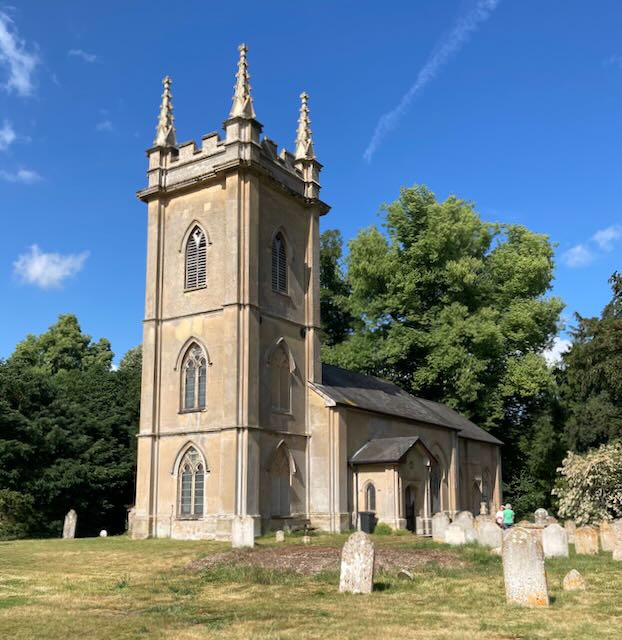
From her birth in 1775 until her family moved to Bath in 1801, Jane Austen spent most of her time in a small triangle of villages: Steventon, Ashe, and Deane. Her father was rector of both Steventon and Deane, leading services and preaching at both parish churches, and serving the people of both communities.

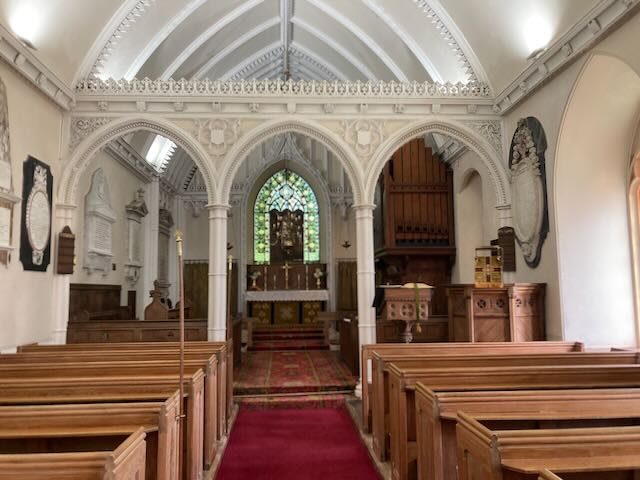
Nave and chancel of Holy Trinity Church at Deane.
The damp Deane parsonage where the Austens lived is long gone; it was replaced by a new building in 1855. One of the churchwardens says, “There was a rectory in the paddock opposite the path leading to the church, which burnt down. I believe the wall [old section in this photo] protected this rectory.”

Deane Parsonage and Living

George and Cassandra Austen lived in the Deane parsonage until 1768 when the Steventon parsonage was ready. Their first three children, James, George, and Edward, were born there. Mrs. Austen’s widowed mother, Jane Leigh, also lived with them at Deane, though she died shortly after the move to Steventon.

The Steventon living was worth only about £100 a year, including about three acres of glebe farmland. So Mr. Knight also let George Austen farm the 200-acre Cheesedown Farm for more income. Still, the Austens found the income too low to support their rapidly growing family. George’s great-uncle Francis of Sevenoaks in Kent bought the options on two nearby livings, Ashe and Deane, for George’s benefit.

The rector of Deane died before the rector of Ashe, so George Austen took the living for the parish of Deane, and Francis sold the other option to another relative, who later installed the Lefroys at Ashe. In 1773, Mr. Austen became rector of Deane, another small parish of “about two dozen families of farm labourers . . . worth £110” per year (Le Faye, 25). He also began taking in boys as students, to further supplement his income.

The Deane parsonage now belonged to George Austen, as part of the living. From 1786-1788, Madam Lefroy’s younger brother, Egerton Brydges, rented it from him and lived there. In 1789, George advertised the parsonage for rent, as “a neat brick dwelling-house with four living-rooms and four bedrooms, as well as all the necessary store rooms and servants’ quarter, plus a large garden, coach-house and stabling for six horses” (Le Faye, 68), making it sound more desirable than it had been. The next tenants were a clergyman’s widow, Mrs. Lloyd, and her daughters Martha and Mary. (Good Bible names for sisters; see John 11.) Martha and Mary soon became close friends of Jane and her sister Cassandra. Eventually both Lloyd sisters married into the Austen family.

In 1792, Jane’s eldest brother James and his wife Anne took over Deane parsonage, spending £200 to refurnish it, more than they could actually afford. James became his father’s curate at Deane, also serving two other small parishes. Their daughter Anna (Jane Anna Elizabeth Austen) was born in the Deane parsonage in 1793, with the help of her grandmother. “Mrs. Austen rose from her bed in the middle of the night, and walked by the light of a lantern a mile and a half of muddy country lane to attend her [daughter-in-law], and to usher into the world a new grandchild” (Le Faye, 84).

James’s wife Anne died in 1795, and Mary Lloyd returned to Deane parsonage as James’s second wife in 1797. In 1801, James and his family moved to the Steventon parsonage when George Austen retired to Bath. James served as curate of Steventon until his father died in 1805, when James became rector of Steventon.

Holy Trinity Church at Deane was completely rebuilt, 1818-1820, in the pointed Gothic style. Much of the church was built of Coade stone, an artificial stone invented and produced by a woman, Eleanor Coade (1733-1821). She developed an amazing material that could be made to look like either wood or marble, resisted weathering, and could be molded into mass-produced items ranging from tiny ornaments to the pinnacles of this church. Thousands of intact examples of Coade stone can still be seen across England and abroad today.

Jane Austen’s Connections with Deane

Jane Austen mentions Deane in 27 of her existing letters. She also includes it in one of her juvenile pieces, “Memoirs of Mr. Clifford.” Mr. Clifford’s “first Day’s Journey carried him only to Dean Gate where he remained a few Days and found himself much benefited by the change of Air.” She is referring to the Deane Gate Inn, where men of the Austen family would catch the stagecoach. It is now a restaurant, the Palm Brasserie.

Jane often visited the parsonage at Deane, first when the Lloyds were living there, then when her brother and his family were there. Dampness and flooding were still an issue. On Oct. 27, 1798, she wrote:

“There has been a great deal of rain here for this last fortnight, much more than in Kent, and indeed we found the roads all the way from Staines most disgracefully dirty. Steventon lane has its full share of it, and I don’t know when I shall be able to get to Deane.”

In November and December she again talks about visits to her sister-in-law Mary at Deane, who gave birth to James Edward (who became Jane Austen’s first biographer) on Nov. 17:

I went to Deane with my father two days ago to see Mary, who is still plagued with the rheumatism, which she would be very glad to get rid of, and still more glad to get rid of her child, of whom she is heartily tired. Her nurse is come and has no particular charm either of person or manner; but as all the Hurstbourne world pronounce her to be the best nurse that ever was, Mary expects her attachment to increase. . . . Sunday. — I have just received a note from James to say that Mary was brought to bed last night, at eleven o’clock, of a fine little boy, and that everything is going on very well. My mother had desired to know nothing of it before it should be all over, and we were clever enough to prevent her having any suspicion of it”—Nov. 17-18, 1798

Jane continued to visit Mary every few days, reporting on her health. She even visited when ice covered the ground: 

“I enjoyed the hard black Frosts of last week very much, & one day while they lasted walked to Deane by myself.–I do not know that I ever did such a thing in my life before. . . . Mary went to Church on Sunday, & had the weather been smiling, we would have seen her here before this time”—Dec. 18, 1798.  This may have been when Mary was “churched,” a ceremony celebrating the safety of a mother after childbirth.

The main families of Deane, Steventon, and Ashe all visited each other and went to balls together. Jane danced at the Harwoods’ ball, in Deane, on Jan. 8, 1796. She often mentions John Harwood in her letters; for example:

“This morning has been made very gay to us, by visits from our two lively Neighbours, Mr. Holder and Mr. John Harwood.”—Dec. 18, 1798

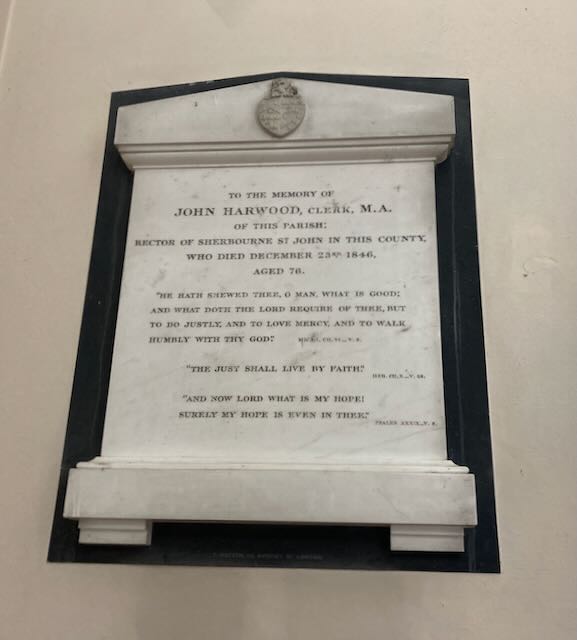
Deane church memorial to John Harwood (1770-1846), a member of the Harwood family of Deane, friends of the Austens. Harwood was rector of nearby Sherbourne St. John, where James Austen was vicar from 1791 to 1819. (The parish had both a vicar and a rector until 1844; the rector got more of the tithes.) Jane Austen mentions John Harwood in her letters in the context of visits, balls, and other events.
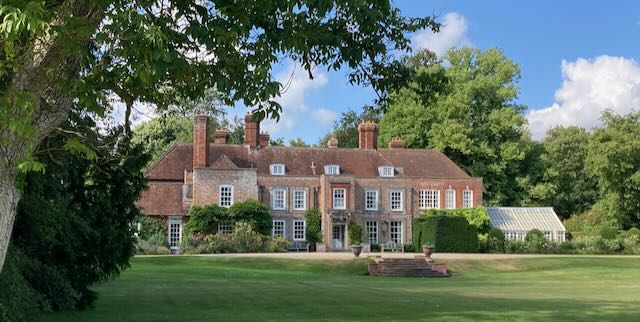
The Harwoods owned Deane House, now The Old Manor House. It can still be seen from the Deane church. Jane Austen danced there.

All Saints Church at Deane, Then and Now

In July, 1818, the Norman-era church at Deane was “in so Dangerous a state of Ruin as to be unsafe for the congregation.” So the patron, Wither Bramston of Oakley Hall, got approval from the Bishop of Winchester to rebuild it at his own cost, about £8000. It was consecrated two years later.

All Saints at Deane is considered “one of the most complete and successful” 19th century Gothic churches (Tanner). It is also renowned for its eight bells, which are rung regularly, and an 1820 Gothic chancel screen. The church today is a grade II listed building, but is not the same as the medieval church building where George and James Austen ministered. Some monuments from their time are on the walls of the current church, however.

An entrance to the Deane church marks its rebuilding in 1818.
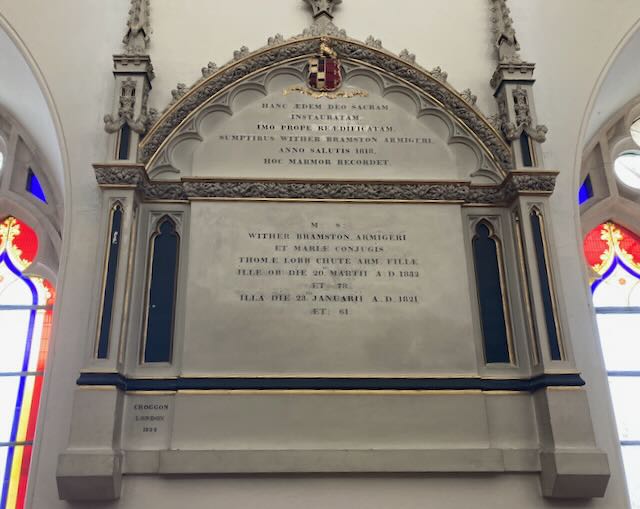
Memorial in Latin to Wither Bramston, died 1832, and his wife. As patron of the Deane living, he rebuilt the Deane church in 1818-1820 (as recorded in the top section of the memorial), at his own expense.

The church could seat 146 people in 1851. On Census Sunday, 94 parishioners attended in the morning and 124 in the evening. Leading up to World War I, the rector offered daily Communion in the church, and in 1917, he reported twenty people in the choir for Evensong. However, the population dropped, and in 2011, Deane included only an estimated 55 inhabitants, with an average age of over 60.

Now there are about 25 houses in the village, and about 8-10 people attend Sunday morning services twice a month. For a larger service, like the Christmas carol service, they may have about 40 attendees. Weddings are held there occasionally, and special services like pet blessings. All Saints is part of the United Benefice of North Waltham, Steventon, Ashe, and Deane.

Our guide to the church, Sue Hebeler, said she loves this church since it is her local church and her husband is buried there. She appreciates the traditional, old-fashioned services. If you’re in the vicinity, you may also enjoy a visit to this lovely, peaceful church.

This embroidered tapestry blesses the church, which was called St. Mary’s before it was rebuilt over 200 years ago. The picture may be more like the church’s earlier form. It reads, “Peace be within this sacred place; And joy a constant guest; With holy gifts and heavenly grace; Be her attendants blest.”

All images in this post ©Brenda S. Cox, 2024.

Brenda S. Cox is the author of Fashionable Goodness: Christianity in Jane Austen’s England. She also blogs at Faith, Science, Joy, and Jane Austen.


Posts on Other Austen Family Churches

Steventon

Chawton

Hamstall Ridware and Austen’s First Cousin, Edward Cooper

Adlestrop and the Leigh Family

Stoneleigh Abbey Chapel and Mansfield Park

Great Bookham and Austen’s Godfather, Rev. Samuel Cooke

Ashe and the Lefroy Family


Sources and Further Reference

Deirdre Le Faye, Jane Austen : A Family Record. Much of Le Faye’s information about Deane is also online at Deane

Terry Townsend, Jane Austen’s Hampshire, has a helpful chapter on Deane.

Richard Tanner, Ashe & Deane, explores the area.

Trailblazing Women of the Georgian Era by Mike Rendell includes a fascinating chapter on Eleanor Coade—manufacturer of artificial stone.

Read Full Post »

As spring turns to summer on our month-by-month exploration of Jane Austen’s life, letters, and novels, we turn our attention to May in Jane Austen’s world. If you’re just jumping on the bus, you can find previous articles in this “A Year in Jane Austen’s World” series here: JanuaryFebruary, March, and April.

During last month’s April showers in England, we dreamed of May flowers…and the Hampshire countryside certainly is showing some May flower power. First up, our monthly view of Chawton House Gardens. It certainly is bursting with color!

Chawton House in May: Photo @ChawtonHouse.

May in Hampshire

May is the time of year when the sun shines more regularly and everything bursts into bloom. Summer is close at hand, which means the temperatures are starting to warm up a bit, but frequent rain helps keep the gardens cool and watered. Austen had this to say in May 1811 in a letter to Cassandra:

The chickens are all alive and fit for the table, but we save them for something grand. Some of the flower seeds are coming up very well, but your mignonette makes a wretched appearance. Miss Benn has been equally unlucky as to hers. She had seed from four different people, and none of it comes up. Our young piony (sic) at the foot of the fir-tree has just blown and looks very handsome, and the whole of the shrubbery border will soon be very gay with pinks and sweet-williams, in addition to the columbines already in bloom. The syringas, too, are coming out. We are likely to have a great crop of Orleans plums, but not many greengages—on the standard scarcely any, three or four dozen, perhaps, against the wall. (Chawton, Wednesday May 29, 1811)

Here is a glimpse of Jane Austen’s House Museum and its blooms this month.

Jane Austen’s House in May, Photo: @JaneAustensHouse.

May in Jane Austen’s Letters

We have several letters from May to peruse. Interestingly, several are written from Bath. In an interesting article entitled “A Brief History of Jane Austen in Bath” on VisitBath.com, we read this about Jane Austen:

While many assume that Jane’s connection with Bath began when she moved to 4 Sydney Place in 1801 after her father’s retirement, the Austen family’s history with the City actually dates back further. Jane’s parents were married at St Swithin’s Church in 1764, and Jane herself visited in 1797 and 1799, lodging with her mother and sister-in-law at 13 Queen Square in 1799 while her brother took the waters for his health. Before moving into Sydney Place, she also stayed with her aunt and uncle, the Leigh-Perrots, at No.1 The Paragon. These short visits had a lasting impact on the young Jane Austen, inspiring her to write Northanger Abbey about Catherine Morland’s first visit to Bath and her “eager delight” at all it offered. (VisitBath.com)

May 17, 1799 (Queen’s Square):

  • Jane’s thoughts on the house: “We are exceedingly pleased with the house; the rooms are quite as large as we expected. Mrs. Bromley is a fat woman in mourning, and a little black kitten runs about the staircase. Elizabeth has the apartment within the drawing-room; she wanted my mother to have it, but as there was no bed in the inner one, and the stairs are so much easier of ascent, or my mother so much stronger than in Paragon as not to regard the double flight, it is settled for us to be above, where we have two very nice-sized rooms, with dirty quilts and everything comfortable. I have the outward and larger apartment, as I ought to have; which is quite as large as our bedroom at home, and my mother’s is not materially less. The beds are both as large as any at Steventon, and I have a very nice chest of drawers and a closet full of shelves — so full indeed that there is nothing else in it, and it should therefore be called a cupboard rather than a closet, I suppose.”
  • Happy and content, despite a delay with her trunk: “I find no difficulty in closing my eyes. I like our situation very much; it is far more cheerful than Paragon, and the prospect from the drawing-room window, at which I now write, is rather picturesque, as it commands a prospective view of the left side of Brock Street, broken by three Lombardy poplars in the garden of the last house in Queen’s Parade.”
The Royal Crescent in Spring (Photo Courtesy of VisitBath.com).

May 1801 (Paragon):

  • May 5 (their journey): “I have the pleasure of writing from my own room up two pair of stairs, with everything very comfortable about me. Our journey here was perfectly free from accident or event; we changed horses at the end of every stage, and paid at almost every turn-pike. We had charming weather, hardly any dust, and were exceedingly agreeable, as we did not speak above once in three miles. Between Luggershall and Everley we made our grand meal, and then with admiring astonishment perceived in what a magnificent manner our support had been provided for. We could not with the utmost exertion consume above the twentieth part of the beef. The cucumber will, I believe, be a very acceptable present, as my uncle talks of having inquired the price of one lately, when he was told a shilling.
  • Food prices: “I am not without hopes of tempting Mrs. Lloyd to settle in Bath; meat is only 8d. per pound, butter 12d., and cheese 9 1/2 d. You must carefully conceal from her, however, the exorbitant price of fish: a salmon has been sold at 2s. 9d. per pound the whole fish. The Duchess of York’s removal is expected to make that article more reasonable — and till it really appears so, say nothing about salmon.”
  • New bonnets: “My mother has ordered a new bonnet, and so have I; both white strip, trimmed with white ribbon. I find my straw bonnet looking very much like other people’s, and quite as smart. Bonnets of cambric muslin on the plan of Lady Bridges’ are a good deal worn, and some of them are very pretty; but I shall defer one of that sort till your arrival.”
The Paragon from Travelpod
  • May 12 (a ball): “In the evening, I hope you honoured my toilette and ball with a thought; I dressed myself as well as I could, and had all my finery much admired at home. By nine o’clock my uncle, aunt, and I entered the rooms, and linked Miss Winstone on to us. Before tea it was rather a dull affair; but then the before tea did not last long, for there was only one dance, danced by four couple. Think of four couple, surrounded by about an hundred people, dancing in the Upper Rooms at Bath. After tea we cheered up; the breaking up of private parties sent some scores more to the ball, and though it was shockingly and inhumanly thin for this place, there were people enough, I suppose, to have made five or six very pretty Basingstoke assemblies.”
  • The sale of their belongings: “I thank you for your Sunday’s letter, it is very long and very agreeable. I fancy you know many more particulars of our sale than we do; we have heard the price of nothing but the cows, bacon, hay, hops, tables, and my father’s chest of drawers and study table. Mary is more minute in her account of their own gains than in ours; probably being better informed in them. I will attend to Mrs. Lloyd’s commission and to her abhorrence of musk when I write again.”
Fancy Ball at the Upper Rooms, Bath, Thomas Rowlandson
  • May 21 – the search for apartments continues: “Our views on G. P. Buildings seem all at an end; the observation of the damps still remaining in the offices of an house which has been only vacated a week, with reports of discontented families and putrid fevers, has given the coup de grace. We have now nothing in view. When you arrive, we will at least have the pleasure of examining some of these putrefying houses again; they are so very desirable in size and situation, that there is some satisfaction in spending ten minutes within them.”
  • Walking with Mrs. Chamberlayne: “It would have amused you to see our progress. We went up by Sion Hill, and returned across the fields. In climbing a hill Mrs. Chamberlayne is very capital; I could with difficulty keep pace with her, yet would not flinch for the world. On plain ground I was quite her equal. And so we posted away under a fine hot sun, she without any parasol or any shade to her hat, stopping for nothing, and crossing the churchyard at Weston with as much expedition as if we were afraid of being buried alive. After seeing what she is equal to, I cannot help feeling a regard for her. As to agreeableness, she is much like other people.”
  • On a small party: “We are to have a tiny party here to-night. I hate tiny parties, they force one into constant exertion. Miss Edwards and her father, Mrs. Busby and her nephew, Mr. Maitland, and Mrs. Lillingstone are to be the whole; and I am prevented from setting my black cap at Mr. Maitland by his having a wife and ten children.”
Panorama of Bath from Beechen Cliff, 1824, Harvey Wood

Jane wrote several other “May letters” from Chawton (1811) and Sloane Street (1813):

May 29, 1811 (Chawton):

  • Springtime storms: “Mrs. Terry, Mary, and Robert, with my aunt Harding and her daughter, came from Dummer for a day and a night,—all very agreeable and very much delighted with the new house and with Chawton in general. We sat upstairs, and had thunder and lightning as usual. I never knew such a spring for thunderstorms as it has been. Thank God! we have had no bad ones here. I thought myself in luck to have my uncomfortable feelings shared by the mistress of the house, as that procured blinds and candles. It had been excessively hot the whole day.”
  • Improvements: “The chimneys at the Great House are done. Mr. Prowting has opened a gravel-pit, very conveniently for my mother, just at the mouth of the approach to his house; but it looks a little as if he meant to catch all his company. Tolerable gravel.”

May 20, 1813 (Sloane Street):

  • Travels: “We left Guildford at twenty minutes before twelve (I hope somebody cares for these minutiæ), and were at Esher in about two hours more. I was very much pleased with the country in general. Between Guildford and Ripley I thought it particularly pretty, also about Painshill; and from a Mr. Spicer’s grounds at Esher, which we walked into before dinner, the views were beautiful. I cannot say what we did not see, but I should think there could not be a wood, or a meadow, or palace, or remarkable spot in England that was not spread out before us on one side or other.”
  • Settling in: “I fancy it was about half-past six when we reached this house,—a twelve hours’ business, and the horses did not appear more than reasonably tired. I was very tired too, and glad to get to bed early, but am quite well to-day. I am very snug in the front drawing-room all to myself, and would not say “thank you” for any company but you. The quietness of it does me good.”

May 24, 1813 (Sloane Street):

  • On visiting an exhibition and finding the Mrs. Bingley’s (Jane Bennet’s) likeness and looking for Mrs. Darcy’s (Elizabeth Bennet’s) likeness: “…to my great amusement, Henry and I went to the exhibition in Spring Gardens. It is not thought a good collection, but I was very well pleased, particularly (pray tell Fanny) with a small portrait of Mrs. Bingley, excessively like her. I went in hopes of seeing one of her sister, but there was no Mrs. Darcy. Perhaps, however, I may find her in the great exhibition, which we shall go to if we have time. I have no chance of her in the collection of Sir Joshua Reynolds’s paintings, which is now showing in Pall Mall, and which we are also to visit. Mrs. Bingley’s is exactly herself,—size, shaped face, features, and sweetness; there never was a greater likeness. She is dressed in a white gown, with green ornaments, which convinces me of what I had always supposed, that green was a favorite color with her. I dare say Mrs. D. will be in yellow.”
  • Later that evening, on searching for Mrs. D (Elizabeth Bennet): “We have been both to the exhibition and Sir J. Reynolds’s, and I am disappointed, for there was nothing like Mrs. D. at either. I can only imagine that Mr. D. prizes any picture of her too much to like it should be exposed to the public eye. I can imagine he would have that sort of feeling,—that mixture of love, pride, and delicacy.”
Jane Bennet, Pride and Prejudice (1995).

May in Jane Austen’s Novels

May isn’t mentioned too terribly much in Austen’s novels, but it is a special point of interest and conversation in Emma because of the timing of Frank Churchill’s visit and the timing of the ball:

Emma

  • Frank’s visit: “Emma heard that Frank wrote in the highest spirits of this arrangement, and seemed most fully to appreciate the blessing of having two months before him of such near neighbourhood to many dear friends—for the house was taken for May and June. She was told that now he wrote with the greatest confidence of being often with them, almost as often as he could even wish.”
  • Mr. Weston’s joy: “Mr. Weston’s own happiness was indisputable. He was quite delighted. It was the very circumstance he could have wished for. Now, it would be really having Frank in their neighbourhood. What were nine miles to a young man?—An hour’s ride. He would be always coming over.
  • A ball: “Mr. Weston’s ball was to be a real thing. A very few to-morrows stood between the young people of Highbury and happiness.”
  • May is better for everything: “Mr. Woodhouse was resigned. The time of year lightened the evil to him. May was better for every thing than February.”
  • Evening fire in May: “The whole party walked about, and looked, and praised again; and then, having nothing else to do, formed a sort of half-circle round the fire, to observe in their various modes, till other subjects were started, that, though May, a fire in the evening was still very pleasant.
Anya Taylor-Joy (left) as “Emma Woodhouse” and Callum Turner (right) as “Frank Churchilll.” (2020). Credit : Focus Features.

May Dates of Importance

This brings us now to several important May dates that relate to Jane and her family:

Family News:

May 1801: Austen family leaves Steventon and settles in Bath. Mrs. Austen and Jane travel via Ibthorpe. James Austen and his family take resident at Steventon rectory.

May 1807: Captain Charles Austen marries Fanny Palmer in Bermuda.

Historic Dates:

18 May 1804: Napoleon crowns himself emperor of France.

Writing:

May 1814: Mansfield Park published anonymously, “By the Author of ‘Sense & Sensibility,’ and ‘Pride & Prejudice.’

Sorrows:

24 May 1817: Jane leaves Chawton and moves with Cassandra to Winchester, for medical treatment.

On this day in 1817, Jane Austen left this house for the final time. She went to stay in Winchester, closer to her doctor, where she died two months later, on 18 July. -Jane Austen’s House Museum

May 24, 2024 @JaneAustensHouse

Lovely May

I hope you’re enjoying our journey through each month of the year in Jane Austen’s world. It is a joy to look through this lens into Austen’s life and letters. We’ll continue our exploration and find out what happened in June in next month’s installment, June in Jane Austen’s World!


RACHEL DODGE teaches college English classes, gives talks at libraries, teas, and book clubs, and writes for Jane Austen’s World blog. She is the bestselling author of The Little Women DevotionalThe Anne of Green Gables Devotional and Praying with Jane: 31 Days Through the Prayers of Jane Austen. Now Available: The Secret Garden Devotional! You can visit Rachel online at www.RachelDodge.com.

Read Full Post »

« Newer Posts - Older Posts »