Feeds:
Posts
Comments

Archive for the ‘Jane Austen’s World’ Category

In the second episode of At Home With the Georgians: A Woman’s Touch, Amanda Vickery mentioned metamorphic furniture and (remarkably) turned a desk into a bed. A visitor to Tony Grant’s excellent post left this question: What is metamorphic furniture?

Modern example of metamorphic furniture: hall table/card table

Tony answered the question admirably. This mechanical furniture, wide-spread in Georgian times, had a dual use. A small folding staircase could be transformed into chair or desk, such as a writing table, library table, or card table. These pieces of furniture were great space savers, as I can attest. Only last week I transformed my faux-Georgian hall table into a card table for my guests. I never guessed until Tony’s post that I owned an example of mechanical furniture. Sweet!

The only change I would make in the video (besides the annoying lilt in my voice) is to make sure that the next time I film an example of my furniture, it is thoroughly dusted and cleaned! Extra points if you can spot my pooch in one of the scenes. His hang dog expression tells me that he was out of sorts, having been told to stay put.

This Victorian piano at the Brooklyn Museum pulls out into a bed. Fascinating. The video is available to view until March 2011.

READ MORE: If your interest in the topic is piqued, Clive Taylor (who also left a comment on the previous post) has written a dissertation on the topic (click here to read The Regency Period Metamorphic Chair) and sells metamorphic library chairs/stairs in his shop, Parbold Antiques.

Read Full Post »

“Heigh ho! sing heigh ho! unto the green holly:
Most friendship is feigning, most loving mere folly:
Then, heigh ho, the holly!
This life is most jolly.”
– William Shakespeare, As You Like It

Decorating one’s house with natural boughs has been a Christmas tradition since Celtic times. Boughs of holly with their bright red berries were especially coveted. (Read Mythology and the Folklore of Holly.) One understands how easily people in rural areas could obtain these bright green leaves, but what about those who lived in London? This image of a holly cart pulled by a donkey provides a solution.

Note that the customer purchases a small amount of boughs. Christmas decorations in the 19th century were modest to none compared to ours. In this 18th-century print of a coffee house or chocolate shop, one can see small leaves of holly placed in each window pane and a bough hanging from the center of the ceiling. (One cannot imagine that mistletoe would  be hung in a public setting.)

Bowles and Carver print, London. Circa 1775

In this image of a lavish family dinner by Cruikshank, not a single bough of holly decorates the room. Most likely a wreath had been hung on the front door or some boughs had been hung from the ceiling. With holly hard to obtain in metropolitan areas, one imagines that the spare use of decorations was as much from necessity as from tradition.

Image: Art.com

This image by Cruikshank of a family celebrating Christmas during early Victorian times  shows a few boughs inserted into the chandelier, a roaring fire, and the Christmas pudding about to be served to the hostess. This year, I have taken the Regency approach to decorating my house, emphasizing the season with just a few well placed decorations. And I love it.

Other Christmas Posts on this blog:

Read Full Post »

18th Century toddler

Gentle Readers; This post is in honor of Jane Austen’s 235th birthday. I have joined a group of bloggers in a blogfabulous celebration, and their links will sit at the bottom of this post. Leave your comments on our blogs for an opportunity to win an array of unique prizes! Copyright @Jane Austen’s World

Jane Austen was born on December 16, 1775 during one of the harshest winters that would be recorded in recent memory in England. A premature cold wave prompted naturalist Gilbert White to observe that the trees in Selborne were looking “quite naked” as early as November 11th. Despite the cold snap, there would still be periods of mild weather. The day that Mrs. George Austen went into labor with her 7th child, White noted, “Fog, sun, sweet day.”

During the latter half of the 18th century, all but a handful of births occurred in the home, but by 1775, the practice of midwifery had changed. Physicians were rapidly taking over obstetrics, replacing the midwive and relegating her to work with only the lower classes or those who lived in areas where a doctor or even an apothecary were not available.

In fact, many women of that era gave birth without the services of a doctor or midwife. Steventon Rectory, the Austen family home, lay seven miles away from the nearest village of Basingstoke, and so on the eventful night that baby Jane was born, the Austen family did not bother to summon a physician.

An 18th century pregnant woman’s corset could be loosened from both front and back. Image from @What clothes reveal: the language of clothing in colonial and federal America, by Linda Baumgarten

Hogarth’s image of a pregnant woman

Mrs. Austen gave birth to her second daughter in her own bedroom. She was attended, I surmise, by female friends and family members, such as her sister-in-law, Philadelphia, which was the tradition of the time. As a matter of course (and sisterhood), female friends and relatives helped to assist in the birth. In England, women who lay in bed while giving birth would lie in a Sims position, or on the side with their knees curled up. One historical source speculated that having a baby in bed could be a messy event and doubted that many women before the age of plastic would risk sullying their sheets and precious feather mattresses by remaining in bed during the final stages of the birth process. This made sense to me, and so I searched for alternate images.

Birthing stools or chairs with sloping backs, which allowed gravity to help pull the baby through the birth canal, had been used for centuries.

16th century woodcut of woman giving birth. The chair is sloped to allow her to lean back.

Birthing attendants also used various positions during labor, as in this 19th century image, which shows an American frontier scene, with the husband holding his wife in a half seated, half leaning position as the midwive and two female companions assisted with the birth.

19th century birth, with husband and attendants

No one recorded precisely how many hours Mrs. Austen took to deliver baby Jane, but one can imagine that during her labor a cozy fire warmed the bedroom on that bitterly cold night,  twine and scissors lay on a nearby table, plenty of fresh water and linen rags stood at the ready, and baby linens were laid near a cradle.  Jane’s birth, which was expected in November, was swift and uneventful. Soon after she entered the world, baby Jane was cleaned, dressed and placed next to her mother in bed or inside her cradle, and wrapped snugly in a long quilted gown and a mantle. 

18th century infant shirt and bonnets, Christie’s

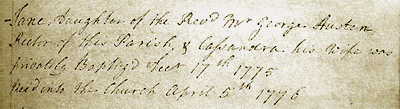
Reverend George Austen baptised his new daughter on December 17th in his home, as he had done with his other children. Then, as Mrs. Austen rested, he wrote notes announcing the birth to friends and acquaintances. For the only time in her life, he publicly called his new daughter “Jenny.” (One wonders if during private family time this nickname stuck.)

On April 5th, baby Jane was formally christened in St. Nicholas church, wearing a square-necked, sleeveless gown of fine cotton that probably opened in front. She would also have been wrapped in a pretty christening blanket.

18th century silver rattles, baby walker, and oak cradle. 

In 1775, fewer babies were swaddled, but the practice took a long time to die off.

Throughout the nineteenth century, the medical profession recommended a less constraining form of swaddling. In this type of swaddling, often practiced by the middle classes, the infant was able to move its legs and the arms were kept free from restraints, although mothers were still advised to keep the swaddling band to support the baby’s back. Baby clothing also became more comfortable.” – Swaddling, FAQ

Babies wore linen clouts, the 18th century form of a thick cloth diaper, which was pinned with straight pins (ouch) or tied with with lacings. The clout was covered by a pilcher, a garment that offered another layer of protection. Today’s pilcher has a plastic lining to prevent urine from leaking through. (Do recall from a previous post, that the 18th century attitude towards urine was different than ours in that urea was regarded as a disinfectant.)

Cap, napkin and pilch. Image @Sharon Ann Burnston’s website

While Georgian attitudes towards sanitation differed from ours, parents did recognize that a baby’s tiny bald head needed extra protection in cold, drafty houses. Caps decorated with hollie point lace protected a baby’s fragile head

Holly point lace caps for infants

Tiny linen shirts and long quilted bed gowns that opened in the front and extended beyond their legs (long clothes) warmed their tender bodies. These baby linens were also decorated with hollie point lace. (Hollie point was a whitework embroidery technique that was popular in the middle ages for church lace, and that was used after the 17th century for baby garments and baby blankets.)

18th c. baby dresses, Sturbridge

During this age of Industrial Revolution, ready-made baby items became more easily available and affordable. Childbed linens and baby clothes could now be purchased in shops or warehouses. Recycling of old clothes and cloths was definitely practiced, and it is without doubt that Mrs. Austen re-used Cassie’s outgrown clothes and bedlinens for baby Jane. Aside from needing a goodly number of clouts, the Austens would already possess most of the baby items their tiny daughter would need.

A day after giving birth to baby Jane, Mrs. Cassandra Austen was pronounced out of danger. Finally able to relax (even from her daily duties, which were overseen by friends or her sister-in-law, Philadelphia, perhaps) she would begin a lying in period to regain her strength. The mother, while resting during the lying in period, would be visited by her female friends, who would help look after the baby or help the mother through the grieving period (if the infant died.) This lying in period traditionally lasted a month, but for some sturdier (more impatient) mothers this period would last only a few weeks. Mothers whose infants died might not emerge for several months more. Ever the good hostess, biscuits and tea would be served to entertain visitors at set times.

Short gown maternity garment. Image @Fashions of Motherhood

Mrs. Austen would open her short gown (which fastened in front) and suckle Jane. But as with all their children, the Austens would send the new baby away to be fostered, a remarkable act of faith in a year when almost half of the more than 20,000 recorded deaths in England were those of infants. I have read articles in which a contemporary writer asserts that a Georgian parents’ grief over a child’s death was not as acute as ours, since so many infants died during that period. But much historical evidence shows that such a sweeping statement is simply not true. Georgian parents loved their children as much as today’s parents and grieved deeply for them. While they were painfully aware of the horrendous mortality rates for infants, this foreknowledge did not assuage their profound sense of loss when a child died.

Infant gown with removable sleeves, emuseum collection, Colonial Williamsburg

Infant’s gown with removable sleeves

Despite the possibility of their child not surviving infancy, the Austens had been in the habit of sending their children away just three months after their births to “a good woman at Deane”, a village close to Steventon. Giving a child over to a wet nurse had once been a common custom, but by 1775 this habit was fading as fast for the gentry as the use of a midwife. For the first crucial months, however, Mrs. Austen would breast feed baby Jane and take care of her personally.

Frost on trees in Hampshire

Baby Jane’s first winter on earth was bitter cold. Gilbert White noted that severe weather, with severe frost and snow, affected most of Europe from 9th Jan through 2nd Feb, 1776, and that the Thames was frozen for some time. A stormy February followed. The prolonged cold spell was broken by interludes of mild temperatures and melting snow, but these did not last long. Snow fall was often considerable, with frequent drifting, and daytime temperatures often dipped below freezing.

St. Nicholas (Chawton) across the fields. Image @Tony Grant

With such a prolonged cold snap, was it any wonder that the Austens kept baby Jane at Steventon until April 5th of that year? In contrast, Cassandra, who was born on January 9, 1773, had been with her foster mother for eight weeks by June 6th. While Edward-Austen Leigh wrote somewhat disapprovingly of his grandparents’ habit of fostering out their children, they must have made the right choices, for all the Austen children survived their infancy. Despite his censure, Edward observed that little Jane’s parents did not neglect her: “The infant was daily visited by one or both of its parents, and frequently brought to them at the parsonage, but the cottage [at Deane] was its home.”

Baby Jane might have resembled Gen Cadwallader’s daughter, 1772, by Peale

Author Irene Collins in Jane Austen, The Parson’s Daughter, identifies “the good woman at Deane” as Elizabeth Littleworth, the wife of a farmworker at Cheesedown, located between Deane and Steventon. These country folks remained close to the Austens for years, for in 1789 Jane acted as godmother to their eldest grandchild and stood as witness to the wedding of John Littleworth’s brother. Like the Martins in Emma, the Littleworths belonged to a lower social station, and the Austens, however grateful for their services, would not have socialized as equals with them.

Child wih leading strings, stays with cardboard stiffening, and child wearing a pudding cap

The Austen children stayed with the Littleworths until they started to walk and talk and could “be regarded as rational beings.” Henry returned to Steventon Rectory at fourteen months, and Cassy and Jane were returned when they reached two years of age.

Walking a toddler on leading strings. Image @Williamsburgrose

When baby Jane was ready to walk and crawl (about the time when she would be returned to her family) her mother would change her out of long clothes into short clothes. Short clothes were ankle length and allowed chubby legs the freedom of movement they needed to practice toddling. Toddlers also wore clothes with “leading strings” and pudding caps, which were padded.

A very fine pudding cap. Image @Metropolitan Museum

These caps, a sort of bumper guard, if you will, prevented injury to a toddler’s head if it fell or bumped into objects as it learned to walk (or so it was hoped).

“Like many mothers at the time, Mrs. Austen recorded her children’s progress in terms of dress. When Cassandra was taken out of her long gown and put instead into ‘petticoats’ (a frock and slip which finished at the ankles), her mother regarded it as a sign that she had left babyhood and would soon be learning to walk. From the petticoat stage, there was little change in girls’ clothing, except that the waistline of the frock went higher and the neckline lower.” – Irene Collins in Jane Austen, The Parson’s Daughter

18th Century Doll

Toddler Jane and her older sister Cassie also wore corsets. Yes, you read the word correctly. The tiny corsets, stiffened with cardboard, were thought to promote posture and help with walking.

Putting stays on young girls and boys was not seen as harsh, but rather as insurance that their figures would develop the correct form, with chest out and shoulders down. While boys usually wore stays only in early childhood, they were considered essential for females throughout their lives. – Philadelphia Museum of Art

These two tiny 18th century girls are wearing corsets

Since these early days, tiny Cassy and baby Jane, barely three years apart, developed a lifelong bond. Cassy most likely played with her younger sister as she would a doll and looked over her. By all accounts, their childhood at Steventon Rectory was happy and relaxed, with the children called by pet names, eating meals at the table, and visiting friends and relatives with their parents. Luckily for the Austen children, attitude towards childhood had begun to change and children were no longer dressed or perceived to be small adults. They were allowed to dress as children and, if they did not live in dire poverty, live a relatively carefree childhood compared to the children from generations before.

Would Mrs. Austen and her two daughters have resembled the Archibald Bulloch family? Painted in 1775 by Henry Bendridge, High Museum of Art, Atlanta.


Read Full Post »

Copyright @Jane Austen’s World. Post written by Tony Grant, London Calling.

John Clare (1793-1864) was born at Helpston, a village in Northamptonshire on July 13th 1793. Jane Austen was 18 years old and living in the south in an equally rural setting of the parsonage at Steventon, Hampshire. Her family and life was very different to John Clare’s. His father was a farm labourer, a fairground wrestler and a ballad singer. The ballad singing was John’s first introduction to verse, rhythm and rhyme.

John Clare was at first educated at a dame school in his native village between 1798 and 1800. Then he went to Glinton school in the next village.

John Clare, Poet

He had a need to write poetry and his first poems were based on his father’s songs. People said of him at the time and nowadays that he was a self-taught poet. It’s difficult to imagine anybody being taught to be a poet. John Clare could hear the rhythms and rhymes in his father’s songs and he did read quite extensively. He was able to think in rhythms and find the right words to say what he wanted by writing poetry. He was sensitive to the sounds and meanings of words and was able to put them together. Great writers don’t learn to be great writers. They have certain skills but the rest is innate. They can hear and find things in words that is very difficult for the rest of us. Otherwise we could all do it. People have struggled to explain the genius of Shakespeare and perhaps Jane Austen. They didn’t come from the aristocracy or were particularly well educated. It was part of their inner selves. That can be the only explanation. Great lawyers or accountants or architects are taught the knowledge they need and some skills but something innate can only make them great.

John Clare's cottage

John Clare’s father became rheumatic and couldn’t work in the fields and so John had to take his place so the family could eat. He worked as a horse boy, a ploughboy and then became a gardener at Burley House. In 1812 he joined the local militia returning home 18 months later.
When he returned he took up lime burning. Lime was very useful for building purposes. It was and is a necessary ingredient for cement and concrete. It can also be spread on fields to keep pests down.

In Casterton, a village nearby, he met Martha Turner. She became his wife and they had eight children together.

John Clare’s first book of poems was called “Poems Descriptive of Rural Life.” This was published in 1820 by Hessey and Taylor who were Keats publisher. The volume ran to four editions and Clare began to become famous in London literary circles. They called him, the, “peasant poet,” a rather derogatory title in many ways. In 1821 he published “The Village Minstrel,” and in 1827 The Shepherds Calendar,” came out. The success of his first volume, which was obviously a curio, eluded these following books. In 1835, “The Rural Muse,” was produced and hardly sold at all. John Clare and his family had no money and were virtually destitute.

Country Church. Image @Tony Grant

In 1837 John Clare was admitted to Matthew Allen’s private asylum of High Beech in Epping Forest. He was there for four years. He had begun to have delusions. He thought he was Shakespeare for a while. His family couldn’t cope with him. The mental strain of being torn between two worlds was destroying him. After four years he was discharged and had to walk the eighty miles home, which took him three days. He ate grass along the way. When he got home he wrote two long poems based on Byron’s poems Don Juan and Childe Harold.These two poems described his state of mind. Again in December 1841 he was certified insane by two doctors. He was admitted to St Andrew’s County Lunatic Asylum in Northampton where he was treated well. He was able to continue writing poetry. He died there in 1864.

Skylark

The Skylark

THE rolls and harrows lie at rest beside
The battered road; and spreading far and wide
Above the russet clods, the corn is seen
Sprouting its spiry points of tender green,
Where squats the hare, to terrors wide awake,
Like some brown clod the harrows failed to break.
Opening their golden caskets to the sun,
The buttercups make schoolboys eager run,
To see who shall be first to pluck the prize–
Up from their hurry, see, the skylark flies,
And o’er her half-formed nest, with happy wings
Winnows the air, till in the cloud she sings,
Then hangs a dust-spot in the sunny skies,
And drops, and drops, till in her nest she lies,
Which they unheeded passed–not dreaming then
That birds which flew so high would drop again
To nests upon the ground, which anything
May come at to destroy. Had they the wing
Like such a bird, themselves would be too proud,
And build on nothing but a passing cloud!
As free from danger as the heavens are free
From pain and toil, there would they build and be,
And sail about the world to scenes unheard
Of and unseen–Oh, were they but a bird!
So think they, while they listen to its song,
And smile and fancy and so pass along;
While its low nest, moist with the dews of morn,
Lies safely, with the leveret, in the corn.

John Clare

John Clare often wrote in Iambic pentameter, that most used metre in the English language. Shakespeare and Milton and many poets since have found iambic pentameter the best form to use. It is a ten-syllable line with pared, soft and strong beat pulses. It’s like an inner natural force. It is the most natural rhythm pattern to use because it is close to a conversational style; it’s like our heartbeat and our breathing patterns. It is most apt for conveying every sort of meaning in the English Language. It’s easy and smooth and a real joy to say.

John Clare moves straight into this perfect rhythm in the first two lines of The Skylark with these rhyming couplets.

The rolls and harrows lie at rest beside
The battered road: and spreading far and wide”

The iambic pentameter mesmerises us, carries us along, and Clare enters right into the detail of the countryside with “rolls,” “harrows” and “the battered road.” We are there immediately with him on his walk or ramble about his village.

Wheat field. Image @Tony Grant

In this poem, John Clare shows his detailed knowledge of the countryside where he lives and his knowledge about country practices and farming equipment. “Rolls and harrows lie at rest,” “ the battered road,” presumably cut deep and rutted by cartwheels are there for him to see. He describes the colour of the clods of clay, a russet colour, and we learn the season when the events of this poem happen, in his description of the growing corn, “sprouting spiry points of tender green.” It’s the time of year the buttercups are, “ opening their golden caskets to the sun.”

The introduction of humans, in Clare’s poetry, always brings foreboding, fear and the possibility of danger and destruction. In the Skylark “schoolboys eager run, to see who shall be first to pluck the prize.” The boys are not there to admire and be sensitive to nature they want to, “pluck,” it, tear it from it’s place and use it for their own fun and amusement. Are they, the boys, the, “anything,” that, “may come at to destroy?”

Clare shows his closeness and affinity with nature and the world of the countryside with words and phrases such as,

…harrows lie at rest,”

“Where squats the hare, to
terrors wide awake,”

“…the skylark flies,
And oe’r her half formed nest, with happy wings
Winnows the air, till in the cloud she sings.”

We are so used to using the word, sings, to describe the sounds a bird makes. Clare has used, in this poem, words to describe country objects and nature; rest, terror, winnows and happy. This is personification. It shows his relationship, his emotional attachment to nature and wild animals. He is part of it and it is part of him.

Skylark in flight

There is a very powerful section in the poem which describes a certain fear and dislocation in the life of the skylark which the schoolboys create.
Clare describes the skylark suddenly and abruptly flying high to distract them from it’s weak, fragile and vulnerable nest on the ground.

The line starts abruptly:

Up from their hurry, see, the
Skylark flies,
And oe’r her half formed nest, with happy wings
Winnows the air, till in the cloud she sings
Then hangs a dust spot in the sunny skies
And drops, and drops, till in her nest she lies,”

The boys have passed by unaware, and the skylark feels safe to return to her nest and probably her eggs or new laid chicks. She has flown high and put on a happy and joyous show, an act, a false hood, all the time terrified about her nest being discovered. Just as suddenly she drops back down to the nest when the coast is clear. It’s a sudden dramatic,reversal and change of positions.

The description of the skylark being, “a dust spot,” adds to this sense of dislocation. I thought it a strange description of the skylark high in the sky. In a literal sense the skylark might look like a dark spot against the bright blue spring sky. However, a dust spot is dirt that needs to be removed, swept away. It’s out of place. The beauty of the skylark reduced to something dirty. This description has a strange resonance. Why should Clare think of the skylark as a piece of dirt?

Woodland. Image @Tony Grant

To relieve us from all this dire, stark reality, Clare, describes at the end of the poem his idea of perfection. His thoughts are about the schoolboys but this is Clare’s hope. It is sad to think that freedom for Clare can only be in death and the hope of heaven. Only there can the skylark, it’s, “low nest, moist with the dew of morn,” be safe.

Like such a bird themselves
Would be too proud

And build on nothing but a passing cloud!
As free from danger as the heavens are free
From pain and toil, there would they build and be.”

It is very easy to compare the events in this poem with Clare’s own life and perhaps his feelings about himself. Is he the skylark torn between heaven and earth, the heights of the literary world where many regarded him as a curio, a country yokel, a,”dust spot?” Is the skylark’s vulnerable nest his own vulnerable family and fragile existence back home in his Northamptonshire village?

Read Full Post »

Copyright @Jane Austen’s World

Looking at the images in this post, one can only imagine how difficult it was for a woman in full evening dress (or court dress) to move around. Between taking care of her shawl, reticule, dance card, and fan, she had to walk upright and sedately so that her head feathers did not topple over after an abrupt movement or caught fire under chandeliers ablaze with candles.

1794-95 Court Dress

Examining the above image, one can readily see that these costumes were designed for high-ceilinged rooms that were opened by high double doors.

A lady's wig catches fire. Thomas Rowlandson. Image @Yale University

In this dramatic image, Thomas Rowlandson catches a moment of real danger both for the lady whose wig (and feathers) caught fire, and for the guests, who might have been trapped in a house fire, for water to put out flames was not easily obtained.  In the late 18th century The London Times reported on several more incidents in which ladies found ways to accommodate their head feathers, or in which the feathers (and mother nature) got the best of them.

Lady Godina's Rout

At all elegant Assemblies there is a room set apart for the lady visitants to put their feathers on, as it is impossible to wear them in any carriage with a top to it. The lustres are also removed upon this account, and the doors are carried up to the height of the ceiling. A well-dressed Lady who nods with dexterity can give a friend a little tap upon the shoulder across the room without incommoding the dancers. The Ladies feathers are now generally carried in the sword case at the back of the carriage.  – Times,  Dec 29, 1795.

Tippies of Newton, 1796 caricature by Richard Newton. Image @Wikimedia Commons

A young lady only ten feet high was overset in one of the late gales of wind in Portland Place, and the upper mast of her feather blown upon Hampstead Hill.  “The maroon fever has been succeeded by a very odd kind of light-headedness, which the physicians call ptereo mania, or feather folly.” The Ladies now wear feathers exactly of their own length, so that a woman of fashion is twice as long upon her feet as in her bed. –  Times, Dec 30, 1795.

1796, High Change in Bond Street, Gillray

We saw a feather in Drury Lane Theatre yesterday evening that cost ten guinea. We should have thought the whole goose not worth the money.  – Times, Jan 6, 1796.

A Modern Belle Going to the Rooms at Bath, James Gillray, 1796. Image @Wikimedia Commons

Here is a contrivance by which A Modern Belle going to the Rooms or Balls can go fully dressed with her feathers fixed. There is to be seen in Gt Queen Street a Coach upon a new construction. The Ladies set in this well and see between the spokes of the wheels. With this contrivance the fair proprietor is able to go quite dressed to her visits, her feathers being only a yard and a half high. –  Times, Jan 22, 1796.

Vis a vis Ladies Coop, 1776

The Times described predicaments regarding head feathers that were not new. Note how twenty years before, both high wigs AND feathers were accommodated. And, indeed, feathers, whether made from ostrich, emu, goose, or peacock, remained popular as a head dress for years to come.

The headdress, while always including a veil, also required feathers as part of it, although, the number and size of the feathers varied with the Monarchy. At the time of Queen Charlotte, young ladies wore one single towering ostrich feather, but through the years, the number of feathers required increased. By the Edwardian Era, the widespread use of feathers to decorate hats and bonnets began the passage of laws that restricted using certain types of bird’s feathers.*

Queen Victoria hated small feathers, so orders were issued that Her Majesty wanted to see the feathers as the young lady approached. Later in Queen Victoria’s reign, as well as in the court of Edward VII, the mandated headdress was three feathers arranged in a Prince of Wales plume–that is, the center feather was higher than the two on each side of it–and it was worn slightly on the left side of the head. Tiaras were worn by married women, and it was extremely difficult to keep the feathers in place, especially during the curtsy.

More on the topic:

Read Full Post »

« Newer Posts - Older Posts »