This Jane Austen blog brings Jane Austen, her novels, and the Regency Period alive through food, dress, social customs, and other 19th C. historical details related to this topic.
Downton Abbey’s connection to Jane Austen is through Lord Carnarvon, whose descendents still own Highclere Castle, where the PBS Masterpiece Classic mini-series’ interior and exterior shots of the fictional country house were filmed. (Read about Andrew Lloyd Weber’s recent attempt to purchase the castle.) In Jane’s day, Lord Carnarvon was Henry, the 1st Earl. Jane wrote in a letter to Cassandra Austen, Saturday25 – Monday 27 th, October 1800 :
“This morning we called at the Harwood’s & in their dining room found Heathcote & Chute for ever – Mrs Wm Heathcote & Mrs Chute – the first of whom took a long ride in to Lord Carnarvons Park and fainted away in the evening…”
Highclere Castle as it looked in Jane Austen's day
The 5th Earl
Lord Carnarvon’s park, which Jane writes of, is the grounds to Highclere Castle. The Carnarvon family has lived at Highclere since 1679, although the Castle as we see it today sits on the site of an earlier house. (Click here to view a short film about the Castle’s history.) A beautiful 6,000 acre park designed by Capability Brown between 1774-7 surrounds the Castle.
In 1842, the 3rd Earl commissioned architect Sir Charles Barry (also responsible for building the Houses of Parliament in Westminster) to redesign the Castle.
One of the most interesting fact about Highclere Castle is that the golden death mask of King Tutankhamun is featured in its gallery today.
Howard Carter and Lord Carnarvon in Egypt
Lord Carnarvon of Tutankhamun fame (George, the 5th Earl) was an Egyptologist who sponsored Howard Carter, the archaeologist who discovered Tutankhamun’s tomb in the Valley of the Kings in 1922. It is said that when Canarvon and Carter broke into Tut’s tomb, they unleashed the mummy’s curse. But the story goes more like this:
Howard Carter cleans the second coffin. Image @Harry Burton
This popular legend was born when Lord Carnarvon, the English Earl who funded the Tutankhamun expedition, died less than six months after the opening of the tomb. Despite the fact that Lord Carnarvon was a sickly individual, and that no such “hieroglyphic curse” was found inscribed on the tomb, this legend persists today. . . Lord Carnarvon had been in a car accident many years earlier and had never fully recovered. About a month after entering the tomb, he cut open a mosquito bite while shaving and infection set in. Blood poisoning and pneumonia quickly followed, and within a few weeks, he passed away. Newspapers reported that mysterious forces unleashed from the mummy and its trappings had caused his death. – King Tut
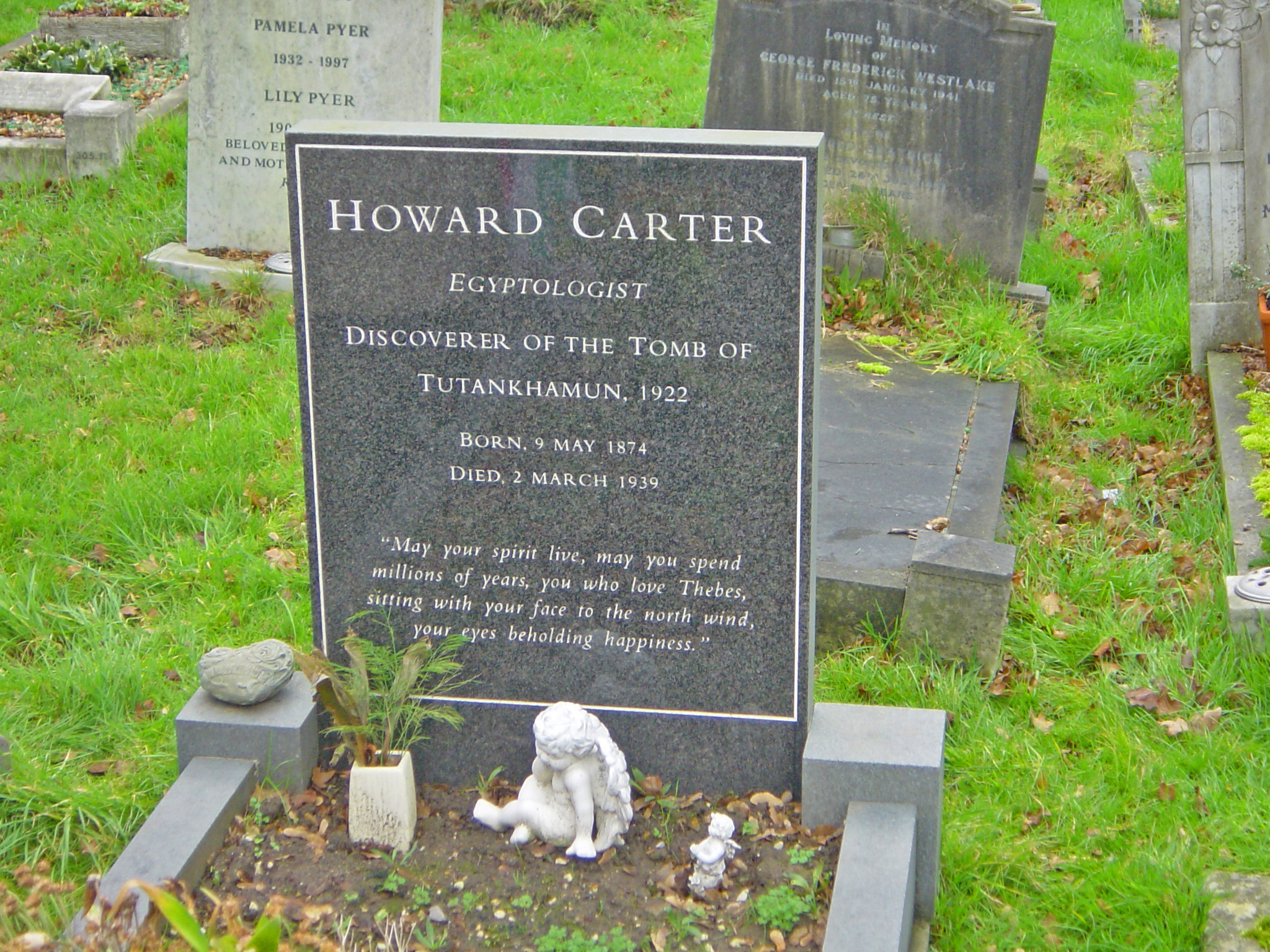
This image of Howard Carter’s grave was taken by Tony Grant, who lives near the cemetery in London. (Thank you, Tony, for the photo and for the quote from Jane Austen’s letter!)
Howard's grave. Image @Tony Grant
Watch Downton Abbey at your local PBS station Sundays, January 9, 16, 23, and 30, 2011 at 9 PM. Read my other posts:
I recently finished reading a charming book by Cora Harrison, I Was Jane Austen’s Best Friend, in which Jane Austen has just reached the age of 15. It is February, 1791, and 16-year-old Jenny Cooper has slipped out of Mrs. Crawley’s boarding school to post a letter to Steventon Rectory warning Rev. and Mrs. Austen that their daughter, Jane, is seriously ill. By doing so, Jenny risks her reputation, for she ventures out alone and unescorted in a rough area of Portsmouth.
This scene sets the stage for the rest of the novel, in which young Jenny Cooper chronicles the months she spends with her best friend Jane and the Austens at the rectory. The girls are avid writers: while Jane spins her creative tales, Jenny describes their routine days in her journal. And what days they were! Jenny observes Jane’s family and friends minutely: her gentle father and stern mother; her charming favorite brother, Henry, and the mentally challenged George, who lived with another family; Cassandra’s love for Tom Fowle; exotic cousin Eliza; the well-dressed Bigg sisters; and other vivid portraits of the people who inhabited Jane’s and Jenny’s world.
Jane Austen reads at Jenny's bedside. Image@Susan Hellard
The scenes are culled from actual events in Jane’s life and from letters that others wrote about her (for none of her letters from that time have survived). As teenagers are wont to do, Jenny and Jane dream of romantic encounters and parties and balls, engage in outdoor activities, and while away their time reading and writing and play-acting, or wishing for pretty gowns.
Image @Susan Hellard
The scene in which a pinch-penny Mrs. Austen must decide which color muslin would look best for ball gowns for all three girls (Cassandra, Jane and Jenny) is priceless, and the descriptions of tender romance between Cassandra and young Tom are heartbreaking to those who know he will die before they can be married. Tom LeFroy makes a suitably short appearance, and Jenny meets handsome Captain Thomas Williams, who in real life became engaged to her within three weeks of their first meeting, and whom she later married before her own untimely death.
Jenny witnessed Jane writing constantly and being inspired by the people she observed. For example, Jenny’s shrill sister-in-law, Augusta, becomes the prototype for Mrs. Elton and Mr. Collins is somewhat inspired by Jenny’s preachy brother.
Augusta. Image @Susan Hellard
While I found the book a delight, not everyone has been thrilled with its purchase. The American cover of I Was Jane Austen’s Best Friend is a bit mature for a novel that targets young girls of eleven or so, but it explains the reason why so many older readers are buying the book.
This is what a high school reviewer had to say about the U.S. cover: “… if you plan on buying [the book] at any time soon, make sure to check out the U.K. version… the cover art is so much cuter!” In fact, the U.K. cover (below) enjoyed the author’s full approval, and was drawn by Susan Hellard, the artist responsible for the charming illustrations displayed in this post and that are sprinkled throughout the book.
Page from the book, in which Jane describes some of her siblings. The style of writing is aimed at a very young audience. Drawings @Susan Hellard.
In writing this novel, Cora Harrison has kept her very young audience in mind. As you can see from the sample page above, the sentences are short and written in plain English, speech patterns and terms from the 18th century are kept to a minimum, the romance is sweet, and the story is written from a young lady’s point of view. While Ms.Harrison hoped that this book would introduce Jane Austen to very young readers, she also envisioned that mothers and grandmothers would enjoy reading the novel as well.
The book's U.K. cover
I have gone into great detail about the author’s intentions for a reason. Reviews of this book, while largely favorable, are varied. Lower rankings come largely from disappointed adult readers who expected a mature romance and a “more interesting plot.” But as the author wrote to me: “I didn’t want to do an in-depth analysis of love. I wanted to do a fun book, romantic in an old-fashioned style.”
Purists have also decried the changes in facts, dates, and characters, but isn’t it the novelist’s prerogative to change historical facts in order to move the plot forward? Besides, Ms. Harrison made her reasons for these changes clear in her Author’s Note in back of the book, which should have been placed as a Foreword. I also think that annotated notes for juvenile readers (such as those included for book clubs), would help adults explain some of the more obscure facts about the Georgian period to their children and place events in the novel in context.
Be that as it may, I rarely read review books from cover to cover, but I kept reading this one until I was finished (and then wished I had a daughter to give it to). This is a sweet book, filled with useful details about life in England 200 years ago. Ms. Harrison’s conjectures on how the Austens lived and interacted with each other is based on the letters and information about Jane that survived. After reading these pages, it is clear that Cora Harrison wrote her novel as an homage to Jane Austen. She also is an author with a mission. “As a teacher I am realistic enough to know that girls won’t automatically read Jane Austen unless their interest is awakened and I hoped to do that…”
Copyright @Jane Austen’s World. Gentle readers, as you know, the northeast has been socked in by snow, ice, gale winds, and bitterly cold temperatures today.
George Scharf, Sketches of People in Snow. Some scenes of winter have never changed.
This is a perfect time for hunkering inside and drinking hot chocolate. Or is it?
Image @City of London. This young lady is wearing pattens to protect her shoes.
My nephew’s children will go sledding, others will go ice skating, and my dog will bound through the snow drifts with undisguised glee, as people have done for ages.
Winter Amusement, Hyde Park, after Ibbetson, 1789. Note the bare feet on the young child in rags. (Foreground)
As early as the 17th century, the noted diarist John Evelyn noted: ” Having seen the strange and wonderful dexterity of the sliders on the new canal in St James’s Park, performed before their Ma[ties] by divers gentlemen, and others with Scheetes, after the manner of the Hollander,s with what swiftnesse they passe, how suddainely they stop in full carriere upon the ice, I went home by water, but not without exceeding difficultie,s the Thames being frozen, greate flakes of ice incompassing our boate. Pepys entry is as follows: St James’s Park Dec 1 1662. “Over the Park where I first in my life it being a great frost did see people sliding with their skeates, which is a very pretty art.”
Dutch steamers on the frozen Zuyder Zee. The leather straps are quite visible on these skates.
Skating has been around since 3,000 BC or thereabouts and stone age skates have been uncovered in bogs. But it was the lowlanders who took to the sport with glee, using wooden platform skates with iron runners as early as the 14th century. At first, skaters strapped their skates around their shoes with leather straps and propelled themselves forward with wooden poles.
William Grant, The Skater, 1782
Then, the Dutch invented a narrower double-edged metal blade that allowed them to glide with their feet, and the poles became obsolete.
1824 Skating Dandies Showing Off
Many 19th century images exist of people skating on frozen streams and ponds, and sledding or sleighing.
1820. In the distance on the right, one can see a man chopping through the ice to allow his cattle to drink water. On the left, another man is spreading grain to feed his animals.
“..moderns sledges are used, which being extended from a centre by the means of a strong rope, those who are seated in them are moved round with great velocity, and form an extensive circle. Sledges of this kind were set upon the Thames during the hard frost in the year 1716 as the following couplet in a song written upon that occasion 1plainly proves:
By the mid 18th century, Robert Jones described paired ice skating, or figure skating in A Treatise on Skating (1772).
The Timid Pupil, 1800. Both this ladies feet are placed together, as her escort gently leads her over the ice.
Sleds and sleighs have been used for centuries to transports logs, people, and good over frozen waters all over northern Europe for centuries.
Frozen river in The Netherlands with townsfolk skating and sledging using various forms of sleds pushed by people, and one pulled by a horse. By Vermeulen
Called coasting, sliding down hills and inclines on hand sleds or sledges provided hours of pleasure, as well as a practical way to get around over frozen landscapes and water. Wooden sleds pulled by a rope are still a familiar sight today.
19th century porcelain (figures in 18th century dress): man pushing woman on a sleigh
Fancy sleighs pulled by horses (or reindeer in the frozen north) transported groups of people, often in comfort, for their feet were placed upon footwarmers that were heated with hot coals, and their bodies were covered by thick furs or blankets.
Victorian sleigh. The travelers are protected from the cold by muffs and a thick blanket. Even the dog wears a coat. Note the bells on the horses.
Happy Christmas Eve and Merry Christmas, everyone! I leave you with this post about Plum Pudding as I celebrate the occasion with my favorite people in all the world – my family. May this season be a truly special one for you. And thank you for visiting Jane Austen’s World.
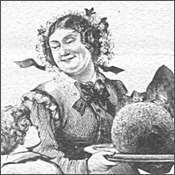
In half a minute Mrs. Cratchit entered — flushed, but smiling proudly — with the pudding, like a speckled cannon-ball, so hard and firm, blazing in half of half-a-quartern of ignited brandy, and bedight with Christmas holly stuck into the top. – Charles Dickens, A Christmas Carol
Stir-Up Day is the name traditionally given to the day on which Christmas puddings are made in England.
Banned by the Puritans in the 1660s for its rich ingredients, the [plum] pudding and its customs came back into popularity during the reign of George I. Known sometimes as the Pudding King, George I requested that plum pudding be served as part of his royal feast when he celebrated his first Christmas in England after arriving from Hanover to take the throne in 1714. By 1740, a recipe for ‘plum porridge’ appeared in Christmas Entertainments. In the Victorian era, Christmas annuals, magazines, and cookbooks celebrated the sanctity of family as much as the sanctity of Jesus’ birth, and the tradition of all family members stirring the pudding was often referenced…Poorer families made the riches version of plum pudding that they could afford…Even workhouse inmates anticipated a plum pudding on Christmas Day.” – Food and Cooking in Victorian England: A History, Andrea Broomfield [Praeger:Westport CT] 2007 (p. 150-151)
Stir-Up Sunday, the last Sunday before Advent, is considered the final day on which one can make the Christmas fruit cakes and puddings that require time to be aged before being served.
The Christmas pudding is traditionally “stirred up” on Stir-Up day day. All family members must take a hand in the stirring, and a special wooden spoon (in honor of Christ’s crib) is used. The stirring must be in a clockwise direction, with eyes shut, while making a secret wish. Source: The Customs and Ceremonies of Britain by Charles Knightly. London:Thames and Hudson, 1986, p. 211.”
—The Folklore of World Holidays, Robert H. Griffen and Ann H. Shurgin editors, Second Edition [Gale:Detroit] 1998 (p. 679)
Stirring the Christmas pudding. Image@LIFE magazine
In past times the words “stir up”…reminded people to begin preparing their Christmas puddings…Children chanted a rhymed verse on that day that mixed the words of the collect with requests for special Christmas fare…Thus, the preparation of the Christmas pudding eventually became associated with this day. Folk beliefs advised each member to take a turn stirring the pudding, and ace that was believed to confer good luck. Another custom encouraged stirrers to move the spoon in clockwise motion, close their eyes, and make a wish.” – Encyclopedia of Christmas and New Year’s Celebrations, Tanya Gulevich, 2nd edition [Omnigraphics:Detroit] 2003 (p. 741)
Cook making Christmas pudding, Cruikshank
Hallo! A great deal of steam! The pudding was out of the copper. A smell like a washing-day! That was the cloth. A smell like an eating-house and a pastrycook’s next door to each other, with a laundress’s next door to that! That was the pudding!- Charles Dickens, A Christmas Carol
A boiled Plum Pudding – Hannah Glasse (18th century recipe)
TAKE a pound of suet cut in little pieces not too fine a pound of currants and a pound of raifins storied eight eggs half the whites half a nutmeg grated and a tea spoonful of beaten ginger a pound of flour a pint of milk beat the eggs first then half the milk beat them together and by degrees stir in the flour then the suet spice and fruit and as much milk as will mix it well together very thick Boil it five hours – Hannah Glasse, The Art of Cookery made plain and easy, p. 137
Rich Plum Pudding Recipe, Lady Godey’s Book, December 1860
Stone carefully one pound of the best raisins, wash and pick one pound of currants, chop very small one pound of fresh beef suet, blanch and chop small or pound two ounces of sweet almonds and one ounce of bitter ones; mix the whole well together, with one pound of sifted flour, and the same weight of crumb of bread soaked in milk, then squeezed dry and stirred with a spoon until reduced to a mash, before it is mixed with the flour.
Cut in small pieces two ounces each of preserved citron, orange, and lemon-peel, and add a quarter of an ounce of mixed spice; quarter of a pound of moist sugar should be put into a basin, with eight eggs, and well beaten together with a three-pronged fork; stir this with the pudding, and make it of a proper consistence with milk. Remember that it must not be made too thin, or the fruit will sink to the bottom, but be made to the consistence of good thick batter.
Taking up the Christmas pudding
Two wineglassfuls of brandy should be poured over the fruit and spice, mixed together in a basin, and allowed to stand three or four hours before the pudding is made, stirring them occasionally. It must be tied in a cloth, and will take five hours of constant boiling.
Carrying the plum pudding
When done, turn it out on a dish, sift loaf-sugar over the top, and serve it with wine-sauce in a boat, and some poured round the pudding. The pudding will be of considerable size, but half the quantity of materials, used in the same proportion, will be equally good.
Presenting the plum pudding
The following articles about plum pudding were published in 19th century periodicals and in a more recent blog:
Colonel Hazard’s Plum Pudding (In which the Colonel proves that plum pudding has impressive staying power.)
Colonel Rowland R. Hazard of electric railroad fame tells a story which gives the plum pudding a new dignity. Several years ago, the colonel suddenly decided to run over to England to make a holiday call on relatives there. It was a few days before Christmas, and just as the colonel was starting for the steamer, a Christmas package arrived for him. He had no time to examine it then, and left orders to have it kept for him. He did not return to New York for two year.s When he did get back, the package was brought down from the garret. It proved to contain a plum pudding that his English friends had sent him. It was as hard as a rock, but Colonel Hazard ordered it to be cooked, and he declares he never tasted a more perfect plum pudding in his life. He is inclined to think that good plum pudding, like the wheat found in the old Egyptian mummy cases, would keep all right for a thousand years. – New York Commercial Advertiser – Good Housekeeping, Vol 5, Hearst Corp, 1887
Plum Pudding
The secret of making plum pudding light and digestible lies in properly preparing the suet, mincing the currants, and boiling a sufficient time. Puddings made with breadcrumbs are lighter than those made wholly of flour; and a mixture of the two makes the best pudding. Plum puddings may be made some time before Christmas, and, having been boiled, the cloth must be opened out, but not taken off the pudding, and dried. Wrapped in paper, and stored in a dry place, puddings will keep good for several months, and only require to be boiled for an hour at the time of serving. – Household Words, A weekly journal, vol 2, 1882. Charles Dickens
Plum pudding is well known for the silver coins and small objects hidden within the pudding to be found by the eater. Common objects were the silver coin for wealth, a tiny wishbone for good luck, a silver thimble for thrift, a ring for marriage or an anchor for safe harbor. These items have migrated from plum pudding to bridal shower cakes, oddly enough…- Gram’s Recipe Box, Plum Pudding
In the second episode of At Home With the Georgians: A Woman’s Touch, Amanda Vickery mentioned metamorphic furniture and (remarkably) turned a desk into a bed. A visitor to Tony Grant’s excellent post left this question: What is metamorphic furniture?
Modern example of metamorphic furniture: hall table/card table
Tony answered the question admirably. This mechanical furniture, wide-spread in Georgian times, had a dual use. A small folding staircase could be transformed into chair or desk, such as a writing table, library table, or card table. These pieces of furniture were great space savers, as I can attest. Only last week I transformed my faux-Georgian hall table into a card table for my guests. I never guessed until Tony’s post that I owned an example of mechanical furniture. Sweet!
The only change I would make in the video (besides the annoying lilt in my voice) is to make sure that the next time I film an example of my furniture, it is thoroughly dusted and cleaned! Extra points if you can spot my pooch in one of the scenes. His hang dog expression tells me that he was out of sorts, having been told to stay put.
READ MORE: If your interest in the topic is piqued, Clive Taylor (who also left a comment on the previous post) has written a dissertation on the topic (click here to read The Regency Period Metamorphic Chair) and sells metamorphic library chairs/stairs in his shop, Parbold Antiques.
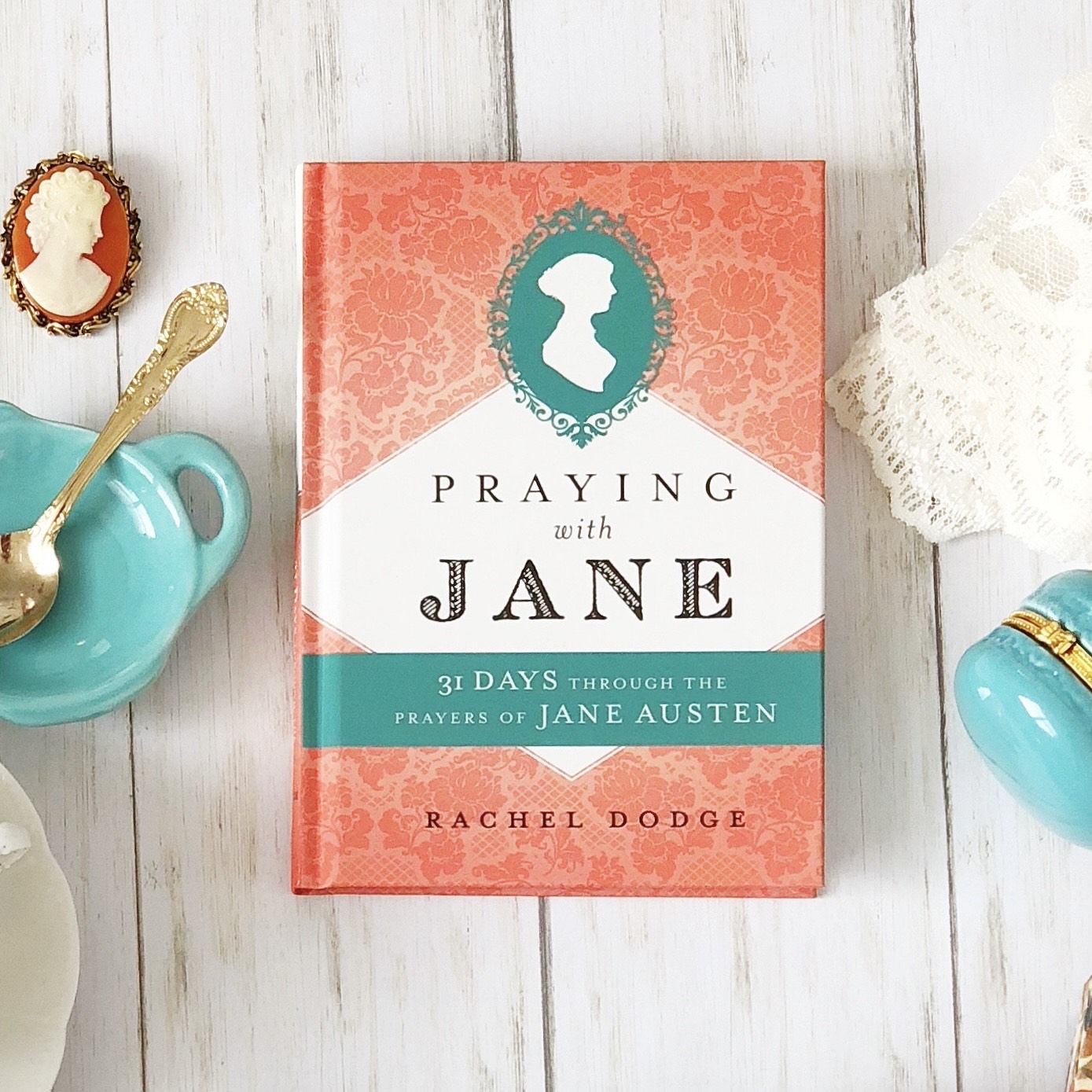
Fashionable Goodness: Christianity in Jane Austen's England is now available! By JAW contributor Brenda S. Cox. See Review. Available from Amazon and Jane Austen Books.
Available through December 31st, 2025. Click on image for details, and share this poster with other teachers and students!
The Obituary of Charlotte Collins by Andrew Capes
Click on image to read the story.
Comments
“My idea of good company…is the company of clever, well-informed people, who have a great deal of conversation.” – Jane Austen, Persuasion
Gentle readers: Please feel free to post your comments and continue the conversation! Due to SPAM, we will no longer accept comments on posts after 30 days of publication. In some instances, links will be removed from comments as well.
Administrators and Contributors
Vic Sanborn, founder of this blog, is supported by a team of talented and knowledgeable writers about Jane Austen and the Regency era. They are:
Tony Grant, who now contributes his photos from London and England
Click on their names to enter their own blogs.
In addition, we thank the many experts and authors who frequently contribute their posts and opinions, and who continue to do so freely or at our request.
Click here to enter the page. Topics include Regency fashion, historic foods, Jane Austen societies, British sites, related topics. Click on image.
May we suggest?
Hello, my name is Vic and I live in Maryland, USA. I have adored Jane Austen almost all of my life. I am a proud lifetime member of the Jane Austen Society of North America. This blog is a personal blog written and edited by me and my team. We do not accept any form of cash advertising, sponsorship, or paid topic insertions. However, we do accept and keep books and CDs to review.
If you would like to share a new site, or point out an error, please email us. (Yes, we are fallible. We'll own up to our mistakes and will make the corrections with a polite smile on our faces.) Write us at
Thank you for visiting this blog. Your comments and suggestions are most welcome.
Project Gutenberg: eBook of Stage-coach and Mail in Days of Yore, Volume 2 (of 2), by Charles G. Harper
STAGE-COACH AND MAIL IN DAYS OF YORE: A PICTURESQUE HISTORY
OF THE COACHING AGE, VOL. II, By CHARLES G. HARPER. 1903. Click on this link.