Feeds:
Posts
Comments

Archive for the ‘Jane Austen’s World’ Category

Chawton House Library has in its collection a rare green suit worn by Jane Austen’s brother, Edward. The suit – a child’s frock coat with matching breeches – looks very similar to the clothes young Edward is seen wearing in the Wellings Silhouette, which depicts his presentation to his adoptive parents. The suit is made of green silk, while the coat is fully lined with gold taffeta. Edward apparently liked oversized buttons, which can be seen in this frock coat and in the Grand Tour painting he had commissioned during his travels through Europe as a young man.

As you can see from the images of the suit (below), extensive and expensive conservation work is needed to stabilize the suit’s condition to prevent its further deterioration. Work on long term preservation is required before the suit (which was made in 1789 ) can be displayed, and donations are needed for its long term preservation.

Edward Austen Knight on the Grand Tour

The suit’s provenance is impeccable. While experts can’t categorically say that this is the actual jacket worn in the Wellings silhouette, it certainly belonged to Edward. The suit was passed down through generations of the Knight and Bradford family, and finally ended up in a dressing up box belonging to the Bradford family. The Bradfords are relations of the Knight Family and also descendents of Edward Austen Knight. Richard Knight, current owner of Chawton House, was given the suit some years ago by the Bradford Family.

Edward a fortunate child, had two families who considered him their son: the Austens and the Knights. The following history (which is reproduced by permission), chronicles how Edward Austen was adopted by the Knight family, a practice commonly followed by childless couples of the time:
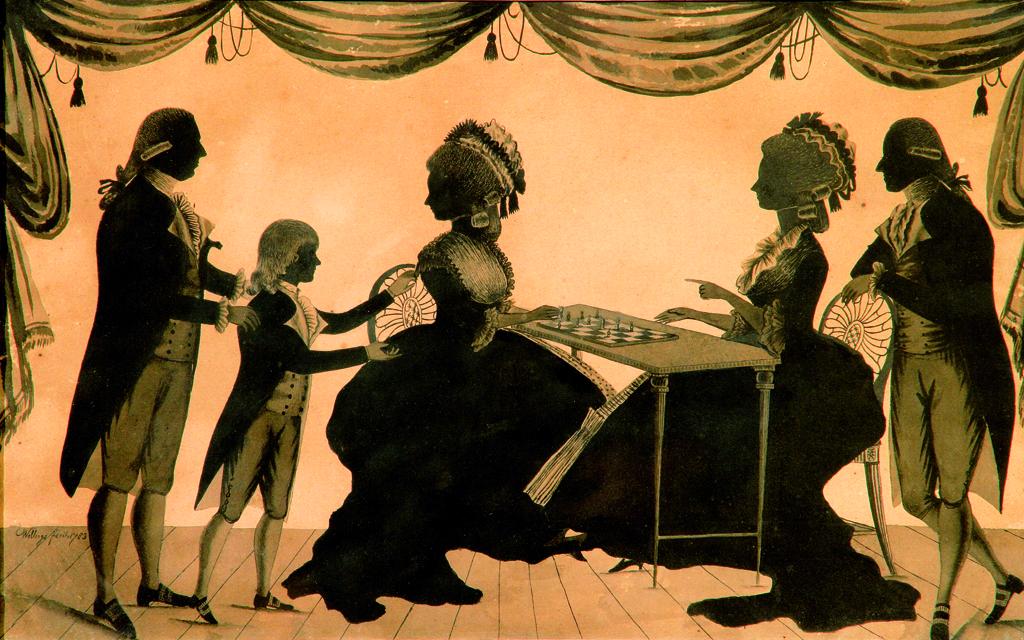
Rev. George Austen presents his son Edward to the Knight family

The freehold of Chawton House has remained in the Knight family ever since the sixteenth century, though on many occasions the ownership passed laterally and sometimes by female descent, requiring several heirs to change their surnames to Knight. Sir Richard Knight, who inherited at the age of two in 1641, had no children and he left the estate to a grandson of his aunt, Richard (Martin) Knight. His brother, and then his sister, Elizabeth, inherited in their turn. During the first part of the eighteenth century, Elizabeth undertook the further development of the house and gardens. She married twice, but again no children were born, and when she died the estate passed to her cousin Thomas Brodnax May Knight, who united it with his own large fashionable property in Kent, Godmersham Park.

In 1781, Thomas Knight II inherited, but when he and his wife Catherine showed no sign of having children of their own, they adopted a son of the Reverend George Austen, who was a cousin of Thomas Knight’s. The Austen’s had six sons and two daughters, and the Knights adopted the third eldest son, Edward. Edward Austen Knight eventually took over management of the estates at Godmersham and Chawton in 1797, living mostly at Godmersham and letting the Great House at Chawton to gentlemen tenants.

In 1809 he offered a house in the village to his mother and two sisters Cassandra and Jane, and it was there that Jane Austen began the most prolific period of her writing life. Her career as a novelist took off with the publication of Sense and Sensibility in 1811, and she went on to publish a further three of her novels while at Chawton (two more followed shortly after her death). She lived in Chawton almost until her death in 1817, only moving to Winchester near the end of her life to be nearer medical care.

This meeting and subsequent adoption is a pivotal moment in English literary history because, had not Edward been adopted by Thomas and Catherine Knight, and then inherited Chawton House, his sister, Jane Austen may not have been able to complete her novels and as a consequence, probably the most famous women writers of the age, would never have been discovered.

The Library intends to eventually display the suit in the Oak room at Chawton House, a room well known by Jane Austen and where the original of the ‘Wellings’ silhouette is located. Supporters are asked to donate funds for the project, which will cost £12,000 ($ 17, 318). A stockman and environmentally controlled cabinet need to be custom-made for a secure display. A child’s mannequin, which must be constructed of conservation quality materials, will also be made for the display.

Green silk Breeches, dated to approximately 1789.

Frock coat with lining

Additional plans include making a replica suit to show to school children. Students and visitors will learn about the social history and background of the suit, including its style and construction, and from what materials the suit was made (silk and taffeta), who made it, and where the silk came from.

To make a donation, click on the link to the Virgin Giving website.

About Chawton House:

The house is open to the public for ‘Open’ tours in the afternoon of Tuesdays and Thursday each week, and pre booked tours most days of the week. Conferences  based on studies of the ‘Long’ 18th Century and women writers are scheduled regularly. Last year an important three day international conference was held to celebrate the bicentennial anniversary of Jane Austen’s arrival in Chawton. The event was attended by Austen scholars from all over the world. In excess of 8,000 visitors visited the house, gardens and library last year.
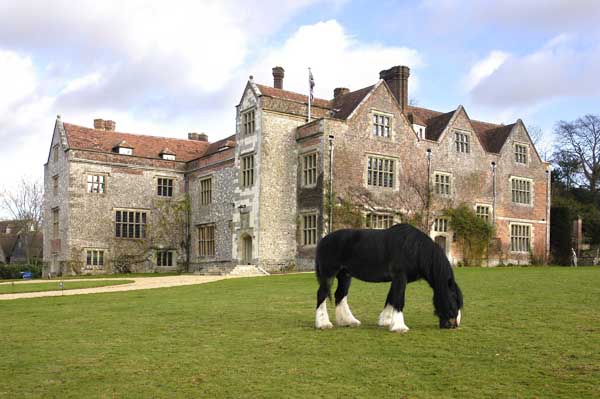
Chawton House (Image from website)

Chawton House Library works in partnership with Jane Austen’s House Museum to provide high quality visits to both sites for primary, secondary and A level schools and colleges. These include presentations of Jane Austen Life and works, tours of both houses, workshops relating to dress, manners and the use of herbs, dancing in replica clothing and an opportunity to handle real objects from the period of Austen’s life. For this work both Houses were awarded a Heritage Education Trust award.  Restoration of Edward’s suit is integral to the history of Chawton House and also has an important place in the interpretation of the life and legacy of Jane Austen.

Thomas Draddyll in 1789 wears a typical boy's suit of the era. Painted by Sir Joshua Reynolds.

Breakdown of Project Costs

  • Conservation of the Suit: £6629.35
  • Display Case: £4788.13
  • Mount or Stockman: £587.50
  • Replica Suit: £646.25
  • Total Project Costs £12,651.23

More on the topic:

Read Full Post »

Great news! Jane Austen’s World has been nominated for best Jane Austen blog by the good people at The Jane Austen Centre. Click on this link to VOTE for *hint* this blog as well as these categories: Which actress is your favorite Emma Woodhouse? Which actor is your favorite Mr. Knightley? Best Austen inspired book published in 2009? What is your favorite Jane Austen Minor Work? Who is your favorite Jane Austen rogue?

You are allowed one vote! While you are there, poke around this great site, which features an online magazine, a shoppe, forum, videos, and other Jane Austen inspired topics and interests. You can also sign up for their email newsletter, which Becca drops in my inbox with welcome regularity.

The Jane Austen Centre, Image, Wikimedia Commons

Read Full Post »

The Prince Regent – “Prinny” – made no secret of his reluctance to marry Princess Caroline of Brunswick. Some years before he had secretly married Mrs. Maria Fitzherbert, a Catholic widow and the woman he loved. But according to the Royal Marriage Act their union was illegal. Princess Caroline, the daughter of Prinny’s eldest aunt AND a Protestant, was considered a more suitable consort by King George III. This proposed union with his cousin went much against the Prince’s  wishes, and when he met the 27-year-old German Princess in 1795, he turned to Lord Malmesbury and said, “Harris, I am not well. Pray, get me a glass of brandy.”

The Prince of Wales had acquiesced to his father’s wishes only to clear his debts, which totaled £630,000 pounds, a staggering sum for that era, and for an increase in his yearly allowance. Although Prinny’s first impression of Caroline was unfavorable, she was thought to be quite pretty in her youth. The Prince, who was soft and fat,  made an equally distasteful first impression on the Princess, and thus the couple, both spoiled and eccentric (to put it mildly) were off to a bad start. During the ceremony Prinny continually looked at his mistress, Lady Jersey, instead of his wife, and at one point the King had to persuade the Prince to finish the ceremony.

The marriage ceremony proceeded as arranged, attended by his well pleased father, on the evening of 8th April, 1795 at the Chapel Royal at St. James’ Palace. The bride wore a elaborate dress of silver tissue and lace and a velvet robe lined with ermine. The distraught bridegroom spent his wedding night lying on the bedroom floor by the fireplace in a drunken stupor.

Prinny and his German bride (Image from the Georgian Index)

Although he was repelled by his wife, George eventually did his duty and brought himself to consummate the marriage and the Princess of Wales gave birth to a daughter and heir to the throne, Princess Charlotte, on 7th January, 1796.”  – English monarchs

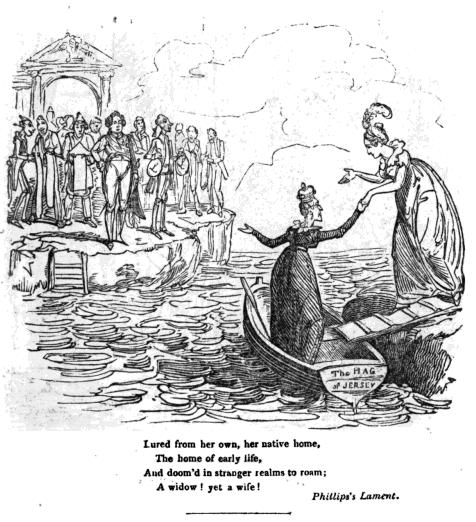
Although not entirely unattractive, Princess Caroline was neither graceful nor elegant, nor did she behave in a regal fashion. Her “clumsy deportment and jerky movements made one MP liken her to a “Fanny Royds” (a weighted Dutch doll with red cheeks that jumps up to standing position)” – Historicizing Romantic Sexuality. Her German manners and demeanor never quite came up to English royal expectations or their level of “sophistication.” Lady Jersey, the Prince’s mistress at the time, was cruel enough to wear a pair of pearl bracelets in front of Caroline that the Prince had originally presented to his bride as a wedding gift. He then took the jewelry back and gave the bracelets to Lady Jersey. The cartoon in the first image, which is sympathetic towards Caroline’s marital situation, shows Lady Jersey as an old hag welcoming a virginal Caroline to England.

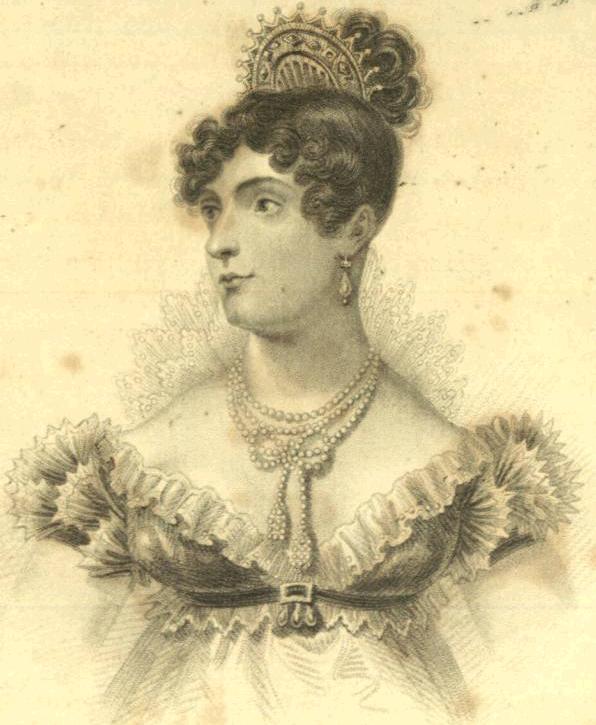
Caroline, Princess of Wales (Image from LIFE)

In her youth Caroline could look quite presentable. A contemporary described her as being

… above the middle height, extremely spread for her age, her bosom full but finely shaped, her shoulders large, and her whole person voluptuous, but of a nature to become soon spoiled; and without much care and exercise she will shortly lose all beauty in fat and clumsiness. Her skin is white but not a transparent white. There is little or no shade in her face, but her features are very fine. Their expression like that of her general demeanour is noble. Her feet are rather small, and her hands and arms are finely moulded She has a hesitation in her speech amounting almost to a stammer … – Memoirs of the Court of England During the Regency (1811-1820)

Observers did agree on several aspects about Caroline: her manners could be coarse and gruff, and her taste in dress was atrocious. Mary Berry described the princess in her journal: “Such an over-dressed, bare-bosomed, painted eye-browed figure one never saw”.  She flouted convention,  “even if this meant exposing her decidedly lustful nature”; this rebellious streak, accompanied by her “outlandish ways and bizarre dress sense” combined to give Caroline an eccentricity not becoming in a female member of the British court, let alone its royal family.” – Elizabeth Fay, Historicizing Romantic Sexuality. As Caroline aged, her penchant for wearing virginal gowns made her look ridiculous and she became a target for satirists, as in the image below.

Caroline tended to dress too youthfully for her age and often cut a ridiculous figure in public.

Caroline, who flaunted her unconventional and ribald tastes, surrounded herself with people of questionable morality.

The Princess evidently preferred gay company, a certain sprinkling of intelligence with a good flow of animal spirits being the ordinary passports to her society. No questions appear to have been asked of either sex; it is therefore not surprising that several of the favoured circle were celebrated more or less for their independence of moral obligations.” – Memoirs of the Court of England During the Regency (1811-1820)

The Duke of Buckingham and Chandos observed of her childhood: “Her faults have evidently never been checked nor her virtues fostered.” The Princess remained capricious and lewd all her life, and her risque conversations kept her attendants  in daily dread of her impetuous pronouncements.

Portrait of Caroline by Thomas Lawrence

Caroline was  –  in her husband’s eyes – expendable. He thought her an unfit wife and mother and permitted her to see her daughter Princess Charlotte only once a week. Prinny’s reluctance to live with his wife and daughter, his politics, and his profligate ways made him unpopular with the public. Princess Caroline made the most of this situation, publicly playing the role of victim, even though by contemporary accounts she did not demonstrate much affection for her daughter. The Queen’s Matrimonial Ladder, published in 1820, demonstrates how sympathetic many were to her plight as the Prince Regent’s ostracized wife. Jane Austen famously wrote:  “Poor woman, I shall support her as long as I can, because she is a Woman and because I hate her Husband.”

Sartiric Cartoon: Princess Caroline shows up at the King's Theatre during the performance of Don Giovanni, reminding the Prince that he is married

Banned from the social gatherings at the Prince’s lodgings and at Carlton House, Caroline established a rival court at Kensington Palace and Blackheath. The strange marriage between this eccentric couple provided an endless source for gossip, for Caroline’s indiscretions (as well as Prinny’s)  were public knowledge:

… her Royal Highness had associates of an infinitely lower grade to whom she often devoted herself with an abandonment of self respect that equally perplexed and disgusted the ladies of her suite.  With such a Court, as may be imagined, the pursuits of the Princess were not remarkable for dignity were often remarkable for its violation.” – Memoirs of the Court of England During the Regency (1811-1820)

In 1814, Caroline moved to Europe, traveling to Germany and Switzerland, and living for some time in Italy.  The Prince sent agents to spy on her in order to prove not only her unfitness as mother and wife, but the burden she placed on the privy purse as well. Her every movement was reported back to England. And there was much to report, for her randy behavior was shocking, so much so that the members of her English entourage left her one by one. She dyed her blond hair black, favored short, diaphanous dresses that were designed for women half her age (she was in her forties), bared her bosom and arms, and danced and partied until the wee hours of the morning. Caroline loved spectacles and grand entrances:

At Genoa, [she] drove through the streets in a phaeton with a child dressed as a cupid leading two tiny horses who pulled the shell-shaped carriage. Caroline was dressed in a body-revealing pink gauze bodice, short white skirt and pink-feathered headdress.” – Historicizing Romantic Sexuality

Lady Bessborough wrote a description of Caroline at a ball during this period:

The first thing I saw in the room was a short, very fat, elderly woman, with an extremely red face (owing, I suppose, to the heat) in a girl’s white frock looking dress, but with shoulder, back, and neck, quite low (disgustingly so) down to the middle of her stomach; very black hair and eyebrows, which gave her a fierce look, and a wreath of light pink roses on her head…I could not bear the sort of whispering and talking all round about…” – The Prince of Pleasure, J.B. Priestley

Caroline and Pergami in the Bath

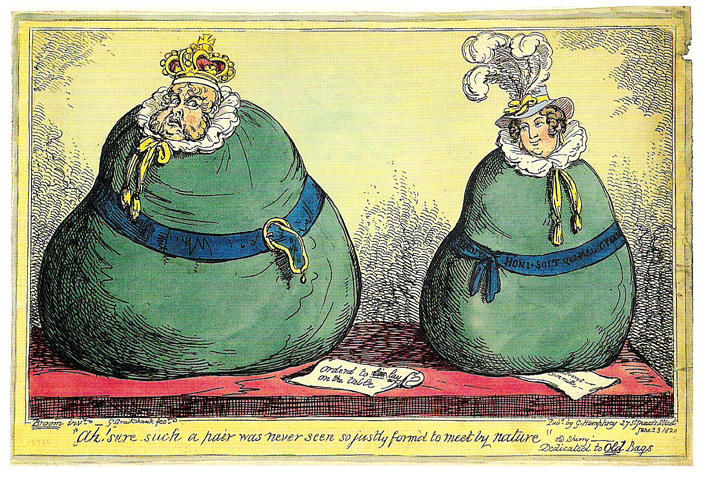
When she arrived in Milan, the peripatetic Caroline met Bartolomeo Pergami, a tall and handsome ex-soldier who became her chamberlain. She began an affair with him, treating him more like her consort than lover. Their brazen relationship opened an investigation into her behavior. Thirty-one Italian witnesses were called, resulting in the conclusion that Caroline had engaged in continued adulterous intercourse. The Two Green Bags illustration (below) comes with the following interpretation: “In this iconic caricature, George and Caroline are depicted as a pair of fat green bags, a clear reference to the green bags that contained the evidence collected against Caroline by the Milan commission. George is much fatter than Caroline, and his bag is girded by a garter belt, part of which hangs down in the manner of a limp penis.” Wikimedia Commons. The truth was that the Princess was happy with Pergami and would have been content to remain in Italy had she been provided with a handsome enough income. (At that time she received 35,000 pounds per year.)

Two green bags

Prinny, who did not bother to hide his many scandalous affairs from the public, was excessively cruel to Caroline when their daughter, Princess Charlotte, died in childbirth. Instead of contacting Caroline directly, she heard about her daughter’s death through secondary sources. When King George III finally died, Caroline returned to England to claim her rights as Queen. Arriving in Dover in June 1820, she was cheered by crowds as she traveled in triumph to London.  The irony was that despite her outlandish behavior abroad, the public so hated George IV that they supported her with wild (almost blind) loyalty, burning bonfires in her honor and setting off illuminations. Caroline took full advantage of her popularity, showing up at public events as often as possible. Her celebrity did not deter George from seeking a formal separation and a divorce from his much loathed wife.

Caroline returns to England against much winded opposition (image from The Queen's Matrimonial Ladder)

He persuaded Lord Liverpool and his government to bring in an Act of parliament to deprive her of the title Queen and to declare the marriage “for ever wholly dissolved, annulled and made void”. The Whigs opposed the measure and their were public demonstrations against the new king.” – Historicizing Romantic Sexuality

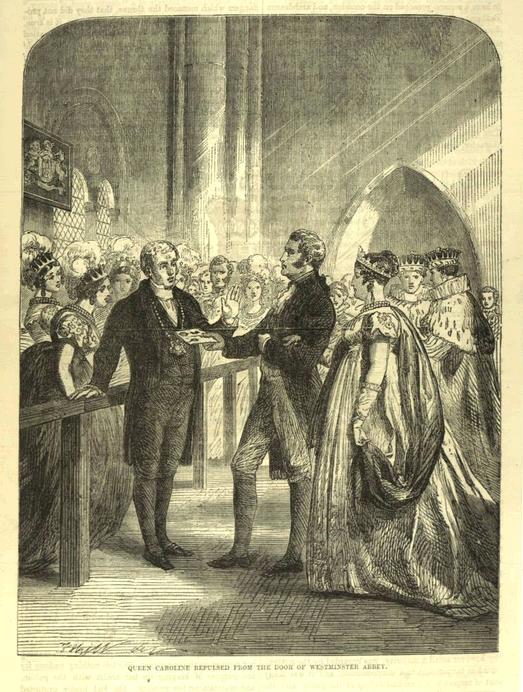
Queen Caroline repulsed from Westminster Abbey (LIFE magazine image)

The bill to deprive Caroline from her right, privileges, and pretension to Queen Consort was thrown out after weeks and weeks of political wrangling. Caroline, who was no fool, said: “No one cares for me in this business.” She appeared fully and royally dressed at King George’s coronation but was turned away from the doors of Westminster Abbey a number of times, as she tried repeatedly to enter several entrances with no success. This outrageous action resulted in further public demonstrations that ended when Caroline died suddenly on August 7th in 1821 of an unknown gastric disorder. She was 53.

Queen Caroline in 1820, (LIFE Magazine image)

More on the Topic

Read Full Post »

Juliette Wells (L) and Christine Stewart (R)

Gentle Readers: Chris Stewart has contributed her recent thoughts to my blog. She has Embarked on A Course of Study regarding Jane Austen, a most fascinating journey that has her interviewing Janeites, dancing country dances, studying Jane Austen’s life and novels, and interviewing Jane Austen Scholars like Juliette Wells. Here then is Christine’s most recent contribution:

(A post in which I complain about everything I’m reading.)

Sometimes I really love my job. And sometimes it sucks the life out of my life. Between it and the fact that more furloughs are on the way so I’ve decided to rent out my house, move in with my sister, and save money (travel to the UK is also on the agenda), my focus has been elsewhere. There’s work to do on the house, documents to file with the property manager, packing. I just haven’t felt like reading anything taxing. I wanted book candy, so I reread Shannon Hales’ Austenland. Which is just as fabulous as I remember. See? I am committed – even my fluff reading is Austen-related.

So back to why I love my job. Stick with me, I do have sort of a theme going here. I’m the program director for literary arts with my state’s arts council and that meant, last month, I was able to make a site visit to Frederick to hear Elizabeth Gilbert (Eat, Pray, Love) speak. It was hosted by an organization that may apply for funding and I needed to attend an event, get a feel for what type of events they present, what type of audience attends, etc.

Before I go further, let me say that I think I’m the only person on the planet who didn’t fall for Eat, Pray, Love. It was just too ‘precious’ a story and didn’t have enough grit. It was all just too perfect for me. And the book/trip was planned. It didn’t just happen. That takes the magic out of it.

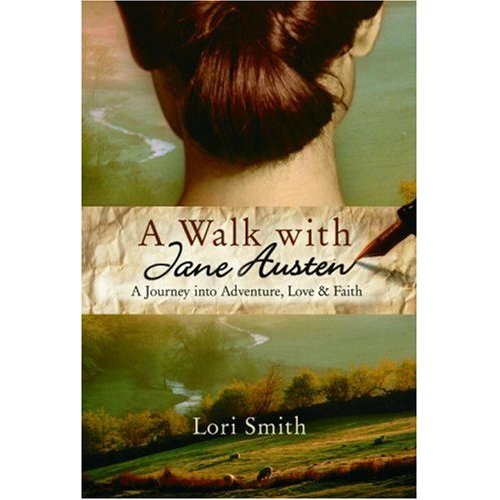
It made me think that maybe the pilgrimage thing is now officially ‘done.’ I mean, there’s EG’s book, and there’s Lori Smith’s book, A Walk With Jane Austen. Thankfully, though, after reading Lori smith’s book, I realize it’s not ‘done’ when it comes to Austen.

I really wanted to like the book. Lori and I see things similarly sometimes; I often found myself thinking she was going to say something and she then said it. I think that’s good. Or it might be predictable. I can’t decide. I was leaning on the side of trying to connect with her as a good reader should.

But there’s very little joy in the book. Most of it is either about God (there’s A LOT of Christianity in this book), or regurgitating Jane Austen info that we can find anywhere, or dissecting a non-existent relationship with a guy named Jack, that she meets at the start of the trip. None of these are positive musings, except the Jane part, as we love Jane, but I would have preferred less rehashing of known info.

And there’s very little in the way of a sense of humor in this book – a ‘make the best of it, find the humor in it’ mentality. I mean, she’s in freakin’ England visiting Austen sites. What is there not to be happy about??? She has an ongoing illness, which I am sorry about, but if it was going to drag her down as much as it does physically, mentally, emotionally (and us with her), then maybe she shouldn’t have gone.

Tina Fey

She also makes a huge error in judgment in the beginning of the book with a man she meets, inexcusable in one who is supposedly so well versed in Austen’s novels, which I go into more detail about in my post.

I don’t really have a connection to Tina Fey here, except that she strikes me as a 21st century Austen in her medium – television. She’s the edgy, sarcastic, funny, sometimes bitter side of all of us. As Elizabeth Gilbert is the open, loving, spiritual, innocent side. I think we should do justice to both. Plus, my best friend swears Tina Fey reminds her of me. I’m taking that as a compliment.

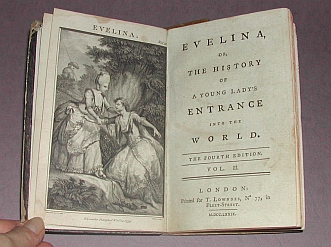
Evelina by Frances Burney

I haven’t just been completely idle; I have started Evelina by Fanny Burney and have decided two things.

You’ll have to go to the website to find out what they are: Embarking on a Course of Study

More Posts on the Topic

Read Full Post »

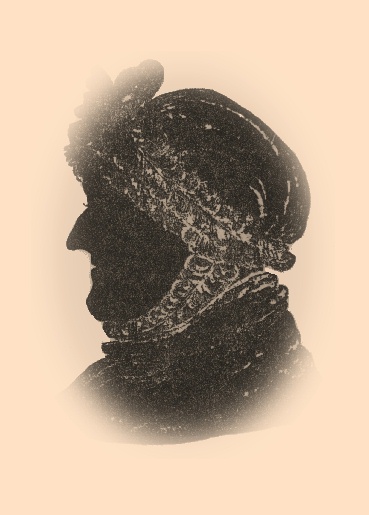
This weekend as we celebrate Mother’s Day, my thoughts turn to Cassandra Austen,  wife of Rev. George Austen and mother of Jane Austen. Cassandra was related to the Leighs of Stoneleigh Abbey.  In 1806, the recently widowed Mrs. Austen visited Adlestrop Rectory in Gloucestershire with her two daughters, where they stayed with her cousins Rev. Thomas Leigh and his sister Elizabeth.  During their visit,  Rev. Thomas Leigh learned that the Hon. Mary Leigh of Stoneleigh Abbey had died and that he would inherit the great house, whose origins go back to 1154. The Austen women traveled with Rev. Leigh to Warwickshire. In the following letter, Mrs. Austen writes glowingly about their stay at the mansion:

“STONELEIGH ABBEY,
“August 13, 1806.

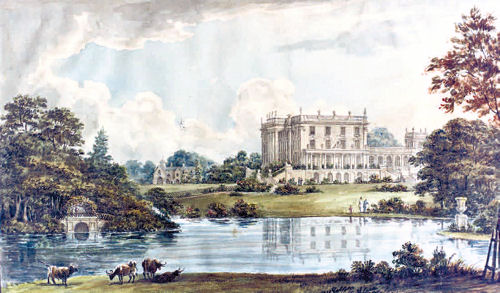
“MY DEAR MARY, – The very day after I wrote you my last letter, Mr. Hill wrote his intention of being at Adlestrop with Mrs. Hill on Monday, the 4th, and his wish that Mr. Leigh and family should return with him to Stoneleigh the following day, as there was much business for the executors awaiting them at the Abbey, and he was hurried for time. All this accordingly took place, and here we found ourselves on Tuesday (that is yesterday se’nnight) eating fish, venison, and all manner of good things, in a large and noble parlour, hung round with family portraits. The house is larger than I could have supposed. We cannot find our way about it – I mean the best part; as to the offices, which were the Abbey, Mr. Leigh almost despairs of ever finding his way about them. I have proposed his setting up direction posts at the angles. I had expected to find everything about the place very fine and all that, but I had no idea of its being so beautiful. I had pictured to myself long avenues, dark rookeries, and dismal yew trees, but here are no such dismal things. The Avon runs near the house, amidst green meadows, bounded by large and beautiful woods, full of delightful walks.

Stoneleigh Abbey, 1808, Humphrey Repton

“At nine in the morning we say our prayers in a handsome chapel, of which the pulpit, &c. &c., is now hung with black. Then follows breakfast, consisting of chocolate, coffee, and tea, plum cake, pound cake, hot rolls, cold rolls, bread and butter, and dry toast for me. The house steward, a fine, large, respectable-looking man, orders all these matters. Mr. Leigh and Mr. Hill are busy a great part of the morning. We walk a good deal, for the woods are impenetrable to the sun, even in the middle of an August day. I do not fail to spend some part of every day in the kitchen garden, where the quantity of small fruit exceeds anything you can form an idea of. This large family, with the assistance of a great many blackbirds and thrushes, cannot prevent it from rotting on the trees. The gardens contain four acres and a half. The ponds supply excellent fish, the park excellent venison; there is great quantity of rabbits, pigeons, and all sorts of poultry. There is a delightful dairy, where is made butter, good Warwickshire cheese and cream ditto. One manservant is called the baker, and does nothing but brew and bake. The number of casks in the strong-beer cellar is beyond imagination; those in the small-beer cellar bear no proportion, though, by the bye, the small beer might be called ale without misnomer. This is an odd sort of letter. I write just as things come into my head, a bit now and a bit then.

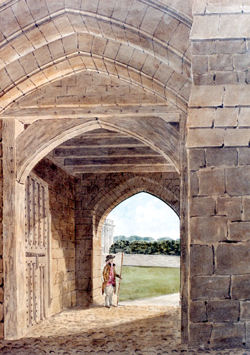
Stoneleigh Abbey, Gatehouse. 1807

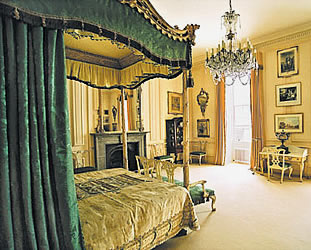
“Now I wish to give you some idea of the inside of this vast house – first premising that there are forty-five windows in front, which is quite straight, with a flat roof, fifteen in a row. You go up a considerable flight of steps to the door, for some of the offices are underground, and enter a large hall. On the right hand is the dining-room and within that the breakfast-room, where we generally sit; and reason good, ’tis the only room besides the chapel, which looks towards the view. On the left hand of the hall is the best drawing-room and within a smaller one. These rooms are rather gloomy with brown wainscot and dark crimson furniture, so we never use them except to walk through to the old picture gallery. Behind the smaller drawing-room is the state-bedchamber – an alarming apartment, with its high, dark crimson velvet bed, just fit for an heroine. The old gallery opens into it. Behind the hall and parlours there is a passage all across the house, three staircases and two small sitting-rooms. There are twenty-six bedchambers in the new part of the house and a great many, some very good ones, in the old.

Bedroom, Stoneleigh Abbey

There is also another gallery, fitted up with modern prints on a buff paper, and a large billiard-room. Every part of the house and offices is kept so clean, that were you to cut your finger I do not think you could find a cobweb to wrap it up in. I need not have written this long letter, for I have a presentiment that if these good people live until next year you will see it all with your own eyes.

Arch, Stoneleigh Manor, Repton, 1807

“Our visit has been a most pleasant one. We all seem in good humour, disposed to be pleased and endeavouring to be agreeable, and I hope we succeed. Poor Lady Saye and Sele, to be sure, is rather tormenting, though sometimes amusing, and affords Jane many a good laugh, but she fatigues me sadly on the whole. To-morrow we depart. We have seen the remains of Kenilworth, which afforded us much entertainment, and I expect still more from the sight of Warwick Castle, which we are going to see to-day. The Hills are gone, and my cousin, George Cook, is come. A Mr. Holt Leigh was here yesterday and gave us all franks. He is member for, and lives at, Wigan in Lancashire, and is a great friend of young Mr. Leigh’s, and I believe a distant cousin. He is a single man on the wrong side of forty, chatty and well-bred and has a large estate. There are so many legacies to pay and so many demands that I do not think Mr. Leigh will find that he has more money than he knows what to do with this year, whatever he may do next. The funeral expenses, proving the will, and putting the servants in both houses in mourning must come to a considerable sum; there were eighteen men servants.” – Letter, Hill, Jane Austen: Her Homes and Her Friends

More on the topic:
Images: Plants info

Bedroom image: UK Student Life

Add to DeliciousAdd to DiggAdd to FaceBookAdd to Google BookmarkAdd to RedditAdd to StumbleUponAdd to TechnoratiAdd to Twitter

Read Full Post »

« Newer Posts - Older Posts »