Feeds:
Posts
Comments

Archive for the ‘Jane Austen’s World’ Category

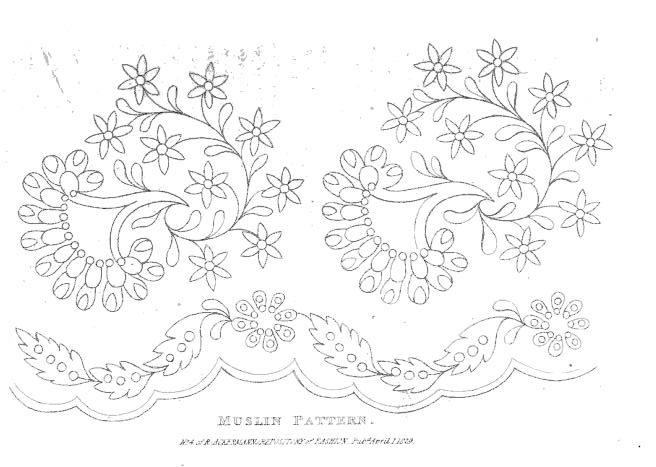
Gentle reader – a few weeks ago someone asked me how the beautiful muslin patterns that Ackermann’s Repository of Fashions offered in its magazines could be transferred. This 19th century Enclyclopedia from Project Gutenberg offers practical suggestions. Among them are:

Tracing patterns against a window pane.—In order to copy a pattern in this way, the first step is to tack or pin the piece of stuff or paper on which the copy is to be made upon the pattern. In the case of a small pattern, the tacking or pinning may be dispensed with and the two sheets held firmly pressed against the window pane with the left hand, whilst the right hand does the tracing, but even then it is safer to pin or gum the four corners of the two sheets together, in case of interruption, as it is difficult to fit them together again exactly.

The tracing may be done with a pencil, or better still, with a brush dipped in Indian ink or water-colour paint.

The process of tracing is easy enough, so long as the hand does not get tired but as this generally comes to pass very soon it is best, if the pattern be a large and complicated one, to stick the sheets to the pane with strong gum or suspend them on a string, fastened across the pane by pins stuck into the window frame on either side.

To copy with oiled paper.—Another rather expeditious mode of transferring patterns on to thin and more especially smooth glossy stuffs, is by means of a special kind of tinted paper, called autographic paper, which is impregnated with a coloured oily substance and is to be had at any stationer’s shop. This you place between the pattern and the stuff, having previously fastened the stuff, perfectly straight by the line of the thread, to a board, with drawing-pins. When you have fitted the two papers likewise exactly together, you go over all the lines of the pattern with a blunt pencil, or with, what is better still, the point of a bone crochet needle or the edge of a folder. You must be careful not to press so heavily upon the pattern paper as to tear it; by the pressure exercised on the two sheets of paper, the oily substance of the blue paper discharges itself on to the stuff, so that when it is removed all the lines you have traced are imprinted upon the stuff.

This blue tracing paper is however only available for the reproduction of patterns on washing stuffs, as satin and all other silky textures are discoloured by it.

To pounce patterns upon stuffs.—The modes of copying, hitherto described, cannot be indiscriminately used for all kinds of stuff; for cloth, velvet and plush, for instance, they are not available and pouncing is the only way that answers.

The patterns, after having been transferred to straw or parchment paper, have to be pricked through. To do this you lay the paper upon cloth or felt and prick out all the lines of the drawing, making the holes, which should be clear and round, all exactly the same distance apart.

The closer and more complicated the pattern is, the finer and closer the holes should be. Every line of the outline must be carefully pricked out.

If the paper be sufficiently thin, several pouncings can be pricked at the same time, and a symmetrical design can be folded together into four and all pricked at once.

Read Full Post »

Jane Austen was born in 1775, the same year as Mrs. Robert Shurlock (born Henrietta Ann Jane Russell). Had Jane married and given birth to a child in 1801, would she have presented as charming a picture as Mrs. Shurlock and her daughter Ann? Both women would have been twenty-six years of age at the time. From this description of Jane, Mrs. Shurlock could well have been a relative, for according to her nephew James Austen-Leigh, his aunt Jane had:

“ full round cheeks, with mouth and nose small and well formed, light hazel eyes, and brown hair forming natural curls close round her face.”

John Russell, the painter and sitter’s father, was known for his skills with pastels, as this image from the Metropolitan Museum of Art clearly demonstrates. Henrietta took lessons from her father and became a talented artist in her own right.

Read Full Post »

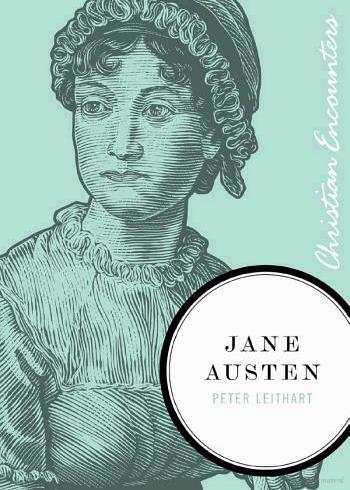
Jane Austen: Christian Encounters arrived on my doorstep  unsolicited. I read it with some trepidation, for the title seemed to reek of Sunday morning sermons from a stern minister, worse, from a silly man like Mr. Collins or Mr. Elton. I discovered with pleasant delight that Peter Leithart, a theology teacher at New St. Andrews College and pastor of Trinity Reformed Church, delivered a tight, concise and highly interesting biography of Jane/Jenny Austen.  His sources were impeccable: Claire Tomalin, Irene Collins, Caroline Austen, Claire Harman, Deirdre Le Faye, Jane Austen’s letters, Roger Sales, J.E. Austen-Leigh, and Henry Austen. I could continue, but I think you get the gist. Gems are dropped throughout the book, like Anna LeFroy’s observation of Jane’s opinion of her  own musical skills:

Nobody could think more humbly of Aunt Jane’s music than she did herself, so much so as at one time to resolve on giving it up. The Pianoforte was parted with on the removal from Steventon, and during the whole time of her residence in Bath she had none. “

Jane’s life is introduced logically, from her earliest years with her family to her education to her early novels and the disruptions in her life (Bath), to her mature years and published novels and early death. These events remind us of Jane’s life as a minister’s daughter. About her father’s death, Leithart writes:

She took comfort, as she frequently did, in the ease of his death, and his lifelong preparation as a believing Christian: “Heavy as is the blow, we can already feel that a thousand comforts remain to us to soften it. Next to that of the consciousness of his worth & constant preparation for another World, is the remembrance of his having suffered, comparatively speaking, nothing…”

Leithart writes his book from a biographical perspective. And also as a Jane Austen scholar. About her characters he discusses her rather gentle ribbing of her own characters and her humanistic viewpoint:

Austen never forgot that her villains and villainesses are also humans. Her breadth of her sympathy is a rare commodity among novelists. We are meant to laugh at Mr. Collins, the pompously obsequious cleric in Pride and Prejudice, but we laugh at him with human sympathy. We know Collins is a buffoon, but few readers hate him.”

After Jane Austen’s untimely death, which Rev. Leithart describes in heart rending detail, he addresses her critics, both positive and negative.  First, the details of her death. Even as it approached, Jane was able to write a light-hearted poem about horse racing in Winchester on St. Swithin’s Day. Rev. Leithart observes:

It is entirely appropriate that her last piece of writing should be comic verse, and that it should deal merrily with a religious theme. Jenny Austen to the last.”

And here is where I take exception to this biography. Jenny? Claire Tomalin observed that Jane Austen was called Jenny once by her father on the day of her birth.  In no other book (or movie adaptation) have I read so many mentions of Jane as Jenny. Leithart was trying to distinguish between the proper Jane, who followed society’s dictates, and the lighter-hearted “Jenny” that friends and family members knew intimately. I found his frequent mention of “Jenny” to be jarring and of-putting in an otherwise delightful, informative, and tightly-knit biography.

Last, but not least, Leithart mentions Jane’s contemporary critics, as well as the more recent ones. He ends the book discussing how Jane’s family, as well as the critics in the mid to late 19th century “sanitized” her image and reinvented it to suit Victorian sensibilities. Jane’s family members described her as sweet-tempered. This observation is mentioned so frequently by her family,  and she expresses concerns for them so often, that it was obvious that Jane cared deeply about those who were close to her.  But she also had an acid streak in her nature, one that has been resurrected only recently by critics and scholars who have closely studied her Juvenilia and letters.  Her well-known but caustic observation has very little of milk-of-human-kindness in it:

Mrs. Hall of Sherbourne was brought to bed yesterday of a dead child, some weeks before she expected, owing to a fright. I suppose she happened unawares to look at her husband.”

The rediscovered “real” Jane was neither a saint nor a shrew, but a woman of her time, a keen observer with a sharp and biting wit, a forthright and unsentimental minister’s daughter, and a woman whose religion and moral beliefs infused  her novels and life.  She also happened to be a genius when it came to writing, but that goes without saying.

Leithart’s short biography is excellent for the Christian who is drawn to Jane’s unerring sense of morality; and for the neophyte who has not yet read a Jane Austen biography. The references to Jane’s religion and Christian beliefs were interwoven into the narrative in an unobtrusive and restrained way. I had feared a lecture; what I received was enlightenment and a book I shall share with my Christian mother who is always asking me: “What is it about Jane Austen that makes you such as devotee?”  Read this book, Mama, and you will understand.
Share/Bookmark//

Read Full Post »

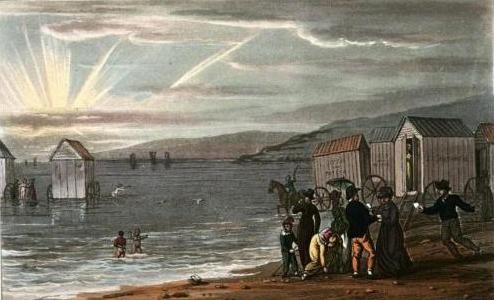
I’m a little late for the party, but a full day still remains until Laurel Ann at Austenprose finishes her in-depth tour of Sanditon, Jane Austen’s last, unfinished novel. Click on this page to catch up on all the links and comments and guest posts.

Sea Bathing in Scarborough, 1813

Read more about the seaside and seaside fashions on this blog to round out your knowledge of how the Regency folks enjoyed their seaside excursions:

Poetical Sketches of Scarborough, 1813, is a digitized book about the seaside resort of Scarborough, including color plates.

Read Full Post »

… or music Jane listened to. Recently Jane Austen’s Regency World Magazine sent a CD along with the issue. The songs include music popular in Jane’s time. I’ve included this musical number from YouTube: Thomas Arne’s “Where the Bee Sucks”, sung by a young lady named Sarah.

Jane Austen in Vermont has posted the list of songs on a CD that subscribers to Jane Austen’s Regency World magazine received in the last issue.

Read Full Post »

« Newer Posts - Older Posts »