Feeds:
Posts
Comments

Archive for the ‘Jane Austen’s World’ Category

Happy 234th Birthday, Jane Austen!

Let’s celebrate by making ratafia cakes

Take 8 fl oz:  apricot kernels, if they cannot be had bitter Almonds will do as well, blanch them & beat them very fine with a little Orange flower water, mix them with the whites of three eggs well beaten & sifted, work all together and it will be like a paste, then lay it in little round bits on tin plates flour’d, set them in an oven that is not very hot & they will puff up & be soon baked.

Makes 36-40

4 fl oz/ 110 g/ 1 cup ground almonds; 2 egg whites; 1 teaspoon orange-flower water or orange liqueur; 6 oz/ 175 g/ ¾ cup caster (superfine) sugar; rice paper

Today we know that bitter almonds may contain prussic acid, so it is wise to use ready-ground sweet almonds and a little orange liqueur for extra flavour instead. Set the oven to heat to 350 F/ 180 C/ Gas Mark 4.  Sieve or pound the almonds in a bowl to get rid of any lumps.  In a second bowl, whisk the egg whites with the orange-flower water or liqueur until stiff. Then mix the sugar into the almonds thoroughly and lastly fold in the whisked whites. Cover a baking-sheet with rice paper and place small teaspoonfuls of mixture on it, well spaced apart.  Bake for 10-12 minutes or until the cakes are just fawn; they must be soft underneath.  Cool them on the sheet, then keep in an airtight tin.  Enjoy them with after-dinner coffee.
(Black, Maggie and LeFaye, Deirdre,  The Jane Austen Cookbook, p. 125)

More on the Topic

Read Full Post »

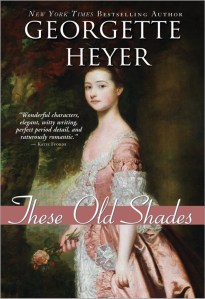
T’is the season to purchase books for a Christmas gift or to curl up with a novel in front of a fire as the cold weather settles in.  The first book I suggested for your consideration was The Harlot’s Progress: Yorkshire Molly, by Peter Mottley, the first in a trilogy and a fictional actualization of Hogarth’s series of etchings called “The Harlot’s Progress”.  My friend, Lady Anne, wrote a review about the second holiday book, These Old Shades by Georgette Heyer, a perennial favorite.

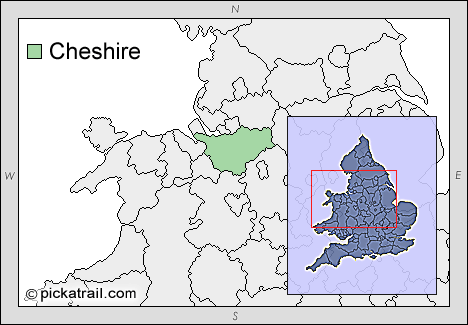
Regency Cheshire by Sue Wilkes

The third book on my recommendation list this holiday season is Regency Cheshire by Sue Wilkes, a history book about the Regency period in Cheshire during the early 19th Century. All I ask of a history book is accurate information about an era or region in which I am interested, and tidbits of information that will enlighten my knowledge of the past in an interesting way. This book offers both. I tend not to read history books from front to back, one of my bigger failings. I will start a chapter in the middle of a book and towards the end, before attempting the first chapters, and Regency Cheshire lends itself well to this practice. I knew very little about Cheshire before I began to read it, and am now curious to visit the area. In no particular order, here are some of the facts related in the book that I found interesting:

“Mad Jack” Mytton, the Squire of Halston Hall, drank seven bottles of port wine per day and kept two bulldogs and a pet bear. One day, Mad Jack got hiccups while drunk. Attempting to frighten them away, he set his shirt on fire with a lighted candle, an incident he survived. – p 72-73

An ailing George III celebrated his jubilee in October 1809. Churchbells rang and flags flew in Macclesfield, where a public dinner was held in his honor for 1,200 people; an ox was roasted in Chester, and the streets were decorated with patterns of colored sand in Knutsford. – p22

Chester hosted the Earl of Chester Plate, a racing event that began in 1802. Inns and private rooms filled up rapidly before race meetings, and special balls, assemblies and plays were held during race week. Along with genteel folks came beggars, blind fiddlers, and unwelcome pick-pockets. – p 71

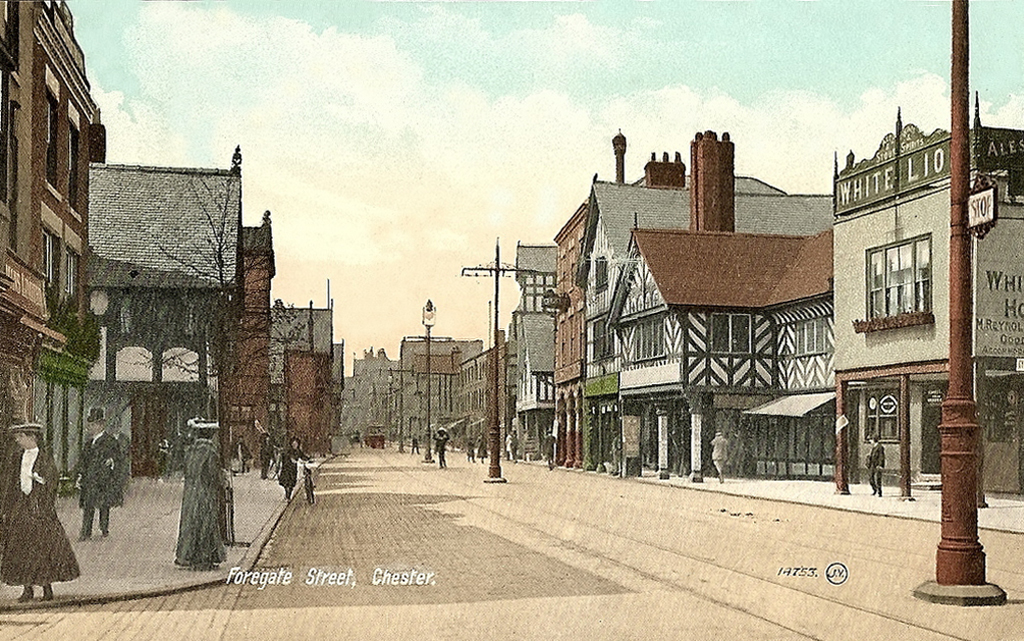
Chester circa 1900

“About 92,000 cows were kept for diary production in the first decade of the nineteenth century and approximately 11,500 tons of cheese were produced each year…Cows were milked twice a day at six o’clock in the morning and evening. The annual yield of cheese from each cow varied hugely, from 50 lb. to over 500 lb, depending on the season, quality of the soil and pasture, time of year, and how well the stock was over-wintered. About eight quarts of milk were needed to produce one pound of cheese.” – p 176-177

“Child workers helped throwsters in workshops or ‘shades’…The throwster’s helper, usually a boy, then ran to the other end of the room, carrying the other ends of the silk threads on bobbins….The throwsters twisted the silk threads by spinning the wheel. Their young helpers ran miles barefoot every day.” – p. 198

“John Wakefield, a gentleman and salt proprietor at Winnington, was accused of of fatally stabbing 21-year-old Richard Maddock, a handsome Northwich flatman. Maddock’s sweetheart, Elizabeth Woodward, a ‘smart, good-looking girl’, aged about twenty and a servant in the Wakefield’s home, was a key witness for the prosecution.  John Wakefield fell desperately in love with her and offered to take Elizabeth to London, and ‘keep me as a lady’, she testified. On the night of 8 September 1817, Wakefield discovered Maddock in the house with Elizabeth. There was a violent struggle. Later, another flatman found Maddock dying about seventy yards from the house. The jury found Wakefield guilty of manslaughter, but the judge gave him just six months in the ‘common gaol’.”- p 112

There are more fascinating stories about Regency Cheshire in this fact-filled, informative, and well-written book. If you have any interest in the Regency era or Chester in the 19th Century, I highly recommend it. Click here to order the book in the UK.

More on the topic:

Read Full Post »

Making traditional black butter

Inquiring readers: Reader Cora Harrison recently placed this comment on my blog: “In one letter, Jane [Austen] spoke of serving ‘black butter’ with wigeon and that she thought the butter was bad … Poor Jane, I thought. However, in reading a book called The Feast of Christmas I discovered that black butter was not butter at all, but what I would call a fruit cheese, made from equal quantities of apples, blackcurrants or blackberries and less sugar, and then boiled until it sets – and of course, the colour would be black!”

Her comment so intrigued me, that I decided to look up the topic. Jane wrote to her sister on December 27, 1808:

The first pot [of black butter] was opened when Frank and Mary were here, and proved not at all what it ought to be; it was neither solid nor entirely sweet, and on seeing it Eliza remembered that Miss Austen had said she did not think it had been boiled enough. It was made, you know, when we were absent. Such being the event of the first pot, I would not save the second, and we therefore ate it in unpretending privacy; and though not what it ought to be, part of it was very good.”

The recipe for making black butter, or apple butter as it is commonly known today, harkens back to medieval times. After the winter crop was picked, the preserve was made in huge quantities. In the 18th century, twenty percent of Jersey’s arable land was made up of orchards, and the tradition of producing ‘black butter’ or ‘Le Niere Buerre’ became an annual social  and festive occasion.  Jersey black butter was made from cider apples that were slowly boiled over a fire. Women would peel hundreds of pounds of apples, while the men and children would gather enough wood to keep the fire going for almost two days. After the cider was ‘reduced’ by half, apples, sugar, lemon, liquorice and spices were added. The Jersey tradition of making black butter included singing, dancing, and storytelling all through the night and until early morning. Jersey Island black butter is characterized by the addition of liquorice, which made the preserve quite dark. – RecipeZaar & BBC Jersey Black Butter.

According to Food Legends, black butter “contains no butter, the butter in the name being like the cheese in lemon cheese, more a description of the consistency and application of the product than anything else; and second, it is not really black, indeed a great deal of effort goes into avoiding the burning that would change the dark brown mass to black.” The following is likely Jane Austen’s recipe for Black Butter. Traditionally, the preserve is spread on bread, or it can be eaten by itself:

    Take 4 pounds of full ripe apples, and peel and core them. Meanwhile put into a pan 2 pints of sweet cider, and boil until it reduces by half. Put the apples, chopped small, to the cider. Cook slowly stirring frequently, until the fruit is tender, as you can crush beneath the back of a spoon. Then work the apple through a sieve, and return to the pan adding 1lb beaten (granulated) sugar and spices as following, 1 teaspoon clove well ground, 2 teaspoons cinnamon well ground, 1 saltspoon allspice well ground. Cook over low fire for about ¾ hour, stirring until mixture thickens and turns a rich brown. Pour the butter into into small clean jars, and cover with clarified butter when cold. Seal and keep for three months before using. By this time the butter will have turned almost black, and have a most delicious flavour. – Copyright Maria Hubert von Staufer March 1995

Black butter on bread

This recipe, which Cora must have at first thought Jane Austen was referring to, is a black butter that is generally served with fish, such as skate or salmon:

Black Butter: Put into a frying pan the necessary amount of butter, and cook it until it has a brown color and begins to smoke. At this moment add a large pinch of concassed parsley leaves and spread it immediately over the object to be treated. – Chest of Books

More on the topic:

Read Full Post »

Inquiring readers: I have no doubt you shall enjoy this post by my good friend, Lady Anne, an expert when it comes to the subject of Georgette Heyer. Lady Anne has read Georgette Heyer’s novels for most of her years upon this earth. Smart, sassy, fabulous, well tressed and well dressed, she has read every GH book backwards and forwards. There is not one tiny detail of Georgette’s novels that escapes Lady Anne’s attention or opinion. As to her review of  These Old Shades- please enjoy.

Set in the Georgian period, about 20 years before the Regency, These Old Shades is considered to be the book that launched Heyer’s career. It features two of Heyer’s most memorable characters: Justin Alastair, the Duke of Avon, and Leonie, whom he rescues from a life of ignomy and comes to love and marry.

The title of the book, These Old Shades, is a subtle allusion to the fact that this book is a far superior reworking of Georgette Heyer’s first book, The Black Moth, a book she wrote for the amusement of her brother who was ill. The characters in The Black Moth are at best two dimensional, but like most of Heyer’s creations, have enough humor and idiosyncrasy to catch our interest. In her case, it was the character of the villain whom she wished to revisit, develop and deepen.

These Old Shades is the first of the Alistair trilogy – she really did like these characters – and is not Regency, nor does it take place primarily in England. Like many of her early books, it falls more accurately into the category of historical romance, and is cast in mid-18th century Paris, with a short idyll at the English county seat of our hero, Justin Alistair, the Duke of Avon. He is known by the soubriquet Satanas, for his cold exactitude and prescient understanding of what his opponent will do next, as well as a certain elasticity in his moral fiber. The Duke has restored his family’s fortune through gambling; he is, as one would expect of one of the first peers of the realm, an arrant snob, careful, although certainly flamboyant, in his dress, and punctilious in manner. The historical background is the court of Louis XV, complete with its intrigues and excesses. It is the perfect backdrop for this story, for which one must be willing to suspend disbelief for pages at a time. It is such fun, and so sparkling in its writing, that one is indeed willing.

We first meet the Duke, dissolute, languid, apparently unaware of his surroundings, when a gamin comes hurtling from a side street and provides Avon with the weapon he has been waiting for to bring about the destruction of the Comte de Saint-Vire, the man who famously insulted Avon beyond courtesy. Avon buys the youngster from his brother, and establishes him as a page dressed in sober black, who attends Avon at parties, assemblies, and the Court at Versailles. The youngster, called Leon, attracts considerable attention, not only for his utter adoration of his master, whom he calls Monseigneur, but also for his startling red hair and dark eyebrows. Such hair and eyebrow combination is evident in the Saint-Vire family. As le tout Paris buzzes, Avon begins laying his plans. Leon is revealed to readers as Leonie, and goes to England in the country to learn how to be a lady. The Duke adopts her and returns to Paris with his ward. His friend Hugh Davenant returns to Paris at the same time and Avon tells him, in a passage that makes clear both the character and performance of this Duke:

“I am becoming something of a patriarch, my dear.”
“Are you? Davenant said, and smiled to himself. “May I compliment
you on your ward?”
“Pray do! You find her to your taste?”
“Infinitely. Paris will be enchanted. She is an original.”
“Something of a rogue,” conceded his Grace.
“Justin, what does Saint-Vire to do with her?”
The thin brows rose.
“I seem to remember, my dear, that your curiosity was one of the
things I deplored in you.”
“I’ve not forgot the tale you told me – in this very room, Justin. Is
Leonie the tool with which you hope to crush Saint-Vire?”
His Grace yawned.
“You fatigue me, Hugh. Do you know, I have ever had a fancy to
play my game — alone.”
Davenant could make nothing of him and gave up the attempt.”

But it is not the plot that carries the reader along; it is the delightful characters. The Duke, the darkest of Heyer’s heroes, has real charm, albeit a little sinister. He is not one you would wish to cross, as we see. Leonie, the heroine, is an effervescent charmer with a ferocious temper and an inherent sense of her own worth that grows through the book. Her character is honest and instinctively noble. She also, like any adorable pet of a large circle, gets away with being outrageous – except when Monseigneur is displeased. The supporting characters have charm and individuality as well. It is no wonder that Heyer comes back to the family twice: once in The Devil’s Cub – to revisit the Duke and his family, with a focus on the Cub, definitely the son of both his parents, and then in what is generally considered her finest novel, in An Infamous Army, where the grandchildren of the second book’s couple play out their roles at Waterloo.

If the story that unfolds is outrageous and unbelievable, the characters develop beautifully, the dialog bubbles delightfully, and we love the rollicking ride.

These Old Shades/Black Moth comparison from Wikipedia

More on the topic:

Read Full Post »

Colin Firth wearing a reindeer jumper in Bridget Jones' Diary

The blog, Built on Facts, discusses Pride and Prejudice and Bridget Jones’s Diary in a post entitled: Metafiction and Self-Reference in Bridget Jones’ Diary

..not only is [Bridget Jones’ Diary] a retelling, it’s a retelling that’s very explicit about that fact. But that’s just the start; in fact Bridget meets him at a party wherein Mr. Darcy is standing around being standoffish, precisely as in Pride and Prejudice. And Bridget comments on this, pointing out to herself that if one is going to be named Darcy one shouldn’t be standing around standoffishly at parties.

More Intelligent Life dot Com features a long interview with Colin Firth about his movie, “A Single Man,” and his life and career. Quite insightful.

LOOK UP Firth’s name in a casting director’s address-book, and you’d find it under “a” for Archetypal Englishman. He has played the comedy version (the cuckolded, tongue-tied writer in “Love Actually”), the villainous version (a Blackadderish lord in “Shakespeare in Love”) and the subtle, smarter-than-he-first-appears version—decent Clifton, the young buffer who’s actually a spy, in “The English Patient”. Yet in reality Firth doesn’t have much time for England.

Both his major relationships have been with women from other countries—first the Canadian actress Meg Tilly, with whom he has a son, and now his wife Livia Guggioli, an Italian documentary producer and mother of his two younger children.

Trousseau features fashion from the 19th century through the early 20th century. This page shows gowns from 1801-1839. Clicking on a dress will lead you to a page; clicking on each image will lead you to an enlarged detail.

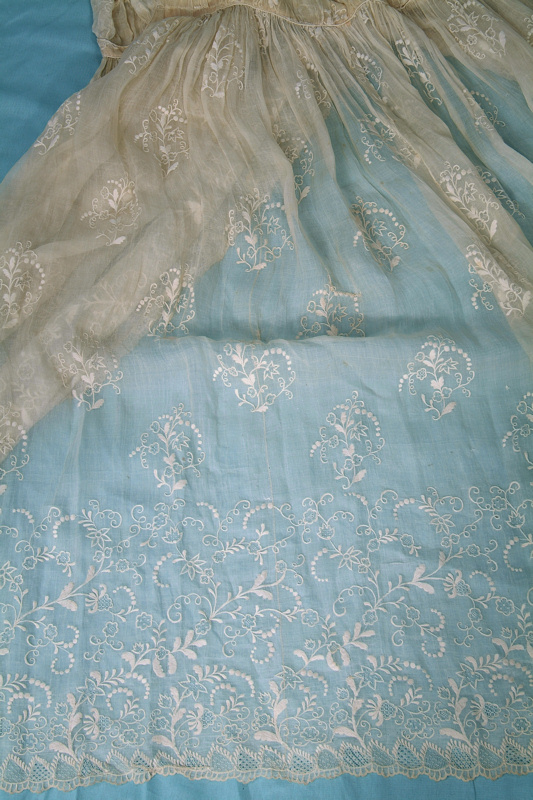
Detail of embroidered muslin dress, 1810-1814

Read Full Post »

« Newer Posts - Older Posts »