Feeds:
Posts
Comments

Archive for the ‘Jane Austen’s World’ Category

Gentle readers, I am taking a short hiatus from this blog for Thanksgiving week. Meanwhile, enjoy these images of people dining in days of yore…

Dining for most people was a simple affair and food was taken from the land. Many families, unless their house was large enough to accommodate a dining room, ate in the kitchen.
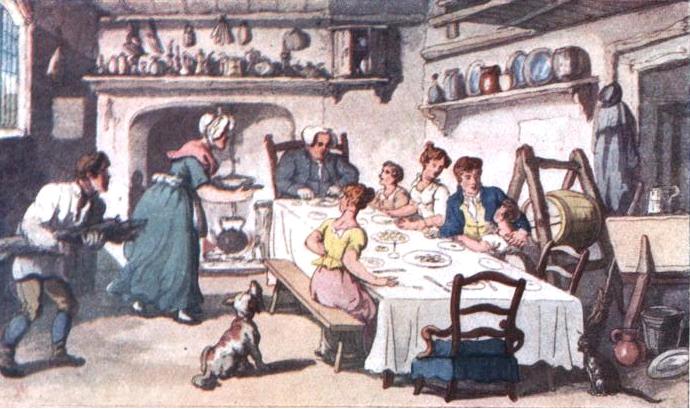
Notice in this image of a family sharing a meal by Thomas Rowlandson (from The Vicar of Wakefield by Oliver Goldsmith), that the meal is eaten during the day and near the fire.

The rich could afford to eat by candlelight, as in this early 20th C. image of a Georgian dinner scene.
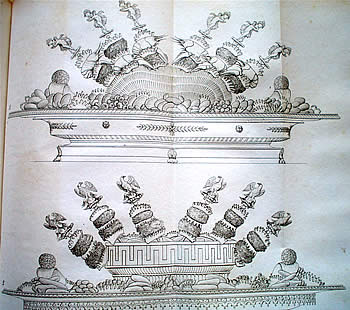
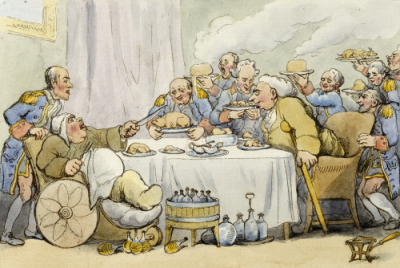
For some, like the Prince Regent, dinners were elaborate affairs.

For other families the meal was more basic and simple.
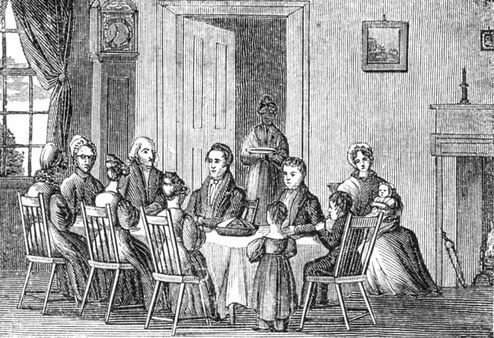
Family Meal

The hours in which people ate meals were changing:

In the beginning of the sixteenth century in England, dinner, the main meal of the day, used to begin at 11:00AM. Meals tended over time to be eaten later and later in the day: by the eighteenth century, dinner was eaten at about 3:00PM…By the early nineteenth century, lunch, what Palmer in Moveable Feasts calls “the furtive snack,” had become a sit-down meal at the dning table in the middle of the day. Upper-class people were eating breakfast earlier, and dinner later, than they had formerly done…in 1808…dinner was now a late meal and supper a snack taken at the very end of the day before people retired to bed. For a long time luncheon was a very upper-class habit; ordinarily working people dined in the early evening, and contented themselves as they had done for centuries with a mid-day snack…Supper now means a light evening meal that replaces dinner; such a meal is especially popular if people have eaten a heavy lunch – The Rituals of Dinner, Margaret Visser [Penguid:New York] 1991 (p. 159-160) – Food Timeline
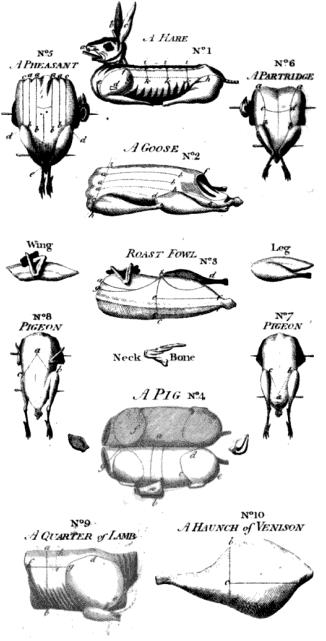
Image source: The Universal Cook: And City and Country Housekeeper, John Francis Collingwood and John Woollams, Principal Cooks at The Crown and Anchor Tavern in the Strand, 1792

Meat made up a large part of the Regency diet, even for the middle class. For most people living in London, the animals had to be brought a long way to market. Due to the length of the journey, the quality of meat was often poor. In contrast, venison and game procured from country estates and served fresh was often considered prize meat.

The Breedwell Family, Thomas Rowlandson

Families tended to be large and extended. In this boisterous family scene by Rowlandson, the Breedwells obviously bred beyond “the heir and the spare.”
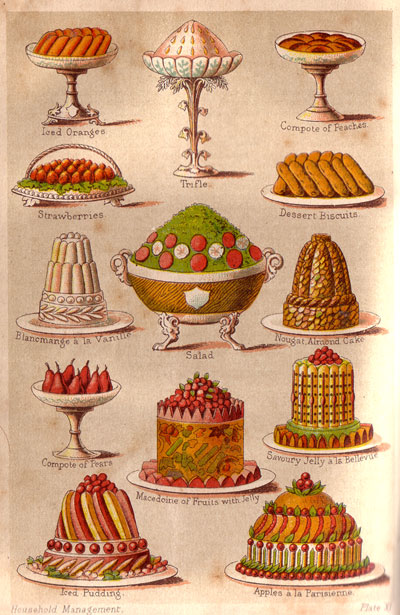
Desserts, Isabella Beaton

Desserts made up the last course of the meal. Even for the middle class this course was elaborate and plentiful, but for the rich it was spectacular.

Walled kitchen garden

Kitchen gardens provided fresh produce during the growing season. The very rich grew fruits and vegetables in hot houses, but most people ate meat, soups, or bread throughout the year. Fruit and vegetables were preserved, or, as in the case of apples and root vegetables, stored through the winter.
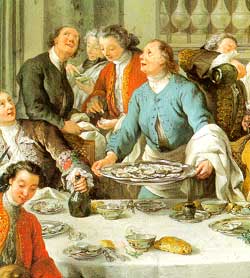
Seafood had to be served fresh and within hours of its harvest. Chances were that this tavern, where oysters were served on a platter, sits in a geographic area by the sea.
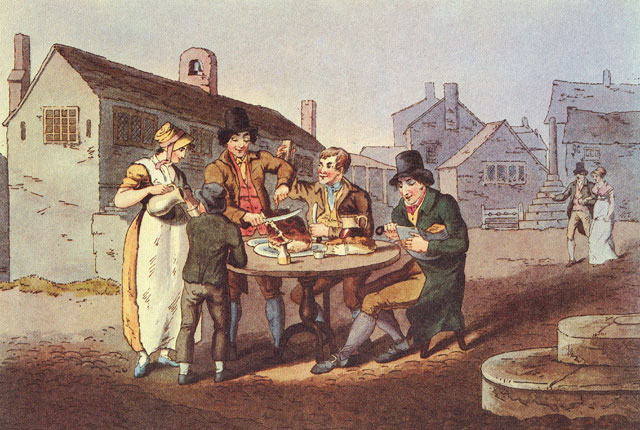
Life in Yorkshire

Elegant, or simple, the family meal meant togetherness.

Happy Thanksgiving everyone

More on the topic:

Read Full Post »

Inquiring readers, Over a week ago, Chris wrote a post about her blog and her personal journey in pursuing a course of study about Jane Austen, her novels, and the time she lived in. This is her second post about her year-long project.

Over here at ‘Embarking on a Course of Study,‘ I’ve been hard at work on the project. Having finished Sense and Sensibility, I asked people to weigh in on who they felt they were most like, Marianne or Elinor, and who they would like to have as a friend. The results so far are overwhelmingly in Marianne’s favor. If you haven’t posted your comment/vote, please do! I’d love to hear from you.

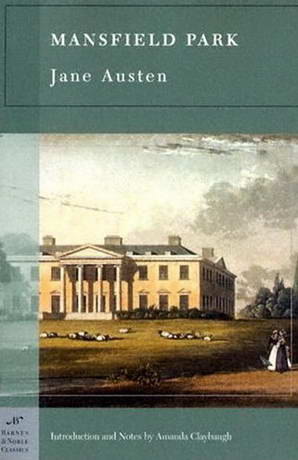
I’ve begun Mansfield Park again and have re-encountered, as I expected, another heroine I don’t much like (my other has always been Emma – I love her spunk, but she does too much damage). I forgot how dull Fanny is. Not that I think Mary Crawford is as fantastic as Lizzie Bennet, with whom I’ve read her compared. Mary is manipulative and racy. I enjoy how she pushes the limits, but not much more. The dynamics among the characters are the most fascinating for me, as are Austen’s insights and writing, of course.

I’ve been reading the Jane Austen Cookbook as well, to decide on something to contribute to my family’s Thanksgiving dinner, and have settled on Little Iced Cakes. As you’ll read in my blog, I had to choose something family would actually eat. I do want to make Things With Fun Names like ‘trifle’ and ‘syllabub’ at some point. I was tempted to go for something really foreign to us these days, like the ‘forcemeat balls,’ which would require the purchase (or capture?) of 2-3 pigeons, but just couldn’t wrap my brain around the concept of eating what struts around the streets of Baltimore on a daily basis. If you’d like to join me in the making of this dessert, the recipe is on my blog, along with a link to other recipes from the Jane Austen Cookbook.

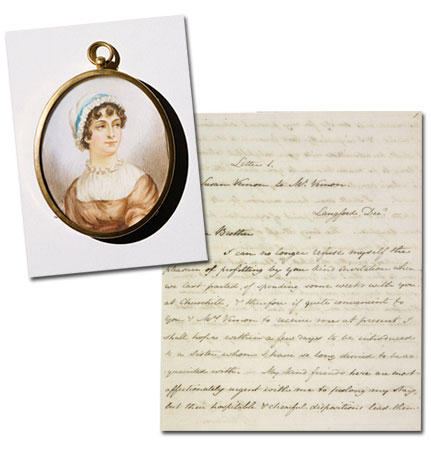
If you’re in New York City any time before March 14th, there’s a wonderful new exhibit at The Morgan Library: A Woman’s Wit: Jane Austen’s Life and Legacy. Comprised of letters, drawings, films, and lectures, it promises to thrill the Austen lover. If you’d like to see the 15 minute documentary film entitled The Divine Jane, which “examines the influence of Austen’s fiction—and her enduring fame— through interviews with leading writers, scholars, and actors,” go to my blog.

Next week, I’ll post notes from my meeting with Professor Robin Bates at St. Mary’s College in St. Mary’s City, Maryland, who has been teaching a class on Austen for years, asking his students to read the books and poems mentioned in her novels, similar to my plan. I will also update you on my efforts to arrange an English Country Dancing class with an instructor from the Baltimore Folk Music Society. I have 8 ladies interested and am working on the venue. We’re all tremendously excited about learning some dances.

For those of you in the US, Happy Thanksgiving!

Chris Stewart

Read Full Post »

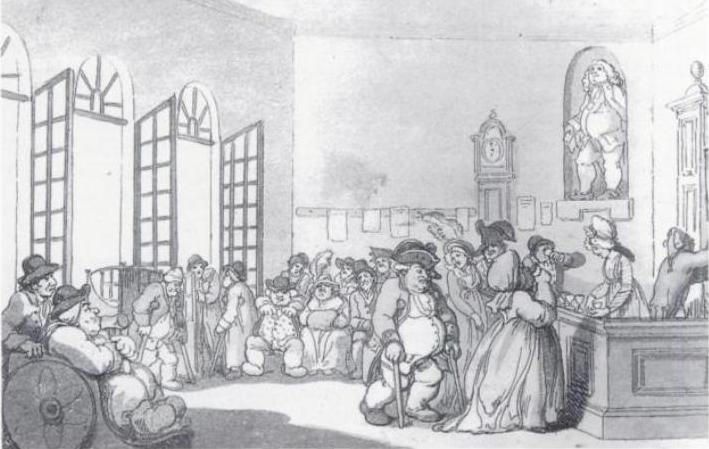
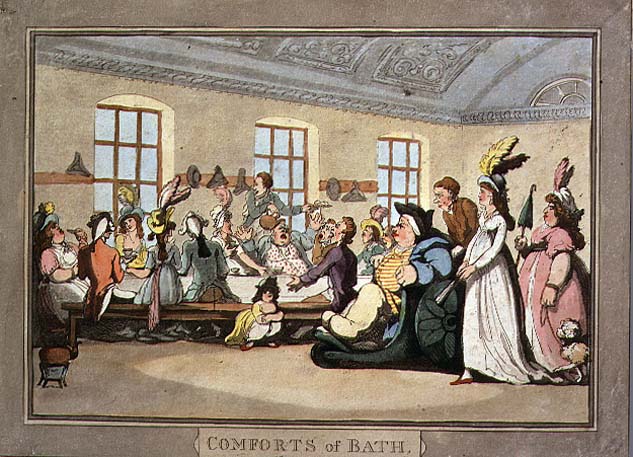
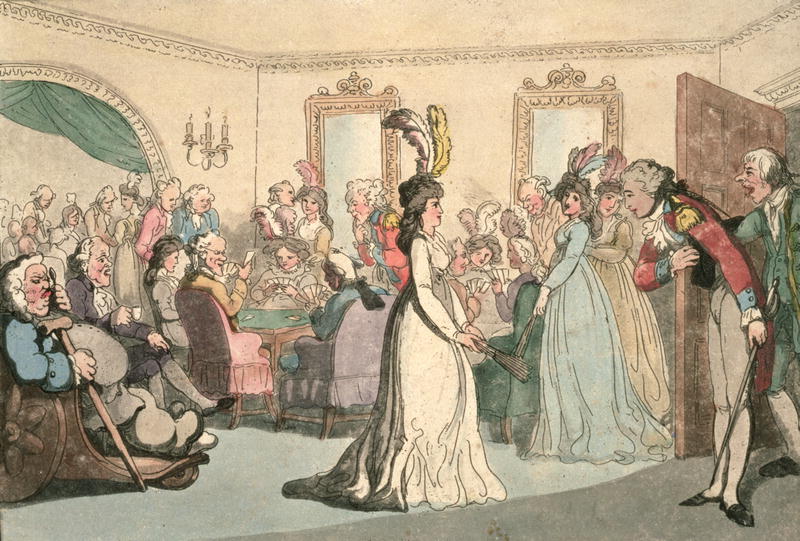
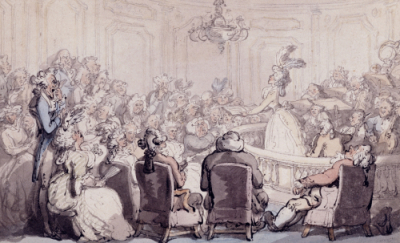
In 1798, the famous caricaturist Thomas Rowlandson drew The Comforts of Bath, a series of satiric drawings. The cartoons were used to illustrate the 1858 edition of the New Bath Guide, written by Christopher Anstey and first published in 1766.* Rowlandson depicted both the social and medical scene in Bath just before the period described by Jane Austen in Northanger Abbey and Persuasion, and by Georgette Heyer in her Regency romances.

The Portrait, Comforts of Bath, 1798, Thomas Rowlandson

In this post I combined Rowlandson’s images with excerpts from an 1811 guidebook, A new guide through Bath and its environs By Richard Warner. The scenes depict the use of mineral water therapy for the invalids who flocked to Bath, a city whose fashionable post-Nash reputation was already well past its prime and whose medical men were generally regarded as quacks or, worse, “potential murderers”. The rotund gentleman in front and center of all these scenes (who undoubtedly suffered from gout, a painful rich man’s disease), was conjectured to be based after Tobias Smollet’s Mr. Bramble. In the pictorial’s subtext, notice how “Mr. Bramble’s” young wife (companion or daughter) flirts with the young officer who boldly woos her (Image above). Even while satirizing them, Rowlandson gets the social details just right. Underneath each image sits a quote from the guidebook.

King Bladud's Bath, Comforts of Bath, Rowlandson

It is fit for the patient when he goeth into the bath to defend those parts which are apt to be offended by the bath, as to have his head well covered from the air and wind and from the vapours arising from the bath, also his kidneys if they be subject to the stone, anointed with some cooling unguents as rosatum comitiffs infrigidans Galeni Santo linum &c. Also, to begin gently with the bath till his body be inured to it, and to be quiet from swimming or much motion which may offend the head by sending up vapours thither at his coming forth, to have his body well dryed and to rest in his bed an hour and sweat, etc.” – A New Guide Through Bath, 1811

The Pump Room, The Comforts of Bath, 1798, Rowlandson

The new Pump Room supplied water from a covered pump. Before the room was built, the populace drank the waters in the open air. But the new rooms allowed them to

…  take the exercise prescribed to them sheltered from the inclemency of the weather. The work was accordingly begun in 1704, finished two years afterwards, and opened for the reception of the company under the auspices of Mr Nash, who had just then become the Arbiter Elegantiarum of Bath…A New Guide Through Bath, 1811

Black and White detail of above print

In the year 1751 [The Pump] Room was enlarged. Accommodated with a beautiful Portico stretching from it in a northern direction in 1786, and adorned with superb Western Frontispiece in 1791, The Corporation further beautified the city in 1796 by taking down the old Pump Room entirely and building on its site the much larger and more magnificent edifice known at present by that name…A New Guide Through Bath, 1811

Public Breakfast, The Comforts of Bath, 1798, Rowlandson

Pertaining to the construction of  the Harrison rooms and the Assembly Rooms:

Temporary booths had hitherto been the only places in which the company could drink their tea and divert themselves with cards, but Mr Harrison, a man of spirit and speculation, perceiving that a building of this nature was much wanted and would probably make him a very suitable return, undertook at the suggestion of Mr Nash to erect a large and commodious room for the purpose of receiving the company.  The succes of this attempt induced a similar one in the year 1728, when another large room was built by Mr Thayer.  A regular system of pleasurable amusements commenced from this period, and the gay routine of public breakfasts, morning concerts, noon card parties, evening promenades, and nocturnal balls rolled on in an endless and diversified succession. – A New Guide Through Bath, 1811

Company at Play, The Comforts of Bath, Rowlandson

Rules card games:

That no persons be permitted to play with cards left by another party;  That no hazard or unlawful game of any sort be allowed in these Rooms on any account whatever nor any cards on Sundays...A New Guide Through Bath, 1811

The Concert, Bath Chambers, Rowlandson

For music sweet music has charms to controul; And tune up each passion that ruffles the soul; What things have I read and what stories been told; Of feats that were done by musicians of old – The New Bath Guide, 1779

Dinner, Comforts of Bath, 1798

Bath has little trade and no manufactures; the higher clafles of people and their dependents conftitute the chief part of the population, and the number of the lower clafles being but fmall…A New Guide Through Bath, 1811

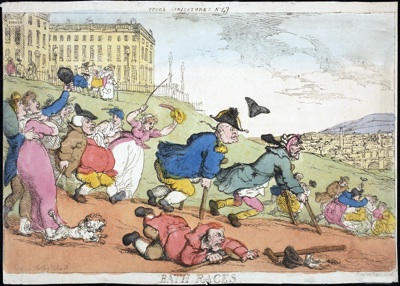
Bath Races, Rowlandson

More on the topic:

Read Full Post »

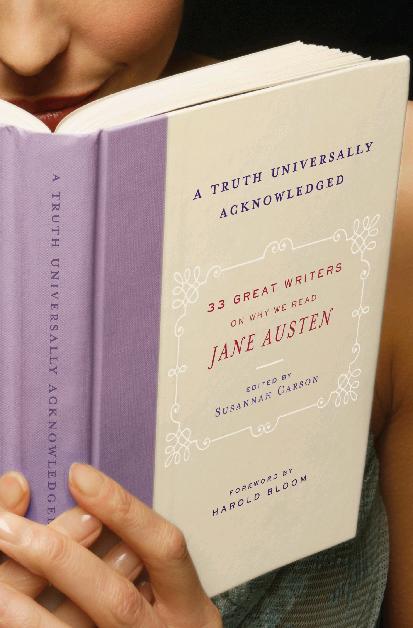
I had just about given up on reading advance copies of Jane Austen sequels, prequels, and mash-ups, when A Truth Universally Acknowledged: 33 Great Writers on Why We Read Jane Austen, edited by Susannah Carson and published by Random House, arrived in my mailbox. A sigh of relief swept over me as I opened the mailer and saw that I had received a serious book about Jane Austen’s body of work – I would not be subjected to reading another mash-up of vampires and zombies, or a sequel with Mr & Mrs Darcy making babies.

I prefer to read literary appraisals written by professional writers. They often express their thoughts about other writers more clearly than academics, whose use of lofty terms, elaborate theories, and learned analysis in their critiques tends to befuddle all but a handful of their colleagues and students. Except for her own essay, editor Susannah Carson (a doctoral candidate) takes a back seat to Virginia Woolf, E.M. Forster, Alain de Botton, Jay McInerney, Anna Quindlen, and Eudora Welty. Esteemed literary critic, Harold Bloom, wrote the foreword. As I read this new book, my gratitude towards these eloquent writers grew.

L-R: Alain de Botton, Anna Quinlan, Harold Bloom, Eudora Welty, E.M.Forster, and Virginia Woolf

Each of the book’s thirty-three essays gave me a new insight about Jane Austen’s novels. While I did not agree with every writer’s take on Jane’s work, I felt that I had been exposed to a variety of new ideas. I’m not sure Jane is quite the paragon of moral virtue as depicted by James Collins. Nor do her novels necessarily end happily ever after. (Witness the number of unsuccessful marriages in her books, and her newly engaged/married characters still have the majority of their lives to live.) Not all her mothers are awful, nor is Mr. Bennet an especially noteworthy father. Regardless of my disagreements, I felt after finishing the book that I had attended a two-day symposium in which bright literary minds discussed and debated my favorite author.

L-R: Benjamin Nugent, Amy Heckerling, C.S.Lewis, AS Byat, J.B. Priestley, & Margot Livesey

Ms. Carson chose essays from both classic and contemporary writers, all of whom are ardent admirers of Jane’s writing. Some essays are long, and some are short, a nice mix. I would have preferred to read essays from a few detractors as well, for unlimited admiration can sometimes seem treacly. Still, I was as thrilled with Eudora Welty’s observations on the “real secret of the six novels’already long life,” as with director Amy Heckerling’s adaptation of the movie “Clueless” from Emma. Amy Bloom, whose “Terrible Jane” was my favorite essay, asserted that Jane knew her own worth as a writer and that, far from being the mild and shy spinster her Victorian family tried to reinvent after her death, she was a witty, fallible, full-blooded, and clear-sighted woman who liked a good party, hated being poor, and was often unkind. (Cassandra did not quite succeed in cutting out all of Jane’s acerbic observations in her letters.)

In her introductory essay, Ms. Carson (r) asked the question: Why do we read Jane Austen? Why indeed? As I read the essays, I began to understand that above all, Jane Austen makes me smile, think and ponder, and reach eagerly for the next page. She created characters that I want to revisit over and over again. As I have aged and grown wiser (presumably), her novels revealed new layers of depth and insights that I had not noticed before. This book has enriched my enjoyment of Jane, and as far as I’m concerned that’s all that matters. I give it three out of three Regency fans.

Read Full Post »

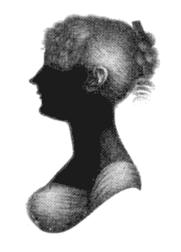
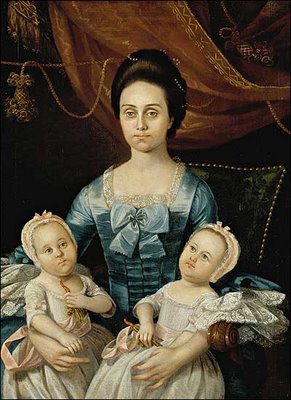
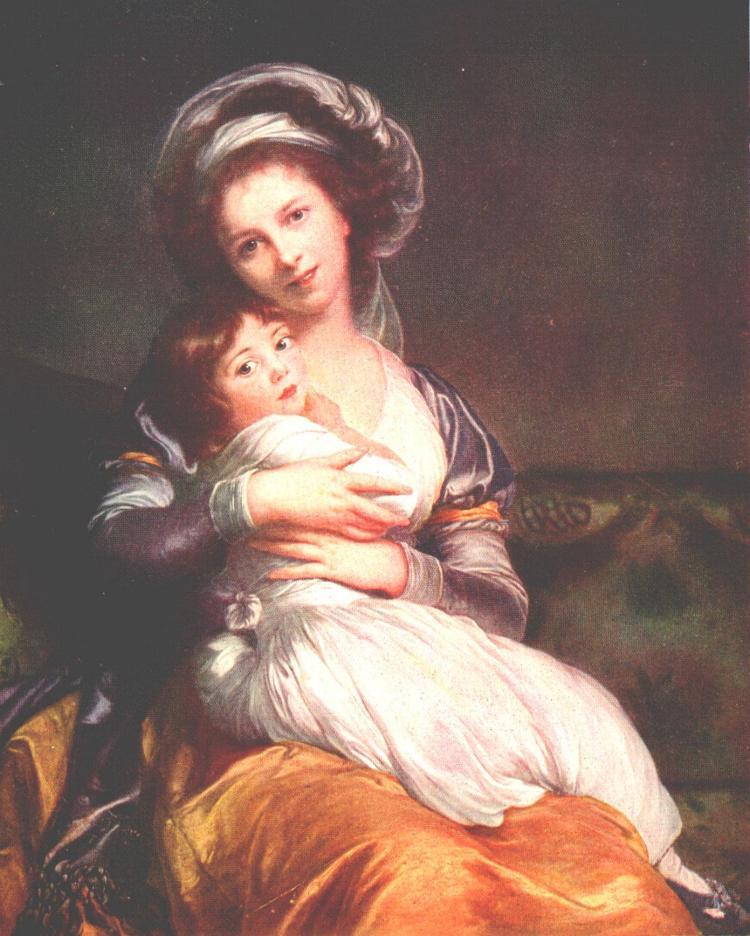
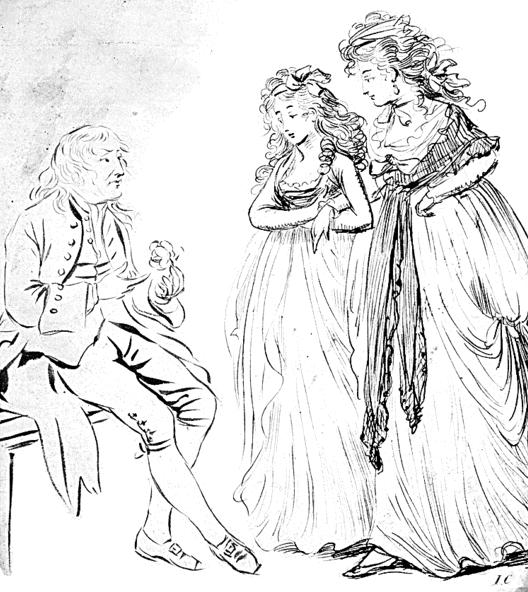
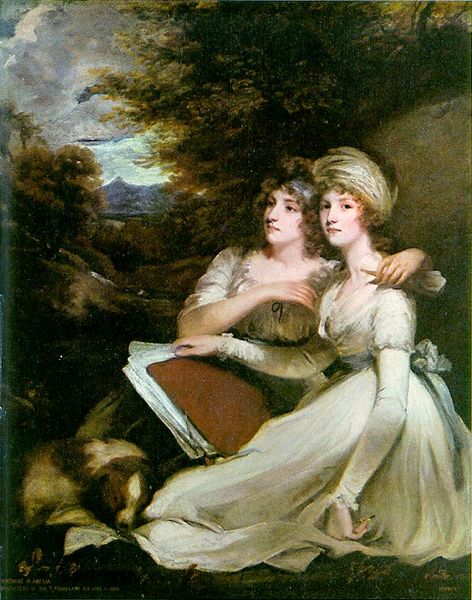
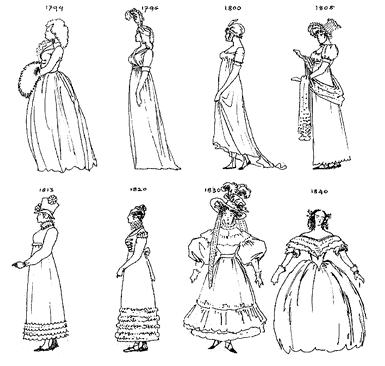
CassandraPretty Cassandra Austen, Jane Austen’s elder sister by two years, lived until the ripe age of 72 . This brief visual guide demonstrates how fashion changed during her lifetime. Wherever possible, I tried to represent Cassandra’s age and the clothes she would have worn during that period. I also used the paired women combination to evoke Cassandra and Jane, even in the years after Jane’s death. The last image shows the changes in the silhouettes of the gowns regarding waists, sleeves, skirts and trains.

Mrs. Thomas Bolling with children, 1773. One can see the style of clothes baby Cassandra and Mrs. Austen would have worn after her birth.

Madame Vigee and child, 1780. Cassandra was seven and Jane had turned five, somewhat older than the child depicted in this painting.

Isaac Cruickshank Sketch 1790. Jane Austen would have been 15 and Cassandra 17 years of age. This image is NOT of the Austen sisters.

Jane Austen was 20 and Cassandra 22 when Hoppner painted this image of the Frankland sisters in 1795

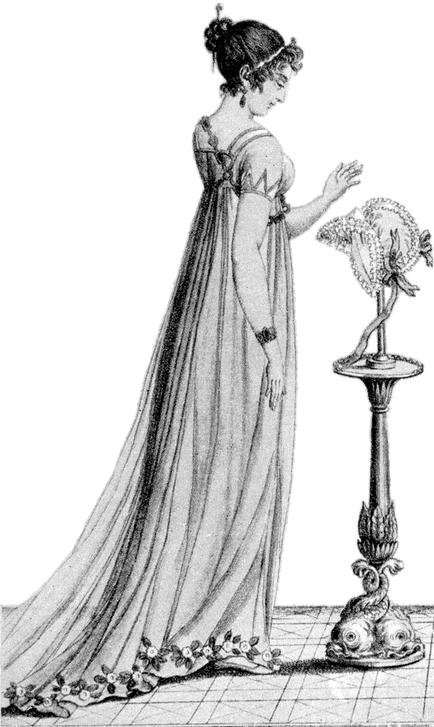
Chemise dress, 1799. Lovely lines, but the trains so popular during these years must have collected dust and dirt.

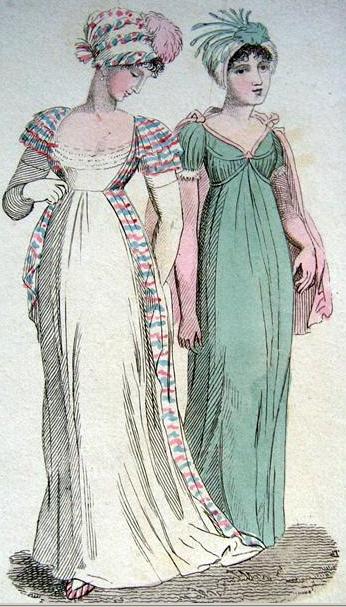
Afternoon dresses, Lady's Monthly Museum, 1802

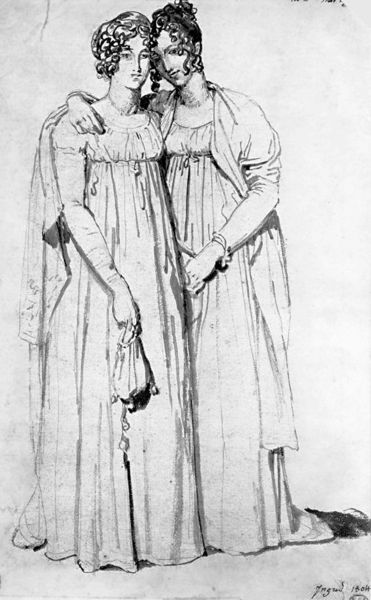
Ingres drew the Harvey sisters in 1804 when Jane was 29 and Cassandra had turned 31

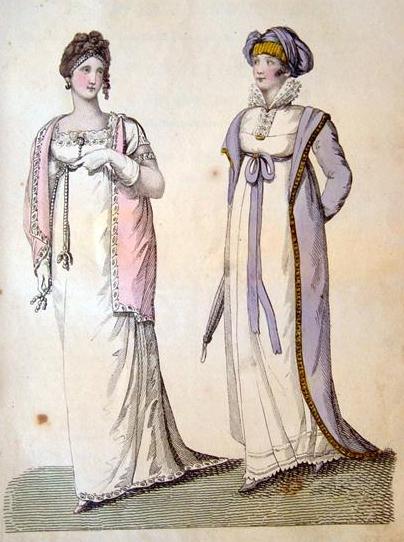
Belle Assemblee, English Costume 1807. Short trains are still fashionable.

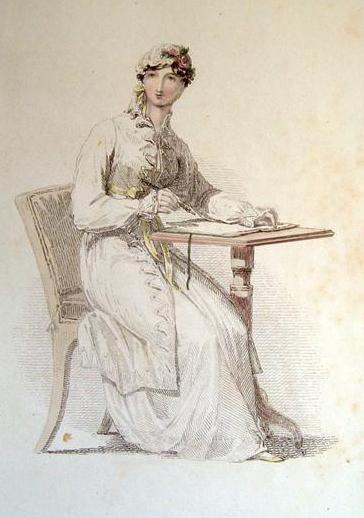
Regency morning dress 1813

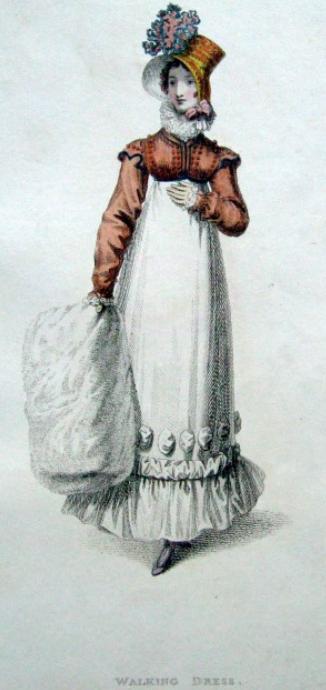
Walking dress 1817, the year Jane Austen died

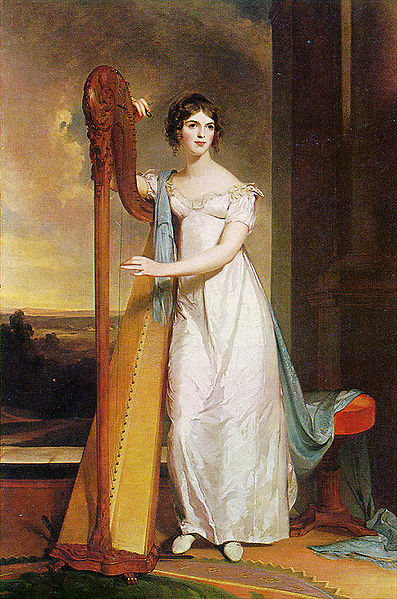
Eliza Ridgely painted by Sully, 1818.

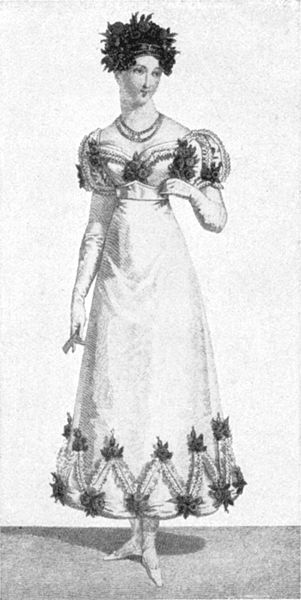
Ball gown, 1820. Notice the shorter dress length and the fancy hem.

Rust brown redingote, 1823

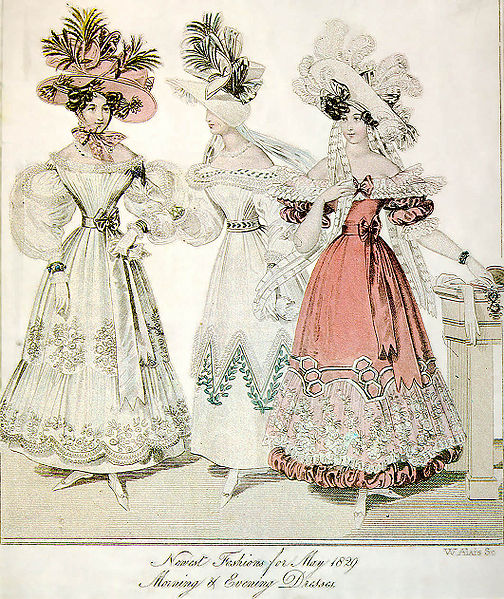
Morning and evening dresses in 1829. Notice how the elaborate hats and hairdos balance the large sleeves. The waistline is situated almost at its natural position and the hemlines reveal slippers and trim ankles.

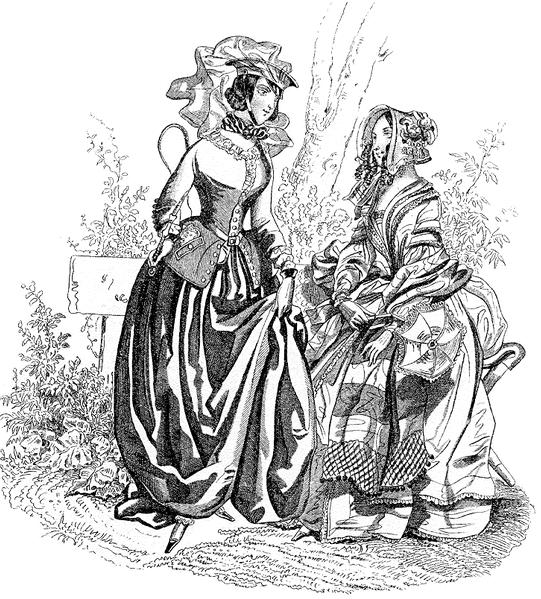
Riding Habit, 1842

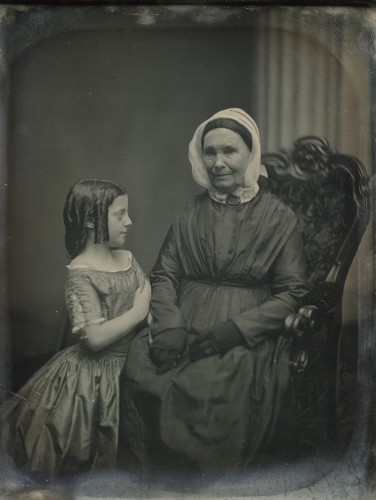
Would Cassandra have resembled this old woman in 1845, the year of her death?

Review of the changes in fashion silhouettes

More on the topic

Read Full Post »

« Newer Posts - Older Posts »