Feeds:
Posts
Comments

Archive for the ‘Jane Austen’s World’ Category

The outbreak into beauty which Nature makes at the end of April and beginning of May excites so joyful and admiring a feeling in the human breast, that there is no wonder the event should have at all times been celebrated in some way. – May 1st, Chambers’ Book of Days”

Inquiring readers, 

Ah, the merry month of May, when flowers bloom in the meadows and young couples go a-maying. May 1st is a day when fertility and fecundity are celebrated with gaiety, song, and dance. On May Day the ancient Celts celebrated the Pagan festival of Beltane around a roaring fire on the tops of hills and mountains. Coincidentally, the Romans celebrated the first of May Day in honor of the goddess Flora. According to the Chambers’ Book of Days, 

“Nations taking more or less their origin from Rome have settled upon the 1st of May as the special time for fetes of the same kind. With ancients and moderns alike it was one instinctive rush to the fields, to revel in the bloom which was newly presented on the meadows and the trees; the more city-pent the population, the more eager apparently the desire to get among the flowers, and bring away samples of them: – Ibid

In medieval times the day was dedicated to Robin Hood, but by 1645, Oliver Cromwell had banned May Day celebrations because of their association with pagan rituals. The celebrations were brought back after the Restoration, when King Charles II was placed on the British throne.

Now the bright morning Star, Dayes harbinger,

  Comes dancing from the East, and leads with her

  The Flowry May, who from her green lap throws

The yellow Cowslip, and the pale Primrose.

  Hail bounteous May that dost inspire 

  Mirth and youth, and warm desire,

  Woods and Groves, are of thy dressing,

  Hill and Dale, doth boast thy blessing.

Thus we salute thee with our early Song,

And welcom thee, and wish thee long.

– Song on May Morning, John Milton 

The following quote from Brand’s & Ellis’s Observations on Popular Antiquities (1813) takes you back to the Elizabethan era: 

“IT  was  anciently  the  custom  for  all  ranks  of  people  to  go  out  a  Maying  early on  the  first  of  Maya.  Bourne  tells  us  that,  in  his  time,  in  the  villages  in  the North  of  England,  the  juvenile  part  of  both  sexes  were  wont  to  rise  a  little  after midnight  on  the  morning  of  that  day,  and  walk  to  some  neighbouring  wood, accompanied  with  musick  and  the  blowing  of  horns,  where  they  broke  down branches  from  the  trees  and  adorned  them  with  nosegays  and  crowns  of  flowers. This  done,  they  returned  homewards  with  their  booty,  about  the  time  of  sun- rise, and  made  their  doors  and  windows  triumph  in  the  flowery  spoil. – (Brand & Ellis, Observations on Popular Antiquities…Vulgar Customs, Ceremonies and Superstitions, 1813, pp. 179-180.) 

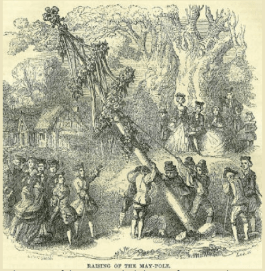
Back then people festooned doors and windows with flower garlands. Every village, town, and district affixed a pole in a public space as “high as a ship’s vessel”.  A tree of an appropriate height was selected and brought in with much ceremony. It was then erected in a spot where it stood from year to year. Many of these poles stood much higher than the church steeple in a village or town.
Maypole

Maypole, Chambers’ Book of Days, May 1st

The MayPole

“But  their cheefest  Jewell  they  bring  from  thence”  [the  woods]  ”  is  their  Male  poole, whiche  they  bring  home  with  greatc  veneration,  as  thus.  They  have  twentie  or fourtie  yoke  of  oxen,  every  oxe  havyng  a  sweete  nosegaie  of  flowers  tyed  on the  tippe  of  his  homes,  and  these  oxen  drawe  home  this  Maie  poole,  (this stinckyng  Idoll  rather,)  which  is  covered  all  over  with  flowers  and  hearbes, bounde  rounde  aboute  with  stringes,  from  the  top  to  the  bottomo,  and  some- tyme  painted  with  variable  colours,  with  twoo  or  three  hundred  men,  women, and  children  followyng  it,  with  greate  devotion.” – Brand & Ellis, p. 193

The MayPole was festooned with wreaths of flowers; revelers danced in rings around it for nearly the entire day. Then, as mentioned before, during Oliver Cromwell’s Commonwealth those revelries ceased:

“By  an  ordinance  of the  [Long]  Parliament,  in  April  1644,  all  May  Poles  were  taken  down,  and removed  by  the  constables,  churchwardens,  &c.  After  the  restoration,  they were  permitted  to  be  erected  again’.” – Brand & Ellis, p. 195
Milk maids dance on May Day

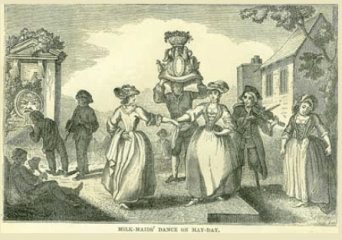
Milk maids dance on May Day, Chambers’ Book of Days

The Book of Chambers writes: “The Puritans—those most respectable people, always so unpleasantly shown as the enemies of mirth and good humour — caused May-poles to be uprooted, and a stop put to all their jollities; but after the Restoration they were everywhere re-erected, and the appropriate rites re-commenced.”

Just sixteen years later, “maypoles were raised across the land as a gleeful marker of the end of Puritan prohibitions.”  (John Chu, National Trust). Rites included chimney sweeps hustling for coins in the streets and milkmaids dancing for pennies as they balanced silverware on their heads. 

The Green Man in Jane Austen’s Day

Green Man 800px-Domreiter,_Blattmaske

Green Man, Wikimedia Commons, File: Domreiter, Blattmaske.jpg

Since early Christian days, many of Britain’s cathedrals and churches – those in countries that were populated by the ancient Romans – featured sculpted images of the “green man.” These pagan images were carved for Christian churches before the Restoration, for superstitions pertaining to nature and tree worship still influenced the middle ages. The Green Man symbolized life, or the death and rebirth that heralded spring and the promise of a plentiful harvest in the coming months. The early churches might have tied these beliefs to the resurrection, which made sense in terms of the Christian faith.

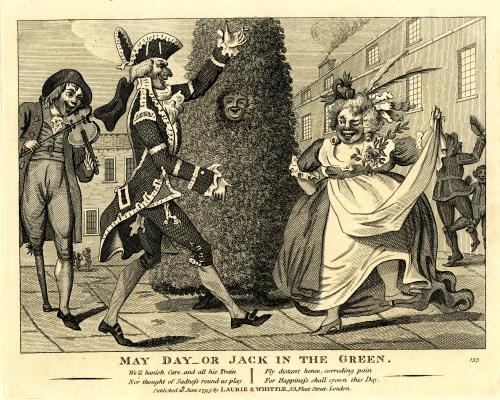
During Austen’s day, the tradition of Jack-in-the-Green became a common sight. 

May Day, or, Jack-in-the-Green

We’ll banish Care, and all his Train

Nor thought of Sadness round us play

Fly distant hence, corroding pain

For happiness shall crown this Day.

(20th June 1795) (May Day, All Things Georgian)

The Morning Chronicle and London Advertiser first mentioned the Jack-in-the-Green  in 1775, (the year of Jane Austen’s birth). The character  was a man who concealed his body with green foliage. This “walking tree” paraded in processions, along with a King and Queen (or a Lord and lady), and jesters, clowns, chimney sweeps, and musicians. The Jack-in-the-Green tradition largely died out in the Victorian era. 
Jack-in-the-Green-BritMus

© The Trustees of the British Museum “A street scene. An elderly man and woman, wearing tawdry finery, dance opposite each other, to the music of a wooden-legged fiddler (left). Between and behind them a grinning face looks from a pyramid of greenery, supported on the feet of the Jack in the Green. A couple of chimney-sweeps dance in the middle distance on the extreme right, and in the background (left) two other climbing-boys on a tiny scale dance together. Beneath the title: ‘We’ll banish Care, and all his Train Nor thought of Sadness round us play Fly distant hence, corroding pain For happiness shall crown this Day.’ 20 June 1795 Etching”

_______

Happy 1st day of May, all! Looking at my yard and its fresh greenery, spring flowers, and the activity of nesting birds, and the pregnant deer wandering through my yard, I realize why May Day traditions and celebrations of fertility continue in this day and age.

I leave you with a wonderful video of Morris dancers, whose traditions stem back to the custom of dancing around the maypole. These dances evolved into rival performances among neighboring villages and eventually evolved into Morris dancing. You can find many regional examples online. This video shows only one such interpretation.

Sources:  Find more information about May Day in the links below.

Hillman’s Hyperlinked and Searchable Chambers’ Book of Days, a website based on The Book of Days: A Miscellany of Popular Antiquities, W & R Chambers (1869). Searched link: May 1st. Scroll down to May Day. May 1st

Brand, John & Ellis, Henry,  Observations on Popular Antiquities Chiefly illustrating the origin of our vulgar customs, Ceremonies and Superstitions: Arranged and revl, with additions. (Published in 1813)  Internet Archive Digital Book

May Day: the tradition of the Jack-in-the-Green and chimney sweeps, All Things Georgian, Joanne Major, 2017. https://georgianera.wordpress.com/tag/may-day/

Satirical Print, The British Museum, https://www.britishmuseum.org/collection/object/P_1866-1114-640

The Green Man, Ellen Castelow, & May Day Celebrations, Ben Johnson Historic UK 

Green Man, Wikipedia. A foliate head in the shape of an acanthus leaf: a corbel supporting the Bamberg Horseman, Bamberg cathedral, Germany, early 13th century. Public Domain File: Domreiter, Blattmaske.jpg  Green man sculptures seen in Iraq, Istanbul, North Wales, etc.

The MayPole Tradition in Ireland, The Fading Years blog, April 26, 2017

The history of May Day, a spring celebration, John Chu, National Trust, UK.

Read Full Post »

By Brenda S. Cox

“I like first Cousins to be first Cousins, & interested about each other.”—Jane Austen, letter to Anna Lefroy, Nov. 29, 1814

Austen’s First Cousins

Jane Austen was closely connected to her three first cousins: Eliza, Edward, and Jane. (She had additional cousins from her father’s half-brother, William Hampson Walter, though she doesn’t seem to have been as close to them.)

Eliza: Her father’s sister Philadelphia had one daughter, lively Eliza Hancock de Feuillide. Eliza, whose first husband was guillotined in the French Revolution, later married Jane’s brother Henry.

Jane: Jane’s mother’s sister (also named Jane) married a clergyman, the Reverend Dr. Edward Cooper. They had two children, Edward and another Jane. That Jane, Jane Leigh Cooper, went away to school for a time with Jane and Cassandra Austen. Her letter home from Southampton told their parents that the girls were seriously ill with typhus. Mrs. Austen and Mrs. Cooper came and took them home. The girls all survived, but, sadly, Mrs. Cooper caught the illness and died. Jane and Edward Cooper spent a lot of time with the Austen family. Jane was even married at Steventon, to a naval captain, Captain Williams, who was later knighted. Charles Austen served under him in the Navy. Tragically, Jane Cooper, by then called Lady Williams, died in a carriage accident in 1798.

Edward: Edward Cooper, Jane Cooper’s brother, became a clergyman like his father. He is mentioned frequently in Jane Austen’s letters. In her first two existing letters (Jan. 9 and 14, 1796), she talks about his visit to Steventon with his young son and daughter.

Edward Cooper, Clergyman

Many of Jane Austen’s friends and relatives were clergymen (estimated at over a hundred, including of course her father and two of her brothers). She held strong opinions on church livings. When Edward got his living, she wrote (Jan. 21, 1799):

Yesterday came a letter to my mother from Edward Cooper to announce, not the birth of a child, but of a living; for Mrs. Leigh [a relative, the Hon. Mary Leigh, of Stoneleigh] has begged his acceptance of the Rectory of Hamstall-Ridware in Staffordshire, vacant by Mr. Johnson’s death. We collect from his letter that he means to reside there, in which he shows his wisdom.

Staffordshire is a good way off [about 140 miles]; so we shall see nothing more of them till, some fifteen years hence, the Miss Coopers are presented to us, fine, jolly, handsome, ignorant girls. The living is valued at £140 a year, but perhaps it may be improvable. How will they be able to convey the furniture of the dressing-room so far in safety?

Our first cousins seem all dropping off very fast. One is incorporated into the family [Eliza de Feuillide], another dies [Jane Cooper, Lady Williams], and a third [Edward Cooper] goes into Staffordshire.  [Brackets added.]

Church of St. Michael and All Angels, Hamstall Ridware, where Jane Austen’s cousin Edward Cooper served as rector.
Bs0u10e01, CC BY-SA 3.0 via Wikimedia Commons

Jane commented that Edward intended “to reside” at his living, which showed “his wisdom.” At this time, many clergy hired curates to serve their livings rather than residing in them and doing the work themselves. In Mansfield Park, Sir Thomas Bertram makes a strong statement about residing at one’s living:

“A parish has wants and claims which can be known only by a clergyman constantly resident, and which no proxy can be capable of satisfying to the same extent. Edmund might, in the common phrase, do the duty of Thornton, that is, he might read prayers and preach, without giving up Mansfield Park: he might ride over every Sunday, to a house nominally inhabited, and go through divine service; he might be the clergyman of Thornton Lacey every seventh day, for three or four hours, if that would content him. But it will not. He knows that human nature needs more lessons than a weekly sermon can convey; and that if he does not live among his parishioners, and prove himself, by constant attention, their well-wisher and friend, he does very little either for their good or his own.”–Mansfield Park, ch. 25

Austen also mentioned that Edward might be able to “improve” his living. That means he might increase his income by negotiating for higher tithe payments from the farmers or leasing extra farmland, as Austen’s father did. Edward Ferrars’s living in Sense and Sensibility is also “capable of improvement” (ch. 39). Cooper added to his income later by becoming rector of nearby Yoxall (much like George Austen, who served two adjacent parishes).

In 1801 Austen said Edward wrote to her after his wife Caroline had a baby.

I have heard twice from Edward on the occasion, & his letters have each been exactly what they ought to be–chearful & amusing.–He dares not write otherwise to me, but perhaps he might be obliged to purge himself from the guilt of writing Nonsense by filling his shoes with whole pease for a week afterwards.–Mrs. G. [Mrs. Girle, Caroline Cooper’s grandmother] has left him £100–his Wife and son £500 each. (Jan. 21, 1801)

It appears that while Jane thought of Edward as too serious, he was willing to write “Nonsense” to her.

Later that month, Edward invited the Austens to come visit his family at the parsonage in Hamstall Ridware. However, Jane says, “at present we greatly prefer the sea to all our relations” (Jan. 25, 1801). Her family had already visited Edward in 1799, when he was a curate at Harpsden. The Austens did visit the Coopers at Hamstall Ridware for five weeks in the summer of 1806, after going to Stoneleigh Abbey. 

Interior of Edward Cooper’s Hamstall Ridware church;
John Salmon via Wikimedia commons CC BY-SA 2.0

Jane seemed to have trouble keeping track of Edward’s children. Some of them died quite young. In 1811 she wrote, “It was a mistake of mine, my dear Cassandra, to talk of a tenth child at Hamstall. I had forgot there were but eight already” (May 29).

In 1808, when Jane’s sister-in-law, Elizabeth Knight, died, Jane wrote, “I have written to Edward Cooper, & hope he will not send one of his Letters of cruel comfort to my poor Brother” (Oct. 15). We don’t know what sort of “cruel comfort” Edward had written in the past. The one still-existing letter from Edward to Jane was written in 1817 and sounds heartfelt and kind. His friend and neighbor John Gisborne wrote that Edward was a great comfort to him in his son’s final illness. But perhaps Edward had taken the opportunity to preach some of his Evangelical ideas in a letter, and Jane and her family did not agree.

Edward Cooper believed and preached an Evangelical interpretation of the Bible. Many of his sermons were published in books, which were reprinted and read for many years, in a long series of editions. So even if Jane didn’t care much for them, others did!

Next month in Part 2, we’ll look at what Edward’s Evangelical ideas were, what Jane Austen thought of his sermons, and why.

Brenda S. Cox writes on Faith, Science, Joy, and Jane Austen. She has written a book called Fashionable Goodness: Faith in Jane Austen’s England, which she hopes will be available by the end of this year.

For Further Reading

Edward Cooper: Jane Austen’s Evangelical Cousin, Part 2

Visiting Edward Cooper,” Gaye King, Persuasions 1987

Hamstall Ridware: A Neglected Austen Setting,” Donald Greene, Persuasions 1985 (Includes a photo of the rectory where Jane and her family visited Edward and his family)

Come and Visit Edward Cooper, Jane Austen’s Evangelical Cousin,” Jane Austen House Museum blog, Sept. 17, 2012 (includes Edward Cooper’s portrait)

Edward Cooper’s letter to Jane April 6, 1817 (article also includes commentary on the letter) 

Jane Austen in the Midlands,” scroll down for a section on Cooper.

Other Sources

Deirdre Le Faye, Jane Austen: A Family Record, 2nd ed.

Deirdre Le Faye, ed., Jane Austen’s Letters, 4th ed.

Laura Dabundo, Jane Austen: A Companion

Irene Collins, “Displeasing Pictures of Clergymen,” Persuasions 18 (1996): 110. Collins says Austen’s correspondence refers to at least 90 clergymen, and her biographers could add many more. 

Irene Collins, Jane Austen and the Clergy

John Gisborne and his daughter E. N. A., Brief Memoir of the Life of John Gisborne, Esq., to which are added, Extracts from his Diary (London: Whittaker, 1852), 114-115, 128, 227. 

Read Full Post »

Spring is a time for gift giving in my family: birthdays, holidays, hostess thank you’s, and Mother’s Day gifts all enter into the equation. This is a perfect time to consider the bounty of choices in stores and online. Museum gift shops have been a particularly good source during my gift hunts.

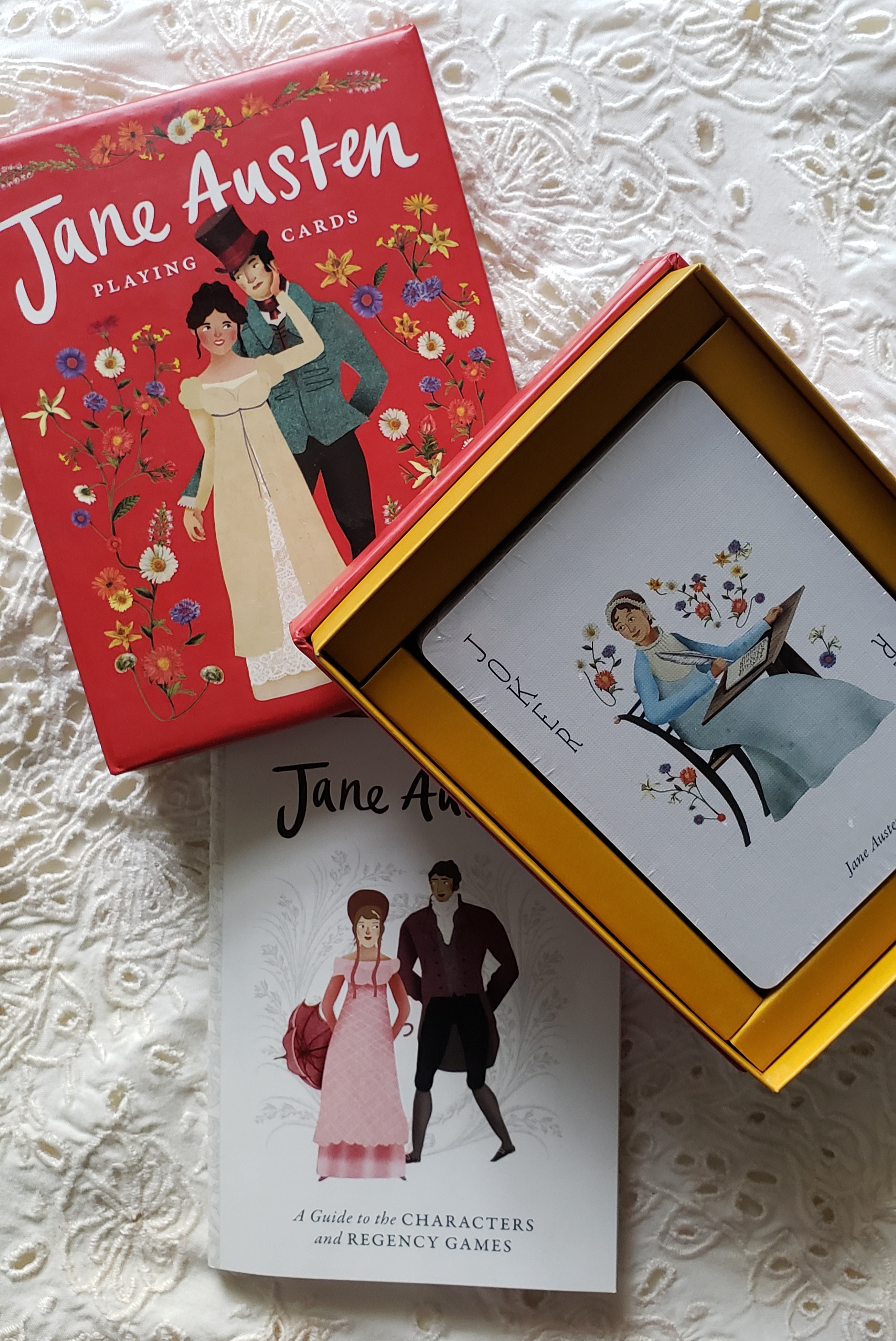
ja-cards

Jane Austen playing cards with instructions on how to play regency card games. Find the item on Amazon, Walmart, and online gift stores. Amazon provides detailed photos of the cards and instructional booklet by John Mullan.


A major benefit for adults who color in coloring books or who draw their own images is that those acts switch our brains from a state of anxiety or stress to creativity and calm. Those Zen moments provide our minds with a mini-vacation from our daily concerns to focus on a pleasurable skill.

Jane Austen: Wit & Wisdom to Color and Display, illustrated by Kimma Parish, is a such an example. (Click on images for closeup and comments). Her fanciful outlines represent flowers, landscapes, feathers, tea cups – those objects that evoke Austen’s novels. Each image is printed on one side of the page to allow the colorist to work on a single page and give the finished product to a friend or loved one. I found this book at the Walters Art Museum in Baltimore, but it is also available online and in book stores. (Note: Children are encouraged to draw and color on blank pages to improve their fine motor skills and nurture their creativity. Coloring books have a place in their development, but should not be the sole means of expressing their creativity. In contrast, adult coloring books are more intricate and are made for a different purpose.)

Jane Odiwe describes her delightful Effusions of Fancy in an article for the Jane Austen Centre online. I have cherished this book, generously sprinkled with Odiwe’s watercolors, since it was first published in 2003. (Click on the images for detail.) The bag, made from a sturdy denim and lined with orange cotton, is the product of The Unemployed Philosophers Guild. This 9″x6″ bag can be used for many purposes, but I kept Cassandra Austen in mind when filling it and have used it for those moments when I want to quickly sketch an idea or thought.

ja-colorcover

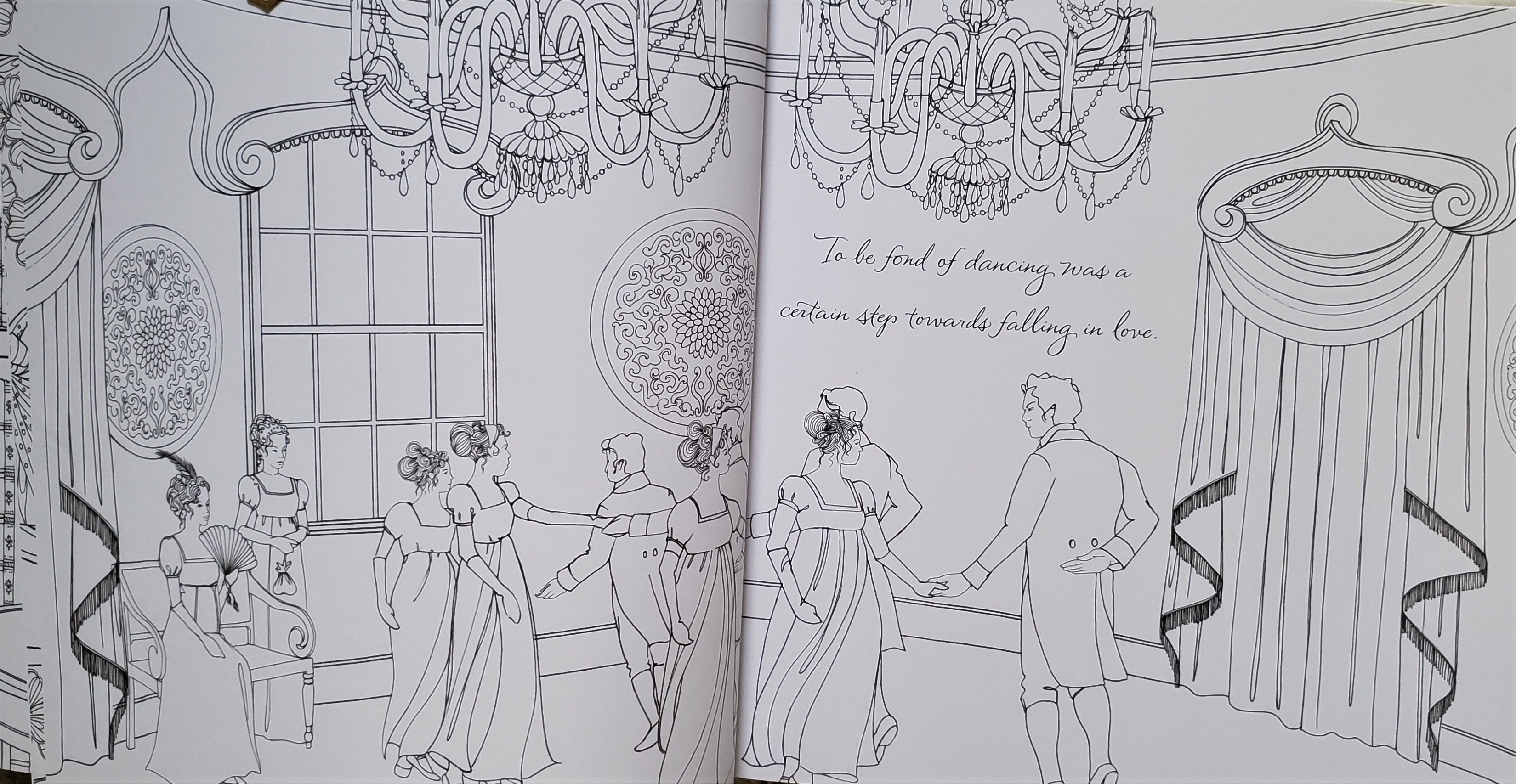
This gorgeously illustrated coloring book entitled Jane Austen’s Pride & Prejudice: A coloring classic portrays scenes from P&P as well as fanciful drawings of gloves, jewelry, fans, and feathers.

Drawn in lush detail by Chellie Carroll, this Pride & Prejudice coloring book is larger than Wit & Wisdom. The drawings are printed on both sides of each page, however, so the pages cannot be dismantled without ruining the pairing of saying and illustrations. But the pages are thick and can absorb the application of gouache or watercolor with a brush if applied with a not-too wet technique. An added benefit at the end of the book is a three-page spread entitled “The Language of Flowers.”

ja-inside-coloring

Ball scene spread over two pages. 

In conclusion, one does not need to scour museum, gift, or book shops to find these lovely items, for they are all available online (although I do like the physical journey). Enjoy sketching painting, playing, and coloring!

Read Full Post »

When visiting Jane Austen’s England today, you can stroll through the gardens at Chawton House and Jane Austen’s House Museum, explore the churches at Steventon and Chawton, and tour the homes and churches where Jane Austen and her relatives lived and worshipped in Bath and other areas of England. But what about Steventon Rectory (or parsonage) where Jane Austen and her family lived for the first 25 years of her life?

At Steventon, you can see the site of the rectory and get an idea of where it used to sit before it was torn down in the 1820s. It’s a beautiful spot in the lovely Hampshire countryside. And there’s more to see than just the fields and lanes where Austen grew up.

The old rectory site where the parsonage once stood. A well is the only visible remnant of that house.

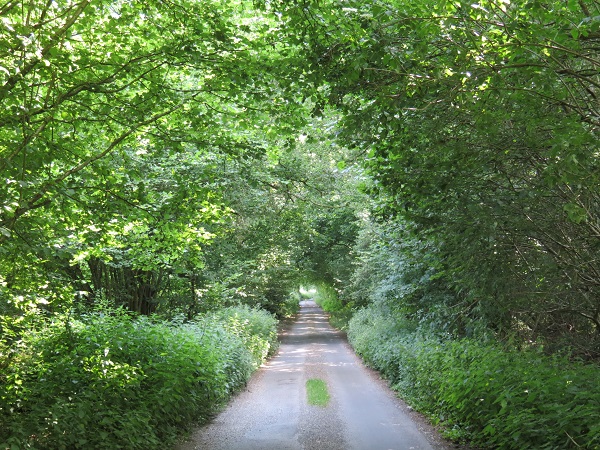
If you drive up the tree-canopied lane further, you come to St. Nicholas Church, where Jane’s father preached and where Jane and her family attended church. The church is usually open for visitors who want to look or sit or reflect.

Road to St. Nicholas Church, Steventon. Photo @ Rachel Dodge.

The Rectory Landscape

Though we can’t take a tour of the gardens and property surrounding the Rectory, we do have detailed descriptions available to help us imagine what it once was like.

Deirdre Le Faye paints a descriptive picture of the Rectory garden in Jane Austen: The World of Her Novels: “Mr. Austen’s study was at the back of the house, on the warm southern side, overlooking the walled garden with its sundial, espaliered fruit trees, vegetable and flower beds and grassy walks.” Green meadows stretched beyond it, dotted with livestock.

In A Memoir of Jane Austen, James Edward Austen-Leigh provides this further description of the landscape surrounding the Rectory:

“[T]he neighbourhood had its beauties of rustic lanes and hidden nooks; and Steventon, from the fall of the ground and the abundance of its timber, was one of the prettiest spots in it… It stood ‘in a shallow valley, surrounded by sloping meadows, well sprinkled with elm-trees, at the end of a small village of cottages, each well provided with a garden, scattered about prettily on either side of the road…”

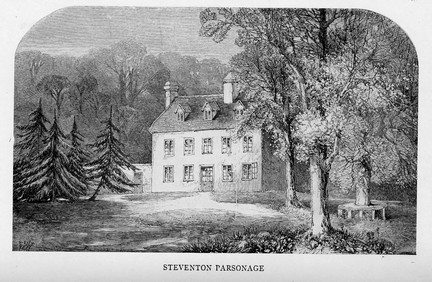
Parsonage, Steventon

Austen-Leigh continues with this: “North of the house, the road from Deane to Popham Lane ran at a sufficient distance from the front to allow a carriage drive, through turf and trees. On the south side, the ground rose gently and was occupied by one of those old-fashioned gardens in which vegetables and flowers are combined, flanked and protected on the east by one of the thatched mud walls common in that country, and overshadowed by fine elms. Along the upper or southern side of the garden ran a terrace of the finest turf…”

Improvements

In Jane Austen’s England, Maggie Lane provides several details about the changes the Austens made during their residency there. She says one of the “constant themes of discussion at Steventon Rectory was ‘improvement.’ Much had been done even before Jane’s birth, but throughout her twenty-five years’ residence there her parents were enthusiastically planting and landscaping their modest grounds.”

The following are some of the grander changes the Austens made to the landscape:

  • They planted a “screen” of chestnuts and spruce fir to “shut out the view of the farm building.”
  • They cut “an imposing carriage ‘sweep’ through the turf to the front door.”
  • The Church Walk – a “broad hedgerow of mixed timber and shrub, carpeted by wild flowers and wide enough to contain within it a winding footpath for the greater shelter and privacy of the family in their frequent walks to the church.”
  • The Elm Walk (or Wood Walk) – a similar hedgerow walk that skirted the meadows and included the “occasional rustic seat” where “weary stollers” could sit or rest.

In Austen-Leigh’s Memoir, he provides further details about the walks and hedgerows:

“But the chief beauty of Steventon consisted in its hedgerows. A hedgerow in that country does not mean a thin formal line of quickset, but an irregular border of copse-wood and timber, often wide enough to contain within it a winding footpath, or a rough cart-track. Under its shelter the earliest primroses, anemones, and wild hyacinths were to be found; sometimes the first bird’s nest; and, now and then, the unwelcome adder. Two such hedgerows radiated, as it were, from the parsonage garden. One, a continuation of the turf terrace, proceeded westward, forming the southern boundary of the home meadows; and was formed into a rustic shrubbery, with occasional seats, entitled ‘The Wood Walk.’ The other ran straight up the hill, under the name of ‘The Church Walk,’ because it led to the parish church…”

Hampshire is still breathtaking; scenes like these give us a sense of the greenery and vegetation Austen might have known.

In October 1800, Jane wrote to Cassandra about the improvements her parents were undertaking at the time: “Our improvements have advanced very well; the bank along the elm wall is sloped down for the reception of thorns and lilacs, and it is settled that the other side of the path is to continue turfed, and to be planted with beech, ash, and larch.”

In November, she wrote again: “Hacker has been here to-day putting in the fruit trees. A new plan has been suggested concerning the plantation of the new inclosure (sic) of the right-hand side of the elm walk: the doubt is whether it would be better to make a little orchard of it by planting apples, pears, and cherries, or whether it should be larch, mountain ash, and acacia.”

Reading these descriptions, it’s easy to see why Jane Austen included “improvements” to the grounds of the estates featured in so many of her novels.

Food and Livestock

However, the Austens didn’t just improve their land to make it more pleasing to the eye or pleasurable for walking. Lane tells us that “the garden at Steventon Rectory was a happy compromise between fashionable ideas and down-to-earth utility – typical of the balanced Austen approach to life.”

In Mrs. Austen’s garden, “vegetables and flowers [were] combined” to balance beauty and provision. One can imagine how the garden must have looked in the spring, summer, and fall, with its tangled profusion of color.

Today, “companion planting” is popular for many gardeners who include flowers among their vegetables.

Beyond the gardens around the Rectory, the Austens kept livestock and grew crops. Mrs. Austen oversaw the poultry-yard and the dairy: “She supervised making all the butter and cheese, baking all the bread and brewing all the beer and wine required by a large household. With the exception of such commodities as tea, coffee, chocolate and sugar, the Austens were virtually self-sufficient in food.” As for Rev. Austen, he grew “oats, barley and wheat, and reared cattle, pigs and sheep” and was able to “not only feed his family, but to sell the surplus.” (Lane)

“All the fruit, vegetables, and herbs consumed by the family were raised here. The Austens’ strawberry fields were famous, and Mrs. Austen was one of the first people in the neighbourhood to grow potatoes.” Taking this all into account, we get a better idea of the gardens and food Jane Austen enjoyed in her youth.

Today, strawberry crops are still grown and produced in Hampshire.

Reading these descriptions of the land surrounding Steventon Rectory can help us better envision what the gardens and fields looked like when Austen was growing up. It’s lovely to try to imagine where she walked and read and thought and imagined; what foods she ate; and what her parents did.

If there ever was a fundraising campaign I could get behind, it would be to someday see a replica (or a scale model) built of the Steventon Rectory and its surrounding gardens. Wouldn’t that be something? For now, I’ll keep dreaming and imagining, which almost just as nice.

If you’d like to take a deeper dive into the Steventon Rectory and its garden and farm, you can read “Why Was Jane Austen Sent away to School at Seven? An Empirical Look at a Vexing Question” in Persuasions On-Line by Linda Robinson Walker.


RACHEL DODGE teaches college English classes, gives talks at libraries, teas, and book clubs, and writes for Jane Austen’s World blog. She is the bestselling author of The Little Women Devotional, The Anne of Green Gables Devotional and Praying with Jane: 31 Days Through the Prayers of Jane Austen. You can visit Rachel online at www.RachelDodge.com.

Read Full Post »

profile-Cassidy-Percoco

Cassidy Percoco

Inquiring Readers: guest author, Cassidy Percoco, submitted this informative article about duels during the Regency era. Enjoy!

The duel is a staple of Regency fiction, whether classic (Colonel Brandon and Willoughby’s duel in Sense and Sensibility) or contemporary (Bridgerton, of course). It’s tempting to think of it as a literary device, but in fact duels were an accepted aspect of upper-class and upper-middle-class life, though the vast majority of gentlemen never fought or even witnessed one.

The duel had been introduced to England from Italy in the sixteenth century, and quickly spread along with other Italian notions of courtesy and civility. These new ideas, which were coming to replace the older traditions of chivalry and courtly love, would become entrenched and end up becoming the standard for gentlemanly behavior for centuries. Where chivalry had been focused on aristocratic men proving their honor through their behavior toward women (or at least high-born ladies), these new standards included a great deal of focus on men proving their honor in relation to other men – and in theory, all gentlemen, whether nobly born or of the gentry, were equal in this.

The major proof of one’s own honor was being seen to behave civilly toward other men acknowledged as honorable, and having them behave civilly toward oneself. A gentleman’s reputation was of paramount importance, and any action taken by someone else to threaten that reputation – a direct insult made to his face, or a slander made behind his back – was a problem. Being hit by another gentleman or being accused of lying were two insults that were frequently seen as so intense that they required a duel to settle. However, not all provocation was so clearly endangering to the reputation: any argument could theoretically lead to a duel if one or both participants became incensed enough, although most of the time gentlemen made allowances for each other to avoid actually coming to the field over simple mistakes like being jostled in the street, as being too eager to duel could also be a strike against one’s reputation.

If the insult came from a servant, pauper, or tradesman, there was no shame in responding immediately with one-sided violence, but when it came from another man of honor, the most appropriate way to repair the hurt was for both parties to meet in a duel at a later time, and to fight (generally with swords, until the 1780s) to wounding or even death. This required “seconds,” gentlemen who assisted the combatants by acting as go-betweens and arranging the time and place of the duel. But on another level, the second’s assistance was in being a gentleman who provided assurance that a duelist was also a gentleman himself, since engaging in a duel with someone who technically was not eligible would have been shameful. The duel was so associated with the nobility and gentry that the idea of tradesmen engaging in one was seen as very humorous. The London Times printed numerous stories (almost certainly fictional) relating duels held by florists, tailors, and the like, always showing some cowardice or intemperance to prove that dueling was really the province of gentlemen.

Aristocrat_man_Final1_sm-Cassidy-Percoco

Portrait of an aristocratic man. Copyrighted image courtesy of Cassidy Percoco, illustrated by Joanne Renaud.

The British government opposed the practice strenuously, imposing penalties on those who were caught dueling or who intended to duel. Killing a man in the heat of passion (which did apply to some earlier duels) could lead to the reduced charge of manslaughter, but the decision to defer immediate violence in favor of a fight at an appointed time and place later meant that deaths from dueling were considered cold-blooded murder. However, the sovereigns tended to pardon convicted duelists, and there was overall a widespread tolerance for violent behavior on the part of gentlemen, whether aimed at each other or their social inferiors. As long as a duel was considered a fair and honorable attempt to satisfy honor, a duelist who killed his opponent could generally avoid consequences. On the other hand, a duel seen as a malicious attempt to kill someone was not given the same tolerance. For instance, a duel between a Major Campbell and a Captain Boyd in Scotland in 1808 was fought in a closed room with no seconds, and resulted in Captain Boyd being fatally wounded; on his deathbed, Boyd accused Campbell of having rushed him into such an unorthodox duel against his wishes, and as a result, Campbell was actually executed.

512px-thumbnail-Dueling pistols

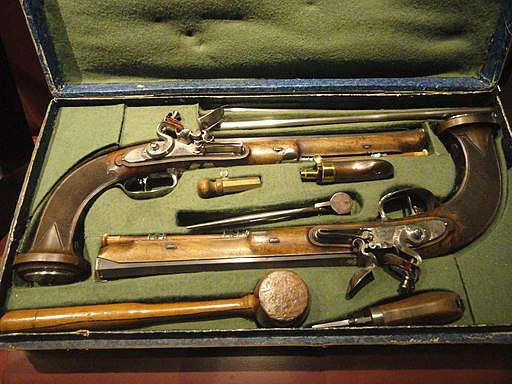
French cased duelling pistols, Nicolas Noel Boutet, single shot, flintlock, rifled, .58 caliber, blued steel, Versailles, 1794-1797 – Royal Ontario Museum – Public domain image by Daderot, Wikimedia Commons.

By the time of the Regency, pistols were the preferred weapon in British duels. They were seen as more equitable, as they required less training to wield than the sword – while some might be expert marksmen, there was less likelihood of a pistol duel being decided by one participant having greater skill. Pistols could also be fitted with hair triggers to fire before a duelist was necessarily ready, and the terms of a duel often required both duelists to simultaneously bring the firearm to bear and fire in one movement to force the shooters not to aim. While some gentlemen were known to purchase dueling pistols with rifling in the barrel to increase their accuracy, and to practice target shooting to improve their own ability, this was strongly deplored.

What was important for the restoration of honor was going through the formula of the challenge, the seconds’ deliberations, and the shooting: it was not important to actually hit, let alone kill, one’s opponent by the time of the Regency. A gentleman who had been insulted needed to be willing to stand up with a pistol to prove his honor or he might be thought weak, and a gentleman who had given insult needed to allow himself to be shot at (rather than apologize) so as not to be thought a coward. While duels sometimes ran to multiple volleys of fire, an initial exchange of bullets without harm could often satisfy the needs of honor.

Dueling had always been particularly associated with military officers, as men born into the gentry and aristocracy were both familiar with weapons and put a high price on honor, and as a result, there was an increase in reported duels during the time of the Napoleonic Wars, particularly in London and in port cities where troops might be quartered. In the following decades, however, the practice died out in Britain. Tolerance for aristocratic violence decreased, and at the same time, the barriers between rich and poor increased such that there was less need to show “honor” as a conspicuous sign of class. Modern mid-nineteenth-century men were restrained workaholics, not impulsive and dissolute rakes, and they had a respect for official hierarchy and the rules. The duel would be left behind as a relic of a chaotic and romantic past.

Further reading:

Stephen Banks, A Polite Exchange of Bullets: The Duel and the English Gentleman, 1750–1850 (The Boydell Press, 2010)

Markku Peltonen, The Duel in Early Modern England: Civility, Politeness, and Honour (Cambridge University press, 2003)

Victor Kiernan, The Duel in European History: Honour and the Reign of Aristocracy (Oxford University Press, 1988)

About the Author:

Cassidy Percoco has been focused on history from the time she was a child. After graduating with an MA in Fashion and Textiles: History, Theory, and Museum Practice from the Fashion Institute of Technology, she embarked on a career in museum collections management, and today she works at the Fenimore Art Museum and The Farmers’ Museum in Cooperstown, NY. She has previously published Regency Women’s Dress: Techniques and Patterns, 1800-1830, and runs Mimic of Modes Historic Patterns.

all portraits-Cassidy-Percoco

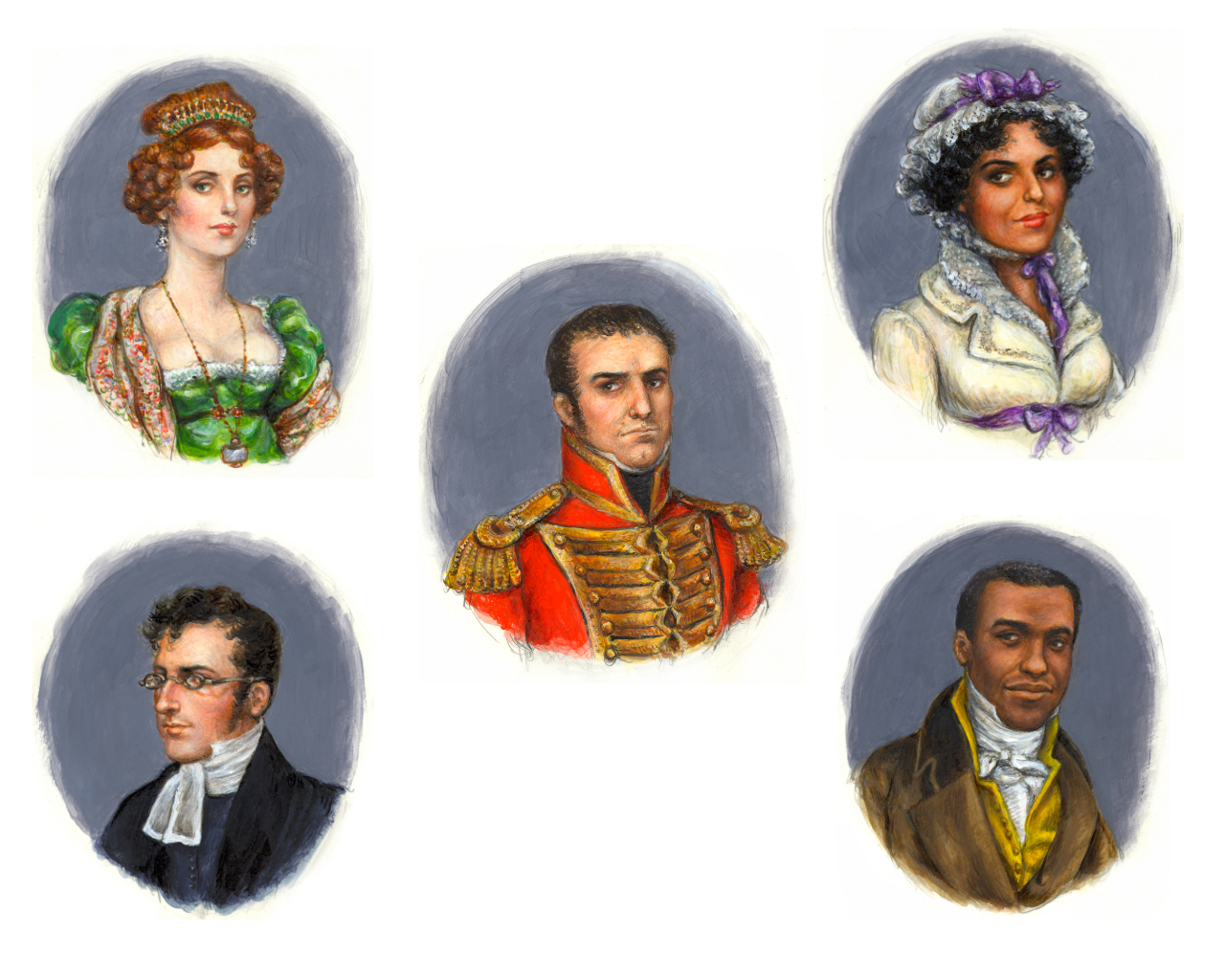
Portraits of roles in Dandies & Dandyzettes. Copyright image courtesy of Cassidy Percoco, illustrated by Joanne Renaud.

A Regency tabletop role-playing game

The topic of dueling is discussed in Dandies & Dandyzettes, a new tabletop role-playing game for one to many players now being funded on Kickstarter. In Dandies & Dandyzettes, players can step into the past and become anyone they can imagine, from a duel-hungry officer to a lady-in-waiting to the queen to a Cheapside lawyer and his family. The book also works as a detailed guide to the world of Regency Britain, from honor ideologies to the specifics of how to send a letter. 

Read Full Post »

« Newer Posts - Older Posts »