Feeds:
Posts
Comments

Archive for the ‘Jane Austen’s World’ Category

By Brenda S. Cox

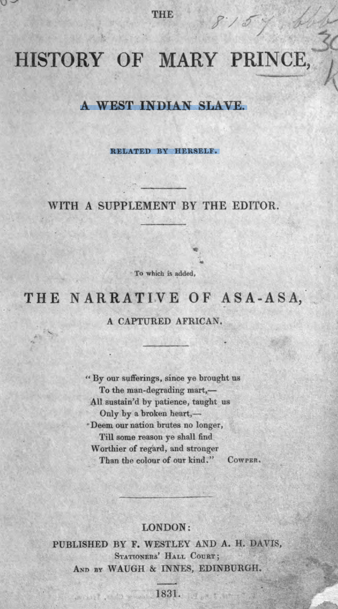
“”By our sufferings, since ye brought us 

To the man-degrading mart,— 

All sustain’d by patience, 

taught us Only by a broken heart,— 

Deem our nation brutes no longer . . .” – Quote opening The History of Mary Prince, A West Indian Slave. The quote is from William Cowper, Austen’s beloved poet. Such narratives at this time often began with quotes from Cowper’s anti-slavery poems, or from the Bible.

We’ve been looking at the situation of black people in Jane Austen’s England. We started with “‘Women of Colour’ in Literature of Jane Austen’s England,” considering Miss Lambe of Sanditon, Olivia of The Woman of Colour, and other fictional women of the time. Next, we learned a little about black people in general in Austen’s England, based on statistics and records, in “Black England: No Wall of Separation?” 

What about the lives of individual black and mixed-race people in Austen’s England? Most of those people were in the lowest “ranks” of society and didn’t leave journals or diaries. Scholars are trying to piece together some of their lives. For an example, listen to Gretchen Gerzina’s talk on Pero Jones and Fanny Coker, an enslaved man and a free woman working as servants in a 1780s Bristol household. 

Today I’ll introduce you to some of the most well-known black and mixed-race people in Austen’s England; people that Jane Austen may have heard of or read about. I can only give you a brief taste of their fascinating stories. For each one, I’ll give you links so you can explore further if you wish. For some, you can read their stories in their own words.

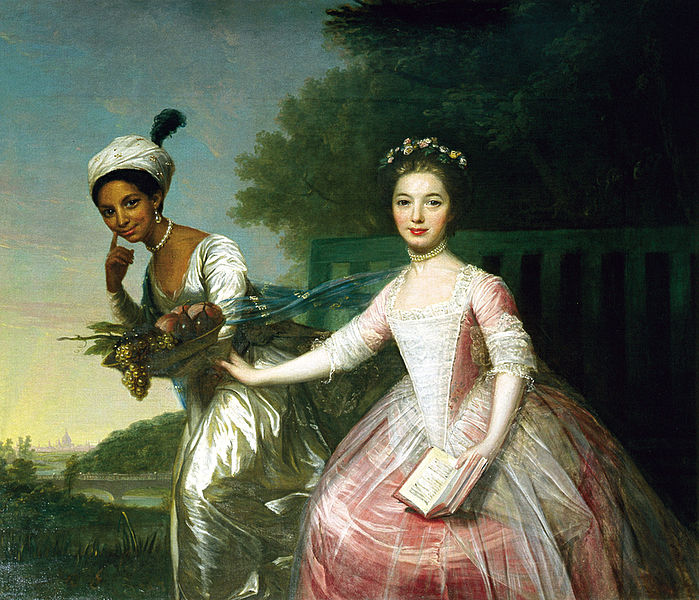
Portrait of Dido Elizabeth Belle Lindsay (1761-1804) and her cousin Lady Elizabeth Murray (1760-1825) by David Martin (1737-1797). Public Domain. commons.wikimedia.org/wiki/File:Dido_Elizabeth_Belle.jpg

Dido Belle

Austen must have known about one real mixed-race woman, Dido Elizabeth Belle (1761-1804). Dido’s father was a British naval captain, Sir John Lindsay, and her mother was a black enslaved woman named Maria. Lindsay was the nephew of the Earl of Mansfield, who became Chief Justice of England and made several rulings benefiting black people in England. Lindsay asked his childless uncle and aunt to raise Dido, and she grew up in the Mansfield household.

When another great-niece, Lady Elizabeth Murray, lost her mother at the age of six, the earl and his wife took her in and raised her along with Dido; they were around the same age. A portrait of the two girls as young ladies shows an apparently close relationship, though the white girl takes the central place in the picture. It is unclear exactly what Dido’s position was in the household. One guest noted that she did not eat dinner with the family and their guests, but joined them afterwards. She then walked arm-in-arm in the garden with her cousin.

The earl became very attached to Dido. In his will he confirmed her freedom and left her money. Dido married a white French servant, John Davinier. Her money enabled him to rise to the status of “gentleman.”

Dido’s white cousin Elizabeth Murray married wealthy George Finch-Hatton, a friend of Jane Austen’s brother Edward Knight. On a visit to her brother in 1805, Jane visited the Finch-Hattons. She was not impressed with Lady Elizabeth, writing on Aug. 24, 1805, “Lady Elizabeth for a woman in her age & situation, has astonishingly little to say for herself.”

It seems likely that Austen would have known about Elizabeth’s adoptive sister. She might conceivably have met her if Dido visited while Jane was at Godmersham, though we have no record of a meeting. Perhaps Austen was imagining how Dido Belle became a beloved member of the Earl of Mansfield’s family when she wrote Mansfield Park. Fanny Price is a little like Dido in that she arrives as a marginalized member of the household, but eventually becomes a valued family member.

For more on Dido Belle, you can listen to “Dido Belle and Francis Barber” or read Paula Byrne’s Belle.  (Byrne also has a chapter (12) on Dido in The Real Jane Austen.) The movie Belle  gives an imaginative portrayal of what Dido Belle’s life might have been like, based on the few facts that we have. Etienne Daly has been researching Dido and her family, and you can find his posts on All Things Georgian

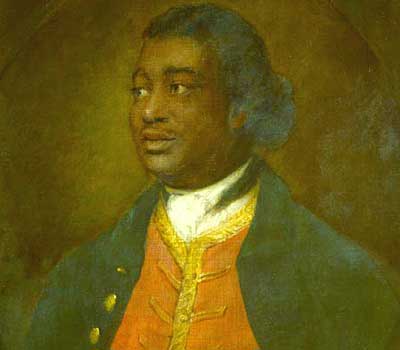
Ignatius Sancho (c. 1729-1780) by Thomas Gainsborough (1727-1788), 1768. Public domain. commons.wikimedia.org/wiki/File:IgnatiusSancho.jpg

Ignatius Sancho

Ignatius Sancho (1729-1780), born on a slave ship, ended up in England. The Duke of Montague took an interest him, educated him, and made him his valet, then his butler. Sancho eventually owned a grocer’s shop in Westminster. He was also a composer and art critic. He mixed with people like Thomas Gainsborough, who painted his portrait. Sancho married a black woman and had six children. He owned enough property that he could vote; he is the first known African-background person in England to have voted in a general election.

Sancho’s letters were published in 1782, after his death. Sancho supported the abolition movement; one letter condemns “the Christians’ abominable traffic in slaves” as “uniformly wicked.” In another he expresses his faith by looking forward to heaven, “the promise of never, never-ending existence and felicity.” He also wrote to encourage a young man who had recently gone to India to stay firm in his faith: “Read your Bible—As day follows night, God’s blessing follows virtue—honor and riches bring up the rear—and the end is peace—Courage, my boy—I have done preaching.”

You can read the original Letters of Ignatius Sancho (1784), with a memoir of his life. Modernized paperback versions with more commentary are also available, as well as Dr. Gerzina’s talk on Sancho

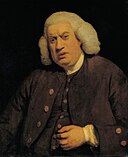
Samuel Johnson, one of Austen’s favorite authors, left most of his possessions to his black manservant, Francis Barber. Samuel Johnson, 1772, by Joshua Reynolds, Public domain, via Wikimedia Commons.

Francis Barber

Samuel Johnson, whose writings Jane Austen appreciated, thought highly of his black manservant, Francis Barber (1745-1801). Born enslaved in Jamaica, Barber was brought to England as a child by his master Richard Bathurst. Bathurst had him baptized him and named him. When Bathurst died, his will freed the boy.

Barber worked as Johnson’s servant. Johnson, who was against slavery, educated Barber and treated him like a son. Barber’s black friends came to visit him in Johnson’s home. Barber left Johnson for a few years, working for an apothecary, and then in the navy. Johnson got him out of the navy and brought him back. Barber married a white wife, Elizabeth, and had five children. They all lived in Johnson’s home.

When Johnson died, he left money, an annuity (yearly income of £70), and most of his possessions to Barber: property, books and papers, and other items. Barber and his wife moved to Lichfield, where he eventually ran a village school. 

Barber’s children and grandchildren married white people. Most became manual laborers, blending in with the poorer population of London. Barber’s son Samuel grew up to become a Methodist lay-minister (a preacher who was not ordained).⁠

For more on Francis Barber, you can check out Dr. Gerzina’s talk, or this biography.

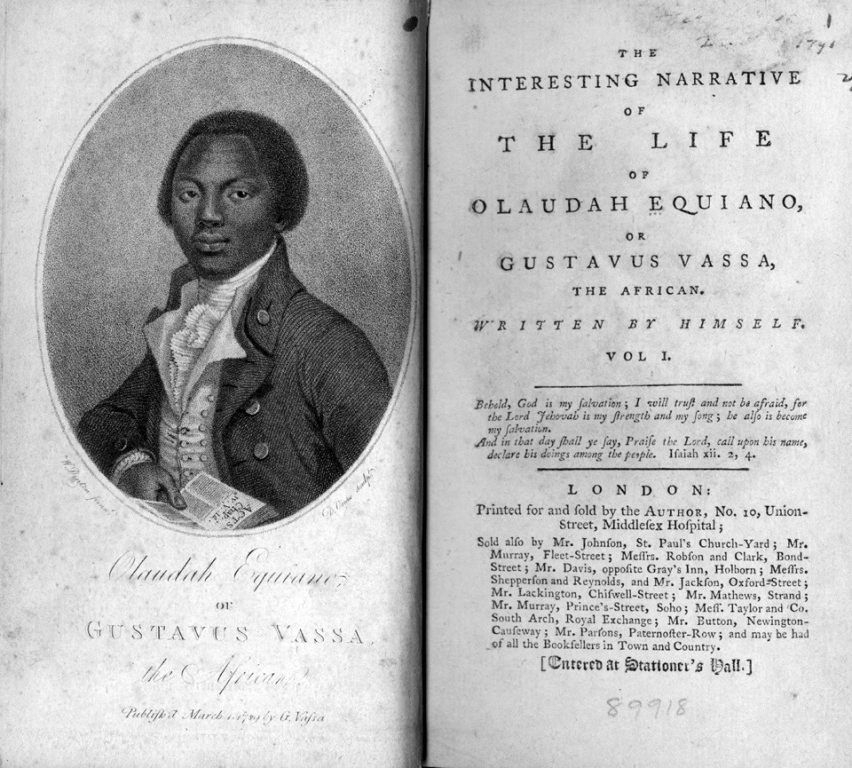
Olaudah Equiano’s autobiography went through multiple editions and was published in multiple languages. archive.org/details/lifeofolaudahequ00equi_0

Olaudah Equiano

Olaudah Equiano (1745-1797) was the most famous formerly-enslaved person in Austen’s England. From the Igbo people group in Nigeria, he was enslaved as a child, owned by a series of people and traveled the world. Through trade, he earned enough to buy his freedom from a Quaker master when he was about 21. After several people in Georgia and the West Indies attempted to kidnap Equiano and re-enslave him, he decided to move to England. From there he worked as a seaman on long voyages.

Equiano became a leader of the movement for the abolition of the slave trade and slavery. His autobiography was published in 1789. The Interesting Narrative of the Life of Olaudah Equiano; or, Gustavus Vassa, the African, Written by Himself  ran through nine editions in England, and was widely read in the US and translated into Dutch, German, and Russian. (Equiano’s owners gave him several names when he was young; Gustavus Vassa was one that he continued using in England.) Equiano traveled around the country promoting his book and campaigning against slavery.

Equiano vividly describes his African childhood and his experiences on a slave ship and as an enslaved man. (Some scholars believe he was actually born in South Carolina rather than in Africa, but his autobiography describes his childhood in Africa.) He tells of the abuses suffered by slaves, and the challenges he faced as a free black man.

In 1774, Equiano was dramatically converted to Christianity. More than 20 pages of his autobiography describe the various people who shared passages from the Bible with him, his own conviction of sin, and finally his vision of “bright beams of heavenly light” coming into a “dark place” as he accepted Jesus’s death for his sins. He became a member of the Church of England. Equiano often tried to persuade others to become Christians. He attempted to get ordained and go as a missionary to Africa, but the bishop chose not to ordain him.

In 1786, Equiano was asked to help with a new project. At first he was enthusiastic about the idea. The government was planning to send a group of black people to Sierra Leone in Africa to set up a colony there. Equiano was to supervise the provisioning of the ships. However, he complained of corruption and poor, insufficient supplies, and was dismissed from his position. The expedition did take place, but the colony faced huge difficulties and many died.

Equiano closed his autobiography with a plea to end slavery, and instead to trade with Africa for goods like indigo and cotton. He went on to explain that he had included many seemingly small details of his life, since he had learned to see the hand of God in all those details, and to learn lessons “of morality and religion” from all that happened; he hoped his readers would also learn from his experiences.

For more on Equiano’s life, I recommend his autobiography. It was very popular in the eighteenth century, though we don’t know if Jane Austen ever read it. Modern versions with additional material are also available. For a briefer survey, listen to Dr. Gerzina’s talk.

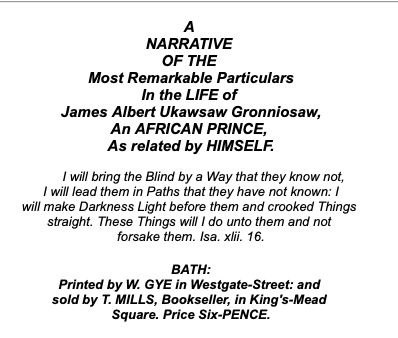
Like many black writers of the time, Gronniosaw included his Christian testimony in his memoir.

Ukawsaw Gronniosaw

Ukawsaw Gronniosaw (c. 1705-1775), an African prince from Nigeria, became a Christian while he was enslaved in America. Like many of the formerly-enslaved people who wrote their stories at this time, he includes his faith experiences. His owner was a Reformed Dutch minister who sent him to school. Gronniosaw was converted when he read Richard Baxter’s A Call to the Unconverted, so he was obviously very literate. He wrote, “I was so drawn out of myself, and so fill’d and awed by the Presence of God that I saw (or thought I saw) light inexpressible dart down from heaven upon me . . . I seemed to possess a full assurance that my sins were forgiven me. I went home all my way rejoicing . . .”.

Gronniosaw was eventually freed and settled in England. He was influenced by multiple denominations there. He became friends with the famous Methodist preacher George Whitefield, joined a Baptist church, shared his testimony with Dutch Calvinists, and received help from Quakers. When he wanted to marry a white English woman who had helped him grow in his faith, the leaders of his church objected: not because of race, but because she was poor. He paid off her debts and married her anyway. She was a weaver; he worked at whatever jobs he could find.

 Gronniosaw, like most black people in Britain, was not born in a British parish and therefore not eligible for parish help when he was in need. In his memoir he describes one severe winter when he and his wife were both unemployed and “reduc’d to the greatest distress imaginable.” He did not want to beg, but when their “last bit of bread was gone” he had to ask for help. They moved elsewhere and his wife found work again as a weaver, but the situation was still difficult. He thanks God for the “charitable assistance” of others and looks forward to relief in heaven.

You can read Gronniosaw’s story in his own words in A Narrative of the Most Remarkable Particulars in the Life of James Albert Ukawsaw Gronniosaw.

Mary Prince’s autobiography increased public outrage over the abuses experienced by enslaved people in the West Indies.

Mary Prince

The only autobiography of a black woman in England that we have from this time is the story of Mary Prince (1788-183?). Mary was born into slavery in Bermuda. She later lived in Antigua, where Moravian missionaries taught her to read and write in a Bible class. She joined the Moravian church, which helped many enslaved people in Antigua. Mary married a freeman in the church, though the Church of England there apparently did not allow slaves to marry. A Moravian missionary attempted to buy Mary’s freedom, but her owner, John Wood, refused to let her go. He took her away from her husband and brought her to England.

In England she fled from the Wood family’s cruelty. The Anti-Slavery Society took her in. She worked as a servant for the secretary of the society, and the society helped her published her autobiography, The History of Mary Prince, in 1831. At the end of her story, she is enjoying the kindness and hospitality of Christians in the Anti-Slavery Society, and appreciates going to church three times on Sunday. But she longs for her husband and her home, and cannot return because that would mean returning to slavery.

Gretchen Gerzina shares some of Mary’s story on Britain’s Black Past,  using some of Mary’s own words. You can read Mary Prince’s autobiography in various editions, and on google books. The Moravians also record information about Mary.

Black Clergy

We also know of a few black or mixed-race clergymen in Austen’s England. Brian Mackey, the son of a white father and a black West Indian woman, held two church livings in 1805.  We only know about his racial background because one of his contemporaries, clergyman William Holland, was his parents’ neighbor and wrote about Mackey in his diary. Nathaniel Wells, mentioned in last month’s post, had two sons who became clergymen. Philip Quaque (or Kwekwe) was a black African who studied in England, was ordained, and married an English wife. In 1766 he returned to Cape Coast, Africa, as the Church of England’s first African missionary. For more on black people in the Church of England, I recommend Black Voices: The Shaping of Our Christian Experience by David Killingray and Joel Edwards, which includes extensive quotes from black people in England over the centuries.

These are only a few of the many black people who lived at least part of their lives in Austen’s England. I hope you will have a chance to read some of their stories in more detail. And please tell us about others you are familiar with!

Note: Last month when I talked about mixed-race Nathaniel Wells and his wealth and position in society, I should also have said that Wells, as his slave-owning father’s heir, owned slave plantations, and the enslaved people apparently were not treated well. Gretchen Gerzina tells more of his troubling story in Britain’s Black Past

© Brenda S. Cox 2021, excerpted from the upcoming book Fashionable Goodness: Faith in Jane Austen’s England by Brenda S. Cox

Other Sources

  • William Holland, Paupers and Pig Killers, 106. Jan. 25, 1805. (On Brian Mackey)
  • Untold Histories by Kathleen Chater (Manchester University Press, 2009)
  • Oxford Dictionary of National Biography
  • Black London: Life Before Emancipation by Gretchen Holbrook Gerzina (Hanover: Dartmouth College Library, 1995)
  • Dr. Johnson’s portrait is from commons.wikimedia.org/wiki/File:Samuel_Johnson_(1911)_Frontispiece.png
  • You can find further resources here.

For more on individual black lives in Austen’s England, check out Professor Gretchen Gerzina’s series, “Britain’s Black Past,” on BBC radio.

I also recommend recordings of this year’s excellent Race and the Regency series from Jane Austen and Co.

You can connect with Brenda S. Cox, the author of this article, at Faith, Science, Joy, and Jane Austen or on Facebook.

Read Full Post »

Inquiring readers: Earlier this week, Tony Grant wrote about the history of Robert Geffrye and the Almshouses in Shoreditch. This post discusses his experience as a guide in an 18th century room. This post links to online images to that room. Enjoy!

Almshouse, number 14, has been set up to show what a pensioner’s rooms would have been like in the 1780s and also a hundred years later in the 1880s. The almshouses were used as charitable houses for the poor for 200 years.

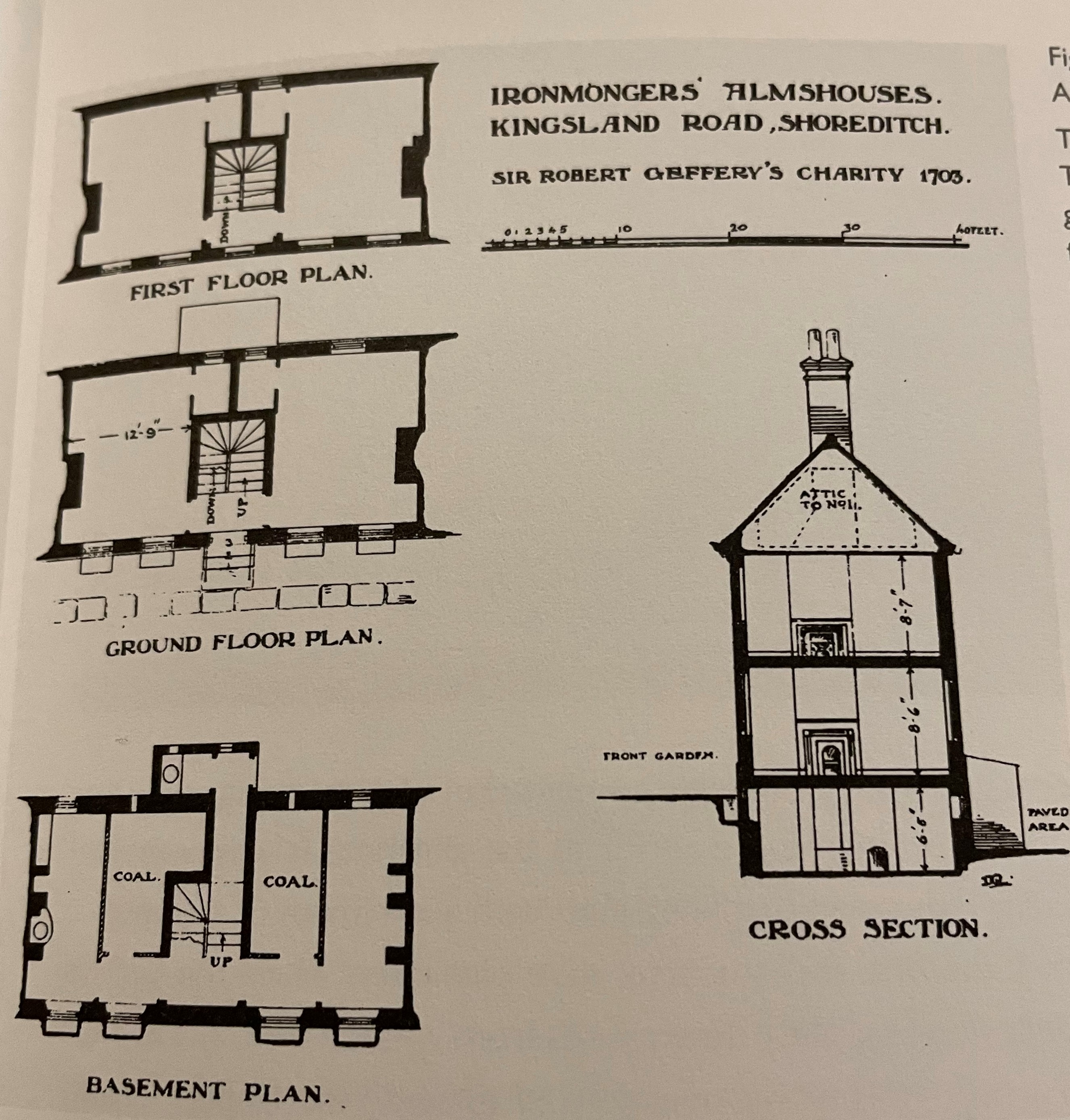
Plan of houses

One of the things I do as a volunteer at the museum is to take visitors around these historic rooms and discuss the history of the building and the lifestyle of the pensioners who lived there. 

The ground floor consists of the 1850s rooms. Jane Austen lived from 1775 to 1817, and these almshouses existed and were in use throughout her lifetime. The world she portrays in her novels is often of the rich landowning gentry and the village community. This other world of poor, mostly  illiterate people lived at the same time as she, and I think we should be aware of them.

When I bring a group into the almshouses, we enter the front door and assemble in the downstairs room with display boards, and a few chairs and a table to show some handling artefacts. By this point, as we walk from the reception area on the opposite side of the almshouses, I have already given the group some background information about Robert Geffrye and the building, and the purpose of the almshouses. 

Once inside the building, I give a quick health safety talk about moving around the almshouses and point out low door lintels. It is important that visitors touch nothing. All are original artefacts from the 18th century.  I tell them about the meeting point if the fire alarms are set off. The room we are in is located in the first ground floor rooms. Another room of the same size and shape is located on the opposite side  of the entrance door on the ground floor and there are two more rooms on the first floor at the top of the flight of stairs. Each almshouse was built  for four pensioners, hence the four room layout.

I then take the group into the room opposite.

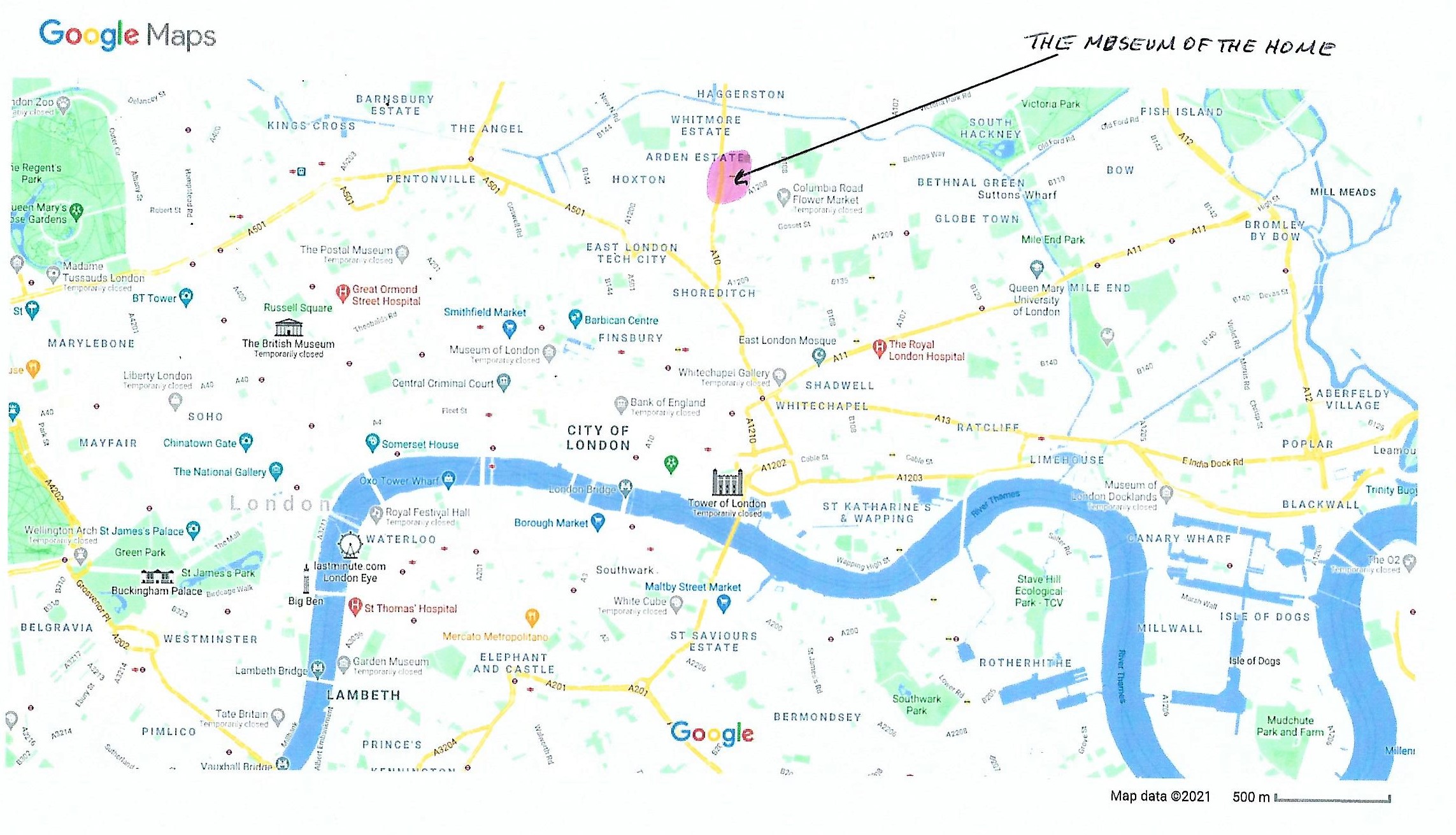
Let’s return to the year 1780 in Shoreditch, just north of the City of London at The Geffrye Almshouses on The Kingsland Road. This ground floor room is set out as it would have been during the 1780s, the first century the almshouses existed.

Map of The Museum of The home (2)

The room appears sparsely furnished. The windows show some light entering the room. The giant London Plane Trees that replaced the original lime trees over 100 hundred years ago cast a shadow in the room, especially in the summer when the trees have their full leaf canopy. The windows today are the Victorian sash windows that replaced the original shuttered windows, but apart from that, everything is as it would have been in 1780. 

A gnarled oak table is positioned under the window, with the wood grain deeply fissured in places. On the table are a pewter plate, a horn mug, and iron and bone handled knife and fork. An iron candlestick holds a candle. I usually light the candles in this room for the visitors to get the full effect of how lighting would have been. Nowadays, we use modern candles with the flame standing bright and true and straight. 

A cylindrical tin hanging on the wall gives us more of an idea of the lighting in this room in the 18th century. It contains tallow candles. These were made from animal fat. They were cheap. When lit they generally smoked and gave off an unpleasant smell. The reason they were kept in this tin container is so that the rats could not eat them. A pair of what look like iron scissors lie near the tallow candles. By trimming the candle wick the smoking, and, hence the smell, could be reduced.  A small iron cone with a long thin handle was used to snuff the candles.  

I always point out the floorboards. This was a luxury for poor people. Generally, workers’ homes had earth floors, which got damp in wet weather and rotted their wooden furniture. Two of the chairs in the room look rather low, with their seats close to the floor. You can see how the legs have been strengthened with cross pieces. The legs have been gradually cut down as they rotted from the floor upwards. 

The bed is a strong wooden frame with ropes stretched across the frame to make a netting for the straw filled mattress to lie on. A coarse woollen blanket covers the bed. Underneath the bed you see a large chamber pot. This was the container the occupants would urinate and defecate in. Each day they emptied their chamber pots into a cesspit at the back of the buildings. The cesspit was emptied regularly by night soil men.

As the diet was mostly vegetables, I surmise that the contents of the cesspit was put onto the local market garden fields as compost. 

Water was obtained from two pumps within the grounds outside of the almshouses. The Geffrye Pensioner was provided with clean fresh water from the “New River,” a canalisation of the River Lea from James Ist’s time. The River Lea starts from a country town called Ware thirty miles north of London. Many springs, including those at Sadlers Wells, feed the river during its course. 

Many Londoners did not have the benefit of clean fresh water. Some aquifers around the city supplied a few pumps, but many people got their water from The Thames, which became more and more filthy as the decades went by. One of the almshouse rules actually stated that the pensioners must not sell water to the local people. The pumps were padlocked and the pensioners were supplied with keys to access the pumps.

The fireplace is an interesting point in this room. It has an iron grate, and iron hooks allow pots to be hung over the flames. A bucket with coal was used to fuel the fire. A tinder box with a piece of flint , a piece of iron to strike a spark, and oiled wool to catch the sparks were used to ignite the fire.

A large iron pot that stands next to the fire was for cooking a vegetable stew called pottage, which was their main diet. Meat was expensive and, unless they managed to trap and catch a rabbit in the local fields or once in a while got hold of an old chicken, they very seldom had meat. 

Pewter plates are interesting. In the 18th century, pewter was an amalgam of tin, antimony, and lead. They didn’t know that lead was poisonous, probably because the effects took a long time to build up in the body. By the cuts and scrapes on the surface of the pewter plates in this room small grains of lead must have gotten into their bodies with every meal.

There is no evidence of written material in this room:  the pensioners in the 18th century were probably illiterate, although they had skills in the iron trade and had been very talented ironworkers.

The small room attached to this main living area stored items such as jugs, plates, brushes, and other utensils.

I then take the visitors into the basement to view the store rooms for coal and the washing facilities for their clothes. A large cauldron, heated by coal from underneath, was used to boil a mixture of water, an alkali made from wood ash, and a certain amount of urine as a bleaching agent. The smell must have been awful. I really can’t imagine they often washed their clothes. Maybe once a year. They had to dry their clothing either in front of the fires in their rooms or in an area at the back of the almshouses. Washing could not be hung at the front for passersby to see. 

And so a visit to some of the poor of the 18th century ends. 

The Museum of the Home encourages us to ask questions about what ”home” means. Because of the history of the buildings themselves, however, we have to ask questions about  Sir Robert Geffrye.  What is his legacy today?

Links:

References:

  • Kathy Haslam : A History of the Geffrye Almshouses,  Published by The Geffrye Museum 
  • Penelope Hunting :  Riot and Revolution ( Sir Robert Geffrye 1613-1704)  Published by The Geffrye Museum 2013

Read Full Post »

Early Life of Robert Geffrye

Robert Geffrye was born at Tredinnick Farm near Landrake in Cornwall in 1613. His father was a yeoman farmer. That meant, unlike a tenant farmer, he owned his own land. He was baptised at St Michael’s Church in Landrake on the 24th May 1613. The local vicar, Roger Jope, chose children from the area to teach the basics of reading and writing. He discovered in Robert a quick and intelligent child. At that time, learning to read and write opened opportunities to any able boy.

A number of national and international incidents happened in the early years of Robert Geffrye’s life. In 1623 and again in 1630, storms affected the crops and many families were left hungry. In 1618, the 30 Years War began in Europe. A period of continuous war over three decades between Catholic and Protestant states in Europe and particularly amongst the Germanic states ensued. Even though Britain was not officially a participant in these wars, James Ist still provided an army of 30,000 English troops to support his Protestant allies. In 1625, three hundred young Cornishmen were conscripted to fight. In 1627 a failed raid on La Rochelle saw the returning English army of 5000 men billeted on Cornish households. Landrake was no exception. Because of the unruly nature of some bands of troops stationed in Cornwall, martial law was imposed on the area. Poor prospects and many dangers beset the young teenage Robert Geffrye.

A young man wanting to get on in life obtained an apprenticeship, especially with one of the great livery companies in the City of London. This was a route to prosperity and advancement. Many Cornish men had made their fortunes by joining such livery companies and many prominent Cornishmen had links to the livery companies. For instance, Richard Randall the Deputy Vice Admiral in Devon had a longstanding connection with The Ironmongers Company. Richard Peate, another Cornishman, made a lucrative career with The Ironmongers and became their senior warden. Robert Geffrye went to London at the age of 17 and applied successfully to join the Ironmongers as an apprentice with Richard Peate.

Robert Geffrye’s father paid Robert Peate the £200 apprenticeship fee. Apprentices became part of their masters family and boarded with them for the seven years the apprenticeship lasted. Robert Geffrye lived with the Peates at Whitecross Street, Finsbury, and initially would have been set to work sweeping the warehouse floor, and packing and weighing goods. Towards the latter years of his apprenticeship he would have worked in the counting house dealing with bills, and learning the elements of book keeping and correspondence, and so became acquainted with Peate’s customers. Daniel Defoe had been an apprentice with the Butchers company. He wrote that on the completion of an apprenticeship, a young man could, 

“turn his hand to anything, or deal in anything or everything.”

Robert Geffrye completed his apprenticeship with credit in August 1637. He was given the freedom of the city, which gave him privileges within the city. He later became a liveryman of the company, putting him in a position of authority, checking standards, and attending church services, dinners, and ceremonies in the name of the company. His dealings were with men who had trained and achieved the same status he had. This put him on a trajectory within the political and trading establishment of the city. 

In 1667 and again in 1687, Geoffrey became the Master of the Ironmongers Company. In 1674 he became the Sherriff of London, an important role in the 17th century. Officeholders had important judicial responsibilities and attended the justices at the Central Criminal Court, The Old Bailey. In 1676, Robert Geffrey became an Alderman and eventually the Lord Mayor of London in 1685. 

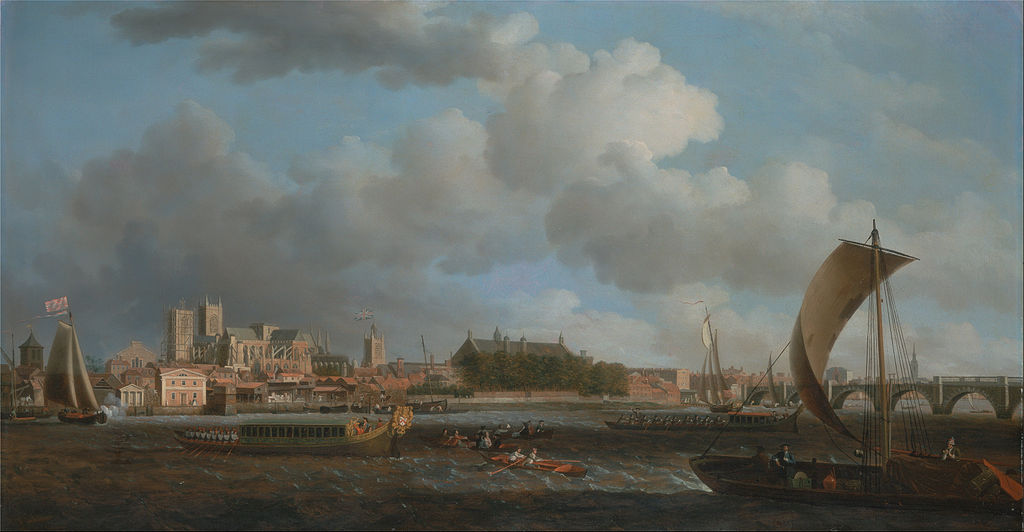
Painting of ca, 1745, Westminster from Lambeth, with the Ceremonial Barge of the Ironmongers Company

Samuel Scott, ca, 1745, Westminster from Lambeth, with the Ceremonial Barge of the Ironmongers Company – Google Art Project.

Robert Geffrey’s life and his rise in importance and influence came during a tumultuous time, starting in his youth with The Thirty Years War, the reign of Charles 1st during the English Civil war, when war was waged between the Parliamentarians known as The Roundheads, who were who were mostly Puritan, and the Cavaliers who were monarchists and Church of England followers. The monarchy was defeated, leading to the execution of Charles 1in 1649. Scotland proclaimed his son, also Charles, as King Charles II, whose army was defeated at the Battle of Worcester in 1651, when he escaped to The Netherlands.

The following nine years were known as The  English Commonwealth under Oliver Cromwell. After Cromwell died, Charles II was invited back to England in 1660 and was welcomed in London in May of that year. Charles II died in 1685 and his brother James became King James II. 

Robert Geffrye lived through The Plague year of 1665, followed by The Great Fire of London in 1666. More conflict followed, including a successful attack by Charles II, a Roman Catholic, on The Medway ports with a Dutch fleet. The victory caused problems among many of the Protestant aristocracy and  government ministers. They wanted to get rid of Charles II and, backed by the Protestant Duke of Monmouth, to usurp him. Monmouth’s army was defeated at The Battle of Sedgemoor in Somerset. He was captured and executed and many of his followers were pursued by Judge Jeffryes  and condemned to death at the famous Bloody Assizes.

James II was able to consolidate his power and reigned until 1688, when he was deposed by William of Orange. During this tumultuous time, Robert Geffrye must have been a very astute politician and able administrator to navigate those times. You have to admire him for his tenacity.

Later life and the Almshouses

During his life Robert married a mercer’s daughter, Priscilla Cropely. They lived in Lime Street, very close to Leadenhall Market in the City and by the Ironmongers Hall. They had no children.

In 1653 he joined The Levant trading company. It is recorded that he traded cloth to Leghorn in Italy. Robert Geffrye  became an administrator in The Levant Company trading with Northern Europe, the Mediterranean  and Turkey. In 1670 he profited from the slave trade by his investments and involvement in the Royal African Company, and in 1680 Robert Geffrye became a joint owner of the trading ship, The China Merchant. He and his fellow owners wanted to hire their ship at first to The East India Company. 

He  became an administrator in The Royal African Company whose whole purpose was the ”Triangular Trade” with the Guinea Coast of West Africa, The West Indies, and Britain. All these great trading companies had strong links to The Ironmongers Company, trading in cloth, tin, lead, pewter, calico, spices, pepper and slaves. It is rather chilling seeing a list of their trading interests with slavery as just one more item on the list.

During the last fifteen years of his life, Robert Geffrye devoted his time to charitable work. He became the president of Bethlem and Bridewell Hospitals. Sir Robert Geffrye and his wife Priscilla were childless. She predeceased him by many years. When he died in 1704 at the age of 91 years, he left a small fortune of £13000. In his will, some of the money went to financing a school in his home village of Landrake in Cornwall, but a substantial amount of the  £13000 was left to build almshouses for poor deserving people who had worked mainly for the ironmongers and fell on hard times when they retired. 

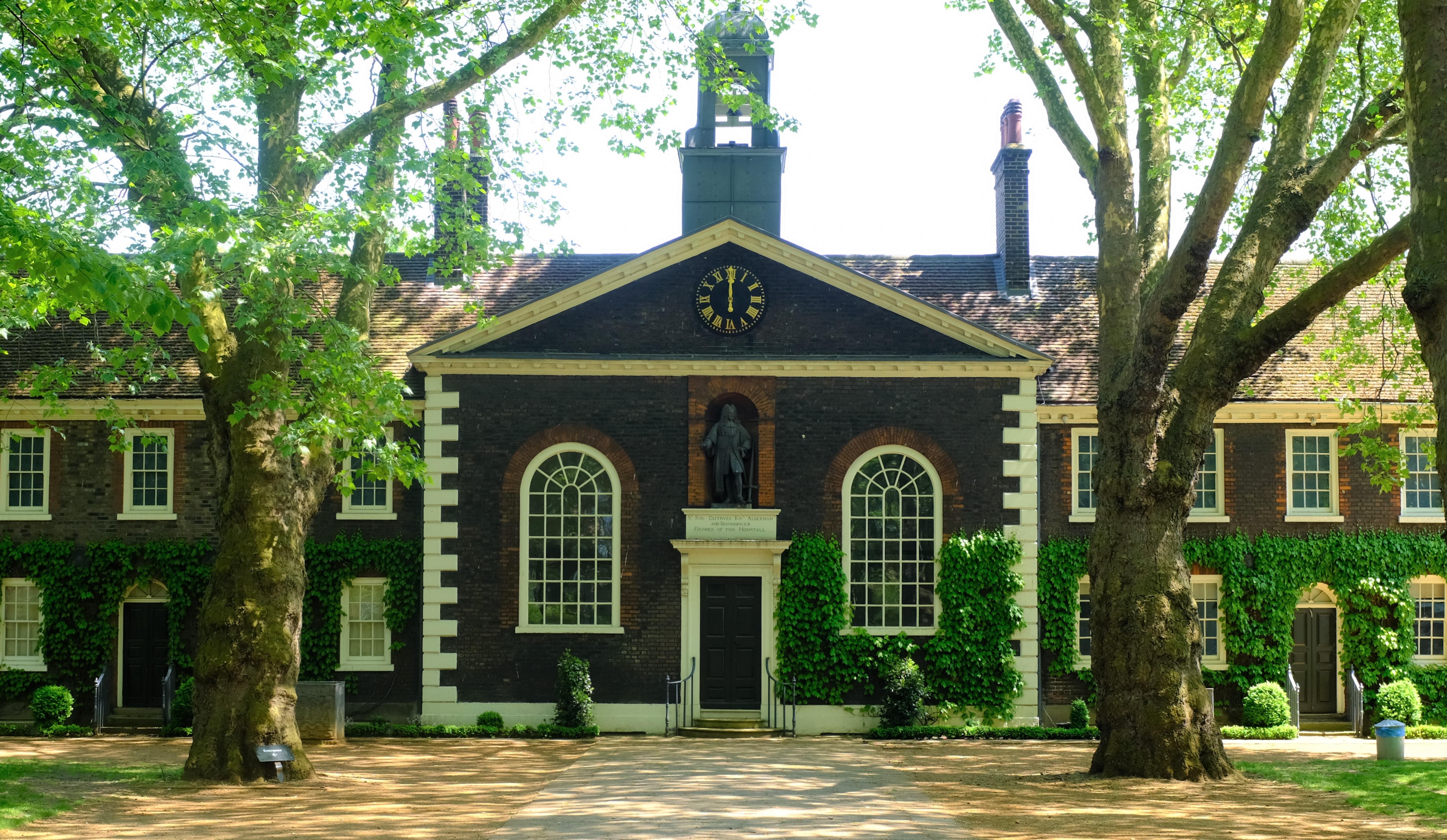
Photo of the Geffrye Almshouse

The Geffrye Almshouses, image by Tony Grant

An almshouse is a charitable home for poor people of good character. The Ironmongers Company set up a group of officers called the Geffrye Charity Committee. They took nearly nine years to find a suitable site to build the almshouses–a site near the city so it had convenient access to the committee based at Ironmongers Hall.

They wanted the site to be conspicuous to passers-by so that Robert Geffrye’s legacy could be seen and admired. They first looked at a site in Old Street that the Ironmongers owned and a site in Bow was also considered. By 1711, the committee was still looking for a site and in November of that year they published an advertisement. A Mr Hunt, who owned a large plot of land fronting the Kingsland Road, responded, and sold the site to the Ironmongers for £200. 

There were other charitable foundations in The Kingsland Road too. Just to the north of this new site, The Drapers had built an almshouse. To the south, The Framework Knitters also had their almshouses. The area, although close to The City, consisted mostly of market gardens and arable farming. Clay pits in the area provided clay for brickmaking. In 1712, the Geffrye Charity Committee drew up their architectural plans for the almshouses. Someone who was not an architect must have been a competent draughtsman, for the plans were very good. The almshouses were well designed in a typical 18th century style copying Christopher Wren and aspects of Inigo Jones.

Tenders were submitted in 1712 for building the houses. Robert Burford, a carpenter, was employed to build the central great room and six almshouses located on the north side. Mr Halsaul, also called a carpenter in the documents, was contracted to build six more almshouses on the south side. In the documents they are merely called carpenters, but they were more likely to have been members of the Carpenters Guild, who had their own building apprentices. The central Great Room was used as a meeting place and to socialise for the first two years of its existence. It was soon turned into a chapel  for Sunday services, which the pensioners were required to attend.

The chosen site sloped to the west. To make it flat, the Committee encouraged people to dump their waste on the land to fill in the dip. Six hundred carts of soil were transported to cover the ground. The actual buildings were constructed at the back on solid ground that had not needed levelling. This provided ground for a solid foundation and left the front area to be grassed over as a  lawn for recreation, and room for Lime trees to be planted. Twelve houses were completed by 1712 with the great room in the middle. Two more houses were added, one to each wing in the following two years, making fourteen altogether.

The Geffrye Charity Committee insisted on high quality materials for the buildings. Today you can see how well constructed they are. The interiors are well designed. The floors are made of strong sturdy oak boards and the interior walls and ceilings are plastered. An American lady I showed round once finished the tour by saying, “ I’m ready to move in now.”

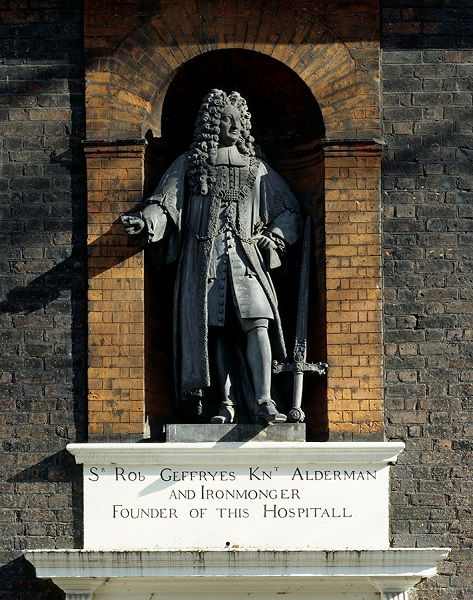
Statue of Robert Geffryes, Founder of the Hospital

Statue of Robert Geffryes, Founder of the Hospital

In December 1714, the first pensioners moved in. The criteria for becoming a pensioner was that you had to be 56 years old at least, poor, and of good character. The rules in the Geffrye Charity Committees documents state, 

“any member or their widow that shall have been Liveryman or Freeman of The Company of Ironmongers shall be preferred.” 

This did not mean that people who were not from the Ironmongers Company could not get in, but Ironmongers were given preference. Until 1740, on average between forty to fifty pensioners lived in the almshouses.

Robert Geffryes’ endowment provided a  Geffrye pensioner with a single room that had a small walk-in cupboard in one corner. They were given a pension of £6 a year. Each pensioner was provided with six sacks of coal a year. A new gown was given to each every Lady Day ( March 23rd). They were required to make ,”petticoats,” from their old gowns. Some of these official pensioners – male – often had wives, and it is thought some even had children living with them. £6 per year was not enough to live on for some. They could petition for extra funds from the almshouse poor box or the Ironmongers Companies estate. Many received extra money in this way. Some were also employed in work in the almshouses. The matron, groundskeeper and chapel clerk were employed from among the pensioners. A chaplain was also employed but he was not a pensioner. The Chaplain held a position of authority over the pensioners.

The committee made up rules for the pensioners to live by and were based on the rules enforced by other almshouses, so they were not unique. 

  • Pensioners could be fined for blasphemy. In this case they would be expelled from the almshouses to return to their parishes. This was not a good thing to happen. Living off their parish made them extremely poor. 
  •  If they were found guilty of adultery or lewdness they could be expelled. 
  • Staying out overnight could bring a fine. The gates were closed from 7pm in the winter and from 9pm in the summer.
  • Rule number 8 stated that a pensioner had to be. “of good life and conversation.” They were expected to get on well with the other pensioners and support each other when ill. Rule number 10 related to drunkenness. A fine would be given. Cases were heard at the Geffrye Charity Committee meetings held in the great room, to begin with. Generally, they were  lenient and expulsion was very rare. 

The almshouses today are called “The Museum of The Home.” Over the last three years a government grant from the lottery fund of £18 million pounds has been given to the museum to extend and develop its work. The basement has been lowered and refurbished to contain exhibitions and displays on the theme of The Home, which covers many aspects. Documentary films have been made about the home lives of local Shoreditch residents and their background. Various themes, such as migrant camps, sleeping rough on the streets ,”games in the home,” and other aspects of home life are covered. The key element about these new exhibitions and displays is to instigate discussion and to ask questions.

The ground floor has remained as the middle class English period rooms from Tudor times to the 21st century. A new addition called “The West Indian Front Room” has been installed as the 1970s room. Eventually, over time, the museum will move away from being predominantly a museum of middle class rooms to rooms that cover all of society. The roof has been opened up to contain a research library.

An important element of the museum’s work is its ground-breaking educational work with schools, colleges, and universities.  A new education block has been built at the back, a major element of the museum. The museum is now famous for its important outreach into the local community. Molly Harrison, the curator of the museum from 1949 into the 50s and 60s, developed child-centred exploratory education techniques, which many museums in Britain and the world over still use today. 

The second part of this series, which is a guided tour of the 18th century room in the Almshouses, will be posted on Thursday of this week. “Welcome to a Guided Tour of the 18th Century Room in the Museum of the Home at the Geffrye Almshouses, Part II.”

Links:

References:

  • Kathy Haslam : A History of the Geffrye Almshouses,  Published by The Geffrye Museum 
  • Penelope Hunting :  Riot and Revolution ( Sir Robert Geffrye 1613-1704)  Published by The Geffrye Museum 2013

Read Full Post »

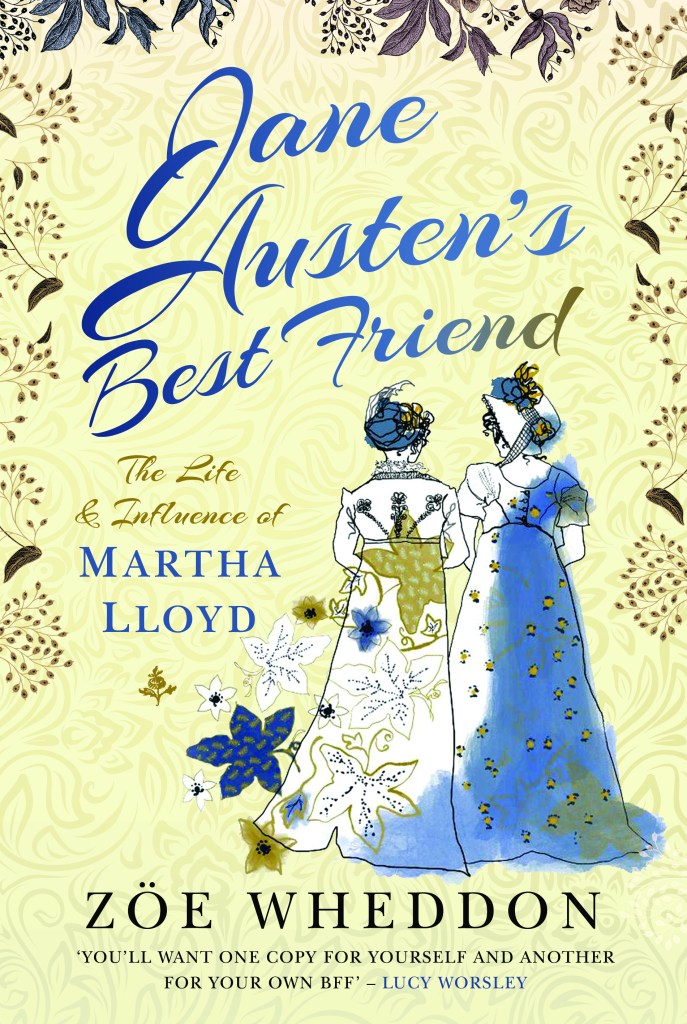
I’ve always been intrigued by the friendship between Jane Austen and Martha Lloyd. (Who wouldn’t want to be close friends with Jane Austen?) When I saw Zöe Wheddon’s new book, Jane Austen’s Best Friend: The Life and Influence of Martha Lloyd, I knew I had to have it.

As a lifelong student of Jane Austen’s life and works, I particularly enjoy books that focus on one aspect of her life. It’s helpful to have gathered into one place all of the information I want to read on a certain topic. Jane Austen’s Best Friend tells the story of Jane and Martha’s friendship and brings together many of the finer details of Martha’s life and her impact on Jane as a person and a writer.

Photo courtesy of Rachel Dodge

I was personally touched by the closeness that was shared by Cassandra, Jane, and Martha. Jane’s deep affection and care for both her sister and her friend are clear. I took note of the fact that Jane formed her strongest bonds with women who were wise and clever, devoted and kind. Her active mind needed people who could keep up with her quick wit—and even challenge her and keep her on her toes—and Martha seems to have fit the bill perfectly.

“I would not let Martha read First Impressions again upon any account, & am very glad that I did not leave it in your power.—She is very cunning, but I see through her design;–she means to publish it from Memory, & one more perusal must enable her to do it.”

Jane Austen in a letter to Cassandra, June 11, 1799.

While this book takes on a lighter, more modern tone, the research is thorough and detailed. Jane’s letters to and about Martha reveal yet another warm, loving relationship in her close circle. The early years of their friendship were marked by silliness, witty remarks, dresses, and balls. Later, their relationship deepened as they walked through pain, loss, change, and grief together. Martha’s inner strength seems to have been particularly important in Jane’s life, especially as she grew older, began to see success as an author, and later became ill.

When I set out to read Jane Austen’s Best Friend, I wasn’t sure how much information could be found about Martha herself, but after reading it, I was amazed at just how much there is to learn about Martha Lloyd. While I enjoyed reading about the bosom friendship between Jane and Martha, I was blown away by Martha herself. She was truly a remarkable woman, and I could have just as happily read a book based solely on her life. It’s easy to see why she and Jane became as close as sisters. I’ve always wished I could spend a day with Jane Austen, but now I’d like to spend a day with these two friends. It certainly seems like they never ran out of things to say or do—and they always had a lot of fun along the way.

If you’ve ever wanted to know more about Martha Lloyd and her friendship with Jane Austen, this is the place to start!

Stay tuned next month as I interview Zöe and share details about her inspiration for Jane Austen’s Best friend, her thoughts on friendship, and some of her favorite highlights from her research for the book.


ABOUT THE AUTHOR

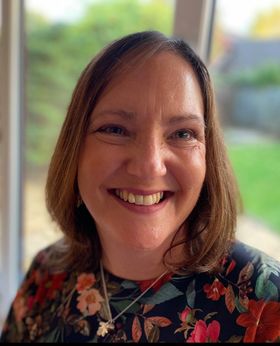
A native of Jane Austen’s beloved county of Hampshire, Zöe lives in a North Hampshire village, on the outskirts of the town that she and her husband Matt both grew up in, with their 3 grown up children and their cat Leia. When she is not researching or writing, Zöe can be found in the classroom teaching Spanish and French or singing ABBA songs loudly in her kitchen. People can get to know her better at www.zoewheddon.co.uk.

Zoe Wheddon, Author

ABOUT THE BOOK

JANE AUSTEN’S BEST FRIEND: THE LIFE AND INFLUENCE OF MARTHA LLOYD is a heart-warming examination of the ‘recipe for friendship’ between Jane Austen, (with whom all Janeites are best friends in their imaginations,) and Martha Lloyd. In looking back somewhat longingly at Martha and Jane’s strong and enduring bond we can examine all their interests, including the hits and misses of their romantic love lives, their passion for shopping and fashion, their family histories, their lucky breaks and their girly chats.

Through an examination of the defining moments of their shared lives together, the book gives readers an insight into the inner circle of the famously enigmatic and private authoress and the life changing force of their friendship.

All fans for Jane Austen everywhere believe themselves to be best friends with the beloved author and this book shines a light on what it meant to be exactly that. JANE AUSTEN’S BEST FRIEND: THE LIFE AND INFLUENCE OF MARTHA LLOYD offers a unique insight into Jane’s private inner circle. Each chapter details fascinating facts and friendship forming qualities that tied Jane and Martha together. This book offers a behind the scenes tour of the shared lives of a fascinating pair and the chance to deepen our own bonds in ‘love and friendship’ with them both.

Available in the USA with Pen and Sword/Casemate.


PURCHASE LINKS:


Amazon (US)
Barnes and Noble (US)
Bookshop.org (UK)


SOCIAL MEDIA

Instagram – Zoe_Wheddon
Website – www.zoewheddon.co.uk
Twitter – @ZoeWheddon
Facebook – @authorzoewheddon


RACHEL DODGE teaches college English classes, gives talks at libraries, teas, and book clubs, and writes for Jane Austen’s World blog and Jane Austen’s Regency World magazine. She is the bestselling author of The Anne of Green Gables Devotional: A Chapter-By-Chapter Companion for Kindred Spirits and Praying with Jane: 31 Days Through the Prayers of Jane Austen. Her newest book The Little Women Devotional is now available for pre-order and releases later this year. You can visit Rachel online at www.RachelDodge.com.

Read Full Post »

The Matthews Project

Introduction:

Inquiring readers,

The teacher who supervised the creation of this project, Ben John Wiebracht, contacted Vic Sanborn of Jane Austen’s World in the summer of 2020 to propose a research project his students would work on in the fall. After hearing the details, she instantly agreed to publish the finished result in a post, and to create a page for this blog to share with other teachers and students. (My apologies to Dr. Wiebracht for editing this document. I’ve placed quotations around his writing whenever I’ve made no changes.)

The project, entitled “A Day in Catherine Morland’s Bath,” was published on January 4, 2021. It is still attracting readers and is approaching 1,300 readers!

The Basics:

The teacher: 

Dr. Ben John Wiebracht, English teacher at Stanford Online High School, a private high school under the umbrella of Stanford University.

The class:

The class chose a senior-level elective called “Love Stories” which tracked the evolution of love stories from the classical era to the early nineteenth century. The final unit was on Northanger Abbey. (Virtual book, Little, Brown, and Company, 1903, Internet Archive). 

The students:

The article was researched, written, and designed by LiYuan Byrne, Josephine Chan, Ariana Desai, Carolyn Engargiola, Ava Giles, Macy Levin, Gage Miles, Sophia Romagnoli, Kate Snyder, Oscar Steinhardt, Lauren Stoneman, Alexandria Thomas, and Varsha Venkatram.

Image of the Adumbration class of 13 students and teacher Ben John Wiebracht.

The class and teacher.

The Article and its Inspiration (The What):

  1.  “A Day in Catherine Morland’s Bath.” (Posted January 4, 2021 in Jane Austen’s World.) As the title suggests, the goal of the article is to give the reader a sense of how Catherine Morland, heroine of Northanger Abbey, and tourists like her would have spent their time when they visited the city.
  2. The article was based on a long-forgotten Georgian poem that Dr. Wiebracht dug out of the archives over the summer: “Bath: An Adumbration in Rhyme” (1795), by the physician and poet John Matthews. 
    1. “The poem has a wealth of information on the amusements and absurdities of Bath, but it’s tough sledding for a modern reader, chock-full as it is of now-obscure allusions to Bath customs and institutions. Our job was to track them down.”
    2. “A fun example: Matthews mentions at one point a “priest” by the name of “King.” Eh? It turns out he’s referring to a fellow named James King, who wasn’t a priest at all but one of the city’s two “Masters of Ceremonies” – responsible for “presiding over social functions, welcoming newcomers, and enforcing an official code of regulations designed to preserve decorum and promote social interaction” (Gores, Psychosocial Spaces: Verbal and Visual Readings of British Culture, 1750-1820, p. 71). Matthews calls him a priest to poke fun at the city’s almost religious devotion to entertainment. And this same King plays a brief but important role in Northanger Abbey: he introduces Catherine and Henry. All of which is to say, paying close attention to Matthews can often lead to a fuller appreciation of Austen.”

Note from the Teacher: Searching for a Unique Contribution (The Why):

“The previous sentence begins to answer this question: we wanted to make a serious contribution to the study of Northanger Abbey

But let me speak as a teacher now, and not just a scholar. Over the years, I’ve grown increasingly uncomfortable with the standard way of teaching writing and research at the high-school level: the five-page essay. A thesis statement establishing the argument, some body paragraphs elaborating or demonstrating the argument, plenty of quotations and analysis – chances are you’ve written a couple in your day! In defense of the form, it does offer a space in which students can practice rhetorical and argumentative skills. My problem with the form is that it has no authentic audience, and the kids know it. Now I might pretend it has an audience by telling them, “imagine you’re writing for someone who is familiar with the text, but hasn’t studied it in depth.” Yeah right! In the history of the world, no one has ever thought: “I’m mildly interested in Northanger Abbey; now let me go find some five-page close-readings of it, but only ones with clear thesis statements and at least two quotes per paragraph.” Nope, the only audience for these essays is the teacher, and the teacher is bringing a very different attitude to the piece and making a very different set of judgments about it than the hypothetical “curious reader.” So the poor students have to pretend to be addressing one audience that for them does not exist, in order to please a very different audience. A recipe for stress – not to mention strained and awkward writing.

What if we changed the equation? What if there were ways to really give students an audience for their academic writing? If we could pull it off, I think it would send the message that the work we ask of students is meaningful and important – that the study of literature itself is important. That’s what the football coaches do, after all (the arch-rivals of us English teachers). How do they convince the kids that running into each other at high speeds is a meaningful, important endeavor? They stick them in a stadium where a bunch of people watch them do it, and it becomes immediately, empirically obvious to the students that football matters. In short, they give the kids an audience.

These were the considerations that prompted me to devise the Matthews project and to reach out to Vic about potentially publishing it on JAW – a forum with a thriving conversation about Austen. And this leads to the practical section of this page.”

Working with Your Students (The How):

If you’re interested in running a project like this with your kids, here are some tips to make it work.

  1. Canon-adjacent may be better than canon. What does that mean? It means that if you’re teaching Pride and Prejudice, it’s going to be tough for your students to break new ground simply by scrutinizing that text. But, if you can find some neglected texts whose study might shed light on Pride and Prejudice, then the picture changes. What about some of her juvenilia? What about Fordyce’s Sermons to Young Women, which found an appreciative reader in Mr. Collins? What about some Georgian satire making fun of pompous clergymen? This is something to do over the summer, when you’re planning the class, and it might take some digging: the text has to be obscure enough that it isn’t already saturated with criticism, but relevant enough to your main text that there are readers out there who might care about it. “Bath: An Adumbration in Rhyme” fit the bill: almost untouched by scholarship, but with clear connections to Northanger Abbey.
  2. Line up your venue in advance. This is key: you want the kids to know who their audience is from the beginning. Are you going to create an exhibit for a local public library? Will you try to get something published on a blog? Will you self-publish the students’ work on Amazon or some such service? Whatever the case, the students, like all writers, will do better work if they have a clear idea of whom they are addressing, and in what form. 
  3. Make sure students’ research tasks are well-defined. In our case, that meant combing through the poem, asking questions about various lines. Who are Tyson and King? What is a “macaroni”? Then students volunteered to tackle a certain number of research questions in groups. As a teacher, one of your roles is to be the executive planner, making sure there is the right number of students working on the right things.
  4. Offer continuous feedback. My students turned up all kinds of fascinating stuff in the course of their research, but of course they embarked on some rabbit trails as well. In order to help them make the most of their efforts, it’s a good idea to keep track of what students are doing while they’re doing it, rather than waiting to assess their work at the end. How can you do this? By creating a single google doc to which everybody contributes. Ours had a list of research questions, and I would simply check in every few days to see what students had added. Then I would leave comments offering encouragement, advice, and, if necessary, redirection. 
  5. Dive in yourself. Don’t be afraid to roll up your sleeves and do a bit of writing and research of your own. Remember that your students are still learning the ropes of our discipline. If you want to produce a publishable class project, you’ll probably have to do more than simply split up duties and set deadlines. You’ll have to integrate and harmonize the students’ efforts, and fill in some of the gaps yourself. It can change the classroom dynamic in a refreshing way, too, to join in the action. It’s a bit like the old master-apprentice relationship, according to which teaching is a matter of showing, doing, and collaborating, not just telling or advising.
  6. Don’t grade. Or, if you must, do it on completion alone. A grade is what you give to practice scholarship, to performative scholarship – the five-page essay and other such readerless forms. The point of the project I’m describing is to allow students to do some real work. And a particularly good way to make it real is to remove yourself, the teacher, as the audience. For the purpose of this project, you’re the opposite of an audience, you’re a co-author, and the real audience is what all good writing deserves: an interested public.

Sub pages:

Link to “Bath: An Adumbration in Rhyme, 1795,” John Matthews

Plans for Going Forward: 

Our class ended last December, but currently about half the students and I are working on a new project: a scholarly edition of “Bath: An Adumbration in Rhyme,” complete with an introduction and notes. We’ll be publishing it with Kindle Direct, an Amazon service. Digital copies of the edition will be available to the public at no cost, and hardcopies for under ten dollars.

In the long term, I hope to start a book series to which successive classes can contribute. It might be called something like “Forgotten Contemporaries of Jane Austen.” The goal of the series would be to recover Georgian and Regency writers whose work has fallen out of print, but whose study can shed fresh light on Austen’s life and work. As with the Matthews project, the students and I would work together to introduce and annotate these texts. We would also share the nitty-gritty tasks of publication — obtaining an ISBN, formatting, that sort of thing.

Jane Austen’s World’s Participation in the Project and Two Powerpoint Presentations: Tony Grant and Victoire Sanborn

About the PowerPoints:  

For a visit to Bath and a visual background, Dr. Wiebracht scheduled two workshops, one for Tony Grant, who lives in England and has served as a tour guide to visitors interested in learning more about the places where Jane Austen lived or visited. His PowerPoint and talk were given first, and should be viewed first for those who are interested.

Vic Sanborn’s presentation came the following month. She, too, had visited Bath and used a few of her own photographs, but mostly she concentrated on discussing the years of 1795-98, when Matthews wrote the Adumbration and when Thomas Rowlandson created his illustrations for “The Comforts of Bath.” Tony’s PowerPoint sets up Vic’s perfectly, for her notes are not in the PPT slides. Enjoy!

  • Link to Tony Grant’s PowerPoint Presentation on a Virtual Tour of Bath, given October 2020. This PPT, consisting of Tony’s photographs of his trips to Bath as both a visitor and a guide, comes with descriptions and annotations. If you use his photographs, please give him attribution.
  • Link to Vic Sanborn’s PowerPoint Presentation of Bath 1795, the year the Adumbration was written. The PPT is without explanatory text or the presenter’s voice. A majority of the images are from Thomas Rowlandson’s Prints of “The Comforts of Bath” from 1798. The images, on Wikipedia and the Metropolitan Museum of Art are in the public domain. If Vic Sanborn’s photos are used, please give her attribution. 

Read Full Post »

« Newer Posts - Older Posts »