Feeds:
Posts
Comments

Archive for the ‘Jane Austen’s World’ Category

I wish you a cheerful and at times even a Merry Christmas.” — Jane Austen

While Christmas festivities were not as commercial as they were during Queen Victoria’s and our time, families in Jane Austen’s era celebrated the holiday with much merriment, many gatherings and parties, and some gift giving. Houses were decorated with evergreens and kissing boughs made of holly, ivy, and mistletoe, although these greens were not brought in until Christmas Eve. On the same night, a large yule log was ceremoniously brought into the house, with the hope that it would last for the rest of the holiday season.

Celebrations lasted from December 6th, St. Nicholas Day, when presents were given, to January 6th , Twelfth Night. On December 25th people attended church service, then ate Christmas dinner. December 26th was known as Boxing Day, when staff and servants were given Christmas boxes and that day off by their benefactors.

The season ended the night of January 5th , the last day of Christmastide, with a Twelfth Night party filled with games and more partying. The revelers ate traditional foods, such as a slice of the elaborately decorated Twelfth Cake, that was topped with enough sugar, sugar figures, and sugar piping to cause a diabetic coma in a horse. (I might have exaggerated slightly.) After the revelers finished partying, superstition dictated that all decorations in the house be taken down and burned, else bad luck would befall the household for the year.

Certain foods marked the season.

Just at this time these shops are filled with large plum-cakes, which are crusted over with sugar, and ornamented in every possible way. These are for the festival of the kings, it being part of an Englishman’s religion to eat plum-cake on this day, and to have pies at Christmas made of meat and plums.” – p. 63, Mr. Rowlandson’s England, text written by English poet Robert Southey as a fictitious Spanish tourist visiting England.

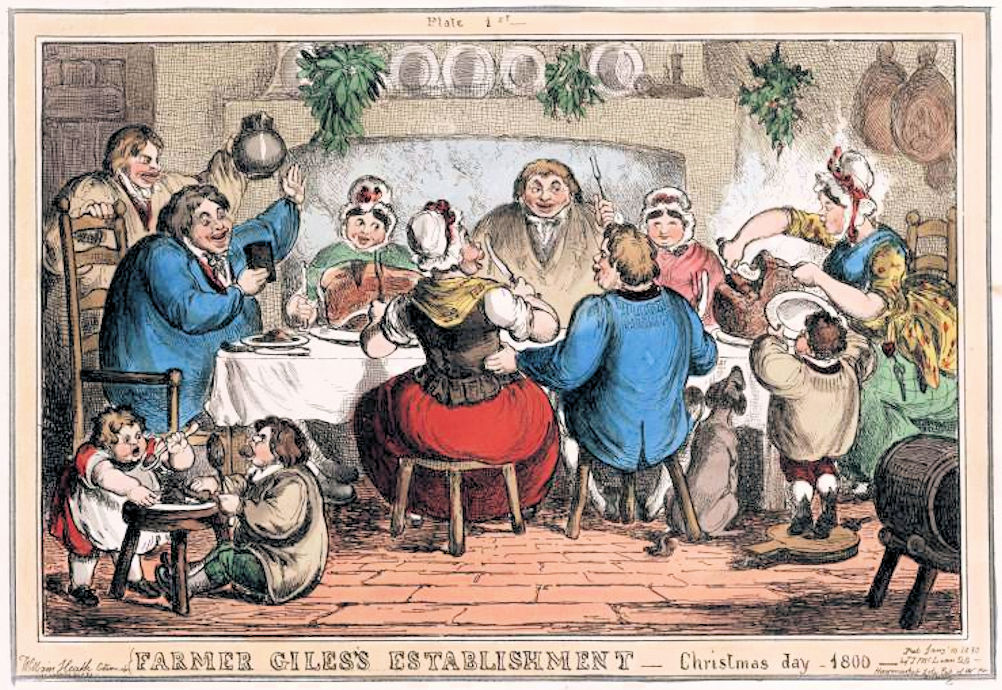
Cartoon of Farmer Giles's Establishment: Christmas Day-1800.

Farmer Giles’s Establishment: Christmas Day-1800. Science Museum Group Collection

In “A Miscellany of Christmas Pies, Puddings and Cakes,” Joanne Major describes the typical foods that were served: Christmas pudding, which started out as plum porridge or pottage (and is also known as plum or figgy pudding); sweet and savory mince pies; Christmas cake; and a savory Yorkshire Christmas-Pie. She includes the following quote in her article:

Stamford Mercury, 15th January 1808

At Earl Grosvenor’s second dinner at Chester, as Mayor of that city, on Friday the 1st instant there was a large Christmas pie, which contained three geese, three turkies, seven hares, twelve partridges, a ham, and a leg of veal: the whole, when baked, weighed 154 lbs.!

The following description confirms Robert Southey’s observation that there was no food or protein an Englishman wouldn’t eat, including animals and seafood from all parts of the world—turtles from the West Indies, curry powder from India, hams from Portugal, reindeer’s tongues from Lapland, caviar from Russia; sausages, maccaroni, and oil from Italy, which also provided olives along with France and Spain; cheeses from Switzerland; fish from Scotland; mutton from Wales; and game from France, Norway, or Russia (p 60, Mr. Rowlandson’s England). In his observations, Southey remarked that an Englishman would hunt and shoot anything that could be stuck in a pot.

Gout, a prevalent disease of the well-to-do Georgian, was the painful result of an excessive and repeated ingestion of large quantities of protein and alcohol. The large gout-inducing Christmas pie described by Earl Grosvenor was most likely a version of the Yorkshire Christmas-Pie described by Hannah Glasse in her influential cookery book, The Art of Cookery Made Plain and Easy.

To Make a Yorkshire Christmas-Pie

“FIRST make a good standing crust, let the wall and bottom be very thick; bone a turkey, a goose, a fowl, a partridge, and a pigeon, Season them all very well, take half an ounce of mace, half an ounce of nutmegs, a quarter of an ounce of cloves, and half an ounce of black-pepper, all beat fine together, two large spoonfuls of salt, and then mix them together. Open the fowls all down the back, and bone them; first the pigeon, then the partridge; cover them; then the fowls then the goose, and then the turkey, which must be large; season them all well first, and lay them in the crust, so as it, will look only like a whole turkey; then have a hare ready cased, and wiped with a clean cloth. Cut it to pieces, that is, joint it; season it, and lay it as close as you can on one side; on the other side woodcocks, moor game, and what sort of wild-fowl you can get. Season them well, and lay them close; put at least four pounds of butter into the pie, then lay on your lid, which must be a very thick one, and let it be well baked. It must have a very hot oven, and will bake at least four hours. This crust will take a bushel of flour. In this chapter you will see how to make it. These pies are often sent to London in a box, as presents; therefore, the walls must be well built.”

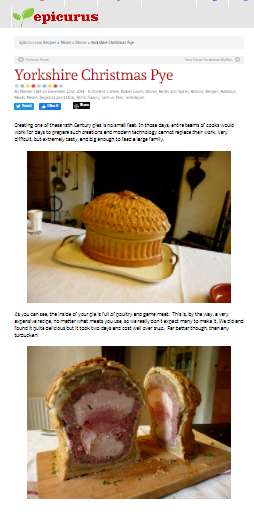
A post entitled “Yorkshire Christmas Pye” in Epicurus describes how tough it was in 2014 to recreate an 18th Century pie. Back then, teams of cooks would work for days to accomplish the feat. According to the chef and author, not even modern appliances could compete with those bygone techniques. The modern pie, from assembly (8 ½ hrs), to baking (4 hrs), to its presentation at the table, took 12 ½ hours in total.

Screenshot of the Epicurus blog page

Screenshot of the Epicurus blog page. Photos of the exterior and interior of the Pye made by Ivan Day, whose scrumptuous recreation of Georgian recipes are works of art: Food History Jottings

The Master Chef modified Glasse’s recipe and used the boned meat of the following animals: turkey, goose, partridge, pheasant, woodcock, grouse, and hare. With the added lard in the crust and butter in the filling, I imagine the diner would probably have lacked the energy to push off from the table.

So, inquiring reader, if you are interested in recreating this English pye recipe for Christmas, I encourage you to start dieting on water and vegetables, and exercising on the hour every waking hour to make room for this artery clogging, but very tasty specialty!

“Thank you for the Christmas Cake” was written as a poem by Helen Maria Williams (Read by Tom O’Bedlam)

Patient readers: I apologize for the messy look of the resources list sitting below. The new WordPress “blocks” are wreaking havoc with my ability to publish material on this blog nicely. Obviously I have not learned this “improved” design adequately. I spend more hours fixing problems than writing the article. I assure you, neither Rachel nor Brenda are having this problem. I’ll get the hang of things soon…(I hope.) My comment is this: what was wrong with the old design and, why, if one chooses the classic mode do the blocks keep jumping to the new mode? I’m irked. This is irksome!

Resources:
  • Some Georgian Christmas Fare!,” December 16, 2011,
    Julie Day, Countryhousereader Blog.
    Great information on Christmas food served at an English
    country house.
    Includes information from
    Bills of Fare for Christmas feasting, 1805 and the suggested meal courses.
  • Christmas: Georgian Style! From Norfolk Tales, Myths & More! This rich source and fascinating blog provides detailed information on a Georgian Christmas in this post.
  • Twelfth Night Cake, British Food and History, January 5, 2019.
    Detailed account of recipes used on that final Christmastide night.
  • The Englishman’s Plum Pudding, History Today, Maggie Black, Volume 31, Issue 12, December 1981. Includes a history of the British Christmas pudding.
  • Mr. Rowlandson’s England, text from Robert Southey,
    Illustrations by Thomas Rowlandson.
    Southey, Robert,
    ISBN 10: 0907462774, Published by Antique Collectors Club Ltd, 1985.
    I loved this book so much (I read it online at the Internet Archive) that I ordered my own copy.
  • Letters from England, Volume 1 (of 3), by Don Manuel Alvarez Espriella.
    This link provides the online text on Project Gutenberg of Robert Southey’s
    first volume, written as a Spanish traveler.

    https://www.gutenberg.org/files/61122/61122-h/61122-h.htm

Other Christmas posts on this blog:

Read Full Post »

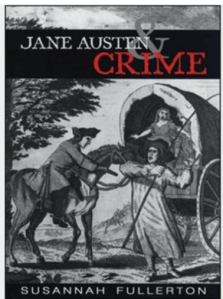
Inquiring readers, Susannah Fullerton lives in Australia, a land Down Under, which at this moment is experiencing spring, that blessed season. Recent articles on this blog have referred to her book, “Jane Austen & Crime,” first published in 2004. Susannah presents yet more historical information from her knowledge of this era. Much of the information in this post was new to me.

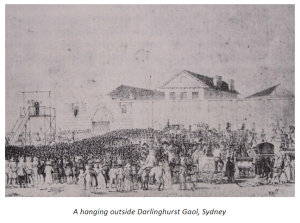
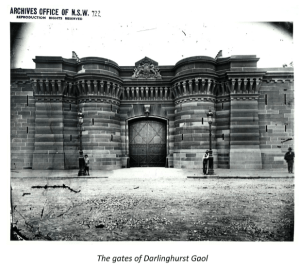
On a hot Australian summer morning in February, 1844, a man was led forth, closely guarded, from the impressive gates of Darlinghurst Gaol in Sydney. It was 9 o’clock in the morning, but already 10,000 people had gathered in the public square in front of the prison, eager to watch the last moments of the condemned man. He was praying as he walked and “appeared to be deeply sensible of the awful position in which he stood. A dark and frowning eternity began to press itself with fearful force upon his mind, while his apparently sincere cries for mercy became more and more earnest as the tragic scene drew on.” He was given a chance to speak some last words to the two clergymen who were present, and then he mounted the scaffold. The noose was placed around his neck, and the man “was launched into another world”.  Church bells tolled his passing nearby. The huge crowd, which included women and children, watched silently, awed by the solemnity of the spectacle and, after the body was cut down and removed to within the prison, they quietly walked away. The event was widely reported the next day in Sydney newspapers, so those who had been unable to attend, could read all about it there.

Image of A hanging outside Darlinghurst Gaol, Sydney

A hanging outside Darlinghurst Gaol, Sydney

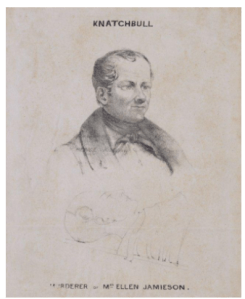
Jane Austen had died more than 25 years before this horrid event. What possible connection could there be between this man, and the great novelist? Well, his name was John Knatchbull and he was the half-brother of the Edward Knatchbull who married Jane Austen’s favourite niece Fanny Austen Knight. Edward and John’s father, Sir Edward Knatchbull, had twenty children by his three different wives.  Fanny’s family and the Knatchbull family, also from Kent, had known each other for some years before her marriage with Edward united them, and it is quite possible that Jane could have heard something of the ‘difficult’ son of the family. 

John Knatchbull was probably born in 1793 (he was baptized in January of that year) in Kent. As a schoolboy he displayed “vicious inclinations” and when he joined the Navy, he soon found himself treated with contempt by fellow officers, and in financial difficulties. To pay what he owed, he indulged in petty frauds and in 1824 he was tried for the theft of two sovereigns and a blank cheque form. That was enough in value to see him hanged in England, but the judge was lenient on the young man and instead sent him to Botany Bay, the dumping ground for England’s unwanted criminals. John Knatchbull was sentenced to remain in Australia for 14 years before being permitted to return to England. His Kentish family was relieved to be rid of him.

Image of John Knatchbull

The family black sheep failed to behave any better once he was in Australia. In 1831 he was sentenced to death for forgery. But once more the sentence was commuted, this time to seven years of penal servitude on Norfolk Island, about the grimmest place a convict could be sent. In his time on Norfolk Island John took part in two mutinies and tried to poison with arsenic the food prepared for the guards. However, by 1839 he was back in Sydney. In 1844 John Knatchbull was planning to marry, but he needed money. Returning to his brutal ways, he stole from a shopkeeper Ellen Jamieson, then killed her by hacking at her skull with a tomahawk. Her two children were left orphaned and her murderer, who tried to make a plea of insanity, was described by the judge as “a wretch of the most abominable description”.  This time there was no leniency and John Knatchbull was sentenced to hang. Darlinghurst Gaol is still there today (though an art college, not a prison, now does business behind its high stone walls). The square where the 1844 hanging occurred is named Green Square, not for the colour of the grass that grows there but because Mr Green was the name of the hangman.

Image of the Gates of Darlinghurst Gaol

Had Jane Austen still been alive, no doubt she and Fanny would have discussed the shameful story and its horrific outcome. Both women were aware that another member of their family could also have ended up in the Antipodes. Aunt Jane Leigh Perrot had been at serious risk of a trip to Botany Bay, when she was accused of shop-lifting in Bath in 1799. Incarcerated for some months in Ilchester Gaol, Mrs Leigh Perrot had defended herself vigorously and, at her trial, she was acquitted. However, she knew a journey to Australia was highly probable and made plans that her husband James would accompany her if she was sent there. The entire Austen family must, at this worrying time, have speculated about what life in the colony would be like for their relations.

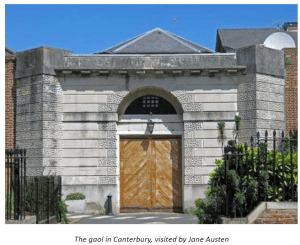
Jane Austen was interested in prisons. In 1813 she visited Canterbury Gaol with her brother Edward, who had to visit the institution as part of his duties as a magistrate. This was a most unusual thing for a Regency lady to do. My book Jane Austen and Crime explains what sort of institution she saw there. Jane Austen’s interest in punishment and imprisonment went into her next novel, Mansfield Park, a novel that is rich in prison imagery and a book that examines various types of imprisonment in its themes.

Photo of the gaol in Canterbury visited by Jane AustenThe gaol in Canterbury, visited by Jane Austen

Anyone who lived in Britain’s Georgian era must have had a strong awareness of crimes and punishments. Hangings, time in the pillory, and other punishments were very public events. Trials were short and brutal, prisons were being much discussed and were undergoing huge changes, and yet some crimes such as smuggling and poaching were regarded much more leniently by the general public. I started to write my book on crimes in Jane Austen’s world and fiction when a bus on which I was travelling stopped by Darlinghurst Gaol and I began to reflect on the Knatchbull story and to wonder what actually constituted a crime in Austen’s day? Was elopement to Gretna Green a crime? What about Maria’s adultery with Henry Crawford – how did the law regard such behaviour? Which of Jane Austen’s characters commit hanging offences, and how does her juvenilia reflect her interest in criminal activity? Which of her characters work as magistrates, who are the lawyers in her fiction, and how did she regard such crimes as duelling and gambling? The result of that moment on a bus was, some years later, my book. Claire Tomalin was kind enough to describe it as “essential reading for every Janeite”. I found it fascinating to see Jane Austen’s world and fiction through the lens of crime – I hope you enjoy and learn from it too.

Photo of Susannah FullertonAbout Susannah Fullerton, OAM, FRSN, President of the Jane Austen Society of Australia: Susannah Fullerton is a Canadian-born Australian author and literary historian. She has been president of the Jane Austen Society of Australia since 1996, which is the largest literary society in Australia.

Image of the book cover of Jane Austen & Crime by Susannah FullertonIf you would like to buy Jane Austen and Crime, it is available from https://susannahfullerton.com.au/bookshop/ (signed copies on request) 

You are welcome to sign up to Susannah’s free monthly newsletter, ‘Notes from a Book Addict’. To sign up, email susannah@susannahfullerton.com.au and

your name will be entered in a draw ON DECEMBER 20TH to win one of the following prizes:
  • A signed copy of Jane Austen and Crime by Susannah Fullterton.
  • An additional copy of the book from Vic Sanborn for U.S. and Canadian citizens.
  • A 1-year subscription to ‘Tea with a Book Addict’, an exciting programme of zoom / video talks which will take you around the world with 12 fabulous novels.
  •  1 video talk of your choice from Susannah’s website
Please quote the password KNATCHBULL to have your name entered in the draw for prizes.
To join in the fun with ‘Tea with a Book Addict’, visit https://susannahfullerton.com.au/tea-with-a-book-addict/ 

Image of Tea with a Book Addict and travel the world with great books with Susannah Fullerton

Other posts by Susannah Fullerton on this blog:

Readers: all other posts by Susannah on this blog and her writings about Jane Austen can be found at this link that tag her name: https://janeaustensworld.wordpress.com/tag/susannah-fullerton/

Read Full Post »

By Brenda S. Cox

“Give us a thankful sense of the Blessings in which we live, of the many comforts of our Lot; that we may not deserve to lose them by Discontent or Indifference.” — Jane Austen’s Prayers I

Jane Austen talks a lot about thankfulness. In all three of her prayers, she gives thanks to God and also prays to be made more grateful for all our blessings. In her novels and other writings, she uses some form of the words thanks or gratitude 722 times! That means each novel probably includes at least a hundred references to thankfulness.

Austen uses thanks in many ways. Surprisingly, she often uses gratitude in talking about marriage proposals and the development of love that leads to marriage.

Thanks for Asking!

An offer of marriage was expected to provoke gratitude, whether the woman said yes or no.

When Emma advises Harriet on how to refuse Robert Martin, she says that Harriet will know how to write “such expressions of gratitude and concern for the pain you are inflicting as propriety requires.” (Italics are added, throughout these quotes.) Obviously, propriety required that if a man asked a woman to marry him, she should thank him.

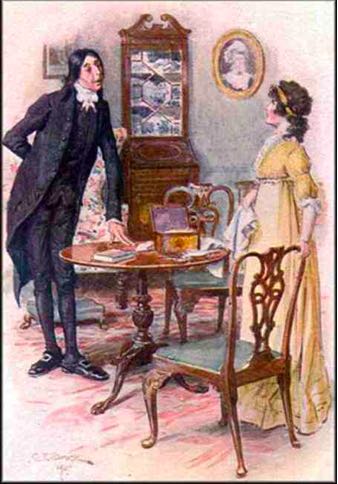
Even if the proposal was unwanted, the woman had to say thank you. Elizabeth Bennet tries to avoid Mr. Collins’s proposal, but still, when he asks, she has to say:

Accept my thanks for the compliment you are paying me.”

When he insists, she says, “I thank you again and again for the honour you have done me in your proposals, but to accept them is absolutely impossible.” Even though she doesn’t want his proposal, she is obligated to thank him for it.

Even for a proposal from Mr. Collins, Elizabeth Bennet had to express gratitude.

There is one exception, though, which might have shocked the original readers.

When Darcy proposes the first time, Elizabeth says to him,

“In such cases as this, it is, I believe, the established mode to express a sense of obligation for the sentiments avowed, however unequally they may be returned. It is natural that obligation should be felt, and if I could feel gratitude, I would now thank you. But I cannot—I have never desired your good opinion, and you have certainly bestowed it most unwillingly.”

Gratitude was an obligation; the woman was obliged to feel grateful that a man liked her enough to ask her to marry him. But she is so angry at his words, and so prejudiced against his character, that she just can’t thank him for his proposal.

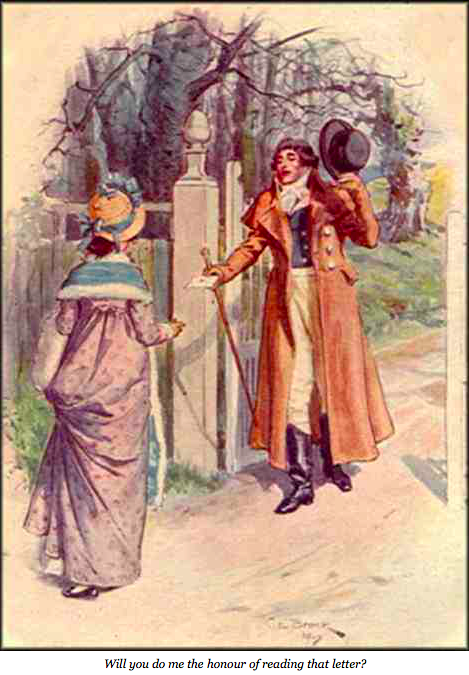
Of course, she soon changes her mind. After she reads his letter, we find that,  “his attachment excited gratitude, his general character respect.” What a switch!

Once Elizabeth reads Darcy’s letter, her attitude changes from ingratitude to gratitude.

And it continues. When at Pemberley, after talking to Mrs. Reynolds, Elizabeth “thought of his regard with a deeper sentiment of gratitude than it had ever raised before.”

First Comes Gratitude, Then Love and Marriage

Elizabeth’s gratitude, of course, led eventually to love.

Charlotte Lucas had told Elizabeth earlier on in Pride and Prejudice, “There is so much of gratitude or vanity in almost every attachment, that it is not safe to leave any to itself. We can all begin freely—a slight preference is natural enough; but there are very few of us who have heart enough to be really in love without encouragement.”

In other words, the boy likes the girl. She starts to like him back, and shows that she prefers him to other boys. He is “grateful” for that, so he likes her even more. Then she likes him more because he shows he likes her. And so on. This, my friends, is Jane Austen’s theory of how love develops. We see it again and again in her novels.

First, think about this question: For which of Jane Austen’s characters was gratitude the beginning of falling in love?

The obvious ones are Elizabeth Bennet and Henry Tilney. We’ll come back to them later.

Fanny Price

But how about Fanny Price?

Early in Mansfield Park, Edmund shows kindness to little Fanny. Then, “her countenance and a few artless words fully conveyed all their gratitude and delight, and her cousin began to find her an interesting object.”

Fanny and Edmund’s relationship starts growing with gratitude—her gratitude to him awakens his interest in her. Further kindnesses lead to more gratitude—Fanny is by nature a very grateful person. Edmund’s love for her, brotherly at first, grows. It takes a long time, but Edmund finally realizes that the perfect woman for him is right in front of him!

Earlier, though, because gratitude leads to love, both Mary Crawford and Edmund Bertram were convinced that Fanny would accept Henry Crawford out of gratitude. Mary tells Henry, “The gentleness and gratitude of her disposition would secure her . . . ask her to love you, and she will never have the heart to refuse.” Edmund tells Fanny, “I cannot suppose that you have not the wish to love him—the natural wish of gratitude.” However, Fanny’s gratitude toward Edmund is much greater than her gratitude toward Henry, and it is Edmund she loves.

Gratitude is not enough to cause Fanny Price to accept Henry Crawford.

Harriet Smith

In Emma, “Harriet certainly was not clever, but she had a sweet, docile, grateful disposition.” All Harriet’s loves are all based on gratitude. First, she is grateful to Robert Martin, who got her walnuts and brought in the shepherd’s son to sing for her. Then she is attracted to Mr. Elton, because Emma says he is attracted to her. Her next love is Mr. Knightley, who rescues her at the dance. She thinks of him with “gratitude, wonder, and veneration.” Of course, Emma thinks Harriet has fallen in love with Frank Churchill, out of gratitude to him for rescuing her from the gypsies. Then when Robert Martin proposes again, Harriet is so grateful that she immediately says yes, not waiting for anyone to dissuade her this time!

NOT Captain Benwick, though

In Persuasion, Captain Wentworth is surprised that Benwick has fallen in love with Louisa Musgrove. Wentworth says, “Had it been the effect of gratitude, had he learnt to love her, because he believed her to be preferring him, it would have been another thing. But I have no reason to suppose it so. It seems, on the contrary, to have been a perfectly spontaneous, untaught feeling on his side, and this surprises me.” He is assuming that gratitude is the normal, most obvious reason for love. If it’s not there, that is unusual.

Also in Persuasion, William Elliot is excused for marrying a rich woman because she was “excessively in love with him . . . She sought him.” Gratitude was an obvious and acceptable reason for marriage.

Elizabeth and Darcy

For Elizabeth Bennet also, love begins with gratitude.

After she sees Darcy at Lambton, she lies awake trying to figure out how she feels about him: “But above all, above respect and esteem, there was a motive within her of goodwill which could not be overlooked. It was gratitude.–Gratitude, not merely for having once loved her, but for loving her still well enough to forgive all the petulance and acrimony of her manner in rejecting him . . . Such a change in a man of so much pride, excited not only astonishment but gratitude—for to love, ardent love, it must be attributed . . . She respected, she esteemed, she was grateful to him. . .”

Austen later explains, “If gratitude and esteem are good foundations of affection, Elizabeth’s change of sentiment will be neither improbable nor faulty.” But, she says, if it is “unreasonable or unnatural” that love should come from gratitude and respect, rather than coming from simply seeing the other person, then “nothing can be said in her defence,” except that she had tried love at first sight with Wickham, and it had not gone well.

When Darcy proposes the second time (if you can call it a proposal), Elizabeth tells him her feelings are so different that she can “receive with gratitude and pleasure his present assurances.” What a change from the first time!

Henry and Catherine

In Northanger Abbey, we find the same justification for love. When Henry Tilney proposes to Catherine Morland, they both know she already loves him. He is now “sincerely attached to her,” but “his affection originated in nothing better than gratitude.” Knowing that she was partial to him “had been the only cause of giving her a serious thought.” Austen adds, “It is a new circumstance in romance, I acknowledge, and dreadfully derogatory of an heroine’s dignity; but if it be as new in common life, the credit of a wild imagination will at least be all my own.”

Henry Tilney’s love for Catherine begins with gratitude, because she thinks highly of him.

Apparently for Jane Austen, gratitude at being loved by someone else was the best first step toward falling in love yourself.

Gratitude to God for the Engagement

Both Anne Elliot and Emma Woodhouse also express gratitude after they are engaged. But now they are expressing it to God, though we might not recognize what they are doing.

The word serious in Austen’s time often signalled something religious. According to Stuart Tave’s A Few Words of Jane Austen, serious reflection or meditation actually meant prayer.

After Anne Elliot accepts Wentworth’s proposal in Persuasion, she needs “An interval of meditation, serious and grateful.” So, “she went to her room, and grew steadfast and fearless in the thankfulness of her enjoyment.” This serious, grateful meditation means that Anne is thanking God for finally bringing her and Captain Wentworth back together.

Emma Woodhouse gets engaged, but she’s still worried about Harriet. However, once she heard that Harriet was also engaged, “She was in dancing, singing, exclaiming spirits; and till she had moved about, and talked to herself, and laughed and reflected, she could be fit for nothing rational. . . . The joy, the gratitude, the exquisite delight of her sensations may be imagined. . . . Serious she was, very serious in her thankfulness, and in her resolutions; and yet there was no preventing a laugh, sometimes in the very midst of them.” Have you wondered how she could be both serious and laughing? Serious tells us that her focus is on God. She is rejoicing and thanking God for bringing both herself and Harriet together with the men they loved.

So, the next time you receive a marriage proposal, be sure to tell the person “Thank you” before you answer. And if you decide to say “Yes,” you may want to thank God as well!

Thankfulness

If you want to think more about thankfulness, and its place in some of our favorite classics, I recommend both of Rachel Dodge’s lovely devotional books:

Praying With Jane, and

The Anne of Green Gables Devotional, which is brand-new.

Each includes gratitude as well as other valuable themes we can apply to our lives. And both would make great Christmas presents! Rachel Dodge, of course, writes regularly for Jane Austen’s World.

If you want more ideas for Austen-themed Christmas gifts, you might want to check out my post on Jane Austen Christmas Presents.

Austen’s novels are full of examples of gratitude and ingratitude. These were important issues for her. Who do you think gives the best example of gratitude, or ingratitude, in Austen’s novels?


You can connect with Brenda S. Cox, the author of this article, at Faith, Science, Joy, and Jane Austen or on Facebook.

Read Full Post »

The JASNA AGM recently closed its workshops to online viewing. It was held virtually in early October. One workshop that resonated with me was Professor Theresa Kenney’s discussion of Reginald De Courcy as the hero in Lady Susan, an epistolary novel written by Jane Austen in 1794-95, when she was 19 to 20 years of age. I had the pleasure of viewing some pages of the manuscript during the exhibit about Jane Austen’s Life and Legacy in 2009 at The Morgan Library in New York. It was the first time that I saw Jane’s handwriting on a page close up and I felt as thrilled as a teenage groupie seeing her heart throb idol in person. As soon as I returned home I read the novel.

Seven years later, two friends and I saw “Love and Friendship,” in which Kate Beckinsale played the conniving Lady Susan Vernon. Needless to say, after viewing Professor Kenney’s AGM presentation, I rewatched the film and was struck by its faithfulness to Austen’s novella. It helped that the script took advantage of entire swaths of Austen’s dialogue in letters written by the main characters.

Introduction:

Professor Kenney in a talk entitled “Abjuring All Future Attachments: Concluding Lady Susan” spoke about the youthful Austen’s experimentation with Reginald as the hero. His status is not at first obvious. We know about him largely through the strong women swirling around his life and who write about him: his sister, Catherine Vernon; his mother, Lady De Courcy; Catherine’s widowed sister-in-law, Lady Susan Vernon; and Lady S’s confidant, Mrs. Alicia Johnson. These main characters reveal much about themselves as they write their true opinions of others behind their backs against the polite, entirely false conversation they engage in when speaking in person.

Deceptions and manipulations abound:

The central character is beautiful, mature Lady Susan, the daughter of a peer, widow of Vernon (no first name), who must find refuge after her dalliance with the very much married Mr. Mainwaring, in whose house she was a guest. And so Lady S appeals to the only available persons left to her, the reluctant Catherine Vernon, whose marriage she attempted to block to her brother-in-law, Charles Vernon. Catherine is no fool and has taken Lady S’s measure:

…if I had not known how much she has always disliked me for marrying Mr. Vernon, and that we had never met before, I should have imagined her an attached friend…She is clever and agreeable, has all that knowledge of the world which makes conversation easy, and talks very well, with a happy command of language, which is too often used, I believe, to make black appear white.- Catherine Vernon to Reginald De Courcy. Letter, VI

Reginald De Courcy, Catherine’s brother, having heard no good news about the beautiful widow, and influenced by his sister and mother, is disposed to dislike her, that is until he meets her and she wraps him around her little finger.

And so the fun begins, Austen style:

According to Prof. Kenney, Reginald’s character is more akin to Marianne Dashwood, Edmund Bertram, Harriet Smith, and Edward Ferrars, who fall violently in love with the wrong person and then miraculously recover a short time later to find a love worthy of them. Kenney termed this phenomenon “shifting affections.” Young Reginald is easily influenced in falling in love with the wrong person. At twenty-three he is quite young and still malleable, a fact not lost on the opportunistic Lady Susan or on his mother and sister, who are alarmed. Catherine writes to her mother, Lady De Courcy:

My dear Mother,—You must not expect Reginald back again for some time. He desires me to tell you that the present open weather induces him to accept Mr. Vernon’s invitation to prolong his stay in Sussex, that they may have some hunting together. He means to send for his horses immediately, and it is impossible to say when you may see him in Kent. I will not disguise my sentiments on this change from you, my dear mother, though I think you had better not communicate them to my father, whose excessive anxiety about Reginald would subject him to an alarm which might seriously affect his health and spirits. Lady Susan has certainly contrived, in the space of a fortnight, to make my brother like her. … I am, indeed, provoked at the artifice of this unprincipled woman; what stronger proof of her dangerous abilities can be given than this perversion of Reginald’s judgment, which when he entered the house was so decidedly against her! – Letter VIII

In the next letter, we gain a good sense of Alicia Johnson, Lady Susan’s confidant and partner in the devious plans intended to ensnare her unsuspecting victim.

My dearest Friend,—I congratulate you on Mr. De Courcy’s arrival, and I advise you by all means to marry him; his father’s estate is, we know, considerable, and I believe certainly entailed. Sir Reginald is very infirm, and not likely to stand in your way long. I hear the young man well spoken of; and though no one can really deserve you, my dearest Susan, Mr. De Courcy may be worth having.Mrs. Johnson to Lady S, Letter IX

This novella is filled with strong women. Two who will move heaven and earth to protect brother and son, and two who behave like a pair of rats intent on devouring the last piece of cheese in an alley. Interestingly, we only hear directly from Reginald in three letters. For much of the novel we see him only through the words and opinions of others, but some of those words are revealing. When his father sends him a letter of alarm due to Lady S’s increasing influence over him, Reginald tries to soothe him.

The father emplores him in Letter XII:

I hope, my dear Reginald, that you will be superior to such as allow nothing for a father’s anxiety, and think themselves privileged to refuse him their confidence and slight his advice. You must be sensible that as an only son, and the representative of an ancient family, your conduct in life is most interesting to your connections; and in the very important concern of marriage especially, there is everything at stake—your own happiness, that of your parents, and the credit of your name.”

To which Reginald answers:

My dear Sir,—I have this moment received your letter, which has given me more astonishment than I ever felt before. I am to thank my sister, I suppose, for having represented me in such a light as to injure me in your opinion, and give you all this alarm…I entreat you, my dear father, to quiet your mind, and no longer harbour a suspicion which cannot be more injurious to your own peace than to our understandings. I can have no other view in remaining with Lady Susan, than to enjoy for a short time (as you have yourself expressed it) the conversation of a woman of high intellectual powers.”

He goes on in a quite lengthy letter to blame his sister’s prejudice for not forgiving Lady S in opposing her marriage to Charles, and is convinced that the world has injured the Lady by questioning her motives, etc. etc. Yet Austen gives this hero short shrift in the narrative. We know very little about his thoughts and reasons for his actions, including being manipulated by Lady S. into feeling bitter towards Frederica, her young daughter, and thinking the girl worthless, even when it becomes clear that she “brightens” in Reginald’s presence.

In other words, Lady S has completely ensnared her sincere young man. He is as gullible with Lady S as Harriet Smith is with Emma, and just as changeable. This shifting of affection and lack of self-knowledge, as Prof. Kenney terms it, defines these characters, who are vastly different from Elizabeth Bennet and Mr. Darcy or Anne Elliot and her Captain Wentworth.

To be fair, Lady S does see some of Reginald’s good qualities (besides his inheritance). She writes to Alicia Johnson:

Reginald is never easy unless we are by ourselves, and when the weather is tolerable, we pace the shrubbery for hours together. I like him on the whole very well; he is clever and has a good deal to say, but he is sometimes impertinent and troublesome.”

She also understands her sister-in-law, Catherine, very well: “[Frederica] is in high favour with her aunt altogether, because she is so little like myself, of course.”

The Spell:

The letters ping pong back and forth, with Lady S only baring her true motives to her like-minded friend, Alicia. Mrs. Johnson’s husband, Mr. Johnson, has forbidden her to consort with Lady S, whom he has banned from his house, but Lady S still has Reginald, who is now set on marrying her.

Interestingly, Reginald is the hero in this tale, a weak one to be sure. His main redeeming quality is that when he learns of Lady S’s dalliance with Mr. Mainwaring his blinders fall off. We hear from him twice more and can feel his wrath in two scathing, but youthfully passionate letters:

…I write only to bid you farewell, the spell is removed; I see you as you are. Since we parted yesterday, I have received from indisputable authority such a history of you as must bring the most mortifying conviction of the imposition I have been under, and the absolute necessity of an immediate and eternal separation from you…”

and later:

Why would you write to me? Why do you require particulars? But, since it must be so, I am obliged to declare that all the accounts of your misconduct during the life, and since the death of Mr. Vernon, which had reached me, in common with the world in general, and gained my entire belief before I saw you, but which you, by the exertion of your perverted abilities, had made me resolved to disallow, have been unanswerably proved to me; nay more, I am assured that a connection, of which I had never before entertained a thought, has for some time existed, and still continues to exist, between you and the man whose family you robbed of its peace…”

screenshot of film-manipulated

Screen shot of Love and Friendship, with all females delighted at the results of Reginald’s and Frederica’s marriage.

The Spell is Removed: Young Reggie grows up!

A few more plot strings remain to be tied. Lady S is an execrable mother. She bullies Frederica and presses her to marry Sir Charles Martin, a dimwit, albeit a rich one. Frederica resists, raising her mother’s ire. Catherine, who loves the girl and pities her situation, takes her in. Lady S, it is obvious, loves no one but herself. She has, in the words of Prof. Kenney, “no time for romantic nonsense.” Her motherly instincts are for show only, and after a few months of separation her letters and attentions to her daughter peter out.

Reginald leaves to lick his wounds, but his mother and sister are always looking out for him, as well as Frederica. The author writes in her conclusion, “Frederica was therefore fixed in the family of her uncle and aunt till such time as Reginald De Courcy could be talked, flattered, and finessed into an affection for her.” And, so, Austen demonstrates that Reginald, a hero with the same weak qualities as a Mr. Bingley or Edward Ferrars, is managed by the real power in the family – the women, although, he has in his favor the quality of realizing his deficiencies and, more importantly, he has a heart.

De Courcy and Frederica marry. And so I ask you fair reader: Who had the happier union? Reginald or Lady S?

Conclusion

Inquiring reader, I hope I have persuaded you to read or reread Lady Susan, a novella that surprised me on the first and second reading. I didn’t think that I would like reading a book that consisted of letters, but was so enthralled with the story that I read it in one sitting.

Just think. Jane Austen wrote this novella during a creative spurt in her early life. In 1794-95, she wrote Lady Susan and in 1795 she wrote Elinor and Marianne, the epistolary version of Sense and Sensibility. In 1796, she began writing First Impressions, the precursor to Pride and Prejudice. What a fertile period for a budding author! And what creativity! At 19, 20, and 21 years of age she laid the groundwork for two great novels and one experimental foray into the many complexities of what makes a hero. While, like Mr. Darcy, Reginald has great wealth, which, according to Prof. Kenney gives him alpha status, he is a bit of a wuss, masterfully controlled like a puppet by female relatives. In the end, Lady S is hoist by her own manipulative petard. She has no recourse but to marry Sir Charles Martin to maintain face and a fortune. Uggh. What a fitting ending.

Austen’s three novels, written in such a short time, laid much of the foundation for her greatness. She would rework them over the years, with only one, Lady Susan, published posthumously. After a lifetime of reading her works, including her Juvenilia, I remain in awe of her immense talent.

Resources:

Lady Susan, Jane Austen, Project Gutenberg Online Book

https://www.gutenberg.org/files/946/946-h/946-h.htm

Lady Susan, Jane Austen, Librivox Audio

https://archive.org/details/lady_susan_0811_librivox

“Love and Friendship,” Amazon Prime movie

Lady Susan: List of Characters: Austenprose

Read Full Post »

For the women of Jane Austen’s position in society, female education was formed mainly at home. While Austen and her sister Cassandra spent a short time away at school, the bulk of their education occurred in the Austen home. In Austen’s novels, we find an interesting variety of educational practices, depending on the home and income of the characters.

As Mr. Darcy famously said in Pride and Prejudice, a truly accomplished woman “must improve her mind by extensive reading” (ch. 8). In Mansfield Park, Edmund Bertram thinks reading, when “properly directed, must be an education in itself” (ch. 2) Thus, we must assume Austen agreed heartily with these opinions of reading as a vital part of a woman’s education. But what else do her novels tell us about the quality and quantity of education available to upper class women in her time?

Education:

In Austen’s day, the education of genteel women was comprised of a wide range of “accomplishments,” such art, music, dancing, religion, household management, languages, history, and literature. In most households, the education of daughters fell mainly to their mothers and governesses, though some went to private schools to learn certain subjects and accomplishments.

According to Miss Bingley, a truly accomplished woman “must have a thorough knowledge of music, singing, drawing, dancing, and the modern languages.” She should also possess “a certain something in her air and manner of walking, the tone of her voice, her address and expressions, or the word will be but half-deserved” (ch. 8).

However, we must keep in mind that educational practices for girls differed greatly from that of boys and varied by family, rank, and income. While some families did place value on book learning for their daughters, most families put greater emphasis on the “ornamental” accomplishments of the day. But what did a female education encompass in Austen’s fictional families? What and by whom were her female characters taught?

Pride and Prejudice

In Pride and Prejudice, the Bingley sisters were “educated in one of the first private seminaries in town,” where they most likely focused on ornamental accomplishments (ch. 4). Mr. Darcy’s sister, Georgiana, had a governess called Mrs. Younge.

In contrast, Mrs. Bennet seems rather deficient in the education of her daughters: She did not engage a governess, did not ensure that all her girls learned to play and sing, and did not take her daughters “to town every spring” to study art under the “benefit of masters” (ch. 29).

Jennifer Ehle as Elizabeth Bennet in Pride and Prejudice (1995).

Elizabeth’s conversation with Lady Catherine provides this account of female education in the Bennet home:

“Compared with some families, I believe we were [neglected]; but such of us as wished to learn never wanted the means. We were always encouraged to read, and had all the masters that were necessary. Those who chose to be idle, certainly might.”

Elizabeth Bennet, Jane Austen’s Pride and Prejudice

Emma

Emma Woodhouse had a governess after her mother died. However, Miss Taylor’s role in Emma’s education is described as “less as a governess than a friend . . . it was more the intimacy of sisters. Even before Miss Taylor had ceased to hold the nominal office of governess, the mildness of her temper had hardly allowed her to impose any restraint; and the shadow of authority [had] now long passed away” (ch. 1). Thus, it’s clear that Emma’s education has not been quite as thorough or strenuous as it might have been.

Mr. Knightley encourages Emma to read more widely. However, he notices that she spends more time making lists of books (“and very good lists they were—very well chosen, and very neatly arranged—sometimes alphabetically, and sometimes by some other rule”) than actually reading: “I have done with expecting any course of steady reading from Emma” (ch. 5).

As for Harriett Smith, she is a “parlour-boarder” at Mrs. Goddard’s school, which is “a real, honest, old-fashioned Boarding-school, where a reasonable quantity of accomplishments were sold at a reasonable price, and where girls might be sent to be out of the way, and scramble themselves into a little education, without any danger of coming back prodigies” (ch. 3)

Mrs. Goddard’s loving care for her students is described here: “[S]he had an ample house and garden, gave the children plenty of wholesome food, let them run about a great deal in the summer, and in winter dressed their chilblains with her own hands. It was no wonder that a train of twenty young couple now walked after her to church.”

Northanger Abbey

The descriptions of Catherine Morland’s education are perhaps the most humorous in Austen’s novels: “She never could learn or understand anything before she was taught; and sometimes not even then, for she was often inattentive, and occasionally stupid.” It takes her three months to memorize the “Beggar’s Petition,” but she learns the fable of ‘The Hare and Many Friends’ as quickly as any girl in England” (ch. 1).

Mrs. Morland, who oversees her education, is a “very good woman, but her time “was so much occupied in lying-in and teaching the little ones, that her elder daughters were inevitably left to shift for themselves.” Her mother wishes her to learn music, but Catherine gives it up after a year. Her “taste for drawing” is described as “deficient.”

Catherine learns “writing and accounts” by her father and French by her mother, but her “proficiency in either was not remarkable, and she shirked her lessons in both whenever she could. Thus, it’s not surprising that “Catherine, who had by nature nothing heroic about her, should prefer cricket, baseball, riding on horseback, and running about the country at the age of fourteen, to books—or at least books of information.”

Sense and Sensibility

In Sense and Sensibility, Mrs. Jennings provides her daughters with a fashionable education: her daughter Charlotte “spent seven years at a great school in town” (ch. 26). In the Dashwood household, great emphasis is placed on reading and music.

Elinor and Marianne are both well-read, while Elinor takes on the majority of the household management and accounting. Marianne has “the knack of finding her way in every house to the library” (ch. 42). She’s also an accomplished musician.

Marianne Dashwood sings and plays

As for Margaret’s education, we find this clue in a comment Mrs. Dashwood makes to Elinor: “When you and the Middletons are gone, we shall go on so quietly and happily together with our books and our music! You will find Margaret so improved when you come back again!” (Ch. 25).

In contrast, Austen makes a pointed remark about Lucy Steele, saying “her powers had received no aid from education.” Lucy is described as “ignorant and illiterate,” being deficient of “all mental improvements,” and wanting of “information in the most common particulars” (ch. 22). In fact, Lucy’s “want of instruction” prevents Elinor from enjoying their conversation fully, for she pities her for “the neglect of abilities which education might have rendered so respectable.”

Mansfield Park

In Mansfield Park, the Bertram girls receive their education “under the care of a governess, with proper masters” (ch. 2). Austen provides this insightful information about their mother’s involvement in their education:

To the education of her daughters Lady Bertram paid not the smallest attention. She had not time for such cares.

Jane Austen, Mansfield Park

As for their father, Sir Thomas is satisfied with knowing his daughters continue “to exercise their memories, practise (sic) their duets, and grow tall and womanly.”

As for Fanny Price, we’re told she is “kept back” by “everybody else” in the family; thus, Edmund’s “attentions” are of the “highest importance in assisting the improvement of her mind, and extending its pleasures.” He realizes Fanny is “clever,” has “good sense,” and possesses a “fondness for reading” (ch. 2).

While Miss Lee teaches Fanny French and listens to her “daily portion of history,” Edmund recommends “the books which charmed her leisure hours, he encouraged her taste, and corrected her judgment.” He makes reading “useful” to her by “talking to her of what she read.”

Persuasion

In Persuasion, Anne Elliot visits her “former governess” in Bath (ch. 17). She was sent to school after her mother’s death where she met her friend Mrs. Smith (née Hamilton):

Anne had gone unhappy to school, grieving for the loss of a mother whom she had dearly loved, feeling her separation from home, and suffering as a girl of fourteen, of strong sensibility and not high spirits, must suffer at such a time; and Miss Hamilton, three years older than herself, but still from the want of near relations and a settled home, remaining another year at school, had been useful and good to her in a way which had considerably lessened her misery, and could never be remembered with indifference.

Jane Austen, Persuasion

While we know little about the particulars of Anne’s education at school and at home, Anne is well-read enough to provide Captain Benwick with book recommendations to help round out his interest in poetry: “she was emboldened to go on; and feeling in herself the right of seniority of mind, she ventured to recommend a larger allowance of prose in his daily study” (ch. 11).

When asked for particular titles, Anne names “such works of our best moralists, such collections of the finest letters, such memoirs of characters of worth and suffering, as occurred to her at the moment.”

Austen’s Insights

Austen certainly has more to say about her female characters and their education than we might realize at first glance. And as always, she provides insight into her characters’ personalities and backgrounds through the deft comments she makes about their education and accomplishments.

It’s clear that Austen valued a literary education and believed women could read, write, and study. In her own life, Austen proved that women could be well-educated and possess a variety of other accomplishments and talents.

RACHEL DODGE teaches college English classes, gives talks at libraries, teas, and book clubs, and writes for Jane Austen’s World and Jane Austen‘s Regency World. If you enjoyed Rachel’s book, Praying with Jane: 31 Days Through the Prayers of Jane Austen, she just released a new book called The Anne of Green Gables Devotional: A Chapter-By-Chapter Companion for Kindred Spirits. For signed copies of either book, visit RachelDodge.com.

Read Full Post »

« Newer Posts - Older Posts »