Feeds:
Posts
Comments

Archive for the ‘Movie review’ Category

Lady Almina

Lady Almina, the Countess of Carnarvon, who lived at Highclere Castle during the turn of the century and through World War 1, had many qualities in common with the fictional Cora, Countes of Grantham in Downton Abbey. Upon Lady Almina’s marriage, her fortune staved off financial ruin for the 5th Earl of Carnarvon and helped to renovate the mansion.

Like Lady Cora, she allowed her house to be turned into a hospital for wounded soldiers, running it at her own expense.

WW1 soldier recuperating at Highclere Castle

On her orders, each wounded officer had the luxury of his own room, with down pillows and linen sheets. She  made beds and dressed wounds” (The Daily Mail).

Lady Almina put together a skilled orthopedic operation at Highclere Castle and she had very good nursing skills, so good that she was often sent some of the hardest cases.

Soldiers were nursed back to health on fresh linen sheets, propped up on fat down pillows so they could gaze out over a beautiful country park. Silver service dinners were followed by a game of cards in the library while sipping a glass of beer, naturally from the house’s very own brewery. A butler was even on hand to pour the convalescents a nip of whisky before dinner. – The Real Downton Abbey: How Highclere Castle Became a World War 1 Hospital (includes a video).
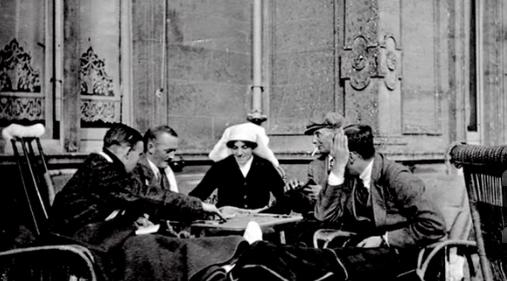
Playing games at Highclere Castle and enjoying home brewed beer

In this matter, Almina showed one of her kinder sides, for she was reportedly a terrible mother and lived largely a selfish and extravagant life until her fortune ran out. The war touched all lives and all class stratas, and not a family was left standing at its end that did not experience a loss:

“All their young men are gone,” lamented the architect Sir Edwin Lutyens of the sons of  Mells Manor, one super-romantic house in Somerset. That was in 1919 when he went to help choose the site of the village war memorial – a figure of St George on a column. The pain of the Horner family at the loss of their son Edward, the last of the male line, can be seen from his monument in the church: a moving statue of the young cavalry officer by Munnings. – The Telegraph, What Next For Downton Abbey?

For several centuries during wars and conflict, great country houses had been conscripted for medical services. One of the earliest country houses to be used as a hospital was Greenwich Palace, which was converted to a navel hospital in 1694.

During World War One:

A genuine sense of wanting to help led to many owners voluntarily turning over their houses as hospitals including the Earl of Harewood offering Harewood House, Lord Howard of Glossop Carlton Towers, Lady Baillie lent Leeds Castle and the 4th Marquess of Salisbury offering Hatfield House as he had done during WWI. – Houses as Hospital: the country house in medical service

The numbers of wounded soldiers who were returned from the battlefields of northern France and Belgium were unprecedented. It was enormously difficulty to remove wounded men from battlefields riddled with shell pocks and guarded by staggered rows of  barbed wire barriers that were miles long. Scores of soldiers who could have survived under immediate medical attention were left to die unattended.  Medics practiced triage, making instant decisions and leaving behind those who stood little chance of surviving or who could not withstand the rigors of being carried to safety. Even when soldiers were successfully brought back to camp, many had to suffer a long wait, for doctors and nurses were overwhelmed, supplies were short, and field hospital conditions were ghastly. A large number died behind the front waiting to be transported.

The soldiers who were brought back to England overwhelmed the hospitals and medical staff that were available. Auxiliary hospitals exploded around England,  many of them the country homes of aristocrats. These houses were not ideally suited for their new positions. During the late 19th century, Florence Nightingale influenced the design of hospitals, noting the importance of separating unsanitary scullery sinks from patient beds, for example, and improving cleanliness and introducing hygiene. While country houses did not provide antiseptic conditions, they became ideal havens for convalescents and for those who suffered from tuberculosis, for these patients required clean country air.

In the second episode of Series 2, the less seriously wounded soldiers or those whose injuries were healing and who needed convalescence were sent to Downton Abbey.  In real life, hospitals and convalescent houses were staffed by a commandant in charge, a quartermaster in charge of provisions, a matron in charge of the nursing staff, and the local voluntary aids, who were trained in first aid and home nursing.

To accommodate the soldiers, family members were confined and restricted to certain rooms in their own home. One would assume this would not be a hardship, since the houses were so large, but the labor shortage and the need for injured soldiers to be housed in large rooms without going up the stairs would most likely necessitate some appropriation of a family’s favorite rooms.  Lord Grantham’s library was divided, so that most of the room became a recreational space and a small section was left to him. Downton Abbey’s central hall became a dining area. Such changes must have grated on the privileged class, who, while wanting to perform their patriotic duty, could not escape encountering the hoi polloi in their daily routine.

With so many men serving as soldiers, servants were stretched thin and forced to perform duties that normally were outside of their scope and that stepped over the boundaries of etiquette. Anna helped to serve at dinner, which would have been totally unacceptable during peace time. Carson, in an effort to maintain the status quo, ruins his health and thus worsens the situation when he is laid low in bed.

Due to the war and its many effects, society was in turmoil. Social change happened on many fronts and class barriers began to blur. As men fought and died in France, women, including those who formerly worked as servants, filled their positions in factories, corporations, and farms. Great houses began to feel the pinch of being short staffed, and genteel ladies who were accustomed to being served had to cook and sew for themselves.

To feed the army, country estates converted their flower gardens to grow fruits and vegetables. At Hatfield House, the Cecil family’s “fields and private golf course were filled with trenches and a man-made swamp to create a maneuvering ground for an experimental weapon under development, the tank.”*

Isobel Crawley, once a working middle class wife – until her son, Matthew, was suddenly propelled into the position of heir to the Earl of Grantham –  finds her true calling in ministering to injured soldiers. She was trained as a nurse and had performed charity work in caring for the sick. The need for her professional services made her feel like a valued woman again. Isobel’s zealousness in converting Downton Abbey into a convalescent home placed her in direct conflict with Cora, Lady Grantham, and continued her battle of wills with Violet, the dowager Countess. Isobel’s situation was not unusual, for during this war many people of the working classes who were professionally trained found themselves in positions of superiority over gently bred women who volunteered as nurses aids.  One Indian soldier remarked with some awe that a noble British lady had ministered to his wounds and treated him as an equal.*

It was only because of the war that a former footman like Thomas would dare enter through the front door or that a doctor could serve as head of the hospital and make decisions that overrode those of the owners of the house. Lady Sybil, whose support of the suffragettes was revealed in the first series, became a VAD (Voluntary Aid Detachment Nurse), for there simply weren’t enough professional nurses to go around.
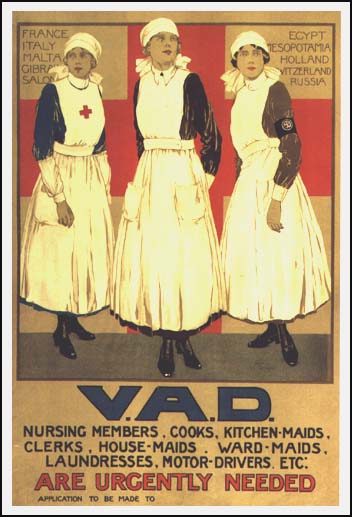
VAD Poster

In many cases, women in the neighbourhood volunteered on a part-time basis, although they often needed to supplement voluntary work with paid labour, such as in the case of cooks. Medical attendance was provided locally and voluntarily, despite the extra strain that the medical profession was already under at that time. – History of British Red Cross

VADs were trained for only a few weeks before working under professional nurses.

Only the middle and upper classes could afford to work for free, and to pay for the courses and exams that were required to become a VAD. Growing up with servants, many of these young women had never had to wash a plate or boil an egg. One girl related how amusing it was to serve tea at the hospital and then return home to have her own tea served by the parlour maid. – The Great War As You May Not Know It

VADs changed linens, sterilized equipment, and served meals, but many were also exposed to the rawer side of war and at times, when the influx of casualties overwhelmed the staff, VADs were expected to perform the duties of a professional nurse.
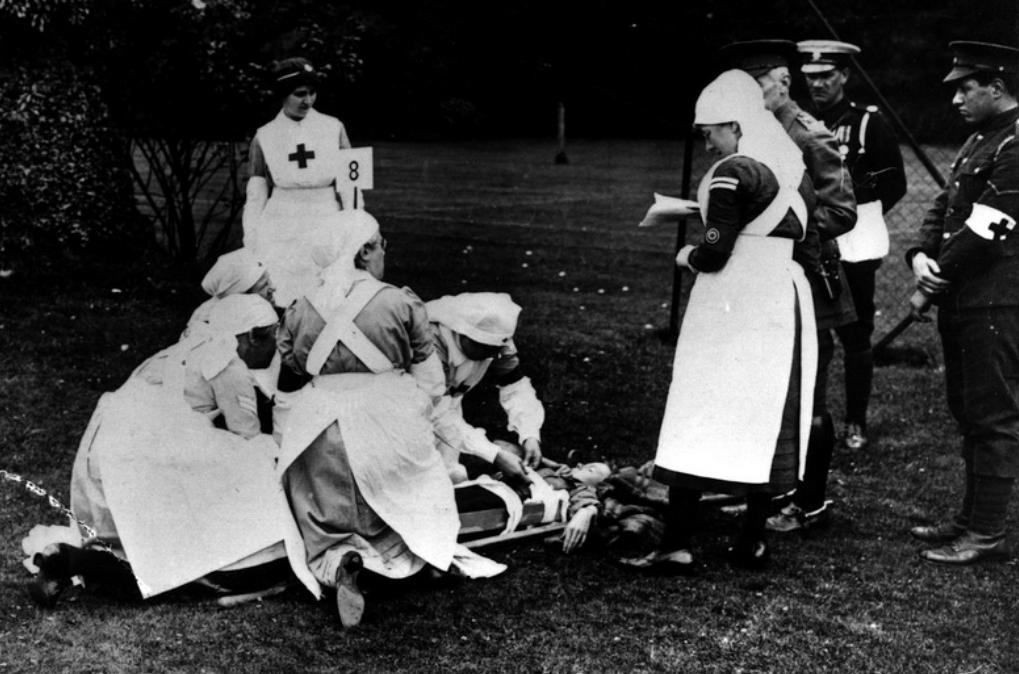
Red Cross VADs

VADs were generally from genteel, sheltered, and chaperoned backgrounds. Some were aristocrats, like Lady Diana Manners – the “Princess Di” of her day – reputedly the most beautiful woman in England and expected to marry the Prince of Wales. Her mother was very much against Diana becoming a VAD, as Diana states in her memoir, The Rainbow Comes and Goes. “She explained in words suitable to my innocent ears that wounded soldiers, so long starved of women, inflamed with wine and battle, ravish and leave half-dead the young nurses who wish only to tend them,” The Duchess gave in, but “… knew, as I did, that my emancipation was at hand,” Diana says, and goes on to admit, “I seemed to have done nothing practical in all my twenty years.” Nursing plunged her and other young women into a life-altering adventure. – The Great War As You May Not Know It

Serving as a VAD changes Lady Sybil, giving her a direction and purpose. Lady Edith, too, finds new meaning in an otherwise predictable life consisting of dinners, parties, and long stretches of boredom. Lady Sybil advised her sister to find her talent and pursue it, which Edith did. One wonders if Lady Mary will  find a similar passion before she throws her life away and marries a man she does not love or (we suspect) respects.

The strength of Downton Abbey’s plot threads this year is how they incorporate the roiling changes in class structure during a complex political time in which the necessities of war, the dissatisfaction of the working classes, and the continued growth of the women’s movement influenced the lives of the series’ characters. More on this topic later.

If you missed Episodes 1 & 2, they can be viewed on PBS’s site through March, 2012 at this link: http://www.pbs.org/wgbh/masterpiece/watch/index.html

Please note: You can watch Downton Abbey Season 1 on Netflix as a DVD or streaming.

Other links and references:

Read Full Post »

From Prada to Nada made $3.3 million at the box office, both foreign and domestic. I’m surprised to read that it was that much. I happened to watch the film on Netflix this past weekend when I had nothing better to do than wash clothes.

The notion of a remake of Jane Austen’s Sense and Sensibility and plucking Marianne and Elinor Dashwood from Barton Cottage and landing them in 21st Century L.A. intrigued me, for Emma Woodhouse’s move from tranquil Highbury to a Beverly Hills high school in Clueless was a resounding success with both critics and viewers. I also liked the idea of switching up cultures, for hadn’t Ang Lee’s hit, Eat Drink Man Woman, been successfully transformed into the delightful Tortilla Soup with its Mexican-American family substituting for the Japanese chef and his daughters? But I quickly came to the conclusion that  From Prada to Nada is to Jane Austen what a black velvet painting is to the Mona Lisa.

Here then is the story:

Mary, Papa, and Nora before his fatal heart attack

Once upon a time in Beverley Hills there lived two very pretty girls in a house called Bonita Casita. They had a Papa but no Mama.

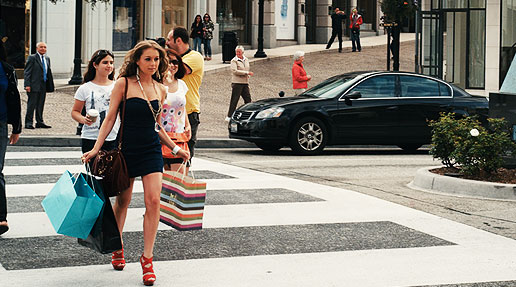
Mary (Alexa Vega) on Rodeo Drive.

One was short and ditzy, liked to shop, and wore party dresses morning, noon, and night. Her name was Mary Dominguez (MD = Marianne Dashwood).

Nora turned norange at Papa's funeral.

The other was a tall, practical, intellectual, wannabee lawyer named Nora (Elinor Dashwood).  While exotically beautiful, she suffered from a fatal Hollywood condition called orange skin. This viewer suspects it was to make her look more cliched Mexican, but should I really be so cynical? Mary had this condition to a lesser extent, and both girls swung from looking tanned to grossly ill, depending on lighting conditions.

I am happy to report that Nora (Camilla Belle) fully recovered from her skin malady shortly after filming.

Neither girl spoke Spanish, a fact that was mentioned often until it was pounded into the viewers’ brains.

While celebrating his birthday with his daughters, Papa falls flat on his face and dies, leaving the two bewildered girls penniless, for everything he seemingly owned belonged to the banks. The girls must move from their cozy environment in 90210 to a tacky neighborhood in East L.A., which is like asking a Swiss palace guard to work in a Columbian prison on short notice.

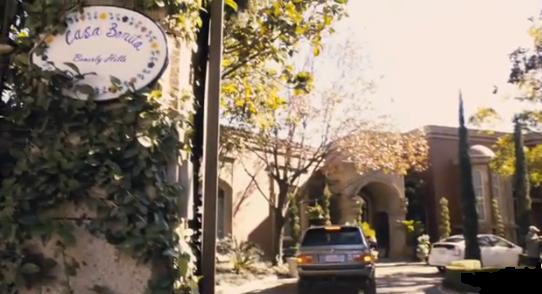
Casa Bonita in Beverly Hills

Before that indignity, they meet their half-brother, Gabriel, a  surprise from their papa’s past, who arrives for the funeral with his cheesy avaricious girlfriend, Olivia. It seems that bro and his tootsie want to renovate Papa’s mansion and sell it for a profit. In other words, bro flips houses for a living. Real class.

Q'eulle surprise! Half-brother Gabriel (Pablo Cruz) arrives at the funeral with his Tootsie, Olivia (April Bolwby), and she's mean, while he's a wuss

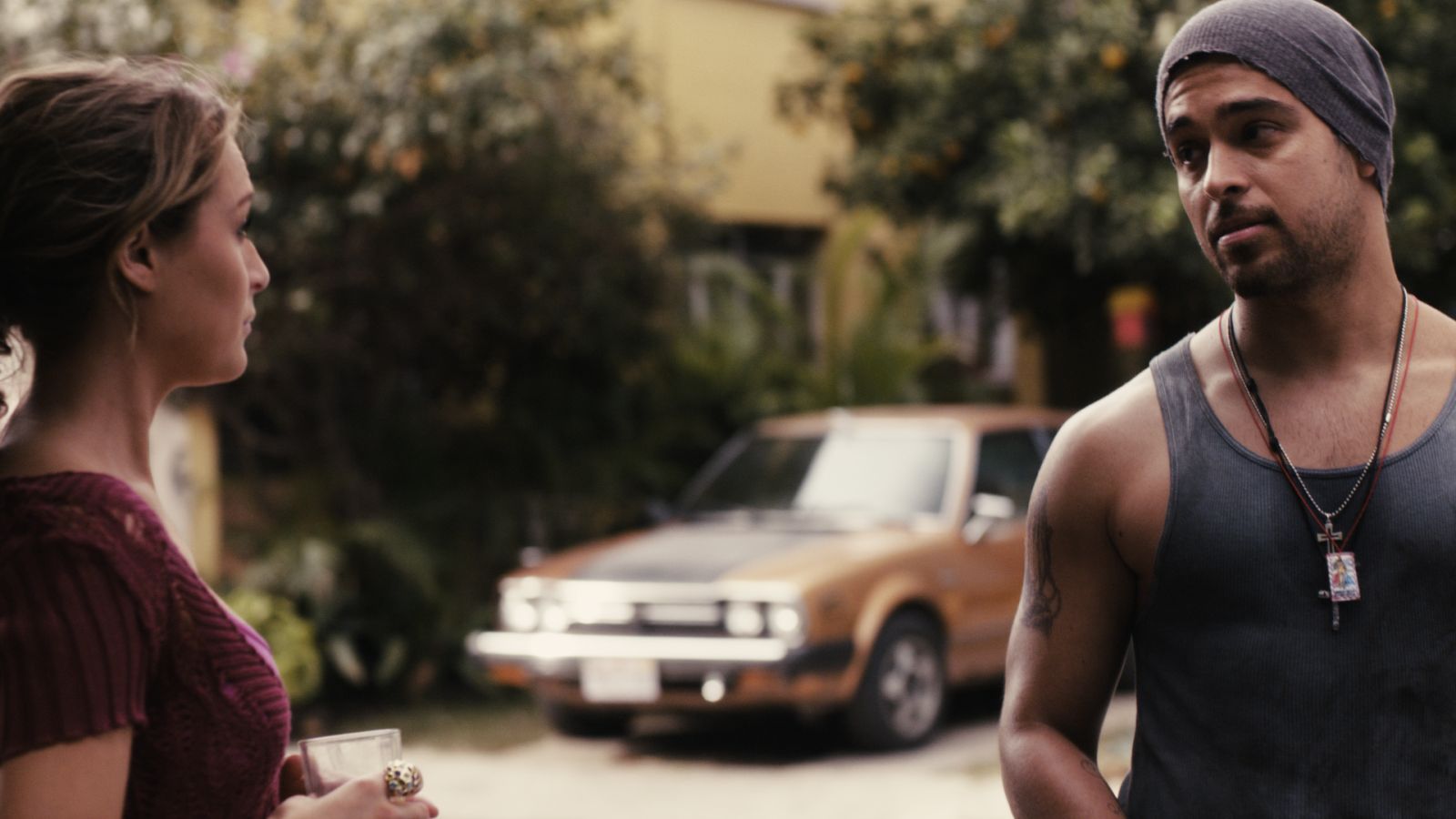
Without a living breathing mother to guide them, as Jane Austen had intended, Maria and Nora have nowhere to go but to their good-hearted aunt’s house all the way over to a neighborhood filled with barrios, gangstahs, and, worse, taco joints. There the girls encounter Bruno (Colonel Brandon) a handsome darkly Latino who obviously did not attend Beverly Hills High.

Bruno (Wilmer Valerrama) and Mary.

He’s friendly, but Mary snubs him, for she begins to suspect that he works for a living and that she  must share a bedroom with her sister. (Not that the two facts have anything to do with each other, but my sentence is no crazier than the plot of the film.)

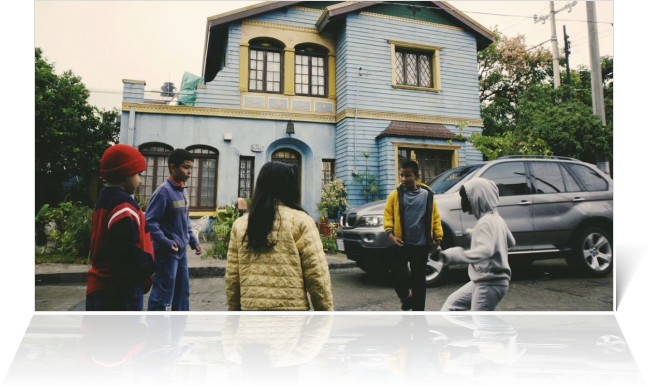
New house, new neighborhood

In rapid succession From Prada to Nada  throws at least one cliche per minute at the viewer, including a small sweat shop in Auntie’s living room, bad girls in the neighborhood, and clothes and interiors that could have been created by Agador (Armand and Albert’s gay Cuban houseboy in The Birdcage). How could this movie stand a chance with intelligent viewers when charactes are named Bad Guy #s 1-3, Comrade, Fiesta guest, and Chola (urban dictionary definition: the girl my brother gets pregnant)?

I imagine that people living in East L.A. were horrified to see Jane Austen’s fine tale mangled and twisted beyond recognition.

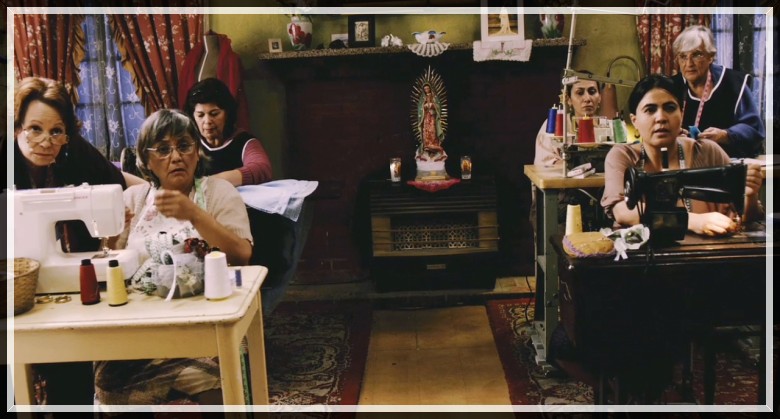
Sewing in Auntie's living room and prepared to hide the evidence at a moment's notice in case of an immigration raid.

The movie stumbles towards its inevitable cliched ending. Edward Ferris falls instantly for Nora and gives her a splendid job in his law firm. They part and then they come together for no reason that I can fathom, except that he is always coming around the house with a truck filled with big items.

Rodrigo (Kuno Becker) meets the aunties

Mary falls head over heels (instead of twisting her heel in the English countryside) for a tutor named Rodgrigo Fuentes, Willoughby’s stand in. He eventually visits Mexico then dumps her and purchases Papa’s hideously renovated mansion from her flipper bro.

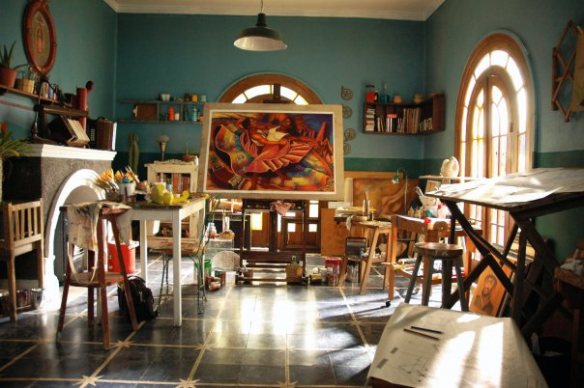
Bruno's amazing studio in his tiny house

Flipper bro turns out to be a nice guy, as does Bruno, who happens to be an immensely talented artist living in the body of a mechanic. For some reason, after her car accident Mary totally flips for the ever patient, long-suffering Bruno, who was able to see past her materialistic ways the moment he met her.

Bruno in his barrio uniform.

After I finished watching this movie, I realized I should have stayed in the basement with my laundry and read a good book as I waited for my washer and dryer to finish spinning. The producers of this clunker forgot one extremely important asset that no self respecting movie can do without: a well-written, intelligent script.

Not all the good intentions in the world of Latinizing Jane Austen, and thus making her more available to those who might otherwise be turned off by her English characters, can save a film so completely devoid of entertainment, originality and wit.

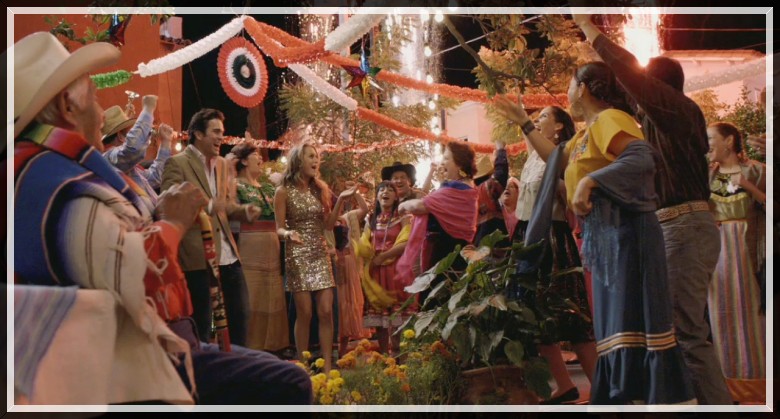
No Tex-Mex film is complete without a fiesta.

I imagine that Lady Catherine de Bourgh would have said of this film: “I take no leave of it. I send it no compliments. It deserve no such attention. I am most seriously displeased.” Amen to that.

Edward Ferris (Nicolas d'Agosto), the prince charming, comes bearing gifts, sweeping Nora off her feet.

Read Full Post »

Gentle readers, Downton Abbey, Season 2 will be shown on PBS through February 19, 2012. I will be writing a series of posts to help illuminate some historical details that might help the viewer who is not familiar with the events of this era. World War I’s connection to Jane Austen is poignant: soldiers in the trenches and those who were shell-shocked or recovering from injuries read Jane Austen’s novels to escape the horrors of war and relive a gentler, more civilized time. 

Warning: Minor plot spoilers

Downton Abbey’s more somber subtext this season is due to the reality of war. Season 2 opens with Matthew Crawley at the Battle of the Somme in Northern France, which lasted from July through November, 1916, and symbolizes the horrors of World War One for the British.

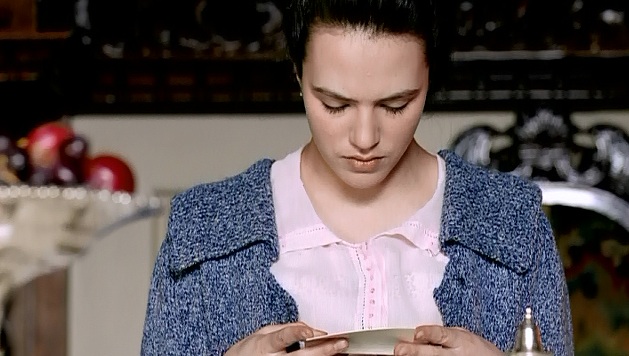
Lady Sybil reads about the death of a male friend. Credit: Courtesy of © Carnival Film & Television Limited 2011 for MASTERPIECE

The Great War was supposed to have lasted only a few months in the minds of British Generals, who were accustomed to quickly overwhelming poorly armed native fighters in the colonies. But this deadly conflict, triggered by Germany as its troops marched through neutral Belgium to invade France  (and which had been building up its cache of war equipment for a long time), lasted for more than 4 years. Casualties were so catastrophic that the numbers border on the unbelievable: Great Britain, 35.8% of the forces; France, 73.3%; Belgium, 34.9%; Germany, 64.9%; Austria/Hungary, 90%!

Battle of the Somme, 1916

Of the over 65 million troops fighting in that war from all over the world, including India and North Africa, nearly 60% were killed or wounded (PBS). Add to this total the killing of innocent civilians and animals, the destruction of villages and farms in Belgium and Northern France, the enormous debt and resulting poverty that European nations faced, and one can only shake one’s head and wonder how the world could have plunged into a second world war a mere 30 years later.

Here then are only a few features of a war which is still remembered for its destructiveness one hundred years later

Barbed wire

The Battle of the Somme was supposed to have gone smoothly after the British artillery spent a week shelling German trenches. Bombardment commenced on July 1st, 1916 and could be heard across the Channel in Britain: 1,738,000 shells rained upon German territory. It was believed that such continuous and massive bombing would open up gaping holes in the barbed wire that protected enemy lines, allowing British cavalry to rush through and overwhelm the Germans who survived the destruction of their trenches. This did not happen. German trenches were dug much deeper than was thought and were not pulverized. To their horror, the English immediately realized that the barbed wire also remained largely intact. This meant that soldiers could not storm the battlefield, but would be fatally delayed as they tried to cut through the barriers, allowing machine gunners to mow them down. And this is what happened. Over 60,000 British troops were lost that first day. At the end of the campaign, the British had lost 420,000 men (the French 200,000 and the Germans 500,000).

A wiring party going forward. Image @Daily Mail

Barbed wire had been used for the first time in the Spanish-American War and Boer Wars, but World War One brought its use in the battlefield to a new level. As soon as territory was conquered, a “wiring party” would go out to lay out barbed wire and protect their hard won land. Barbed wire was almost impossible to deal with until tanks were invented, although this piece of equipment was highly unreliable at first.

Modern weaponry

In my opinion, war has never been civilized or gentlemanly, but World War One raised the brutality to a new level that the stodgy British generals, in particular John French and Douglas Haig, were unable to fathom. The invention of machine guns allowed a single gunner to mow down hundreds of men within minutes. Flame throwers, known as Flammenwerfers in German, were portable and were first used by the Germans to terrify the British and French soldiers. The allies quickly learned to retaliate in kind.

Credit: Courtesy of © Carnival Film & Television Limited 2012 for MASTERPIECE

Lady Sybil with soldier blinded by mustard gas. Credit: Courtesy of © Carnival Film & Television Limited 2011 for MASTERPIECE

In 1914, the French were the first to unleash poison gas on the enemy. This gas was more an irritant, much like pepper spray is regarded today, and did not maim or kill. In 1915, the Germans used chlorine gas on the unsuspecting British, which leads to a slow and torturous death by asphyxiation. There were other gases. Phosgene gas would first go unnoticed and by the time the damage was felt, it was too late to save the victim. Mustard gas caused blistering both on the face and inside the respiratory organs. Many who survived mustard gas were permanently blinded. The vagaries of the wind often carried gas back to the troops who had unleashed it on the enemy. Over time both sides learned to wear gas masks, providing them for their horses and messenger dogs as well. However, the gas cloud killed any animal indiscriminately – horses, birds, wildlife, rodents that happened to be in its path died horrible deaths. Airplanes made their first appearance, dropping bombs from the sky and on civilians, and the mortality rate of fighter pilots was extremely high, ranging in the suicidal. German U-boats (early submarines) were amazingly effective in sinking ships and preventing food and ammunitions from reaching the allies.

Trench Rats

The rats were as big as cats some soldiers swore. Millions infiltrated the trenches, running over sleeping men and raiding their pockets or foodstuffs. Rats swarmed the battlefields, feasting on rotting corpses, first going for the eyes, then gorging themselves on the rest of the body until their bellies were swollen.

There was no proper system of waste disposal in trench life. Empty tins of all kinds were flung away over the top on both sides of the trench. Millions of tins were thus available for all the rats in France and Belgium in hundreds of miles of trenches. During brief moments of quiet at night, one could hear a continuous rattle of tins moving against each other. The rats were turning them over.” – Private George Coppard, Royal West Surrey Regiment

Rats can multiply by the tens of thousands in no time (one pair can produce 880 offspring per year) and there was no way to escape them. Although ever present, soldiers never quite became inured to these bold, opportunistic rodents.

Matthew on leave, with his fiancee Lavinia Swire, greeting Sir Richard Carlisle. Credit: Courtesy of © Carnival Film & Television Limited 2011 for MASTERPIECE

In Downton Abbey Season 2 Matthew Crawley leaves the front and visits England quite frequently. The reality was that the men spent only part of their time in the trenches, rotating to different sectors. Typically they would spend 2 weeks in the trenches, a week in support lines or support trenches, two weeks in reserve, and then one week resting. Out of a year, a soldier would spend about 4 months in the front lines. This was about all they could stand. Living with the constant fear of death by shelling, sniper, or disease drove some men out of their minds. It must be added that as in all wars, the men spent countless days, even weeks, living lives of boredom which were interspersed with moments of sheer terror. The problem that many faced was that at any day their number could be up, and with odds worse than Russian Roulette, for there was a 1:3 chance that the next battle would be a British soldier’s last.

Thomas, now a medic, in the trenches. Credit: Courtesy of © Carnival Film & Television Limited 2011 for MASTERPIECE

Shell shock

A society known for its stiff upper lip would have a hard time admitting that its finest and brightest men could suffer from shell shock. During the early 20th century, shell shock was not yet clearly defined. Men suffering from shell shock exhibited a variety of symptoms, ranging from psychological blindness to stomach cramps and diarrhea, as well as facial twitches, uncontrollable sweating, nightmares, tremors, and an inability to eat or sleep. By 1917, as many as 1 in 7 men, or 80,000 British soldiers, were discharged from service for emotional disorders related to the war. Sadly, many were regarded as malingerers and sent back to the front. Some committed suicide, others deserted or refused to obey orders, in which case they were court-martialled or shot.

In Downton Abbey, Lord Grantham’s new valet, Andrew Lang obviously suffered from shell shock. O’Brien, Lady Grantham’s lady’s maid, shows uncharacteristic sympathy when she realizes Lange’s condition, because her brother suffered from the same malady and was misunderstood. Mrs. Patmore’s nephew, Archie, must also have experienced the same fear and panicked. He was not quite so lucky and was caught and shot for desertion.

Also read:

Life in the Trenches: Edwardian Promenade

Season 2, Episode One Recap on Austenprose

Please note: the ads at the bottom of my posts are wordpress ads. I make no money from my blog.

Images Credit: Courtesy of © Carnival Film & Television Limited 2012 for MASTERPIECE

Read Full Post »

Gentle Readers, Patty of Brandy Parfums frequently contributes articles of interest to this blog. Her latest post is about Anonymous, the film about the authorship of Shakespeare’s plays, which recently opened in theatres.

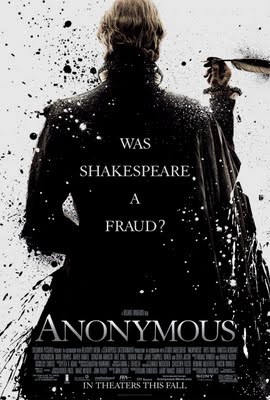
Film Poster

Introduction  – Instead of writing a traditional plot-spoiler review of Anonymous, which can be found in many newspapers and magazines, I’ve written what I think will be more useful – a short guide to Shakespeare authorship. Enjoy! – Patricia Saffran

Jamie Campbell Bower as the young earl of Oxford

A Guide to Shakespeare Authorship

Jane Austen knew Shakespeare’s plays well and based a number of her novels on Shakespeare’s characters and plot devices. Stephen Derry writes about these many references in his paper for the Jane Austen Society of North America, ‘Jane Austen’s Use of Measure for Measure in Sense and Sensibility.’ Derry begins his paper by saying -In Mansfield Park, Edmund Bertram declares that one is familiar with Shakespeare in a degree from one’s earliest years. His celebrated passages are quoted by everybody we all talk Shakespeare, use his similes, and describe with his descriptions.

Tudor England

Knowing of Jane Austen’s profound knowledge of Shakespeare should give those who love her works a keen interest in all things Shakespeare – and in this new movie, which brings the Elizabethan period to life. This is the first time a major movie studio has taken a leap, with an elaborate period production, costumes, and star-studded cast, to delve into the question plaguing scholars for centuries, as to who the author of  Shakespeare’s plays really was.

Joely Richardson as a young Elizabeth I and Jamie Campbell Bower as a young Earl of Oxford

The gamble has payed off, as this is a truly sensational
movie. It takes place during the succession of Queen Elizabeth I, and the Essex Rebellion against her – a period of turmoil and political instability. During this period, being the author of a play with politically loaded or satirical material was dangerous. Some authors chose anonymity………

Shakespeare authorship as an area of inquiry is not new. While making a list of the greatest Elizabethan poets, Henry Peacham in The Compleat Gentleman published in 1622, when the First Folio was being created, lists Edward de Vere, the Earl of Oxford, first on his list and does not include Shakespeare at all. Many believe that this was Peacham’s way of hinting that Edward de Vere, not William Shakespeare, wrote the plays and poetry.

Rafe Spall as William Shakespeare

More recently, in the past 150 years, there have been many notable actors, writers, and Supreme Court judges who have questioned William Shakespeare as the author of the plays. Among them are Mark Twain, Leslie Howard, Charlie Chaplin, Orson Welles, Sigmund Freud, Charles Dickens, Walt Whitman, Henry James, J. Thomas Looney, Michael York, Sandra Day O’Connor, Harry A. Blackmun, and John Paul Stevens. Besides de Vere and William Shakespeare, the other main candidates to have written the plays are Bacon, Marlowe, and Neville.

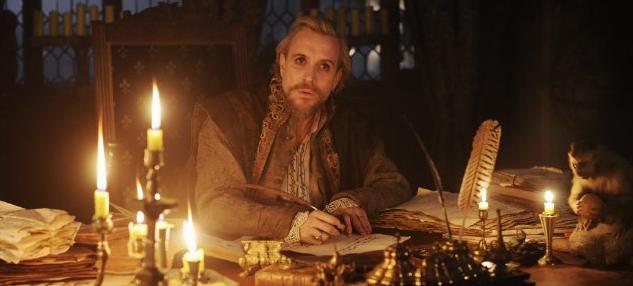
Rhys Ifans as the mature Earl of Oxford

A fantastic short video by the director of Anonymous, Roland Emmerich, summarizes ten reasons why it is implausible that the Stratford William Shakespeare wrote the plays. For some, the main reason is that unlike all other great authors of the period, no letters exist either to or from Shakespeare.

Preview: Was Shakespeare a Fraud?

A new book coming out November 8th continues to examine the question of Shakespeare authorship – The Shakespeare Guide to Italy by Richard Paul Roe, paints the Stratford man who never left England as an improbable author of the many distinctively Italian plays.

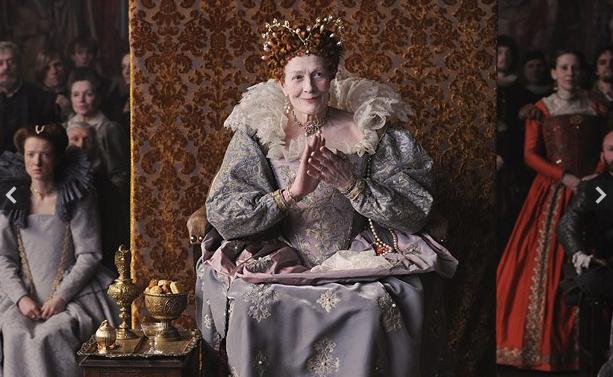
Vanessa Redgrave as the mature Elizabeth I

Current scholars, and by extension many of their now journalist proteges, who defend William Shakespeare as the author of the plays, are extremely defensive and say there is no room for doubt. Time will likely make the world more receptive to exploring Shakespeare authorship, but for now Anonymous will inspire interest in this fascinating field. I highly recommend this film.

For more on Shakespeare and Shakespeare Authorship:

About the film:

Anonymous, the new movie about Edward de Vere, the Earl of Oxford, as the true author of Shakespeare’s plays. With Rhys Ifans, Vanessa Redgrave, David Thewlis, and along with those who actively support authorship studies, Derek Jacobi and Mark Rylance. Directed and produced by Roland Emmerich, released by Columbia.

Read Full Post »

The third episode of Upstairs Downstairs will be shown this Sunday. Will you tune in?  (Watch all three episodes from April 25 through May 24 at this link.) Better yet, the BBC will make the DVD available for sale Tuesday, April 26th.

BBC’s Upstairs Downstairs DVD is available for purchase!

Upstairs Downstairs has been brought back with a fresh new cast. It is 1936 and six years since parlormaid Rose (Jean Marsh) left 165 Eaton Place. Fate brings her back to the house and its new owners, Sir Hallam Holland (Ed Stoppard), his wife Lady Agnes (Keeley Hawes), and his mother, Lady Maud Holland (Eileen Atkins). Rose recruits a new “downstairs” family to help run the elegance and finery of the “upstairs” world. Set against the historical backdrop of a pre-World War II Britain with a new King on the throne, with Fascism on the rise on the continent, and with sexual, social and political tensions at 165 Eaton Place, this new series provides an evocative take on the master-servant relationship.

In honor of the U.S Premiere on PBS’s Masterpiece Classic, the BBC is giving away a free DVD just two days following the conclusion of the third episode. This DVD includes the making-of featurette Upstairs Downstairs – Behind Closed Doors. (SRP: $34.98 ($43.98 in Canada)

CONTEST is CLOSED. The winner is Felicia!!: For an opportunity to win the DVD, all you need to do is leave a comment stating what you liked best about this 2010 series! The drawing (by random number) will be held on Tuesday, April 26th at 11:59 PM, EST.

Read this blog’s reviews of UpDown in these posts:

Read Full Post »

« Newer Posts - Older Posts »