Feeds:
Posts
Comments

Archive for the ‘Popular culture’ Category

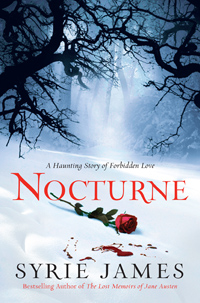
When Nicole Whitcomb’s car runs off a Colorado mountain road during a blinding snowstorm, she is saved from death by a handsome, fascinating, and enigmatic stranger.

Snowbound with him for days in his beautiful home high in the Rockies, she finds herself powerfully attracted to him. But there are things about him that mystify her, filling her with apprehension. Who is Michael Tyler? Why does he live in such a secluded spot and guard his private life so carefully? What secret—or secrets—is he hiding?

Review of Nocturne: From the desk of Shelley DeWees (The Uprising) …

“Never have I had such an intense relationship with books as when I was a young girl. I raged inside them and lived a double emotional life, half real girl, half inhabitant of a distant world, and I chose book neither because of, nor in spite of, their artistic merit, only for their ability to pull me through the looking glass.”
–Caitlin Flanagan, What Girls Want: Vampire Novels Illuminate the Complexities of Female Desire

It’s Saturday afternoon. The rain is lashing against the windows of your bedroom, obscuring your view into the outside world and in turn, hiding yourself from anything beyond your immediate surroundings. A delicious sense of solitude creeps through you, and you know you’ve got all day to sit and soak it up…no job, no husband, no nothing to distract you. Relieved and carefree, you toss yourself on the bed and carefully unfold the book you’ve been waiting to read, the book you’ve been toting around in your bag for weeks or clutching to your chest like some kind of emotional armor. You’re quickly absorbed once again, lying on your stomach with your legs in the air, and hours upon hours of unbroken silence pass before you know it while your brain floats on a cloud of imagination…

Typical Saturday? Maybe in our most magnificent fantasies. Or how about in our memories?

Losing yourself in a book is truly a remarkable thing. The moment when you look at the clock to realize that midnight has come and gone is a special one, not to be taken lightly. That is, of course, until you become conscious of that fact that, yes, you have to be up in 3 hours and to work in 5. And therein lays the problem. Somewhere along the path of growing up we lost the ability to retreat into our heads, forsaking our giggly girl-reader for a woman almost-reader with a car payment and a pension plan. We traded away the gift of reading trashy, poorly written books that take you somewhere else in favor of using our adult scrutiny to decide whether a book was “good.” When you were a girl, a book became “good” simply if it gave you the giddy feeling that 40-something men must get when they get an unexpected glimpse of pornography: “a slingshot back to a world of sensation that, through sheer force of will and dutiful acceptance of life’s fortunes, you thought you had subdued,” says Caitlin Flanagan, author of “What Girls Want: Vampire Novels Illuminate the Complexities of Female Desire.

Fortunately for us and our shriveled imaginations, it’s never too late to get it back. Thus, I’d like to introduce you to a vampire romance where the characters are predictable and the plot is laughably absurd. The weak woman falls hopelessly in love with a too-perfect man, surrounded by an idyllic setting where gender roles from the 1960’s abound….and no, I’m not talk about that other vampire series. Nocturne, the newest gift from Syrie James, is infinitely better written than that other thing, far better in terms of structure and development but equally silly and delicious.

Nicole Whitcomb, with her lovely red-headed beauty and underdeveloped common sense, drives off the road in a winter storm and is saved by the overly enchanting Michael Tyler. She wakes up in his perfect house among his flawless made-to-attract-her life and…big surprise…falls for him. But wait! He’s a VAMPIRE! What, didn’t you know that? Whoa. Their story unfolds just as you would expect, and the no-I-can’t-yes-you-can banter progresses just as it did in that other novel series. However, the sexual energy builds and the two characters finally succumb to their urges…very well, by the way.

I found myself glued to the pages of this novel, despite its definite installment under the “brain candy” column. A slight glimmer of the teenager I once was showed her face once again, and I dissolved into giggles and gasps like a silly school girl. My adult brain got to take a hiatus for awhile, sipping on margaritas while my imagination hummed into motion, and only shouting in protest at one or two points. It’s not artistic literature, but Nocturne will grip you like books once did, upstairs in your room, hidden away while still in plain sight. It was a unique moment, something that I’m a bit embarrassed to admit (but that must be my overachieving adult side talking).

Excerpt from Nocturne:

Nicole’s heart began to beat erratically. She’d heard scary things about mountain men who’d lived too long in isolated places. Who was this guy? He seemed cultured and spoke very formally, as if he belonged in the Queen’s court or in a palace surrounded by servants.

What was an Englishman doing in this remote corner of the Colorado mountains, unless he was hiding from something? But if he was a killer, surely he would have murdered her already, instead of carefully tending to her wounds. Wouldn’t he?

“You haven’t told me your name,” she said, straining to keep her voice even.

“Haven’t I? I beg your pardon. Michael Tyler.”

“How is it that you live up here? I thought this was national forest land.”

“It is. But there are pockets of private land scattered throughout.”

“Do you live here all year long?”

“I do.”

“By yourself, or …”

“I live alone.”

Her questions seemed to annoy him. He stood up and Nicole sensed that he was about to leave the room. In an effort to lighten the mood—or maybe just to put herself more at ease—she glanced at the grand piano and said with a forced smile, “So I take it it’s either you who plays that piano, or the resident ghost?”

A surprised twinkle lit his blue eyes. He sat back down in his chair with the first hint of a smile. “Definitely the ghost. Watch out for her. She plays at the oddest hours and has been known to leave candles burning in the most unlikely places.”

“She?”

“A raven-haired beauty. From her clothing and hairstyle, I deduce that she’s from the previous century. Which is strange when you consider that I only built the house ten years ago.”

Nicole laughed. His smile was charming. His accent was so lovely, she could listen to it all day long. Maybe there was nothing to be afraid of after all…” (Read a longer excerpt here.)
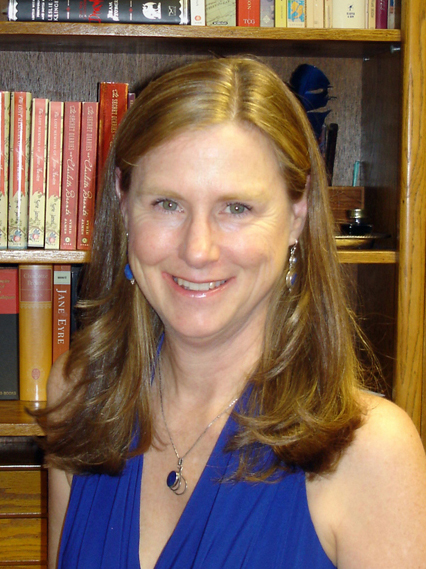
Syrie James

More links:

Read Full Post »

Inquiring readers: Raquel Sallaberry from Jane Austen em Portugues sent the link to this post on Promantica about the entail in Downton Abbey entitled “Downton Abbey Fans – Welcome to the MOST Boring Law School Class.” The title is not exactly descriptive, for this wonderful post explains in great detail why the entail cannot be superceded, why Cora’s money is tied up and Lady Mary cannot inherit, and why Matthew Crawley cannot relinquish the title.

The Earl of Grantham and Matthew Crawley walk around the grounds of Downton Abbey

Magdalen, one of the blog contributors, introduces the expert:

By special request, I have asked my ex-husband to help us understand the law of the entail, critical to the plot of Downton Abbey.  Henry is a) British, b) an attorney, c) smart, and d) the son and grandson of QCs, i.e., barristers (British attorneys who appear in court) selected to be “Queen’s Counsel.”  (Although, to be fair, I think Henry’s grandfather took silk — Britspeak for becoming a QC — long enough ago that he was actually King’s Counsel!)
The blog goes on to describe the difference between real property, personal property, and intellectual property. Magdalen then dives into her questions:

First off, what’s an entail?
It is a limitation on the current tenant’s (in our case, the 6th Earl of Grantham) ownership interest in the estate. If he owned Downton Abbey outright, he would have a fee simple. Instead, he has a fee tail, which gives him a life interest so he can’t be evicted in his lifetime, but not the right to say who gets Downton Abbey after he dies.

The Earl of Grantham summarizes the situation best: "I'm a custodian, not an owner."

Okay, so how would an entail work?
The normal entail would be to “the 6th earl and heirs of his body” (meaning his legitimate biological children) or “and heirs male of his body” or “and heirs male of his body to be begotten on Cora.” When the 6th earl had no sons, the second and third of those would terminate, allowing the 6th earl to dispose of the money by will. The first would allow a daughter to inherit, but I’m not sure if it would pass to Mary or to the three daughters jointly or in shares…

To read the rest of this fascinating post, please click on this link to Promantica.

Thank you, Raquel (and Magdalen and Henry). This article is fascinating, fun to read, and very, very informative.

Read this blog’s other posts about Downton Abbey:


Read Full Post »

Inquiring readers, from now until the U.S. airing of Downton Abbey, this blog will explore the facets of living in an English country house during the Edwardian era, and drawing upon the similarity and differences between the Edwardian and Regency eras.

Downton Abbey. Credit: Courtesy of © Carnival Film & Television Limited for MASTERPIECE

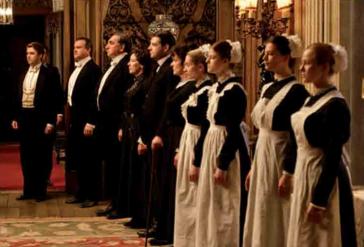
Servants await the arrival of guests. Credit: Courtesy of © Carnival Film & Television Limited for MASTERPIECE

Many of us today cannot understand why servants in country manors such as Downton Abbey would consider catering to the whims of others as a desirable occupation. In reality, service in great houses was preferred over other jobs that were available during the 18th and 19th centuries, such as tedious and often dangerous labor in factories or backbreaking work on farms.

Downton Abbey. Credit: Courtesy of © Carnival Film & Television Limited for MASTERPIECE

Siobhan Finneran as O’Brien, the countess’s ladies maid, Rose Leslie as Gwen, housemaid, and Joanne Froggatt as Anna, head maid. Credit: Courtesy of © Carnival Film & Television Limited for MASTERPIECE

Unlike their poorly paid counterparts, servants were housed and fed by their masters. They had the ability to save a large portion of their salaries, or send money to support their families back home. At the end of their stay with their hosts, guests paid servants a tip for their services. Housekeepers, as Jane Austen famously showed in Pride and Prejudice, served as tour guides when the family was absent. Mrs. Reynolds no doubt received a tip from the Gardiners after showing the public rooms of Mr. Darcy’s great estate.

Jane Austen's World

Mrs. Reynolds, the housekeeper, escorts Elizabeth Bennet and the Gardiners through Pemberley

Although servants began their careers at the bottom, working menial jobs and catering to the upper servants as well as their masters, they could move up in the servant hierarchy. It was not uncommon for a scullery maid to be promoted to kitchen maid and eventually up to a cook.

Downton Abbey. Jane Austen's World

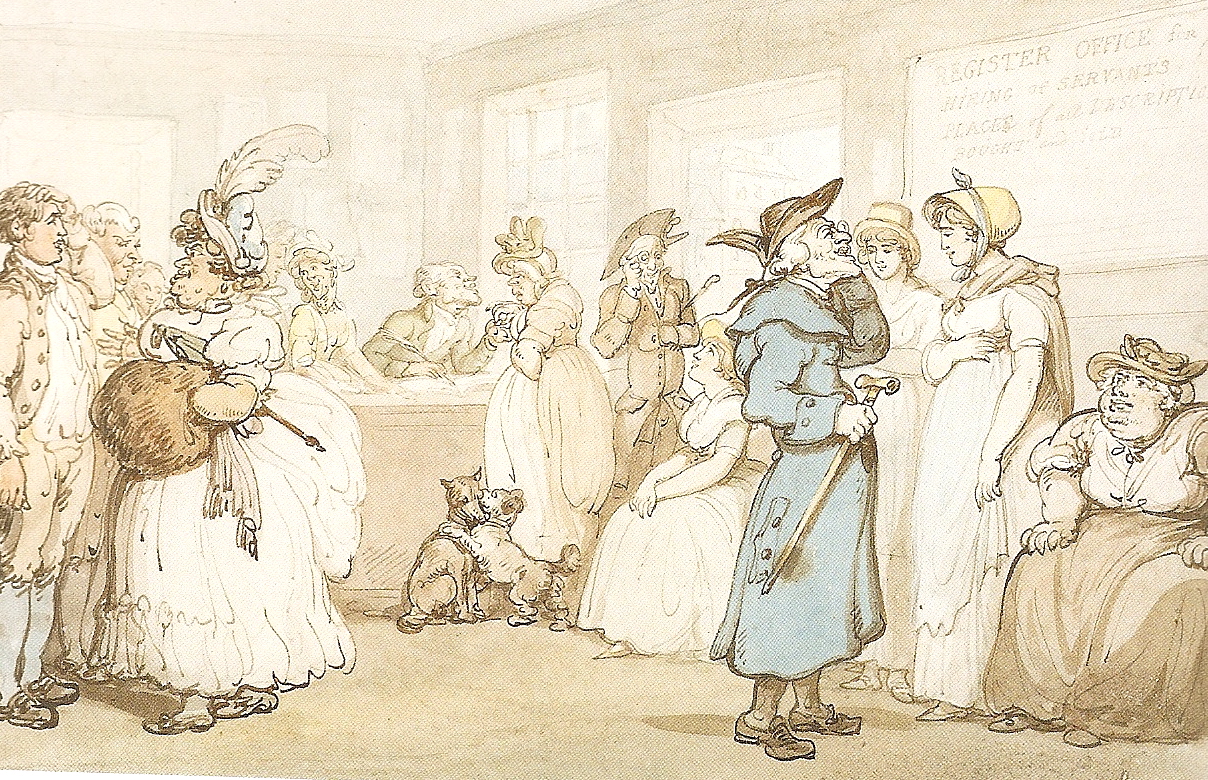
The registry office

A good and reliable servant was a prized commodity. Young, able servants were in a constant state of flux (they worked on average for 2-3 years before moving on), always looking for a better position, which they could acquire as long as their masters gave them good references. Servants found new work in registry offices, where they would enter their name in the registry book, or through word of mouth. (Read more about this topic in my post, Hiring Servants in the Regency Era and Later.)

Downton Abbey 2010. Credit: Courtesy of © Carnival Film & Television Limited for MASTERPIECE

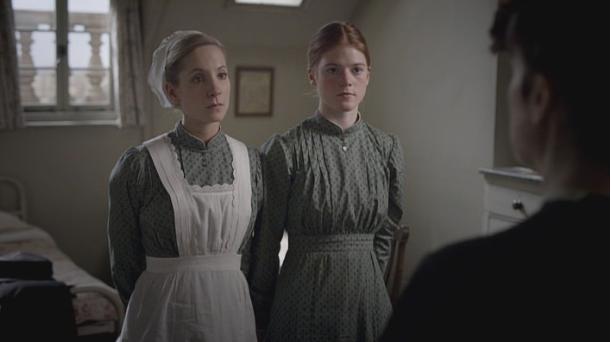
Anna (Head maid) and Gwen (house maid) in their room. Credit: Courtesy of © Carnival Film & Television Limited for MASTERPIECE

Upon rising, servants would labor first and eat only after the family had risen, dressed, and breakfasted. When Downton Abbey opens, the camera follows the servants as they rise and ready the house for the day. The earliest rising servant was the scullery maid, or tweeny, who sat lowest on the pecking order. She would stoke the kitchen fire for the cook and boil water. The kitchen maid would perform these offices if there were no tweeny or scullery maid.

Credit: Courtesy of © Carnival Film & Television Limited for MASTERPIECE

Daisy, the kitchen maid, lays a fire in the library. Credit: Courtesy of © Carnival Film & Television Limited for MASTERPIECE

Housemaids would tread silently up the servant (back) stairs unseen and unheard with fresh water and carrying covered slop pails. Quietly, so as not to wake their masters, the servants – maids and footmen – would empty chamber pots, remove cold ashes in the fireplace, carry up coal and stoke a new fire, and tidy any messes away from the previous day.

The servant stairs. Credit: Courtesy of © Carnival Film & Television Limited for MASTERPIECE

Downstairs they would continue making preparations for the day, opening drapes and shutters, dusting and polishing, and sweeping floors. The only time that the servants might be visible to family or guests was when they cleaned and polished the main halls and stairway. At all other times they were expected to remain invisible as they worked around the house, using the servant’s stairs and working in a room when the family was not expected to use it.

Credit: Courtesy of © Carnival Film & Television Limited for MASTERPIECE

Breakfast at Downton Abbey. Credit: Courtesy of © Carnival Film & Television Limited for MASTERPIECE

With or without guests, the daily routine for a family at its country house was unalterable, due in part to the servants, whose meal-times were rigid, and in part to Edwadian era tradition. At nine 0’clock, housemaids and valets arrived to draw bedroom curtains and deliver a cup of teac as ordered by the hostess the night before.” – The End of High Society

Downton Abbey 2010. Credit: Courtesy of © Carnival Film & Television Limited for MASTERPIECE

The servants quarters. Credit: Courtesy of © Carnival Film & Television Limited for MASTERPIECE

Servant’s dining space and table, Downton Abbey

The hierarchy among the servants was strictly defined. At the top stood the butler and housekeeper. Dowton Abbey, the series, highlights eleven servants who ran the household, but in 1912, Highclere Castle, where the exterior and interior shots were filmed, used the services of 25 maids, 14 footmen, and three chefs. Although Downton Abbey follows only 11 of the upper servants closely, one can see other servants (housemaids, a scullery maid, young boys, coal men, and the like) in the background going about their business.

Credit: Courtesy of © Carnival Film & Television Limited for MASTERPIECE

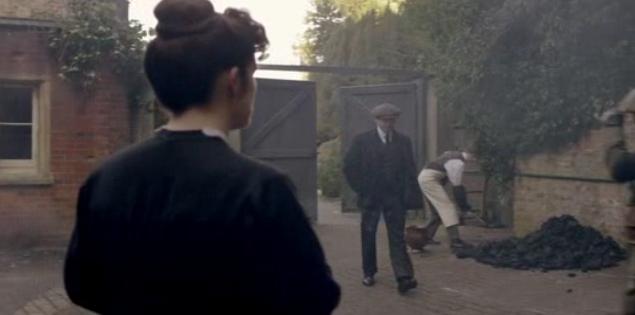
Back of the house. In the background, a servant scoops coal.Credit: Courtesy of © Carnival Film & Television Limited for MASTERPIECE

In addition to the main house, servants worked in the service buildings, such as the stables, garage, dairy, bakehouse, laundry, gun room, and pantry. The kitchen in these great houses often sat away from the house (to prevent cooking smells from wafting up to the public and private rooms) and were connected to the main house via underground passages. This meant that the food often arrived at the dining table cold or, at best, lukewarm.

Credit: Courtesy of © Carnival Film & Television Limited for MASTERPIECE

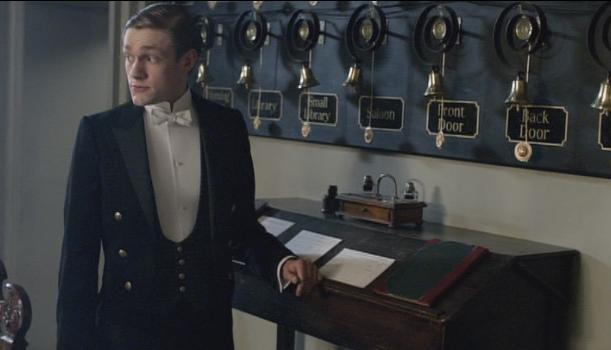
The servant bells behind William, the second footman. Credit: Courtesy of © Carnival Film & Television Limited for MASTERPIECE

In the lower common area, servants were summoned by the family via a system of bells connected to each room. In theory, even when servants had finished with their duties and were finally sitting down to eat their breakfast, they were subject to be called at a moment’s whim. But was this always the case? While the servants of Downton Abbey are shown to be loyal and proud of their positions, the Punch cartoon below shows a group of shiftless servants who are slow to respond to their master’s summons.

‘Oh, ah, let ’em ring again!’ by George Cruikshank

The servants of Downton Abbey worked hard, but as shown in the series, they knew their place and were proud of their positions.

Downton Abbey 2010. Credit: Courtesy of © Carnival Film & Television Limited for MASTERPIECE

Jim Carter as Mr. Carson, the Butler. Credit: Courtesy of © Carnival Film & Television Limited for MASTERPIECE

The Butler: Jim Carter, who you may remember as Captain Brown from Cranford, portrays Mr. Carson, the butler, with grave dignity. He is as protective towards the Crawley family as he would have been to his own. While Mr. Carson is fair, he does not hesitate to reprimand a servant or even fire one if he thinks it is for the benefit of the house. Mr. Carson was not only in charge of the male servants, but also of the wine cellar and the butler’s pantry, which contained the family plate and silver. In addition to his managerial duties, he is shown in several scenes either polishing the silver or pouring over the books and counting the bottles of wine.

Downton Abbey 2010. Jane Austen's World

Phyllis Logan as Mrs. Hughes, Housekeeper. Credit: Courtesy of © Carnival Film & Television Limited for MASTERPIECE

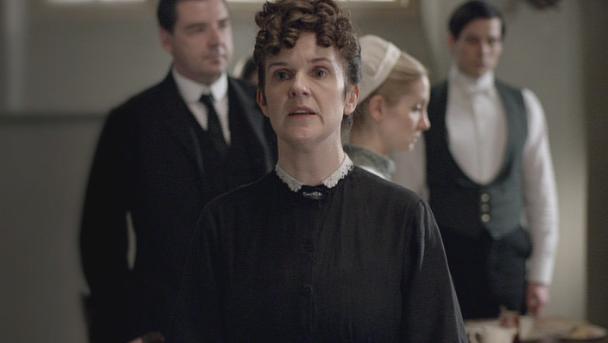
The Housekeeper: Phyllis Logan as Mrs. Hughes is Mr. Carson’s counterpart. Head of the female servants, she consults with her mistress daily about the meals, family plans, and any guests that are expected. Mrs. Hughes (even if they are single, which Mrs. Hughes was, housekeepers were given the distinction of being a Mrs.) was also responsible for the linen and china. A kind and observant woman, Mrs. Hughes nevertheless keeps her female team in line. She begins to wonder if, by devoting her life to this household, she has missed out on managing one of her own.

Downton Abbey 2010.

Brendan Coyle as John Bates, the Valet. Credit: Courtesy of © Carnival Film & Television Limited for MASTERPIECE

The Valet: (Brendan Coyle) In small households, such as Matthew Crawley’s, the position of butler and valet was combined. But Downton Abbey is a great house, and there are servants aplenty. Mr. Bates’s arrival creates a stir that causes the lady’s maid and first footman to plot against him. A stoic and capable man who served the earl as batman during the war, he must perform his duties of dressing the earl and seeing to his wardrobe regardless of the war injury that requires him to use a cane. For Mr. Bates, the flights of steep stairs can be daunting, and he is incapable of carrying large trays or helping with dinner service when more hands are needed.

Downton Abbey 2010.

Joanne Froggatt as Anna, Head Housemaid. Credit: Courtesy of © Carnival Film & Television Limited for MASTERPIECE

Head Housemaid: Joanne Froggatt as Anna is a pretty, quiet, and dependable presence. She works with a positive attitude and champions those who need defending. As head housemaid, she assists the daughters of the house with their hair and wardrobe, but she also performs the duties of a regular maid, dusting, cleaning, and changing the bed linen.

Downton Abbey 2010.

Lesley Nicol as Mrs. Patmore, the Cook. Credit: Courtesy of © Carnival Film & Television Limited for MASTERPIECE

The Cook: Lesley Nicol as Mrs. Patmore, the cook, is hiding a secret, one that threatens her very livelihood. The viewer will be struck by the sheer volume and variety of dishes that she creates and oversees daily. Although only her kitchen maid, Daisy, is seen as her regular assistant, there would have been others in a house this size. At the very least, Mrs. Patmore would have needed a permanent person in the scullery, and other assistants to help maintain order in the kitchens.

Downton Abbey 2010. Credit: Courtesy of © Carnival Film & Television Limited for MASTERPIECE

Siobhan Finneran as O’Brien, Lady’s Maid. Credit: Courtesy of © Carnival Film & Television Limited for MASTERPIECE

The Lady’s Maid: Siobhan Finneran plays O’Brien as a cold, ruthless woman, who trusts no one. When the Countess of Grantham states that she and O’Brien are friends, for they are often in each others’ company,  O’Brien knows better than to disagree, but disagree she does. A lady’s maid caters to her mistresses’ every whim, making sure that not one coat button is missing or one strand of hair is out of place. Such a close daily association often develops intimacy over time. The countess mistakenly thinks that O’Brien is as fond of her as she is of her maid.

Downton Abbey 2010.

Rob James-Collier as Thomas, First Footman.Credit: Courtesy of © Carnival Film & Television Limited for MASTERPIECE

The First Footman: Thomas (Rob James-Collier) is a piece of work. An ambitious man, who cares only for his own advancement, he will use anyone to achieve his goals, even if it means destroying another’s reputation. A first footman will serve as valet to the male guests if they arrive without a male servant. Footmen are expected to wear livery and are generally tall and handsome. Only the very rich could afford footmen, and thus they were a form of status symbol.

Downton Abbey 2010.

Allen Leech as Tom Branson, the Chauffeur. Credit: Courtesy of © Carnival Film & Television Limited for MASTERPIECE

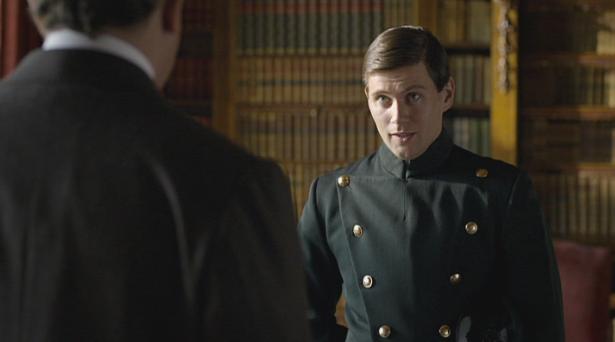
The Chauffeur: Allen Leech as Tom Branson, the chaffeur, demonstrates how very different Edwardian England is from Regency England. Carriages are being replaced by automobiles, but the infrastructure for maintaining cars is not yet in place. A chauffeur not only drove the family around, but he was also its mechanic, keeping the car in top shape, acquiring parts when they were needed, and making sure there was enough petrol on hand to satisfy the family’s needs. This chauffeur can also read and has been given permission by the earl to check books out of his library.

Downton Abbey 2010.

Thomas Howes as William, the Second Footman. Credit: Courtesy of © Carnival Film & Television Limited for MASTERPIECE

The Second Footman: (Thomas Howes) William’s position among the upper servants is low, for he must answer to the butler, housekeeper, and first footman. Young, fresh-faced, and just starting out, William misses his loving family. Yet service allows him to better himself and someday work his way up to the position of butler. One wonders if William will ever achieve that ambition, for times are changing and the aristocracy will be hard pressed to hang onto their lands and houses after the second world war.

Downton Abbey 2010.

Rose Leslie as Gwen, House Maid. Credit: Courtesy of © Carnival Film & Television Limited for MASTERPIECE

The House Maid: (Rose Leslie) Young Gwen is a housemaid with a goal – that of becoming a typist. Towards this end, she has been secretly taking typing courses. When her secret is uncovered the other servants are astounded – how could anyone prefer working in as some faceless office over service in a great house? Yet Gwen represents the future, in which political and socio-economic changes for women will end their dependency on the men of their family and force many to start fending for themselves.

Downton Abbey 2010.

Sophie McShera as Daisy, Kitchen Maid. Credit: Courtesy of © Carnival Film & Television Limited for MASTERPIECE

The Kitchen Maid: (Sophie McShera) Poor Daisy is at the bottom of the status ladder. Subject to the cook’s every whim (and to the housekeeper’s and anyone else who happens nearby) she goes about her duties cheerfully. When disaster strikes, Daisy not only steps in but demonstrates that she is more than ready to step up the servant hierarchy.

Downton Abbey will be shown Sunday night on your local PBS station starting at 9 p.m. Click here to view the video clips.

More about the series:

Read Full Post »

Jane is NOT amused

These past two weeks I have been anticipating Downton Abbey daily, getting ready for PBS’s presentation of the series, researching historical tidbits that will add to the reader’s enjoyment, and eagerly anticipating the U.S. audience’s reaction.

Then The Daily Mail (or The Daily Fail, as an astute reader called the tabloid) published an article, Downton Downsized, accusing PBS of cutting 2 hours from the original 8 hour U.K. presentation. Writer Chris Hastings not only pointed to the edits with glee, but accused PBS of dumbing down the series for American audiences. Hastings quoted PBS Executive Producer Rebecca Eaton as admitting “that American audiences demand a ‘different speed’ to their shows.”

The article was an insult to the American viewing audience, and PBS for that matter. It did not take into account that PBS shows no commercials (as ITV does), which means that the U.S. And U.K. Versions of Downton Abbey are practically the same length, even with minor editing. Neither did it acknowledge that PBS viewing audiences are sophisticated, patient, well-read, and well-traveled, as well as knowledgable about history and social customs in the U.K.

I watched the first two ITV episodes of Downton Abbey, to compare them to the so called edited PBS version. I saw so little difference, even with the discussion about inheritances and the British entail, that I wondered what this across-the-pond kerfuffle was all about.

When Sarah Crompton from The Telegraph, wrote her opinion about The Daily Fail’s article, she gave me hope that relations between U.S. and U.K. viewing audiences are still friendly and filled with mutual respect. Crompton wrote:

“Anyone who has read any of the novels of Edith Wharton will know that the statement from PBS executive producer Rebecca Eaton that “we thought there might be too many references to the entail… It is not a concept people in the US are very familiar with” is simply untrue. The difficulties of fortune and inheritance power whole tracts of American 19th-century fiction.”

Crompton goes on to say with confidence that educated American audience would have no trouble following Downton Abbey’s plot. She also found Eton’s statement extraordinary, mentioning The Wire and The Larry Sanders Show as two examples of intelligent, complex and creative television shows that originated in the U.S. and that our audiences have supported.

“This is, after all, the country that gave us The Wire, possibly the most complex series of plotlines ever devised. Are we really to think that US audiences understand drug-dealing in Baltimore any better than they grasp 19th-century legal shenanigans? Of course not. PBS is just being silly.

It is, ironically, the sophistication of the best of American television that I most admire.” – Sarah Crompton, The Telegraph, Americans Understand the Wire, So Why Simplify Downton Abbey for Them?

Insulted by The Daily Mail’s stance, I placed a poll about the edits on my regular Sunday Throwdown feature on Jane Austen Today, asking readers what they thought. The results of that poll demonstrate that PBS viewers do not want to watch a changed version of this British show or any British show for that matter. We feel confident that we can take the slow-pokey, esoteric passages as well as any Brit and not yawn half-way through or lose our way because we don’t understand British social customs or legalities.

The comments left by those who voted in the poll show that the PBS brass might be overreacting to our willingness to sit through exposition. I suspect that in talking about needing a faster-paced plot, Ms. Eaton was discussing the new viewers PBS is courting, but this is only a guess. Be that as it may, in their comments the poll voters expressed mostly their hurt from The Daily Mail’s view about American audiences and the nasty tone of the article. Here is a sampling:

If we Americans can watch 8 hours of Bleak House and Little Dorrit and love it, then we should be able to handle [Downton Abbey]. As for the plot being complicated, Americans flocked to “Inception” and loved it. No way “Downton Abbey” can be more complicated than that.

Rebecca Eaton should know that the attention span problem she refers to does not apply to “her” audience!

I’m very disappointed. Below the Daily Mail article sits a parody for American viewers to help us “understand” the series.

“…although it seems the beautifully nuanced portrait of pre-First World War upper-class life could prove just a little too complex for the trans­atlantic audience.” How insulting!

I am offended by anyone who would feel the American audience can’t support good drama.

I was weaned on Masterpiece Theatre and PBS and this pains me to see this reaction by Eaton. I have seen the UK version. It is not that complicated.

I am really hurt by this attitude! England means the world to me. How can they say Americans need these shows dumbed down?

This is typical ignorance on the part of the Brits. I say that as an American of much experience and relatives in UK. Annoyed as hell.

Don’t underestimate the size of the American audience who are longing for something other than arid, mindless TV fair geared to a 10 year old audience!!!

I think The Daily Mail article brought up two issues that raised hackles and confused readers, who assumed that PBS shared Chris Hastings’ disdain for the American viewing audience and that we require dumbed down versions of British T.V. shows in order to understand them. Since this mentality was shared by Joe Wright, who directed Pride and Prejudice 2005 and who offered an insulting “American” ending for U.S. audiences, no wonder we are baffled.

The second issue is one that many of us who adore PBS imports from Britain have noticed all too often recently. When purchasing the BBC (or ITV) and PBS versions of the same movies, PBS films are routinely shorter, with scenes that have been cut out. Why? These edited versions (sometimes only one or two scenes are missing) lend credence to Rebecca Eaton’s assessment that U.S. audiences demand a different pace. I would love for this PBS executive to explain her statement more fully, for I must admit that the differences between the first two episodes of ITV’s version of Downton Abbey and PBS’s first 100 minutes are so minor as to be barely noticeable. If this is the case, and if the change in pace is barely perceptible, and if Matthew Crawley still shows up in the first 90 minutes, why make the changes at all?

Other bloggers who have written about this controversy:

Read Full Post »

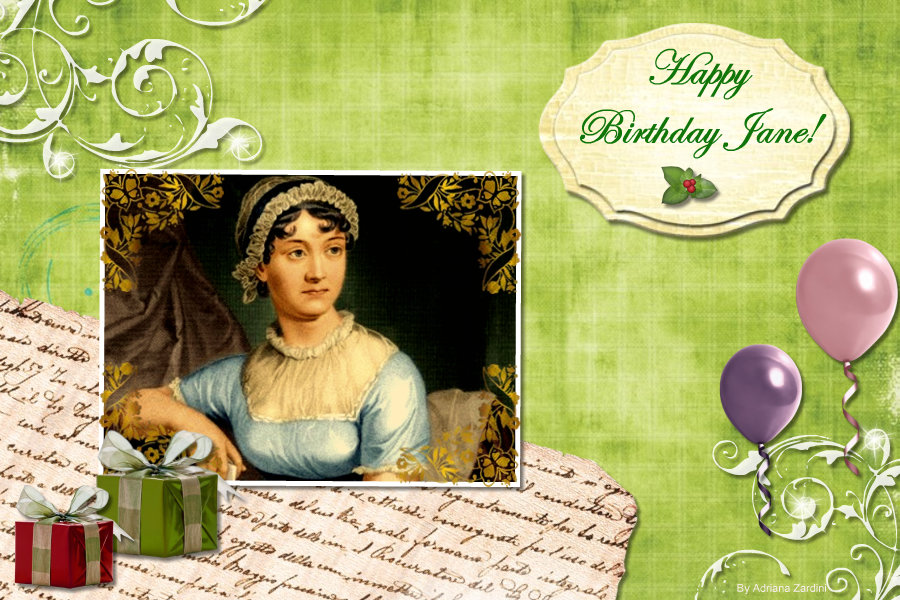
It wouldn’t be fair to neglect someone as important and dear to us as Jane Austen on her birthday. She was born on 16th December 1775, it’ll be 235 years next week . We owe so many immensely pleasant moments to her that we decided she deserved a great B-day celebration. My Jane Austen Book Club and other bloggers and Austen dedicated writers are going to have a blog party in her honour. You are all invited to join us on our “HAPPY BIRTHDAY, JANE!” event next Thursday December 16th. Who will be there? Where is the party going on?

My blog, Jane Austen’s World, will be joining in on the celebration with the post, Baby Jane Austen’s First Two Years! As well as these other fine authors and bloggers:

You’ll find Happy Birthday posts and tributes to Jane Austen on all these blogs on December 16th with the HAPPY BIRTHDAY, JANE logo created by Adriana Zardini (JASBRA) just for the occasion. Lovely, isn’t it? Visit all the blogs on December 16th and leave your comments + e-mail address to have lots of chances to win one of the wonderful gifts we are giving away:


The books include – 1 signed copy of…

  • Willoughby’s Return by Jane Odiwe
  • Confessions of a Jane Austen Addict by Laurie Viera Rigler
  • Rude Awakenings of a Jane Austen Addict by Laurie Viera Rigler
  • Murder at Mansfield Park by Lynn Shepherd
  • Intimations of Austen by Jane Greensmith
  • Darcy’s Passions: Fitzwilliam Darcy’s Story by Regina Jeffers
  • First Impressions. A Tale of Less Pride and Prejudice by Alexa Adams
  • Jane and the Damned by Janet Mullany
  • Bespelling Jane Austen by Janet Mullany

Other gifts:

  • Austen bag offered by Karen Wasylowski
  • DVD Pride & Prejudice 2005 offered by Regina Jeffers
  • Package of Bingley’s Tea. (flavor “Marianne’s Wild Abandon” ) offered by Cindy Jones
  • DVD Jane Austen in Manhattan offered by Maria Grazia
  • 3 issues of Jane Austen Regency World offered by Maria Grazia

Giveaways will end on December 23rd . Winners will be announced by Maria Grazia, organizer of this celebration, on My Jane Austen Book Club.

Read Full Post »

« Newer Posts - Older Posts »