This Jane Austen blog brings Jane Austen, her novels, and the Regency Period alive through food, dress, social customs, and other 19th C. historical details related to this topic.
Once again December has caught me flat footed. It is almost 10 days into the month and I am still researching interesting historical information about Christmas holiday celebrations as Jane Austen would have known them. While many books, articles, bloggers and internet sites cover this topic in detail, I hope to add a few interesting items that might not be widely known. I urge you to read Austenonly’s excellent article, “But Surely Christmas in England Didn’t Exist Until Dickens Invented It? “, which explains how and why this season was suppressed for years by the Puritans in the mid-17th century, when Charles I had been deposed and beheaded, and how our customs managed to survive and flourish.
As many of you know, Christmas celebrations as we know it in modern times (the decorative tree, a German custom, the elaborately wrapped presents, and the many traditional carols we still sing today) are rooted in Victorian times. So how did Jane Austen and her contemporaries celebrate this important Christian holiday? I hope to link to many articles of interest and provide a few insights of my own.
I learned with shock that many of my favorite carols, such as Silent Night and The First Noel, were written after Jane Austen’s death. I chose the following two 17th century carols (which Jane Austen might not have known, but which had been retrieved from obscurity in 1841 by Thomas Wright in Specimens of Old Christmas Carols ) because of the Boar’s Head motif, which has endured to this day. I love the old English spelling in these songs and yet their content speaks to the celebrations we still hold today.
A Carol bringyng in the bores heed.
Caput apm’ dgfero, Reddens laudes Domino.
[From a Collection of Christmas Carols, printed by Wynkyn de Worde, in 1521, from which book it is given by Hearne, in his notes to William of Newbery, iii. p. 17 5.]
The bores heed in hande bring I,
With garlands gay and rosemary;
I praye you all synge merely,
qui estis in convivio.
The bores heed, I understande,
Is the chefe servyce of this lande;
Loke where ever it be fande,
servite cum cantico.
Be gladde, lordes, bothe more and lasse,
For this hath ordeyned owr stewarde,
T o chere you all this Christmasse,
The bores heed with mustarde.
XIX. [The following modernised form of the foregoing carol, is given by Dr. Dibdin, as preserved and used up to a very recent period at Queen’s College, Oxford. Dibdin’s Ames, vol. ii. p. 252.]
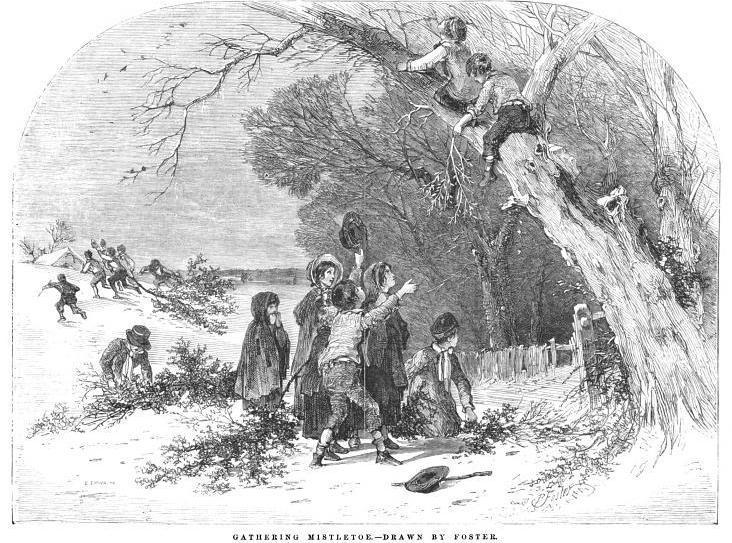
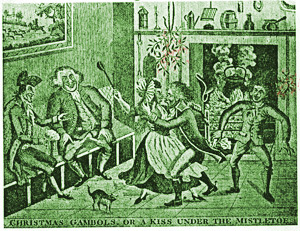
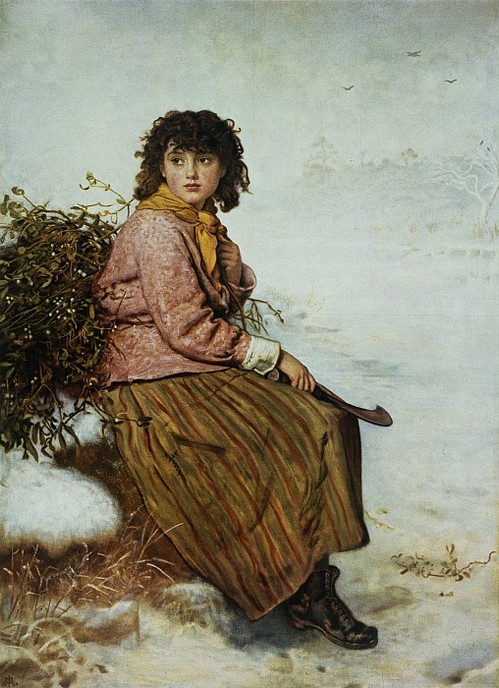
Dear Readers, Happy Holidays! If you happen to stand under a sprig of mistletoe (these days it is most likely artificial), you will probably hug or kiss the person standing nearest you. This tradition did not appear in English literature until the 18th century. The practice of gathering mistletoe began in the second century BC with the Druids in ancient Britain. They gathered the parasitic plant at the start of winter from the sacred oak as a symbol of hope, peace, and harmony. Sprigs were hung in homes to herald good fortune. The plants were also used for medicinal purposes to promote female fertility and as an antidote for poison. Today we associate mistletoe boughs with Christmas. Gathered on this page are a few quotes from various sources.
Illustrated London News, Dec 20, 1851
The Mistletoe Season
Down South for the past month all the boys and girls who want to earn money have been gathering mistletoe.
Weeks before the Christmas-time, these young people begin to hunt the woods for mistletoe. Having found it, they watch it growing. If they find that some one else watching the same bunch, they announce it is their mistletoe.
The mistletoe grows on the tree, but is no more a part of the tree than the moss with which Northern children are familiar, or vines that climb up the outside of the tree. The mistletoe grows high up in the tree and, if out on a slender branch, must be reached after with a stick and pulled off gently. Even then it is not out of danger, for the beauty is marred if the little plant falls to the ground. – New outlook, Volume 52, edited by Alfred Emanuel Smith, Francis Walton Outlook Publishing Company, Inc., U.S., 1895, p. 1146
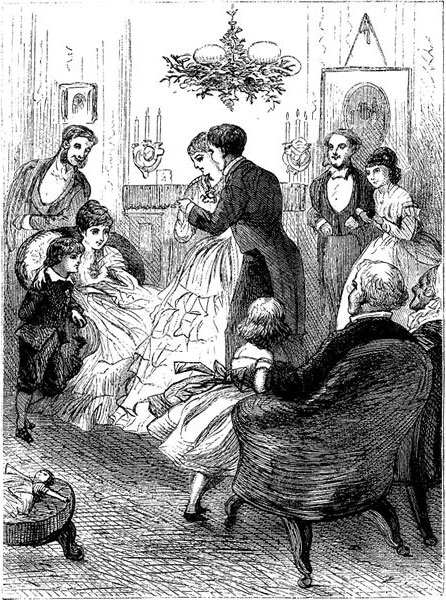
Mistletoe sprigs decorated chandeliers, doorways, and ceilings.
A ball of mistletoe, ornamented with ribbons, would be hung around Christmastime, and no unmarried girl could refuse a kiss if she was underneath it. At every kiss, the boy would pluck one of the mistletoe berries, and when there were no more berries, the ball was taken down until the next year. If a girl didn’t receive a mistletoe kiss by the time the ball was taken down, she couldn’t expect to marry in the following year. So the kiss could be a promise of marriage or a symbol of admiration, but it was also a kind of mystical fortune-telling trick. – Apartment Therapy – History of the Mistletoe
Gathering mistletoe in Nomandy
The best time for gathering mistletoe is in November after a few frosts have fallen and before the sap freezes, though it may be gathered and used at any period of the year. When gathered it should at once be spread out to dry as it will mould in a very short time if kept in a box or sack. It is best to dry it in the shade. – United States medical investigator, 1878, p 132.
Kiss under the mistletoe
Mistletoe grew in England and the United States. The common mistletoe of England grew on orchard trees and forest trees, and seldom on oak trees, which is why Druids revered it for its rarity. Mistletoe sapped the strength of apple trees in Brittany and Normandy. There it was gathered for the London market. The American mistletoe grows on deciduous trees, especially the tupelo poplar and red maple, from New Jersey, southern Indiana and east Kansas, to the Gulf. – The Standard reference work: for the home, school and library, Volume 5, edited by Harold Melvin Stanford Standard Education Society, 1921
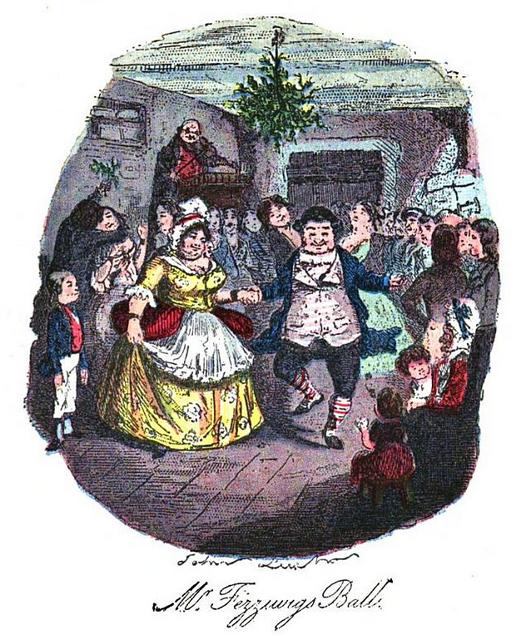
Mr Fezziwig's ball, John Leech, A Christmas Carol by Dickens
By the Victorian era, there was scarcely a house or cottage that did not have mistletoe at Christmas time.
Happy Christmas Eve and Merry Christmas, everyone! I leave you with this post about Plum Pudding as I celebrate the occasion with my favorite people in all the world – my family. May this season be a truly special one for you. And thank you for visiting Jane Austen’s World.
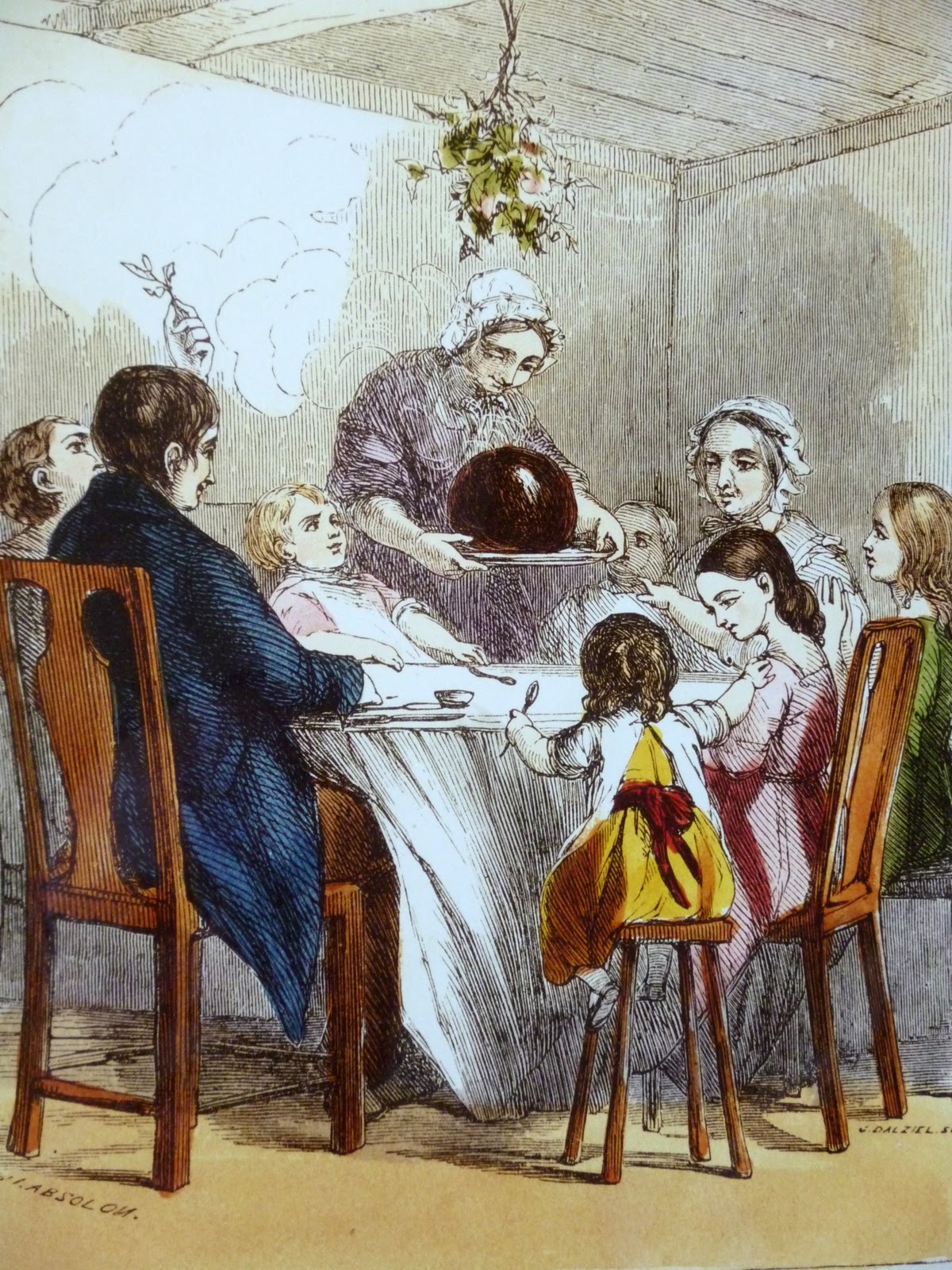
In half a minute Mrs. Cratchit entered — flushed, but smiling proudly — with the pudding, like a speckled cannon-ball, so hard and firm, blazing in half of half-a-quartern of ignited brandy, and bedight with Christmas holly stuck into the top. – Charles Dickens, A Christmas Carol
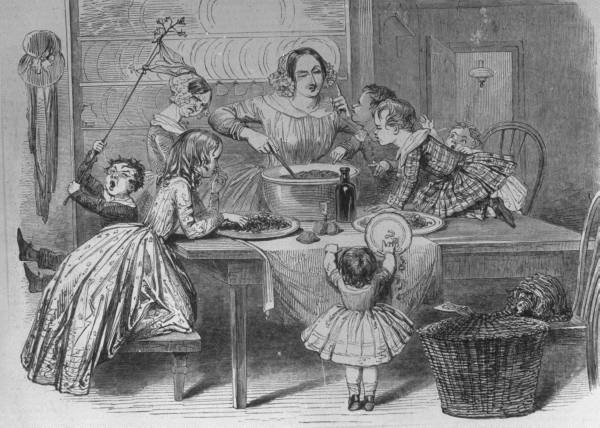
Stir-Up Day is the name traditionally given to the day on which Christmas puddings are made in England.
Banned by the Puritans in the 1660s for its rich ingredients, the [plum] pudding and its customs came back into popularity during the reign of George I. Known sometimes as the Pudding King, George I requested that plum pudding be served as part of his royal feast when he celebrated his first Christmas in England after arriving from Hanover to take the throne in 1714. By 1740, a recipe for ‘plum porridge’ appeared in Christmas Entertainments. In the Victorian era, Christmas annuals, magazines, and cookbooks celebrated the sanctity of family as much as the sanctity of Jesus’ birth, and the tradition of all family members stirring the pudding was often referenced…Poorer families made the riches version of plum pudding that they could afford…Even workhouse inmates anticipated a plum pudding on Christmas Day.” – Food and Cooking in Victorian England: A History, Andrea Broomfield [Praeger:Westport CT] 2007 (p. 150-151)
Stir-Up Sunday, the last Sunday before Advent, is considered the final day on which one can make the Christmas fruit cakes and puddings that require time to be aged before being served.
The Christmas pudding is traditionally “stirred up” on Stir-Up day day. All family members must take a hand in the stirring, and a special wooden spoon (in honor of Christ’s crib) is used. The stirring must be in a clockwise direction, with eyes shut, while making a secret wish. Source: The Customs and Ceremonies of Britain by Charles Knightly. London:Thames and Hudson, 1986, p. 211.”
—The Folklore of World Holidays, Robert H. Griffen and Ann H. Shurgin editors, Second Edition [Gale:Detroit] 1998 (p. 679)
Stirring the Christmas pudding. Image@LIFE magazine
In past times the words “stir up”…reminded people to begin preparing their Christmas puddings…Children chanted a rhymed verse on that day that mixed the words of the collect with requests for special Christmas fare…Thus, the preparation of the Christmas pudding eventually became associated with this day. Folk beliefs advised each member to take a turn stirring the pudding, and ace that was believed to confer good luck. Another custom encouraged stirrers to move the spoon in clockwise motion, close their eyes, and make a wish.” – Encyclopedia of Christmas and New Year’s Celebrations, Tanya Gulevich, 2nd edition [Omnigraphics:Detroit] 2003 (p. 741)
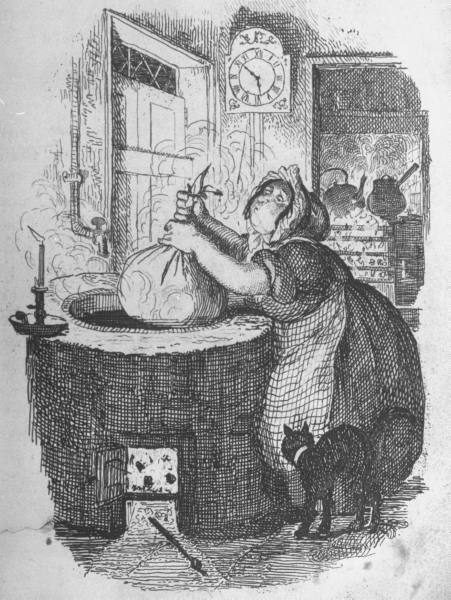
Cook making Christmas pudding, Cruikshank
Hallo! A great deal of steam! The pudding was out of the copper. A smell like a washing-day! That was the cloth. A smell like an eating-house and a pastrycook’s next door to each other, with a laundress’s next door to that! That was the pudding!- Charles Dickens, A Christmas Carol
A boiled Plum Pudding – Hannah Glasse (18th century recipe)
TAKE a pound of suet cut in little pieces not too fine a pound of currants and a pound of raifins storied eight eggs half the whites half a nutmeg grated and a tea spoonful of beaten ginger a pound of flour a pint of milk beat the eggs first then half the milk beat them together and by degrees stir in the flour then the suet spice and fruit and as much milk as will mix it well together very thick Boil it five hours – Hannah Glasse, The Art of Cookery made plain and easy, p. 137
Rich Plum Pudding Recipe, Lady Godey’s Book, December 1860
Stone carefully one pound of the best raisins, wash and pick one pound of currants, chop very small one pound of fresh beef suet, blanch and chop small or pound two ounces of sweet almonds and one ounce of bitter ones; mix the whole well together, with one pound of sifted flour, and the same weight of crumb of bread soaked in milk, then squeezed dry and stirred with a spoon until reduced to a mash, before it is mixed with the flour.
Cut in small pieces two ounces each of preserved citron, orange, and lemon-peel, and add a quarter of an ounce of mixed spice; quarter of a pound of moist sugar should be put into a basin, with eight eggs, and well beaten together with a three-pronged fork; stir this with the pudding, and make it of a proper consistence with milk. Remember that it must not be made too thin, or the fruit will sink to the bottom, but be made to the consistence of good thick batter.
Taking up the Christmas pudding
Two wineglassfuls of brandy should be poured over the fruit and spice, mixed together in a basin, and allowed to stand three or four hours before the pudding is made, stirring them occasionally. It must be tied in a cloth, and will take five hours of constant boiling.
Carrying the plum pudding
When done, turn it out on a dish, sift loaf-sugar over the top, and serve it with wine-sauce in a boat, and some poured round the pudding. The pudding will be of considerable size, but half the quantity of materials, used in the same proportion, will be equally good.
Presenting the plum pudding
The following articles about plum pudding were published in 19th century periodicals and in a more recent blog:
Colonel Hazard’s Plum Pudding (In which the Colonel proves that plum pudding has impressive staying power.)
Colonel Rowland R. Hazard of electric railroad fame tells a story which gives the plum pudding a new dignity. Several years ago, the colonel suddenly decided to run over to England to make a holiday call on relatives there. It was a few days before Christmas, and just as the colonel was starting for the steamer, a Christmas package arrived for him. He had no time to examine it then, and left orders to have it kept for him. He did not return to New York for two year.s When he did get back, the package was brought down from the garret. It proved to contain a plum pudding that his English friends had sent him. It was as hard as a rock, but Colonel Hazard ordered it to be cooked, and he declares he never tasted a more perfect plum pudding in his life. He is inclined to think that good plum pudding, like the wheat found in the old Egyptian mummy cases, would keep all right for a thousand years. – New York Commercial Advertiser – Good Housekeeping, Vol 5, Hearst Corp, 1887
Plum Pudding
The secret of making plum pudding light and digestible lies in properly preparing the suet, mincing the currants, and boiling a sufficient time. Puddings made with breadcrumbs are lighter than those made wholly of flour; and a mixture of the two makes the best pudding. Plum puddings may be made some time before Christmas, and, having been boiled, the cloth must be opened out, but not taken off the pudding, and dried. Wrapped in paper, and stored in a dry place, puddings will keep good for several months, and only require to be boiled for an hour at the time of serving. – Household Words, A weekly journal, vol 2, 1882. Charles Dickens
Plum pudding is well known for the silver coins and small objects hidden within the pudding to be found by the eater. Common objects were the silver coin for wealth, a tiny wishbone for good luck, a silver thimble for thrift, a ring for marriage or an anchor for safe harbor. These items have migrated from plum pudding to bridal shower cakes, oddly enough…- Gram’s Recipe Box, Plum Pudding
Fact: Queen Charlotte introduced the Christmas tree to England. Recently I read in Yahoo answers.com that the Christmas tree was introduced to England by Prince Albert, Queen Victoria’s consort. The majority of the readers had “voted” that this must be so. Wrong. While he and Queen Victoria popularized the custom, they did not start the tradition.
In 1800, Queen Charlotte, the German-born wife of King George III and mother of the Prince Regent, placed a decorated yew tree in Queen’s Lodge, Windsor for the children of leading families. She had also arranged a ‘pyramid of toys upon the table’ to hand out as gifts. Dr. John Watkins, the Queen’s biographer, wrote the following description:
In the middle of the room stood an immense tub with a yew tree placed in it, from the branches of which hung bunches of sweetmeats, almonds, and raisins in papers, fruits and toys, most tastefully arranged, and the whole illuminated by small wax candles. After the company had walked around and admired the tree, each child obtained a portion of the sweets which it bore together with a toy and then all returned home, quite delighted. – Windsor Castle and the Christmas Tree
A fir tree, about as high again as any of us, lighted all over with small tapers, several little wax dolls among the branches in different places, and strings of almonds and raisins alternately tied from one to the other, with skipping ropes for the boys, and each bigger girl had muslin for a frock, a muslin handkerchief, and a fan, and a sash, all prettily done up in a handkerchief, and a pretty necklace and earrings besides.
More about Christmas traditions during the regency era:
This illustration was made over 80 years after Jane Austen died, but there’s a “Regency feeling” about the dresses, hairstyles, and interior. Read more about Christmas of old in these links, and in the post below.
Fashionable Goodness: Christianity in Jane Austen's England is now available! By JAW contributor Brenda S. Cox. See Review. Available from Amazon and Jane Austen Books.
Available through December 31st, 2025. Click on image for details, and share this poster with other teachers and students!
The Obituary of Charlotte Collins by Andrew Capes
Click on image to read the story.
Comments
“My idea of good company…is the company of clever, well-informed people, who have a great deal of conversation.” – Jane Austen, Persuasion
Gentle readers: Please feel free to post your comments and continue the conversation! Due to SPAM, we will no longer accept comments on posts after 30 days of publication. In some instances, links will be removed from comments as well.
Administrators and Contributors
Vic Sanborn, founder of this blog, is supported by a team of talented and knowledgeable writers about Jane Austen and the Regency era. They are:
Tony Grant, who now contributes his photos from London and England
Click on their names to enter their own blogs.
In addition, we thank the many experts and authors who frequently contribute their posts and opinions, and who continue to do so freely or at our request.
Click here to enter the page. Topics include Regency fashion, historic foods, Jane Austen societies, British sites, related topics. Click on image.
May we suggest?
Hello, my name is Vic and I live in Maryland, USA. I have adored Jane Austen almost all of my life. I am a proud lifetime member of the Jane Austen Society of North America. This blog is a personal blog written and edited by me and my team. We do not accept any form of cash advertising, sponsorship, or paid topic insertions. However, we do accept and keep books and CDs to review.
If you would like to share a new site, or point out an error, please email us. (Yes, we are fallible. We'll own up to our mistakes and will make the corrections with a polite smile on our faces.) Write us at
Thank you for visiting this blog. Your comments and suggestions are most welcome.
Project Gutenberg: eBook of Stage-coach and Mail in Days of Yore, Volume 2 (of 2), by Charles G. Harper
STAGE-COACH AND MAIL IN DAYS OF YORE: A PICTURESQUE HISTORY
OF THE COACHING AGE, VOL. II, By CHARLES G. HARPER. 1903. Click on this link.
 Once again December has caught me flat footed. It is almost 10 days into the month and I am still researching interesting historical information about Christmas holiday celebrations as Jane Austen would have known them. While many books, articles, bloggers and internet sites cover this topic in detail, I hope to add a few interesting items that might not be widely known. I urge you to read Austenonly’s excellent article, “But Surely Christmas in England Didn’t Exist Until Dickens Invented It? “, which explains how and why this season was suppressed for years by the Puritans in the mid-17th century, when Charles I had been deposed and beheaded, and how our customs managed to survive and flourish.





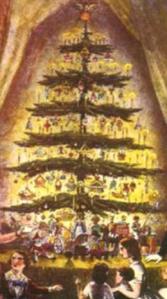 Fact: Queen Charlotte introduced the Christmas tree to England. Recently I read in Yahoo answers.com that the Christmas tree was introduced to England by Prince Albert, Queen Victoria’s consort. The majority of the readers had “voted” that this must be so. Wrong. While he and Queen Victoria popularized the custom, they did not start the tradition.







 Jane Austen's World