Feeds:
Posts
Comments

Archive for the ‘Regency Customs’ Category

Two generations gone—gone in a moment! I have felt for myself, but I have also felt for the prince regent. My Charlotte is gone from the country—it has lost her. She was a good, she was an admirable woman. None could know my Charlotte as I did know her. It was my study, my duty, to know her character, but it was also my delight. – Prince Leopold to Sir Thomas Lawrence after the death of his wife.
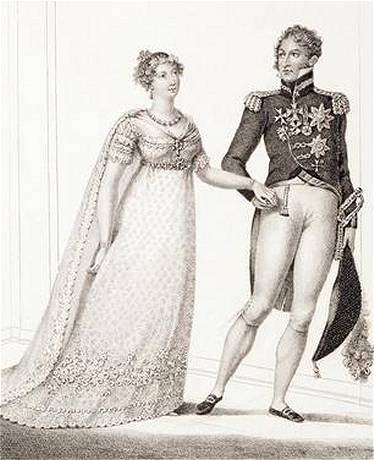
Princess Charlotte and Prince Leopold at their Wedding

Princess Charlotte and Prince Leopold at their Wedding

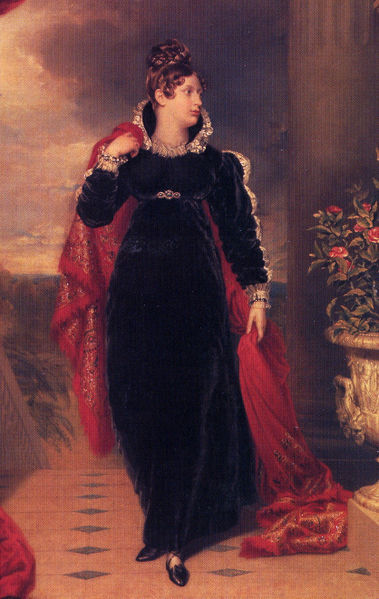
Princess Charlotte’s death after giving birth to a still-born son on November 5, 1817 elicited a national outpouring of grief that was unprecedented in Britain, and her funeral drew massive mourning crowds on a scale similar to those who thronged to Princess Diana’s funeral in 1997. In stark contrast to her father, the Prince Regent, who was universally despised, the young princess was extremely popular, and her pregnancy was closely followed by an enthusiastic public. Charlotte, the only child of George, Prince of Wales (later Prince Regent and George IV) by his wife Caroline of Brunswick, had been married a mere seventeen months before to Prince Leopold of Saxe-Coburg-Gotha amid pomp and splendor. A dutiful young Regency wife, she became pregnant almost immediately, but suffered two miscarriages before carrying her third child to full term. Though her grandfather, George III, had 7 sons and 5 daughters, Charlotte was the only legitimate grandchild. Thus this pregnancy was a truly significant one.

Charlotte  began her pregnancy as a healthy and robust young woman, but after months of blood-letting and a strict diet, an accepted medical practice prescribed by her physician, Sir Richard Croft, she grew feeble. Her death after her tortuous two-day, 50-hour labor would precipitate a new age in medicine,
Princess Charlotte

Princess Charlotte

ending arch-conservatism in obstetrics. At the time that Princess Charlotte gave birth there were two schools of medical thought in delivering a baby: intervention and non-intervention. During the previous century, anatomical knowledge about the birth process increased. Henrick Van Deventer showed that the female pelvis was unyielding during labor, and forceps were introduced. Intervention during labor was still crude, largely consisting of extracting the baby with forceps during a breech birth in order to save the mother’s life. A cesarean section, which might have saved the baby, would surely have resulted in Princess Charlotte’s death.

Princess Charlotte’s physician had married the daughter of a prominent physician who had trained him and who belonged to the non-intervention school of obstetrics. On the evening of November 3, the Princess’s water broke. Although Dr. Croft had accurately diagnosed a breech birth, he decided not to use forceps during the first stage of labor. He also did not administer pain killers. Prince Leopold was so concerned about his wife’s labor that he rarely left her side.

Throughout the Princess’s labour, Royal Physicians, courtiers and ladies-in-waiting had been in constant attendance. The Archbishop of Canterbury and the Home Secretary waited in a downstairs room, while her husband, Prince Leopold, was often at her side. The first stage of her labour, lasting 26 hours, was characterised by inefficient contractions of the uterus – there was very slow progress towards the full dilatation, or opening up, of the cervix that is an essential step in natural birth. The second stage of labour, that part involving the actual pushing of the baby out into the world, which at the beginning of the 21st century we believe should be accomplished in two or three hours, dragged on for twenty-four. The attending doctors were concerned by the appearance of meconium, the dark green bowel contents of the newborn – meconium detected in the course of labour suggests that the infant is becoming distressed. And indeed the child, a boy, was stillborn. Following the birth there was a brisk haemorrhage which undoubtedly contributed to the Princess’s demise. Despite the best efforts of the galaxy of medical talent gathered at Charlotte’s bedside, the royal line could not be secured. So depressed by the tragic event was the Royal Physician Sir Richard Croft that he later committed suicide. – De Costa
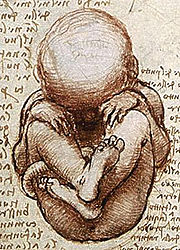
leonardo-fetus-in-wombAfter 50 hours, Princess Charlotte delivered a stillborn 9-pound son. His head had been in a sideways position and was too large for her pelvis. After the delivery Charlotte seemed to do well at first, and she was even given some port wine to drink after two days without food (she mentioned later that the alcohol made her tipsy), but after several hours she became restless, had difficulty breathing, and her pulse became rapid and feeble. She developed malaise and weakness, followed by somnolence then agitation, with progressive worsening and death. Five and half hours after her delivery she died from post partum haemorrhage and shock. Three months after this event, Sir Richard Croft committed suicide, unable to live with the resulting criticism and the knowledge that he had been responsible for the two deaths. Later it was concluded that:

Physicians attending her had failed to act with effective means at their disposal, hastening her demise. In the aftermath of this widely publicized tragedy, “rational intervention” — best represented in the work of Davis — gained force once again. This development included the use of ergot (to stimulate uterine contraction during labor and for expulsion of the placenta), experimentation with blood transfusion, and the introduction of anesthesia for obstetrics by Simpson, all intended to make birth safer, as well as less painful. – Obstetric Literature and the Changing Character of Childbirth

For my other post about medicine in this era, click on: The Physician in the 19th Century

For more information about this triple tragedy and about the Princess, click on the links below:

Read Full Post »

The orange wine will want our care soon. But in the meantime, for elegance and ease and luxury, the Hattons and Milles’ dine here to-day, and I shall eat ice and drink French wine, and be above vulgar economy. Luckily the pleasures of friendship, of unreserved conversation, of similarity of taste and opinions, will make good amends for orange wine.- Jane Austen to Cassandra, Godmersham, June 20, 1808

Icehouse, Bedale Park

Icehouse, Bedale Park

Jane wrote casually of eating ice in a day when the preservation of huge chunks of river and pond ice was no mean feat. Solid blocks of ice were hewn from nearby frozen ponds and rivers in winter, then hauled by teams of horses and men to a suitable storage space. Ships also brought in chunks of ice from glaciers and icebergs.

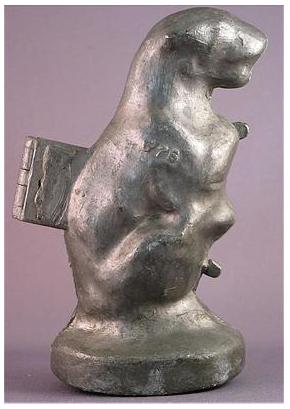
In early days, deep underground chambers whose doors faced north kept the temperatures freezing inside their heavily insulated structures, preserving the ice for up to two years.  By the 17th and 18th centuries, owners of great houses built icehouses adjacent to their dwellings. These storage spaces had double insulated walls and double doors that kept the warm air out. The cold chambers also kept water, milk, butter, and other perishables refrigerated.  Iced food remained the province of the rich, who could afford to build an ice house and pay servants who shaved the ice and prepared ices, ice sculptures, bombes, and ice cream. Experiments in flavors and designs abounded:

Squirrel ice cream mold, ruby lane antiques

Squirrel ice cream mold, ruby lane antiques

In the late 17th and early 18th century, long before refrigeration was available, Europeans were making ices and ice creams. Although they were often unsure about freezing techniques, they began experimenting with flavors immediately. Confectioners tried everything from breadcrumbs to grated cheese to candied orange flowers in these new frozen treats. They molded them into fanciful shapes and served them with style and flair. Once in a while, they stumbled – putting foie gras or puréed asparagus in ice cream, for example – but most of their experiments were successful. They led the way to the wonderful range of flavors we enjoy today. (Histories, Legends, and Myths of Ices and Ice Cream)

The great chefs were especially creative in the use of ice for preserving food, and making exotic foods. In a day before electricity, intricately carved ice sculptures of swans and cherubs and the like were all the rage in Europe. The great French chef Antonin Careme used iced water to make his spun sugar sculptures and kept desserts on ice and the pastry room cool to keep the unbaked pastries cool. (Crème du Carême)

Recipes for creating ices and ice cream haven’t changed much, but the methods have. By the mid 19th century small portable iceboxes and an ice cream maker had been invented, replacing laborious hand stirring with a handcrank until the mixture thickened. The following is an 18th-century ice cream recipe that illustrates how labor intensive and time consuming ice cream making had once been:

English ice cream pail, Derby 1790

English ice cream pail, Derby 1790. Image from Historic Foods.

Pare, stone and scald twelve ripe Apricots, beat them fine in a Marble Mortar, put to them six Ounces of double refined Sugar, a Pint of scalding Cream, work it through a Hair Sieve, put it into a Tin that has a close Cover, set it in a Tub of Ice broken small, and a large Quantity of Salt put amongst it, when you see your Cream grow thick round the Edges of your Tin, stir it and set it in again ’till it all grows quite thick, when your Cream is all Froze up, take it out of your Tin, and put it in the Mould you intend it to be turned out of, then put on the Lid, and have ready another Tub with Ice and Salt in as before, put your Mould in the Middle, and lay your Ice under and over it, let it stand four or five Hours, dip your Tin in warm Water when you turn it out; if it be Summer, you must not turn it out ’till the Moment you want it; you may use any Sort of Fruit if you have not Apricots, only observe to work it fine. – Ice cream recipe from The Experienced English Housekeeper by Elizabeth Raffald, 1769,  page 228:

  • Georgian Ices and Victorian Bombes is another informative post from Historic Food, one of the most interesting and historical food sites on the web. In it you will find a wealth of illustrations, photos, and information about making ice cream.
  • Lemon Ice: The Jane Austen Centre published a recipe for making lemon ice similar to one made in the 18th century. The article adds additional information about the origins of ice cream.
  • Ice Cream and Chocolate Parlor since 1700 describes an Italian ice cream parlor that has been in existence for over 300 years. Their specialty is an almond ice cream that is probably as easy to make and flavorful as the one below.
  • Histories, Legends, and Myths of Ices and Ice Cream provides a timeline and interesting tidbits of information about ices and ice cream over the ages.
Almond ice cream

Almond ice cream

Read Full Post »

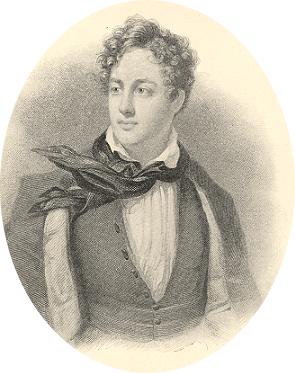
John Clubbe, the author of ‘Bend it Like Byron: The Sartorial Sublime’, an 18-page PDF document published by Erudit, starts off with some interesting insights about Beau Brummell, Lord Byron, and Napoleon Bonaparte, linking them sartorially during their time and with later dandies, like David Beckham:

Byron

Byron

Byron liked being linked with Brummell and Napoleon. In fact, along with Hazlitt and Thackeray he made the association himself. He told Brummell he regarded him “as one of the great men of the nineteenth century.” Evaluating his contemporaries, he placed “himself third, Napoleon second, and Brummell first.” The ranking would have pleased Brummell, but so generous an estimate by Byron of Brummell’s greatness — what can he mean? I have come to think Byron astonishingly prescient. He and Napoleon play leading roles in the Romantic Sublime, but if we ponder what I delight in calling the Sartorial Sublime we discover that Byron gauged well the contemporary fame — and even presaged the future significance — of George Bryan (“Beau”) Brummell.

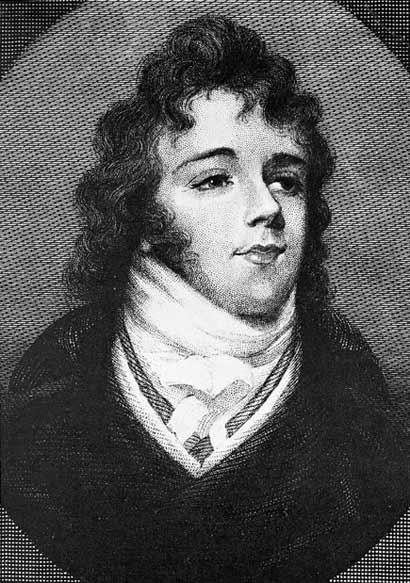
Beau Brummell

Beau Brummell

While Brummell’s fame as a dandy is still widely known, many have forgotten Lord Byron’s obsession with dress and with the dandy’s attitude of studied boredom, indifference and disdain. His calculated approach to language and style placed him squarely in the pantheon of dandies.  J. B. Priestey wrote about dandyism, saying: “In its indifference to serious matters and its intense focus upon trivia, Regency dandyism was a half-defiant, half humorous way of life. There was in it a good deal of poker-faced impudence.” (The Prince of Pleasure and the Regency.) As Mr. Clubbe writes, “Brummell did not concern himself with vulgar politics or economic matters.” This attitude, along with his fastidiousness and obsession with detail in dress, set him apart from other men and drew the Prince Regent’s admiration.

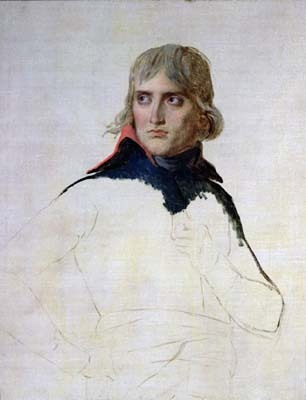
Bonaparte, unfinished portrait by Jacques Louis David

Bonaparte, unfinished portrait by Jacques Louis David

According to Clubbe, Napoleon Bonaparte shrewdly used clothes and dress to stage his ambitions.  His private secretary wrote that the general was always impeccably dressed, even when marching. While Bonaparte was instantly recognizable by the simplicity of his attire, his use of clothes in ceremonial state of affairs was another matter. Bonaparte’s garments  of robes and ermine could “rival in opulent grandeur those of the Sun King himself.”

Dandyism in its varying forms survives intact today. Clubbe links David Beckham’s modern forays into fashion with Brummell’s, but that he has yet to achieve that seemingly effortless style and attitude towards fashion. This article is well worth reading for its insights and information. (See link below.) In addition I added more links about Beau Brummell and dandies of his age, and highly recommend a visit to Dandyism.net, which I regard the premier dandy web site.

Bend it Like Byron: The Sartorial Sublime of Byron, Bonaparte, and Brummel, With Glances at Their Modern Progeny, John Clubbe, Erudit, 2005.

More links about dandies:

Read Full Post »

The General between his cocoa and his newspaper, had luckily no leisure for noticing her… Jane Austen, Northanger Abbey

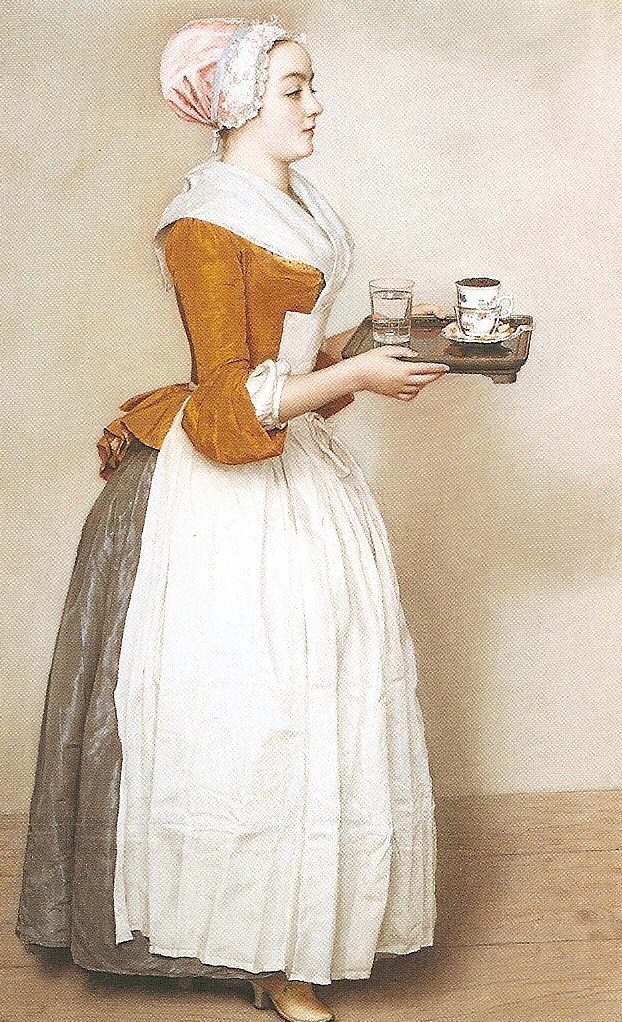
Detail, Chocolate Maid, Jean-Etienne Liotard, 1744-45

Detail, Chocolate Maid, Jean-Etienne Liotard, 1744-45

When sixteenth-century explorers brought cocoa beans from Mexico to Seville in 1585, little did they realize how much their exotic taste would appeal to European palates. Or perhaps they did. At that time hot chocolate was flavored with a mix of peppers and spices.

The first recipe for a chocolate drink was published in Spain in 1644 by Antonio Colmenero de Ledesma in his book, A Curious Treatise of the Nature and Quality of Chocolate. The spices included hot chiles, and the recipe goes as follows:

  • 100 cacao beans
  • 2 chiles (black pepper may be substituted)
  • A handful of anise
  • “Ear flower”  *
  • 1 vanilla pod
  • 2 ounces cinnamon
  • 12 almonds or hazelnuts
  • pound sugar
  • Achiote (annatto seeds) to taste –
  • All of these ingredients were boiled together and then frothed with a molinillo, the traditional Aztec carved wooden tool. The achiote was used to redden the color of the drink.From Chiles and Chocolate

    *Also known as “xochinacaztli” (Nahuatl) or “orejuela” (Spanish).

    “Chiles and Chocolate” goes on to provide another chocolate recipe published in France 50 years later. This one has significantly reduced the amount of chili peppers. The recipe was published in 1692 by M. St. Disdier of France, who was in the chocolate business:

  • 2 pounds prepared cacao
  • 1 pound fine sugar
  • 1/3 ounce cinnamon
  • 1/24 ounce powdered cloves
  • 1/24 ounce Indian pepper (chile)
  • 1 1/4 ounce vanilla
  • A paste was made of these dried ingredients on a heated stone and then it was boiled to make hot chocolate.

    The primary difference between hot cocoa and hot chocolate today is that hot cocoa is made with cocoa powder, which lacks the fat of cocoa butter. Hot chocolate is made from melted chocolate bars mixed with cream.

    According to Khodorowsky and Robert: “The vogue for drinking chocolate, already established in Spain, reached the British Isles thanks to a Frenchman, who in 1657 opened the first chocolate factory in London. Unlike in France, where it was a pleasure strictly limited to the aristocracy, this ‘excellent West Indian drink’ was made available to the middle classes from the outset. Soon, alongside the coffee houses which made their appearance from 1652, there opened the first chocolate houses. London was also the setting, in 1674, for a historic invention: solid chocolate, presented in the form of ‘Spanish rolls’ or pastilles, and sold by the Coffee Mill and Tobacco Roll shop.” – The Gates of Vienna: The History of Cacao and Chocolate

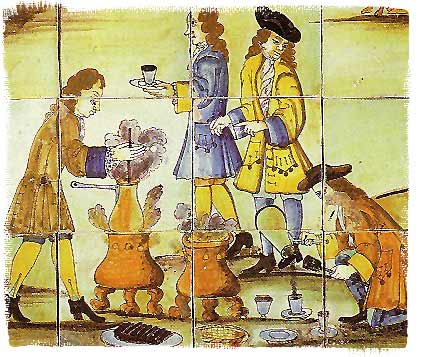
    Spanish, ceramic tiles, making chocolate

    Spanish, ceramic tiles, The laborious process of making chocolate

    After 1700 chiles disappeared as a major ingredient in chocolate drinks, although they were still used in traditional Mexican mole sauces. In Sweetness and Power: The Place of Sugar in Modern History, Sidney Mintz offers a plausible explanation for the replacement of sugar for chiles:

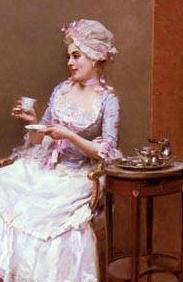
    Raimundo Madrazo, Hot Chocolate, mid-18th Century

    Raimundo Madrazo, Hot Chocolate, mid-18th Century

    The seemingly unquenchable desire for sugar in the modern world is not simply the outcome of the tongue’s biologically based affinity for sweetness, but rather the historical result of a conjuncture of factors. As Mintz traces sugar’s transformation from a medicinal additive to a luxury good among the upper classes, he argues that sugar “embodied the social position of the wealthy and powerful.” He points to “sugar’s usefulness as a mark of rank—to validate one’s social position. To elevate others, or to define them as inferior.” Sugar use traveled down to other classes in large part because their members accepted the meanings of their social superiors: “those who controlled the society held a commanding position not only in regard to the availability of sugar, but also in regard to at least some of the meanings that sugar products acquired … the simultaneous control of both the foods themselves and the meanings they are made to connote can be a means of a pacific domination.” – Tasting Empire: Chocolate – History cooperative

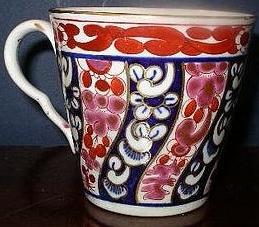
    English worcester porcelain chocolate cup, 1800

    English worcester porcelain chocolate cup, 1800

    During the 18th century, techniques were invented to improve the grinding of cocoa beans and by the end of that century chocolate was prepared with milk and sugar. It wasn’t until the 19th century that chocolate was molded into shapes and eaten as solid bars.

    Even with the new grinding mills, the process of making chocolate remained laborious. Jim Gay, who makes chocolate in Colonial Williamsburg, explained in an article for American Heritage Chocolate:

    The chocolate production process [he] follows involves “roasting cocoa beans, shelling them, crushing them in a large mixing bowl and transferring them to a heated grinding stone. Using an iron rolling pin, the cocoa beans are ground into a liquid and sugar and spices are added.”  Gay explained that 18th-century chocolate “isn’t something you’re used to.” Its less sweet than modern chocolate and grittier because its impossible to grind the particles that finely using hand-made processes. Gay also said that “each month [the chocolate] has a slightly different texture and flavor; the flavor profiles always [change].” – http://www.dogstreetjournal.com/story/3152

    untitled

    Chocolate beans ground into powder

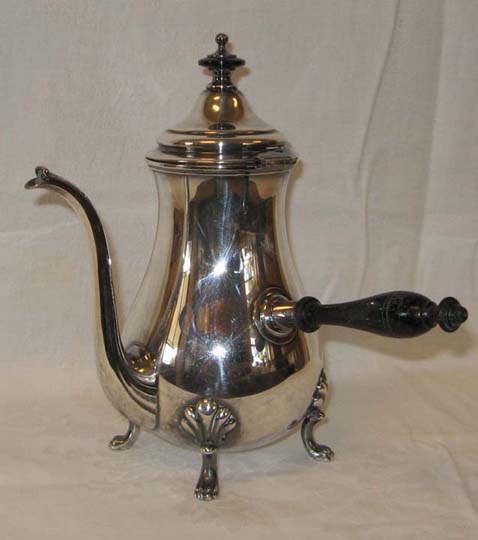
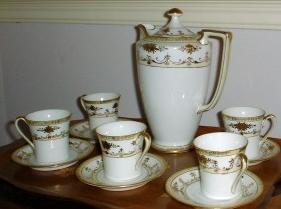
    The craze for drinking tea, chocolate, and coffee during this period resulted in an increased demand for porcelain and ceramic tea sets, chocolate pots, and coffee mugs. In response to public demand porcelain manufactures began to make specialized vessels that reflected the unique requirements that each beverage demanded in brewing and presentation, and which led to instantly identifiable tea, chocolate, andd coffee set. Coffee pots were generally taller and slimmer than short round tea pots, which were designed to keep boiling water hot. As in the image below, spouts were placed low on the body of small chocolate pots, which also sported a straight handle.

    In comparison to chocolate pots, coffee pot spouts were long and sometimes arched, while the chocolate pot spout was fairly short (see image below). The inside of a coffee pot spout typically had a filter, or small partition with holes that kept the grounds from getting into the cup. A chocolate pot was made with a hinged finial that allowed for the insertion of a swizzle stick for stirring the hot chocolate. To prevent their loss, some of these finials were attached to the pot with a silver chain.

    Due to the complexity of making the beverage, chocolate never attained the same popularity as coffee. By the latter part of the 18th century coffee houses had sprung up by the hundreds in London, and although the craze for chocolate had largely gone out of fashion by 1750, one of the most famous chocolate houses, White’s, still leaves a lasting impression:

    The fame of St. James’s Street rests mainly upon its association with the coffee or chocolate houses and clubs which for some two and a half centuries have made it and Pall Mall the social rendezvous of masculine aristocratic society in London. This association dates back to the reign of William III, and more particularly to the fire of January 1697/8 which ravaged the Palace of Whitehall and resulted in the removal of the Court to St. James’s. Only two chocolate houses- White’s (1693) and Ozinda’s (1694)-are known to have been in existence in St. James’s Street and Pall Mall before the fire, but the succeeding years saw the establishment of the Cocoa Tree (1698), the Smyrna (1702), the Thatched House Tavern (1704 or 1705) and the St. James’s Coffee House (1705), all catering for the new client created in the neighbourhood by the presence of the Court of St. James.- Jermyn Street Asscociation

    Noritake chocolate set

    Noritake chocolate set

    More links on the topic:

    Read Full Post »

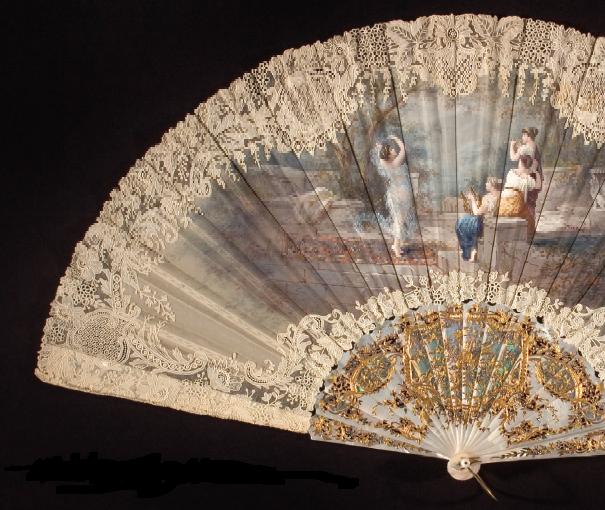
    When one thinks of a fashionably attired Regency lady, one also thinks of the lovely fan she most likely carried. These graceful objects were first used for cooling, but during the 19th century they became an indispensable fashion accessory. Flirtations were carried on with fans, which hid blushing cheeks or communicated a specific message. (Click on ‘The Language of the Fan’ post below)

    In the eighteenth century, wealthy Georgian ladies, especially English ones, waved [fans] at masquerade balls, and wore them as a fashion accessory with almost every outfit that they owned. There were daytime fans, white satin bridal fans and even mourning fans painted with grisaille, i.e. black, white and grey. Classical fans, brought from Italy, replaced the luscious rococo of the French. As well as drawing attention to beautiful and perfectly manicured hands, these items played a big part in delicate flirtations. In fact, a whole ‘language of the fan’ had developed in England in Tudor times which became especially popular for middle and upper-class Victorian women who were courting. A folded fan placed against a lady’s chin told a gentleman that she found him attractive, for example, while snapping a fan shut was a curt dismissal! No wonder that the sixteenth century English writer, Joseph Addison, stated: “Men have the sword, women have the fan and the fan is probably as effective a weapon!”- Life in Italy, Handheld Fans

    The following passage was written in the U.S. in mid-nineteenth century America. It describes an oppressively hot day in church in which so many ladies were fanning themselves that they created a significant breeze for others. “One old lady must have been thinking of a dancing-tune to which her feet kept time in the days of her youth, as her fan kept time with a regular hop, skip and jump, not at all like any psalm-tune I ever heard.” The author goes on to describe fans made of red and yellow, or resembling a great palm-leaf, or made of a peacock’s tail or turkey feathers, their delicate  ivory or sandalwood sticks and guards creating clicking sounds.

    Those two young ladies who sit where side glances cross very conveniently from the crimson-cushioned pew occupied by a single gentleman, have consecrated theirs to the most effectual display of their ruby lips and laughing dimples, and I am kind enough to hope it will not be “all in vain,” and, as I have hinted, really think fans are often put to a worse use. No insignificant thing is the little flutterer, whatever may be its form or fashion – how many smiles and frowns and titters it hides, to say nothing of the blushes that take shelter behind its graceful folds. Many an ague fit have they given me; yet on the whole, I am not sure that I would banish them; were they the authors of ten times as much mischief, for I think it would cause a flutter among ladies, that would be more deleterious.

    Into what a consternation they would be thrown if suddenly deprived of this relief in all embarrassments; and it is a curious fact, that in all heathen as well as all Christian nations, it is a favorite shield of the gentle sex. In all histories of queens and courts and festivals, the fan is conspicuous, whether it be among the Princes of Christendom, in India or China, or in the Islands of the seas. The true reason is that it is so graceful an appendage, and so kind a helpmeet in a moment of timidity or an hour of idleness.” –Minnie Myrtle, The Ladies and Their Fans, New York Times, June 30, 1854

    Top Image from: Hagley Magazine: Fan Exhibit

    Diagram of fan: The Fan Museum

    Read Full Post »

    « Newer Posts - Older Posts »