This Jane Austen blog brings Jane Austen, her novels, and the Regency Period alive through food, dress, social customs, and other 19th C. historical details related to this topic.
The two first dances, however, brought a return of distress; they were dances of mortification. Mr. Collins, awkward and solemn, apologizing instead of attending, and often moving wrong without being aware of it, gave her all the shame and misery which a disagreeable partner for a couple of dances can give. The moment of her release from him was ecstasy. – Elizabeth Bennet dancing with Mr. Collins at the Netherfield Ball
Mr. Collins could have used the services of the excellent caller at the Regency Ball at the JASNA AGM in Brooklyn. Had he been able to follow her direction (or had he learned his dance steps as a child, as did most well-bred Regency children), then he would not have made Elizabeth feel such shame about her partner. When I attended my first Regency ball, I felt as delighted as a child in a candy store at Christmas. The costumes and music lent authenticity to the event. Even those in modern dress (like myself) felt welcome.
As you can see from the clip, individuals with a wide range of dancing talent were present. The caller, or calling master, taught the steps, people practiced, and then they danced to the lovely music provided by the trio.
Caller at the Regency Ball
An important social element was the calling of the dance by the leading lady (a position of honor), who would determine the figures, steps, and music to be danced. The rest of the set would listen to the calling dancing master or pick up the dance by observing the leading couple. Austen mentions in her letters instances in which she and her partner called the dance. – Regency Dance, Wikipedia
I love the next clip, in which the caller sensed a lack of concentration on behalf of her audience. Listen to her final words!
With so many people in one room, and (in those days) the heat from the candles, ballrooms tended to become hot. Flimsy gowns provided little advantage for over-heated bodies restrained by corsets; time and again fans came to the rescue, as in this short scene. The poor men simply had to grin and bear it and sweat the night away, for, believe me, an evening of dance with two sets per dance partner, could be quite strenuous.
After learning the various moves, the group danced the set. The musicians (a trio in this instance) then struck up the music and the dancers progressed through the set, the movements beautiful to behold. My humble flip camera did not do much justice to the proceedings, and could capture only a few of the moments. If you have never attended a Regency ball and are a Jane Austen fan, I suggest that you find a group in your area.
This experience makes Austen’s ballroom scenes come alive as I reread the passages. One also experiences the social aspects of the dance – the dancers themselves, the people arranged on the sidelines watching, the musicians, and the outer rooms, where others assembled and talked or sought refreshment. In former days, game rooms would be set up for those who opted not to dance.
More images below. If anyone knows the names of the people I captured, please send them on! Thank you.
Lisa Brown. Image @Edward Voytovich. Click on image for a larger view.
Inquiring readers. My first JASNA AGM in Brooklyn started out with a bang. Not only did I room with the wonderful Deb Barnum (Jane Austen in Vermont), but the first workshop I attended was given by Lisa Brown, co-coordinator of the Rochester and Syracuse Regions of JASNA (and the official photographer at the AGM, it seems). She presented a fashion show and workshop demonstration of Regency fashions, including detailed instructions on how to rework 1970s and 1980s gowns into very creditable Regency costumes. A similar custom was studiously followed by Regency ladies, such as the Miss Bennets and Miss Austens, whose income precluded them from custom ordering as many handmade gowns as they liked. Two hundred years ago, cloth and trim were quite expensive, although changes wrought by the Industrial Revolution in weaving, dying cloth, and creating off the rack gowns would make clothes more affordable as the 19th century progressed. Jane Austen wrote frequently of refurbishing a new bonnet or reworking a gown to suit an occasion.
Lisa Brown stands in the center of her models
Lisa graciously gave me permission to use the videos I took of her fashion show and from my notes. The personal impressions are mine.
The back of Lisa’s gown with the drawstring details. Note the floral print.
The Layers of a Regency gown
In Regency fashion, it’s all about lift and undergarments. The distinctive Regency “shelf” was created with straps tied from the side (not center) and short stays with busks and wires. The stays were drawn from the bottom to the top, and as the stays tightened the bosom (shelf) rose. During the extended Regency era (1795-1820) women wore fewer clothes than their mothers and aunts. Sheer fabrics, exposed bosoms, and bare arms in the evening were the hallmarks of the Regency style.
This image of Jennifer Ehle as Elizabeth Bennet shows her wearing a day gown with long sleeves. Note the gathering in the back and the silhouette of her Regency shelf bosom
The typical dress layers included (from skin side out): a simple shift made of sturdy cotton or linen that could withstand repeated laundering; short stays; a petticoat; and a gown. While women wore stocking and garters, under drawers were not generally worn until later in the 19th century. If a woman opted to wear them, they would be crotchless (mostly for convenience.)
Regency gown fashion show
In this video Sarah wears a 1970s dress found in a vintage shop and a period bonnet. The sleeves look modern, but the overall effect is very charming. Sarah is the author of the delightful post: I was a Model in a Regency Jane Austen Fashion Show.
Nadia wears a modern reworked holiday dress that converted nicely into a Regency style costume. I felt that the skirt lacked authenticity in that there was no gathering of the fabric in the back.
Julie wears a simple gray gown. To me the accessories turned this vintage dress into a Regency look, for the dress details were too sleek to be authentic.
Joyce in a green silk tafetta that could have used some trim or a shawl or something to turn this dress into a show stopper.
Jaclyn’s brown tafetta dress is one of my favorites. The gloves, bonnet, puffy sleeves, low scooped neck, and slight gathering in the back added realistic touches.
Jane wears a cotton dress with spencer jacket and long ties. I imagine Mrs. Austen might have looked much like her.
Meg looks like she is going to market. On stage she showed her reversible cape, which she took off for the runway. Her outfit is typical of a married lady who, after her marriage, begins to wear a cap. After turning 27, unmarried women don caps as well, much like Jane Austen and her sister Cassandra. Meg also wears a delicate fichu, an item typically worn during the day. It can be tucked in or worn out. The fichu indicated casual day dress. If a lady with a limited wardrobe wished to dress up for the evening, she would take off her fichu and add dressier accessories to spruce up her look.
Aniela is also off to market. On stage she wore a spencer, a spinster’s cap, and a tucked-in fichu, a garment appropriate for all ages. Walking down the runway, you can see her fan on a little chain. Angela is a resourceful young woman, who found her short, form-fitting “spencer” at Forever 21. All she needed to do to turn this day gown into evening wear was to take off her cap and fichu, change from short gloves to long gloves, and change her jewelry. Voila! She is ready to visit neighbors for dinner and join in a dance! Notice the Van Dyke points on her sleeve.
Lynn Marie wears a spencer and parasol. Lisa cautioned that only umbrellas made in the 40s, 50s, or 60s would do as Regency parasols. Umbrellas from that time period were still made pagoda style, with the fabric coming up to the top of the frame. Notice how Lynn Marie’s dress has the gathered pleats in the back. If you choose to make a dress with a print pattern make sure that the prints are small and set far apart. Modern prints are often too large and set too closely together. In choosing cloth to make Regency gowns and for the sake of authenticity, Lisa also warned us to stay away from fabrics that are reminiscent of the two Lauras – Laura Ingalls Wilder and Laura Ashley. Hah!
Joyce wears a dark sleeveless pelisse with a long train. An elegant look that flows beautifully when she walks.
Nadia wears long sleeves during day and gloves. Dark fabric was chosen for daywear, since the color was easier to keep clean. Lighter colors, such as whites and pastels, were worn at night. White was a symbol of wealth since laundering took a great deal of time and effort. A white gown easily became soiled and required enormous maintenance to keep pristine (imagine how dirty those trains must have become even if the woman was confined to walking indoors.) Jane Austen’s audience knew exactly how pampered Eleanor Tilney was when her character was described as wearing only white.
In her second costume, Sarah wears a long sleeved dress and a quaint Amish straw bonnet with lining, flowers, and a ribbon. Trims were expensive and transferred from dress to dress, on the neck or sleeves, or at the bottom of a dress. Between 1805-1815, embellishments at the hem increased from 1″ of trim to 2″, to 3″ or more in 1817, the year Jane Austen died.
Jaclyn’s polyester pink 1970s gown turns into a pretty Regency ball gown. Today’s enterprising seamstress can order Indian muslin in specialty stores and find sheer netting overlays at curtain shops.
Julie’s pink gown is based on Empress Josephine’s coronation gown. The elaborate satin overdress is worn over a simpler dress underneath.
Aniela wears a pretty pale dress, very simple in design. Her day look includes short gloves and a basket. This dress can easily be converted for a night time look by adding the right accessories.
Lynn Marie wears a dramatic ball dress from David’s Bridal. It was an age when showing one’s ankles was deemed scandalous, but showcasing one’s bosom was not. In fact, the Regency shelf was a display area on which a possible suitor could feast his eyes and the lady in question could show off her pretty necklace as well as her womanly assets.
Proper jewelry for that era consisted of small round shapes, such as seed pearls, small crosses, and delicate stones. To resemble a proper Regency miss, one should not wear posts or hoop earrings, long chains of pearls, or chokers, which were a Victorian affectation. Choose flat-heeled ballet style shoes or slippers, and half-boots with outer wear.
Dr. Syntax Visits a Boarding School for Young Ladies
One of the most unexpected (and wonderful) finds in the Emporium at the 2012 JASNA meeting in NYC were the four Rowlandson prints that I purchased. One, entitled “Dr. Syntax Visits a Boarding School for Young Ladies” is charming. I included a number of images I found online to accompany this post. Except for the composition, t is remarkable how strikingly different each looks. My print resembles none of the ones displayed here – it is slightly yellowed and delicately colored, but the colors are neither bright nor faded. I can’t wait to frame it.
Dr syntax visits a boarding school for young ladies,1821. This image fromthe Yale Center of British Artis much paler than mine, in which the headmistress’s skirt is colored red and the young ladies in the foreground wear colored dresses.
This 190+ year old hand-colored aquatint came from The Tour of Doctor Syntax, published by Ackermann’s Repository in London from 1812-1821. Dr. Syntax, a British clergyman, sits under a tree next to a stern looking Lady Governess, who addresses the young pupils arrayed around them. The scene accompanies text in The Second Tour of Dr. Syntax, In Search of Consolation. The illustration reveals how Rowlandson works, outlining the figures with a reed pen and then delicately washing certain areas of the print with color. His pen and inks were then etched by a professional engraver, an artist in his own right. The impressions were then hand colored.
Rowlandson’s Prints
Rowlandson was prolific. Art historians deem his earlier works to be more artistic and carefully observed. As his reputation spread, he began to produce his designs in haste and the quality of his art began to suffer. His caricatures became predictable and in some instances overly exaggerated, but he never lost the facility with which he handled his pen.
In this series, Rowlandson created the illustrations first. Writer James Combe then wrote the narrative that accompanies the images. “This series is one of the best parodies of the more traditional narratives on journeys to different parts of England featuring more “serious” landscape illustrations and prose.” ( Prints from The Tours of Dr. Syntax, Prints With a Past.)
Doctor Syntax talks to the Young Ladies at Boarding School
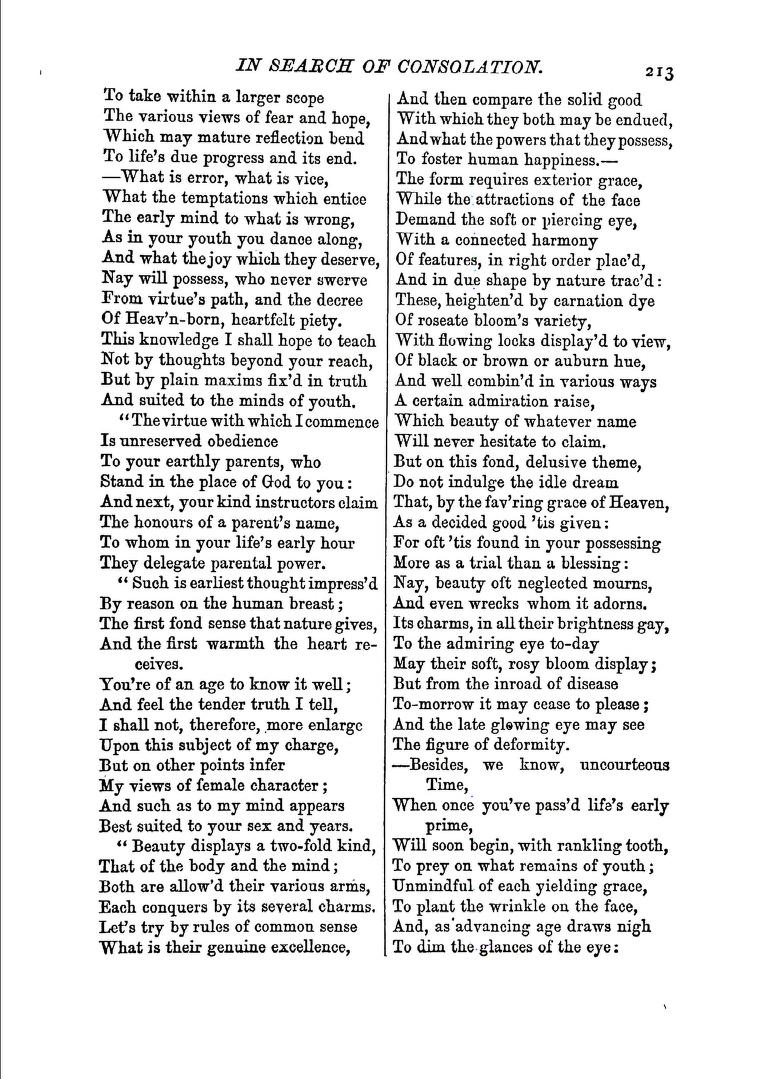
Below sits the text (in verse) that accompanied this image, in which Dr. Syntax expounds on his listeners’ youth and character, and how they can learn from good example:
In the following page, Dr. Syntax exhorts his young charges to never swerve from virtue’s path and to take care of their good looks, for “flowing looks display’d to view, of black or brown or auburn hue, and well combin’d in various ways, a certain admiration raise…”:
Dr. Syntax does not want for words. In fact, he is a bit of a windbag. How those girls could sit enraptured during this speech is a marvel to me. In this section the rich graces of the mind hold the beauty of the whole, the mortal form, th’ immortal soul.
I wonder if Dr. Syntax even drew breath! In this section the good doctor reinforces the concept that a woman’s place is in the home, overseeing the family and household.
The Doctor says his goodbye, admonishing the listeners to pay attention the kind preceptress, who “will explain what of this subject doth remain, and bring the whole before your view, to prove my solemn doctrine true.”
Dr. Syntax’s Three ToursDoctor Syntax’s three tours in search of the picturesque, consolation, and a wife. By William Combe. The original ed., complete and unabridged, with the life and adventures of the author, now first written, by John Camden Hotten. Eighty full page illustrations drawn and coloured after the originals by T. Rowlandson. Published 1868 by J. C. Hotten in London . Library of Congress, PR3359.C5 D6 1868
I can’t believe it’s been a day since the excitement of my first JASNA (Jane Austen Society of America) Annual Meeting. This one was held in Brooklyn, which turned out to be a fabulous place for this Janeite, for I walked over half of the Brooklyn Bridge between sessions and loitered in Brooklyn Heights, a truly wonderful neighborhood in which to while away one’s time. Then there were the plenary sessions, break out sessions and the EMPORIUM, where money flowed from my pocket into the vendors’. (I had to ship my loot back!)
Feather fan. Only some discoloration and one blemish flaw this otherwise remarkably preserved fan.
One of the loveliest displays was the antique fan exhibition presented by Dr. Abbey Block Cash. The variety of fans was astounding. One, made entirely of feathers, was in almost pristine condition (see image). The fans were so delicate that I would be afraid to handle them and many were hand painted. One in particular caught my eye … a puzzle fan from 1820:
The fan is made of French brise with blond horn sticks. The four images that open in four directions are:
Bouquet of flowers
Marriage proposal
Farm house
Planting scene
I went to the website suggested in the brochure, the Fan Association of North America at this link. Information on this site was varied and practical. What I liked in particular were the links to other fan sites. FANA is well worth a visit and exploration if you are interested in these beautiful yet practical accessories.
Not all the fans belonged to the Regency Era. As you can see, most are hand painted with exquisite scenes. The last fan in this video was made ca. 1910 (I hope my memory serves me right) and depicts scenes painted by Kate Greenaway. It is obvious from the quality of the fans that all were destined for the upper crust. I did not see a fan of the sort that the lower classes could afford, such as those with advertisements. (Because I did not see such fans, does not mean that they were absent.)
I wish I had the presence of mind to ask about the language of the fan, for there are so many myths swirling around that topic, but those of you who have been to an AGM know how much there is to see and do, and how many people one MUST meet NOW.
The red fan was exquisite and dramatic. The fan in back of it sports Kate Greenaway images of children.
There were some notable absences at this year’s AGM: I so wanted to meet my frequent blog partner Laurel Ann Nattres (editor of Jane Austen Made Me Do It and Austenprose) and Margaret Sullivant (editrix of Austenblog), but alas they did not come this year. You will see over the coming weeks the people I DID meet, such as Joan Klingel Ray, Susannah Fullerton, Deb Barnum (my lovely roommate), Lori Smith, Syrie James, and Dianah Baycich. Some of us fell all over each other like twins separated at birth. Every Janeite should make at least one JASNA Meeting. You simply will not be disappointed. I must add that the folks from JASNA NY did a splendid job of putting this complex (and largest) JASNA conference together. Kudos to all.
A Dance with Jane Austen: How a Novelist and her Characters went to the Ball, Susannah Fullterton
“Ah”, I said, when I saw Susannah Fullerton’s book in my mail box. “Here’s just the book I need.” Some of the biggest gaps in my Austen reference library concern dance and music. Whenever I wanted to find out more about the social customs of balls and dancing, how ladies and gentleman conducted themselves, the food served at supper balls, the etiquette of a gentleman’s introduction to a lady before he could dance with her, precisely when the waltz became acceptable not only among the racy upper crust but with villagers in the hinterlands as well, and the difference between private balls and public balls, I had to consult a variety of books. This was time-consuming, and a bit frustrating, for there were variations in details that each source offered.
And now Susannah Fullerton has come to my rescue! Readers who have visited the Jane Austen Society of Australia(an excellent site) know that Ms. Fullerton is its president, and that she has written a previous book, Jane Austen and Crime.A Dance With Jane Austen is a compact illustrated book crammed with information, but written in a relaxed and accessible style. Topics include: Learning to dance, Dressing for the dance, Getting to and from a ball, Assembly balls, Private balls, Etiquette of the ballroom, Men in the ballroom, Dancing and music, ‘They sat down to supper’, Conversation and courtship, The shade of a departed ball, and Dance in Jane Austen films.
Ms. Fullerton culls information from Austen’s letters, novels, and historic texts, such as The Complete System of English Country Dancing, by Mr. Wilson, a dancing master of some renown and decided opinions. She also describes how Beau Nash, the influential master of ceremonies and taste maker in Bath, laid down a set of rules for Society to follow. Nash single-handedly changed a small, sleepy city into THE playground for the smart set with his dictums and innovations, which lasted well beyond his death.
The Five Positions of Dancing, Wilson, 1811
Jane Austen was no stranger to Bath’s public assemblies, or to dancing in private settings. She loved to dance and rarely said no when a man approached her for a set. Jane danced as often as she could, wryly observing to her sister when she was in her thirties and when partners became scarcer: “You will not expect to hear that I was asked to dance, but I was.”
Getting to a ball might be problematic for those who had no means to keep horses or carriages. It made little sense to walk miles in fancy garb over dirt roads to a social event, and so arrangements needed to be made for those who were going to a dance to piggy-back with individuals who were willing to take them. This meant arriving and leaving a dance on someone else’s schedule. Catherine Morland did not walk to the Assembly Rooms, but took a sedan chair, for private carriages were seldom used within Bath proper. Her journey from “Great Pulteney Street to the Upper Rooms would have cost her between one shilling and six pence and two shillings (one way) – an expensive luxury at the time.”
A Modern Belle Going to the Rooms at Bath, Gillray caricature
The dancing ritual was one of courtship, and Jane Austen took full advantage of a ball to set the stage for character development. In each novel she takes a different approach. Lizzie and Darcy tense relationship began at the Meryton Assembly Ball, a situation that was not helped at the private ball at the Lucas’s house nor at the Netherfield Ball, where Lizzie’s family behaved abominably. The dances in Mansfield Park serve to show how selfish the characters are, and to point out Fanny’s isolation from the neighbors. Dancing masters taught children to dance properly, and they received further practice at children’s balls, but Fanny had few opportunities for practice, and she felt tense when she was prominently displayed at her birthday ball. Jane Austen masterfully used the dances in Emma to show how Emma never quite loses sight of Mr. Knightley even as she dances with Frank Churchill, and one gets a good sense of the frustration Catherine Morland feels at not being able to dance at her very first ball in Bath, for there was no one to introduce her and Mrs. Allen properly, or the utter irritation she feels when John Thorpe ruins her well-laid plans to dance with Mr. Tilney at a later assembly ball. Austen also uses balls to demonstrate how outrageous Marianne Dashwood’s behavior is towards Willoughby, breaking many rules of etiquette and decorum.
A Broad Hint of Not Meaning to Dance, James Gillray, published by Hannah Humphreys
Ms. Fullerton sets aside a few pages to discuss dances in films. These elaborately staged scenes are highly popular with film buffs. The costumes are beautiful, as is the music, and the settings are often quite lavish. But be aware that most of the dances and music are often inaccurate and chosen for cinematic effect. (As an aside, I was glad to note that Susannah’s take on Pride and Prejudice 1940 was similar to mine.)
Susannah Fullerton
Insights such as these make this book a sheer pleasure to read. A Dance with Jane Austen will be a valuable addition on the book shelves of any Regency author, Janeite, and history buff. As Susannah Fullterton says about her book:
Dances in the Regency era were almost the only opportunity young men and women had to be on their own without a chaperone right next to them, and dancing provided the exciting chance of physical touch. ..Dances were long – one often spent 30 minutes with the same partner – so there was plenty of opportunity for flirtation, amorous glances, and pressing of hands. After the dance was over, there was all the pleasure of gossip about everything that had happened.”
A Dance with Jane Austen will be available in October. Readers who are lucky enough to go to the Jane Austen Society Annual General Meeting in New York in a few weeks will have the opportunity to meet Ms. Fullerton! I give this book 5 out of 5 Regency tea cups.
Preorder the book at this Amazon.com linkor atFrances Lincoln Publishers
Hardcover: 144 pages
Publisher: Frances Lincoln (October 16, 2012)
Language: English
ISBN-10: 0711232458
ISBN-13: 978-0711232457
Please note: The blue links are mine; other links are supplied by WordPress. I do not make money from my blog. I do, however, receive books from publishers to review.
Fashionable Goodness: Christianity in Jane Austen's England is now available! By JAW contributor Brenda S. Cox. See Review. Available from Amazon and Jane Austen Books.
Available through December 31st, 2025. Click on image for details, and share this poster with other teachers and students!
The Obituary of Charlotte Collins by Andrew Capes
Click on image to read the story.
Comments
“My idea of good company…is the company of clever, well-informed people, who have a great deal of conversation.” – Jane Austen, Persuasion
Gentle readers: Please feel free to post your comments and continue the conversation! Due to SPAM, we will no longer accept comments on posts after 30 days of publication. In some instances, links will be removed from comments as well.
Administrators and Contributors
Vic Sanborn, founder of this blog, is supported by a team of talented and knowledgeable writers about Jane Austen and the Regency era. They are:
Tony Grant, who now contributes his photos from London and England
Click on their names to enter their own blogs.
In addition, we thank the many experts and authors who frequently contribute their posts and opinions, and who continue to do so freely or at our request.
Click here to enter the page. Topics include Regency fashion, historic foods, Jane Austen societies, British sites, related topics. Click on image.
May we suggest?
Hello, my name is Vic and I live in Maryland, USA. I have adored Jane Austen almost all of my life. I am a proud lifetime member of the Jane Austen Society of North America. This blog is a personal blog written and edited by me and my team. We do not accept any form of cash advertising, sponsorship, or paid topic insertions. However, we do accept and keep books and CDs to review.
If you would like to share a new site, or point out an error, please email us. (Yes, we are fallible. We'll own up to our mistakes and will make the corrections with a polite smile on our faces.) Write us at
Thank you for visiting this blog. Your comments and suggestions are most welcome.
Project Gutenberg: eBook of Stage-coach and Mail in Days of Yore, Volume 2 (of 2), by Charles G. Harper
STAGE-COACH AND MAIL IN DAYS OF YORE: A PICTURESQUE HISTORY
OF THE COACHING AGE, VOL. II, By CHARLES G. HARPER. 1903. Click on this link.