Feeds:
Posts
Comments

Archive for the ‘Regency Life’ Category

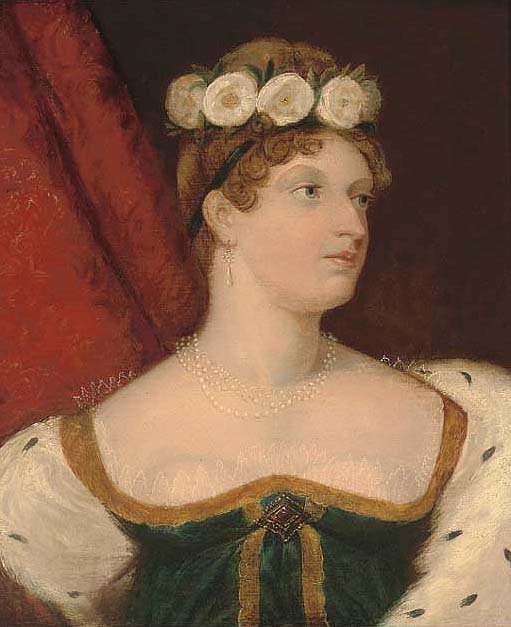
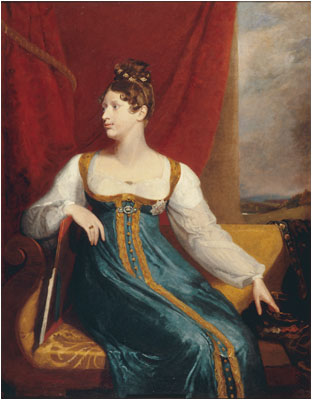
It is a rare occasion when we can compare a gown in a portrait with the actual dress. The painting, after George Daw, of the Prince Regent’s daughter, Princess Charlotte, shows her wearing a charming blue gown in a domestic, albeit royal, setting.

Princess Charlotte in her Russian Dress. Painting after George Daw, 1817. Image @Wikipedia

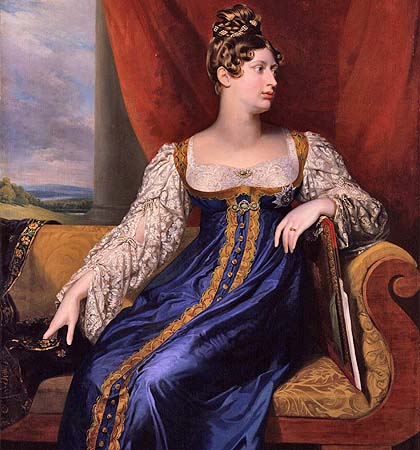
A second portrait depicts the same dress more royally. Princess Charlotte (or the artist) has accessorized the dress with ermine, lace, and pearls.

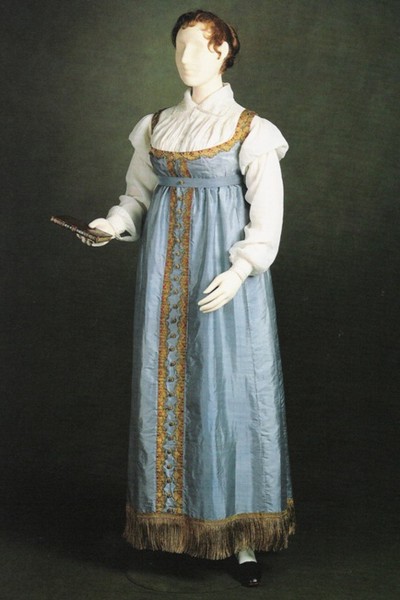
The mannequin from the Museum of London exhibit a few years back is dressed more informally, as if she was in the morning room reading. I found the image on Pinterest, but unfortunately the pin did not state the image’s origin. (A reader wrote that the dress belongs to the Royal Collection.)

As you can see, the dress no longer possesses the rich blue hue as shown in the paintings. So many of the costumes of that era are not only in a fragile state and can rarely be shown, but we cannot trust that the colors have remained the same.

Princess Charlotte's "Russian" outfit as shown at The Museum of London. The gown belongs to The Royal Collection.

Below is the original portrait by George Daw, which shows Princess Charlotte wearing the same dress. Click here for yet another view of Charlotte in a similar gown, but without the trim and wearing a lace cap. My sense is that after her death Princess Charlotte’s image became sought after and that many portrait copies were made (both in oil and in print) to satisfy the mourning public.

Princess Charlotte, George Daw, 1817. Image @National Portrait Gallery

Find more views of the gown at Jenny La Fleur’s site. Images of the gown can be seen in the exhibit catalogue called In Royal Fashion: Clothes of Princess Charlotte of Wales and Queen Victoria, 1796-1901, which can only be obtained second hand.

The exhibit: Princess Charlotte, The Lost Princess, will be on display at the Prince Regent Gallery in the Brighton Pavillion through 10 March, 2013.

My other posts about Princess Charlotte:

Read Full Post »

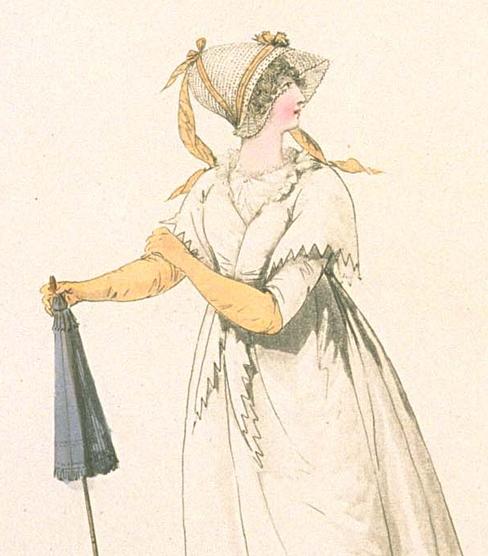
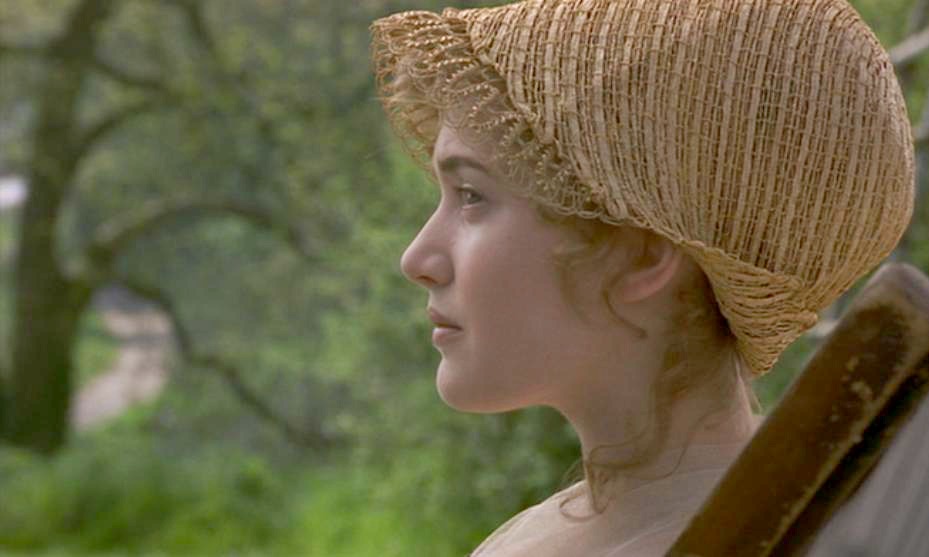
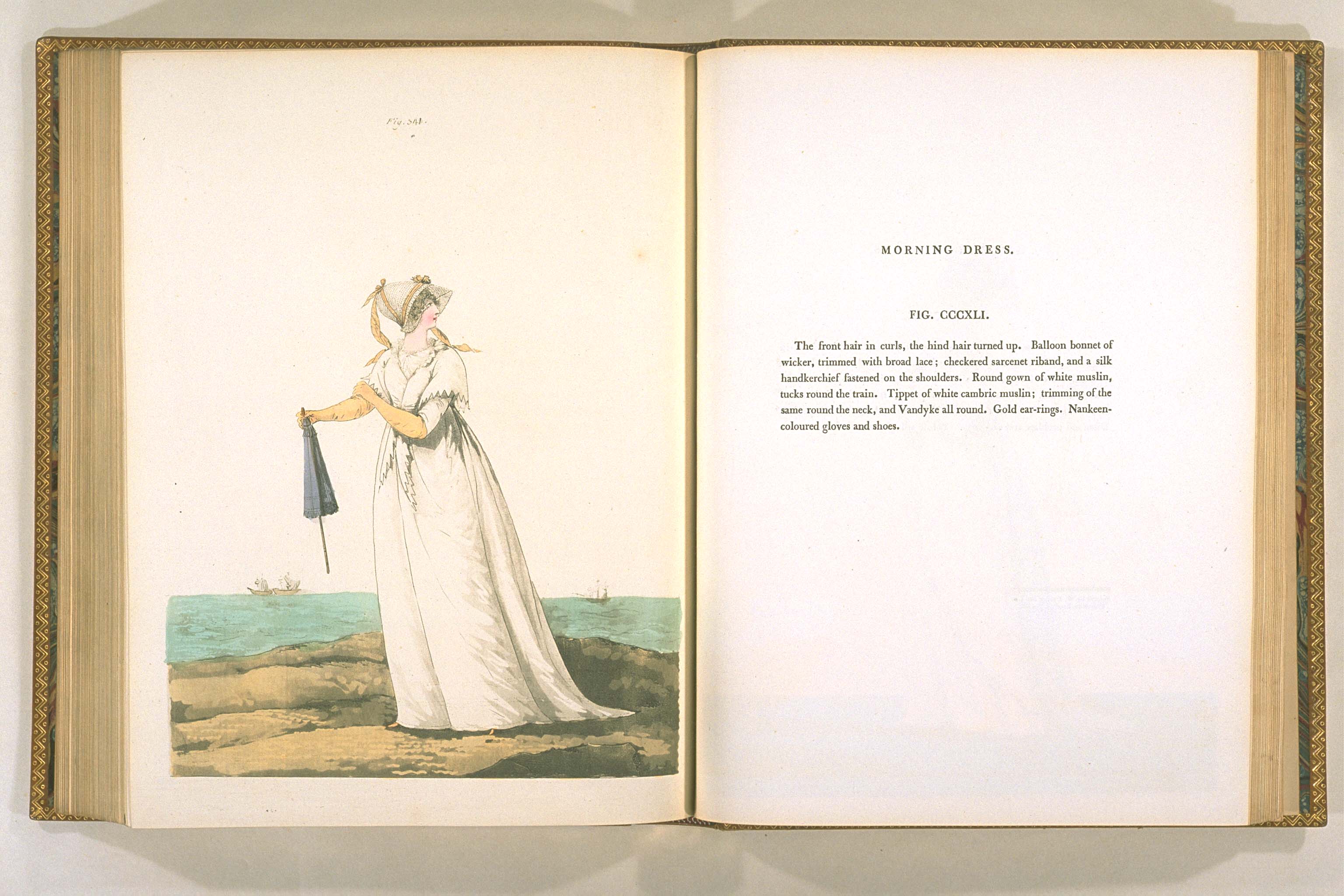
In Sense and Sensibility 1996, Kate Winslet as Marianne wears a charming straw sun bonnet as she recuperates from her illness. When I ran across the fashion plate of a morning dress from The Gallery of Fashion, 1794-1798, I was immediately struck by the similarity, although the brim in the fashion plate is more elaborate.

Detail of a morning gown and balloon bonnet, Heideloff, The Gallery of Fashion

The magazine described the head wear as a “balloon bonnet of wicker, trimmed with broad lace. The front hair is in curls, the hind hair is turned up.”  I suspect that Lydia Bennet would have wrapped ribbons around her capote much as in the above image.

Kate Winslet’s capote is simpler, but equally charming. Capotes, or scoop-shaped bonnets, were popular in the early Regency and first made their appearance in the 1790s. The hats accommodated the modish hair styles of that era, which were short or piled on top of the head.

Bonnet, 1805-1810. Image@The Victoria & Albert Museum

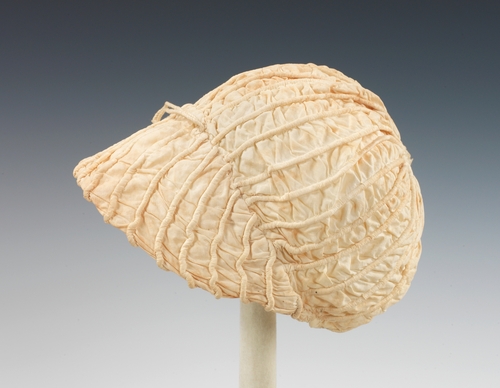
Generally made to be worn outdoors, capotes were also worn as evening headwear early in the 19th century. This evening capote is elaborately trimmed.

Infant bonnet, 1820. Image @Metropolitan Museum of Art

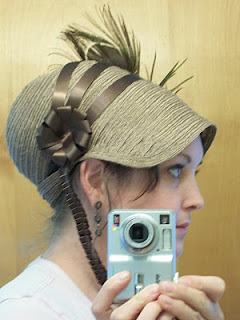
The charming bonnet was made for an infant.  Click here to read the description. The image below shows a modern interpretation of a Regency era capote bonnet. (Living With Jane)

Image @Living With Jane

The shape of the Capote bonnet changed as hairdos changed, and the hat crown shifted to accommodate the increased height of swept up hair. The poke, or brim, also became larger over time. This definition describes the Victorian capote: Close fitting bonnet with rigid brim, either of straw or boned into shape. Soft, shirred crown , ribbon bows tied under the chin, Victorian 19 c. with deep ruffle in back. Also poke bonnet, fanchon, scuttle bonnet, sun bonnet. – Glossary of hats, Village Hat Shop.

View images of the Victorian capote here http://www.metmuseum.org/collections/search-the-collections/80044650 and here http://www.metmuseum.org/collections/search-the-collections/80044657. You can see the vast difference between the two styles, yet they are still capotes.

This link leads to instructions for making a Capote Beguin, or Edwardian Era bonnet.

Make Your Own Regency Bonnet

More on the topic:


Read Full Post »

Fashion is always more than it seems on the surface. Take this charming Regency morning dress from Ackermann’s Repository (April, 1812), for example. Its detailed description in the magazine demonstrates how many historic influences shaped this romantic costume. The lady who wore these garments as a total ensemble would have known about its medieval, Elizabethan and Jacobean associations.

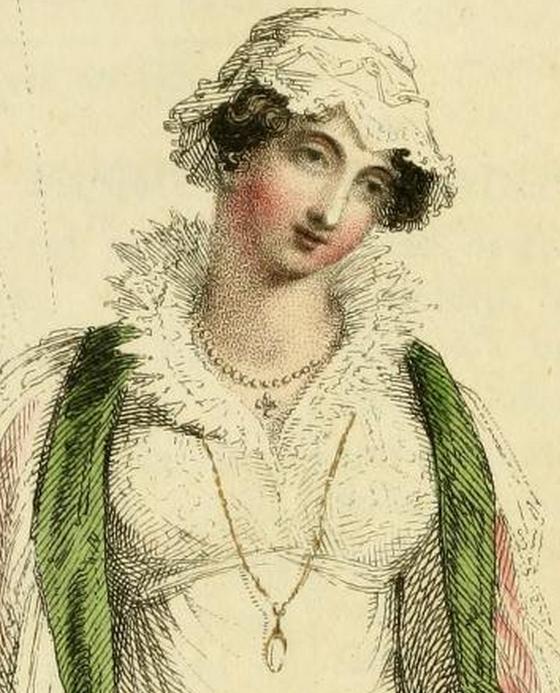
Morning or Domestic Costume: A superfine Scotch or French cambric over a cambric slip, with full long sleeve, and ruff a la Mary Queen of Scots. A neck-chain and sight set in gold; bracelets and necklace of white or red cornelian. A Flora cap, composed of white satin and lace. A capuchin or French cloack of blossom satin, or Pomona green, trimmed with thread lace. Slippers of pale pink or green; and gloves of tan or Limerick kid.

Cambric material, also called batiste and made of bleached linen or cotton, was widely used in the 19th century for handkerchiefs, shirts, bed and table linens, and as fabric for lace. Scotch cambric was actually a fabric made in India. French cambrics were hard to come by after the British banned imports from France during the war.

Detail of cap, ruff, and necklace with quizzing glass, or 'sight'.

The Mary Queen of Scots ruff indicates the influence of the Elizabethan era in fashion and architecture. At this time, British fashion began to diverge from French fashion because of the Napoleonic wars, which effectively blocked normal communication and travel between the two countries. By 1811, fashion designers, who were influenced by the Romantic sensibilities of British poets and philosophers, looked to the Tudors and the Gothic eras for new fashion statements. Ruffles and slashed sleeves began to appear, and gowns began to veer from the elegant simplicity of Grecian designs to more embellished dresses.

Flora McDonald

I found almost no references to the flora cap, which hugs the skull. In this instance, a lace brim frames the face and hair. Historically, Flora McDonald was immortalized through her association with Bonnie Prince Charlie, and in the early 19th century,  Sir Walter Scott symbolized her as the embodiment of romanticized Scottish Jacobitism. One portrait of Flora shows her wearing a lace cap. Interestingly, today’s baseball and American hunting caps pop up when one Googles either Flora cap or Jacobean hats.

Cornelian, primarily found in India, was a popular semi-precious stone used in jewelry. The rust red is more prevalent over the white. Think of the colors of a cameo and you will have an idea of what bracelets and necklaces made of cornelian might look like. In this instance, the fashion plate depicts a white carnelian necklace.

Capuchin cloaks were loose hooded cloaks  whose design origins dated back to the medieval period. Capuchin monks, a 16th century off shoot of the Franciscan monks, wore distinctive pointed hooded cloaks, whose popularity remained strong through the 18th and 19th centuries.

I found this Victorian reference to Limerick kid gloves highly fascinating:

the best foreign glove is not better in any respect than the best Irish glove,—because the best London-made kid glove is rarely imported, or, if imported, cannot be sold as cheap as the best Dublin, Cork, or Limerick kid,—because the majority of imported gloves are made by frame, instead of by hand, and that the stitching by hand is much surer and firmer than sewing by machine; as, if one stitch give in a hand-made glove, that stitch alone goes, while if a stitch give in a machine-made glove, the whole finger is apt to go—and, lastly, because the article that is generally sold, is made of what, in the trade, is called “seconds,” the raw material being what is technically termed ” slink lamb,” and not kid; the difference of which may be better understood when I state that “seconds,” or “slink lamb,” can be bought by the manufacturer at from 1s. 3d. to 2s. per dozen, while kids range from 8s. 6d. to 14s. per dozen. What is usually called French kid, is, in reality, Italian lamb. So that my advice is—stick to the Irish kid, which will give good wear, and look charmingly on the hand.” – The industrial movement in Ireland, as illustrated by the National exhibition of 1852 (Google eBook), John Francis McGuire, 1853, p. 87

Detail of the Limerick kid gloves.

Although this lady is wearing a household garment meant to be seen only by family and close friends, and which she will keep on until she goes out to shop or visit friends, she is also wearing a cloak and gloves. One of the coldest vacations I ever spent was a week in April in London (the second coldest was a windy weekend in August in San Francisco). I visited a friend who lived in an ill-heated apartment, and I shivered for 7 days during one of the rainiest weeks this Dutch girl ever experienced. I imagine that the domestic outfit  portrayed in this fashion plate was well suited to staving off cold drafts and the shivers.

Several years ago I engaged in an online discussion about whether a lady wore gloves indoors. My “opponent” was adamant in her assertions that ladies did NOT wear gloves inside, saying that Regency portraits indicated that they never would. Never say never. I replied that this made no sense. Ladies tried to look their “Sunday” best for expensive portraits destined to be hung in long galleries, which meant showing off their most beautiful clothes and their milk white, unsullied hands. Besides, I found one or two paintings that portrayed a woman wearing gloves inside the house. I imagine that in some instances, a visitor might keep her gloves on if her visit was short and she was offered nothing to eat or drink.  (Think of Lady Catherine de Bourgh’s imperious visit to the Bennets to confront Elizabeth about her intentions with Mr. Darcy.) The gloves in this print might mean that the woman was sitting in a glassed-in conservatory or in the confines of her private garden.

A lady who lived in a freezing mausoleum of a house would be a fool not to keep her gloves on. This fashion plate shows such a sensible young woman.

Read Full Post »

Can you imagine Jane Austen at her spinning wheel? We will soon have the possibility of seeing the Austen family’s spinning wheel at Chawton Cottage after its restoration. My sense is that it was highly unlikely that Jane Austen herself spent much time using it for spinning.

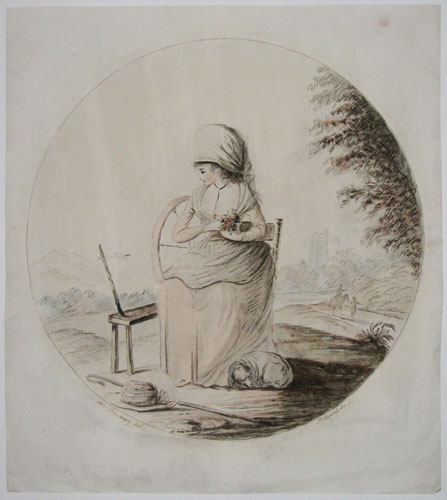
A lady spinning at her wheel, after Wm Bunbury, 1781. Image @Grosvenor Prints*

She wrote in a letter from Chawton dated Friday, May 31, 1811 to Cassandra, who was staying at Godmersham Park:

I have taken your hint, slight as it was, and have written to Mrs. Knight, and most sincerely do I hope it will not be in vain. I cannot endure the idea of her giving away her own wheel, and have told her no more than the truth, in saying that I could never use it with comfort. I had a great mind to add that, if she persisted in giving it, I would spin nothing with it but a rope to hang myself, but I was afraid of making it appear a less serious matter of feeling that it really is.

Jane’s wit and humor came to the fore, and she used it to good effect to show how little such a gift would mean to her. Mrs. Knight eventually died and biographer, David Nokes, writes:

There came news from Kent of the sad death of Mrs. Knight. The old lady left a donation of £20 to be distributed among the poor of Chawton parish, but Jane was relieved to find there was no mention of the spinning-wheel.  – David Nokes, Jane Austen: A Life, p. 392

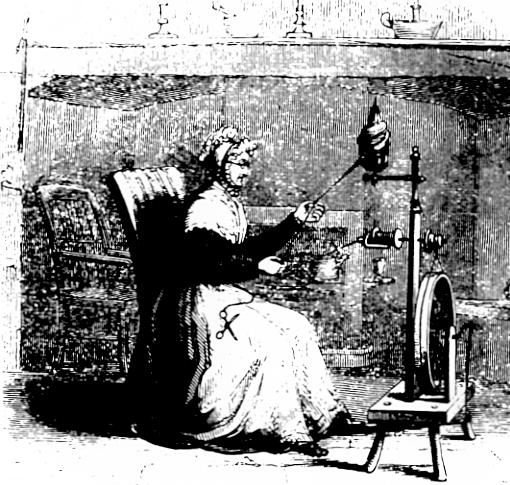
Cottage woman at work on her spinning wheel. Burnett

And so Jane was saved from the burden of spinning. Many of  her female friends and relations enjoyed the pasttime. Her nephew, Edward Austen-Leigh, wrote in his memoir:

With regard to the mistresses, it is, I believe, generally understood, that at the time to which I refer, a hundred years ago, they took a personal part in the higher branches of cookery, as well as in the concoction of home-made wines, and distilling of herbs for domestic medicines, which are nearly allied to the same art. Ladies did not disdain to spin the thread of which the household linen was woven. Some ladies liked to wash with their own hands their choice china after breakfast or tea. In one of my earliest child’s books, a little girl, the daughter of a gentleman, is taught by her mother to make her own bed before leaving her chamber. It was not so much that they had not servants to do all these things for them, as that they took an interest in such occupations. – Edward Austen Leigh, A Memoir of Jane Austen, p 37

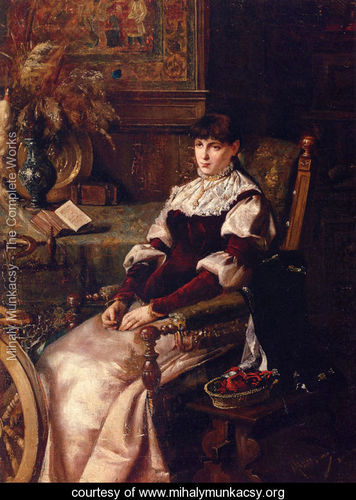
Spinning was popular with ladies all over Europe. Late 19th c. painting by German artist Mihaly Munkacsy

It is quite likely that the thread used for the lace on Mrs. Hurst’s gown in Pride and Prejudice (over which Mrs. Bennet exclaims) was spun by the lady who made it. In those days, ladies of the highest order spun yarn used for embroidery or lace making. They gathered in small groups to spin wool and wile away the time as they gossiped or engaged in pleasant conversation. Jane Austen notes on January 14, 1796 that “Anna is now here; she came up in her chaise to spend the day with her young cousins, but she does not much take to them or to anything about them, except Caroline’s spinning-wheel.”

The unlikely accomplishment of spinning had been a social skill practiced at the highest levels of society, probably because the parlor spinning wheels which the socially prominent operated were beautifully wrought and highly decorative. (In Jane Austen’s letters, we find Austen commenting to her sister regarding a proposed gift of a spinning-wheel, which she refuses because of the sense of identification of the fine tools of women’s work with their owners [Selwyn 68].)  Further, a woman’s ability to create a smooth sewing thread was considered a remarkable accomplishment; – Susan E. Jones, Thread-cases, Pin-cushions, and Card-racks: Women’s Work in the City in Jane Austen’s Persuasion

Fashionable ladies most likely did not bother to do the hard work of cleaning, sorting, dyeing, carding, and greasing yarn in preparing the wool for the spinning wheel. Instead, they performed the lighter tasks of spinning the wool yarn into a finer thread.

In a recent BBC Radio 4 interview, Val and David Bryant discussed the very special “Planta” wheel owned by the Austen family. Val is an expert on the history of spinning wheels and her husband is a spinning wheel restorer. The couple spoke about their remarkable acquisition, which is being restored in Chesire.

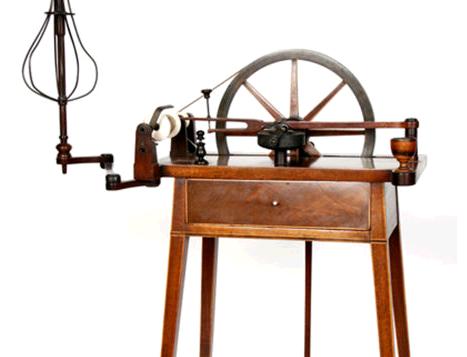
Austen family "Planta" spinning wheel in the shape of a table, with Sheraton style legs and a drawer. Image @BBC Radio 4

The spinning wheel once owned by the Austens is a beautiful and rare specimen made like a piece of furniture. It looks like a little table with Sheraton-style legs and had a little drawer. Its maker, John Planta (c. 1798-1824), was a craftsman from Fulneck, Yorkshire near Leeds. His specialty was to produce high quality spinning wheels in a unique Sheraton style.

This spinning wheel resembles the fine drawing room models that were designed for ladies who spun for pleasure: It is a world away from ordinary spinning wheels destined for the cottage industry.  The Bryants speculated that this elegant spinning wheel was a “must-have” gadget for its day. They were becoming so fashionable and desirable, that some were embellished with inlays and finials. The Austen’s spinning wheel is remarkable in that it still has the original instructions on how to use it.

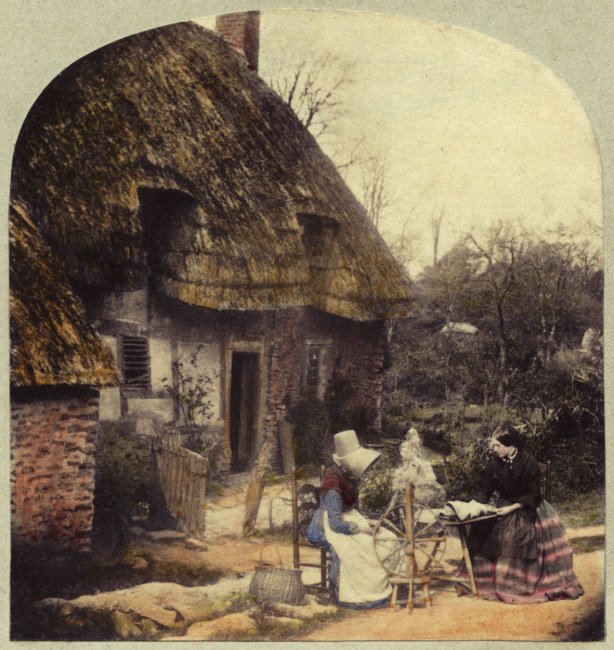
Victorian photograph of a cottage woman at her spinning wheel, 1850. Image @Daily Mail

The Austen family spinning-wheel is currently missing a treadle and footman that drives the crank, and it needs a new pulley. It also squeaks. Once it is restored, it will go on display in Chawton Cottage for all the visitors to see! I’ll keep you posted.

More on the topic:

Read Full Post »

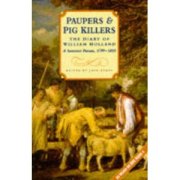
From the first page, William Holland had me hooked with his diary. His daily notations are not erudite. He does not wax eloquently about politics, philosophy, religion, or science, but with observations like these, who cares? Our parson has a way of planting us right in the middle of his little village:

Friday November 1 [1799]  The Clerk in the yard wheeling dung and Robert [Holland’s servant] looking about him and moving like  a snail. The Clerk cleared the liney and fetched three bushells more of pease for the sow. One of the Miss Chesters died yesterday, quite young, not ill above ten days. Poor girl her state of probation was soon over.

Then there are these short gems:

Wednesday November 6   Little Lewis the Apothecary came to me, rubbing his hands and moving his retreating chin in and out of his stock — attentive bur rather avaricious, mean and trifling.”

“Saturday November 9  Mr Robert has been wearing my spurs — now I have found out the method to get his horse on. Tis a difficult thing to get a servant worth anything. His slowness and laziness and want of method puts me out of patience. When the year is out he must go.”

Our country parson isn’t loquacious. Anita N writes about him on an online forum: “Apparently not the most charming man–but honest in his political and social views, and detailed about his daily life. That’s what I want to read: life sketches, muck, vitriol and common views of the time.”

Our parson lived in Over Stowey in  Somerset. Even today the village is described as having “no commercial centre because there is virtually no commerce – not a pub, post office or shop” – only farms lying in the outer districts of the village. There are few area descriptions in Holland’s observations, since his purpose is to focus on the people he encounters each day. From what I have read so far, his diaries simply record the mundane events in his life. He is not a particularly good writer, and his usage of punctuation is minimal at best.

View of Over Stowey. Image @The Quantock Online Community

Holland held the opinions of an old-fashioned High Church Tory. The following definition serves well enough for readers who do not much about Tories:

Tories conceive of sovereignty as residing in rulers and view “the people” as subjects whose duty is to obey. Tories are thus identified with a system of hereditary power–exercised especially by monarchs and the established Church. – Historical Outline of Restoration and 18th Century British Literature
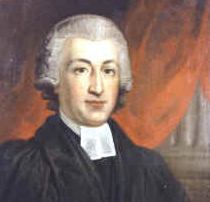
James Woodforde, 1740-1803, an amiable country clergyman, also wrote a diary. His is the image of a typical country parson of his day. Image @History Today.

Our country parson despised Democrats and took many swipes at them. One imagines that he must have shuddered at the very thought of Thomas Paine, the epitome of a Democrat and a radical, if ever there was one. Paine was against:

kingcraft, lordcraft and priestcraft. An original thinker far ahead of his time, he sought to redress poverty (seemingly endemic in advanced European societies) through an interventionist programme of welfare redistribution, including old-age pensions, marriage allowances and maternity benefits. – Thomas Paine, Citizen of the World, BBC History

In the Diaries’ opening observation on Wednesday October 23, 1799, our parson writes:

Saw that Democratic hoyden Mrs Coleridge who looked so like a friskey girl or something worse that I was not surprised that a Democratic Libertine should choose her for a wife. The husband gone to London suddenly, no one here can tell why. Met the patron of democrats, Mr Thos Poole who smiled and chatted a little. He was on his gray mare, Satan himself cannot be more false and hypocritical. “

Yet Holland was a compassionate man. He is constantly worried about the poor.

Thursday November 7   Still more rain, where will it end? The Poor, the Poor, how are they to live this winter? we must do all we can to assist and Providence will do the rest.

This series of observations about a mad man gives one a good sense of how a village takes care of its own:

Thursday December 5   The madman in the Poorhouse outrageous. Farmer Morle’s behaviour is absolutely scandalous but I’ll make him know his duty e’er long. The man is chained and lies on straw, shocking situation. Alas poor human nature how many afflictions art thou liable to.

Saturday December 7  Went to the Messrs Riches this evening about the man in the Workhouse, both determined to join in sending him to the Mad House in Bristol be the expence what it will. Says Master James ‘Mr Holland I reckon it be a bad business, he is a very bad fellow, there is something more in it than madness.’ Mr James thinks, in my opinion, that he is possessed by the Devil or bewitched.”

The parson then thinks about calling on the Vestry about the madman, but puts this off.

Monday December 9 Were alarmed with an account of the madman in the Workhouse having got loose and threatening everyone around with destruction. We procured two men to sit up with him and secure him from doing mischief till morning.

Holland writes that the madmen is quiet for two days, then he raves again. It seems that he uses the terms Poorhouse and Workhouse interchangeably. Finally, the men in the village decide what to do with the mad man:

Monday December 16 Went to Mr Ruscomb Poole at Marsh Mill to consult about the pauper in the Workhouse. Farmer Morle and Mr Lewis came in the evening and we went to the Poorhouse, examined the man, he had a fit at the time. We do not think him properly insane to be an object for a Madhouse. We shall try some other Methods.

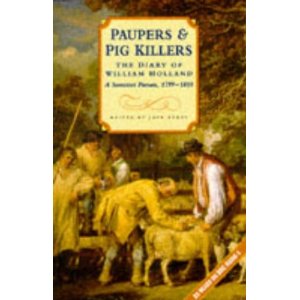
Rev. Holland describes the days leading up to Christmas, including a little impromptu dance party that his daughter holds for her friends. There are 18 more years to read. Although this is not a review of the book, per se, I highly recommend it. I found my copy in a second-hand shop on Amazon. All I can say is that our Somerset Parson makes the early 19th century come alive from a male perspective. Between the diary of William Holland and Jane Austen’s letters, one gains a good sense of how different the life of a country woman is from that of a country parson. Next on my book wish list: The Diary of James Woodforde. I understand that this man loved his food.

More on the topic:

Read Full Post »
« Newer Posts - Older Posts »