Feeds:
Posts
Comments

Archive for the ‘Regency Life’ Category

Another book review so soon on this blog? Well, yes. This book from Shire Publications, Victorian and Edwardian Horse Cabs by Trevor May, is short, just 32 pages long, but it  is filled with many facts and rare images of interest to lovers of history. In Jane Austen’s day most people walked to work, town, church, and market square, or to their neighbors. Six miles was not considered an undue distance to travel by foot one way. The gentry were another breed. They either owned their own carriages or hired a public horse cab. These equipages were available as early as the 1620’s.

Hackneys, or public carriages for hire made their first significant appearance in the early 17th century. By 1694, these vehicles had increased to such a number that a body of Hackney Coach Commissioners was established in London. The commissioners dealt out licences, which was a bit of a joke, for a mere four inspectors were responsible for over 1,000 vehicles.

Hackney Coach 1680

Most of these licensed hackney coaches were purchased second hand. All that an enterprising person needed to establish his own hackney coach business was enough money for a used carriage and three horses, two that worked in rotation, and one that could be used as a replacement in case of injury or illness. The death of a horse could lead to a cab owner’s financial ruin. Another important ingredient was housing for the horses.
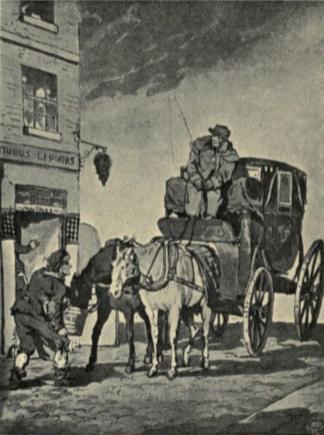
Hackney Coach 1800. Image @Wikimedia Commons

By, 1823, the lighter horse cabs began to replace cumbersome hackney coaches in great quantity, and by the mid 1830’s, the hansom cab set the new standard for modern horse cabs. Aloysius Hansom, an architect, designed the first carriage. When Hansom went bankrupt through poor investments, John Chapman took over, designing an even lighter, more efficient cab, one whose framework did not strike the horses on their backs or sides whenever a carriage ran over an obstacle in the road.
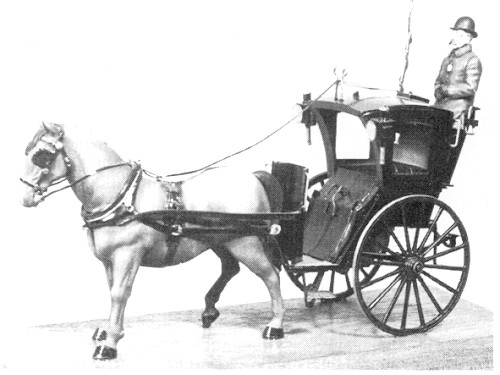
Hansom Cab

Commercial cab firms tended to be small, even as late as 1892. Only one or two proprietors provided a large number or variety of equipages, like Alfred Pargetter, whose concern advertised removal carriages, cabs, and funeral coaches for hire. While cabs were licensed, their drivers were not and the road could present a dangerous obstacle course. The video clip below shows how adroitly horses and carriages managed to avoid each other with seemingly few rules (mostly towards the end of the clip). Notice how some lucky individual horses pulled relatively light loads compared to other horses forced to pull heavy carts.

These two video clips, one from 1903 and the other from 1896 (unbelievable!) show the end of an era, for by 1914, motorized vehicles were rapidly replacing the horse-drawn cart.

I recommend this book to anyone with an insatiable appetite for a pictorial history on a particular topic. Trevor May is an expert on the Victorian era, and he has managed to squeeze more information about horse-drawn cabs in this short book (more a thick pamphlet) than I have read before. The images are simply splendid.
Read Full Post »

christineInquiring readers, Several weeks ago, Chris asked me to link to her blog. Looking at it and reading her posts, I asked her to keep me updated on her work, which she describes as a personal journey that she is doing “for the pleasure of pursuing a course of study in a structured manner, which I greatly miss from my time in graduate programs. And to have fun and explore, more deeply, the work of a writer I admire and the time period in which she lived.” Below are her thoughts, and a link to her blog, Embarking on a Course of Study, which I encourage you to visit.

Would you, if you could, spend a year entering ‘on a course of serious study’ as Marianne Dashwood vows to do at the end of Sense and Sensibility? If the answer is yes, please join me in an Austen-inspired project of that nature. Specifically, “A writer, reader, and Austen lover spends a year (or more) embarking on a course of study similar to that probably undertaken by Marianne in Sense and Sensibility, without the benefit of Colonel Brandon’s library and with room for diversions, digressions, and (hopefully) fun fieldwork.”

I’ve begun by rereading the novels (which has been both a joy and a frustration at times, and I’m sorry I waited so long to pick them up again!), and Austen’s letters. I’m contacting Austen scholars for reading suggestions and to interview them. So far the Chawton Library has been the most helpful. Sadly, JASNA, not so much.

I have my first interview with a professor at St. Mary’s College here in Maryland, who is offering a class on Austen that examines the important aspects of the time period in which they were written: poliltics, economy, social codes, etc.

I admit the fieldwork so far has been the most fun. I’ve been country dancing (a real thrill, but surprisingly hard to learn and hot/sweaty!), am working on a silk ribbon embroidery project, and am deciding between hat decorating and archery classes. I have the Jane Austen Cookbook, as well, and plan on cooking one or two items for this year’s Thanksgiving dinner. I’ve promised my family not to make pigeon, which I admit I was not sorry to give up.

The reading list is growing and my goal is to alternate the serious with the silly. So – Mrs. Richardson then Sir Walter Scott, and on like that.

I hope to attend the festival in Bath next fall, so will probably need to find a seamstress to make me something fabulous or brave the process myself. Let’s see how well I do with the silk ribbon embroidery first!

This is not a project in the vein of a PhD dissertation or an intellectual discussion, though I welcome ideas, comments, and suggestions of all kinds. I’m trying to stay as true to Marianne as I can, but also see where this path leads me, personally.

Based on my post a few weeks ago (‘The Ruins of the Patapsco Female Institute’), that could be to a class in NYC on walking in heels at ‘Miss Vera’s Finishing School for Boys Who Want to Be Girls.’

You just never know where we’ll end up!

My latest post is on Elinor vs. Marianne. Who would you rather have as a friend? Who are you most like? Would love to hear from you.

Read Full Post »

Everything we now use is made [in] imitation of those models lately discovered in Italy. – Observation by an Englishman

diana sackville detail 1777

Diana Sackville, 1777

In the late 18th century, hairstyles for women took a dramatic turn from the pouffed-up and constructed hairdos of the earlier Georgian age to the simple hair styles inspired by the Greeks, Romans, and Egyptians. Curls now framed the face and chignons replaced the complicated, almost architectural concoctions that took hairdressers hours to create. Ancient statues and works of art brought back as spoils of war or as souvenirs from grand tours revealed classical hairstyles. Women began to wear simpler hairdos with long hair pulled back in chignons or simple pony tails, long curls trailing over the shoulder, and short ringlets framing the face. Hair ornaments consisted of flower wreaths, ribbons, jewelry, tiaras, and combs.

greek and roman influences

Hairstyles on statues from antiquity

Lady Caroline Lamb (lower left) sported a saucy short bob, whose influence can be seen from the portrait in the Roman mural at the Metropolitan Museum. Madame Recamier, whose hair is longer, achieves a similar effect with ringlets around her face. Her curly hair, gathered in back, allowed the ringlets to fall. At right, the Marchioness of Queenston achieved a very similar style to Madame Recamier’s, but her bandeau sat further back on her head and the ringlets framing her face were thicker.

Curly styles

Longer hair, while not as prevalent as the up-do’s, usually took the form of a long curl draped over the shoulder. At second to right, Mrs. Henry Baring wore a more casual “do”, with her locks streaming around her neck and shoulders.

long hair

The long curl

Straight, simple hairstyles with few ringlets and ordinary bangs, or a style simply parted in the middle were worn, but were not drawn or painted by artists or depicted in fashion plates as often as the curlier styles.

plain ringlet free

Fashion plates of the time show how these hairstyles looked with bonnets and hair ornaments with a (l – r) walking dress, ball gown, afternoon dress, or morning dress.

fashion plate

The hairstyles that Kate Winslet and Emma Thompson wore in Sense and Sensibility seemed to be particularly true to the period (in my opinion). Some of you may have noticed that I use Kate Winslet’s image of Marianne as my avatar.

hair styles

This image of a Roman statue (a copy of an earlier Greek statue) shows the hairstyle that would become prevalent in the later Regency/early Victorian era (1820’s to 1830’s).

marble head of a woman roman copy of greek statue

1st C. AD Roman bust

“We wore white crepe dresses trimmed with satin ribbon & the bodices & sleeves spotted with white beads. . . Thursday night, Pearl combs, necklaces, earrings, & brooches. . . Tuesday evening we had sprigged muslin. . . gold ornaments & flowers in our heads & Friday we wore yellow gauze dresses over satin, beads in our heads & pearl ornaments” – Fanny Knight Austen

Evening dresses, fronticepiece, The Mirror of Graces,, 1811

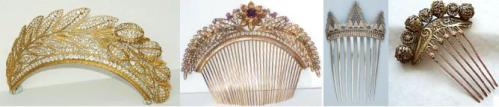
Fanny Knight wrote a vivid description of how women dressed and what sort of accessories were popular when she was a young woman. The 1811 fronticepiece to The Mirror of Graces (above) shows how simple and elegant the combination of Neoclassical hair, dress, and accessories looked.  Jewelry styles favored smaller, lighter forms of draped chains and classical motifs, which were reflected in hair ornaments. These days jewelry from the Georgian era is difficult to find, for many of the pieces were refitted or redesigned to reflect motifs of the neoclassical period. (Neoclassical Jewellery ). Ebay Guides can be extremely useful in researching information about this era, such as this one entitled,  Georgian and Regency Combs and Hair Accessories – 1800-1814. (Click here for the PDF document.)

tiaras and combs

Georgian tiara and combs, early 19th c.

In addition to gold and silver hair ornaments, such as tiaras and diadems, young women wore silk ribbons, strands of pearls, feathers and other fancy hair ornaments in their hair, most notably for balls and formal occasions. These hair jewels were a visible sign of a family’s or husband’s wealth. Bonnets, hats, or turbans were also worn on social outings. The second image from the right (above) is of a George III silver comb, 1807.  “Silver combs of this type appear to have been a speciality of Birmingham, where they were produced in a small quantity and in a collectable variety of forms.” (Cinoa)

As the Regency era progressed long hair became increasingly popular and full ringlets began to appear near the side of the face. Hair ornaments for balls included jewellery, bandeaux, turbans and wreaths of grapes and towards the latter end of the Regency era flowers, turbans and ostrich feathers were seen to adorn the hair. (Overseale House)

ornaments

These days we achieve curls and ringlets with a hot curling iron. The use of hot irons in the 19th century was tricky, for hair could easily be singed. Back then, curls were made with pomade, a hair gel, and curling papers. The lost art of the paper curl describes how a person today can make a similar curl using old-fashioned techniques.

Lydia is exposed to an unregency like cut

Perdita Weeks as Lydia Bennet in Lost in Austen

The transition from the structured hairstyles of the mid-18th Century to the Regency period was not achieved without its own set of complications, as this James Gillray cartoon shows. The cartoon was drawn in the earlier Neoclassical period, when round gowns were still worn.

gillray fashion cartoon

A lady putting on her cap, Gillray, 1795

The fashion plate below shows how charming and uncomplicated, yet classic, the combination of the 1802 hairstyles and afternoon dresses are together, whereas the 1811 fronticepiece showed how rich both hair and fabric can be made to look using similar principles of fashion design.

1802 Lady's Monthly Museum afternoon dress june Payne Milliner Old Bond Street

Afternoon Dress 1802 Lady's Monthly Museum

More links on this topic:

Read Full Post »

Vendors of fruit and flowers, of milk and muffins are not agreeable visitors when they roar for a living, and the poor organ-grinder little knows, let us hope, the anguish he inflicts upon sensitive nerves. – Street Noises, The Illustrated London News, 1882

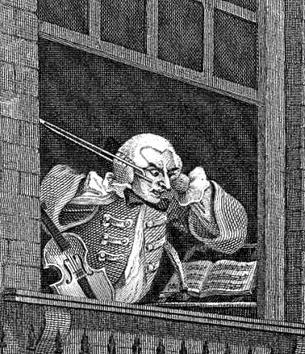
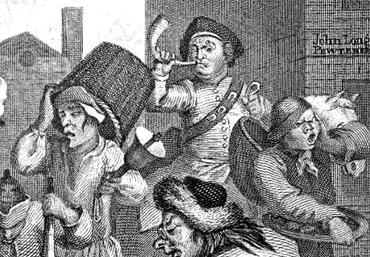
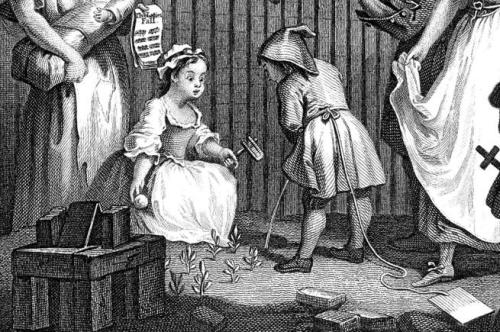
the musicianWilliam Hogarth’s famous 1741 etched engraving of ” The Enraged Musician” visually described the cacophony of sounds heard all over the city of London: the shouts of vendors, clattering of wagon wheels and clopping of horses’ hooves, impromptu concerts from street musicians, clackety-clack of ladies’ pattens (which protected delicate shoes from mud), and the clapping of hooves and bleeting of animals as drovers guided them to Smithfield Market. Laws were enacted to control these noises, but the change did not occur overnight, nor did these laws completely eliminate all irritating sounds for city dwellers. In 1841, 100 years after Hogarth engraved his famous scene, Charles Knight described London’s noises (London, Vol 1, Charles Knight, 1841):
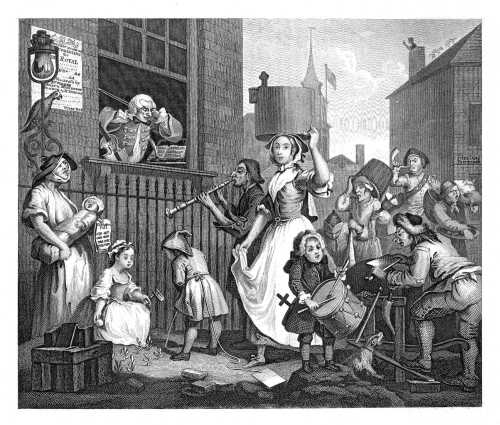
Enraged_musician William Hogarth

In this extraordinary gathering together of the producers of the most discordant sounds we have a representation which may fairly match the dramatist’s description of street noises …

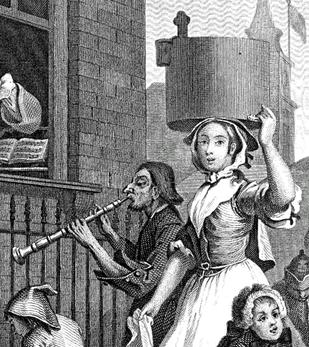
street musician and vendor

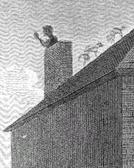
Here we have the milk maid’s scream, the mackerel seller’s shout, the sweep upon the house top, to match the fish wives and orange women; the broom men and costar mongers …

chimney boy

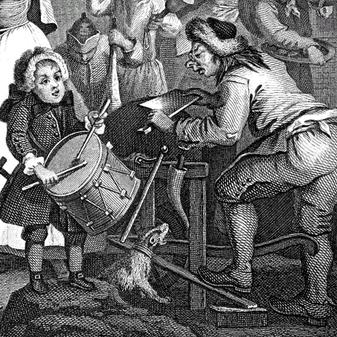
The smith, who was ominous, had no longer his forge in the busy streets of Hogarth’s time, the armourer was obsolete, but Hogarth can rival their noises with the pavior’s hammer, the sow gelder’s horn, and the knife grinder’s wheel…

drummer and knife sharperner

The waits of the city had a pension not to come near Morose’s ward, but it was out of the power of the Enraged Musician to avert the terrible discord of the blind hautboy player.

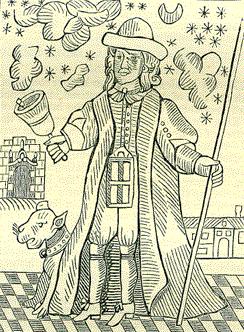
Bellman, Book of Days

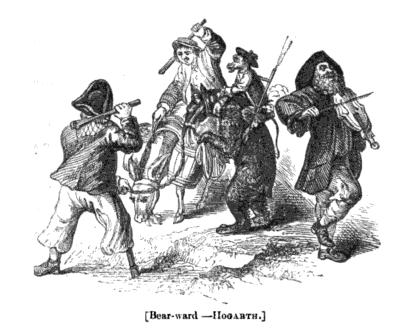
The bellman who frightened the sleepers at midnight was extinct, but modern London had acquired the dustman’s bell. The bear-ward no longer came down the street with the dogs of four parishes, nor did the fencer march with a drum to his prize …

Hogarth, Bear-Ward, Bear and Monkey

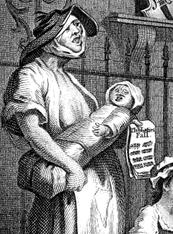
…but there was the ballad singer with her squalling child, roaring worse than bear or dog, and the drum of the little boy playing at soldiers was a more abiding nuisance than the fencer Morose, and the Enraged Musician had each the church bells to fill up the measure of discord…

crying baby

In our own days there has been legislation for the benefit of tender ears, and there are now penalties with police constables to enforce them against all persons blowing any horn or using any other noisy instrument for the purpose of calling persons together, or of announcing any show or entertainment, or for the purpose of hawking selling distributing, or collecting any article or of obtaining money or alms…

bell horn and shouts

These are the words of the Police Act of 1839, and they are stringent enough to have banished from our streets all those uncommon noises, which did something to relieve the monotony of the one endless roar of the tread of feet and the rush of wheels…

peeing in the road

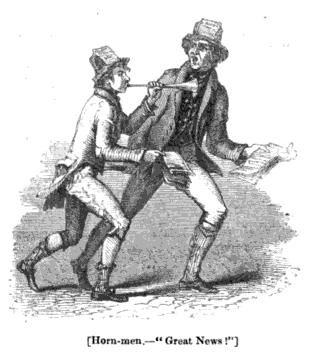
The street noise now is deafening when we are in the midst of it, but in some secluded place, such as Lincoln’s Inn Gardens, it is the ever present sullen sound of angry waves dashing upon the shingles. The horn that proclaimed extraordinary news running to and fro among peaceful squares and secluded courts was sometimes a relief…

hornmen great news

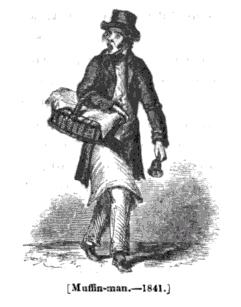
The bell of the dustman was not altogether unpleasant. In the twilight hour, when the shutters were not yet closed and the candles were not yet burnin,g the tinkle of the muffin man had something in it very soothing…

muffin man 1841

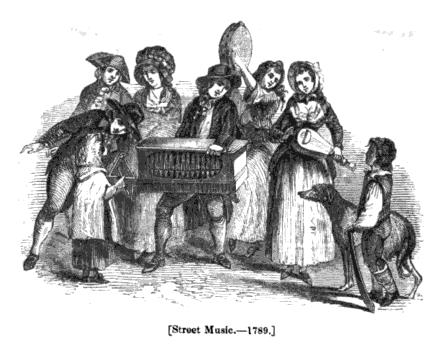
It is gone, but the legislators have still left us our street music…

street music 1789

There was talk of its abolition, but they have satisfied themselves with enacting that musicians on being warned to depart from the neighbourhood of the house of any householder by the occupier, or his servant, or by a police constable, incur a penalty of forty shillings by refusal. De la Serre, who came to England with Mary de Medici when she visited the Queen of Charles I, is enthusiastic in his praises of the street music of London In all public places … – London, Vol 1, Charles Knight, 1841

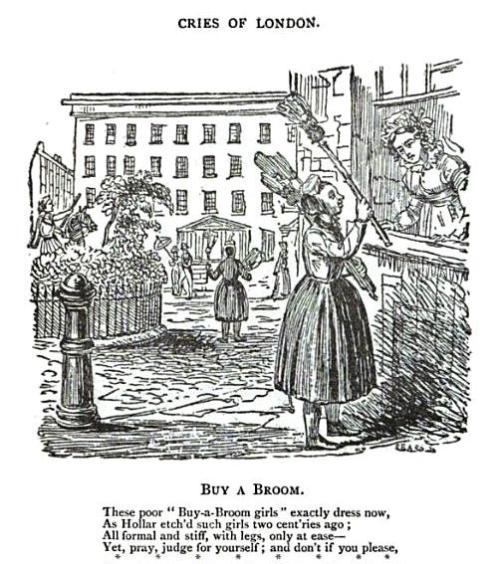
Addendum: Compared to the noises of the City, the West End’s new neighborhoods were comparatively quiet.

buy a broom 1881 cries of london

An interesting aside: To add insult to injury, one closeup of Hogarth’s etching shows a young boy relieving himself in the middle of the street. The sour smells of London added greatly to the din as well.

More on the topic:

Read Full Post »

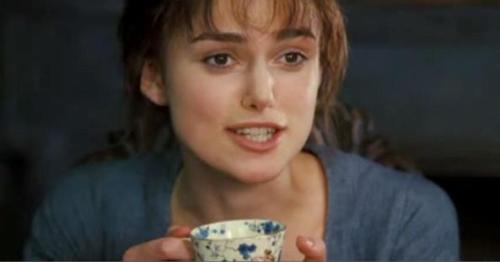
A reader is desperate to find the porcelain set used for this scene in Pride and Prejudice 2005. This was the best image she could pull from the film.

lizzy with teacup

The scene is where Jane and her family discuss whether or not she will be allowed to use the carriage for her travels to dine with Miss Bingley and Mrs. Bennet’s refusal to allow her to do so. Any help you might be able to offer in this matter is highly appreciated.

Read Full Post »

« Newer Posts - Older Posts »