Feeds:
Posts
Comments

Archive for the ‘Regency Life’ Category

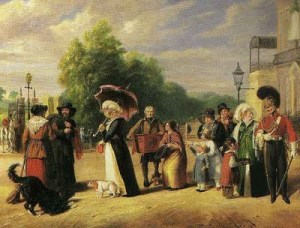
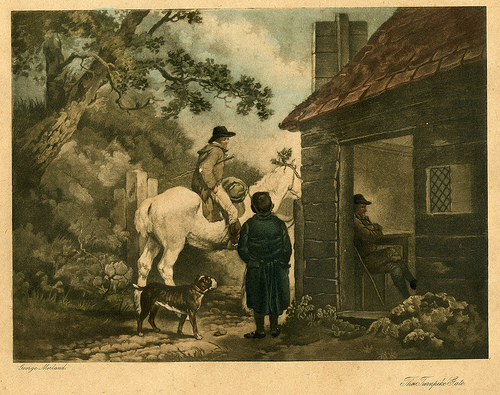
Turnpike Gate, George Morland

Turnpike Gate, George Morland

Historical romances abound with tales of aristocrats falling in love with beautiful women outside of their own class and marrying them. Several years ago in The Dairy Maid and the Master of Uppark, I wrote about Sir Harry Fetherstonhaugh, who married his milkmaid.  These exceptions prove the rule, for  Society frowned severely upon those who married downward. Thomas Thynne, 5th Viscount Weymouth, who made the mistake of falling in love with the tollgate keeper’s daughter, was never to become the 3rd Marquess of Bath.  He first eloped to Paris with his pretty bride, then lived in Italy, where he waited to claim his inheritance. No matter how hard his father (the 2nd Marquess) tried, he could not get around the legalities of the entail and disinherit his son. So the Marquess dug in his heels, willing himself to live longer than the Viscount …

The first Marquess of Bath was said to have been a great womanizer, gambler, and dissipator. His biggest contribution to posterity was in hiring Capability Brown to landscape his estate at Longleat, a former priory, changing the gardens from formal parterres to a more natural design.  After his death in 1792, his son, Thomas Thynne, the second Marquess of Bath, rebuilt the outdated portions of the old priory. By 1815, he had spent over£100,000 on improvements. In 1820, the second Marquess opened the grounds to the public once a week and free of charge, encouraging picknics and similar leisurely pursuits. One would think that by setting such a sober example, his children would live equally responsible lives, but this was not to be the case for all.
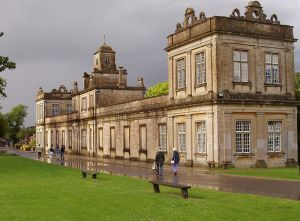
Longleat Outbuilding

The 2nd Marquess and his plumb intellectual wife, Isabella, had eleven children. Two daughers married well, but three of his sons caused them no end of trouble. Without consulting his parents, Thomas, the 24-year-old heir, eloped with beautiful, raven-haired Harriet Robbins, the daughter of a humble local toll-keeper named Thomas Robbins. Up to that point, the young Viscount had not led an exemplary life and had a reputation for drinking and gambling. The Marquess was furious with his son’s marriage.  He must have made his extreme displeasure known, for after two months of silence young Thomas replied in a letter from Italy:

You know the remorse I feel for having given so many miseries to so good a father … a sort of fate hurried us on … I saw myself surrounded by misfortunes which I find at last were of my own making … My mind was in a state of confusion and despair, and I am ashamed to say I tried to attach the blame on you. I did not dare open the last letter from you for a long time, but when I did, I flew to anything to drive away reflection…

The young Viscount was smitten by “the artful charms of a country girl, then hurled [his] fortune to the wind in hasty flight“.  The letter did not assuage the Marquess, who set about to disinherit his heir. He attempted to “bribe” Thomas by offering money in exchange for his inheritance, but the Viscount rejected the offer, opting to live in Italy while literally waiting for his father to die.
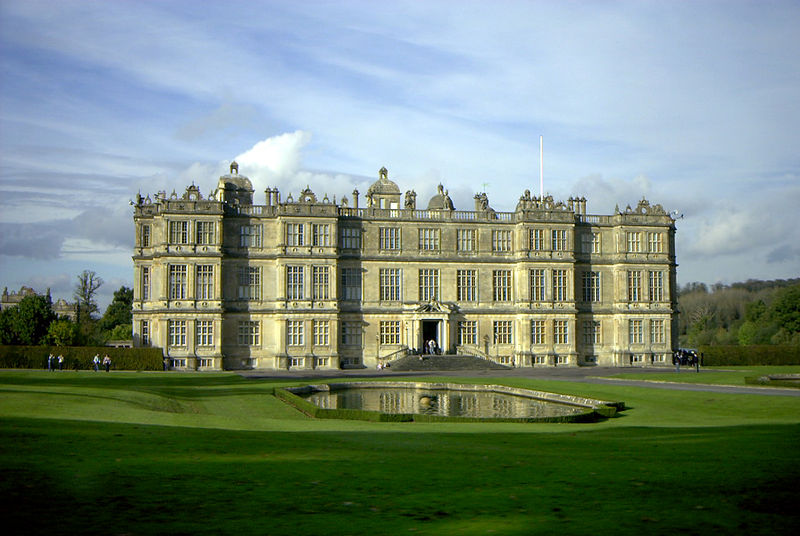
 

Longleat House. Image @Wikimedia Commons

Weymouth was not the only child to disappoint the Marquess, for two of his other three sons, Charles and Edward, lived lives of such extravagance and mounted such enormous debts, that the Marquess fired off a letter to The Times “disclaiming all responsibility for their behaviour” and any liability for their debts. Charles and Edward had expected their father to bail them out. When this did not occur, they moved from England. It is thought that Charles ended up in Canada and Edward in Australia, but the records are not clear on this topic.   Thomas’s mother, Isabella, was the only member of the family to travel to Paris to visit the Viscount and his wife. Seeing that they were reasonably happy, she forgave them for their unkindness and misconduct, but she was never able to arbitrate a truce between her husband and son. Before her death in 1830, she wrote in a letter to her husband:

Accept my grateful thanks for all the kindness and happiness you have bestowed on me for so many years, which has been returned by the warmest affection that one mortal is capable of for another…Talk to our children of your interests, of your affairs, and try to get reacquainted with theirs. Be their friend, as well as their respected father …
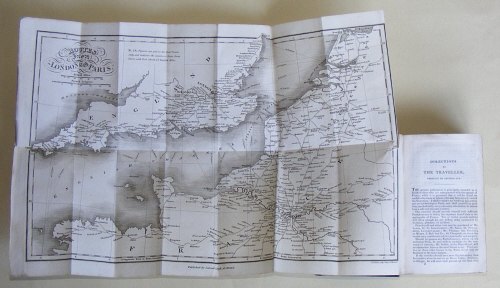
London to Paris Routes, Planta's Paris, 1825

London to Paris routes

Despite his wife’s wishes, the Marquess remained obdurate. After Isabella’s death, any hope of reconciliation vanished, and both he and his son were determined to outlive the other. In January of 1837, the Viscount died at the age of 41 without an heir. He shrugged off his mortal coil a scant five weeks before his father, who died at the age of 74.  Harriet, only a few years younger than her husband, was now a widow.

“So the family now awaited with bated breath to hear if she were pregnant. Insensitive suggestions were made about getting her to submit to an official examination so as to preclude the possibility of her turning up at Longleat in years to come, having acquired a son of approximately the right age, to claim the inheritance retrospectively.

Yet such cynicism proved unwarranted. Harriet went on to marry an Italian nobleman and never did have any children. But in any case, she did not attempt, nor wish, to give any further trouble to the Thynne family. –  Strictly Private
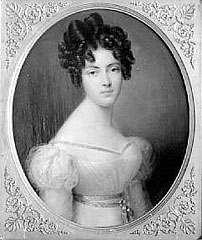
Harriet, Marchioness of Bath

Harriet, Marchioness of Bath and Henry Thynne's wife. Image @Turtle Bunbury

As for the title and the inheritance, they passed to Henry Thynne, a captain in the Royal Navy, who died soon afterwards. A Pyrrhic victory, indeed.

Facts about Harriet Matilda Robbins – Born:18 Nov 1800. Died: 18 June 1873. Daughter of Thomas Robbins. She married, Thomas Thynne, Viscount Weymouth, son of Sir Thomas Thynne, 2nd Marquess of Bath and Hon. Isabella Elizabeth Byng, on 11 May 1820. Her married name became Thynne. She married, secondly, Count unknown Inghirami after 1837, and died on 18 June 1873 at Florence, Italy. From 1837 on her married name became Inghirami.

More on this topic:

Read Full Post »

apsley house

“The last time! a going! gone.”
“Auctioneer.

“Down! down! derry down!”
“Public.

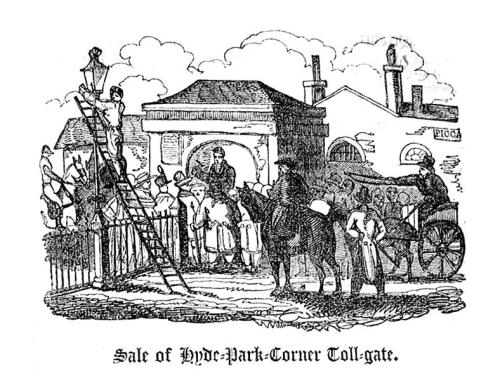
A toll-gate was moved in 1721 from Piccadilly, near Berkeley Street and the present location of the Ritz Hotel, to the west end of Hyde Park in London. It was a real barrier, its gates stretching across the road, and the area was illuminated by a dozen oil lamps before the age of gas. (London, Vol 1, Charles Knight) After passing through the toll, the first building travelers encountered was “Number One”, London, or Apsley House. The residence was named after Baron Apsley, who built the house in 1771. Its most famous and recognizable resident was The Duke Of Wellington. Hyde Park Corner tollgate was one of the busiest tollgates in London, and remained active until 1825, when it was dismantled piece by piece and sold.

Hyde Park Corner, 1822, Charles Cranmer Jr

Sir,
I have taken the liberty of enclosing you a representation of a scene which took place at Hyde-park-corner last Tuesday, October 4th, being no less than the public sale of the toll-house, and all the materials enumerated in the accompanying catalogue. If you were not present, the drawing I have sent may interest you as a view of the old toll-house and the last scene of its eventful history. You are at liberty to make what use of it you please. The sale commenced at one o’clock, the auctioneer stood under the arch before the door of the house one the north side of Piccadilly. Several carriage folks and equestrians, unconscious of the removal of the toll, stopped to pay, whilst the drivers of others passed through knowingly, with a look of satisfaction at their liberation from the accustomed restriction at that place. The poor dismantled house without a turnpike man, seemed “almost afraid to know itself”—”Othello’s occupation was gone.” By this time, if the conditions of the auction have been attended to, not a vestige is left on the spot. I have thought this event would interest a mind like yours, which permits not any change in the history of improvement, or of places full of old associations, to take place without record.

I remain, sir,
Yours, &c.
A CONSTANT READER.

sale of hyde park corner toll gate

These entries come from the October 4th Every-Day Book by William Hone, 1825-26,. The following account relates the dismantling of the property:

The sale by auction of the “toll-houses” on the north and south side of the road, with the “weighing machine,” and lamp-posts at Hyde-park-corner, was effected by Mr. Abbott, the estate agent and appraiser, by order of the trustees of the roads. They were sold for building materials; the north toll-house was in five lots, the south in five other lots; the gates, rails posts, and inscription boards were in five more lots; and the engine-house was also in five lots. At the same time, the weighing machine and toll-houses at Jenny’s Whim bridge were sold in seven lots; and the toll-house near the bun-house at Chelsea, with lamp posts on the road, were likewise sold in seven lots. The whole are entirely cleared away, to the relief of thousands of persons resident in these neighbourhoods. It is too much to expect every thing vexatious to disappear at once; this is a very good beginning, and if there be truth in the old saying, we may expect “a good ending.”

More on the Topic

Read Full Post »

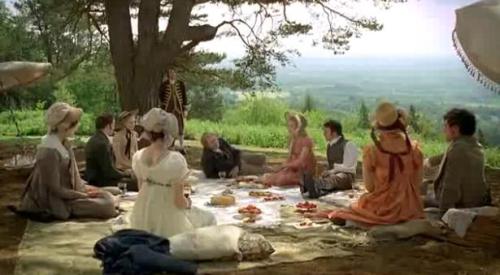
box hill3

The incident at Box Hill loomed large in this episode. What did you think of the series as a whole? How did it stack up against other Emma film adaptations? Vote here.
box hill mr knightley gift of book
More polls sit below asking you how well the actors fit in their roles. To save you from fatigue, not all the show’s actors are listed.


emma mr knightley

eltons frank

bates harriet mr martin

emma and knightley kiss

Read Full Post »

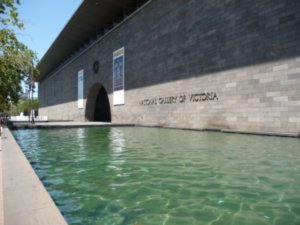
The National Gallery of Victoria

The National Gallery of Victoria

Inquiring Reader: Emma, the author of this post, lives in Melbourne, Australia. After she interviewed me for a class assignment, I asked her if she would give us her impressions of the the fabulous fashion show at the National Gallery of Victoria. Happily, she said yes. Click here to read an article on Jane Austen Today and for more images from the exhibit. I first featured this post on Jane Austen Today and decided to embellish it a little, adding more images of the museum and items in the exhibit. New links have been added, as well as additional comments about the dresses. About 50 costumes were shown in the exhibit. If you click on all the links to view images on other sites, you will see about 20% of the outfits and a few of the Regency items that accompanied them.

Entrance arch to the National Gallery of Victoria

Entrance arch to the National Gallery of Victoria

Entrance to exhibit

Entrance to exhibit

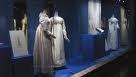
The National Gallery of Victoria has a permanent space for textile exhibits that is often overlooked by visitors. So, you can imagine my surprise when I entered the Persuasion space and found it far from empty. There were young children, middle aged couples, elderly couples and a selection of tourists, all gathered in the rooms openly admiring the clothing and documents behind their glass cases.

Exhibits with dresses, drawings and artifacts

Exhibits with dresses, drawings and artifacts

The collection was set up beautifully in their cases, decorated to become rooms – painted blue, with pianofortes, writing desks and sitting chairs.

It was interesting listening to the thoughts of those around me, with many observing the “heaviness of the walking dress” and the “gorgeous detailing on that white muslin.” Of course every woman in the room stopped to admire the outfit worn by Colin Firth in the BBC adaptation of Pride and Prejudice, no doubt reliving the lake scene.

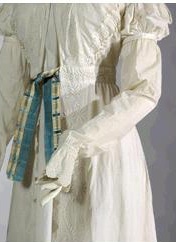
Detail, cotton muslin dress, 1815

Detail, cotton muslin dress, 1815

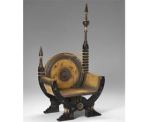
Regency chair "throne"

Regency chair "throne"

With so many pieces to choose from I had no idea how I was going to pick one or two to write about, but finally I have settled on the ball and the walking dress.

Having read many ball scenes in Austen’s works it what inevitable that I would love the ball dress. The dress was an empire line, with a skirt that went outwards into a cone shape, and the sleeves were puffed with lace detailing. It was interesting to read the plaque which revealed just how complicated the ball dress actually was – with there being gauze, embroidery with silk floss, lace, satin, piping and some sort of plants vine used in its construction.

And then there was the walking dress, a dress that I’m not sure I’d like to go for a walk in myself. I’d expected something lighter so I was very surprised by the heavy bronze satin dress in the case. It appeared very restrictive – fitted, long tight sleeves – but was incredibly beautiful and well made.

The bronze walking dress is at right

The bronze walking dress is at right

The exhibit closes at the gallery on November 8, 2009. I encourage anyone that can make it to go. It’s free of charge and definitely a collection not be to missed.

This 1802 round gown is similar to one that Jane Austen would have worn

This 1802 round gown is similar to one that Jane Austen would have worn

Click here for an audio tour of the exhibit. In it you will learn that this exhibit shows the more provincial, country dresses that were designed for walking and outdoor activities. Empire dresses allowed for a greater freedom of movement than in previous eras. The thin cotton, often low-cut gowns also revealed more of a woman’s figure than before, prompting Jane Austen to write about a vicar’s wife that she was “nakedly and expensively dressed.”
pub_Persuasion_P

Pelisse and dress, 1818

Pelisse and dress, 1818

More links to images:

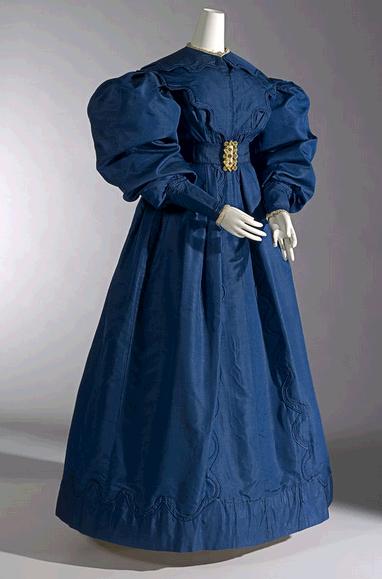
Carriage dress, silk gros de naples, 1830

Carriage dress, silk gros de naples, 1830


Photos NVG

Read Full Post »

Romola speaks as emmaEmily Hill of the Evening Standard isn’t thrilled with this adaptation of Emma:
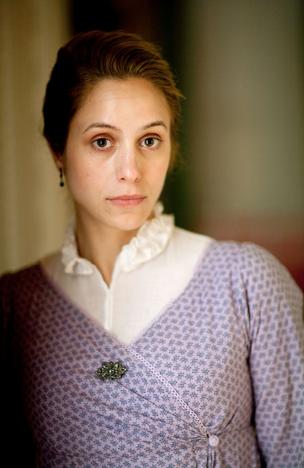
The tension of the series comes not from the characters being marooned in stuffy Regency England, but from the bizarre twenty-first-century dating psychobabble. At some point, whoever created this very pretty 9 pm drama seems to have thrown the actual novel aside and adapted the work with exclusive reference to other Jane Austen adaptations and what they think middle-aged women want to down with their end-of-Sabbath Chardonnay. Even the actors seem to be stuck in synthetic Austen-land.

My review of Emma sits at this link

Having watched 3/4 of the film, tell us what you thought of Emma, Episode Three


My rambling discourse about hair echoes my thinking about this production of Emma, for I can’t decide whether I like it or not. Count me as one of the viewers who is still sitting on the fence. I understand that the producers wanted to modernize and jazz Emma up, so that a new audience can appreciate her story. But many liberties were taken in the process,  such as with Jane Austen’s dialogue and wit, which are practically nonexistent. Let’s examine the hair styles in this film. Ringlets were in vogue at the time Jane Austen wrote the novel. They peeped out of bonnets and mobcaps. Even when hair was pulled back into a chignon, ringlets would be fashioned around the face and in front of the ears.

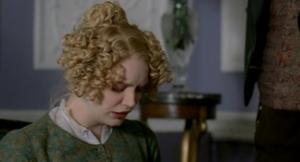
harriet smith hair
In this image, Harriet Smith’s hair style has ringlets aplenty, but is more reminiscent of the updos worn in 1826-1832, when the ringlets resembled poodle ears. Of course, this hairdo did have a certain cinematic effect, for Harriet is a bit silly and naive and the hairdo suits her personality to a tee. If you recall, Mrs. Bennet (Alison Steadman) in 1995’s Pride and Prejudice was given a similar hair do, and every time she spoke, her ringlets shook, making her seem even sillier.

Ballgown 1826

Ballgown 1826

Fashion plate 1832

Fashion plate 1832

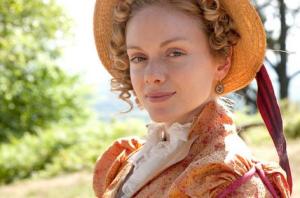
In the next image, Christina Cole (Augusta Elton), below, demonstrates the sort of hair/bonnet combination I have come to associate with the era. Her loose ringlets peep out from under her straw hat most becomingly.
augusta elton Christina Cole
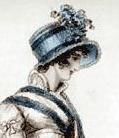
Emma was published in 1815. Let’s compare Augusta’s hair and cap to fashion plate images of the same year. Close enough, don’t you think? Her bonnet is different, but there were many modish styles to choose from and one can’t quibble with a becoming straw cap.
1815 cap and bonnet1815 bonnet

Jodhi May as Mrs. Weston

Jodhi May as Mrs. Weston

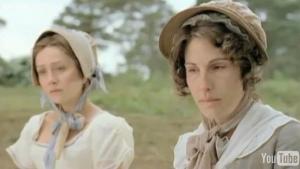
Why was such a plain and unflattering hairstyle chosen for beautiful Jodhi May? Was her hair Quakerish on purpose so that she would not compete in beauty with Emma? At this point she is no longer a governess, but the mistress of her own house and can dress herself accordingly. Even poor Miss Bates (sitting at right below) shows more attempt at “styling”.

Miss Fairfax and Miss Bates at Box Hill

Miss Fairfax and Miss Bates at Box Hill

This plain upswept chignon was adorned with simple curls in front of the ears, which would have helped Jodhi’s hairstyle immensely, making it seem more “authentic.”
chignon ringlets
In this image, Blake Ritson wears his hair a la Brutus, a style commonly worn by men in the Regency era. Poor Harriet (Louise Dylan) is stuck with the poodle style for the duration of the film.
blake ritson and louise dylan
In the image below, Blake looks like he’s about to enter Bedlam, which I suppose was his hair stylist’s intention, for Mr. Elton IS a ridiculous character. Still, Blake’s facial ticks should have been enough to clue the viewer in. We didn’t need crazy hair as well.

Did the stylists use 21st century hair gel to accomplish this style?

Did the stylists use 21st century hair gel to accomplish this style?

To be fair, men pomaded their hair and created fantastic styles. Witness Beau Brummel in 1805.

BeauBrummellKlein

beau 1805

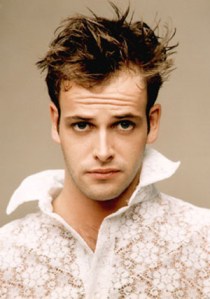
Which begs the question: Why did Jonny Lee Miller fashion his hair a la the 21st century?

Oops, wrong image

Oops, wrong image

I meant to insert this one

I meant to insert this one

Men wore their hair in many styles, some elaborate, and some quite sleek and modern to our eyes. Jonny’s hairstyle is remarkably close to McMurdo’s below, who, from the neck up would not look too out of place in today’s world.

Lieut Colonel Bryce McMurdo, 1800-1810 by Henry Raeburn

Lieut Colonel Bryce McMurdo, 1800-1810 by Henry Raeburn

Women often wore caps in bed, which they drew over their paper curlers.  Hair was washed only occasionally in those days, and caps prevented pillow cases from being soiled from accumulated oil and dirt.
harriet sick

Ok, we get it. Harriet is SICK. Where is her night cap?

I just had to include the image below. Yes, very young girls at that time wore their hair loose, and, yes, they had to be taught their manners.  (For aren’t we all little savages until our governesses teach us better?) For my finnicky taste, this image shows a woman who is much too modern in hairstyle and facial expression. At the very least, Emma would have been taught to place her hand in front of her mouth when yawning.

yawn Goodness. What would the servants have thought?

I’m still on the fence, waiting to like this film adaptation. It seems that the numbers are tanking and people are not staying with the show (a bad omen for the future of bonnet movies on BBC). Kali at StrangeGirl.com and blog author of Emma Adaptations is still liking this adaptation, although elements are starting to get on her nerves. Please feel free to agree or disagree with anything said in this post. :)

Read Full Post »

« Newer Posts - Older Posts »