Feeds:
Posts
Comments

Archive for the ‘Regency Life’ Category

Sea – Ship – drowned – Shipwreck – so it came,
The meek, the brave, the good, was gone:
He who had been our living John
Was nothing but a name. – William Wordsworth
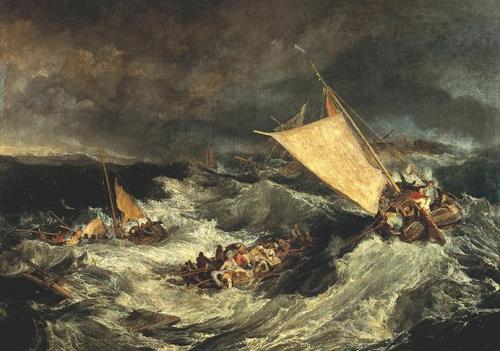
The Shipwreck, 1805, Turner

The Shipwreck, 1805, Turner

In 1805, John Wordsworth, a captain employed by the East India Company and younger brother of the poet William Wordsworth, died along with 2/3  of his crew on board the Earl of Abergavenny only 1 1/2 miles off the shoreline of Weymouth in shallow waters.  John was anxious to sail from Portsmouth, for he had invested a large sum of his own money in this trip, intending to make a fortune for himself and his family, including his brother William.
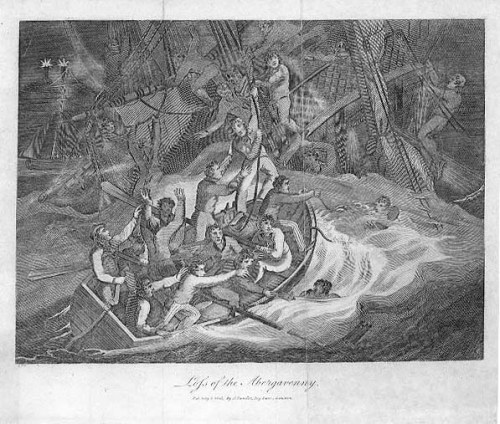
Loss of the Abergavenny

Loss of the Abergavenny

The ship, headed for India and China, carried valuable goods  such as books, lace, perfume and silver for trade, and was worth an estimated £270,000. (John’s investment represented only a tiny portion of the whole.) The Earl of Abergavenny encountered bad weather and hit an underwater shingle bank off Portland, and was “badly holed.” Taking in water, the ship was unable to reach a safe haven. Most of those who died, did so from drowning or the cold. It was surmised that John Wordsworth did not try to save himself, but clung to the ropes and drowned with his ship.
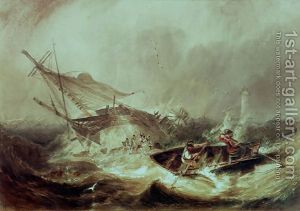
Rowing to the Rescue, Shipwrecked Sailors Off the Northumberland Coast

Rowing to the Rescue, Shipwrecked Sailors Off the Northumberland Coast

Rescuing those in distress was a perilous venture, for storm conditions made it extremely dangerous for rescuers to set out. While sea rescues were dangerous, there was a cost benefit for the local citizens, for many of the ships carried precious cargo. Once the crew had been saved, the locals could plunder the bounty after the storm had subsided, which many did. A breed of dog known as the Portland Newfoundland Sea Dog or Rescue Dog (which died out in the 19th century), was trained to rescue people in danger of drowning.
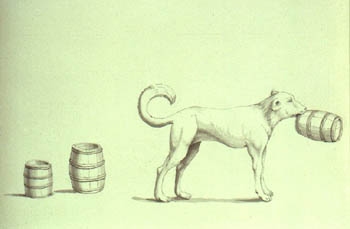
Portland Sea Dog: "portrait of a dog which brought 3 barrels of spirits out of the sea."

Portland Sea Dog: "portrait of a dog which brought 3 barrels of spirits out of the sea."

Jane Austen would most likely have heard of the loss of The Abergavenny, as well as the story of another famous tragedy, that of the Halsewell, which foundered in Weymouth Bay in 1786. This wreck was especially poignant, for the captain died along with his two daughters.
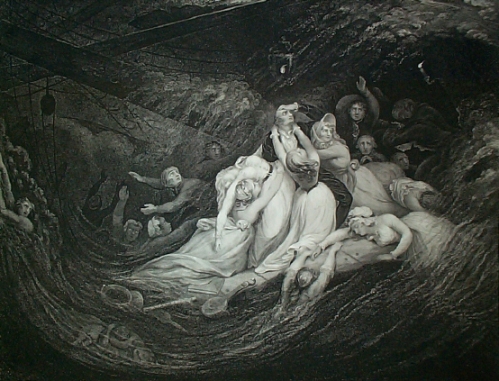
Loss of the Halsewell, Wilkinson

Loss of the Halsewell, Wilkinson

Over a hundred perished in the wreck, including the Captain, his two daughters and nieces, and the First Officer, his nephew. Another 60 seamen and soldiers, who managed to reach the cliffs, died of cold or were washed into the sea. About 70 were rescued from the cliffs. – The British Library

The tragedy, with the deaths of so many, including the women (who had joined the voyage probably in search of marriage), excited the keen interest of the public. Two ship’ officers wrote an account, which sits in the British Library. Read portions of the account in this link.
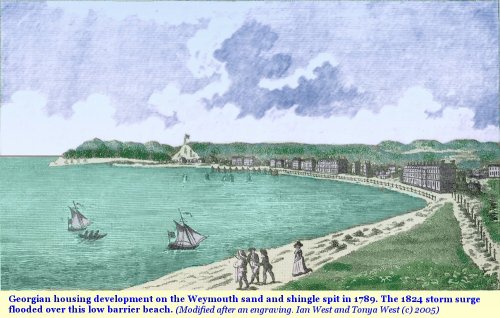

Georgian Housing development 1789

The waters off East Sussex were known for their treacherous conditions, and over 1,000 ships have wrecked in the area. Strong undertows and currents, shingle banks, and unexpected storms combine to make the area deadly.

As John Meade Faulkner wrote in his classic tale “Moonfleet” in 1898, “And once on the beach, the sea has little mercy, for the water is deep right in, and the waves curl over full on the pebbles with a weight no timbers can withstand. Then if the poor fellows try to save themselves, there is a deadly undertow or rush-back of the water, which sucks them off their legs, and carries them again under the thundering waves. It is that back-suck of the pebbles that you may hear for miles inland, even at Dorchester, on still nights long after the winds that caused it have sunk, and which makes people turn in their beds, and thank God they are not fighting with the sea on Moonfleet Beach”

Hurricane and storm surges make the area dangerous for the citizenry as well. In 1824, a storm surge swept over the shingle spit on which a Georgian housing development (pictured above) sat, and swept away parts of villages. There was extensive damage as is indicated in the image below.*
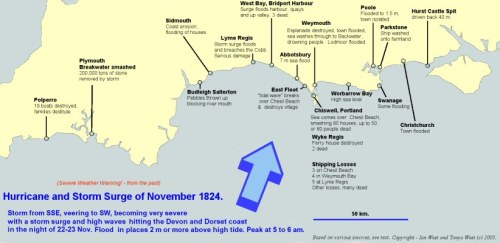
Hurricane Map, 1824
Hurricane Map, 1824

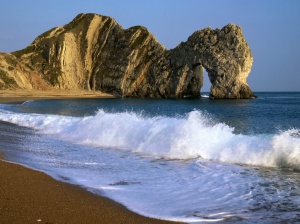
Luworth Cove, Dorset

Luworth Cove, Dorset

More Information on the Topic

JMW Turner: The Shipwreck, 1805

East Devon and Dorset World Heritage Site

Grace Galleries: Images of Shipwrecks

Dove Cottage, The Wordsworth Museum

*Geology of the Wessex Coast of Southern England.

Read Full Post »

Once upon a time children wore miniature versions of their parents’ clothing styles. Then, in 1780 or 1790, depending on the source you read, children began to be dressed differently, wearing fashions designed just for them.

Bowden Children, John Hoppner, late 18th c.

Bowden Children, John Hoppner, late 18th c.

Skeleton suit, Kate Greenaway

Skeleton suit, Kate Greenaway

Not that small boys, left to their own devices, would have worn high-waisted, ankle length trousers made of heavy cotton or linen and white cambric shirts with ruffled trim, but these “skeleton suits” as they were called were popular for at least fifty years. The pants had high waists, because they were buttoned onto the long sleeved jacket.

Although these long-sleeved, trousered suits were meant to be comfortable, they had three layers at the waist, not including underwear. Heaven knows how hot the boys must have felt in the summer or during active play! Or how quickly the white ruffed shirts soiled! Completing the outfit were white stocking, flat-soled strap slippers, and a military-style cap. The strapped slippers can best be seen in the 1841 fashion plate image at the bottom of this post.

Boy with cap

Boy with cap

A skeleton suit, one of those straight blue cloth cases in which small boys used to be confined before belts and tunics had come in … An ingenious contrivance for displaying the symmetry of a boy’s figure by fastening him into a very tight jacket, with an ornamental row of buttons over each shoulder and then buttoning his trousers over it so as to give his legs the appearance of being hooked on just under his arm pits. (Charles Dickens, Sketches by Boz, 1838-39.)

webmedia.php

Adding insult to injury, was the underwear that young boys wore under these layered clothes. This sample comes from the Manchester Art Gallery.

Detail of The Hoppner Children, 1791. Formal skeleton suit.

Detail of The Hoppner Children, 1791. Formal skeleton suit.

The smaller the boy, the more elaborately frilled the collar. Colors were generally light, with the most popular being blue or green. Sometimes the suits were made of scarlet or mustard as well. For more formal occasions, a colorful sash might be added and the trousers made of silk or velvet and trimmed with lace. A young man about to go to Eton would wear the larger Eton collar.

Detail of Fluyder Children, Sir Thomas Lawrence. Skeleton suit with sash

Detail of Fluyder Children, Sir Thomas Lawrence. Skeleton suit with sash

Detail, 1841 fashion plate

Detail, 1841 fashion plate

More Links:

Little Anne illustration, Kate Greenaway

Little Anne illustration, Kate Greenaway

Read Full Post »

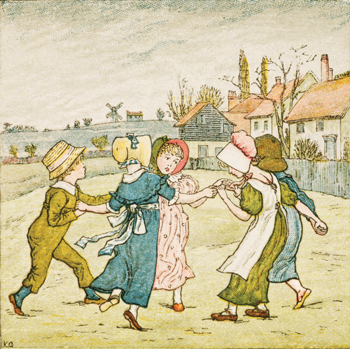
Kate Greenaway was a Victorian artist who drew incidents from every day life in the Regency era from a nostalgic point of view. Although infused with Victorian sensibility, her drawings are charming and still quite popular today. A contemporary illustrator, Walter Crane, said about her:

The grace and charm of her children and young girls were quickly recognized, and her treatment of quaint early nineteenth century costume, prim gardens, and the child-like spirit of her designs in an old-world atmosphere, though touched with conscious modern ‘aestheticism,’ captivated the public in a remarkable way.

kate greenaway different kinds of blind

For Crafters: Find free Kate Greenaway clip art at this site.


Kate was born in March 1846 in Hoxton. At the age of twenty Kate produced her first printed piece.
She also started doing greeting card, calendar and book illustrations.  One of her card designs sold over 25,000 copies in just a few weeks.  Although she was paid only 3 pounds she was starting to be noticed. Her first book [Under the Window] was produced in collaboration with Edmund Evans, with whom her father had apprenticed.  Evans spared no expense and the 20,000 copies sold almost immediately so a second printing of 70,000 was produced. –  Kate Greenaway
Today many of her illustrated books can be seen online.  The Queen of the Pirate Isle, autored by Bret Harte in 1885 and offered on Project Gutenberg, is illustrated by Kate. Check it out at this link.

Illustration from The Queen of the Pirate Isle.
In 1884,  The Language of Flowers, considered by many to be the finest of Kate Greenaway’s books, was published. Only 19,500 copies were issued in all.  While Kate continued to paint watercolours for the rest of her life, she could not match the spectacular success of her earlier career. She died in 1901.

Language of Flowers, Illustrated by Kate Greenaway, 1884

Language of Flowers, Illustrated by Kate Greenaway, 1884

Kate Greenaway by David Levine

Kate Greenaway by David Levine

More links: Listed in this section are a series of books with Kate’s masterful illustrations. 

Greenaway_11_lady_sitting

Read Full Post »

Inquiring reader, in honor of this week’s tepid heat wave in Richmond, I continue my coverage of all things seaside during the Regency era. To our moderns eyes, Regency fashions by the seashore covered as much of the body as ordinary clothes, and were as complicated as regular fashions. Let’s take a closer look.

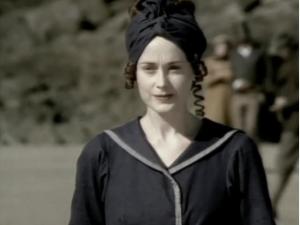
Becky Sharpe (Natasha Little) in bathing costume, Vanity Fair 1998

Becky Sharpe (Natasha Little) in bathing costume, Vanity Fair 1998

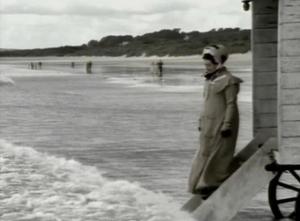
I question this image from 1998’s Vanity Fair, in which Natasha Little as Becky Sharpe looks more like a Victorian seaside gamboller than a proper Regency lady. In addition, she would have changed into this bathing costume inside the bathing machine and gone into the water largely unnoticed. She is shown in full view of both men and women on the beach wearing this outfit, which was clearly meant for swimming.

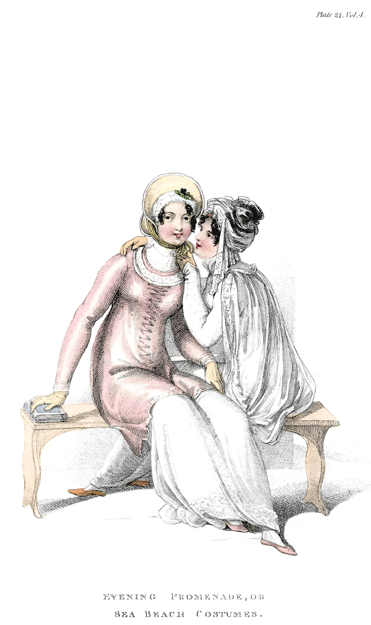
This Belle Assemblee fashion plate depicts a more demure approach to seaside fashion. The muslin gowns are rather plain, meant for the day, but it is only 1810 after all, when dress silhouettes were still classically severe. These dresses could be worn in full view of other vacationers on the beach. One sees the “wrapping” in the style of the turbans and pelisse and cape. A seaside outing was meant to be bracing and restorative, and therefore people would venture to the beach regardless of the weather.
1810_October sea beach costume

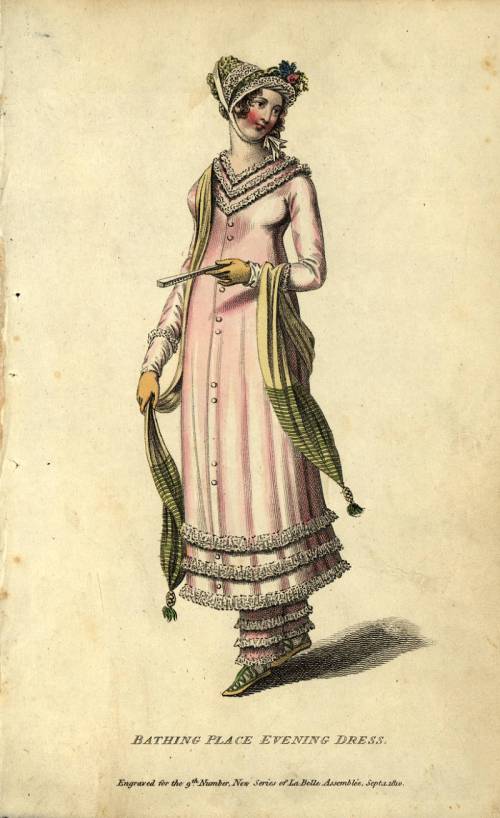
The women are sitting, or else the length of the dress would become obvious. The length of dresses meant to be worn when walking along the shore were cut a little higher, one supposes to accommodate a walk along the beach when sand and waves would wreak havoc with delicate hems. The lady in the illustration is dressed for the evening, perhaps for a fete on a public pier, who knows? Either way, she is dressed to be seen in high style, even if the tiered lacy hems of her bloomers are showing.

Bathing place evening dress, 1810

Bathing place evening dress, 1810

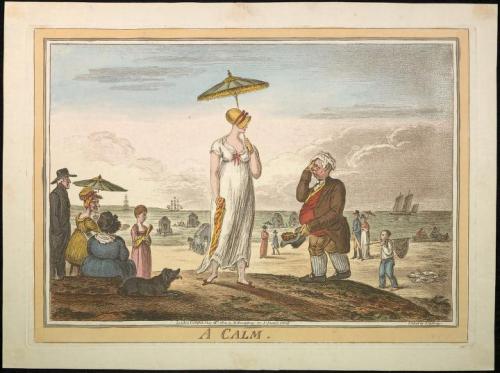
Famed illustrator James Gillray showed seaside fashion in all its glory. From the high tide hem of the lady in the center, to the completely covered up garb of the women sitting on the beach. This lovely illustration from 1810, “The Calm,” shows the seashore on a calm day, with our fashionable miss as exposed as she can decently be – her arms and neck bare, her head covered by a small straw bonnet, and her tiny parasol barely protecting her delicate skin from Sol’s harmful rays.a calm 1810 gilray
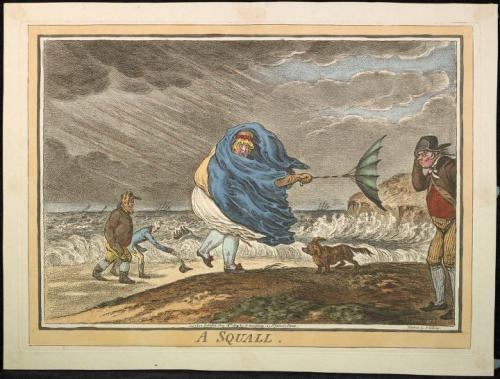
This illustration shows the sea shore on a raw day that many Britons will recognize, with the winds whipping up waves, woolen capes, and muslin skirts. Even covered up, this lady exposes more to prying eyes than was appropriate!

A squall, Gilray 1810

A squall, Gilray 1810

Taking cold dips in the ocean and drinking foul-tasting spa water were two of the health benefits derived from visiting a seaside resort. Inhaling the fresh sea air was another. These fashions again show how thoroughly one covered up before venturing out of doors.

Poetical Sketches of Scarborough, 1813

Poetical Sketches of Scarborough, 1813

Regardless of their location in or out of the water, non-swimmers remained covered up. It is ironic that once in the water, so many men and women would swim completely naked, but there you have it: Seaside, Regency style.

Steps to the sea, Vanity Fair, 1998

Steps to the sea, Vanity Fair, 1998

On a side note, a dog lover like myself will find the Gilray prints and the Scarborough print quite interesting, for dogs are prominently displayed as realistic touches.

Read Full Post »

Martha Gunn, dipper

Martha Gunn, dipper

In a scene in 1998’s Vanity Fair with Natasha Little as Becky Sharp, she visits Brighton with her husband and friends. The film, set during the Regency era, depicted a scene in which one of the party is taken from a bathing machine and dipped into the cold waters by a large woman. The bather floats on her back with her bathing costume billowing from the trapped air. This comical scene was based on fact. Brighton during the late 1790’s early 1800’s  employed some twenty male and female “dippers”” whose jobs were to vigorously dip their clients into the sea and push them through the waves, keeping them afloat, then help them back into the bathing machine.

floating with billowing skirt vanity fair 1998Brighton’s most famous dipper was Martha Gunn, a large, sturdy woman whose fame exists to this day. Bathers were separated by sex, a restriction that remained until 1930 in Brighton, and were drawn  into the waters by horses hitched to bathing machines. The bathers would be inside the vehicles changing into their bathing costumes, or not, for, screened from the world and the opposite sex, they would enter the waters au naturel. The terminology for immersion differed for the sexes. When men immersed men into the waters, it was called bathing. When women immersed women into the waters, they were dipping.
Sea Bathing machine

Sea Bathing machine

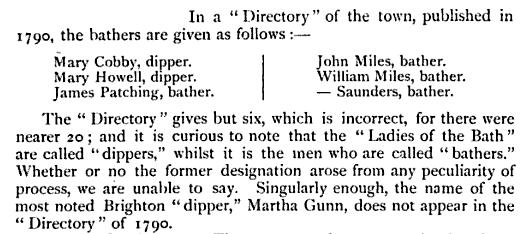
On page 233 in a Directory of Brighton published in 1790 the bathers are listed as follows:

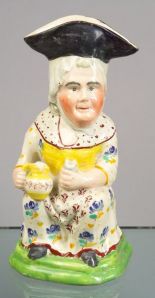
Martha Gunn Toby Jug

Martha Gunn Toby Jug

Born in 1726, Martha Gunn dipped seaside visitors from around 1750 until she was forced to retire through ill health around 1814. She was such a popular figure that the Prince of Wales granted her free access to his kitchens.  The dipper was known as ‘The Venerable Priestess of the Bath’ by the locals. Large and  strong, well known and respected by the townsfolk as well as the visitors, Marth appeared in comic caricatures of the times. “Life for Dippers and Bathers was not easy – standing all day in the sea even in August calls for a tough constitution and Martha Gunn’s ample size was no doubt one of the reasons for her success in the cold waters.” ( Martha Gunn) Mrs. Gunn died in 1815 and is buried in the yard at St Nicholas Church. Her portrait hangs in the tea-room of the Royal Pavilion, and her house still stands on 36 East Street. Her fellow dippers and bathers continued to perform their duties in Brighton until the mid 19th century.

[Dippers] were also technicians of the ritual process: on-site masters of the requirements of the sea-bathing treatment. They judged the waves, the state of their clients, and their daily requirements: bathing at such and such a time or for so long. Many of the bathers could not swim: Dippers, often women, were essential figures of dependable strength and assurance. This might explain the inordinate affection of them. The ritual purging and bathing, the ministrations of the Dipper, and the natural influence of the seashore itself with its salt water, sea air, and ‘ozone’ were vital ingredients in both the reality and perception of a Cure. – Ritual Pleasures of a Seaside Resort, Chris Jenks, p169.

Martha's grave

Martha’s grave

Read Full Post »

« Newer Posts - Older Posts »