Feeds:
Posts
Comments

Archive for the ‘Regency Life’ Category

Bathing machine

Some historians attibute the invention of the bathing machine to Benjamin Beale, a Quaker and a glove and breeches maker who lived in Margate, a coastal seaside resort in England, during the 18th century. This was not so. Beale’s actual contribution in 1750 was the invention of an awning attached to the rear of the bathing machine. The cloth hood became popularly known as a modesty hood. It could be lowered in front of the machine down to the water and provide a private bathing area for the modest swimmer. There were variations to the hood, such as a  canvas awning called a lift, which could be extended over the back of the cart like a tent and completely hide the bather from view. An additional benefit of the hood was that it also protected delicate skin from the sun.

During the 18th and 19th centuries, people did not bathe in the sea for pleasure but for their health. After the publication of the Use of Seawater in the Diseases of the Glands by Dr Richard Russell in 1752, sea bathing became more fashionable.

Ramsgate bathing machines off the High Street

Ramsgate bathing machines off the High Street

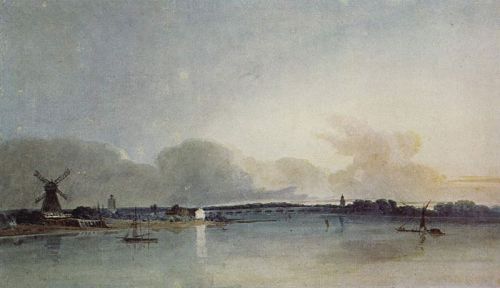
The engraving above is an early version of the of the lower High Street in Margate in Benjamin Beale’s time before the Bathing rooms were constructed. The view from the bay shows how the Bathing Machines were accessed from the lower High Street.

Woman swimming in the sea; the need for privacy in such a situation is acute

Woman swimming in the sea; the need for privacy in such a situation is acute

It was considered inappropriate for the upper and middle classes to swim in the waves together, thus bathing machines became popular. Modesty and decorum dictated that the opposite sex should bathe in isolation from each other, for nude bathing for both sexes was common until the Victorian age.  “It is believed that naked bathing continued until 1862, when a law was passed stating that male and female bathers were to be segregated by not less than 60 feet, and that all owners of bathing machines would provide gowns or dresses to female bathers and drawers or similar to male bathers.”  After swimming, bathers would re-enter the bathing machine, dry off, and change back to their street clothing. The bathing machine would be wheeled back to the beach and the bather would emerge fully dressed. “The hiring charge for a bathing machine in 1770 varied from 9d for two or more gentlemen bathing themselves to 1/6d for a gentleman taking a machine with a guide.”*

Bathing machine and attendants

Bathing machine and attendants

Imagine to yourself a small, snug, wooden chamber, fixed upon a wheel-carriage, having a door at each end, and on each side a little window above, a bench below – The bather, ascending into this apartment by wooden steps, shuts himself in, and begins to undress, while the attendant yokes a horse to the end next the sea, and draws the carriage forwards, til the surface of the water is on a level with the floor of the dressingroom, then he moves and fixes the horse to the other end – The person within being stripped, opens the door to the sea-ward, where he finds the guide ready, and plunges headlong into the water – After having bathed, he re-ascends into the apartment, by the steps which had been shifted for that purpose, and puts on his clothes at his leisure, while the carriage is drawn back again upon the dry land; so that he has nothing further to do, but to open the door, and come down as he went up – Should he be so weak or ill as to require a servant to put off and on his clothes, there is room enough in the apartment for half a dozen people. – The Expedition of Humphrey Clinker, Tobias Smollett, 1771

Beale bathing machine

Beale bathing machine

Beale did not get rich off his invention, and he was reduced to poverty after his machines were destroyed in storms.

“The public are obliged to Benjamin Beale, one of the people called Quakers, for the invention,” writes the author of A Short Description of the Isle of Thanet, published in 1796. But it was the old story; the public became grateful after the inventor had been ruined by his enterprise. His successors had reaped the harvest. Old Benjamin Beale’s widow could remember in her last days the first family that ever resorted to Margate for the purpose of bathing being carried into the sea in a covered cart. In 1803 Beale’s machines were one of the institutions of Margate. It was alarmingly claimed for them that “they may be driven to any depth into the sea by careful guides.” – New York Times, August 11, 1906

southsea_common from a lithograph from A. Pernell 1865

The design of the bathing machine changed little in 150 years, and most, except those built for the rich, remained nothing more than damp wooden boxes on wheels. In the 1865 lithograph of the Southsea above, Beale bathing machines can be seen with their awnings fully unfurled to the water.

Read Full Post »

colin darcy as vampireInquiring readers,

Mr. Darcy, Vampyre by Amanda Grange took me one month to read. For 200 pages the interminable plot seemed to twist in endless slow circles, like flotsam in the wide Sargasso Sea, before true vampyric action began. Mrs. Darcy’s (nee Bennet’s) letters, recently uncovered in a dusty attic, illuminate what actually transpired in her mind as she traveled from castle to castle during her honeymoon. Her first letter to her sister Jane can be found in the post below, or in this link. Her third letter can be read at this link. Here then, is the second of three installments. So much hoopla has surrounded this highly anticipated novel, that I felt it incumbent upon me to share all three of Lizzie’s letters.

My dearest Jane,

I must be going mad, for inexplicably I find myself living a life I would never have chosen inside a book entitled Mr. Darcy, Vampyre. First, the author, Ms Grange, has got my character wrong. Had Mr. Darcy announced before our wedding that he was planning to take me on a Grand Tour of the Continent instead of a proper honeymoon, I would have delicately persuaded him to take me to Pemberley, for it was inside that grand edifice that I expected to be fully made his bride! Instead, we have been wandering over Swiss hill and Italian dale on an aimless journey, with Mr. Darcy disappearing at the most inopportune moments. For 200 pages I have been consorting with strangers for whom I care not one whit. One even let slip that she believes she is 500 years old, at which point I heard the cuckoo clock strike thirteen times.

Jane, I am most perplexed at my husband’s continued lack of “amore”. He gives me “looks”, not of the yearning variety either, but simply “looks.” Having observed barnyard animals and their straightforward approach to reproduction, I have a good notion of where my wifely duty lies (for as we both know our parents were sadly lacking in educating us on this topic), and I know that begetting an heir requires more than merely looking. Thus I was as all prepared to shut my eyes and think of England as Mr. Darcy had his wicked way with me, but Ms. Grange has my Fitzwilliam shirking his husbandly responsibilities! In fact, I feel as if I’m trapped inside a book whose plot seems to have no point

I’ve had so much alone time on my hands that, as with Father’s study, I’ve spent hours in my husband’s Venetian library pouring over his enormous collection of books. He seems to have a strange fixation with vampyres, owning dozens of ancient, well-thumbed tomes containing vivid descriptions of immortal beings who must suck the blood of humans to survive. Does Mr. Darcy believe he is a vampyre, as the title of Ms. Grange’s book suggests? If so, is this the reason why he has been avoiding me? But of course this could not be so! For I’m as hot blooded a woman as they come, and what self-respecting vampyre could resist the rich red corpuscles pulsing through my blue veins? I have one bulging vein on my left wrist that is particularly tempting, not to mention those  that lie close to the surface of my neck. The ancient books also describe vampyres as suffering mightily from internal struggles, for they are doomed to kill those they love or turn them into vampyres, but frankly, the biggest struggle Mr. Darcy has demonstrated in this novel thus far is deciding on whether to join me for dinner  and …

Pray, is that a noise coming from the corridor? I must lay my quill aside, for perhaps it is my husband finally coming to claim my virginal self.

Mr Darcy, Vampyre coverAdieu for now! Your ever hopeful sister,
Lizzie

  • Living Girl Reads suggests that Henry Crawford, predatory male that he is, would have made a better vampyre. What think you?

Read Full Post »

Interior of Lindisfarne Priory, 1797, Thomas Girtin

Interior of Lindisfarne Priory, 1797, Thomas Girtin

Young Thomas Girtin’s painter friend was the famous artist J.M.W. Turner. As teenagers both men had been employed to color prints with watercolor paints. While Turner lived to be over seventy-five years of age, Girtin died of consumption at 27. Turner would recall in his later years: “Had Tom Girtin lived I should have starved.” No small praise.  During his short life, Girtin gained a major reputation as a watercolor artist and played an important role in establishing English Romantic watercolor paintings as an art form. As one biographer noted, “While Girtin lived, Turner followed.”  One can only imagine how fascinated young and romantically minded Catherine Morland would have been had she seen Girtin’s painting of the priory ruins.

Watercolor landscape, Thomas Girtin, 1800

Watercolor landscape, Thomas Girtin, 1800

Three years before his death, Girtin had acquired important patrons who collected his works. Thankfully the young artist had been prolific and his influence was not soon forgotten. In 1842, while sketching high in the Swiss Alps, a mature Turner, reminded of a unique effect of light in darkness, penciled a brief note in the margin of his drawing: “Girtin’s White House.”

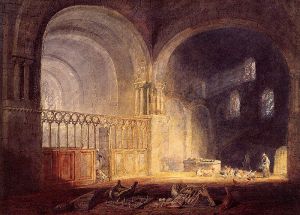
Transept of Ewenny Priory, Glamorganshire, JMW Turner, 1797

Transept of Ewenny Priory, Glamorganshire, JMW Turner, 1797

Read about Thomas Girtin in these links:

Read Full Post »

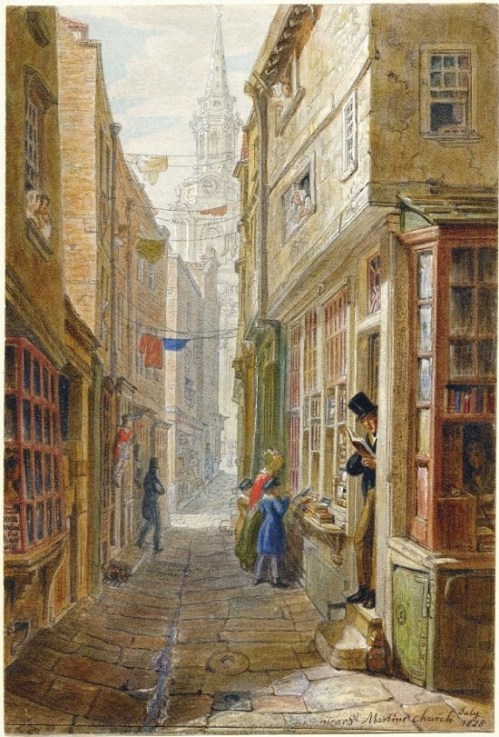
St. Martin's Church Lane, George Scharf, 1828

St. Martin's Church Lane, George Scharf, 1828

Inquiring reader:  I was visually arrested by this image of St. Martin’s Church Lane, which was painted by the German artist, George Johann Scharf (1788-1860), who lived on this street during the prime of his career. The image, painted in 1828, is a snapshot of London during George IV’s reign as king and captures the metropolis as I imagine it in those days. Born in Bavaria, George Scharf studied painting and lithography under Professor Hauber in Munich. The illustrator began traveling throughout Europe in 1810 and was caught up in the siege of Antwerp in 1814. He escaped and enlisted in the English army, where he drew maps and sketches of fortifications and troop movements. After Waterloo, Scharf moved to Paris, and in 1816 he emigrated to England and became a successful illustrator of ordinary life in England.

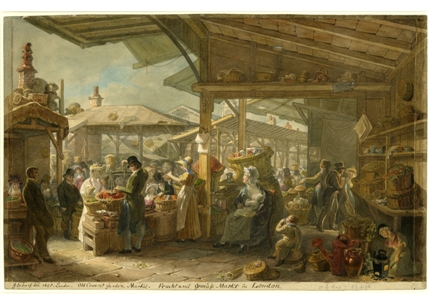
Old Covent Garden Market, 1825, George Scharf

Old Covent Garden Market, 1825, George Scharf

George Scharf has been described as the pictorial equivalent of the literary chronicler of early Victorian London, Charles Dickens. Scharf studied in Munich and became an expert in lithographic printing and miniature portrait painting. He settled in London in 1816, at a time when the capital was undergoing a dramatic expansion, and spent the rest of his life in the city. The rapidly changing face of early Victorian London is depicted in this exhibition through some 60 works. Scharf’s vivid, detailed drawings capture every aspect of ordinary life, showing people going about their daily business in fine detail – from the boots on their feet to the buttons on their coats and the hats on their heads – recorded with an immediacy that is almost photographic.

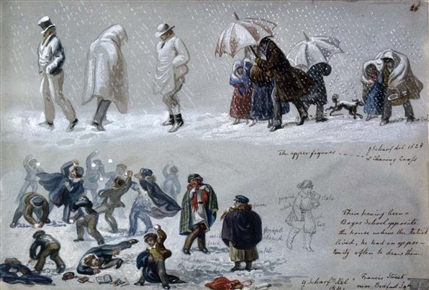
Sketches of people in snow, Scharf, 1820-30, British Museum

Sketches of people in snow, Scharf, 1820-30, British Museum

Not only do the pictures offer an interesting insight into London’s inhabitants, Scharf also precisely recreates the architectural landscape of the city. His work combines a sensitive observation of the individuals in the pictures with architectural accuracy to give a full picture of the city and its people as he saw it. In the 1820s and 1830s London experienced a huge growth in what would now be described as ‘consumer culture’ and Scharf’s pictures depict the advertising hoardings and shop signs that started to appear all around the city. They also reflect how society changed, with the introduction of gas lighting, which made the streets safer, and meant that London could start to develop a nightlife, leading to the opening of the first music halls. Private View Held By Richard Andrews, ExhibitionsNet.com

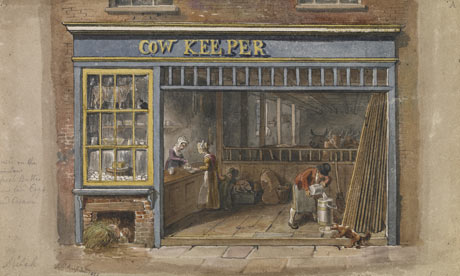
Cow Keeper's Shop, George Scharf, London 1825

Cow Keeper's Shop, George Scharf, London 1825

Once Scharf arrived in  London, he married his landlady’s sister. London was then a thriving centre for lithography – the new printing process, and Scharf was to enjoy success with mostly topographical views and genre scenes that could be transformed into prints.* These three scenes show how dairies operated in London. Cows were milked on the premises. In the Cow Keeper’s Shop, a customer is making a purchase while the man on the right pours milk into large tin pails.

Milkmaids, George Scharf

Milkmaids, George Scharf

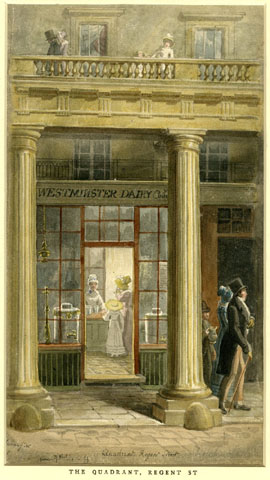
The milk was collected twice daily and taken out into the city streets by girls, usually Welsh or Irish, who carried two heavy pails on a yoke. Their routes varied, but were usually a few miles long. The girls called out through the streets and squares for customers to purchase the fresh milk.  Their cries included, “Milk below, Maids!” and “Buy any milk?” In the scene below, a wealthier class of customer makes a purchase in Westminster Dairy. City conditions for cows were not optimal, cooped up inside as they were. A few lucky beasts would spend their day grazing in Green Park, where maids sold milk by the cup.

The Quadrant, Regent St., George Scharf

The Quadrant, Regent St., George Scharf

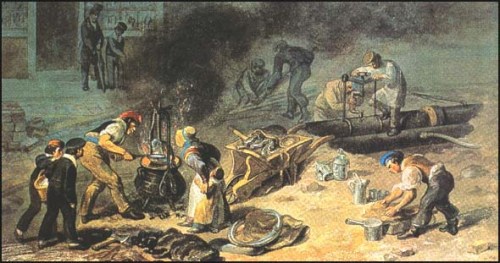
During this era, the city of London was  transformed into a modern metropolis. Massive renovations included gas lights, new canals, sewers, and water mains, creating a boon for construction. George Scharf captured these scenes of upheaval time and again, focusing on the laborer more than the surrounding buildings.

Laying a water-main in Tottenham Court Road, George Scharf, 1834

Laying a water-main in Tottenham Court Road, George Scharf, 1834

Laying the foundations of the Lycian Room, British Museum, George Scharf, 1845

Laying the foundations of the Lycian Room, British Museum, George Scharf, 1845

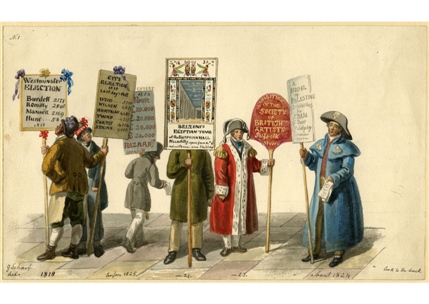
Placard carriers were a common sight in early 19th century London. People were hired to carry signs or wear sandwich boards and circulate in targeted areas.

Carrying Election Advertisements, George Scharf, Scenes of London

Carrying Election Advertisements, George Scharf, Scenes of London

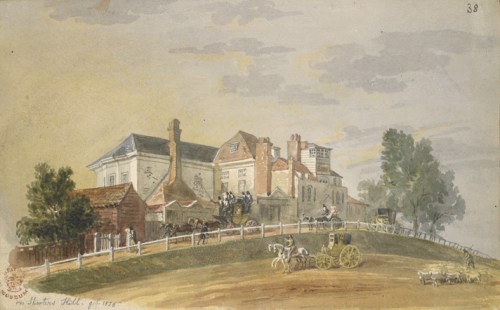
Shooter’s Hill, which offers splendid views, is the tallest point south of London. Situated along the Dover Road, it was notoriously dangerous at night, attracting highwaymen and robbers. In the 18th century a hotel was built for wealthy travelers on this spot, but Shooter’s Hill was also well known for a nearby gibbet and gallows. Samuel Pepys wrote in 1661: “I rode under a man that hangs at Shooters Hill and a filthy sight it was to see how the flesh is shrunk from his bones”. (British Library, Online Gallery)

Shooter's Hill, George Scharf, 1826

Shooter's Hill, George Scharf, 1826

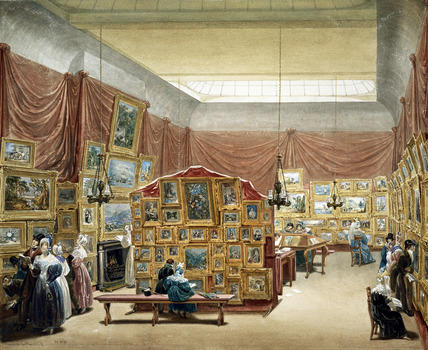
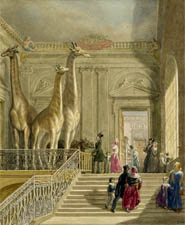
Tens of thousands of sculptures, paintings, animals, and scientific artifacts arrived from abroad during this era of exploration, war, and colonization, and were displayed in newly built museums and galleries.

The Gallery of New Society of Painters, George Scharff, The Victoria & Albert Museum

The Gallery of New Society of Painters, George Scharff, The Victoria & Albert Museum

Visitors at Montagu House, British Museum, George Scharf

Visitors at Montagu House, British Museum, George Scharf

Like today, people purchased tickets to attend art exhibitions. Painters jockeyed for prime positions for their paintings,which were hung one on top of the other. The best wall space was reserved for the better known artists or the larger, more important works.

Glass and wood cases contained artifacts brought back by explorers or filled with collections from private individuals. Exotic animals were stuffed and displayed in halls big enough to contain them.  The plundering of important artifacts and antiquities from other cultures, such as the Elgin Marbles, was controversial even then and remains controversial to this day. While some bemoaned the pillage, others enthusiastically came to see the exhibited items.

Touring, George Scharf

Touring, George Scharf

George Scharf also created  illustrations for a number of London’s scientific institutions, such as the Zoological and Geological Societies and the Royal College of Surgeons. This work brought him into contact with leading scientists, including Robert Owen and Charles Darwin.*

Forensic Trial, George Scharf, Feb 1844, London

Forensic Trial, George Scharf, Feb 1844, London

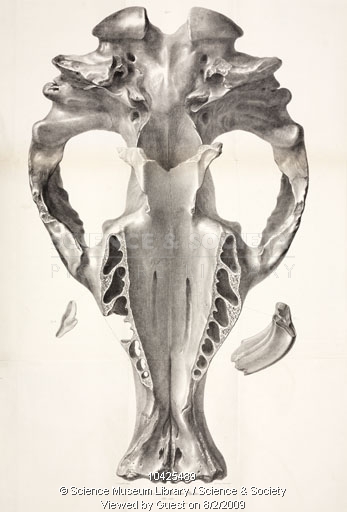
A row with Darwin over the pricing of drawings of South American fossil bones – Darwin thought he was being ripped off – curtailed this lucrative source of income and marked a decline in Schaff’s fortunes.*

Skull of toxodon platensis, 1832-1836, George Scharf

Skull of toxodon platensis, 1832-1836, George Scharf

The artist’s last years were rather abject: living apart from his family, he was reduced to trying to sell his London drawings to the City Corporation, who turned him down. He even solicited minor German royalty for a pension in exchange for all of his work, but was again rebuffed. Following his death in 1860, his wife, Elizabeth, sold over a thousand drawings and watercolours to the British Museum. *Joe Staines, The Guardian

More about the topic:


Sir George Scharf, self portrait, watercolor, 1872

Sir George Scharf, self portrait, watercolor, 1872

A short word about Sir George Scharf, George Scharf’s son (1820-1895). Sir George was a British art critic who studied in the schools of the Royal Academy. He illustrated books related to art and antiquity, largely taught and lectured, and helped to design the Greek, Roman, and Pompeiian courts at the Cyrstal palace.  Sir George Scharf was also appointed director to the National Portrait Gallery. (1911 Encyclopedia, Sir George Scharf)

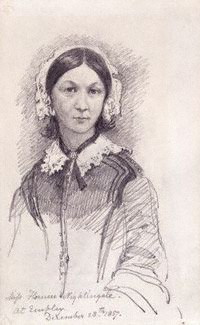
Florence Nightingale, Sir George Scharf, 1847

Florence Nightingale, Sir George Scharf, 1847

Read Full Post »

Wednesday, June 27, 1711, Mr. Addison writes a letter to The Spectator:

Mr. Spectator – Women are armed with fans as men with swords, and sometime do more excution with them. To the end therefore that ladies may be entire mistresses of the weapon which they bear, I have erected an academy for the training up of young women in the exercise of the fan, according to the most fashionable airs and motions that are now practiced at court. The ladies who carry fans under me are drawn up twice a-day in my great hall, where they are instructed in the use of their arms, and exercised by the following words of command: – Handle your fans, Unfurl your fans, Discharge your fans, Flutter your fans – By the right observation of these few plain words of commands, a woman of a tolerable genius, who will apply herself diligently to her exercise for the space of but one half-year, shall be able to give her fan all the graces that can possibly enter into that little modish machine… For the rest of Addison’s letter to The Spectator, please click here.

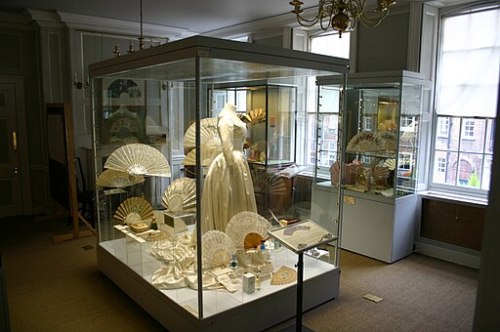
Wikimedia Commons, Image of the Fan Museum, Greenwich, UK

A lady’s fan carried far more symbolism than the mere act of cooling by agitating the air. At first considered a novelty, the fan gained popularity in Europe in the mid-sixteenth century and could be seen in the paintings of fine Elizabethan ladies. The folding fan, which was introduced from the Far East, gradually replaced the fixed fan. Made from vellum or paper, these fashionable and expensive accessories lent themselves well to elaborate painting and decoration. By 1709, fans began to be manufactured in London and a Fan Makers’ Company was established. Commemorative fans that celebrated an historic event were quite popular among the well to do, and their styles echoed the fashion of the day. Neoclassical fans, like the commemorative fan depicted above, lacked color and were generally bare of decoration, reflecting the simple white muslin dresses so popular during the Regency era. When dresses became more ornate and colorful again, fans followed the trend. They were highly prized for their aesthetics, for “in the ordinary fan of the present day Art has not strayed far from Nature.”

Over the centuries, a language of the fan evolved. Legend has it that by the time the Victorian era began fan gestures had been rigidly codified, wherein each movement and snap of the wrist carried a message fraught with meaning, although some experts dispute this. (See comment below made by Pierre Henri Biger, a fan expert.)  Once popular both during the day and evening, fans gradually became restricted only for the evening, increasing in size in the last two decades of the nineteenth century.  Their popularity waned and waxed as the quote below suggests, but until they could be cheaply manufactered in large quantities, they remained the province of only those who could afford them. In the late 19th century to early 1920’s, fans were made in profusion to carry advertisements, and were given away as souvenirs by hotels, restaurants, and businesses.*

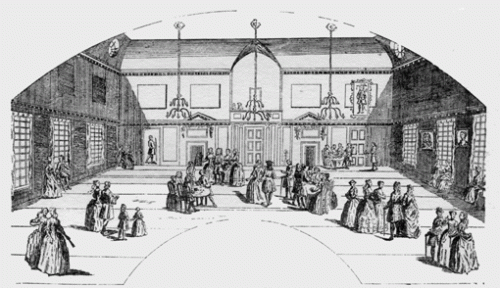
Fan Design, The Lower Rooms, Bath

Fan Design, The Lower Rooms, Bath

For just a century after Addison wrote, the fan figured prominently in polite society, matched, when the sword went out of fashion, against the snuff-box and the clouded cane, and often victorious. The satirists and dramatists wore in turn bitter and pleasant in their references to it. Painters and their sitters paraded it ostentatiously. It is said to have done wonders in diplomacy, and who could wonder at the success of flying sap and masked battery against garrisons defended by an eye-glass, a pinch of snuff, and a malacca. The fan’s apogee was in the days of the minuet de la cour. But since athletic waltzes, polkas, and mazurkas have elbowed out their courtly predecessors, the once ” modish little machine” has retired into obscurity with the “wall-flowers,” or, if at all, is used by the dancers as inartistically as though it were the archetypal ” vanne” or wind engine. Brighter days may, however, dawn, and society which, in its way back to costumes of the Watteau and Pastoral periods, has already reached the stage of short waists and long trains, may over in our time reclaim the little exile from its temporary partial shade. – Nature and Art, by Day & Sons, 1866, p62

More about this fascinating fashion accessory

Read Full Post »

« Newer Posts - Older Posts »