Feeds:
Posts
Comments

Archive for the ‘Regency Period’ Category

Available March 8, also as a Kindle book

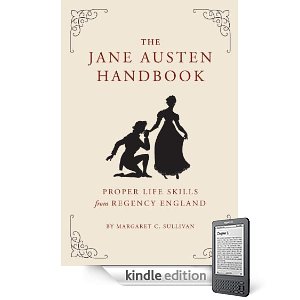
The Jane Austen Handbook: Proper Life Skills from Regency England by Margaret C. Sullivan, will be available for purchase on March 8. Ms. Sullivan, who many readers know as the editrix of Austenblog, has graciously consented to answer a few questions. Like her books and blog, her information is filled with wit and insight.

Thank you for taking the time to answer my questions, Margaret.

Hello to readers of Jane Austen’s World and thanks for having me!

1. How long did it take you to write The Jane Austen Handbook? Was it self-published at first? Who distributed the book? (I know that it sat proudly on the shelves of the gift shop at The Jane Austen Centre in Bath.)

It has always been published by Quirk Books! Just now it has a new cover. Also Quirk books are now being distributed by Random House. Before they were mostly in gift stores (Like the JA Centre–and my friend Julie Tynion sent me a photo of the book on the shelves of the gift shop at Jane Austen’s House Museum in Chawton. I think they heard my SQUEEEEE at the International Space Station.) The coolest place I think anyone told me they saw the book was the gift shop of the QE2, while she was still a cruise ship.

As to how long it took me to write it, I had six weeks between the offer and the due date for the first draft, so it was a pretty frantic time. However, the editor and I had worked out an outline so I wasn’t starting completely from scratch, and there were rewrites a little bit later, especially the section on dancing, which I think is my favorite and was greatly expanded in the rewrite stage.

I was working full-time while I was writing it as well, which in retrospect was not the smartest idea. At least near the end I should have taken some time off. I was worn out!

2. Did you approach Quirk Books or did they approach you in publishing this edition of your book?

They approached me. They already had a line of handbooks such as the Batman Handbook, the Spiderman Handbook, etc., which were usually geared towards big summer films. They wanted to do something more literary, and decided to do a Jane Austen Handbook to go along with the release of Becoming Jane. (And yes, I do realize that I am Irony’s Plaything in that regard.) The editor told me she found the blog and thought I would be a good candidate, and “stalked me online” for a few days before approaching me.

Jason Rekulak, Godfather of the Jane Austen Zombie Revolution (like I said, Irony’s Plaything), called me last year and said Random House was interested in re-releasing the book, and it was due for a reprint anyway, but they wanted a different cover. Et voila! Random House’s distribution is, I believe, more focused on traditional bookstores. Also, as a great enthusiast for ebooks, I’m really pleased that at last the Handbook will be available in digital, and I confess I’m also curious to see what the ebook will look like.

3. In regard to writing and publishing, what advice would you give a newbie writer?

As to advice for aspiring authors, I would say to always endeavor to be professional. Jane Austen was extremely professional in her dealings with publishers and fans. Then she abused them with great spirit among her friends. ;-) She was also very professional in the way she approached her craft. She worked at it and was an excellent self-editor, and knew what made a story enjoyable and what was good writing. It distresses me when authors let their emotions get the better of their professional demeanor. Bad reviews happen, and part of the job is learning to accept them, even when they hurt or don’t seem fair. Act like you’ve been there. Shoving your Published Author status in people’s faces seems vulgar to me. And once you arrive, help those who come after you!

4. You’ve been visible on the blogosphere since *cough* its dark ages. Am I right in thinking that your began Austenblog in 2004? What was being the queen of the Jane fandom like back then?

Yes! I created AustenBlog during the very hot July 4th weekend of 2004, and had an official launch later that month. Back then we were excited about a new film version of P&P! Once again: Irony’s Plaything!

I certainly wasn’t the queen of the Austen fandom then, nor am I now. ;-) I don’t think there is a queen. It’s much too anarchic a group. If they don’t like something or their desires aren’t being met, they’ll go make a website or online community of their own, especially now with all the great online tools available. Also nobody really knew about AustenBlog at first. It’s always been movies that attracted the most attention, so when the last bunch of films were being made and shown was when we first attracted a lot of attention. (Say it with me: Irony’s Plaything!)

5. Tell us about the changes in Jane fandom since then and what you think of future trends for Austen aficionados.

I think the main difference is that the fandom is becoming more diverse and I think as a whole not so “particularly friendly to very severe, very intense application,” as Mr. Tilney would say. Their Jane Austen fandom goes along with lots of other interests, some inter-related and some not. There are still obsessives as well, and I’m pleased to see more people having fun with their fandom and allowing themselves to be sometimes silly with it. It’s interesting, while JASNA tends to attract the more devoted fans, I’ve noticed a bit of a culture shift over the past ten years or so. The members are becoming a little more popular culture-oriented, or at least more aware of the popular culture aspects of the fandom, even if that’s not necessarily their cup of tea. Costuming has become a lot more popular. At my first AGM in 2000, only a handful of people dressed in period costume for at least part of the conference, and in the past couple of years it’s really taken off. I think the programs are becoming more diverse, too–there is something for everyone. Janeiteism is a big tent, and I celebrate it, even while I sometimes deplore the fringier groups. ;-)

6. Your love for Henry Tilney is well known. What are the qualities about this hero that attract you so? Which scene in Northanger Abbey in particular do you find memorable?

NA was the fifth of the six novels that I’d read (MP was last) and when this charming, funny guy showed up, I was instantly attracted to his obvious intelligence and wit and general coolness, but it seemed to me that in the other four novels I’d read, the funny, charming guy turned out to be the villain. Thus, I spent the whole book waiting for the other shoe to drop. Imagine my joy when I got to the end and realized it was not only fun to love Henry Tilney, it was the right thing to do.

Henry is not only charming, but honorable. He’s very human and really not as perfect as I’d like to pretend, but he is kind to Catherine, and besides his sister is practically the only person in the book who never condescends to her or treats her like she’s stupid or tries to trick her. If his conversation sometimes goes over her head, it’s paying her a compliment in a way–the compliment of rational companionship, if I may borrow a little from Miss Dashwood!

I have many favorite scenes, but I’ve picked one out, from Vol. II, Ch. I:

Henry smiled, and said, “How very little trouble it can give you to understand the motive of other people’s actions.”

“Why? — What do you mean?”

“With you, it is not, How is such a one likely to be influenced, What is the inducement most likely to act upon such a person’s feelings, age, situation, and probable habits of life considered? — but, How should I be influenced, what would be my inducement in acting so and so?”

“I do not understand you.”

“Then we are on very unequal terms, for I understand you perfectly well.”

“Me? — yes; I cannot speak well enough to be unintelligible.”

“Bravo! — an excellent satire on modern language.”

“But pray tell me what you mean.”

“Shall I indeed? — Do you really desire it? But you are not aware of the consequences; it will involve you in a very cruel embarrassment, and certainly bring on a disagreement between us.”

“No, no; it shall not do either; I am not afraid.”

“Well, then, I only meant that your attributing my brother’s wish of dancing with Miss Thorpe to good-nature alone convinced me of your being superior in good-nature yourself to all the rest of the world.”

Catherine blushed and disclaimed, and the gentleman’s predictions were verified. There was a something, however, in his words which repaid her for the pain of confusion; and that something occupied her mind so much that she drew back for some time, forgetting to speak or to listen, and almost forgetting where she was…

For all those who say that Henry isn’t really in love with Catherine, read that scene. He is not going to pay her profuse compliments that she might not trust to be real; and when he does pay her a compliment, he does it subtly, with humor, and with that “something” that gives Catherine the collywobbles. You can practically smell the pheromones flying back and forth. That man’s in love–and so is Catherine! I think in that scene her love for Henry turns the corner from a girlish crush to a deeper and more adult feeling.

7. My assumption is that you have been to England and visited a number of places that Jane Austen lived in and visited herself. Do you have any extraordinary memories that you’d like to share with us?

I traveled to the UK in October 2005 to celebrate the 200th anniversary of the Battle of Trafalgar–I’m a big Age of Sail fan as well–with my Horatian buddies (we Hornblower fans call ourselves Horatians). While in Portsmouth I walked the ramparts, like Fanny Price, and saw the ruins of the Marine chapel where they went to church (and also was amused to see a hair stylist shop run by one Andrew Price in downtown Portsmouth–nice to see the Prices are still in town, even if they are in trade). I felt very close to Captain Wentworth and his friends there. In London, we went to the National Portrait Gallery to visit Jane’s portrait, and the British Library to see her writing desk and the manuscripts for History of England and the canceled chapters of Persuasion.

We also went to Bath, and it was a real thrill. I kept running into Jane’s characters around every corner, especially as my two favorite books are the two Bath books, Persuasion and NA. I remember walking up Milsom Street, getting to the top of the street, looking up, and seeing “Edgar’s Buildings” engraved on the wall. Walking through Laura Place, down Pulteney Street, out to see 4 Sydney Place where the Austens lived, were all amazing–especially to know that in many ways they were nearly the same as in Jane Austen’s time. I also loved going up to Camden Place and seeing how utterly perfect it was to be the home of Sir Walter Elliot. All of Bath was, quite literally, at his feet; and yet it was built on unsteady land, and did not have the proper neoclassical regularity–it was all off-center. Perfect! And a really funny moment was when we were taking the bus uptown, and asked the bus driver to let us know when we were near Camden Crescent. He looked at our cameras and, clearly not a Janeite, said, “Taking pictures, luv? You should go over to Lansdowne Crescent instead. For my money, it’s the prettiest crescent in Bath.” I wonder what Sir Walter and Miss would have said to that! It was such a delightfully Austenian moment.

And of course we went to Chawton and Steventon. They were the places I felt closest to Jane herself. Chawton was charming, so peaceful and quiet, and inspiring for a writer. Finding Steventon was not easy–it was kind of like trying to find Shangri-La. The GPS sent us to Berkshire, which of course is totally the wrong direction. We drove despairingly around Basingstoke trying to find a local who could direct us, but we were a mile away from Steventon at one point and locals just looked at us blankly when we asked if they could give us directions. Finally we found a helpful person who gave us excellent directions, and arrived at the church in late afternoon just as the rain was letting up. I loved both St. Nicholas’ churches, in Chawton and Steventon–I loved that they were both still obviously working churches, and not just tourist attractions. Jane would have really appreciated that, I think. (And thanks to Mike for driving and his lovely pianoforte playing at Chawton, and Kathleen for the companionship, snark, and hosting me in London! I should have just let you guys ring the churchbell at Steventon.)
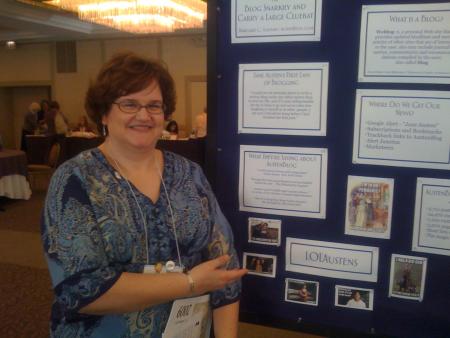
Margaret Sullivan at JASNA, 2008. Image @Laurie Viera Rigler

Margaret, it was a pleasure to interview you! I’ve seen your book and intend to review it soon. I can’t wait to read it. Vic

Thanks for the interview! This was really fun!

More on the topic:

Read Full Post »

Inquiring readers: Recently I ran across the Contracts Prof Blog, a member of the Blog Professor Blogs network. Professor Franklin G. Snyder kindly granted me permission to reprint in full a second post written by Professor Jeremy Telman of Valparaiso University on February 1, 2010. (See the first post at this link.)  This post discusses the similarities and dissimilarities between a dance partnership and a marriage partnership in Northanger Abbey:

Image @Contracts Prof Blog

Thus the dashing Mr. Tilney addresses Catherine Morland, heroine of Northanger Abbey, upon discovering her in conversation with the odious Mr. Thorpe at the commencement of a dance:

That gentleman would have put me out of patience, had he staid with you half a minute longer. He has no business to withdraw the attention of my partner from me. We have entered into a contract of mutual agreeableness for the space of an evening, and all our agreeableness belongs solely to each other for that time. Nobody can fasten themselves on the notice of one, without injuring the rights of the other. I consider a country-dance as an emblem of marriage. Fidelity and complaisance are the principal duties of both; and those men who do not chuse to dance or marry themselves, have no business with the partners or wives of their neighbours.”

The conversation proceeds on the similarities and dissimilarities between a dance partnership and a marriage partnership. But if Catherine really wanted to impress Mr. Tilney, she would have pointed out that his real complaint sounded in tortious interference rather than in breach of contract.
[Jeremy Telman]

Legal Definition of Tortious/Wrongful Intereference (in Business Relationship)

The theory of the tort or wrong of interference is that the law draws a line beyond which no one may go in intentionally intermeddling with the business affairs of others. So, a systematic effort to induce employees to leave their present employment and take work with another is unlawful when the purpose of such enticement is to cripple or destroy their employer rather than to obtain their skills and services in the legitimate furtherance of one’s own business enterprise.

It also becomes unlawful when the inducement is made through the use of untruthful means, or for the purpose of having the employees commit wrongs such as disclosing the former employer’s trade secrets. – ‘Lectric Law Library Lexicon


Read Full Post »

Inquiring readers: Recently I ran across the Contracts Prof Blog, a member of the Blog Professor Blogs network. Professor Franklin G. Snyder kindly granted me permission to reprint in full the post contributed by Professor Jeremy Telman of Valparaiso University on March 18, 2010. Professor Telman discusses a promise made in Chapter 22 of Persuasion:

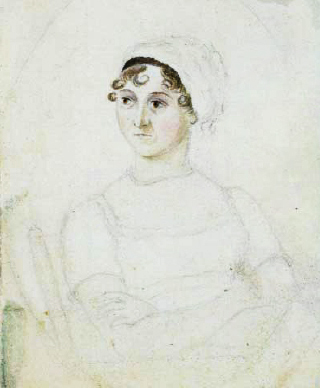
Cassandra Austen's watercolor of her sister Jane, c. 1810. Image at the National Portrait Gallery, London

Promise and Contract: Jane Austen’s Take

While thinking about the problems relating to promise and contract explored by Michael Pratt, I came across this scene from Chapter 22 of Jane Austen’s Persuasion. The setting, of course, is Bath. The characters are Charles Musgrove and his wife, Mary, the pathetic, self-pitying and miserable sister of Jane Austen’s protagonist, Anne Elliot. Charles has just announced, with something like triumph, that he had procured tickets for them all to go to the theater the following evening. His wife interrupts him:

Good heavens, Charles! how can you think of such a thing? Take a box for to-morrow night! Have you forgot that we are engaged to Camden Place to-morrow night? and that we were most particularly asked to meet Lady Dalrymple and her daughter, and Mr Elliot, and all the principal family connexions, on purpose to be introduced to them? How can you be so forgetful?”

“Phoo! phoo!” replied Charles, “what’s an evening party? Never worth remembering. Your father might have asked us to dinner, I think, if he had wanted to see us. You may do as you like, but I shall go to the play.”

“Oh! Charles, I declare it will be too abominable if you do, when you promised to go.”

“No, I did not promise. I only smirked and bowed, and said the word `happy.’ There was no promise.”

To me, this example illustrates the tension between our ordinary language sense of what it means to make a promise and Professor Pratt’s focus on promissory intent. As the doctrine of promissory estoppel recognizes, manifestations that could be reasonably expected to induce reliance and do induce such reliance can create a legal obligation. But we ordinarily think of promissory estoppel as an equitable supplement to contracts law that addresses our moral intuition that, even absent a contract, it is wrong to allow people to induce others to rely to their detriment on one’s representations. I substitute the word “manifestations” for “promise” here because I think Professor Pratt is right that what the law enforces are not “promises” but legal undertakings — that is, expressions of intent to be legally bound by a statement of future intention.

So, Charles Musgrove did not “promise” in Professor Pratt’s sense, but he may have promised in the sense of the law. His manifestations might also be regarded by others in his social circle as a promise, which suggests some tension between our intuitions about what constitutes promising and Professor Pratt’s understanding of that phenomenon. I think this places me in the camp that Professor Pratt labels “deflationist.” I suppose I’ve been called worse.

In short, we might use the word “promise” to describe both statements that bind us because through them we undertake a moral obligation and moral obligations that arise because others reasonably rely on our representations regardless of our intent. Professor Pratt thinks there are good reasons for keeping these different types of moral obligation separate, but I am not persuaded that anything is gained from the distinction.
[Jeremy Telman]

Estoppel (definition from the Business Dictionary):

Legal rule of evidence (and not a cause of action) which (1) prevents a party from making an allegation or denial that contradicts what it had previously stated, or what has been legally established, as the truth, (2) supports a claim for damages of the party that had a good-faith reliance on a misleading representation of another party.

Read Full Post »

She lost her pattens in the muck
& Roger in his mind
Considered her misfortune luck
To show her he was kind
He over hitops fetched it out
& cleaned it for her foot…
From the Middle Period Poems of John Clare (1820s)

It is commonly acknowledged that country roads in the day of Jane Austen became muddy and rutted in heavy rains, and therefore nearly impassable. In cities and towns, streets required constant sweeping of horse dung and dirt by street sweepers. Ladies wearing long white gowns and soft satin or kid slippers were constantly dodging dirt, protecting their hems from wet grass, and finding ways to walk on roads and cobblestones whose condition were poor at best.

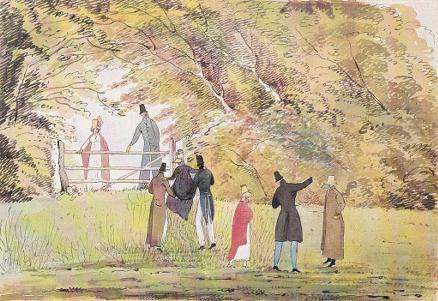
Diana Sperling's watercolor of a walk to a neighbor's house in mud

Diana Sperling painted her delightful watercolor sketches between 1812 and 1823. In two of the paintings, she shows precisely how difficult it was for ladies (and gents) to walk over poorly maintained roads – or no roads at all! One imagines that Jane Austen and her family, who were country gentry like the Sperlings, encountered similar difficulties when walking.

Charles Sperling conveys a lady over wet grass, by Diana Sperling.

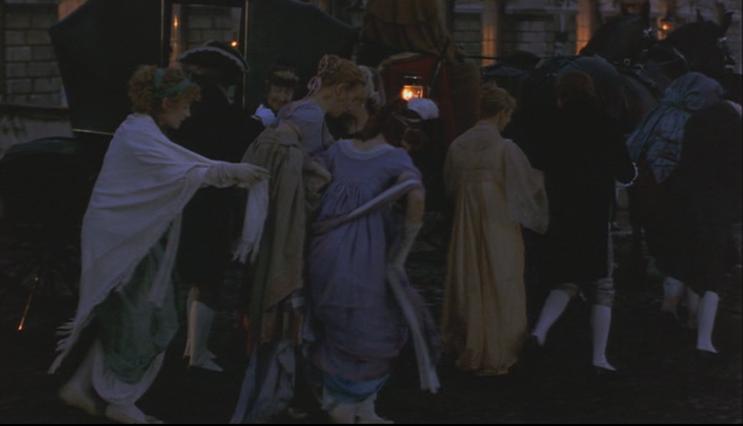
In Ang Lee’s Sense and Sensibility, one can see Marianne in particular holding up her skirts and daintily traipsing over a London street as the party walks from their carriage to the Dashwood’s ball in London. I found this scene particularly interesting, for this is one of the few films that depict how difficult it was for ladies to keep their garments clean as they walked down London’s streets. Regency women must have collectively heaved a sigh of relief when hemlines became fashionably short.


Marianne Dashwood (Kate Winslet) holds up her skirt, shawl, and reticule as she walks gingerly towards the ball.


In Rolinda Sharples' Clifton Assembly Room (1817), one can see the lady on the lower right changing her slippers in the cloak room.

The problem of keeping one’s feet and skirts clean was solved by wearing pattens, although this practice was rapidly fading in the early 19th century.


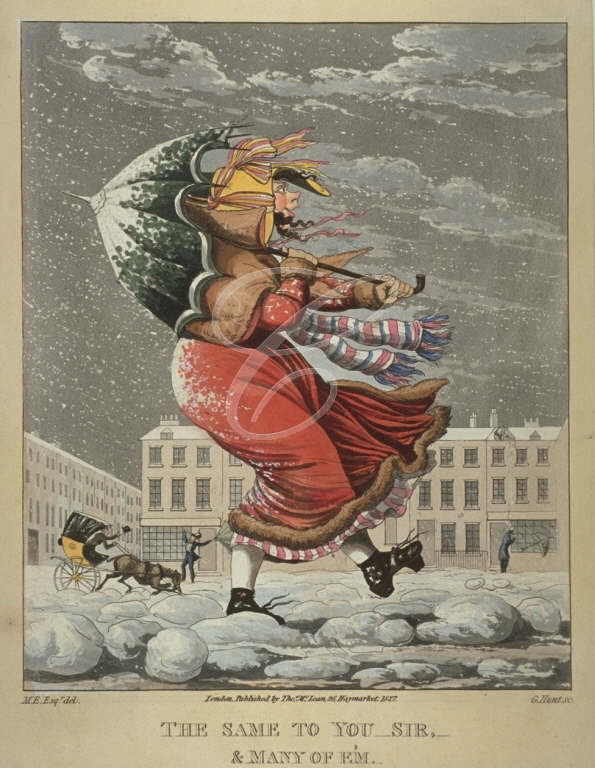
Lady wearing pattens in snow. Image @City of London

In A Memoir of Jane Austen, her James Edward Austen Leigh wrote about his aunts Cassandra and Jane:

The other peculiarity was that when the roads were dirty the sisters took long walks in pattens. This defence against wet and dirt is now seldom seen. The few that remain are banished from good society and employed only in menial work…

As an illustration of the purposes which a patten was intended to serve, I add the following epigram written by Jane Austen’s uncle Mr Leigh Perrot, on reading in a newspaper of the marriage of Captain Foote to Miss Patten

Through the rough paths of life,

with a patten your guard,

May you safely and pleasantly jog,

May the knot never slip,

nor the ring press too hard,

Nor the Foot find the Patten a clog.

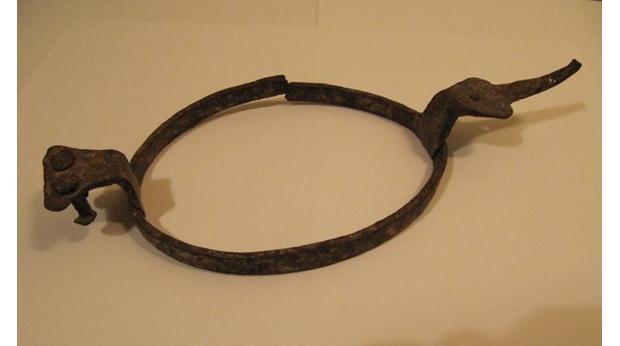
18th century fragment, iron shoe patten

A patten was an oval shoe iron that was riveted to a piece of wood and then strapped to the underside of a shoe. This unwieldy and loud contraption served to raise the shoe out of the mud or a dirty street.  Even a clean street would sully the hems of delicate white muslin gowns, and thus ladies would commonly wear pattens. However, these contraptions were loud. As Jane Austen described in Persuasion:

“When Lady Russell, not long afterwards, was entering Bath on a wet afternoon, and driving through the long course of streets from the Old Bridge to Camden Place, amidst the dash of other carriages, the heavy rumble of carts and drays, the bawling of newsmen, muffin-men, and milk-men, and the ceaseless clink of pattens, she made no complaint..”

Early 19th century pattens

Pattens had been banned from churches for some time. As early as 1390, the Diocese of York forbade clergy from wearing pattens and clogs in both church and in processions, considering them to be indecorous: “contra honestatem ecclesiae”*. An 18th century notice in St Margaret Pattens, the Guild Church of the Worshipful Company of Pattenmakers, requested that ladies remove their pattens on entering; other English churches had similar signs, and in one case, provided a board with pegs for ladies to hang them on. One surmises that churches banned the use of pattens because of their loud clatter on stone floors.

Early 19th century pattens. Image @Museum of Fine Arts, Boston

Constance Hill, who with her sister followed in the footsteps of Jane Austen a century after Jane’s death, described the noise of these raised iron clogs:

It is true that in bad weather ladies could walk for a short distance in pattens, which were foot-clogs supported upon an iron ring that raised the wearer a couple of inches from the ground. But these were clumsy contrivances. The rings made a clinking noise on any hard surface, and there is a notice in the vestibule of an old church in Bath, stating that “it is requested by the church-wardens that no persons walk in this church with pattens on.” – Constance Hill, Jane Austen: Her Homes and Her Friends

Pattens were clumsy platforms that raised the shoe a few inches from the ground. The most common patten after the 17th century was made from a  flat metal ring which made contact with the ground. The ring was then attached to a metal plate nailed into the wooden sole. By the 18th and 19th centuries, men’s shoes had thicker soles and the wealthier gentlemen tended to wear riding boots, and thus pattens were worn only by women and working-class men in outdoor occupations.  Soon, pattens were abandoned by ladies as well, and only the lower classes wore them as they went about their duties.

Pattens worn by a maid, 1773

There were three main types of pattens: one with a wooden ‘platform’ sole raised from the ground by either with wooden wedges or iron stands. The second variant had a flat wooden sole often hinged. The third type had a flat sole made from stacked layers of leather.*

18th century silk shoes protected by pattens. Image @Wall Street Journal

One can imagine the sad state of paths and roads the world over, which necessitated the use of such clumsy footwear in England, America, Turkey, and China, to name a few countries.

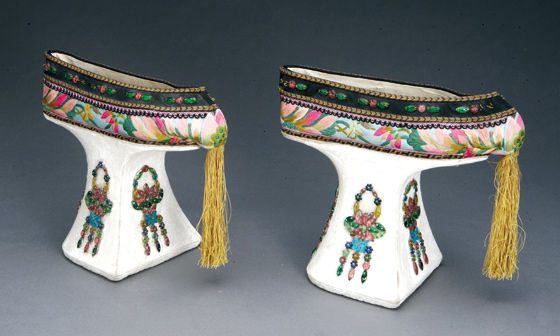
Late 19th century Chinese porcelain patten shoes

Images of pattens over the centuries:

Read Full Post »

From the desk of Shelley DeWees…An interview with Karen V. Wasylowski, author of Darcy and Fitzwilliam: A Tale of a Gentleman and an Officer

About the book: The first ever Jane Austen BROmance from debut author Karen V. Wasylowski, Darcy and Fitzwilliam: A Tale of a Gentleman and an Officer is a truly original look into the life of Mr. Darcy. Butch Cassidy has the Sundance Kid, Felix has Oscar. Darcy has…Fitzwilliam! Readers of Pride and Prejudice know that Darcy and Fitzwilliam are thick as thieves and each other’s most cherished counsel. But as strong as their bond is, the two are still polar opposites! Darcy is quiet and reserved, while the vivacious Colonel Fitzwilliam is a confirmed bachelor whose military feats have made him a hero. Cousins, best friends, and sparring partners, Darcy and Fitzwilliam have always been there for each other.

To read Shelley de Wees’s refreshing review of this debut novel, click on this link to Jane Austen Today.

1.The problems faced by the characters in Darcy and Fitzwilliam are not quaint trifles by any means. Rather than being consumed by dilemmas of fashion or gossip or health, they’re instead met with huge setbacks and major trials of spirit. They encounter serious issues of social expectations, the solutions of which require lots of thinking and personal toil. What inspired you to write this way, especially in a genre that’s usually overrun with fluffy worlds of happiness and harmony?

First of all, thank you so much for saying that because that was truly what I wanted, to portray these men as real people, not Darcy the perfect romance hero and Fitzwilliam the affable side kick, nor did I want the women to be just caricatures of femininity. Real life is a struggle, very often between men and women, and that is so much more interesting to me than ball gowns and Almacks. There is a saying that life is what happens while we are busy making other plans and that’s the truth. Love and family can bring ecstasy and make you crazy, and sometimes all at once.

2. I really admired the way Lady Catherine De Bourgh was portrayed. Witty and stubborn yet refreshingly aware of her surroundings, your representation of her was one of the more ambitious ones in Austenesque literature. What motivated you to develop her so fully?

I loved writing Lady Catherine. I could say outrageous things that made no sense. As head of the family she feels she has the right, no the obligation, to infuriate these two men and interfere in their lives because, in her eyes, they are still horrid boys. She means well, she really does, and she’s the voice of the older generation that never can quite come to terms with the younger one. In my head Judy Dench starred as Lady Catherine, looking outraged at Fitzwilliam’s filthy boots or explaining procreation to Lizzy. Judy Dench was brilliant in my head.

3. When you’re not writing or volunteering, how else do you spend your time? Do you have any other hobbies?

No, not really. We live in Florida and that’s a pretty laid back lifestyle. Eating out is a hobby here, sleeping late. I love writing but I’m not disciplined in the least and I don’t feel much confidence yet. At any moment I think I’ll never create another scene or another word and that is scary, but exhilarating.

4. Tell us about the process you engage in when you sit down to write. Do you need complete silence, or do you write in the bedroom while throwing wild parties in the livingroom? Do you stick to a schedule? Do you prefer to write barefoot? Any other weirdness you’d like to share for the sake of our fascination?

Most of the time I need silence; anything on the television in the family room will bother me and I sit at my desk and marvel at the amount of female screaming there is on television – very disturbing on many levels. Other times a car could backfire in the family room and I wouldn’t hear it. There is no rhyme or reason. I have no schedule at all, spend a great deal of time ‘getting ready’ which means I play computer chess, and solitaire, I check Facebook, answer e-mails, go into the chat rooms, read the fan fiction sites, see if anyone left a nice compliment for one of my stories there, etc. After about an hour of this I feel ready to start. And then the phone rings – I get angry, grumble that I’m being disturbed, and the whole process begins again. It’s amazing I finished a book at all.

5. Are you working on anything new? Any more beguiling tales of love and intrigue we should know about?

Well, to tell you the truth, I have two books started. One covers the time before Darcy and Fitzwilliam, centering on Lizzy and Darcy and how they coalesce into a single unit as it were. I imagine it was quite a process for him to really understand her family and for her to adjust to his status. Their differences were vast, and I don’t think we, two hundred years later, can truly appreciate how difficult their adjustment must have been. I also want to show the effects of the war on Fitzwilliam and how years of warfare had attacked his spirit, causing his slide into the sort of debauched lifestyle he was living at the beginning of Darcy and Fitzwilliam.

The second book then is the period after Darcy and Fitzwilliam. It involves their children and all the blessings and madness that go with parenthood and getting older. Only heaven knows if either book will see the light of day but it is fun to be with my boys again. I told my husband, “You know it’s like I know what goes on in their heads.” He looked at me like I was crazy and said, “Karen, you are their heads.” I had forgotten. They are that real to me.

6. Finally, is there anything else you’d like to say?

I’d like to thank Deb Werksman and Sourcebooks Landmark for publishing Darcy and Fitzwilliam. No agent would even consider me – I wasn’t a famous name, nor a celebrity. So, I defied all logic and sent my manuscript directly into the publisher who gave me my chance. It proves that if you really love what you are doing and if you have faith in it, anything is possible. Never give up.

Karen Wasylowski

About the author Karen V. Wasylowski: Karen is a retired accountant and CPA. This is her first novel. She and her husband spend much of their free time volunteering with charitable organizations in their community. Karen and her husband live in Bradenton, Florida.

About the interviewer Shelley de Wees: This is Shelley de Wees’s first interview for this blog. She has written five reviews for me – three for Jane Austen’s World and two for my other blog, Jane Austen Today. Shelley also oversees her own blog, The Uprising, which features vegan recipes. Yum. She lives in the northern U.S. I shiver just thinking about the cold at this time of year.

Image of the author taken from My Jane Austen Book Club.

Read Full Post »

« Newer Posts - Older Posts »