Feeds:
Posts
Comments

Archive for the ‘Regency Period’ Category

Happy Christmas from Jane Austen’s World

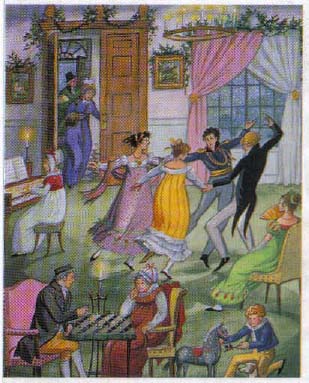

Heap on more wood! — the wind is chill;
But let it whistle as it will,
We’ll keep our Christmas merry still.
Each age has deemed the new born year
The fittest time for festal cheer.
And well our Christian sires of old.
Loved when the year its course had rolled,
And brought blithe Christmas back again,
With all his hospitable train.
Domestic and religious rite
Gave honour to the holy night:
On Christmas eve the bells were rung;
On Christmas eve the mass was sung;
That only night, in all the year,
Saw the stoled priest the chalice rear.
The damsel donned her kirtle sheen;
The hail was dressed with holly green;
Forth to the wood did merry men go,
To gather in the mistletoe,
Then opened wide the baron’s hail
To vassal, tenant, serf, and all;
Power laid his rod of rule aside,
And ceremony doff’d his pride.
The heir, with roses in his shoes,
That night might village partner choose.
The lord, underogating, share
The vulgar game of “post and pair!”
All hailed with uncontroll’d delight
And general voice, the happy night
That to the cottage, as the crown,
Brought tidings of salvation down.
The fire with well dried logs supplied,
Went roaring up the chimney wide;
The huge hail table’s oaken face,
Scrubb’d till it shone, the day to grace,
Bore then upon: its massive board
No mark to part the squire and lord.
Then was brought in the lusty brawn,
By old, blue-coated serving-man;
Then the grim boar’s head frowned on high,
Crested with bays and rosemary.
Well can the green-garbed ranger tell,
How, when, and where, the monster fell;
What dogs before his death he tore,
And all the baiting of the boar.
The wassail round in good brown bowls,
Garnished with ribbon, blithely trowls.
There the huge sirloin reeked: hard by
Plum-porridge stood, and Christmas pie;
Nor failed old Scotland to produce
At such high tide her savoury goose.
Then came the merry masquers in,
And carols roar’d with blithesome din;
If unmelodious was the song,
It was a hearty note, and strong.
Who lists may in their mumming see
Traces of ancient mystery;
White shirts supplied the masquerade,
And smutted cheeks the visor made
But oh! what masquers, richly dight,
Can boast of bosoms half so light!
England was merry England when
Old Christmas brought his sports again.
’Twas Christmas broached the mightiest ale,
’Twas Christmas told the merriest tale;
A Christmas gambol oft would cheer
A poor man’s heart through half the year.

Sir Walter Scott, 1808, from Marmion

Read Full Post »

T’is the season to purchase books for a Christmas gift or to curl up with a novel in front of a fire as the cold weather settles in.  The first book I suggested for your consideration was The Harlot’s Progress: Yorkshire Molly, by Peter Mottley, the first in a trilogy and a fictional actualization of Hogarth’s series of etchings called “The Harlot’s Progress”.  My friend, Lady Anne, wrote a review about the second holiday book, These Old Shades by Georgette Heyer, a perennial favorite.

Regency Cheshire by Sue Wilkes

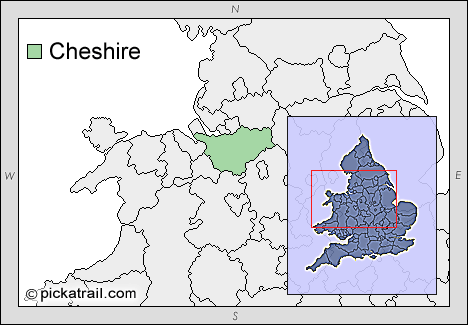
The third book on my recommendation list this holiday season is Regency Cheshire by Sue Wilkes, a history book about the Regency period in Cheshire during the early 19th Century. All I ask of a history book is accurate information about an era or region in which I am interested, and tidbits of information that will enlighten my knowledge of the past in an interesting way. This book offers both. I tend not to read history books from front to back, one of my bigger failings. I will start a chapter in the middle of a book and towards the end, before attempting the first chapters, and Regency Cheshire lends itself well to this practice. I knew very little about Cheshire before I began to read it, and am now curious to visit the area. In no particular order, here are some of the facts related in the book that I found interesting:

“Mad Jack” Mytton, the Squire of Halston Hall, drank seven bottles of port wine per day and kept two bulldogs and a pet bear. One day, Mad Jack got hiccups while drunk. Attempting to frighten them away, he set his shirt on fire with a lighted candle, an incident he survived. – p 72-73

An ailing George III celebrated his jubilee in October 1809. Churchbells rang and flags flew in Macclesfield, where a public dinner was held in his honor for 1,200 people; an ox was roasted in Chester, and the streets were decorated with patterns of colored sand in Knutsford. – p22

Chester hosted the Earl of Chester Plate, a racing event that began in 1802. Inns and private rooms filled up rapidly before race meetings, and special balls, assemblies and plays were held during race week. Along with genteel folks came beggars, blind fiddlers, and unwelcome pick-pockets. – p 71

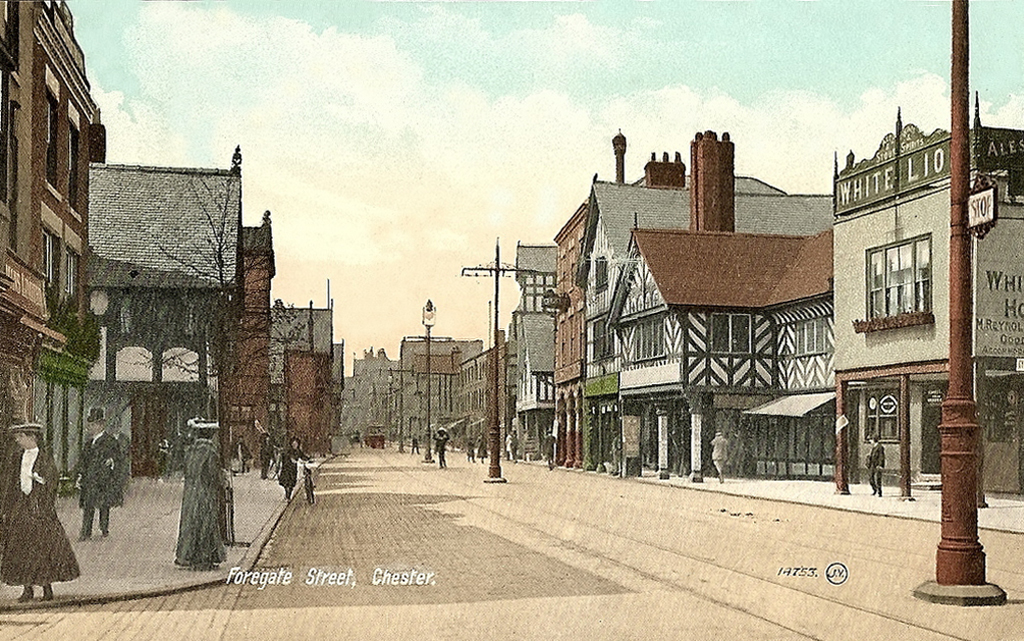
Chester circa 1900

“About 92,000 cows were kept for diary production in the first decade of the nineteenth century and approximately 11,500 tons of cheese were produced each year…Cows were milked twice a day at six o’clock in the morning and evening. The annual yield of cheese from each cow varied hugely, from 50 lb. to over 500 lb, depending on the season, quality of the soil and pasture, time of year, and how well the stock was over-wintered. About eight quarts of milk were needed to produce one pound of cheese.” – p 176-177

“Child workers helped throwsters in workshops or ‘shades’…The throwster’s helper, usually a boy, then ran to the other end of the room, carrying the other ends of the silk threads on bobbins….The throwsters twisted the silk threads by spinning the wheel. Their young helpers ran miles barefoot every day.” – p. 198

“John Wakefield, a gentleman and salt proprietor at Winnington, was accused of of fatally stabbing 21-year-old Richard Maddock, a handsome Northwich flatman. Maddock’s sweetheart, Elizabeth Woodward, a ‘smart, good-looking girl’, aged about twenty and a servant in the Wakefield’s home, was a key witness for the prosecution.  John Wakefield fell desperately in love with her and offered to take Elizabeth to London, and ‘keep me as a lady’, she testified. On the night of 8 September 1817, Wakefield discovered Maddock in the house with Elizabeth. There was a violent struggle. Later, another flatman found Maddock dying about seventy yards from the house. The jury found Wakefield guilty of manslaughter, but the judge gave him just six months in the ‘common gaol’.”- p 112

There are more fascinating stories about Regency Cheshire in this fact-filled, informative, and well-written book. If you have any interest in the Regency era or Chester in the 19th Century, I highly recommend it. Click here to order the book in the UK.

More on the topic:

Read Full Post »

Making traditional black butter

Inquiring readers: Reader Cora Harrison recently placed this comment on my blog: “In one letter, Jane [Austen] spoke of serving ‘black butter’ with wigeon and that she thought the butter was bad … Poor Jane, I thought. However, in reading a book called The Feast of Christmas I discovered that black butter was not butter at all, but what I would call a fruit cheese, made from equal quantities of apples, blackcurrants or blackberries and less sugar, and then boiled until it sets – and of course, the colour would be black!”

Her comment so intrigued me, that I decided to look up the topic. Jane wrote to her sister on December 27, 1808:

The first pot [of black butter] was opened when Frank and Mary were here, and proved not at all what it ought to be; it was neither solid nor entirely sweet, and on seeing it Eliza remembered that Miss Austen had said she did not think it had been boiled enough. It was made, you know, when we were absent. Such being the event of the first pot, I would not save the second, and we therefore ate it in unpretending privacy; and though not what it ought to be, part of it was very good.”

The recipe for making black butter, or apple butter as it is commonly known today, harkens back to medieval times. After the winter crop was picked, the preserve was made in huge quantities. In the 18th century, twenty percent of Jersey’s arable land was made up of orchards, and the tradition of producing ‘black butter’ or ‘Le Niere Buerre’ became an annual social  and festive occasion.  Jersey black butter was made from cider apples that were slowly boiled over a fire. Women would peel hundreds of pounds of apples, while the men and children would gather enough wood to keep the fire going for almost two days. After the cider was ‘reduced’ by half, apples, sugar, lemon, liquorice and spices were added. The Jersey tradition of making black butter included singing, dancing, and storytelling all through the night and until early morning. Jersey Island black butter is characterized by the addition of liquorice, which made the preserve quite dark. – RecipeZaar & BBC Jersey Black Butter.

According to Food Legends, black butter “contains no butter, the butter in the name being like the cheese in lemon cheese, more a description of the consistency and application of the product than anything else; and second, it is not really black, indeed a great deal of effort goes into avoiding the burning that would change the dark brown mass to black.” The following is likely Jane Austen’s recipe for Black Butter. Traditionally, the preserve is spread on bread, or it can be eaten by itself:

    Take 4 pounds of full ripe apples, and peel and core them. Meanwhile put into a pan 2 pints of sweet cider, and boil until it reduces by half. Put the apples, chopped small, to the cider. Cook slowly stirring frequently, until the fruit is tender, as you can crush beneath the back of a spoon. Then work the apple through a sieve, and return to the pan adding 1lb beaten (granulated) sugar and spices as following, 1 teaspoon clove well ground, 2 teaspoons cinnamon well ground, 1 saltspoon allspice well ground. Cook over low fire for about ¾ hour, stirring until mixture thickens and turns a rich brown. Pour the butter into into small clean jars, and cover with clarified butter when cold. Seal and keep for three months before using. By this time the butter will have turned almost black, and have a most delicious flavour. – Copyright Maria Hubert von Staufer March 1995

Black butter on bread

This recipe, which Cora must have at first thought Jane Austen was referring to, is a black butter that is generally served with fish, such as skate or salmon:

Black Butter: Put into a frying pan the necessary amount of butter, and cook it until it has a brown color and begins to smoke. At this moment add a large pinch of concassed parsley leaves and spread it immediately over the object to be treated. – Chest of Books

More on the topic:

Read Full Post »

Historic fruit trees were discovered in a National Trust garden in Ickworth House estate, Suffolk.

A notebook packed with unique garden history has been discovered in a filing cabinet in a gardener’s shed at the National Trust’s Ickworth estate in Suffolk. The notebook documents more than 200 varieties of local plum, gage, pear and apple trees, all planted at Ickworth from 1898 to 1930. Some of these varieties, which include Blickling, King of the Pippin, Lady Ludeley, Hoary Morning and Court of Wick, were previously unknown to Ickworth staff. – Country Life

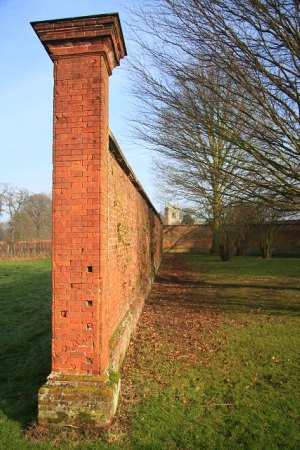
Ickworth garden wall

Re-planting of Ickworth’s historic wall fruit (fruit trees trained against the garden walls) will start in autumn 2010 when research is complete. – History Times.com

Ickworth silver garden

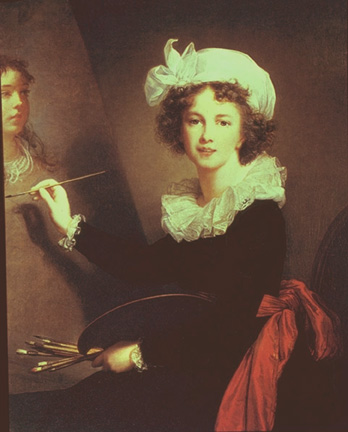
Elizabeth-Louise Vigée Le Brun, with the artist's daughter Julie as subject

Elizabeth-Louise Vigée Le Brun painted three original and authenticated self-portraits, one of which hangs in Ickworth.

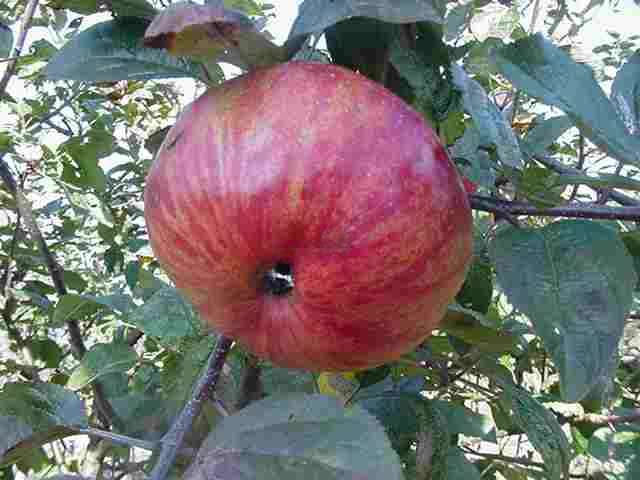
Hoary Morning apple

More on the topic:

Read Full Post »

Gentle readers, I am taking a short hiatus from this blog for Thanksgiving week. Meanwhile, enjoy these images of people dining in days of yore…

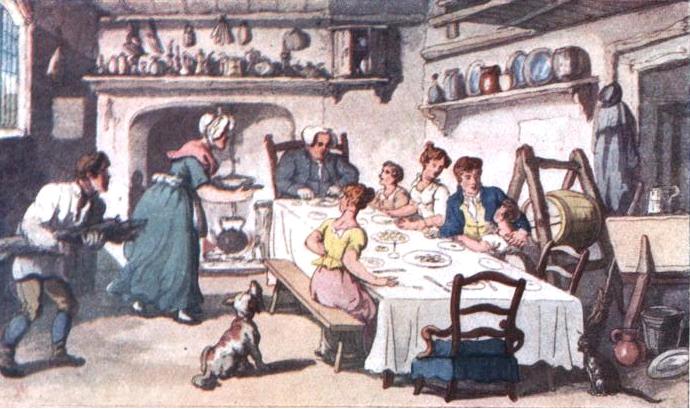
Dining for most people was a simple affair and food was taken from the land. Many families, unless their house was large enough to accommodate a dining room, ate in the kitchen.

Notice in this image of a family sharing a meal by Thomas Rowlandson (from The Vicar of Wakefield by Oliver Goldsmith), that the meal is eaten during the day and near the fire.

The rich could afford to eat by candlelight, as in this early 20th C. image of a Georgian dinner scene.

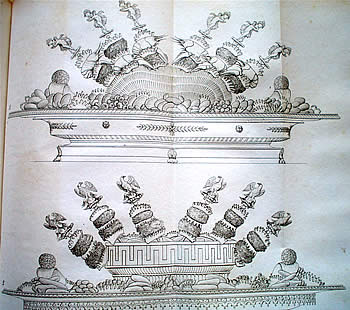
For some, like the Prince Regent, dinners were elaborate affairs.

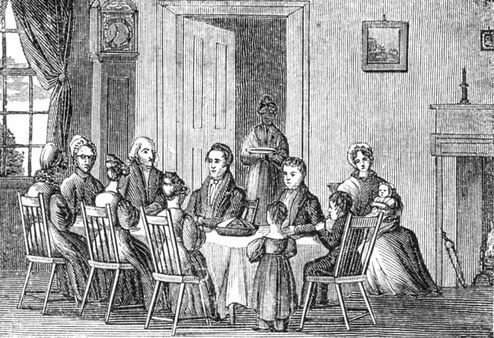
For other families the meal was more basic and simple.

Family Meal

The hours in which people ate meals were changing:

In the beginning of the sixteenth century in England, dinner, the main meal of the day, used to begin at 11:00AM. Meals tended over time to be eaten later and later in the day: by the eighteenth century, dinner was eaten at about 3:00PM…By the early nineteenth century, lunch, what Palmer in Moveable Feasts calls “the furtive snack,” had become a sit-down meal at the dning table in the middle of the day. Upper-class people were eating breakfast earlier, and dinner later, than they had formerly done…in 1808…dinner was now a late meal and supper a snack taken at the very end of the day before people retired to bed. For a long time luncheon was a very upper-class habit; ordinarily working people dined in the early evening, and contented themselves as they had done for centuries with a mid-day snack…Supper now means a light evening meal that replaces dinner; such a meal is especially popular if people have eaten a heavy lunch – The Rituals of Dinner, Margaret Visser [Penguid:New York] 1991 (p. 159-160) – Food Timeline

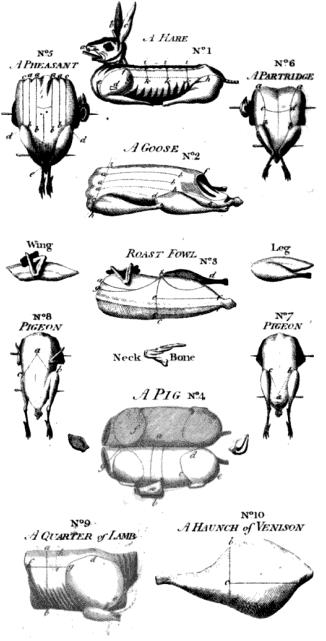
Image source: The Universal Cook: And City and Country Housekeeper, John Francis Collingwood and John Woollams, Principal Cooks at The Crown and Anchor Tavern in the Strand, 1792

Meat made up a large part of the Regency diet, even for the middle class. For most people living in London, the animals had to be brought a long way to market. Due to the length of the journey, the quality of meat was often poor. In contrast, venison and game procured from country estates and served fresh was often considered prize meat.

The Breedwell Family, Thomas Rowlandson

Families tended to be large and extended. In this boisterous family scene by Rowlandson, the Breedwells obviously bred beyond “the heir and the spare.”

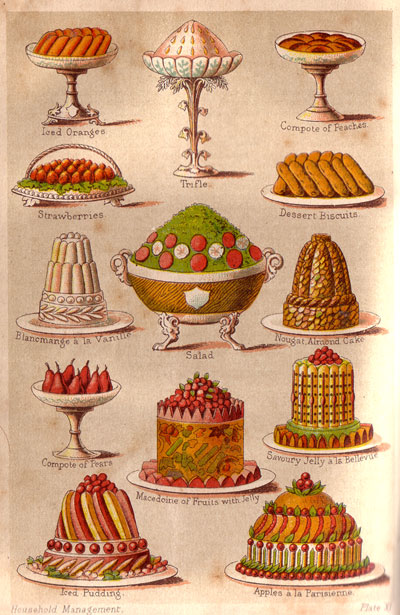
Desserts, Isabella Beaton

Desserts made up the last course of the meal. Even for the middle class this course was elaborate and plentiful, but for the rich it was spectacular.

Walled kitchen garden

Kitchen gardens provided fresh produce during the growing season. The very rich grew fruits and vegetables in hot houses, but most people ate meat, soups, or bread throughout the year. Fruit and vegetables were preserved, or, as in the case of apples and root vegetables, stored through the winter.

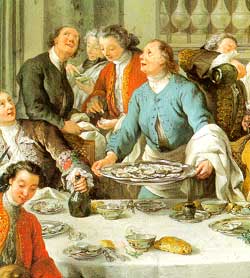
Seafood had to be served fresh and within hours of its harvest. Chances were that this tavern, where oysters were served on a platter, sits in a geographic area by the sea.

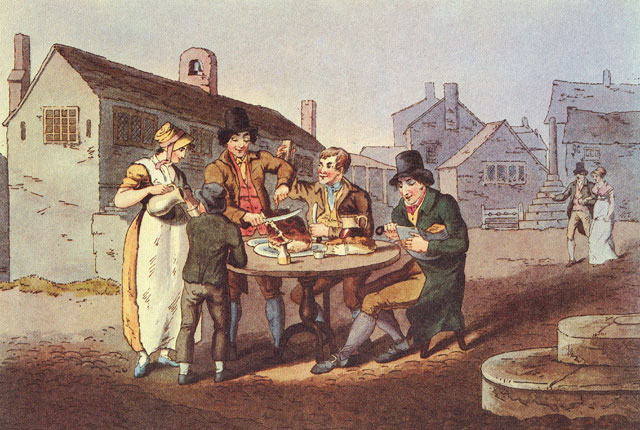
Life in Yorkshire

Elegant, or simple, the family meal meant togetherness.

Happy Thanksgiving everyone

More on the topic:

Read Full Post »

« Newer Posts - Older Posts »