Feeds:
Posts
Comments

Archive for the ‘Regency Period’ Category

In 1798, the famous caricaturist Thomas Rowlandson drew The Comforts of Bath, a series of satiric drawings. The cartoons were used to illustrate the 1858 edition of the New Bath Guide, written by Christopher Anstey and first published in 1766.* Rowlandson depicted both the social and medical scene in Bath just before the period described by Jane Austen in Northanger Abbey and Persuasion, and by Georgette Heyer in her Regency romances.

The Portrait, Comforts of Bath, 1798, Thomas Rowlandson

In this post I combined Rowlandson’s images with excerpts from an 1811 guidebook, A new guide through Bath and its environs By Richard Warner. The scenes depict the use of mineral water therapy for the invalids who flocked to Bath, a city whose fashionable post-Nash reputation was already well past its prime and whose medical men were generally regarded as quacks or, worse, “potential murderers”. The rotund gentleman in front and center of all these scenes (who undoubtedly suffered from gout, a painful rich man’s disease), was conjectured to be based after Tobias Smollet’s Mr. Bramble. In the pictorial’s subtext, notice how “Mr. Bramble’s” young wife (companion or daughter) flirts with the young officer who boldly woos her (Image above). Even while satirizing them, Rowlandson gets the social details just right. Underneath each image sits a quote from the guidebook.

King Bladud's Bath, Comforts of Bath, Rowlandson

It is fit for the patient when he goeth into the bath to defend those parts which are apt to be offended by the bath, as to have his head well covered from the air and wind and from the vapours arising from the bath, also his kidneys if they be subject to the stone, anointed with some cooling unguents as rosatum comitiffs infrigidans Galeni Santo linum &c. Also, to begin gently with the bath till his body be inured to it, and to be quiet from swimming or much motion which may offend the head by sending up vapours thither at his coming forth, to have his body well dryed and to rest in his bed an hour and sweat, etc.” – A New Guide Through Bath, 1811
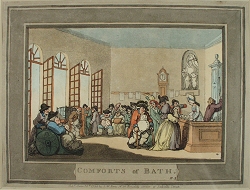
The Pump Room, The Comforts of Bath, 1798, Rowlandson

The new Pump Room supplied water from a covered pump. Before the room was built, the populace drank the waters in the open air. But the new rooms allowed them to

…  take the exercise prescribed to them sheltered from the inclemency of the weather. The work was accordingly begun in 1704, finished two years afterwards, and opened for the reception of the company under the auspices of Mr Nash, who had just then become the Arbiter Elegantiarum of Bath…A New Guide Through Bath, 1811
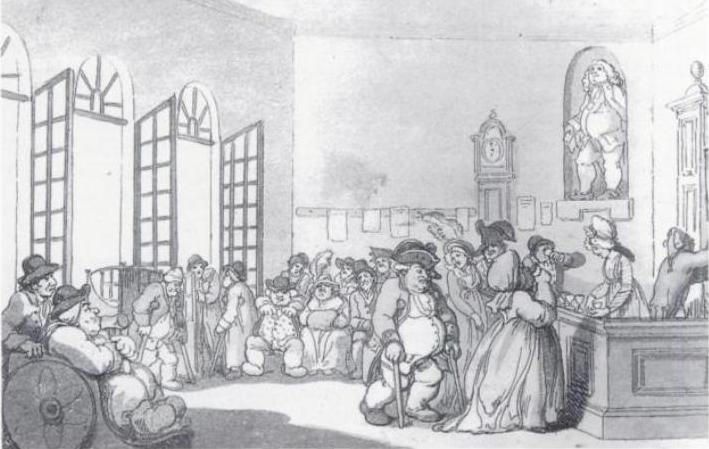
Black and White detail of above print

In the year 1751 [The Pump] Room was enlarged. Accommodated with a beautiful Portico stretching from it in a northern direction in 1786, and adorned with superb Western Frontispiece in 1791, The Corporation further beautified the city in 1796 by taking down the old Pump Room entirely and building on its site the much larger and more magnificent edifice known at present by that name…A New Guide Through Bath, 1811
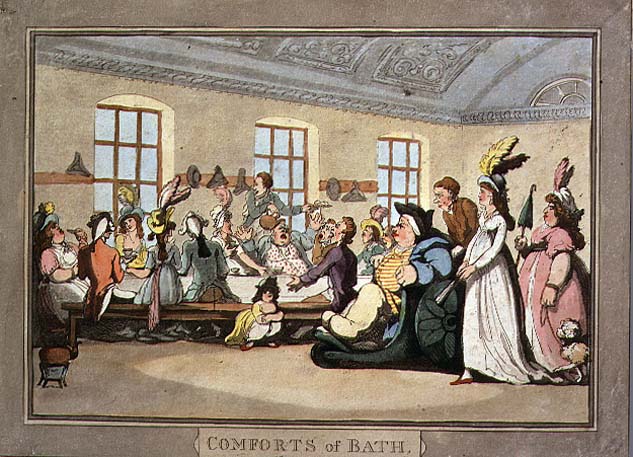
Public Breakfast, The Comforts of Bath, 1798, Rowlandson

Pertaining to the construction of  the Harrison rooms and the Assembly Rooms:

Temporary booths had hitherto been the only places in which the company could drink their tea and divert themselves with cards, but Mr Harrison, a man of spirit and speculation, perceiving that a building of this nature was much wanted and would probably make him a very suitable return, undertook at the suggestion of Mr Nash to erect a large and commodious room for the purpose of receiving the company.  The succes of this attempt induced a similar one in the year 1728, when another large room was built by Mr Thayer.  A regular system of pleasurable amusements commenced from this period, and the gay routine of public breakfasts, morning concerts, noon card parties, evening promenades, and nocturnal balls rolled on in an endless and diversified succession. – A New Guide Through Bath, 1811
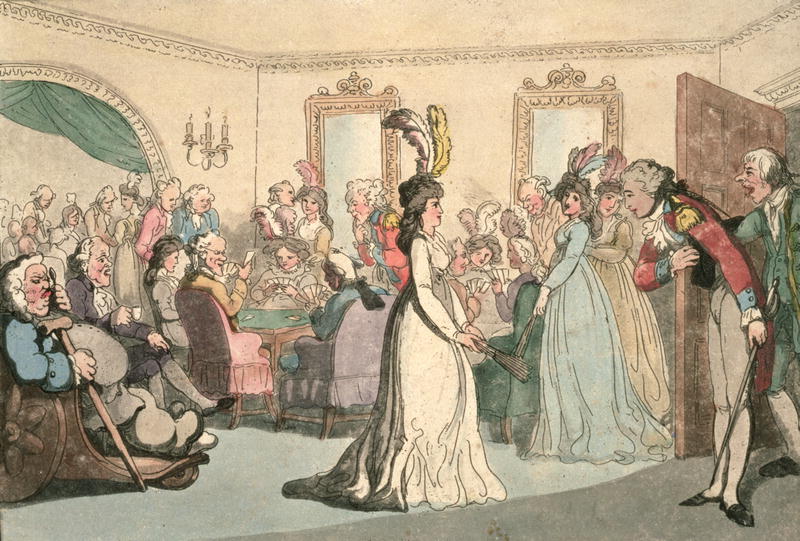
Company at Play, The Comforts of Bath, Rowlandson

Rules card games:

That no persons be permitted to play with cards left by another party;  That no hazard or unlawful game of any sort be allowed in these Rooms on any account whatever nor any cards on Sundays...A New Guide Through Bath, 1811
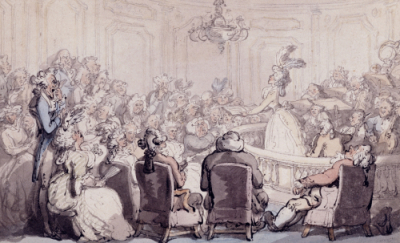
The Concert, Bath Chambers, Rowlandson

For music sweet music has charms to controul; And tune up each passion that ruffles the soul; What things have I read and what stories been told; Of feats that were done by musicians of old – The New Bath Guide, 1779
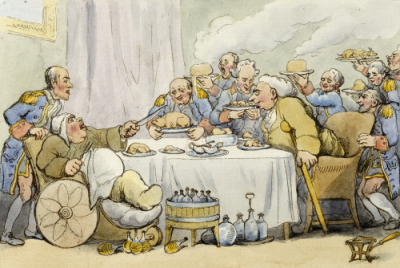
Dinner, Comforts of Bath, 1798

Bath has little trade and no manufactures; the higher clafles of people and their dependents conftitute the chief part of the population, and the number of the lower clafles being but fmall…A New Guide Through Bath, 1811
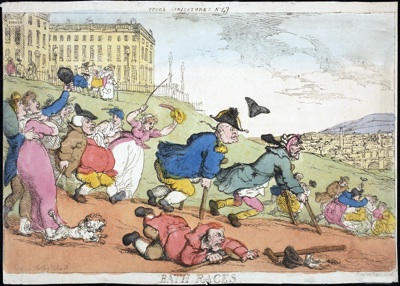
Bath Races, Rowlandson

More on the topic:

Read Full Post »

Pierre-Joseph Redouté’s flower prints are so lush and detailed that you can almost pick the flowers off the page. In the famous rose print below, a single drop of water rests exquisitely on a rose petal of the top rose. Born in a family of artists*, Pierre-Joseph became known as the premier botanical illustrator of his day (indeed, to this day). His influence spread far and wide and can be still felt in illustrations on cards, decorative boxes, books, wallpapers and prints, and calendars.

pierre-joseph-redoute

The watercolor images in this post were taken from his famous book of prints, Les Roses. Redouté, known as the “Raphael of flowers, mastered the technique of stipple engraving- in which he uses tiny dots, rather than lines, to create engraved copies of his watercolor illustrations. This new technique allowed him to make subtle variations in coloring (see the detail of the magnolia in the last image below).

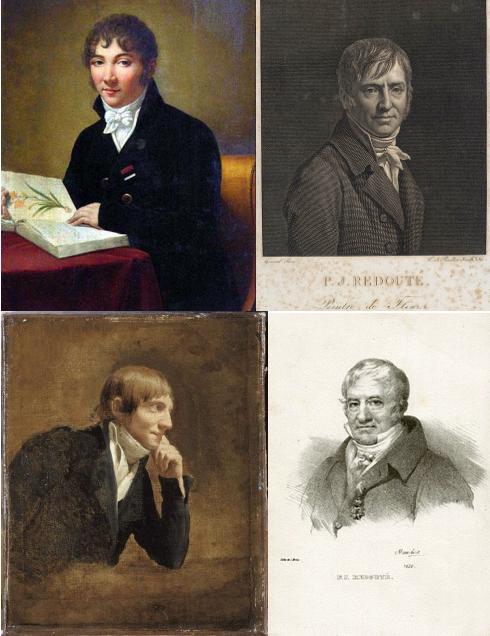
4 faces of PJ Redoute

The four faces (and ages) of Pierre-Joseph Redouté

Redouté completed the three volumes of Les Roses, his best known work, between 1817 and 1824. His most popular illustrations are assembled in Les Liliacées (486 watercolors); and Les Roses (169 watercolors). Hand-colored stipple engravings, such as the magnolia sitting at the bottom of this post, were made from these watercolors. – Discovery Editions

Rosa gallica_maheka from Redoute's Les Roses 1817-1824 Huntington LibraryJosephine, wife of Napoleon Bonaparte, was known for her spectacular garden at Chateau de Malmaison, where exotic plants were cultivated. The plants, acquired from around the world, were documented by France’s leading horticulturists and botanists, and painted by Pierre-Joseph Redouté.
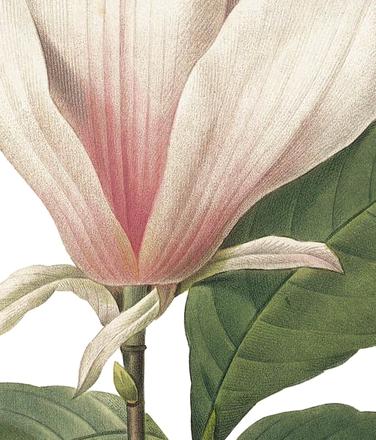
Magnolia

Detail of the magnolia engraving below.

magnolia closeup

More on this topic

Read Full Post »

Vendors of fruit and flowers, of milk and muffins are not agreeable visitors when they roar for a living, and the poor organ-grinder little knows, let us hope, the anguish he inflicts upon sensitive nerves. – Street Noises, The Illustrated London News, 1882

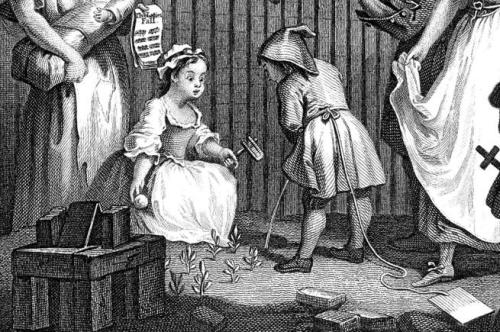
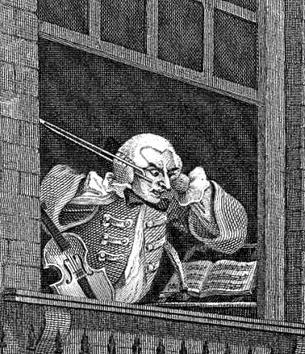
the musicianWilliam Hogarth’s famous 1741 etched engraving of ” The Enraged Musician” visually described the cacophony of sounds heard all over the city of London: the shouts of vendors, clattering of wagon wheels and clopping of horses’ hooves, impromptu concerts from street musicians, clackety-clack of ladies’ pattens (which protected delicate shoes from mud), and the clapping of hooves and bleeting of animals as drovers guided them to Smithfield Market. Laws were enacted to control these noises, but the change did not occur overnight, nor did these laws completely eliminate all irritating sounds for city dwellers. In 1841, 100 years after Hogarth engraved his famous scene, Charles Knight described London’s noises (London, Vol 1, Charles Knight, 1841):
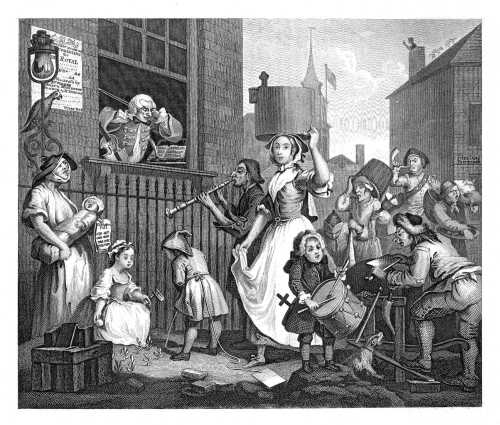
Enraged_musician William Hogarth

In this extraordinary gathering together of the producers of the most discordant sounds we have a representation which may fairly match the dramatist’s description of street noises …

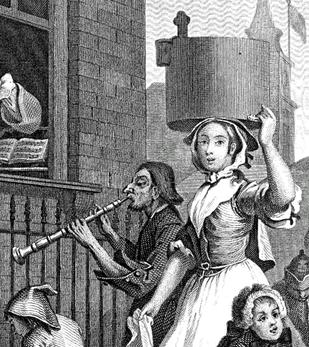
street musician and vendor

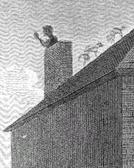
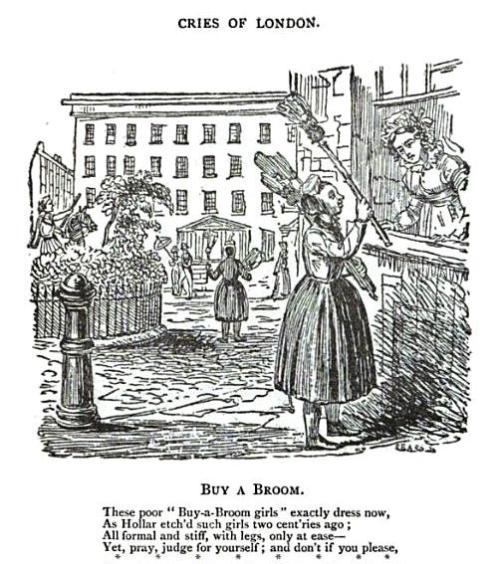
Here we have the milk maid’s scream, the mackerel seller’s shout, the sweep upon the house top, to match the fish wives and orange women; the broom men and costar mongers …

chimney boy

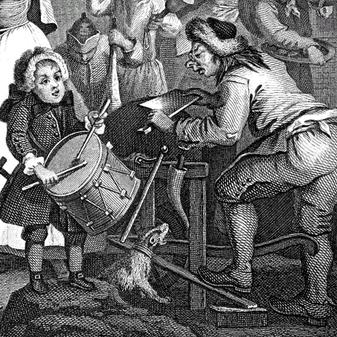
The smith, who was ominous, had no longer his forge in the busy streets of Hogarth’s time, the armourer was obsolete, but Hogarth can rival their noises with the pavior’s hammer, the sow gelder’s horn, and the knife grinder’s wheel…

drummer and knife sharperner

The waits of the city had a pension not to come near Morose’s ward, but it was out of the power of the Enraged Musician to avert the terrible discord of the blind hautboy player.

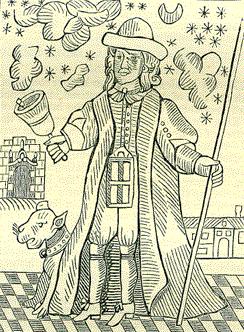
Bellman, Book of Days

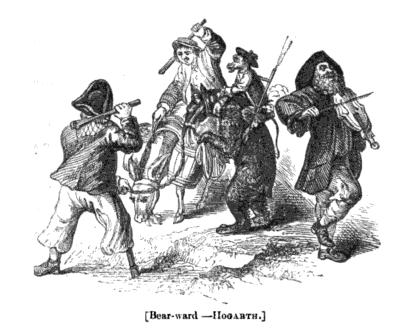
The bellman who frightened the sleepers at midnight was extinct, but modern London had acquired the dustman’s bell. The bear-ward no longer came down the street with the dogs of four parishes, nor did the fencer march with a drum to his prize …

Hogarth, Bear-Ward, Bear and Monkey

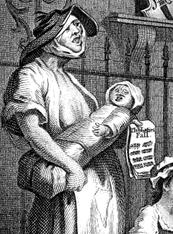
…but there was the ballad singer with her squalling child, roaring worse than bear or dog, and the drum of the little boy playing at soldiers was a more abiding nuisance than the fencer Morose, and the Enraged Musician had each the church bells to fill up the measure of discord…

crying baby

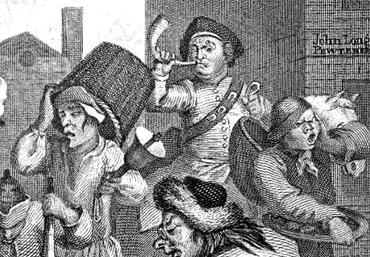
In our own days there has been legislation for the benefit of tender ears, and there are now penalties with police constables to enforce them against all persons blowing any horn or using any other noisy instrument for the purpose of calling persons together, or of announcing any show or entertainment, or for the purpose of hawking selling distributing, or collecting any article or of obtaining money or alms…

bell horn and shouts

These are the words of the Police Act of 1839, and they are stringent enough to have banished from our streets all those uncommon noises, which did something to relieve the monotony of the one endless roar of the tread of feet and the rush of wheels…

peeing in the road

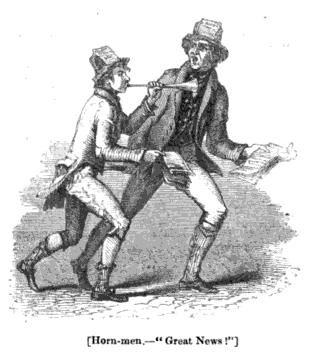
The street noise now is deafening when we are in the midst of it, but in some secluded place, such as Lincoln’s Inn Gardens, it is the ever present sullen sound of angry waves dashing upon the shingles. The horn that proclaimed extraordinary news running to and fro among peaceful squares and secluded courts was sometimes a relief…

hornmen great news

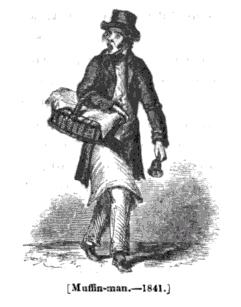
The bell of the dustman was not altogether unpleasant. In the twilight hour, when the shutters were not yet closed and the candles were not yet burnin,g the tinkle of the muffin man had something in it very soothing…

muffin man 1841

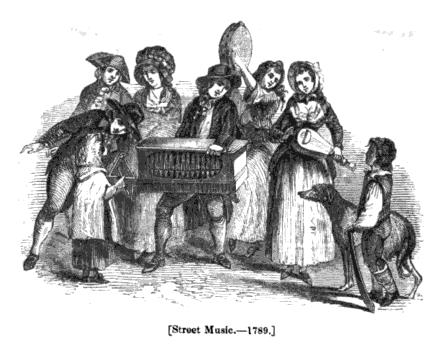
It is gone, but the legislators have still left us our street music…

street music 1789

There was talk of its abolition, but they have satisfied themselves with enacting that musicians on being warned to depart from the neighbourhood of the house of any householder by the occupier, or his servant, or by a police constable, incur a penalty of forty shillings by refusal. De la Serre, who came to England with Mary de Medici when she visited the Queen of Charles I, is enthusiastic in his praises of the street music of London In all public places … – London, Vol 1, Charles Knight, 1841

Addendum: Compared to the noises of the City, the West End’s new neighborhoods were comparatively quiet.

buy a broom 1881 cries of london

An interesting aside: To add insult to injury, one closeup of Hogarth’s etching shows a young boy relieving himself in the middle of the street. The sour smells of London added greatly to the din as well.

More on the topic:

Read Full Post »

English Pleasure Gardens

It would be very pleasant to be near Sydney Gardens; we might go into the labyrinth every day. – Jane Austen to Cassandra Wednesday, January 21, 180

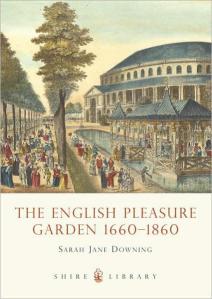
The English Pleasure Garden 1660-1860 is a small, slim volume that easily slips into my purse. I was rather skeptical that a mere 63 pages could contain very much information but I was wrong.  Sarah Jane Downing, the author, has assembled a large variety of pleasure garden images that I have not seen before, and written about the topic in a clear and readable style that was loaded with information. This book is a must for history buffs and historical romance authors who wish to write a scene set in Vauxhall or Ranelagh gardens, or perhaps in venue that is less well known, for Ms Downing writes about gardens I had not known existed.

While London’s west end boasted clean and spacious streets, the rabbit warren streets in The City were filthy, overcrowded, and dangerous. The possibility of a few hours of escape to a pleasure garden with its broad walks, decorative shrubbery, hidden bowers, music and entertainments, and fireworks drew a large number of crowds. In the 18th century, London and its environs boasted sixty-four pleasure gardens of various sizes. Aside from their obvious attraction, pleasure gardens attracted a variety of visitors from all walks of life. Aristocrats rubbed elbows with the hoi polloi, who could gain entry to even the most luxurious gardens if they could come up with one shilling for a ticket (no mean feat, for an ordinary day laborer made no more than one shilling per week.)

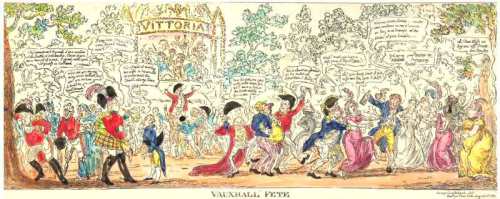
Vauxhall Pleasure Gardens

Vauxhall Pleasure Gardens

There were three kinds of public gardens people could choose from: 1) Bowling greens at pubs or tea gardens with a small but pleasant green space and limited social opportunity, 2) fashionable spa resorts that offered bowling, taking the waters, and pleasant graveled walks, and provided some entertainments, and 3) the great pleasure gardens, which were filled with glamorous and wondrous sights, and acres of lighted paths, music pavilions and private supper boxes, and arranged for a variety of fantastic entertainments, music, and dancing. The best known pleasure gardens were Vauxhall, once known as Spring Gardens, and Ranelagh Gardens, which gave Vauxhall a run for its money. Its spacious Rotunda allowed for large crowds to gather inside. Ranelagh could open in February, whereas other gardens waited until Easter.

View of a lunch party inside Ranelagh garden's famous rotunda

View of a lunch party inside Ranelagh garden's famous rotunda

Vauxhall tickets, British Museum

Vauxhall tickets, British Museum

All good things must come to an end and the gardens’ success at attracting large crowds spelled their doom. Eventually it was hard to tell the aristocrats from the poseurs, or a courtesan from a lady. As the gardens attracted an increasingly larger group of dubious people and fewer of the upper classes, their reputations suffered. Rowdy behavior, vandalism, crime, and prostitution all served to keep the “right” people away, but this development didn’t necessarily spell their death knell. They would eventually close due to competition from a distant source. The advent of cheap and rapid transportation allowed people to seek their pleasures along the grand promenades at sea side resorts, and once again the classes separated during leisure hours, each into their own niche.

This lovely little book also describes pleasure gardens outside of London – Sydney Gardens in Bath, Vauxhall Gardens in Birmingham, Tinker’s Garden in Manchester, etc. At $12.95, The English Pleasure Garden 1660-1860, loaded with color images, is a bargain. Read my post about 18th & 19th Century Pleasure and Tea Gardens in London at this link.

These links lead to more information about pleasure gardens, but they do not match the variety of information to be found in this slim volume.

Read Full Post »

Jane AustenSir Walter Elliot, of Kellynch-hall, in Somersetshire, was a man who, for his own amusement, never took up any book but the Barontage; there he found occupation for an idle hour, and consolation in a distressed one – Persuasion
Gentle reader, it is hard to name my favorite books about Jane Austen and her era. Thankfully, Laurel Ann at Austenprose has already compiled her list to wrap up Jane Austen Sibling Week, so I only need to add in my two cents worth. Where Laurel Ann concentrated on pure biographies, I shall mention the picture books that resemble the intent of this blog in both content and form:

Lane Jane Austens WorldJane Austen’s World, Maggie Lane. When I named this blog I had no idea this book existed. Maggie, who knows the period so well, writes about Jane’s life and what daily life looked like for her and her family. The illustrations are lush, and the content is presented on two pages, so that one moves from Courtship to Travel to The Royal Navy and The Picturesque seamlessly. The information is just enough for a casual reader to learn more about the era and to steer a more determined Janeite on a world of Regency era discovery.

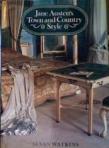
Watkins Town and Country StyleJane Austen’s Town and Country Style, Susan Watkins. I purchased this now well-thumbed book in England when it was first published. The cover is a lush photo of a bedroom in Stoneleigh Abbey, the ancestral seat of Cassandra Austen nee Leigh’s family. Themes covered include etiquette, the country house, architectural themes, fashion, and entertainment. The theme of this novel is the architectural settings and interior environments of the Regency era, and its pages linger over images and information about embroidery, gardens, furniture, wallpaper, architectural styles, fashion, etc.

Hughes Hallet My Dear CassandraMy Dear Cassandra, The Illustrated Letters of Jane Austen, Selected and introduced by Penelope Hughes-Hallet. Not only do Jane’s own observations come alive, but the letters are arranged in context of her life and images of the era. The format is excellent and very well done. Not all of Jane’s letters are included in this selection, but I would say that for those who have never read Jane’s letters before, this is a great introduction.

le faye jane austen the world of her novels (2)Jane Austen, The World of Her Novels by Deirdre Le Faye. I find it remarkable that each of these authors have a different perspective of Jane and her life. Yes, there is an overlap of information, but each author brings her own take on Jane to their book. Deirdre spends little time with Jane and her family, and devotes more pages to the novels, their settings, and images that evoke the era and region in which the books were set. Deirdre’s book contains more text and fewer images than the other books, but it is well organized and the illustrations help the reader to understand the unique places in which the novels are set and how they contribute to the story and characters.

Jane Austen An Illustrated Treasury DicksonJane Austen: An Illustrated Treasury by Rebecca Dickson. At first glance this seems like a coffee table book that is filled with illustrations. The book also features removable memorabilia, including handwritten letter, drafts, paintings, and more.  It looks like a fluff piece, because it is so beautifully designed, but the author discusses all of Jane’s novels in context of the age and with images that take your breath away. I found the font in the body of the main text annoying to read, but that is a minor quibble. This is a great gift for a budding Janeite fan in your family.

Obviously, there are many other excellent biographies about Jane Austen that Laurel Ann and I have not mentioned. These are just a few in my collection that the new Jane Austen fan will love. Jane Austen scholars have access to more scholarly works, and there are many new biographies that have been published in recent years. This post ends our Jane Austen Sibling week. Thank you for coming to our blogs to participate in this event. Vic

Our posts in honor of Jane Austen Sibling Week:

Read Full Post »

« Newer Posts - Older Posts »