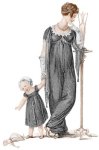
I’ve placed these gorgeous Ackermann fashion plates here to wish my readers who are mothers a Happy Mother’s day. Aren’t these images precious?
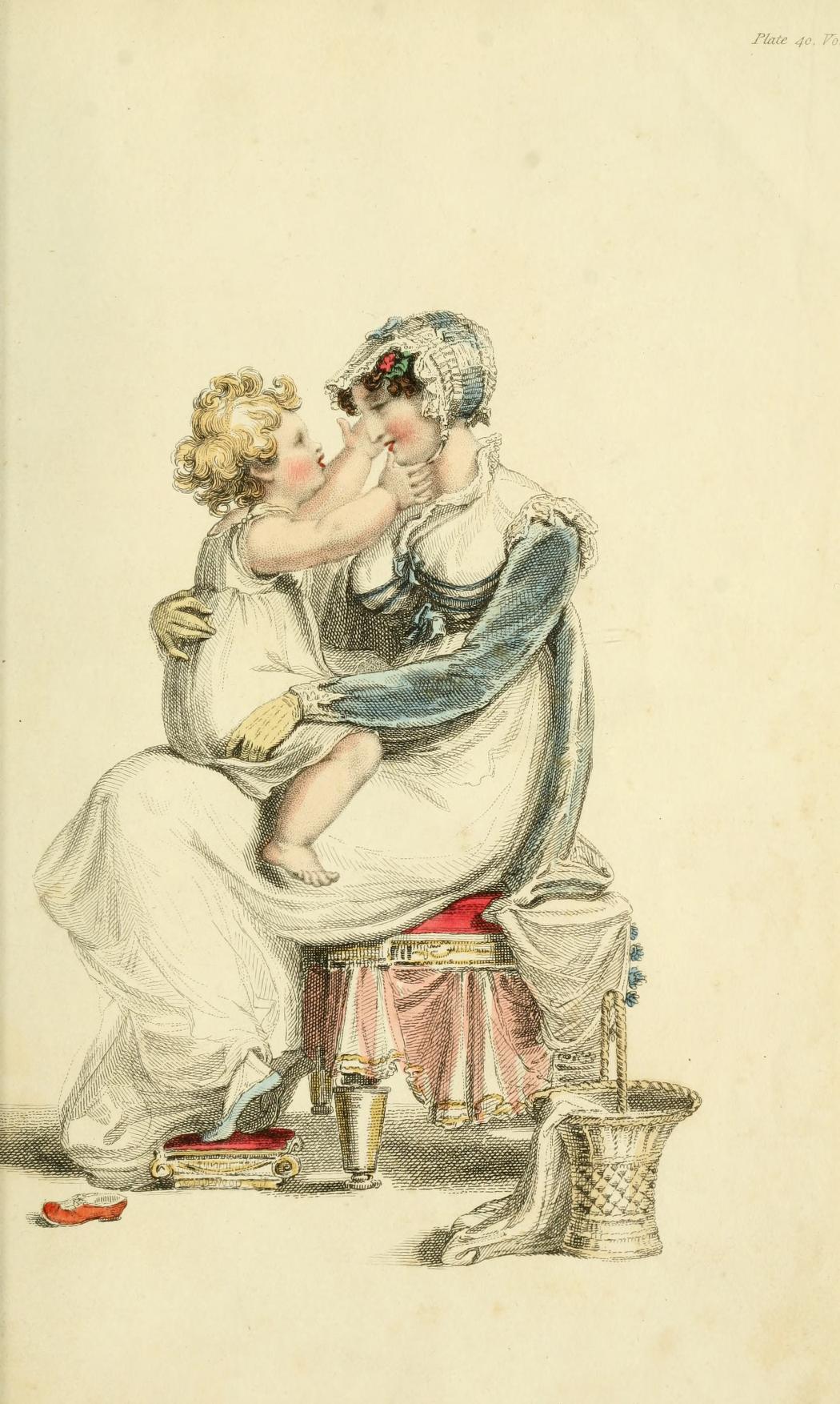
1812 morning dress or domestic dress.
Click on images to enlarge.

1826 evening gowns, March.
Posted in 19th Century England, Children's regency fashion, Jane Austen's World, Regency Life, Regency Period, Regency style, Regency World, tagged Ackermann fashion plates, Ackermanns Repository, Regency Fashion on May 13, 2012| 10 Comments »
I’ve placed these gorgeous Ackermann fashion plates here to wish my readers who are mothers a Happy Mother’s day. Aren’t these images precious?
1812 morning dress or domestic dress.
Click on images to enlarge.
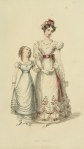

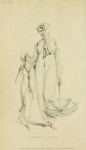
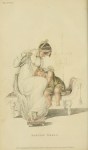
1826 evening gowns, March.
Posted in 19th Century England, Jane Austen's World, Regency Customs, Regency Etiquette, Regency Life, Regency Period, Regency society, Regency World, Royalty, tagged Lucy Worstley, Prince Regent on May 3, 2012| 25 Comments »
Elegancy and Decadence: The Age of the Regency is a BBC production hosted by Lucy Worsley, the author of If Walls Could Talk: An Intimate History of the Home. The video is one hour long. So, sit back and enjoy.
Posted in Fashions, Jane Austen's World, Regency Life, Regency Period, Regency style, Royalty, tagged Princess Charlotte, Princess Charlotte's blue gown, Regency Fashion on April 22, 2012| 17 Comments »
It is a rare occasion when we can compare a gown in a portrait with the actual dress. The painting, after George Daw, of the Prince Regent’s daughter, Princess Charlotte, shows her wearing a charming blue gown in a domestic, albeit royal, setting.
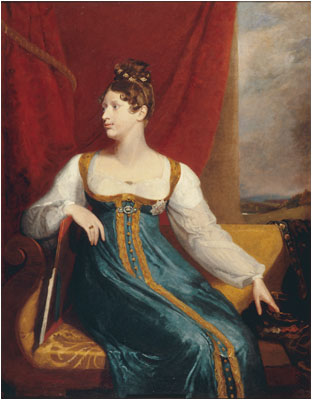
Princess Charlotte in her Russian Dress. Painting after George Daw, 1817. Image @Wikipedia
A second portrait depicts the same dress more royally. Princess Charlotte (or the artist) has accessorized the dress with ermine, lace, and pearls.
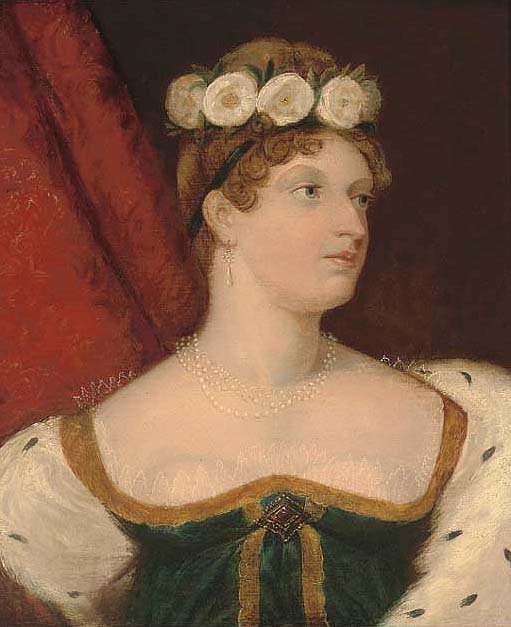
Image @Grand Ladies
The mannequin from the Museum of London exhibit a few years back is dressed more informally, as if she was in the morning room reading. I found the image on Pinterest, but unfortunately the pin did not state the image’s origin. (A reader wrote that the dress belongs to the Royal Collection.)
As you can see, the dress no longer possesses the rich blue hue as shown in the paintings. So many of the costumes of that era are not only in a fragile state and can rarely be shown, but we cannot trust that the colors have remained the same.
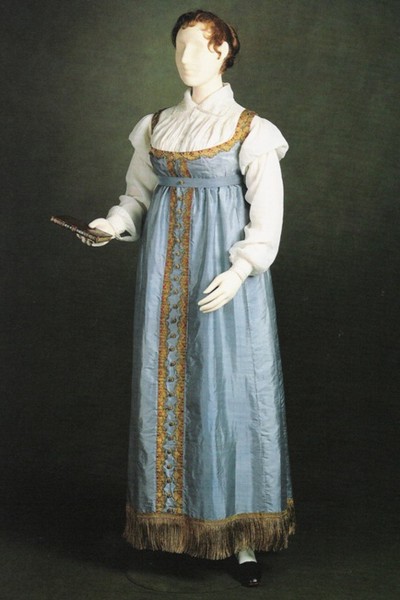
Princess Charlotte's "Russian" outfit as shown at The Museum of London. The gown belongs to The Royal Collection.
Below is the original portrait by George Daw, which shows Princess Charlotte wearing the same dress. Click here for yet another view of Charlotte in a similar gown, but without the trim and wearing a lace cap. My sense is that after her death Princess Charlotte’s image became sought after and that many portrait copies were made (both in oil and in print) to satisfy the mourning public.
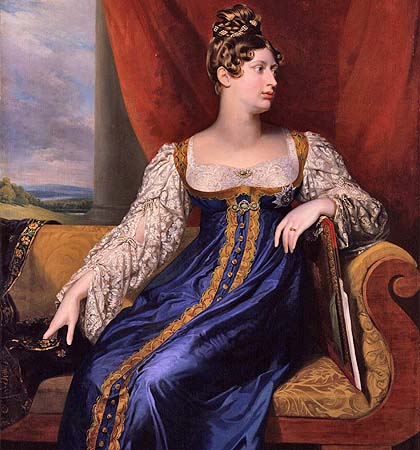
Princess Charlotte, George Daw, 1817. Image @National Portrait Gallery
Find more views of the gown at Jenny La Fleur’s site. Images of the gown can be seen in the exhibit catalogue called In Royal Fashion: Clothes of Princess Charlotte of Wales and Queen Victoria, 1796-1901, which can only be obtained second hand.
The exhibit: Princess Charlotte, The Lost Princess, will be on display at the Prince Regent Gallery in the Brighton Pavillion through 10 March, 2013.
My other posts about Princess Charlotte:
Posted in 18th Century England, 19th Century England, Georgian Life, Jane Austen's World, Regency Customs, Regency Life, Regency Period, Regency World, tagged English Country parson, The Diary of William Holland, William Holland on March 29, 2012| 14 Comments »
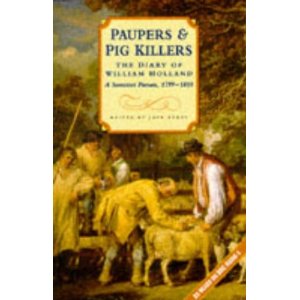 From the first page, William Holland had me hooked with his diary. His daily notations are not erudite. He does not wax eloquently about politics, philosophy, religion, or science, but with observations like these, who cares? Our parson has a way of planting us right in the middle of his little village:
Friday November 1 [1799] The Clerk in the yard wheeling dung and Robert [Holland’s servant] looking about him and moving like a snail. The Clerk cleared the liney and fetched three bushells more of pease for the sow. One of the Miss Chesters died yesterday, quite young, not ill above ten days. Poor girl her state of probation was soon over.
Then there are these short gems:
Wednesday November 6 Little Lewis the Apothecary came to me, rubbing his hands and moving his retreating chin in and out of his stock — attentive bur rather avaricious, mean and trifling.”
“Saturday November 9 Mr Robert has been wearing my spurs — now I have found out the method to get his horse on. Tis a difficult thing to get a servant worth anything. His slowness and laziness and want of method puts me out of patience. When the year is out he must go.”
Our country parson isn’t loquacious. Anita N writes about him on an online forum: “Apparently not the most charming man–but honest in his political and social views, and detailed about his daily life. That’s what I want to read: life sketches, muck, vitriol and common views of the time.”

Image @The Family Tree Forum
Our parson lived in Over Stowey in Somerset. Even today the village is described as having “no commercial centre because there is virtually no commerce – not a pub, post office or shop” – only farms lying in the outer districts of the village. There are few area descriptions in Holland’s observations, since his purpose is to focus on the people he encounters each day. From what I have read so far, his diaries simply record the mundane events in his life. He is not a particularly good writer, and his usage of punctuation is minimal at best.
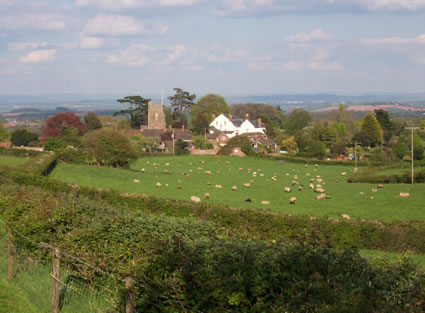
View of Over Stowey. Image @The Quantock Online Community
Holland held the opinions of an old-fashioned High Church Tory. The following definition serves well enough for readers who do not much about Tories:
Tories conceive of sovereignty as residing in rulers and view “the people” as subjects whose duty is to obey. Tories are thus identified with a system of hereditary power–exercised especially by monarchs and the established Church. – Historical Outline of Restoration and 18th Century British Literature
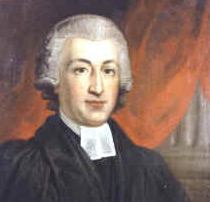
James Woodforde, 1740-1803, an amiable country clergyman, also wrote a diary. His is the image of a typical country parson of his day. Image @History Today.
Our country parson despised Democrats and took many swipes at them. One imagines that he must have shuddered at the very thought of Thomas Paine, the epitome of a Democrat and a radical, if ever there was one. Paine was against:
kingcraft, lordcraft and priestcraft. An original thinker far ahead of his time, he sought to redress poverty (seemingly endemic in advanced European societies) through an interventionist programme of welfare redistribution, including old-age pensions, marriage allowances and maternity benefits. – Thomas Paine, Citizen of the World, BBC History
In the Diaries’ opening observation on Wednesday October 23, 1799, our parson writes:
Saw that Democratic hoyden Mrs Coleridge who looked so like a friskey girl or something worse that I was not surprised that a Democratic Libertine should choose her for a wife. The husband gone to London suddenly, no one here can tell why. Met the patron of democrats, Mr Thos Poole who smiled and chatted a little. He was on his gray mare, Satan himself cannot be more false and hypocritical. “
Yet Holland was a compassionate man. He is constantly worried about the poor.
Thursday November 7 Still more rain, where will it end? The Poor, the Poor, how are they to live this winter? we must do all we can to assist and Providence will do the rest.
This series of observations about a mad man gives one a good sense of how a village takes care of its own:
Thursday December 5 The madman in the Poorhouse outrageous. Farmer Morle’s behaviour is absolutely scandalous but I’ll make him know his duty e’er long. The man is chained and lies on straw, shocking situation. Alas poor human nature how many afflictions art thou liable to.
Saturday December 7 Went to the Messrs Riches this evening about the man in the Workhouse, both determined to join in sending him to the Mad House in Bristol be the expence what it will. Says Master James ‘Mr Holland I reckon it be a bad business, he is a very bad fellow, there is something more in it than madness.’ Mr James thinks, in my opinion, that he is possessed by the Devil or bewitched.”
The parson then thinks about calling on the Vestry about the madman, but puts this off.
Monday December 9 Were alarmed with an account of the madman in the Workhouse having got loose and threatening everyone around with destruction. We procured two men to sit up with him and secure him from doing mischief till morning.
Holland writes that the madmen is quiet for two days, then he raves again. It seems that he uses the terms Poorhouse and Workhouse interchangeably. Finally, the men in the village decide what to do with the mad man:
Monday December 16 Went to Mr Ruscomb Poole at Marsh Mill to consult about the pauper in the Workhouse. Farmer Morle and Mr Lewis came in the evening and we went to the Poorhouse, examined the man, he had a fit at the time. We do not think him properly insane to be an object for a Madhouse. We shall try some other Methods.
Rev. Holland describes the days leading up to Christmas, including a little impromptu dance party that his daughter holds for her friends. There are 18 more years to read. Although this is not a review of the book, per se, I highly recommend it. I found my copy in a second-hand shop on Amazon. All I can say is that our Somerset Parson makes the early 19th century come alive from a male perspective. Between the diary of William Holland and Jane Austen’s letters, one gains a good sense of how different the life of a country woman is from that of a country parson. Next on my book wish list: The Diary of James Woodforde. I understand that this man loved his food.
More on the topic:
Posted in 19th Century England, Architecture, Georgian London, Jane Austen's World, Regency Life, Regency London, Regency Period, Regency World, tagged milk maids, St. James's chapel, Tottenham Road, Tottenham Road turnpike, Turnpikes and toll roads on March 27, 2012| 7 Comments »
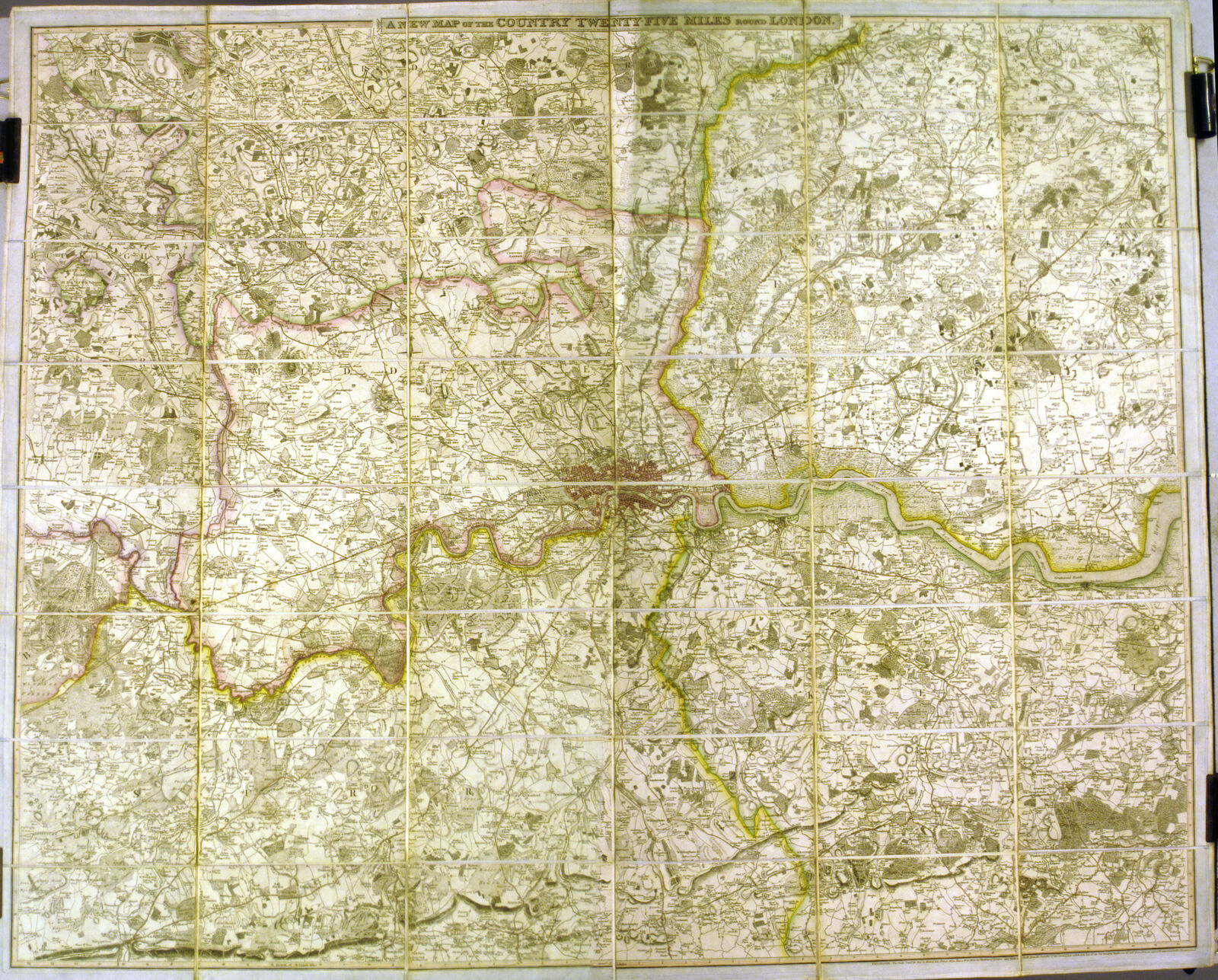
Inquiring readers, I had read about the closeness of rural areas near London during Jane Austen’s day. This image of Tottenham Court Road from the 1812 edition of Ackermann’s Repository shows the countryside beyond the toll gate. One imagines that Jane Austen was accustomed to such vistas when she visited her brother Henry in London. One moment she would be traveling through the countryside, the next moment she would be entering a teeming metropolis (Click here to see map):
In the first years of the eighteenth century, pastures and open meadows began by Bloomsbury Square and Queens Square; the buildings of Lincoln’s Inn, Leicester Square and Covent Garden were surrounded by fields, while acres of pasture and meadow still survived in the northern and eastern suburbs outside the walls. Wigmore Row and Henrietta Street led directly into fields, while Brick Lane stopped abruptly in meadows.“World’s End” beside Stepney Green was a thoroughly rural spot, while Hyde Park was essentially part of the open countryside pressing upon the western areas of the city. Camden Town was well-known for its “rural lanes, hedgeside roads and lovely fields”where Londoners sought “quietude and fresh air.” – Extract from “LONDON The Biography”, by Peter Ackroyd. Published by Vintage, 2001

The contemporary description of this view of St.James Chapel is telling:
The edifice selected for the subject of our view in the metropolis, for the present number, is the chapel of ease, situated near the turnpike in Tottenham-court-road, belonging to the church of St. James, Piccadilly. It was erected after a design of the celebrated architect, Mr. James Wyatt.
The contiguous parsonage-house on one side, and a school on the other, together with the plantations in the area between the front railing and the buildings, give great additional consequence to the appearance of the whole…
The vicinity of this chapel has recently witnessed one of those transformations of fields into houses, produced in every direction around the metropolis as if by the effect of enchantment. A prodigious street has just sprung up on the left-hand side, in continuation of Tottenham-court-road; and thus London has proceeded another good stage in its progress to Kentish Town. – St. James Chapel, Tottenham Court Road, 1812, Ackermann’s Repository
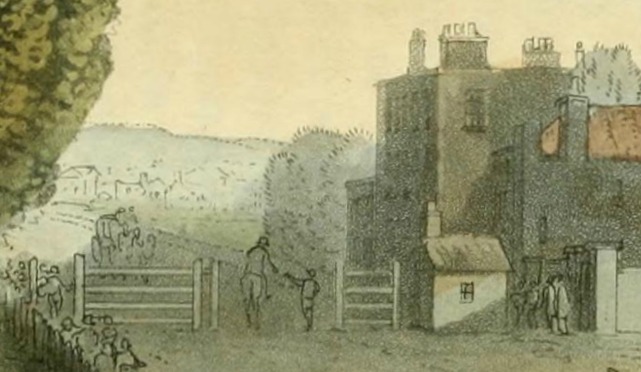
Detail of the turnpike. The toll keeper is collecting money from a man on horseback. Notice the small toll house, and the rural scene beyond.
The great age of toll gates and turnpikes was the 18th Century. In the latter part of the previous century, turnpikes were established and run by trusts. They could only be set up through Acts of Parliament, the first of which was passed in 1663. The idea was that the trusts would take over responsibility from parishes to maintain major trunk roads. They would collect the tolls, manage the finances and fulfil their obligation to use those funds to maintain the roads – Toll gates and turnpikes, London Historian’s Blog
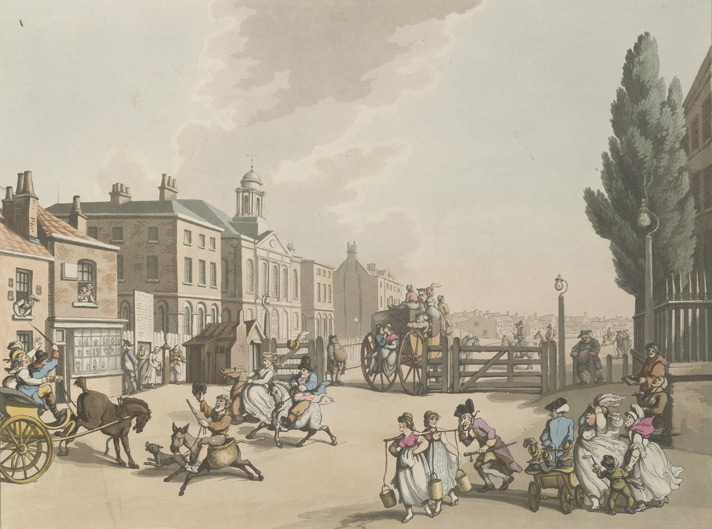
Entrance, Tottenham Court turnpike by Rowlandson. Image @ Europeana
Rowlandson’s image shows another view of the turnpike. Pedestrians continued without hindrance via the side openings (except for the obese man, who seems to be stuck), but people on horseback and vehicles slowed to pay a toll in the gated center. Note Rowlandson’s detail of an old lecherous man ogling the two milk maids.
One milkmaid recorded her daily route and the results are astonishing: 19 miles. Milkmaids are famous for their pretty skin, and this was largely because many of them had acquired immunity to smallpox through milking duties. As milk delivery was a daily occurrence, many milkmaids ran slates for their customers, proving they were to some extent both literate and numerate, and also hard enough to call in a debt. – The Cries of Georgian London
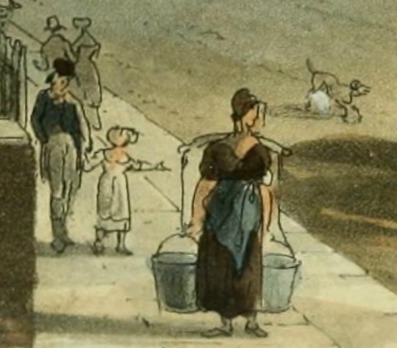
Milk maids provided fresh drinks to customers. This one has just passed through the toll gate and has a long day's walk and work ahead of her.
“The cry of ‘Milk’ or the rattle of the milk-pail, will never cease to be heard in our streets. There can be no reservoirs of milk, no pipes through which it flows into the houses. The more extensive the great capital becomes, the more active must be the individual exertion to carry about this article of food. The old cry was ‘Any milk here !’ and it was sometimes mingled with the sound of ‘Fresh cheese and cream;’ and it then passed into ‘Milk, maids below;’ and it was then shortened into ‘Milk below;’ and was finally corrupted into ‘Mio’ which some wag interpreted into mieau—demi-eau—half water.” – Buying Bread and Milk in 18th and 19th Century London, Susannah Ives
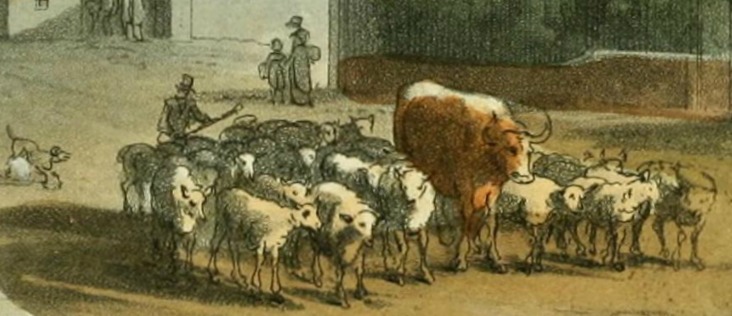
Detail of cattle being driven to market. One imagine that the streets were filled with dung and the smells of the animals, most of whom must have been frightened of the big city's sights and sounds.
This detail of sheep and an oxen being driven through the streets to market was a common sight. The people in this great metropolis had to be fed. In just a few hours these hapless animals will find themselves in the noisy, tumultuous, and bewildering environment of Smithfield Market, for instance. Without refrigeration, their meat would be sold, consumed or prepared within hours of their slaughter.
Cattle were driven through the streets until the mid 19th century. In an article for Household Words in March 1851 Dickens, with characteristic sarcasm, describes the environmental impact of having live cattle markets and slaughterhouses in the city:
“In half a quarter of a mile`s length of Whitechapel, at one time, there shall be six hundred newly slaughtered oxen hanging up, and seven hundred sheep but, the more the merrier proof of prosperity. Hard by Snow Hill and Warwick Lane, you shall see the little children, inured to sights of brutality from their birth, trotting along the alleys, mingled with troops of horribly busy pigs, up to their ankles in blood but it makes the young rascals hardy.” – Dickens’ London
2025 AGM in Baltimore

RECOMMENDED BOOKS AND RESOURCES



Available through December 31st, 2025. Click on image for details, and share this poster with other teachers and students!


Click on image to read the story.

Gentle readers: Please feel free to post your comments and continue the conversation! Due to SPAM, we will no longer accept comments on posts after 30 days of publication. In some instances, links will be removed from comments as well.


If you would like to share a new site, or point out an error, please email us. (Yes, we are fallible. We'll own up to our mistakes and will make the corrections with a polite smile on our faces.) Write us at

Thank you for visiting this blog. Your comments and suggestions are most welcome.
STAGE-COACH AND MAIL IN DAYS OF YORE: A PICTURESQUE HISTORY
OF THE COACHING AGE, VOL. II, By CHARLES G. HARPER. 1903. Click on this link.

Disclaimer: Our team makes no profit from this blog. We may receive books (physical or digitized) for review purposes.
Copyright Statement: © Jane Austen's World blog, 2009-2024. Unauthorized use and/or duplication of this material without express and written permission from this blog’s author and/or owners is strictly prohibited. Excerpts and links may be used, provided that full and clear credit is given to Jane Austen's World with appropriate and specific direction to the original content.
 Jane Austen's World