Feeds:
Posts
Comments

Archive for the ‘Regency style’ Category

Emma was not inclined to give herself much trouble for his entertainment, and after hard labour of mind, [Lord Osborne] produced the remark of its being a very fine day, and followed it up with the question of:  “Have you been walking this morning?”

Walking dress with blue half boots, 1818. La Belle Assemblee.

“No my lord, we thought it too dirty.” (Unpleasant, stormy.)

“You should wear half boots.” After another pause: “Nothing sets off a neat ankle more than a half boot; nankeen galoshed with black looks very well. Do not you like half boots?”

“Yes; but unless they are so stout as to injure their beauty, they are not fit for country walking.” – Jane Austen, The Watsons

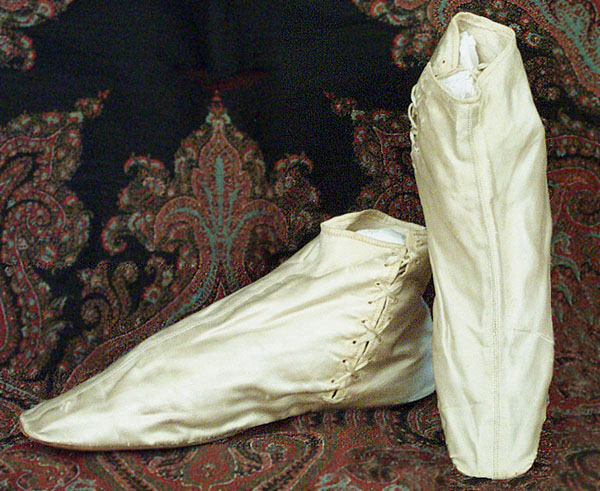
Satin half boots, 1830. Image @Vintage Textile

Ladies shoes were quite delicate in Jane Austen’s day. They were made of satin or soft kid leather, and thin soles with short heels.  Kid leather was a soft and pliable leather made from young goat skin that was often used for slippers (and gloves as well). Shoes made from kid leather could be dyed or embroidered, but the thin flimsy material could barely withstand ordinary wear and tear, much less rough treatment.
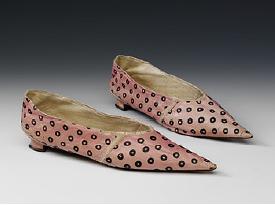
Delicate pastel kid shoes with stencilled motif, 1800. Image @Victoria & Albert Museum

During the mid-Regency, tied shoes went out of fashion as lace-up half-boots became popular for outdoor wear. Made of leather or nankeen (a durable natural cotton from China, with a distinct yellow color), these boots were more geared for long walks in the country than the delicate slippers they replaced. But the boots were deceptive, for the leather was quite thin by today’s standards and tore and scuffed easily or were quickly ruined by the elements. As a general rule, thick leather shoes with sturdy wooden soles were worn by laborers. The ruling classes, it was felt, needed no such rough and tumble items.

1795-1815 leather boots. Image @Metropolitan Museum Collection.

Although still a minority in women’s footwear at the beginning of the 19th century, ankle boots would become the dominant style of daytime footwear by the 1830s. This early pair of fashionable boots shoes shows the importance of angular lines, repeated throughout designs and evident from what ever position the boots are viewed. The museum also possesses a similar boot with a small “Italian” heel (2009.300.1487), demonstrating the overlap in styles. The original shoelaces, unlike those now in the boots, would have most likely matched the dark teal color of the leather. – Met Mus collection database

1795-1810, blue European boots. Image @Metropolitan Museum Collection

Boots began to become fashionable for women in the last quarter of the 18th century, but their use was limited primarily to riding and driving. Few pairs survive, and the peculiar wrap-around leg on this example is specific to this period and extremely rare. Although not well-fitted enough to provide a particularly secure fastening to the foot, the wrapped leg may have been intended to provide superior protection from dust and moisture than the standard laced closure. Colored footwear was a favored means of complimenting plain white dresses in the early 19th century, and the dark teal blue color seen here seems to have been particularly favored.- Boots

1812-1820 ladies boots. Image @Victoria & Albert Museum

In the early years of the 19th century boots gradually became acceptable for women. By 1804, half-boots with front lacing and ribbon trimmings, like this pair, had started to appear in fashion illustrations for ‘walking’ or ‘morning’ dress. Hardwearing cottons – the striped uppers are made of cotton jean – became increasingly available and were used as alternatives to leather. Heroines in novels by Jane Austen (1775-1817) are often described wearing footwear of this kind. V&A

Nankeen half boots, 1795-1810. Image @Virginia Review

Toughening Nankeen for rough wear and tear: To Wash- Put a handful of salt into a vessel with a gallon of cold water immerse the nankeenm and let it remain for twenty four hours; then wash it in hot lye without soapm and hang up to dry without wringing it, Nankeen washed in this manner will keep its colour for a long time – The Dictionary of Daily Wants, 1866

1830. Sturdier damask gaiter boots. Image @Vintage Textile

Read Full Post »

1810 woven Chinese silk cloth with handpainted decorations. Image @Victoria & Albert Museum

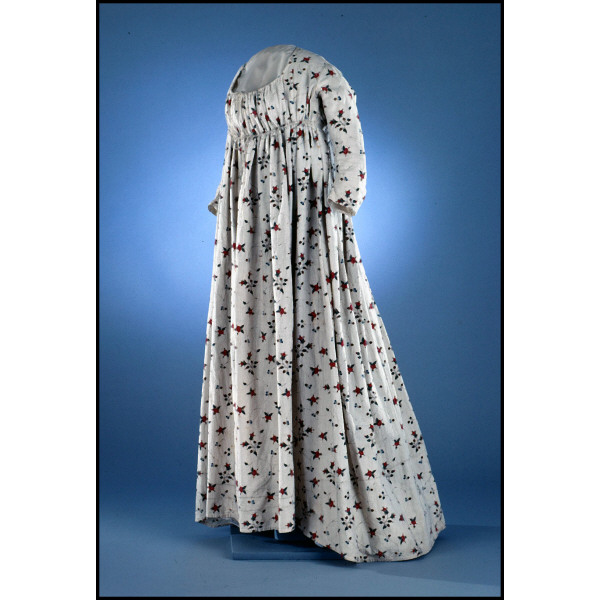
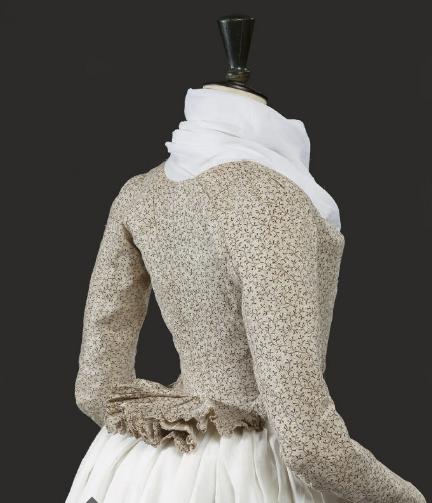
We have come to associate delicate white muslin material woven in India with Regency fashion to such a degree that it is easy to forget that other colors and printed fabrics were also used, and that many silk and cotton dresses were made of fabrics with colorful patterns and distinctive designs, such as this 1820’s day dress, or this 1790 caraco printed jacket…


1790 Caraco jacket of printed cotton. Image @Christie's

…or the lively Ackermann dress below.

Dinner dress, Ackermann. 1817

Some of the fabrics were  lavishly embroidered…

1810 Evening Dress with embroidery

… or painted to produce a patterned effect.

1780-1800. Painted satin cloth. Image @Victoria & Albert museum

But with the industrial revolution, printing and dying techniques began to be improved.

Fabric, Manchester art gallery

By the mid-eighteenth century, wood-block printing on cotton and linen textiles had developed to a high standard, even though the home market was affected by legislation protecting the silk and wool industries.” – *V&A


Block printed round gown. Image @Colonial Williamsburg

The dyeing techniques used to produce the strong fast colours on imported Indian chintzes which had dazzled European customers in the seventeenth century had been mastered, and colour ranges were developed further with the introduction of ‘pencilling’ of indigo in the 1730s, and ‘china blue’ by the early 1740s.” – *V&A

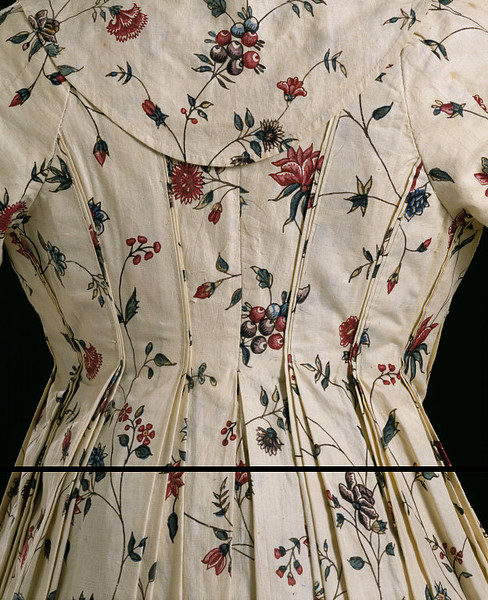
Block printed cotton, 1790. Image @Victoria & Albert Museum

“A commentator on the state of British textile arts in 1756 wrote : “chintz…can imitate the richest silk brocades, with a great variety of beautiful colours. This length of block-printed cotton dress fabric is typical in its design and colouring of English production at the end of the 18th century.” – *Block Printed Cotton, Victoria & Albert Museum


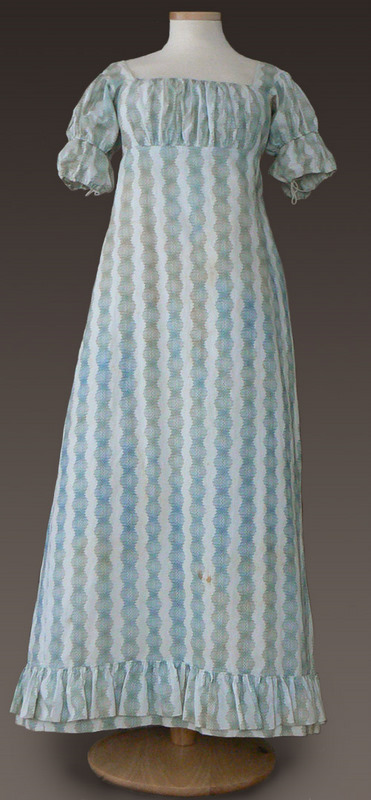
Child's cotton dress roller printed, 1820. Image @Vintage Textile
Roller printing also became popular.

Roller printing, a mechanical improvement on the copperplate technique, was developed in England in the late eighteenth century and was in use in the north of England by 1790.” – **Met Museum

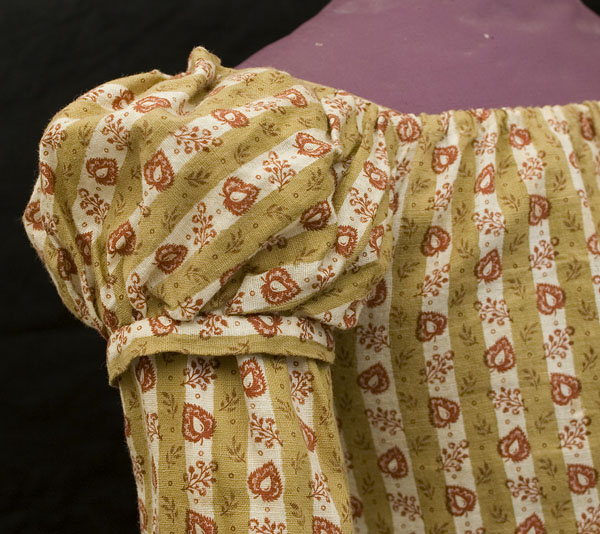
Detail, roller printed Regency day gown.

The copper roller gave manufacturers the ability to print larger quantities of fabrics at greater speeds, for lower prices, and the production of printed cotton increased dramatically in the nineteenth century.” – ** Source: Textile Production in Europe: Printed, 1600–1800 | Thematic Essay | Heilbrunn Timeline of Art History | The Metropolitan Museum of Art

1800 dress fabric, British. Image @Victoria & Albert Museum


19th century white cotton gown with roller print. Image @Greene Collection

More on the topic:

1795-1800 Printed cotton gown detail. Image @Victoria&Albert Museum

Read Full Post »

Banyan, Dress for Excess

Dress for Excess: Fashion in Regency England, the fashion exhibition at the Brighton Pavilion this year, features a quilted printed (chintz) banyan, or men’s dressing robe worn over a shirt and knee breeches. (Click here to see the full image of the robe .)

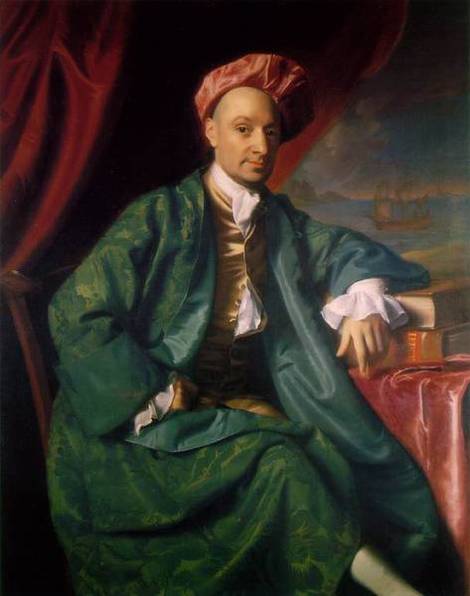
When at home, a gentleman would change into an informal knee-length dressing gown known as a banyan, and wear it around his family at breakfast,  playing games, such as cards or backgammon, and while reading in his library or writing letters. One can readily imagine Mr. Bennet wearing a banyan in his study, and most definitely Mr. Woodhouse (image below), as he sat by the fire reading a newspaper.

Mr Woodhouse (Bernard Hepton) in a fur-lined fitted man's dressing gown, or banyan

The banyan was a loose, full kimono style in the early 18th century, but later evolved into a more fitted style with set-in sleeves, similar to a man’s coat. It was known as an Indian gown, nightgown, morning gown, or dressing gown. First used as a type of robe, it was originally worn for leisure and in at-home situations; but came to be worn as a coat out-of-doors, in the street, or for business. Many gentlemen had their portraits made while wearing banyans. They were made from all types of fabrics in cotton, silk, or wool (Cunningham, 1984). – Cross cultural influences on fashion prior to the twentieth Century

Nicholas Boylston in a loose fitting banyan, 1767. Painted by John Singleton Copeley. Image @Wikipedia

More on the Topic

Tartan wool banyan lined in bottle green silk, 1800. Image @Christie's


Read Full Post »

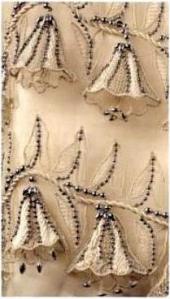
Embroidered bells on Princess Charlotte's court gown.

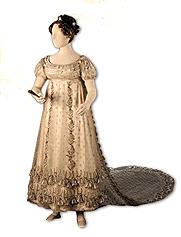
Several years ago I featured Princess Charlotte’s bellflower court dress, a sumptuous creation that must have taken a boatload of seamstresses untold hours of work to complete. I had the privilege of viewing this fragile dress when it was on exhibit at the Museum of London, and I often wondered how the bell flowers (which were worked with silver thread and tiny glass beads) were made.

The court dress, 1814. Image @Museum of London

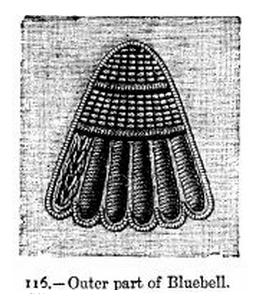
Mrs. Beeton’s Book of Needlework (1870) provides a glimpse. Although the illustrations are rough compared to the royal example, one begins to understand how time consuming this needlework was for the women who labored long hours in poor lighting conditions.  The book describes the process for bluebells, which were embroidered in a raised satin stitch. The pieces were worked separately, then half of the embroidered piece was sewn onto an outlined embroidered shape on the fine fabric. This shape represented the inner part of the flower.

Bluebell embroidered work.

The first two illustrations from Beeton’s book show 1) the complete bluebell and 2) the inner part of the flower with the overcast outline.

The flat outer part of the bluebell. This piece is fastened onto the outline.

The second illustration shows the raised outer part as a flat piece. This second embroidered piece was fastened in a three dimensional way onto the overcast outline. Then the excess material was carefully cut away without damaging the underlying fabric. (This job must have been tougher and more delicate with Princess Charlotte’s gauzy net dress.)

I recall clearly seeing that some of the bellflowers had been torn away or were missing – and wondered if someone had stepped on Princess Charlotte’s train, or if she had snagged the hem on something.

Read Full Post »

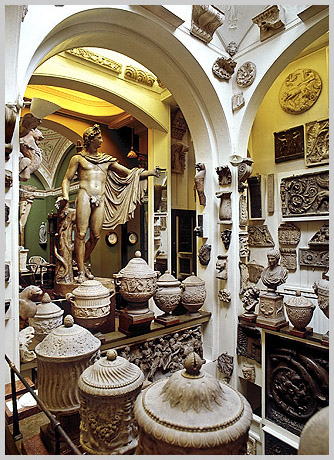
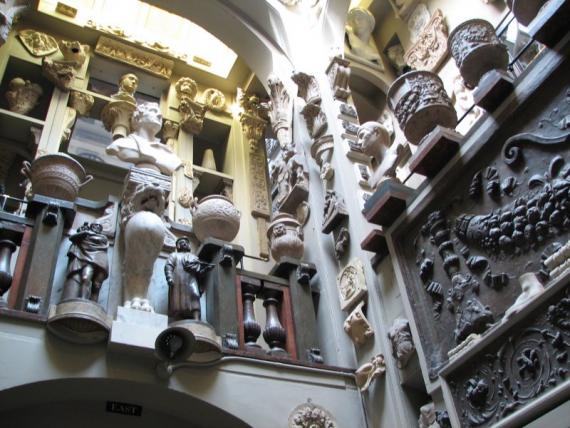
Interior, Sir John Soane’s House Museum

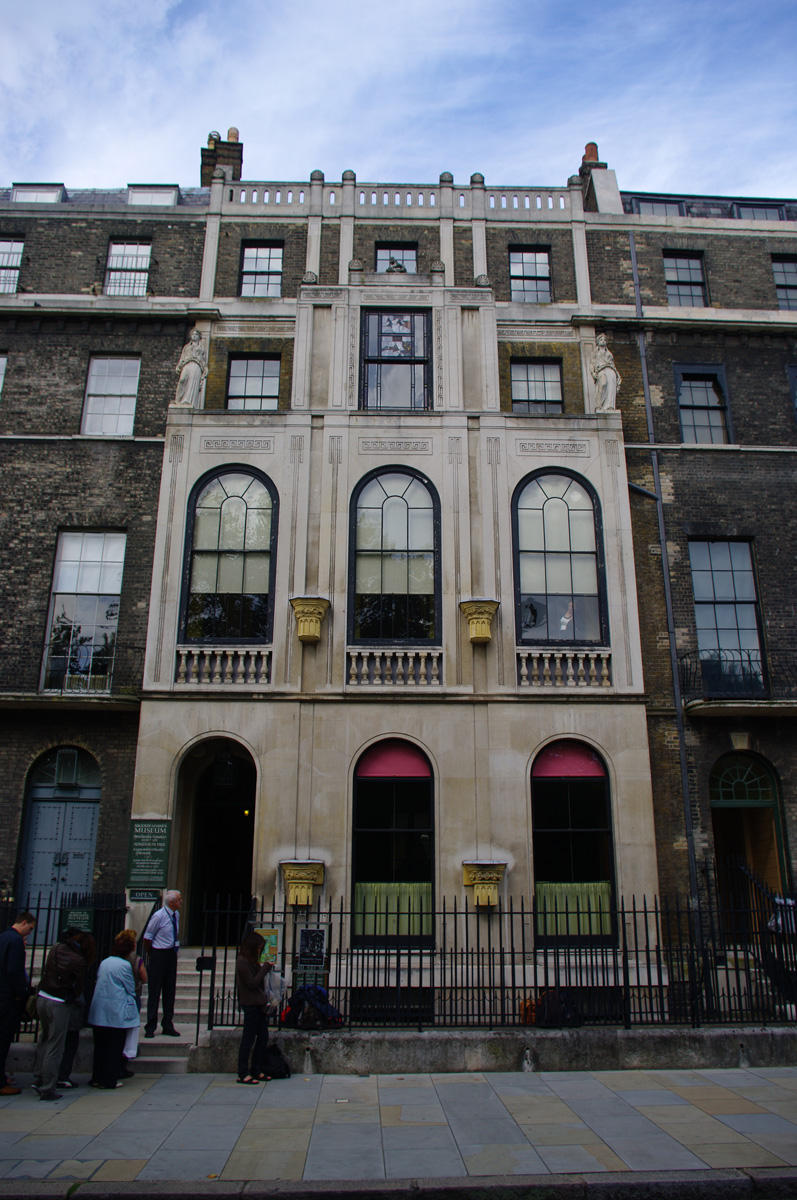
At Lincoln’s Inn Field , architect Sir John Soane (1753-1837) built three townhouses between 1792 and 1824 to house his remarkable collection of antiquities and objects d’art. The Museum was established by a private Act of Parliament in 1833 The house was opened to the public after the architect’s death in 1837.

Today, the museum is best seen on first Tuesday evening of each month when it is lit by candlelight. In three years, after a £7 million restoration, Soane’s private apartments will be opened to view for the first time in 170 years. Soane was known for his original designs of internal spaces and lighting, and for incorporating shallow domes, segmental arches, and clerestories.

Sir John Soane’s House and Museum. Image @Tony Grant

During the latter half of the 18th century (before the Napoleonic Wars), it was the custom of British collectors, painters and patrons to study antiquities of the ancient world during their Grand Tour of the Continent. The great collectors returned home laden with objects that they had acquired, most notably sculptures, gems, coins, vases, mosaics,  paintings, and architectural fragments from such countries as Italy, Egypt, and Greece. These visitors, mostly gentlemen, also brought back their vast knowledge (and love) of classical architecture, which in turn influenced the Neoclassical buildings, interiors, and styles so popular during the Georgian and Regency eras.

Interior of the Soane Museum**

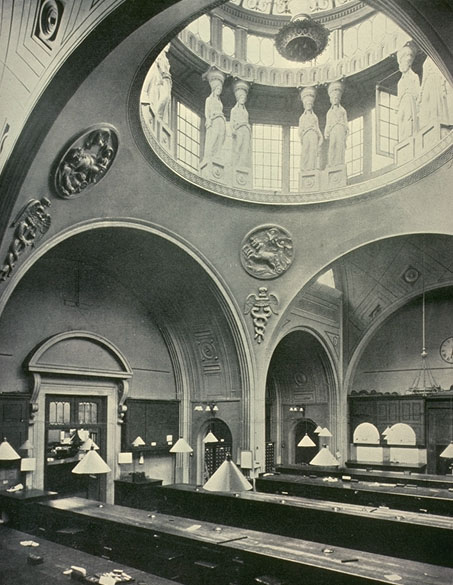
Interior, original Bank of England

Sir John Soane traveled to Italy between 1777 – 1780 to study architecture on a scholarship from the Royal Academy, and acquired his collection between the 1780s and his death in 1837. Among his designs are the Bank of England (now torn down), Dulwich College Art Gallery, and his own houses in Lincoln Fields Inn.

On his appointment as Professor of Architecture at the Royal Academy in 1806 Soane began to arrange the Books, casts and models in order that the students might have the benefit of easy access to them and proposed opening his house for the use of the Royal Academy students the day before and the day after each of his lectures. By 1827, when John Britton published the first description of the Museum, Soane’s collection was being referred to as an ‘Academy of Architecture’. – Sir John Soane’s Museum: Official Site


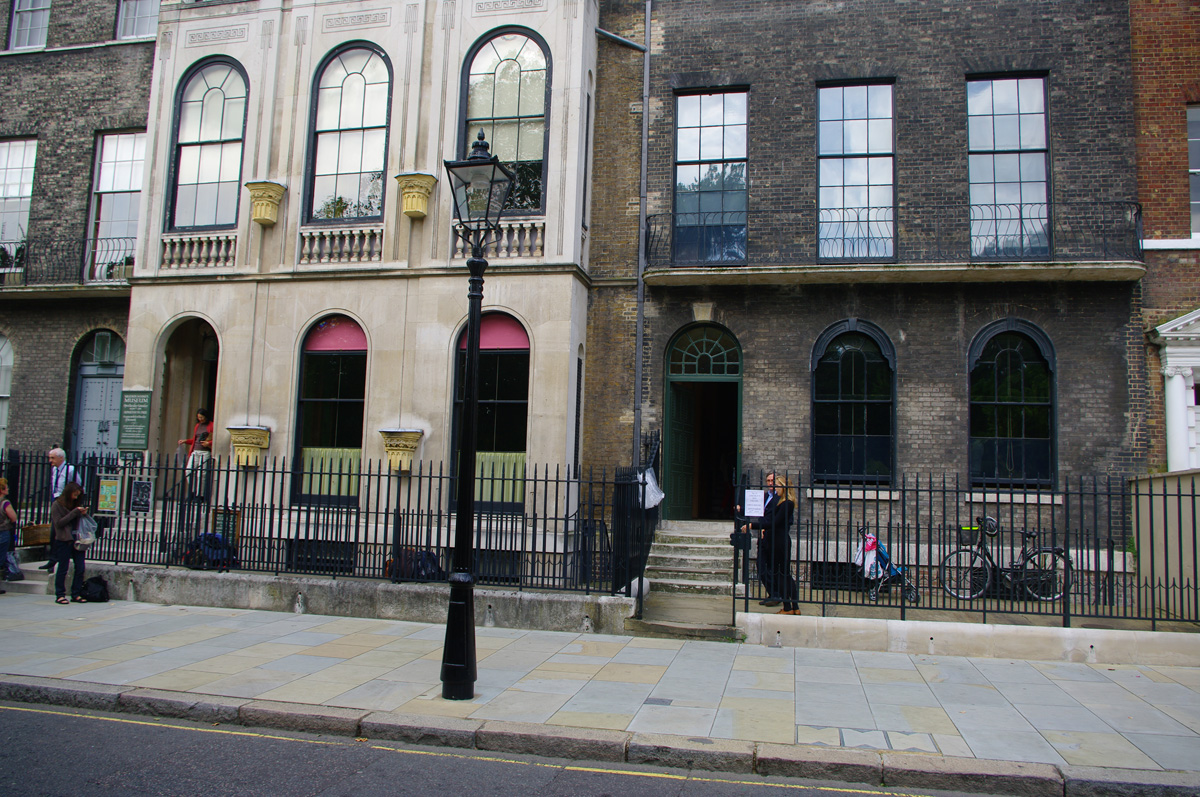
The three doorways to the Sir John Soane’s House Museum. Image @Tony Grant

Read Full Post »

« Newer Posts - Older Posts »