Feeds:
Posts
Comments

Archive for the ‘Regency style’ Category

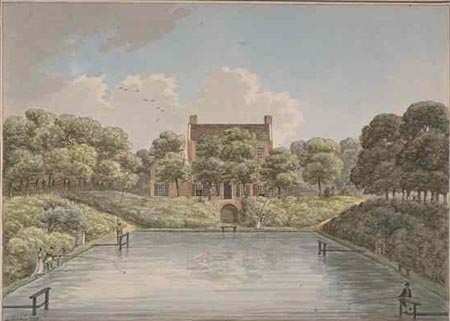
Wentworth Before, Humphry Repton

Wentworth Before, Humphry Repton

One of the biggest names in landscaping during the late 18th and early 19th centuries was Humpry Repton (1752-1818), a self-made man who transformed the formal landscapes around England’s great houses along more natural, fluid, and graceful lines. Repton, who saw the relationship between house and landscape as a picturesque whole, wrote:

Wentworth After, Humphry Repton

Wentworth After, Humphry Repton

“In landscape gardening everything may be called a deception by which we endeavour to make our works appear to be the product of nature only. We plant a hill to make it appear higher than it really is, we open the banks of a natural river to make it appear wider, but whatever we do we must ensure that our finished work will look natural or it would fail to be agreeable.” Agreeable meant adding cattle or deer as focal points, and architectural structures that drew the eye. At times, entire villages were transported away from the great house and mature trees were transplanted so that the bucolic vision of manse and land could remain unspoiled and natural.

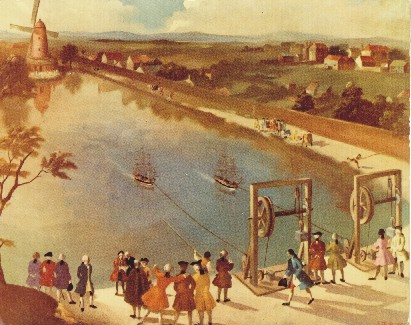
Transplanting trees, 1794, Hayes

Transplanting trees, 1794, Hayes

In following his vision, Repton moved roads,  created ponds, planted copses,  and built architectural structures. An artist, he painted his vision of how the property would look in 50 years in a series of red books, many of which still survive. Stoneleigh Abbey,  the ancestral home of Jane Austen’s mother’s family, was one of Repton’s most important commissions. Those who are planning to visit Stoneleigh Abbey will have an opportunity to view Repton’s red book for the Leighs, which took him a year to create and which will be on exhibit through 2009. Repton’s famous red books  showed painted scenes of the landscape before and after his transformations. In Observations on the Theory and Practice of Landscape Gardening, he wrote:

“The perfection of landscape gardening consists in the four following requisites. First, it must display the natural beauties and hide the defects of every situation. Secondly, it should give the appearance of extent and freedom by carefully disguising or hiding the boundary. Thirdly, it must studiously conceal every interference of art. However expensive by which the natural scenery is improved; making the whole appear the production of nature only; and fourthly, all objects of mere convenience or comfort, if incapable of being made ornamental, or of becoming proper parts of the general scenery, must be removed or concealed”.

In 1796, following his own advice, Repton painted two watercolours for Whiton, the seat of Samuel Prime, esq., as seen below – (Images from Plants and Gardens Portrayed.)

Whiton, View from the Saloon Before, Humphry Repton, 1796

Whiton, View from the Saloon Before, Humphry Repton, 1796

Whiton, View from the Saloon After, Humphry Repton, 1796

Whiton, View from the Saloon After, Humphry Repton, 1796

Jane Austen famously mentioned Repton and the vogue for landscape transformations in Mansfield Park:

“Mr. Rushworth,” said Lady Bertram, “If I were you, I would have a very pretty shrubbery. One likes to get out into a shrubbery in fine weather.”

Mr. Rushworth was eager to assure her ladyship of his acquiescence, and tried to make out something complimentary; but, between his submission to her taste, and his having always intended the same himself, with the superadded objects of professing attention to the comfort of ladies in general, and of insinuating that there was one only whom he was anxious to please, he grew puzzled, and Edmund was glad to put an end to his speech by a proposal of wine. Mr. Rushworth, however, though not usually a great talker, had still more to say on the subject next his heart. “Smith has not much above a hundred acres altogether in his grounds, which is little enough, and makes it more surprising that the place can have been so improved. Now, at Sotherton we have a good seven hundred, without reckoning the water meadows; so that I think, if so much could be done at Compton, we need not despair. There have been two or three fine old trees cut down, that grew too near the house, and it opens the prospect amazingly, which makes me think that Repton, or anybody of that sort, would certainly have the avenue at Sotherton down: the avenue that leads from the west front to the top of the hill, you know,” turning to Miss Bertram particularly as he spoke. But Miss Bertram thought it most becoming to reply—

“The avenue! Oh! I do not recollect it. I really know very little of Sotherton.”

Fanny, who was sitting on the other side of Edmund, exactly opposite Miss Crawford, and who had been attentively listening, now looked at him, and said in a low voice—

“Cut down an avenue! What a pity! Does it not make you think of Cowper? ‘Ye fallen avenues, once more I mourn your fate unmerited.’”

He smiled as he answered, “I am afraid the avenue stands a bad chance, Fanny.”

“I should like to see Sotherton before it is cut down, to see the place as it is now, in its old state; but I do not suppose I shall.”

“Have you never been there? No, you never can; and, unluckily, it is out of distance for a ride. I wish we could contrive it.”

“Oh! it does not signify. Whenever I do see it, you will tell me how it has been altered.”

“I collect,” said Miss Crawford, “that Sotherton is an old place, and a place of some grandeur. In any particular style of building?”

“The house was built in Elizabeth’s time, and is a large, regular, brick building; heavy, but respectable looking, and has many good rooms. It is ill placed. It stands in one of the lowest spots of the park; in that respect, unfavourable for improvement. But the woods are fine, and there is a stream, which, I dare say, might be made a good deal of. Mr. Rushworth is quite right, I think, in meaning to give it a modern dress, and I have no doubt that it will be all done extremely well.”

Miss Crawford listened with submission, and said to herself, “He is a well–bred man; he makes the best of it.”

“I do not wish to influence Mr. Rushworth,” he continued; “but, had I a place to new fashion, I should not put myself into the hands of an improver. I would rather have an inferior degree of beauty, of my own choice, and acquired progressively. I would rather abide by my own blunders than by his.”

“You would know what you were about, of course; but that would not suit me. I have no eye or ingenuity for such matters, but as they are before me; and had I a place of my own in the country, I should be most thankful to any Mr. Repton who would undertake it, and give me as much beauty as he could for my money; and I should never look at it till it was complete.”

“It would be delightful to me to see the progress of it all,” said Fanny.

“Ay, you have been brought up to it. It was no part of my education; and the only dose I ever had, being administered by not the first favourite in the world, has made me consider improvements in hand as the greatest of nuisances. Three years ago the Admiral, my honoured uncle, bought a cottage at Twickenham for us all to spend our summers in; and my aunt and I went down to it quite in raptures; but it being excessively pretty, it was soon found necessary to be improved, and for three months we were all dirt and confusion, without a gravel walk to step on, or a bench fit for use. I would have everything as complete as possible in the country, shrubberies and flower–gardens, and rustic seats innumerable: but it must all be done without my care. Henry is different; he loves to be doing.” – Mansfield Park, Chapter 6
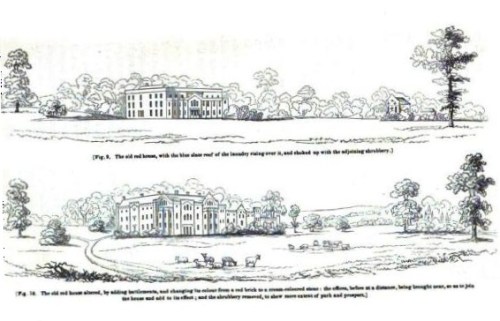
Repton's suggested improvements for house and landscape, p. 48, The Landscape Gardening and the Landscape Garden of the Late Humprhey Repton

Repton's suggested improvements for house and landscape, p. 48, The Landscape Gardening and the Landscape Garden of the Late Humprhey Repton

Repton, who was prolific in his thirty year career, taking on over 400 commissions, believed in providing picturesque vistas that included focal points from certain stops along a circuitous path wending its way through the landscape. He wrote how he accomplished this:

First, by collecting the wood into larger masses and distinguishing the lawns in a broad masterly manner without the confused frittering of too many single trees;

Secondly, by the interesting line of road winding through the lawn;

Thirdly, by the introduction of cattle to enliven the scene; and

Lastly, by the appearance of a seat on the knoll and a part of the house with its proposed alterations displaying its turrets and pinnacles amongst the trees. –  The Landscape Gardening and Landscape Architecture of the Late Humphrey Repton, Esq Being His Entire Works on These Subjects By Humphry Repton, John Claudius Loudon

Learn More About Humphry Repton by clicking on these links:

Hayes Image: Lasdun, Susan. The English Park, Royal, Private and Public. London. 1991, p 103. Print.
Read Full Post »

wilton_pride_prejudice_1a_450x300Philip Sheppard, who wrote Crystallized Beauty, a musical piece that was used to advertise the Jane Austen Season for ITV last year, has made his recent compositions for piano available on one post. Click on the link to listen to an unnamed piece based on an empty drawing room at night, a slow ballade waltz, a piece entitled The Long Letter, the full version of Crystallized Beauty, and Elena.

Read Full Post »

During the regency era, men and women spent the day separately, pursuing their own interests and schedules. It was perfectly permissable to spend a morning alone writing letters, reading to oneself, or riding, but after dinner families and friends were obligated to entertain each other with conversation, musical performances, parlor games and cards, or reading aloud. For most families, candles were considered a luxury, and, except for the richest families, most families could only afford to burn a few at a time. After dinner a family would assemble in one candlelit room to spend an evening together. In her letter to her friend Martha Lloyd, Jane Austen writes a letter full of humor about the topics she has been researching to contribute to her share in the conversation during her next visit:

Regency family in the evening

Regency family in the evening

My Dear Martha,

I did not receiver your note yesterday till after Charlotte had left Deane, or I would have sent my answer by her, instead of being the means, as I now must be, of lessening the elegance of your new dress for the Hurstbourne Ball by the value of 3d. You are very good in wishing to see me in Ibthorp so soon, and I am equally good in wishing to come see you … You distress me cruelly by your request about books; I cannot think of any to bring with me, nor have I any idea of our wanting them. I come to you to be talked to, not to read or hear reading. I can do that at home; and indeed I am now laying in a stock of intelligence to pour out on you as my share of conversation. I am reading Henry’s History of England, which I will repeat to you in any manner you may prefer, either in a loose, desultory, unconnected strain, or dividing my recital as the historian divides it himself, into seven parts, The Civil and Military: Religion: Constitution: Learning and Learned Men: Arts and Sciences: Commerce Coins and Shipping: and Manners; so that for every evening of the week there will be a different subject; the Friday’s lot – Commerce, Coin and Shipping – you will find the least entertaining; but the next evening’s portion will make amends. – Steventon, Wednesday Evening, November 12, 1800, A Memoir of Jane Austen by James Edward Austen Leigh

Read Full Post »

One of the reasons I enjoyed Georgette Heyer’s Frederica so much was because she included vivid descriptions of London as Lord Alverstoke squired Frederica’s two young brothers to places of boyish interest. One of their destinations was the Peerless Pool, a once popular pleasure spot that has faded into distant memory since its closing in 1850.

peerless-pool-21

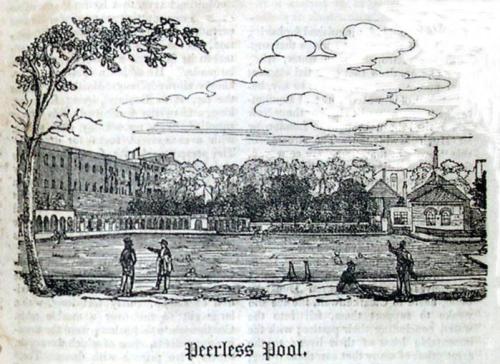
Perilous Pond, an ancient London spring whose overflowing waters formed a pond near Old Street, was a noted place for duck hunting in the 17th century. The pond acquired a dark name because of the many youths that had drowned in it.  In 1743, a local jeweller named William Kemp converted this pond into London’s first outdoor public swimming pool, renaming it the Peerless Pool. Situated behind St. Luke’s hospital, the newly embanked pool was 170 x 108 ft in dimension and from 3-5 feet deep. Bathers would dress in a vestibule made of marble, and descend into the waters by marble steps to a fine gravel bottom. A screen of trees and an arcade that surrounded the pool provided both privacy and shade from the sun. Adjacent to the pool, Kemp constructed a grand artificial canal stocked with carp, tench, and other fish for cockney sportsmen. Similar to the pleasure gardens described in the previous post, visitors could expect other attractions in the form of a small library with light literature, bowling green, and “every innocent and rational amusement”,*  including ice skating in winter.

peerless3

At the annual subscription rate of £1 10s or one  shilling per visit, the costs were prohibitive for all but the upper and rising middle classes.

Text not available
The London Pleasure Gardens of the Eighteenth Century By Warwick Wroth, … assisted by Arthur Edgar Wroth With sixty-two illustrations By Warwick William Wroth, Arthur Edgar Wroth

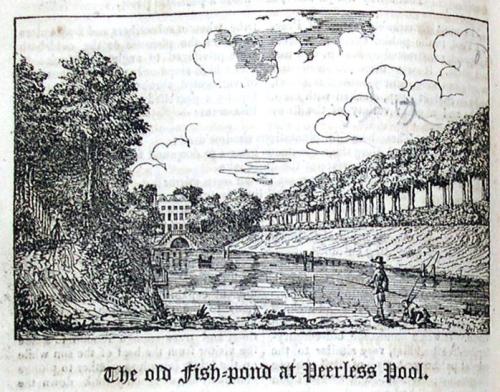
During the time that Jane Austen visited her brother Henry in London and in which Georgette Heyer set Frederica, the fish pond no longer existed:

Around 1805, the lease was acquired by Joseph Watts who drained the fish pond and constructed Baldwin Street on part of the site. William Hone visited the pool in 1826 and found that very little had changed:

“Trees enough remain to shade the visitor from the heat of the sun on the brink. On a summer evening it is amusing to survey the conduct of the bathers; some boldly dive, others timorous stand and then descend step by step, unwilling and slow; choice swimmers attract attention by divings and somersets, and the whole sheet of water sometimes rings with merriment. Every fine Thursday and Saturday afternoon in the summer columns of Bluecoat boys, more than a score in each, headed by their respective beadles, arrive and some half strip themselves ‘ere they reach their destination. The rapid plunges they make into the Pool and their hilarity in the bath testify their enjoyment of the tepid fluid.” – Lidos in London no longer open

peerless-pool

The Peerless Pool attracted a variety of visitors for over a century, including those boys from the Bluecoat School as previously mentioned.  The attraction was closed in 1850 and built over, and the trees removed. No traces of the old site remain except for the names of Peerless Street and Bath Street. Ironically, the Old Fountain Public House situated on Baldwin Street today maintains an indoor fish tank.

Read more about the Peerless Pool in these links:

old-fish-pond-peerless-pool

Read Full Post »

st-helena-tavern-and-tea-gardens-2
Over 200 outdoor pleasure gardens and tea gardens proliferated in London from the 16th to the early 19th centuries.  Primarily frequented by working class people who lived in the city, they were located in the pleasanter parts of London’s suburbs. In days of yore, the countryside was only a walk (or short carriage drive or ferry ride) away from the city center. Tea and pleasure gardens afforded the populace a respite from the sights, smells, and congestion of city life. In his essay on Tea Gardens, William Boulton writes:

“It was the citizens of such a town, sober merchants and shopkeepers, apprentices, sempstresses, and artisans who worked continuously, but leisurely and without much stress, during the week and spread themselves over an area of many square miles on Sundays, who formed the chief patrons of the al fresco entertainment. The lawyers and military men who filled the chief of the few recognised professions of the last century, supplied their quota of course, and the aristocracy came to most of the alfresco entertainments at one time or another, but merely as incidental visitors.”

Even the humblest tea gardens situated in inns and taverns vied for customers by offering special attractions like cake and ale, a bowling green, play tables, or a pond. Larger more luxurious gardens, such as Vauxhall or Ranelagh, offered a myriad of entertainments in the form of musicales, fireworks, illuminated groves, balloon rides, and theatricals. Considered the forerunners of today’s amusement parks, pleasure gardens provided extensive walks, private arbors, supper boxes, rotundas, and Chinese pavilions. Regardless of their size, the competition among these open air recreational gardens was fierce. Open only for a short season, the proprietors had to earn enough income to keep their establishments open and make a decent living.


Text not availableThe London Pleasure Gardens of the Eighteenth Century By Warwick Wroth, … assisted by Arthur Edgar Wroth With sixty-two illustrations By Warwick William Wroth, Arthur Edgar Wroth

Various strata of social classes commingled in these public spaces, although the upper classes tended to visit less frequently. When they did honor an establishment with their presence, they could create a stir.

“In 1733, in the month of May, it occurred to the Princesses Caroline and Amelia to attend [Islington Spa] regularly and take its waters. These royal ladies were duly saluted with twenty-one guns, and all London flocked to the gardens to see a real princess.” – London’s Tea Gardens, An Essay by William B. Boulton

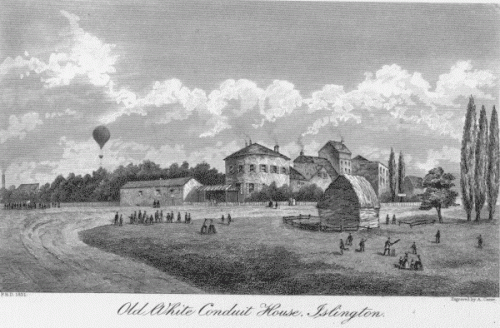
Profits shot up sky high for the owner after these royal visits, making the Islington Spa a commercial success. The White Conduit House, situated just 2-3 miles north of Marlyebone Gardens,  was another popular garden destination. In 1753, the proprietor, Mr. Bartholomew, ran the following enterprising advertisement:

whiteconduit

For the better accommodation of ladies and gentlemen, I have completed a long walk, with a handsome circular fish-pond, a number of shady pleasant arbours, inclosed with a fence seven feet high to prevent being the least incommoded from people in the fields; hot loaves and butter every day, milk directly from the cows, coffee, tea, and all manner of liquors in the greatest perfection; also a handsome long room, from whence is the most copious prospects and airy situation of any now in vogue. I humbly hope the continuance of my friends’ favours, as I make it my chief study to have the best accommodations, and am, ladies and gentlemen, your obliged humble servant, Robert Bartholomew. Note. My cows eat no grains, neither any adulteration in milk or cream.

The White Conduit House, also known as the “Minor Vauxhall”, began to offer balloon ascents, fireworks, and evening concerts. But its popularity gradually waned and the establishment offered its last entertainments in 1849.

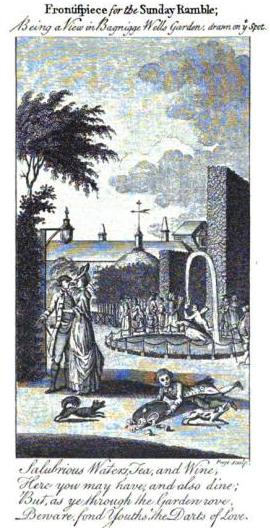
Food and entertainments depended on the time of day. In Bagninne Wells, for example, morning visitors tended to be invalids who would drink the mineral waters and partake of an early breakfast.

Bagnigge Wells

Bagnigge Wells

As the day wore on the invalids withdrew and the place was prepared for another class of customers. The citizens, their wives and daughters, came for their afternoon outing; the long room if the weather threatened, and the arbours if the sun shone, were filled with sober parties of shopkeepers or with boys and their sweet hearts, drinking tea and eating the bread and butter and the buns baked on the ground for which the place was famous. Negus was another of the products of Bagnigge held in much favour, and there were cider and ale for the more jovial spirits who smoked under the shade of the Fleet willows and watched the games of skittles and Dutch pins which were played in the eastern part of the gardens during the long summer evenings.

In the afternoon tea was served, as well as stronger drinks, like negus.  Visitors could relax,  drink syllabub, eat cake, and listen to the music of Handel. Or an amorous couple could sit and flirt in a private arbor. At night the pleasure gardens glittered with illuminated walks and fireworks. These public venues weren’t all pleasure. Pickpockets, “frail women”, sharpers, and other less desirable visitors would mingle among the crowds, adding a hint of danger and seaminess.

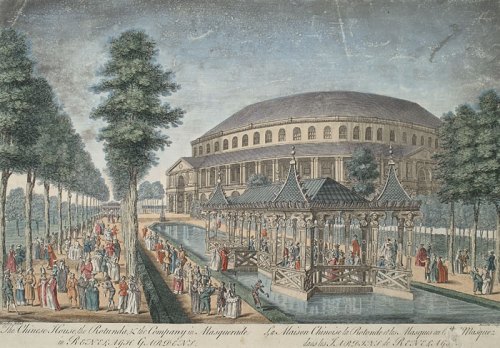
Rotunda at Ranelagh Gardens, 1754

Rotunda at Ranelagh Gardens, 1754

Towards the end of 1810, Bagnigge Wells was increasingly frequented by the lower classes, or as one late 19th century writer termed, “Cockney Crowds.” By 1813 the gardens were put up for auction. Vauxhall lasted until 1857.  Ranelagh’s famed rotunda closed in 1803 and was demolished in 1805. Today the site provides part of the grounds of Chelsea Hospital where the Annual Chelsea Flower Show is held.

Definition of

A Tea Garden: A tea garden was a place to drink tea and stroll around lawns, ponds and view statues. These smaller versions of pleasure gardens flourished in the late 18th century. Examples were Cuper’s Gardens and the area that became the Caledonian Cattle Market in London, England.en.wikipedia.org/wiki/Tea_garden

A Pleasure Garden is usually a garden that is opened to the public for recreation. They are differentiated from other public gardens by containing entertainments in addition to the planting; for example, concert halls or bandstands, rides, zoos or menageries.

Learn more about Pleasure Gardens at these sites

Read Full Post »

« Newer Posts - Older Posts »