Feeds:
Posts
Comments

Archive for the ‘Regency style’ Category

Domestic Happiness, Morland

Domestic Happiness, Morland

When we think of artists during the Georgian era, painters like Hogarth, Gainsborough, Reynolds, and Lawrence immediately come to mind. These days we rarely include George Morland. A prolific painter of rural scenes, he lived from 1763 to 1804. Many of his simple subjects would have been familiar to Jane Austen – children playing, women sewing, a family sitting by a fire, two men sitting outside an inn, people gathering firewood, men walking on a windy day, etc. Click on the first link below to view the most extensive collection on the web of this prolific artist’s paintings.

Read Full Post »

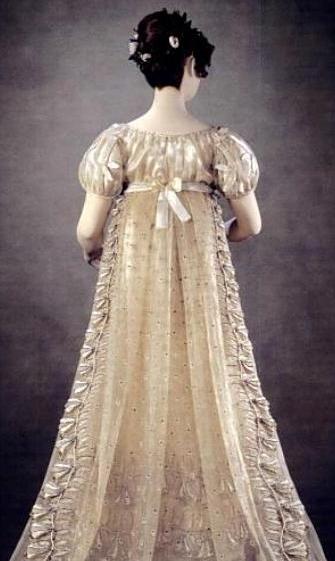
Princess Charlotte's Court Dress, 1814-16, also known as the Bellflower Dress

Princess Charlotte's Court Dress, 1814-16, also known as the Bellflower Dress

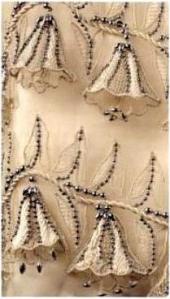
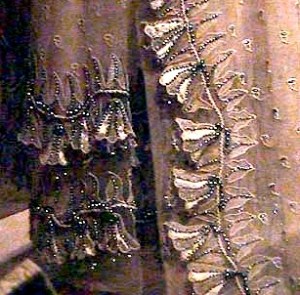
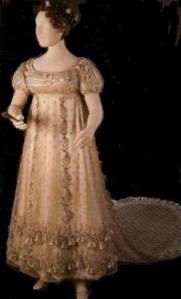
embroidered-bellsWhen I saw Princess Charlotte’s bellflower court dress (1814-16) at the Museum of London I remember being transfixed and standing in front of the glass case for a half hour. I could not get over the exquisite details and embroidery of this gossamer thin gown, and wondered at the hours it took to create it, the number of seamstresses that must have toiled over it, and its cost. It was so beautiful that I mistook it for a wedding dress. The train, which showed slight damage where some of the embroidered bells were missing, is similar to the one on Princess Charlotte’s silver net wedding gown. Tradition has it that this court dress was made for Princess Charlotte on her engagement in 1814. The bellflowers were fashioned from silk covered wire and net decorated with silver thread darning and the tiny beads were made from blown glass. (The London Look, p 22)

The Museum of London website states that this sumptuous dress, which is “covered with hundreds of tiny three-dimensional bellflowers, exemplifies the technical excellence of London’s dress-makers in this period. The dress needed 600 hours of conservation work and is so fragile it may never be shown in public again.”

Detail of bells and net embroidery

Detail of bells and net embroidery

Short in stature and slightly dumpy, and not known for her fashion sense, Princess Charlotte could easily afford elaborate costumes. Her provisioners included the William King of Pall Mall, a silk mercer, and Mrs. Triaud and Mrs. Bean, London dressmakers who worked on her trousseau. (The London Look, p 22.)

According to a contemporary description, the Princess entered her mother’s drawing room in May 1815 in an exquisitely beautiful dress that (from the description) looked similar to the bellflower dress:

Gold lama and white draperies over a petticoat of rich white satin and gold twisted trimming; train of rich figured white satin, body elegantly trimmed with rich gold and blond lace; head-dress, plume of ostrich feathers, with a beautiful diadem of brilliants; necklace and ear-rings of diamonds. – The London Look, p 24

  • The London Look, Fashion from Street to Catwalk. By Christopher Breward, Edwina Ehrman, Caroline Evans, 2004

princess-charlotte-court-dress3Front of gown, Museum of London

Read Full Post »

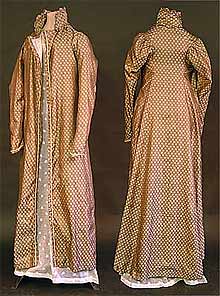
Image of Jane Austen's pelisse coat

Image of Jane Austen's pelisse coat

Isn’t Jane Austen’s pelisse coat pretty? It has an oak pattern on a beige and brown ground. The pelisse was donated to the Hamphire Museum in 1993 and can be viewed in this link. View close ups of the coat here.

According to Fashion-Era: “Both the late 18th century and the early 19th century pelisse were three quarter length coat. Later versions had a shoulder cape or capes. It was often trimmed with fur, ruched silk trimmings or satin along its edges.” Pelisses can be without sleeves or with sleeves and vary in length.

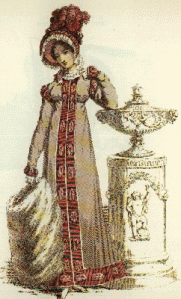
1819 Walking Dress, Ackermann's Repository

1819 Walking Dress, Ackermann's Repository

Lara Corsets and Gowns reproduced a pelisse coat from an 1819 Ackermann fashion plate.  The following is Catherine Decker’s description of this coat: “Walking Dress, featuring Pelisse. This grey pelisse is trimmed with ruby velvet and has a matching ruby velvet bonnet, with ostrich feathers dyed to match. The huge fur muff would stay popular for the next few years, but muffs in the late 1820s were generally of a more reasonable size.”

  • Click here to see the modern reproduction and for ordering information.

Read Full Post »

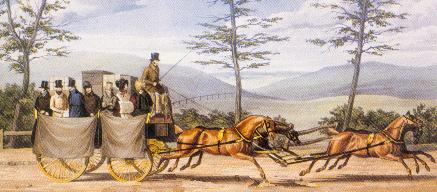
Bianconi Coach

Bianconi Coach

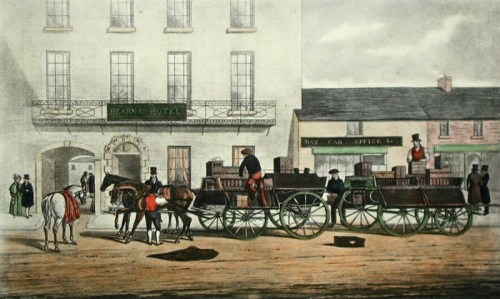
Have you ever heard of Charles Bianconi? The Irish probably have: Bianconi revolutionized public transport in Ireland in the early 19th century. An immigrant in 1802 from Costa Masnaga, Italy, he founded a network of coaching routes  that covered Ireland from Belfast to Cork from a terminus that began at the Hearn Hotel in County Tipperary on July 6th in 1815. The first Bianconi carriage was a two-wheel horse drawn cart that carried three or four passengers.  The new venture, known as the  Bianconi Coach Service for private passengers,  made the 30-year-old immigrant the ” King” of the Irish roads.

Charles Bianconi

Charles Bianconi

Bianconi quickly expanded his fleet  to 900 horses and  67 coaches.

Travel on one of these “Bians” as they were to become known, cost one-penny farthing a mile. Such demand was there for his transport that over the next 30 years a huge network of communications were established, with Clonmel, Co Tipperary as its hub. Huge employment was also now created from this growing transport business. The year 1833 saw the “long car” go into production from his coach building premises in Clonmel which enabled him to carry up to twenty passengers, plus cargo and mail deliveries for both  British and Irish Post Offices. Here in Thurles, his depot was situated in O`Shea`s Hotel which today trades as McLoughneys, a ladies clothing boutique. The stables where he fed and changed his horses between journeys still exists, relatively unchanged, to this very day and  are situated at the rear of Ryan’s Jewellers shop, Liberty Square, Thurles, Co. Tipperary.The advent of railway in 1834 brought home to Bianconi the realisation that his coaching business had now only a limited future. He immediately began to buy shares in the different rail lines as they were being built. He began to sell his coaches and long carts to his employees who had worked for him. – Thurles Information

Bianconi Coaches in front of the Hearn Inn

Bianconi Coaches in front of the Hearn Hotel

Read Full Post »

We continue our revisit with Sense and Sensibility and visual review of Part 2 of the movie (click here for Part 1) wherein Mrs. Ferrars is suitably creepy and mean, and Marianne’s tear ducts gush more water than the fountains at Chatsworth House. While many details in Jane’s novel were changed in this production, the film’s length was satisfying. Strangely I found many echoes of Emma Thompson’s and Ang Lee’s excellent 1995 film in this adaptation as well.
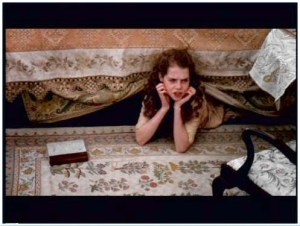
Margaret hiding in the library is a scene taken from the 1995 film.

Margaret hiding in the library is a scene taken from the 1995 film.

Lucy and Anne Steele had different accents. While Lucy seemed more refined, Anne stole the show.

Lucy and Anne Steele spoke in different accents. While Lucy seemed more refined, Anne was comedic.

Henry Dashwood, much older than in Jane's novel, seems a bit embarassed wearing those curls and collar.

Henry Dashwood, much older than in Jane's novel, seems a bit embarrassed wearing long curls and a frilly collar.

Edward chopping wood in the rain.

Working off his frustration, Edward chops wood in the rain.

Elinor talks to Edward in the rain.

Elinor, confused with Edward's behavior, talks to him in the rain.
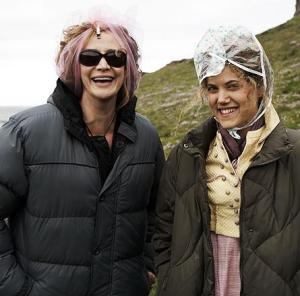
In fact most of the outdoor shots were filmed in the rain.
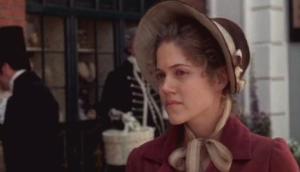
In fact most of the outdoor shots were filmed in the rain.

In London Marianne looks for Willoughby in vain.

Newly arrived in London, Marianne looks for Willoughby in vain.

Lucy and Anne ogle the nasty beasts at the assembly.

Lucy and Anne ogle the nasty beasts, as Anne describes the men at the ball.
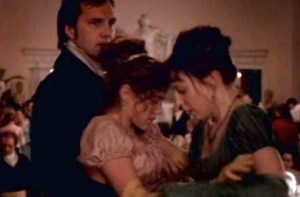
When she finds him she is seriously displeased.

When Marianne sees Willoughby she overcome.

Marianne finally receives a letter from Willoughby.

Marianne finally receives a tepid letter of explanation from Willoughby.

Edward awkwardly offers his arm to his betrothed in front of Elinor.
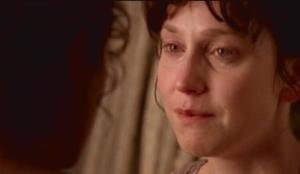
Edward awkwardly offers his arm to his betrothed in front of Elinor.

Elinor confesses to Marianne how unhappy she has been.

Elinor confesses to Marianne how unhappy she has been.

Mrs. Ferrars is seriously displeased with Edward when he confesses his engagement to Lucy.
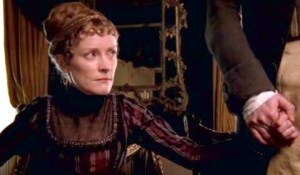
Mrs. Ferrars is seriously displeased with Edward when he confesses his engagement to Lucy.

Fanny Dashwood, equally upset, holds onto her husband's hand.

Fanny Dashwood, equally upset with the news, clenches her husband's hand.
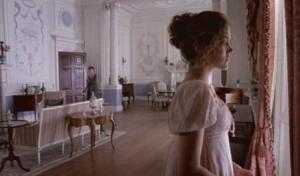
Marianne wants to leave London.

Marianne cannot wait to leave London for home.

Walking to Willoughby's house, Marianne is refreshed by the rain.

She walks to Willoughby's house in the rain and catches a lung infection, more reminiscent of the 1995 film than Jane's novel.

The colonel is beside himself with worry.
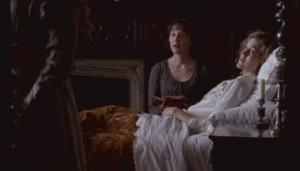
The colonel is beside himself with worry.

Charity Wakefield, looking suitably wan, properly thanks Colonel Brandon.

Marianne looked suitably wan in bed, but very pretty when she thanks the colonel.

An anguished Willoughby tries to convince Elinor that he truly cared for Marianne.
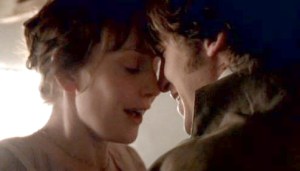
An anguished Willoughby tries to convince Elinor that he truly cared for Marianne.

The film ends on a happy and romantic note in a scene that is eerily similar to 1995's Sense and Sensibility.

The film ends on a happy and romantic note in a scene that is eerily similar to 1995's Sense and Sensibility.

The colonel carries his bride across the threshold.

The colonel carries his bride across the threshold.

My other Sense and Sensibility posts sit here, including Sense and Sensibility Soaked.

Post script: Where was Janet McTeer/Mrs. Dashwood? A fine actress, she wasn’t given much camera time except for reaction shots.
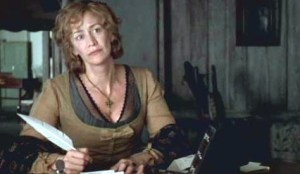
Think I'll add a few more Mrs. Dashwood lines in the script. Wonder if anyone will notice?

Think I'll add a few more Mrs. Dashwood lines in the script. Wonder if anyone will notice?

Read Full Post »

« Newer Posts - Older Posts »