Feeds:
Posts
Comments

Archive for the ‘Regency style’ Category

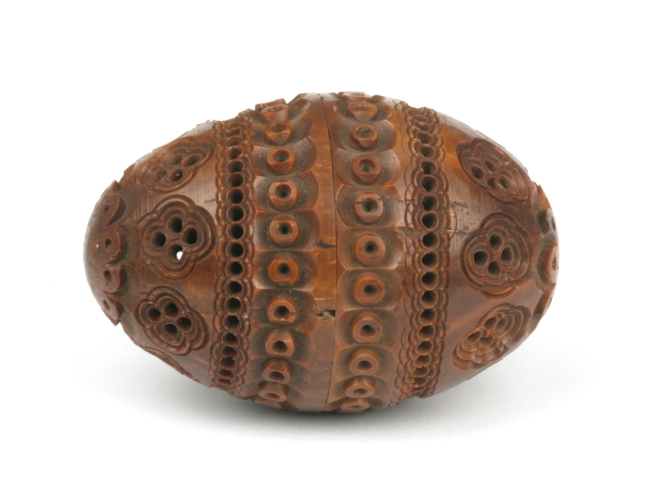
Coquilla nut ink stand, late 18th- early 19th c. Image @Antiques Atlas

Yesterday I came across an interesting description in Ackermann’s Repository of Arts, Literature, Commerce, Manufactures, Fashions, and Politics, April, 1812, about coquilla nuts, which a certain Mr. R. Ackermann displayed at his Repository, No 101, Strand (having purchased a considerable quantity of this fruit).

From whence the Portuguese obtained it, is so little known, that even the botanical library of Sir Joseph Banks cannot ascertain the circumstance. The probable conjecture, however, is, that it is the produce of the Portuguese possessions in Africa. It is, in a great measure, unknown in this country, nor can it be otherwise, as it is near sixty years since the custom-house entries mention an importation of it…”

19th c. coquilla nut pounce pot or spice shaker. Image @Ruby Lane

The coquilla nut is in fact the fruit of the Brazilian Palm, which is closely related to the coconut palm. The nut is 3-4 inches long, and has a very hard, richly streaked brown shell that is capable of taking a fine polish. It is a source of palm oil. The tree also offers up a stiff, wiry leaf fiber that is used for making brooms and rope. Coquilla nuts were routinely converted into a variety of highly ornamental articles:

The uncommonly pleasing colour of the  shell, the hardness and the native mottle which appears when it is highly polished, renders it capable of being employed, with the most agreeable effect, as it is susceptible of the most tasteful forms — on the writing-table, in wafer-boxes and seals, pounce, sand-boxes, &c. — on the ladies’ work-table, in needle-cases and thimble-cases, cotton-boxes, pincushions, &c. — or on the toilette and dressing-table, in boxes for lip-salve, rouge, scented sponges, and every kind of pomade. In the form of egg-cups, the nuts will be found to decorate the eating ‘table. As bell-pulls, they are very elegant.

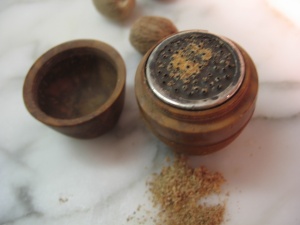
19th c. coquilla nut pomander and nutmeg grater. Image @Christie's.

Coquilla nuts were also made into umbrella handles, candlesticks, and dice cups. The carved product was combined with ivory, or in the case of jewelry, with jade. I could find no examples of jewelry, and wonder it the nut was widely used for such a use.

As they appear to great advantage when worked up into beads, rosaries, and crosses, they will, doubtless, give a pleasing variety to personal decoration, when shaped into necklaces, bracelets, ear-rings, and other trinkets. Little useful pocket articles, as nutmeg-graters, cases for smelling-bottles, and other similar portable conveniences ; in short, whatever has been formed from ivory, may be produced from the shell of the Coquilla, whose beauty will not fail to attract, while the price of the article will satisfy the purchaser.”

Coquilla nutmeg grater. Image @Historic Cookery

Antique coquilla nut items are still quite reasonably priced, as this nutmeg grater from Historic Cookery attests. The Ackermann’s description indicated that the item was carried in the owner’s pocket, in order to season food ordered at a chopping house or club, no doubt.

19th century coquilla nut flea trap. Image @Physick.com

The most interesting coquilla nut item is this one: a flea trap.

It is easy to forget the squalor, poor hygiene, stench and infestations which our forefathers endured. In the 18th and 19th century flea traps were filled with a few drops of blood and honey or resin, depending on your financial means. Supposedly, fleas attracted by the blood would enter the trap and get stuck to the honey or resin. They were hung around the neck, worn in ladies clothes or kept in bed. – Physick.com

Coquilla nut flask. Image @Millers Antiques Guide

This coquilla nut flask seems a relatively simple item (One wonders how much liquid such a small flask would contain, unless it was whiskey or laudanum, or some other potent substance). Examining it closely, one can read inscribed on its top:

 ‘In the West Indies, I did grow upon a tree so high a negro come and cut me down a soldger…did me buy.., H. Neal, 35, Royal Sussex’. – Millers Antiques Guide 

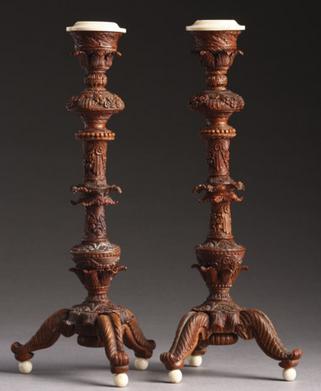
Some coquilla nut items were larger and more elaborate. One surmises that a series of nut carvings were joined and glued together to create these beautiful candlesticks carved by Indian artisans in Bengal, who worked from designs supplied by locally based European tradesmen.

Late 18th C. Anglo Indian coquilla nut and ivory table candlesticks. Image@Online Galleries: The Antique Portal

…these candlesticks typical of the Murshidabad workshops delicately carved decoration, may have stood on an ivory ‘teapoy’, whose form was directly taken from a European candlestand.” – The Antique Portal

Carved 19th c. coquilla nut case thread, thimble holder. Image @WorthPoint

More about the featured items:

Read Full Post »

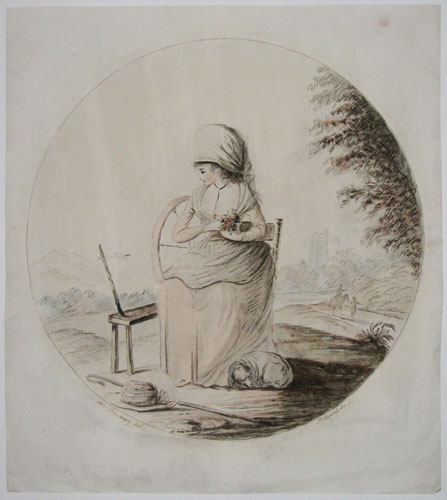
Can you imagine Jane Austen at her spinning wheel? We will soon have the possibility of seeing the Austen family’s spinning wheel at Chawton Cottage after its restoration. My sense is that it was highly unlikely that Jane Austen herself spent much time using it for spinning.

A lady spinning at her wheel, after Wm Bunbury, 1781. Image @Grosvenor Prints*

She wrote in a letter from Chawton dated Friday, May 31, 1811 to Cassandra, who was staying at Godmersham Park:

I have taken your hint, slight as it was, and have written to Mrs. Knight, and most sincerely do I hope it will not be in vain. I cannot endure the idea of her giving away her own wheel, and have told her no more than the truth, in saying that I could never use it with comfort. I had a great mind to add that, if she persisted in giving it, I would spin nothing with it but a rope to hang myself, but I was afraid of making it appear a less serious matter of feeling that it really is.

Jane’s wit and humor came to the fore, and she used it to good effect to show how little such a gift would mean to her. Mrs. Knight eventually died and biographer, David Nokes, writes:

There came news from Kent of the sad death of Mrs. Knight. The old lady left a donation of £20 to be distributed among the poor of Chawton parish, but Jane was relieved to find there was no mention of the spinning-wheel.  – David Nokes, Jane Austen: A Life, p. 392

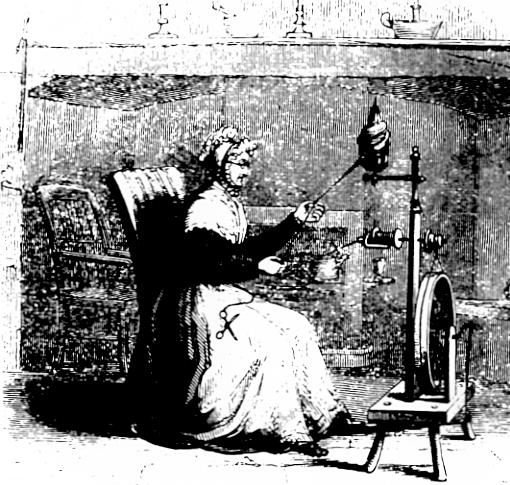
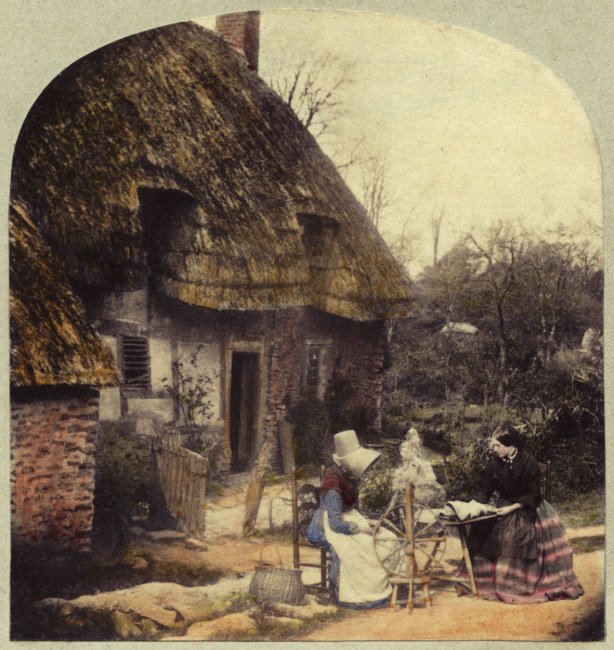
Cottage woman at work on her spinning wheel. Burnett

And so Jane was saved from the burden of spinning. Many of  her female friends and relations enjoyed the pasttime. Her nephew, Edward Austen-Leigh, wrote in his memoir:

With regard to the mistresses, it is, I believe, generally understood, that at the time to which I refer, a hundred years ago, they took a personal part in the higher branches of cookery, as well as in the concoction of home-made wines, and distilling of herbs for domestic medicines, which are nearly allied to the same art. Ladies did not disdain to spin the thread of which the household linen was woven. Some ladies liked to wash with their own hands their choice china after breakfast or tea. In one of my earliest child’s books, a little girl, the daughter of a gentleman, is taught by her mother to make her own bed before leaving her chamber. It was not so much that they had not servants to do all these things for them, as that they took an interest in such occupations. – Edward Austen Leigh, A Memoir of Jane Austen, p 37

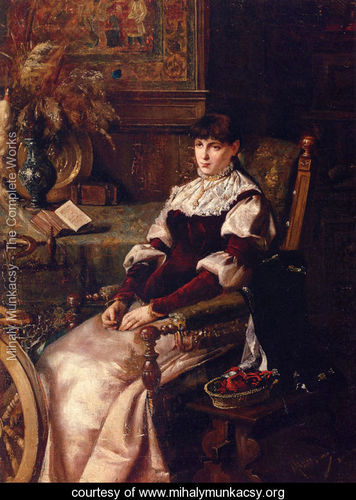
Spinning was popular with ladies all over Europe. Late 19th c. painting by German artist Mihaly Munkacsy

It is quite likely that the thread used for the lace on Mrs. Hurst’s gown in Pride and Prejudice (over which Mrs. Bennet exclaims) was spun by the lady who made it. In those days, ladies of the highest order spun yarn used for embroidery or lace making. They gathered in small groups to spin wool and wile away the time as they gossiped or engaged in pleasant conversation. Jane Austen notes on January 14, 1796 that “Anna is now here; she came up in her chaise to spend the day with her young cousins, but she does not much take to them or to anything about them, except Caroline’s spinning-wheel.”

The unlikely accomplishment of spinning had been a social skill practiced at the highest levels of society, probably because the parlor spinning wheels which the socially prominent operated were beautifully wrought and highly decorative. (In Jane Austen’s letters, we find Austen commenting to her sister regarding a proposed gift of a spinning-wheel, which she refuses because of the sense of identification of the fine tools of women’s work with their owners [Selwyn 68].)  Further, a woman’s ability to create a smooth sewing thread was considered a remarkable accomplishment; – Susan E. Jones, Thread-cases, Pin-cushions, and Card-racks: Women’s Work in the City in Jane Austen’s Persuasion

Fashionable ladies most likely did not bother to do the hard work of cleaning, sorting, dyeing, carding, and greasing yarn in preparing the wool for the spinning wheel. Instead, they performed the lighter tasks of spinning the wool yarn into a finer thread.

In a recent BBC Radio 4 interview, Val and David Bryant discussed the very special “Planta” wheel owned by the Austen family. Val is an expert on the history of spinning wheels and her husband is a spinning wheel restorer. The couple spoke about their remarkable acquisition, which is being restored in Chesire.

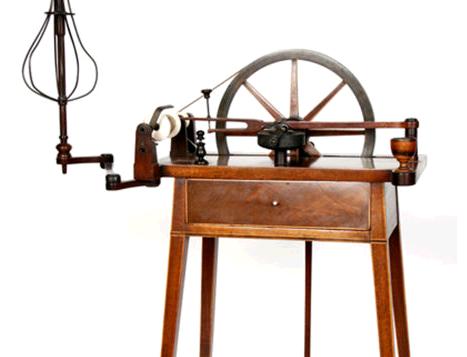
Austen family "Planta" spinning wheel in the shape of a table, with Sheraton style legs and a drawer. Image @BBC Radio 4

The spinning wheel once owned by the Austens is a beautiful and rare specimen made like a piece of furniture. It looks like a little table with Sheraton-style legs and had a little drawer. Its maker, John Planta (c. 1798-1824), was a craftsman from Fulneck, Yorkshire near Leeds. His specialty was to produce high quality spinning wheels in a unique Sheraton style.

This spinning wheel resembles the fine drawing room models that were designed for ladies who spun for pleasure: It is a world away from ordinary spinning wheels destined for the cottage industry.  The Bryants speculated that this elegant spinning wheel was a “must-have” gadget for its day. They were becoming so fashionable and desirable, that some were embellished with inlays and finials. The Austen’s spinning wheel is remarkable in that it still has the original instructions on how to use it.

Victorian photograph of a cottage woman at her spinning wheel, 1850. Image @Daily Mail

The Austen family spinning-wheel is currently missing a treadle and footman that drives the crank, and it needs a new pulley. It also squeaks. Once it is restored, it will go on display in Chawton Cottage for all the visitors to see! I’ll keep you posted.

More on the topic:

Read Full Post »

Oak cask for making vinegar. Image @Taste of Croatia

Vinegar has had a long and noble history of uses for mankind. Since ancient times it has been used as a preservative. Delicate fruits and berries were ripe for such a short season that vinegar, with its acetic acid content, was used to to preserve them. (Blackberry vinegar recipe)

Add sugar and water, to the mixture and one had created a tart and pleasing beverage. Mix it with alcohol, and this sweet concoction became a tasty mixer! Vinegar Cocktails Are Making the Rounds 

As vinegar is so necessary an article in a family, and one on which so great a profit is made, a barrel or two might always be kept preparing, according to what suited.” – A new system of domestic cookery: formed upon principles of economy, and adapted to the use of private families (Google eBook), Maria Eliza Ketelby Rundell, Printed by Norris & Sawyer, 1808.
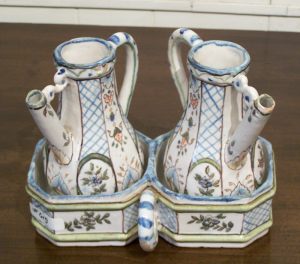
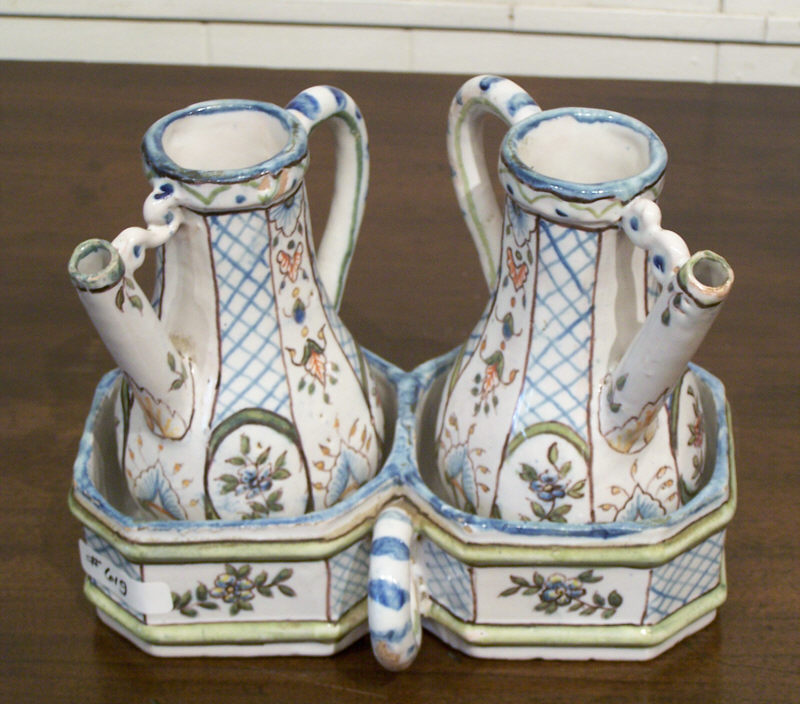
18th century French faience oil and vinegar set

Vinegar is made from many sources: grapes, apples, sugar cane, or malted barley or oats.

In foods it is used for its antibacterial properties, as an acidity stabiliser, diluting colourings, as a flavouring agent and for inhibiting mould growth in bread. In brewing it is used to reduce excess losses of carbohydrate from the germinated barley and to compensate for production variations, so producing a consistent quality beer.

It can be found in beer, bread, cheese, chutney, horseradish cream, pickles, salad cream, brown sauce, fruit sauce, mint sauce and jelly and tinned baby food, sardines and tomatoes.” – La Leva di Archimede

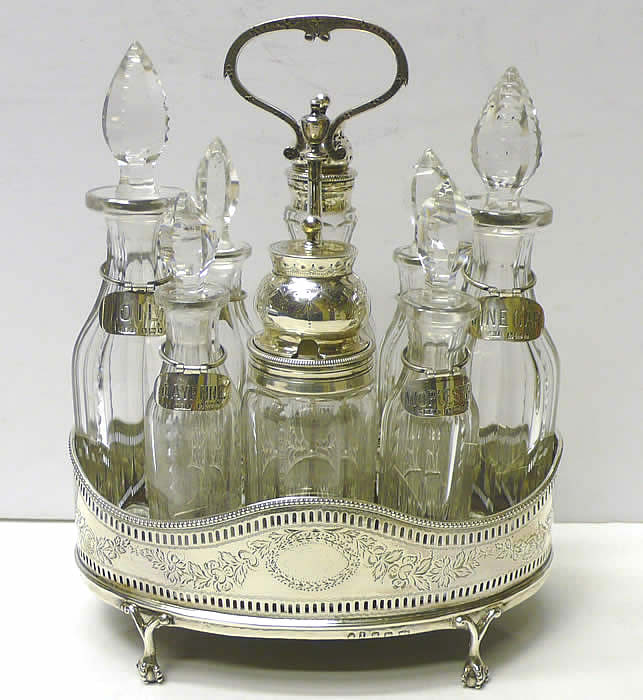
George III condiment set, silver 1782 Sheffield

Herbs, fruits and spices have long been added to vinegar for flavor, and recipes for infused vinegars were handed down for generations. ‘Sugars of lead,’ a sweet tasting substance, was made by pouring vinegar over lead. This liquid would be used to sweeten harsh cider, but as every self-respecting 21st century reader knows, this substance was quite poisonous. One can only conclude that sugars of lead must have been quite deadly to Europeans addicted to drinking cider. – Enzyme facts, vinegar history 

Recipes for vinegar are found as early as the 17th century. In the Delightes for Ladies (1602), Sir Hugh Plats offers this recipe for distilling and purifying vinegar. Notice his caution of the use of lead.

How to distill wine vinegar or good Aligar that it may be both cleare and sharpe

I Know it is an usuall manner among the Novices of our time to put a quart or two of good vinegar into an ordinay leaden stil, and so to distill it as they doe all other waters. But this way I do utterly dislike, both for that heere is no separation made at all, and also because I feare that the Vinegar doth carry an ill touch with it, either fro the leaden botto or the pewter head or both. And therefore I could wish rather that the same were distilledin a large bodie of glasse with a head or receiver, the same beeing placed in sand or ashes. Note that the best part of the vinegar is the middle part that ariseth, for the first is fainte and phlegmatick, and the last will taste of adustion, because it groweth heavie toward the latter end, and must be urged up with a great fire, and therefore you must now and then taste of that which commeth both in the beginning & towardes the latter end, that you may receive the best by it selfe.
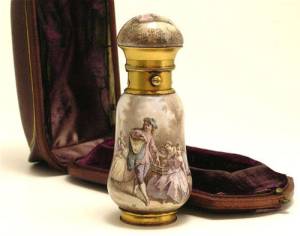
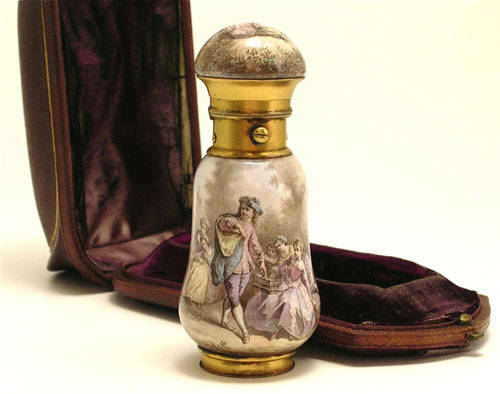
18th C. French vinaigrette bottle

Aromatic vinegar in the minds of 17th-19th century users had many medicinal purposes for preventing infections and megrims (headaches), reviving a fainting person, and covering bad odors. It was used to treat dropsy, croup, stomach aches, as well as sore throats. Vinegar teas were consumed by diabetics, and the liquid was used to heal wounds and fight infections. (Bragg, Health Information.) Vinegar was also a well-known cleaning agent and furniture polish, although it was not recommended for polishing marble, since the acid would eat into the smooth surface, leaving it pockmarked over time.

Vinegar was considered an indispensable item in the 18th century for arousing a fainting person or masking foul odors. When the sponge was soaked only in vinegar, its original use, it could help prevent the wearer from fainting. A person stepping outside a crowded London street might carry aromatic soaked sponges to hold close to the nose to mask the odor of raw sewage and rotting garbage.
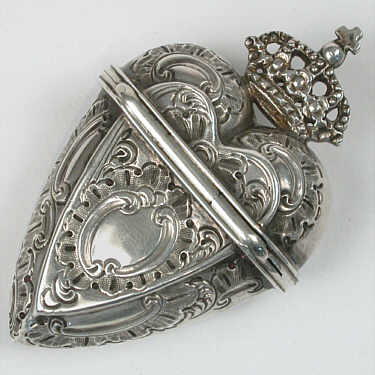
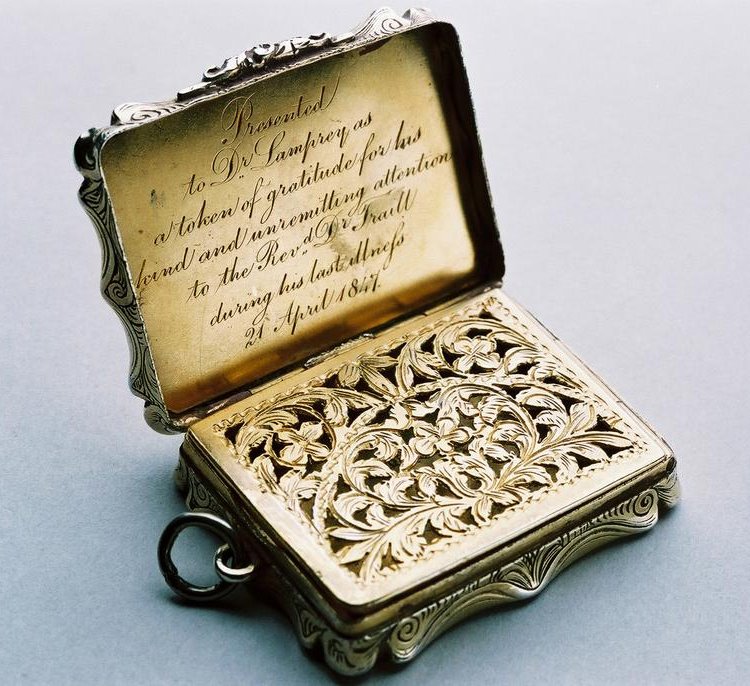
19th c. Victorian silver vinaigrette

In the early 19th century, there wasn’t garbage men that carted away the trash. People threw the stuff out the window. Slop pails went out the window in the 18th century. And when you left your house, you would encounter odors that made you just choke. So they invented a device called the vinaigrette. And it was a box or a little trinket carried to revive oneself if one felt faint.

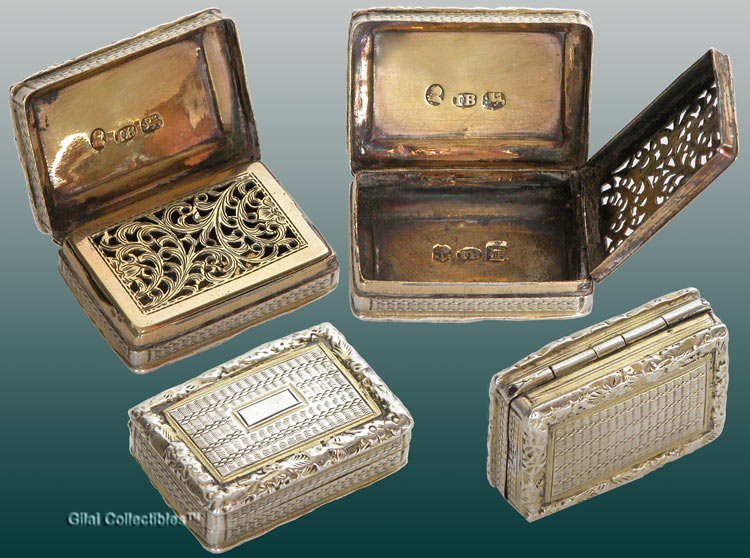
So now they can’t breathe, they go outside, they smell the rotten garbage and the sewage, and they think they’re going to faint. They opened up their vinaigrette, which they held in their hand, and inside is a gold-pierced grill with beautiful decoration. But underneath the grill is a sponge. They would soak that sponge in an aromatic solution, sort of a mixture of perfume and ammonia, like smelling salts.” – Barry Weber, Antiques Road Show 
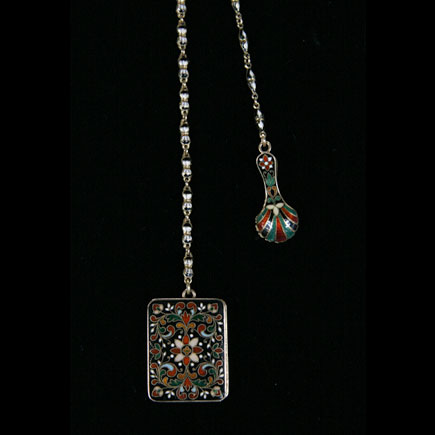
Vinaigrette and train holder. Image @Antiques Road Show

That was the concept of the vinaigrette. But the other end of this, you seldom see these all together. This is called a train holder. And this is shaped like a shell. When you squeeze it, it opens. The train was the long part of the ball gown. And they didn’t want it to drag in the dirt and be soiled. So they would hook the train holder onto the edge of the train, and then they would hold the vinaigrette in their hand, and this kept the train from dragging behind them.” Barry Weber, Antiques Road Show 

Vinaigrettes were small decorative containers that held the vinegar-soaked sponges. The inside of the vinaigrette would be gilded to protect the silver from staining.

Used by both men and women, vinaigrettes were suspended from chatelaines, placed in pockets, hung from long chains, bracelets or finger rings. Often designed in the shape of a rectangular box, the more spectacular vinaigrettes took on the look of a vase of flowers, a purse, an urn, almost any contemporary theme. Made from multicolored gold or silver and sometimes silver-gilt, many were decorated with Italian mosaics, mother-of-pearl or other gem materials. – Antique Jewelry University
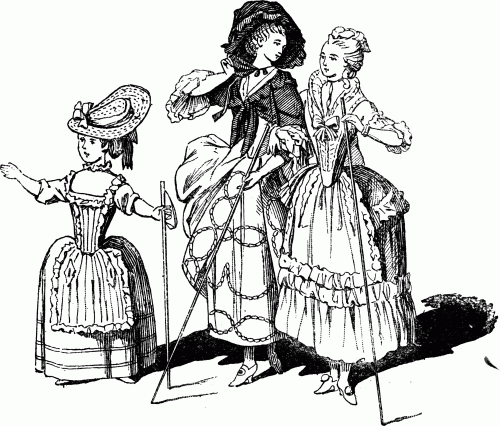
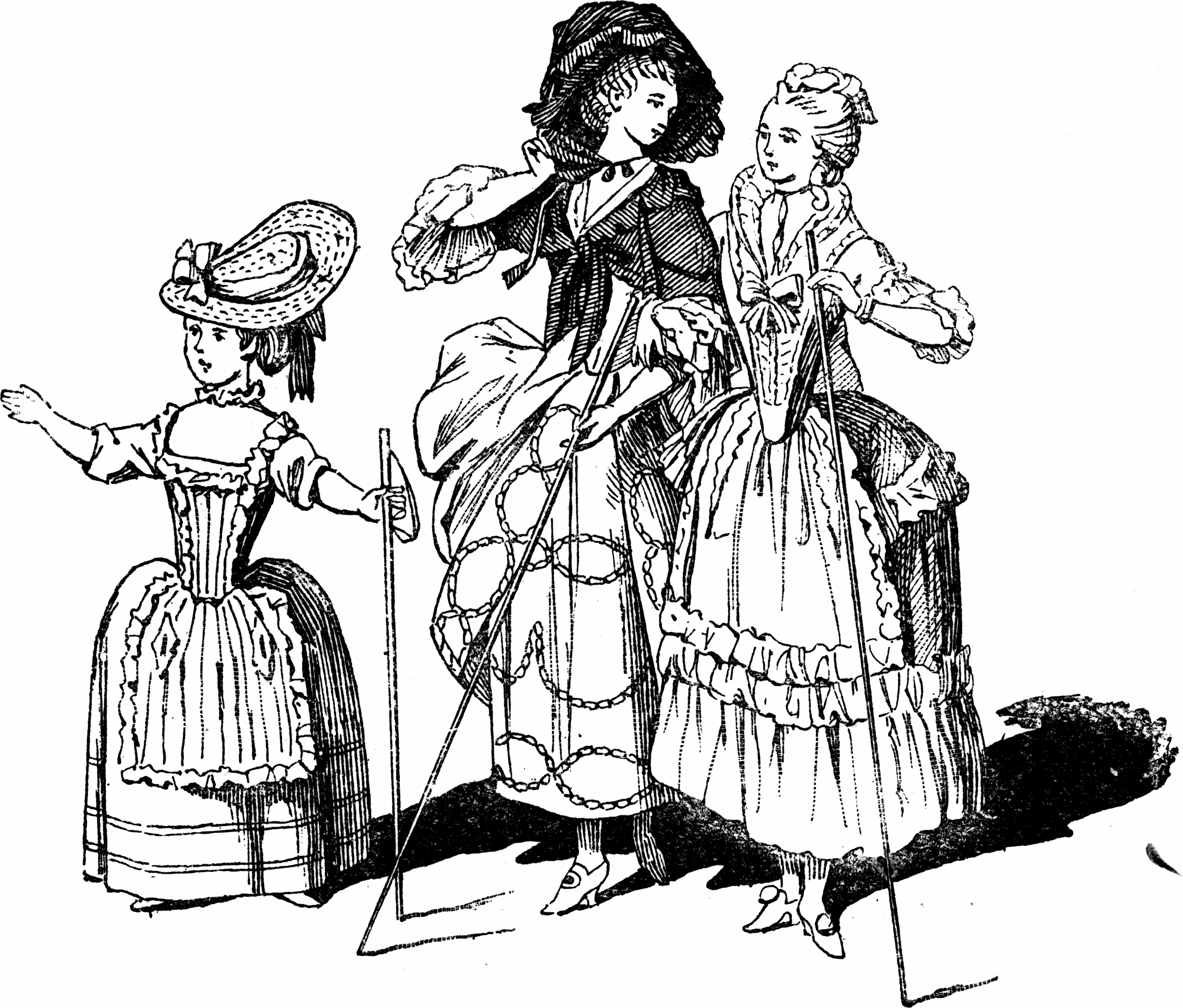
18th century French ladies carrying canes

The soaked sponges were also carried in a compartment in the head of walking canes.

…many ladies of the 18th and 19th centuries carried a “vinaigrette” cane to protect them from a variety of ailments. Throughout history, vinegar has been heralded for its medicinal qualities. A sponge soaked in the healing liquid was placed in a small container with holes in it on the handle of the cane. Should a lady’s tight corset cause her to faint or should she encounter someone with a dreaded illness, her vinaigrette tucked into her cane was close at hand to protect her.” – Collecting Antique Walking Sticks or Canes 

Vinaigrette, Nathaniel Mills. Image @Leopard Antiques

Often spices such as cinnamon, lavender, roses, or orange were added to sweeten the smell.

The vinaigrette was a most necessary adjunct to the toilette in the late eighteenth and early nineteenth centuries, when it was considered the correct thing for a lady to show symptoms of fainting on occasion. The little boxes with a grating inside—through which the essence contained in a saturated sponge could be inhaled— are of all sorts and conditions. Some are quite plain, others have delicately chased or monogrammed tops, or views engraved on the lids; others, again, are of fantastic shapes. The vinaigrette was the descendant of the old pomander, and the forerunner of the midVictorian smelling bottle; but whereas the vinaigrette is accessible to the most modest purse for a very small sum, the real old genuine pomander is very scarce indeed, and it means a lot of money to come by one at all. The pomander was round, and often of china, and contained a wonderfully strong-smelling ball, compounded of spices and pungent scents which could hardly fail to bring round the most upset of ladies. – Byways of Collecting, 1908, Ethel Deane, Pp 170-172.

The small containers known as vinaigrettes were actually an English invention. The French called them “boite de perfum”. They came in many shapes and sizes, and eventually became decorative items that lovers exchanged as tokens of affection. (Limoges Boxes: A Complete Guide)
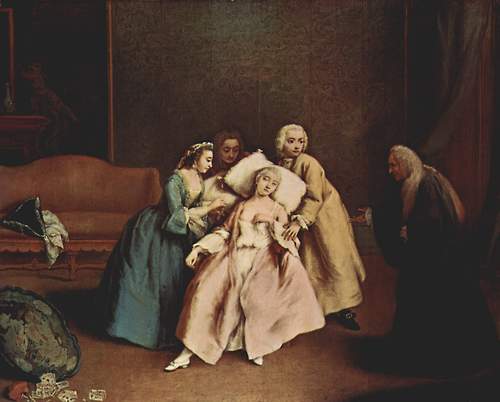
The vapours from a vinaigrette caused the person to inhale sharply and then breathe more rapidly. Restoratives carried different names and were made from various recipes, not just with vinegar: In addition to vinaigrettes, there are smelling-salts, hartshorn, and Hungary water or lavender water. Ladies prone to fainting would also keep a bottle of laudanum nearby. Laudanum, a painkiller, was an alcoholic herbal preparation that containing approximately 10% powdered opium. Smelling-salts were an infusion made with ammonium carbonate and alcohol and scented with lemon or lavender oil. Hartshorn (aqueous ammonia)was made from carbonate of ammonia distilled from the shaved or powdered horns of a male deer. Hartshorn and smelling salts or sal volatile could be mixed with water and drunk as a restorative. Hungary water was a perfumed restorative made with distilled water and sweet-smelling herbs and flowers. This was dabbed on the skin of a person suffering from “nerves.”- Jennifer Kloester, Georgette Heyer’s Regency World, 157-58

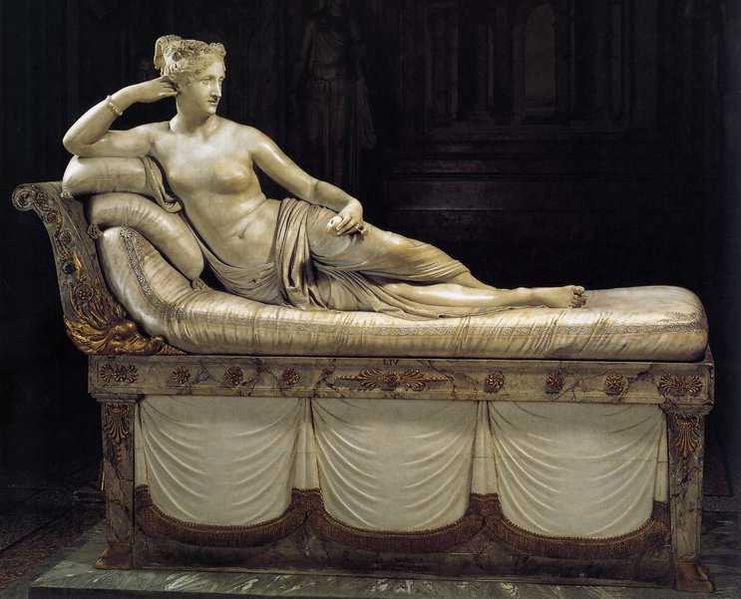
Pauline Bonaparte transformed into a goddes of antiquity on her day couch. Neoclassical statue by Canova, 1805-1808, @ Borghese Gallery

And so we finally come to the fainting couch or a chaise longue, or a reclining chair with a long seat that supported the legs of the fainting person. These couches were placed in drawing rooms and dressing rooms, and were used for relaxation as well.
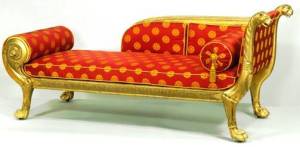
Early 19th century Recamier day bed. Image @Victoria & Albert Museum

This post will not go into the myriad reasons why women of this era fainted with such regularity. Tightly laced corsets certainly had something to do with the condition, but with so few rights and options open to them in their life’s choices, one cannot blame women of that time for reacting to the child-like treatment their husbands and fathers accorded them with fits, vapours, nerves, and fainting spells.
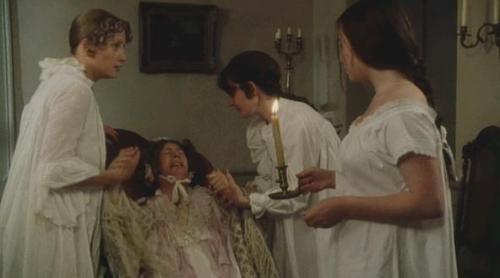
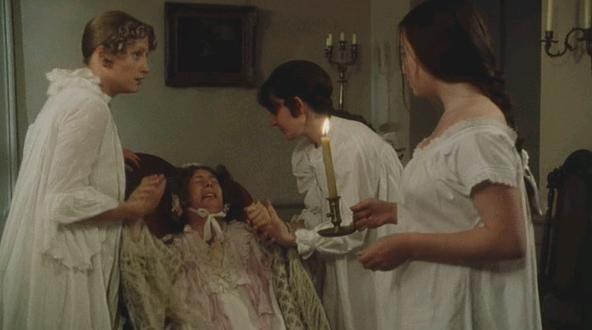
The Bennet family is well acquainted with Mrs. Bennet's nerves. Pride and Prejudice 1995

A character like Mrs. Bennet, who had her origins in Jane Austen’s real life observations, did not have many opportunities for maturing or turning into a well-educated and sensible woman. Mr. Bennet had given up on her and her childish behavior was enabled by her caring daughters and siblings.
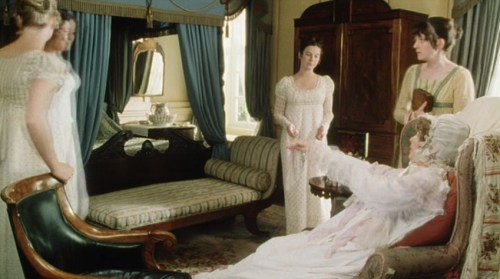
Scene from 1995 Pride and Prejudice. Mrs. Bennet is overcome from the thought of Lydia's elopement. Note that she is not using the day bed but has a chair propped under her feet.

Vinegar had many other uses:

A recipe for black dye

Let one pound of chopped logwood remain all night in one gallon of vinegar. Then boil them, and put in a piece of copperas, as large as a hen’s egg. Wet the articles in warm water, and put them in the dye, boiling and stirring them for fifteen minutes. Dry them, then wet them in warm water, and dip them again. Repeat the process, till the articles are black enough. Wash them in suds, and rinse them till the water comes off clear. Iron nails, boiled in vinegar, make a black dye, which is good for restoring rusty black silks. – A Treatise on domestic economy for the use of young ladies at home and at school, by Catharine Esther Beecher, 1849, p. 299-303

For whitening scorched articles of  clothing

Scorched articles can often be whitened again by laying them in the sun wet with suds. Where this does not answer, put a pound of white soap in a gallon of milk and boil the article in it. Another method is to chop and extract the juice from two onions and boil this with half a pint of vinegar, an ounce of white soap, and two ounces of fuller’s earth. Spread this when cool on the scorched part, and when dry, wash it off in fair water. Mildew may be removed by dipping the article in sour buttermilk, laying it in the sun, and after it is white, rinsing it in fair water. Soap and chalk are also good, also soap and starch, adding half as much salt as there is starch, together with the juice of a lemon. Stains in linen can often be removed by rubbing on soft soap, then putting on a starch paste, and drying in the sun, renewing it several times. Wash off all the soap and starch in cold fair water. – A Treatise on domestic economy for the use of young ladies at home and at school, by Catharine Esther Beecher, 1849  p 296.

Reviving a person overcome with fumes:

In case of stupefaction from the fumes of charcoal or from entering a well, limekiln, or coal mine, expose the person to cold air; lying on his back, dash cold water on the head and breast, and rub the body with spirits of camphor vinegar or Cologne water. Apply mustard paste to the pit of the stomach, and use friction on the hands feet and whole length of the back bone. Give some acid drink, and when the person revives, place him in a warm bed in fresh air. Be prompt and persevering. – A Treatise on domestic economy for the use of young ladies at home and at school, by Catharine Esther Beecher, 1849 p. 243.

This late 19th century poem by Edith Willis Linn talks nostalgically about vinaigrettes as a thing of the past. At this time, lovers gave each other these small decorative items as tokens of affection:

AN OLD VINAIGRETTE – Poem by  Edith Willis Linn, C. W. Moulton, 1892.

LITTLE gleaming box of silver

Wrought in flowery design;

Drifted down the silent ages

To this humble hand of mine;

From the days of kingly France,

From the days of minuet dance,

From the days of stately graces,

Powdered hair and painted faces;

Bring a shining thread of story

To this all-prosaic hour;

From those castles proud and olden,

Those salons of wit and power.

You have known the love and woe

Of fair dames of long ago;

Round you like a love-tale wreathing

Is the perfume of their breathing.

Silent! Not a word to give me!

See, I raise your flowery lid;

Whisper in your heart my secret

Knowing you will keep it hid.

An Old Vinaigrette.

One more life now leaves its trace;

One more love has lent its grace;

Keep it sacred down the ages

On your shining silver pages.

Now my imprint I have given

Though you never bear my name:

Graven with your silver roses

Are all lives of praise or blame.

All things that we touch or wear

Must the spirit’s impress bear.

Every hand that ever won you

Left a fadeless mark upon you.

Love and hate and jealous passion,—

All I feel have been your own;

Shall my life not breathe about you

Purer love than you have known?

Nobler grows this life with years,

Grander grow earth’s hopes and fears;

May the traces of my living

Make this heirloom worthier giving.

Whence and Whither.

Read Full Post »

Beauty and Cosmetics 1550-1950 by Sarah Jane Downing was published this month by Shire Library.  Small and compact, as Shire publications tend to be, this wonderfully illustrated book describes the standards of beauty popular in each era, from 1550 when alabaster brows were highly prized, to the black eyebrows that were favored by 18th century women.  As with her best-selling Fashion in the Time of Jane Austen, Ms. Downing provides the reader with a comprehensive overview of the topic. She begins with the Tudor Court and ends with the delightful cosmetic advertisements of the first half of the 20th century.

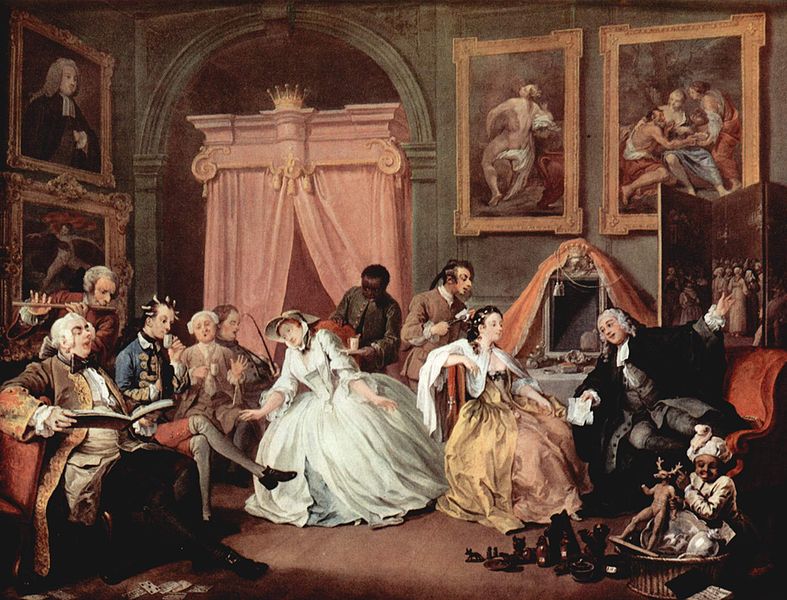
Marriage à-la-mode: The Countess's Morning Levee, William Hogarth, c. 1745

Because my blog’s theme centers on the Georgian and Regency eras, I will confine much of my recap to those years.

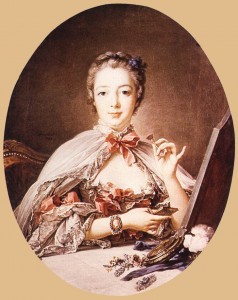
A woman applying beauty patches, Boucher

Mirrors, once only possessed by the rich, became so popular in London in the mid-16th century that British manufacturers petitioned Parliament to ban foreign imports. The ritual of the dressing table became quite elaborate and ladies began to entertain guests as they prepared themselves for the day.

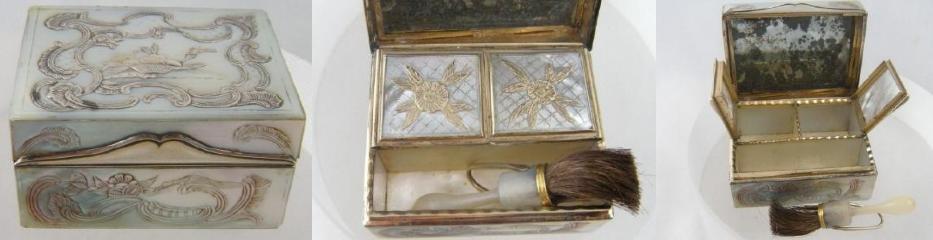
French mop gold boite a mouche patch box with brush, 1730. Images @ Etsy

Decorative patches covered skin blemishes and blotches, sometimes to such an extent that a face could be covered with a variety of dots, half-moon crescents, stars and even a coach and horses! The popularity of using patches began in the mid-17th century and did not wane until the end of the 18th century.

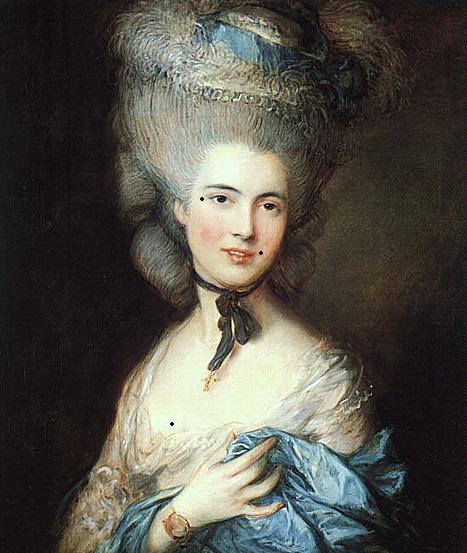
Woman with patches, pale skin and rouged cheeks. Thomas Gainsborough

Porcelain skin was highly prized and created with white lead-based skin cream. Blush was then applied to create a doll-like look. Cosmetics were created in a variety of ways. Here are the ingredients for one recipe for lead face powder that did not come from this book: several thin plates of lead, a big pot of vinegar, a bed of horse manure, water, perfume & tinting agent. Once can only guess how this concoction was put together and at its smell.

Marquise the Pompadour applying face powder with a brush. Boucher, 1758.

Ms. Downing describes in her book:

lead sheets were unrolled and beaten with battledores until all the flakes of white lead came off. These were gathered and ground into a very fine powder… p. 24

Gainsboroughs portrait of Grace Dalrymple Elliot in 1782 shows the craze for dark eyebrows.

For a while during the third quarter of the 18th century, dark eyebrows became all the rage. Lead-based cosmetics, used over time, caused hair-loss at the forehead and over the brows, resulting in a receding hair-line and a bare brow. For those who lost their eyebrows, it became the custom as early as 1703  to trap mice and use their fur for artificial eyebrows. Sadly, the glue did not always adhere well, and a lady could be caught with her brows out of kilter. This hilarious poem was written by Matthew Prior in 1718:

On little things, as sages write,

Depends our human joy or sorrow;

If we don’t catch a mouse to-night,

Alas! no eyebrows for to-morrow. – p.28

Aging beauties staved off the ravages of time with sponge fillers and rouge (sound familiar?), while many women risked poisonous side effects from using their deadly cosmetics. Maria, one of the Gunning sisters who went on to become Lady Coventry, was so addicted to her lead-based paints that she died in 1760 at the age of 27 knowing full well that she was at risk.

Maria, Countess of Coventry

The French Revolution swept away the widespread use of makeup, which was associated with the aristocracy. Defiantly, some aristocratic ladies went to their doom wearing a  full complement of make-up: pale skin, patches, rouged cheeks and rosy lips.

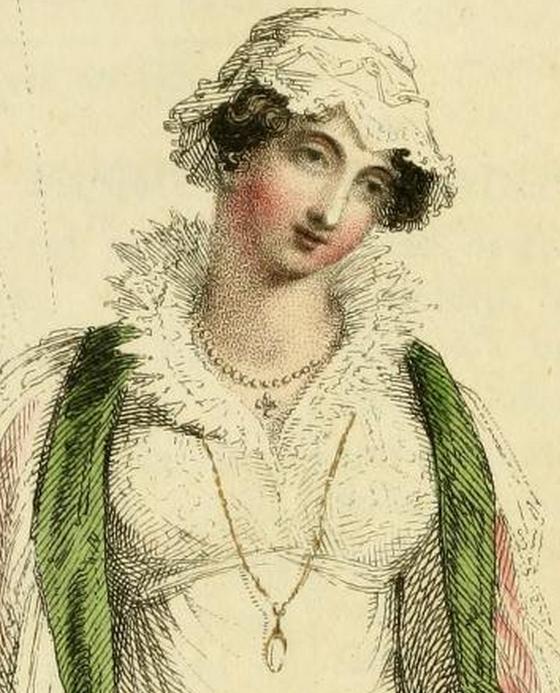
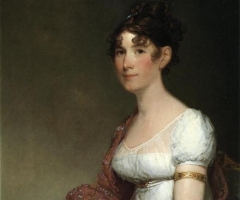
The more natural look of the regency woman. Note that the cheeks are still rouged.

Rousseau influenced the concept of nature and a more natural Romantic look took hold, aided by the blockade of cosmetics during the Napoleonic Wars. The death of many soldiers resulted in widespread melancholia and the affectation of a consumptive look. Ladies, nevertheless, were never far from their rouge pot.

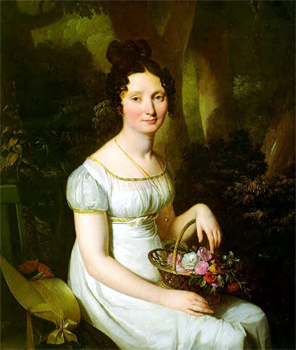
Another Regency portrait with subtle makeup. The flower basket adds to the natural look.

As with all Shire books, Sarah Jane Downing’s trip through time provides us with brilliant insights, in this instance it is via cosmetics and how society viewed beauty in each era. By the 1950s, the success of a marriage was defined by how well a woman took care of herself. This included makeup. Beauty, as Ms. Downing wrote, “was switched from a pleasure to an obligation.”  Oh, my. I give the delightful Beauty and Cosmetics 1550-1950 four out of five Regency tea cups.


Product Details

Paperback: 64 pages
Publisher: Shire (February 21, 2012)
Language: English
ISBN-10: 0747808392
ISBN-13: 978-0747808398
Product Dimensions: 5.8 x 0.2 x 8.2 inches

More on the topic:

Read Full Post »
My regular Jane Austen readers have been patient as I succumbed to Downton Abbey fever and began to cover events 100 years after Jane Austen’s death. Customs changed during that intervening century. Take the matter of dress. While proper Regency ladies changed their outfits from morning gowns to walking gowns when they went out, and changed into dinner dress when dining, by Victorian and Edwardian times the custom of a lady changing her clothes throughout the day had turned into a fine art.  One could get by with no less than 4-5 changes per day. A woman who packed to visit a country estate was sure not to be seen in the same outfit twice. This meant that for a 4-day visit she would need at the very minimum to have her maid pack 16 changes of outfits. One can only imagine the work of a lady’s maid to keep all the clothes and unmentionables in perfect (and clean) condition. Such attention to detail required quite a bit of organization.

Morning dress, 1815. Ackermann plate. While she looked proper in her at home attire, this morning dress looks stodgy compared to the Edwardian teagown.

Corsets were worn all through the 19th century and into the early part of the 20th century. Women were constricted into these garments for most of their waking day, but there were times when they were free from these tight-laced garments.  During the early 19th century, upper class women at home would wear comfortable (but beautiful) morning gowns. Dressing gowns were also worn. Such gowns were meant to be seen by the family and close relatives only. The moment a woman expected to be seen, she would change into more proper dress.

Cora, the Countess of Grantham, lived during a time when teagowns were all the rage. These beautiful ornate gowns had the advantage of being simply cut and worn without a corset. It was possible that for just a few hours she could relax comfortably before dinner.

They were generally loose-fitting and elaborately trimmed, and gave full vent to the dressmaker’s or couturier’s skill and taste for theatricality. Tea-gowns were influenced by historical styles from eighteenth century Watteau-pleats, to renaissance hanging sleeves and empire waistlines and quite often, all of them at the same time. Never has so much love and art been invested in such an arguably unnecessary garment. All kinds of informal garments including tea jackets, peignoirs, dressing gowns, combing sacques, morning robes and dressing jackets also had their place in the leisured Edwardian lady’s wardrobe, all of them beautifully decorated and almost all of them now obsolete. 1900-1919: The Last Age of Elegance 

American dancer and actress Irene Castle wearing a teagown, 1913

It had long been the custom for a lady to entertain both male and female visitors in her boudoir. (Read my article on this topic.) During the Regency era, dressing gowns were quite plain and simple compared to teagowns.

1810-23 dresssing gown. Image @Met Museum

At times the teagown gave rise to temptation, for a woman could entertain in private and not need the services of her maid:

Worn between five and seven oclock,  gave rise to the French phrase ‘cinq à sept‘. This referred to the hours when lovers were received, the only time of day when a maid wouldn’t need to be there to help you undress and therefore discover your secret. – “Style”, The World of Downton Abbey, Jessica Fellowes

Early 19th century dressing gown. Image @Met Museum

Attired in her tea-gown, a soft flowing robe of filmy chiffon or fine silk, trimmed with an abundance of lace and often free of corsetry, the hostess must have been a tempting prospect for many men. Such loose gowns afforded women great comfort, ease of access and a tremendous sense of femininity. Little wonder then that whilst hemlines rose and fell the tea-gown, which had appeared in England as early as 1875 lingered on until the 1920s. – Edwardian tea gowns, fashion era

This Lingerie-style dress embellished with Irish crochet, c.1905 (below) can be seen in more detail on Vintage Texiles. Made of sheer cotton decorated with lace and ruffles, this sheer dress required a slip.

Edwardian teagown, 1905. Image @Vintage Textile

More on the topic:

Read more on the topic: Tea Gowns, Edwardian Promenade

Image of an early 19th century dressing gown at the Met Museum

Read Full Post »
« Newer Posts - Older Posts »