Feeds:
Posts
Comments

Archive for the ‘Regency World’ Category

Happy Christmas Eve and Merry Christmas, everyone! I leave you with this post about Plum Pudding as I celebrate the occasion with my favorite people in all the world – my family. May this season be a truly special one for you. And thank you for visiting Jane Austen’s World.

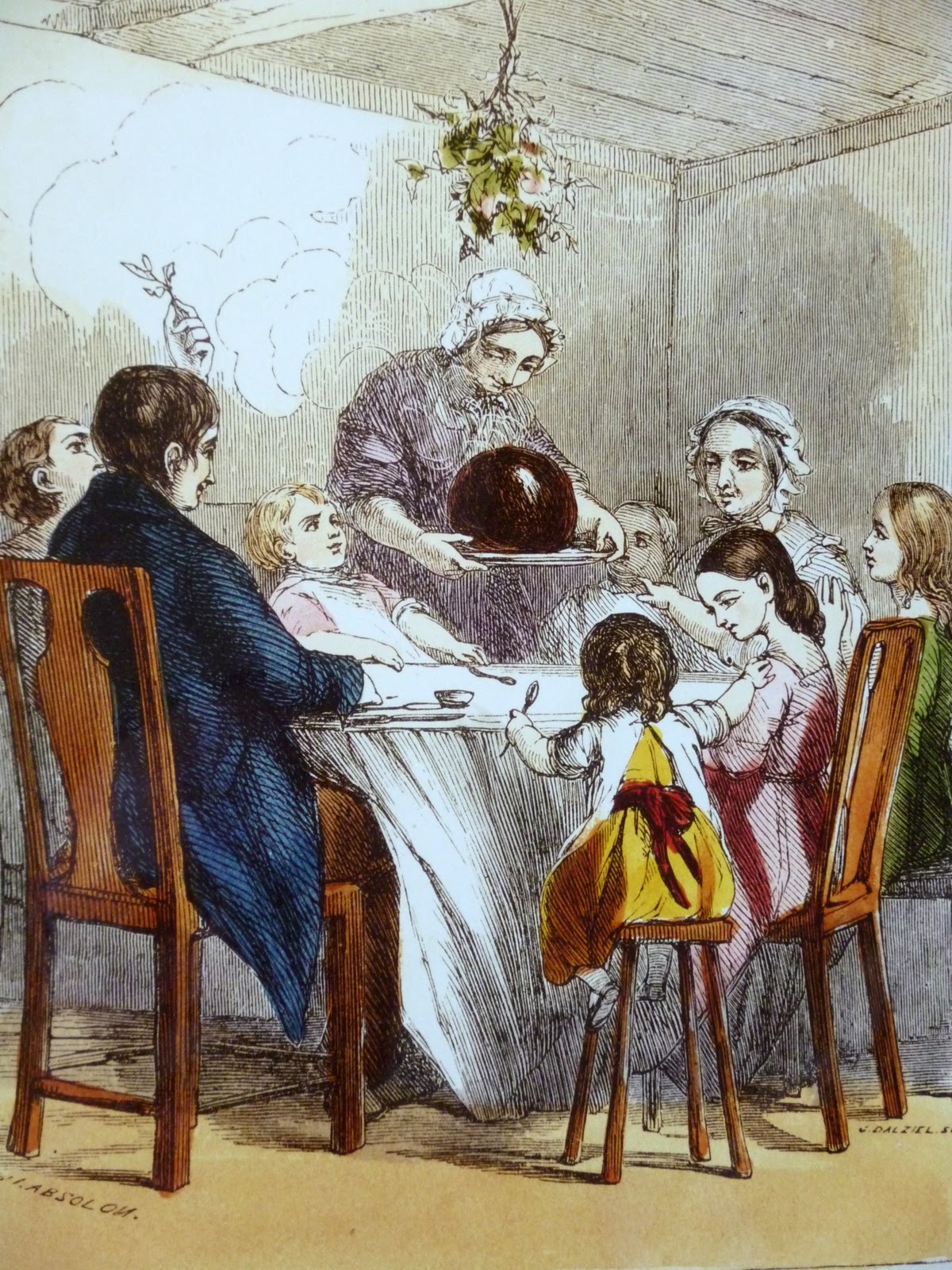
In half a minute Mrs. Cratchit entered — flushed, but smiling proudly — with the pudding, like a speckled cannon-ball, so hard and firm, blazing in half of half-a-quartern of ignited brandy, and bedight with Christmas holly stuck into the top. – Charles Dickens, A Christmas Carol

Stir-Up Day is the name traditionally given to the day on which Christmas puddings are made in England.

Banned by the Puritans in the 1660s for its rich ingredients, the [plum] pudding and its customs came back into popularity during the reign of George I. Known sometimes as the Pudding King, George I requested that plum pudding be served as part of his royal feast when he celebrated his first Christmas in England after arriving from Hanover to take the throne in 1714. By 1740, a recipe for ‘plum porridge’ appeared in Christmas Entertainments. In the Victorian era, Christmas annuals, magazines, and cookbooks celebrated the sanctity of family as much as the sanctity of Jesus’ birth, and the tradition of all family members stirring the pudding was often referenced…Poorer families made the riches version of plum pudding that they could afford…Even workhouse inmates anticipated a plum pudding on Christmas Day.” – Food and Cooking in Victorian England: A History, Andrea Broomfield [Praeger:Westport CT] 2007 (p. 150-151)

Stir-Up Sunday, the last Sunday before Advent, is considered the final day on which one can make the Christmas fruit cakes and puddings that require time to be aged before being served.

The Christmas pudding is traditionally “stirred up” on Stir-Up day day. All family members must take a hand in the stirring, and a special wooden spoon (in honor of Christ’s crib) is used. The stirring must be in a clockwise direction, with eyes shut, while making a secret wish. Source: The Customs and Ceremonies of Britain by Charles Knightly. London:Thames and Hudson, 1986, p. 211.”
The Folklore of World Holidays, Robert H. Griffen and Ann H. Shurgin editors, Second Edition [Gale:Detroit] 1998 (p. 679)
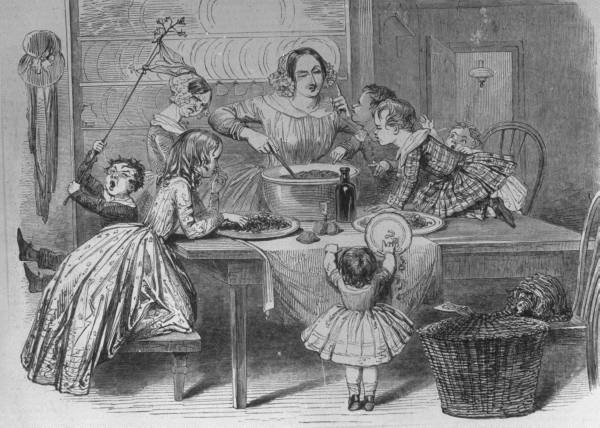
Stirring the Christmas pudding. Image@LIFE magazine

In past times the words “stir up”…reminded people to begin preparing their Christmas puddings…Children chanted a rhymed verse on that day that mixed the words of the collect with requests for special Christmas fare…Thus, the preparation of the Christmas pudding eventually became associated with this day. Folk beliefs advised each member to take a turn stirring the pudding, and ace that was believed to confer good luck. Another custom encouraged stirrers to move the spoon in clockwise motion, close their eyes, and make a wish.” – Encyclopedia of Christmas and New Year’s Celebrations, Tanya Gulevich, 2nd edition [Omnigraphics:Detroit] 2003 (p. 741)
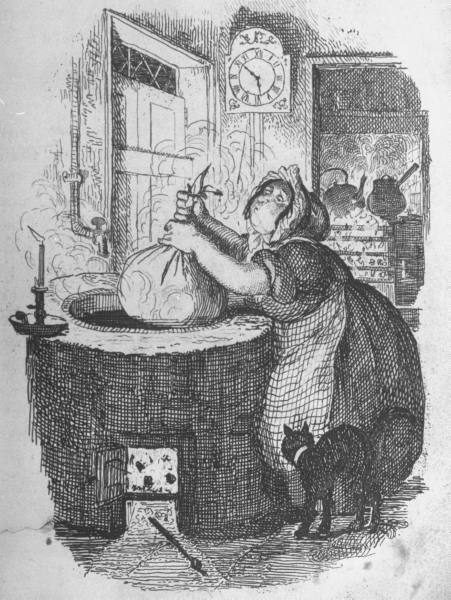
Cook making Christmas pudding, Cruikshank

Hallo! A great deal of steam! The pudding was out of the copper. A smell like a washing-day! That was the cloth. A smell like an eating-house and a pastrycook’s next door to each other, with a laundress’s next door to that! That was the pudding!- Charles Dickens, A Christmas Carol

A boiled Plum Pudding – Hannah Glasse (18th century recipe)

TAKE a pound of suet cut in little pieces not too fine a pound of currants and a pound of raifins storied eight eggs half the whites half a nutmeg grated and a tea spoonful of beaten ginger a pound of flour a pint of milk beat the eggs first then half the milk beat them together and by degrees stir in the flour then the suet spice and fruit and as much milk as will mix it well together very thick Boil it five hours – Hannah Glasse, The Art of Cookery made plain and easy, p. 137

Rich Plum Pudding Recipe, Lady Godey’s Book, December 1860

Stone carefully one pound of the best raisins, wash and pick one pound of currants, chop very small one pound of fresh beef suet, blanch and chop small or pound two ounces of sweet almonds and one ounce of bitter ones; mix the whole well together, with one pound of sifted flour, and the same weight of crumb of bread soaked in milk, then squeezed dry and stirred with a spoon until reduced to a mash, before it is mixed with the flour.

Cut in small pieces two ounces each of preserved citron, orange, and lemon-peel, and add a quarter of an ounce of mixed spice; quarter of a pound of moist sugar should be put into a basin, with eight eggs, and well beaten together with a three-pronged fork; stir this with the pudding, and make it of a proper consistence with milk. Remember that it must not be made too thin, or the fruit will sink to the bottom, but be made to the consistence of good thick batter.

Taking up the Christmas pudding

Two wineglassfuls of brandy should be poured over the fruit and spice, mixed together in a basin, and allowed to stand three or four hours before the pudding is made, stirring them occasionally. It must be tied in a cloth, and will take five hours of constant boiling.

Carrying the plum pudding

When done, turn it out on a dish, sift loaf-sugar over the top, and serve it with wine-sauce in a boat, and some poured round the pudding. The pudding will be of considerable size, but half the quantity of materials, used in the same proportion, will be equally good.

Presenting the plum pudding

The following articles about plum pudding were published in 19th century periodicals and in a more recent blog:

Colonel Hazard’s Plum Pudding (In which the Colonel proves that plum pudding has impressive staying power.)

Colonel Rowland R. Hazard of electric railroad fame tells a story which gives the plum pudding a new dignity. Several years ago, the colonel suddenly decided to run over to England to make a holiday call on relatives there. It was a few days before Christmas, and just as the colonel was starting for the steamer, a Christmas package arrived for him. He had no time to examine it then, and left orders to have it kept for him. He did not return to New York for two year.s When he did get back, the package was brought down from the garret. It proved to contain a plum pudding that his English friends had sent him. It was as hard as a rock, but Colonel Hazard ordered it to be cooked, and he declares he never tasted a more perfect plum pudding in his life. He is inclined to think that good plum pudding, like the wheat found in the old Egyptian mummy cases, would keep all right for a thousand years. –  New York Commercial Advertiser – Good Housekeeping, Vol 5, Hearst Corp, 1887

Plum Pudding

The secret of making plum pudding light and digestible lies in properly preparing the suet, mincing the currants, and boiling a sufficient time. Puddings made with breadcrumbs are lighter than those made wholly of flour; and a mixture of the two makes the best pudding. Plum puddings may be made some time before Christmas, and, having been boiled, the cloth must be opened out, but not taken off the pudding, and dried. Wrapped in paper, and stored in a dry place, puddings will keep good for several months, and only require to be boiled for an hour at the time of serving.  – Household Words, A weekly journal, vol 2, 1882. Charles Dickens

Christmas pudding on a hook. Image @eons

This pictorial article in eons explains the various steps in making a Christmas pudding.

Surprises Inside Plum Pudding

Plum pudding is well known for the silver coins and small objects hidden within the pudding to be found by the eater. Common objects were the silver coin for wealth, a tiny wishbone for good luck, a silver thimble for thrift, a ring for marriage or an anchor for safe harbor. These items have migrated from plum pudding to bridal shower cakes, oddly enough…- Gram’s Recipe Box, Plum Pudding

Sources for this post:
Read Full Post »

In the second episode of At Home With the Georgians: A Woman’s Touch, Amanda Vickery mentioned metamorphic furniture and (remarkably) turned a desk into a bed. A visitor to Tony Grant’s excellent post left this question: What is metamorphic furniture?

Modern example of metamorphic furniture: hall table/card table

Tony answered the question admirably. This mechanical furniture, wide-spread in Georgian times, had a dual use. A small folding staircase could be transformed into chair or desk, such as a writing table, library table, or card table. These pieces of furniture were great space savers, as I can attest. Only last week I transformed my faux-Georgian hall table into a card table for my guests. I never guessed until Tony’s post that I owned an example of mechanical furniture. Sweet!

The only change I would make in the video (besides the annoying lilt in my voice) is to make sure that the next time I film an example of my furniture, it is thoroughly dusted and cleaned! Extra points if you can spot my pooch in one of the scenes. His hang dog expression tells me that he was out of sorts, having been told to stay put.

This Victorian piano at the Brooklyn Museum pulls out into a bed. Fascinating. The video is available to view until March 2011.

READ MORE: If your interest in the topic is piqued, Clive Taylor (who also left a comment on the previous post) has written a dissertation on the topic (click here to read The Regency Period Metamorphic Chair) and sells metamorphic library chairs/stairs in his shop, Parbold Antiques.

Read Full Post »

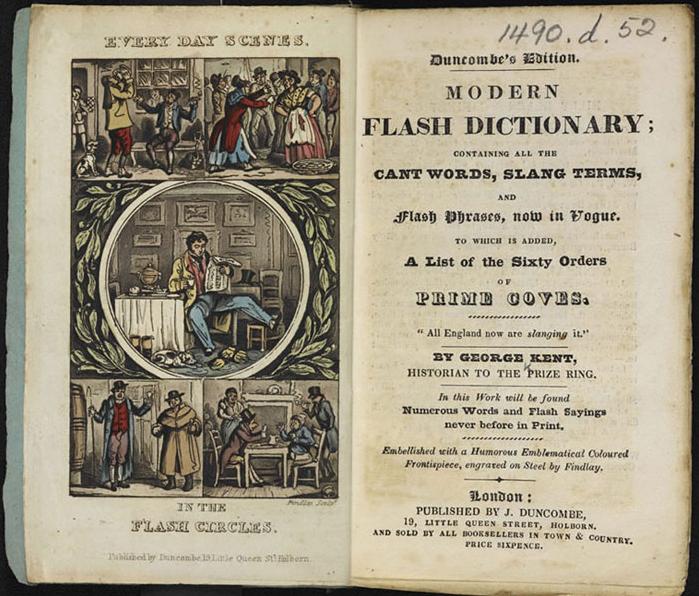
Gentle readers: The exhibition, Evolving English: One Language, Many Voices is showing at the British Library in London from November 12, 20101 through April 4, 2011. Featured is this flash dictionary, one of many exhibits:

Image from the British Library exhibit, Evolving English

This cheap pamphlet was aimed at young working men interested in sport, gambling and drinking. It amied to cover criminal cant, sporting slan and ‘flash phrased now in vogue’. In the19th century, the word flash had several meanings. A fashionable man-about-town was commonly referred to as a flash cove and the meaning survives today in the phrase ‘flash Harry’. The dictuionary includes figures we would recognise, including fencers and shoplifters and unfamiliar terms, such as ‘priggers’ (pickpockets and ‘spicers’ (highwaymen). – George Kent, Modern Flash Dictionary. London, 1835.

Listen to David Crystal, language expert, explore aspects of the evolution of the English language in this podcast.

Look up 19th century cant in this interactive online Lexicon of Thieves’ Cant Dictionary. When I looked up ‘Hangman’, for example, these terms came up: “Derrick, Jack Ketch, Ketch, nubbing cove, sheriff’s journeyman, topping cove, turned off.”

Read Full Post »

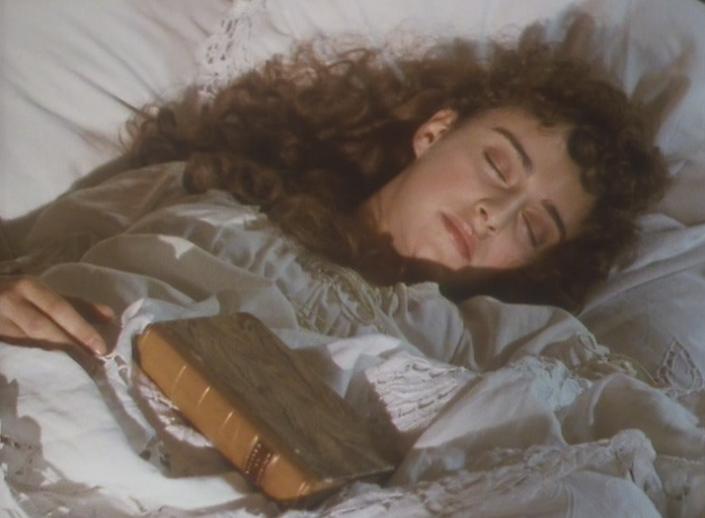
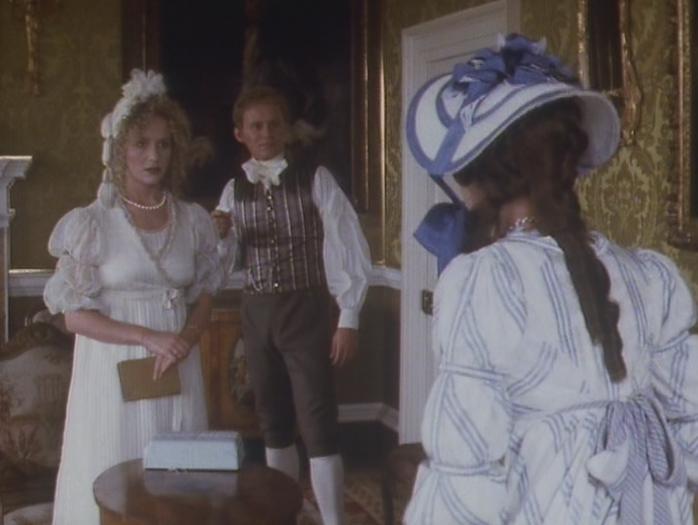
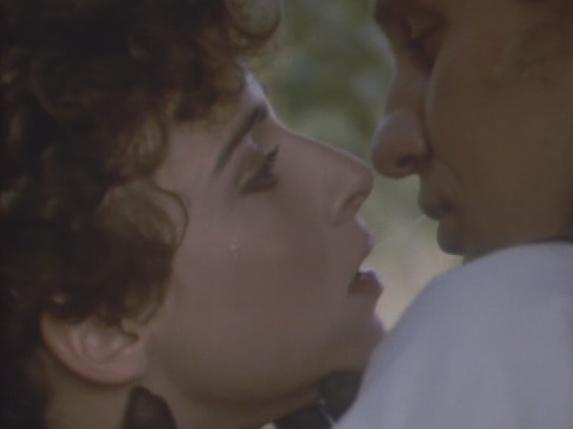
Until a cold felled me low this week, I had refrained from rewatching Northanger Abbey 1986, which I had a tough time sitting all the way through the first few times around. This film has left me feeling frustrated for its lost opportunities and many misses, and I wonder if the director and script writer wish today that they could change some of the creative decisions they made almost a quarter of a century earlier. In this film, we see the story unfold from young Catherine Morland’s (Katherine Schlesinger’s) point of view. This means we get a lot of Gothic novel fantasies made up by script writer Maggie Wadey, and hardly any Jane Austen at all.

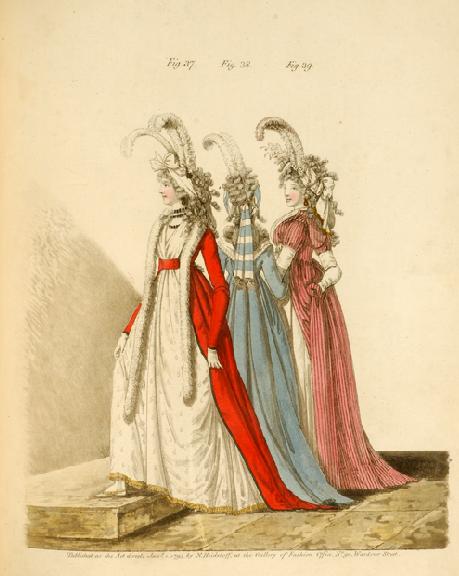
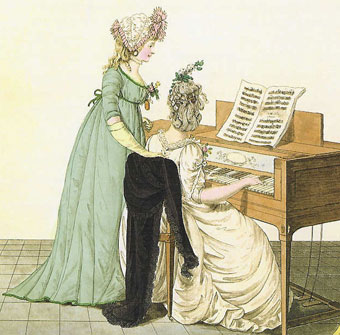
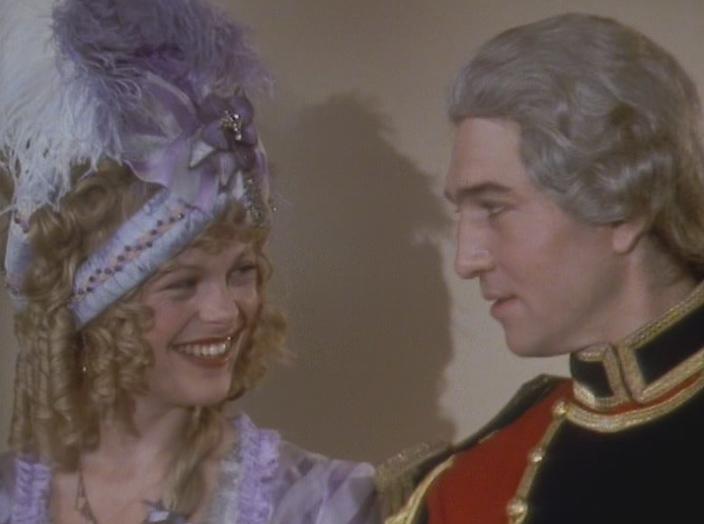
Isabella Thorpe and her mother wear outfits, hats, and hairdos that seem inspired by Von Heideloff prints

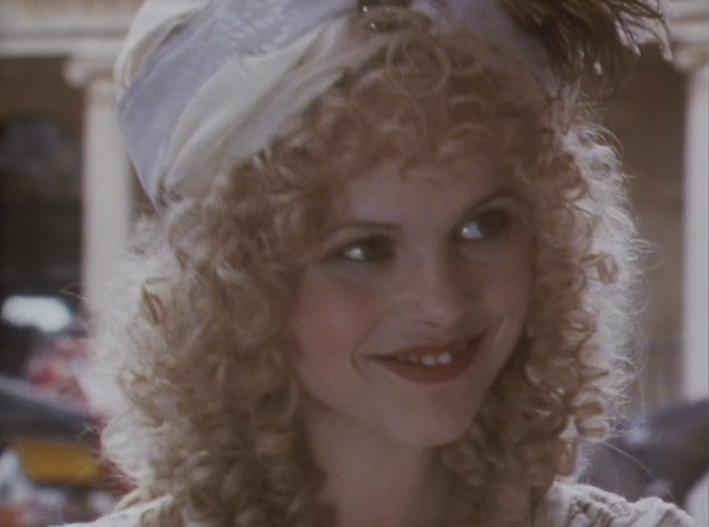
The production values are quite stunning, considering how old this BBC adaptation is and how poorly made films for television were in that era. Costumes designed by Nicholas Rocker are the fashion equivalent of beautiful meringues and chocolate bonbons (how could any of these women, except Mrs. Allen or Eleanor Tilney have afforded such luxurious gowns?). Despite the breathtaking settings and authentic backdrops, this 90-minute film adaptation with its strange synthetic music manages to entirely miss the satiric point of Jane Austen’s wonderful take on the gothic novel. And someone should have told the makeup department to lay off the heavy mascara and lipstick on all the ladies.

1795 Von Heidoloff fashion plate

Although the length of this adaptation is a mere 90 minutes, script writer Maggie Wadey added scenes and characters that detracted from the story or overwhelmed it, and that replaced moments in the book that were important to drive the plot forward and understand the characters better.

While Jane Austen made it clear that young Catherine had quite an imagination, these over the top film scenes were jarring and took away valuable cinematic time from good story telling.

I also found major problems with the musical score. The four musical clips embedded in this post and written by composer Ilona Sekacs in no way evoke the Regency era.  Click to hear the theme for the DVD – a 47 second music clip.

Catherine's Gothic dreams drive the music

Sekacs’ synthesized music and odd vocalizations from a female choir concentrate almost solely on giving us an eerie sense of ” Gothic doom”. Unfortunately, the composer uses the  “Lah da dah-Ooh” chorus throughout the film, and occasionally throws in a Gregorian Chant for good measure. Only during the ball scenes and at a musicale in Northanger Abbey are we allowed to hear music made with traditional instruments and that might have been heard during the Regency era.

An occasional tinkle from a pianoforte would have added greatly to a Georgian era atmosphere

I can only surmise that Ilona Sekacs was influenced by Vangelis, who had won an Academy Award for his score for Chariots of Fire five years before this production. Although Chariots was a period film, Vangelis’ electronic score sounded fresh and sweeping as 1920’s male runners practiced their speed against a back drop of endless beaches, rolling waves, and big sky. His score was a huge success in the early 80’s and he was rewarded for it. Alas for Jane Austen lovers, electronic synthesizers do not work as effectively in evoking a Bath drawing room, or as a backdrop for such Regency pastimes as walking, taking the waters, and carriage rides.

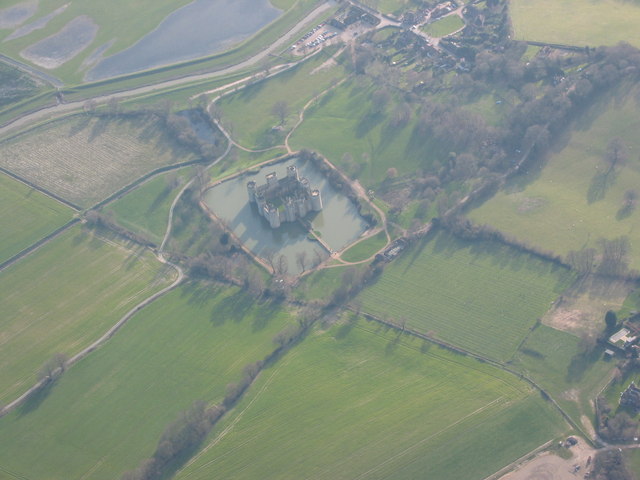
Bodiam Castle, built 1385

As the opening credits roll by, Catherine’s views Northanger Abbey from the carriage (to the accompaniment of this musical clip, which features male and female chanters and trumpets blaring). The Abbey is actually Bodiam Castle, a 14th-century keep with a water moat, and a well-known tourist destination.

Bodiam Castle's grounds from the air

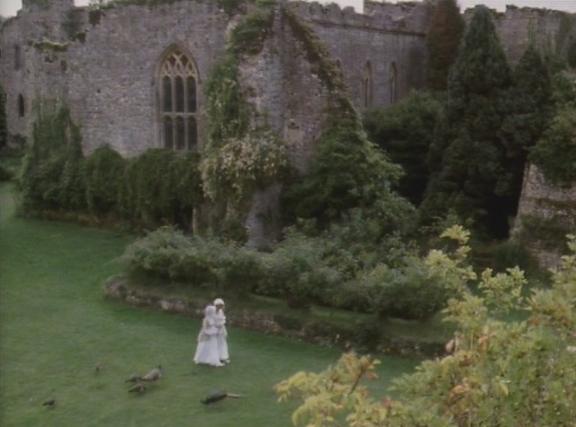
I instantly sat up and took notice, for I have visited Bodium Castle. It was a ruin during Jane Austen’s day and was only partially rebuilt in 1829, a good twelve years after her death. According to Jane’s novel, Northanger Abbey was surrounded by extensive gardens, and I wondered how the director would pull off the scene where the general boasted of his fruit trees.  Imagine my surprise when I saw Catherine and Miss Tilney walking towards a side entrance of an entirely new building with different architectural details and nary a moat in sight. “Badly done”, as Mr. Knightley would have said. Bad transition, indeed.

A stroll through the gardens of Northanger Abbey

But I have jumped ahead of myself, for there are other earlier errors for which I cannot forgive this production. Take Henry Tilney (Peter Firth), for instance. At the Assembly Ball, he bumps into Catherine and Mrs. Allen (a delightful Googie Withers) without a proper introduction from the Master of Ceremonies. Except for Henry’s comments about muslins, his fey but wise sense of humor is almost entirely missing at the start of this film.

Henry Tilney bumps into Catherine Morland and Mrs Allen.

I must admit that I do not like Firth‘s portrayal of Henry Tilney and could never see him as this character. But even so, Henry’s charming conversation was given short shrift, and he appears only long enough for Catherine to develop an interest in him before disappearing. Click here to view a YouTube clip (and hear period appropriate music) of Henry’s first meeting with Catherine.

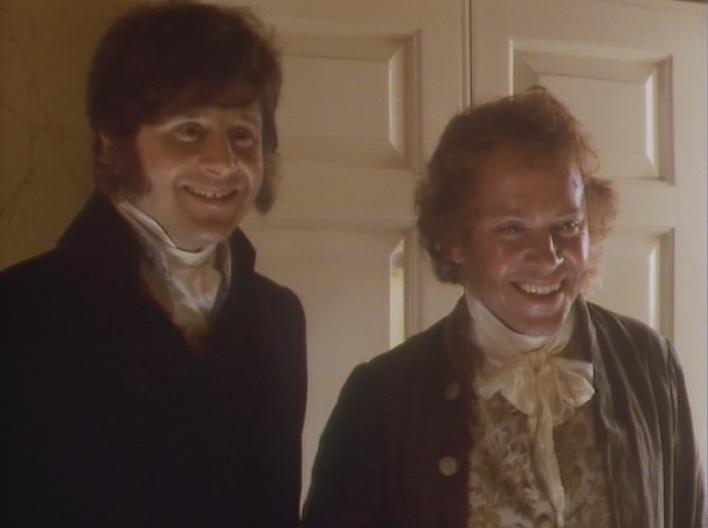
James Morland introduces John Thorpe

Where Henry’s role was severely diminished, John Thorpe’s presence early in the film was largely retained.  Mrs. Allen and Catherine do not bump into Mrs. Thorpe as they walk through Bath, as Jane Austen had written. Rather, as you can see in this YouTube clip, Catherine’s brother, James, visits the Allens and makes the introduction. Catherine then meets Isabella, overplayed by Cassie Stuart.

Isabella Thorpe, pretty but calculating

Because of the film’s short length, Isabella’s overly forward and friendly manner seems doubly rushed. The second time she meets Catherine, she reveals her love for James and her wish to marry him, and the next thing you know, James goes racing off to his father to beg for his permission to marry her.

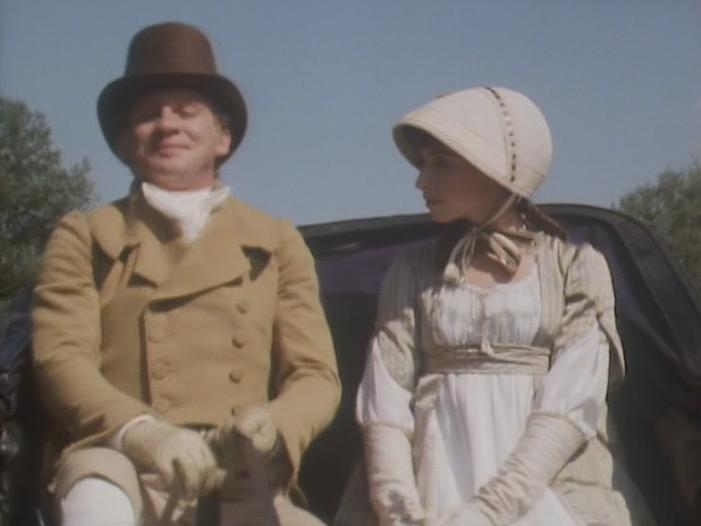
John's loud coat should clue Catherine about his character

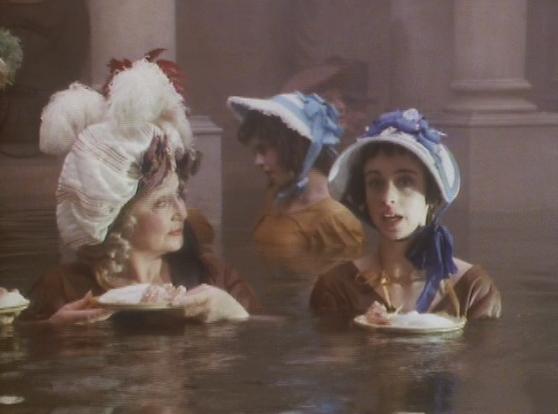
But once I again I digress.  John Thorpe (Jonathan Coy) is suitably sleazy (can’t you tell from his hideously striped suit?) and even Catherine leaves her Gothic fantasies long enough to be appalled by his boorishness. Thorpe’s early scenes are quite effective and then … he disappears. Except for a few mentions later, he literally falls off the face of the DVD, but not before he participates in one final scene in the hot baths, where Catherine, Isabella, Mrs. Allen, and Eleanor Tilney gather to bathe in the hot mineral waters. The party enters the baths to the strains of odd discordant music. An entire chorus is now crowding in on Catherine’s brain, and she can only stare wide-eyed around her.

Mrs. Allen and Catherine in the hot bath

But Catherine, who has a full and active day ahead of her, can bathe for only a short time. She makes a walking date with pretty Eleanor Tilney (Ingrid Lacey), who happens to be there. After sweating for some time in a hot and humid room, Catherine and Isabella emerge from the building with every curl in place and looking fresh in their beautiful unwrinkled, delicate muslin walking dresses. Isabella begins to fret over Catherine’s excessive attention to Eleanor. It is at this point that the uninitiated will start to lose an important thread of the story, for unless the viewer has already read the book, she will have no idea why John and Isabella are so determined to have Catherine accompany them to Clifton.

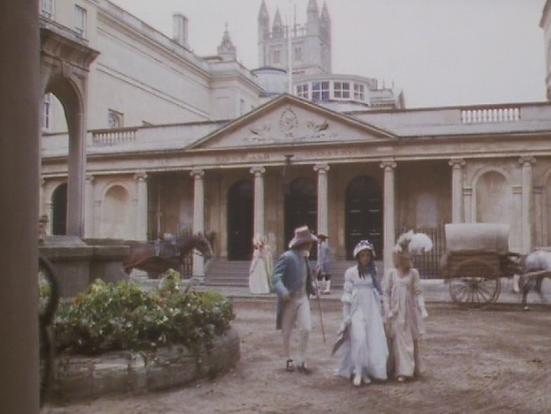
Bath is a beautiful setting as always

The plot has been so compressed and muddled, that the motivation that drives these characters is a bit murky.  The uninitiated will wonder: Why is John so interested in Catherine? Why is Isabella jealous of Eleanor? Why, indeed.

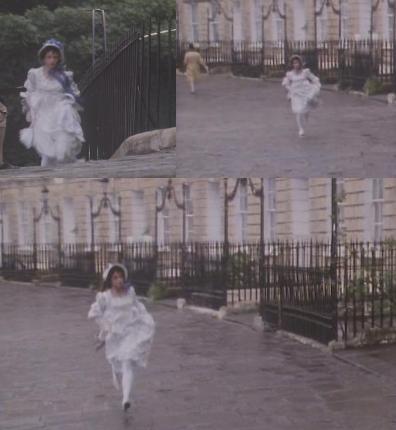
As John meets the ladies outside the hot baths he reveals that he has rearranged Catherine’s walking date with Eleanor, which sets Catherine’s temper off and sends her running through the streets towards General Tilney’s house.

In my opinion, this would have been a good time to insert Vangelis’s oscar-winning score for Chariots of Fire, since a run through Bath by a Jane Austen heroine is now rapidly becoming a Jane Austen TV adaptation tradition. (See Persuasion 2007.)

Catherine interrupts the Tilneys

Catherine rushes past the footman as he opens the Tilney’s front door, enters the house alone, and barges into the drawing room to apologize to Eleanor for John’s arrogance. All the while, she still looks fresh as a daisy.

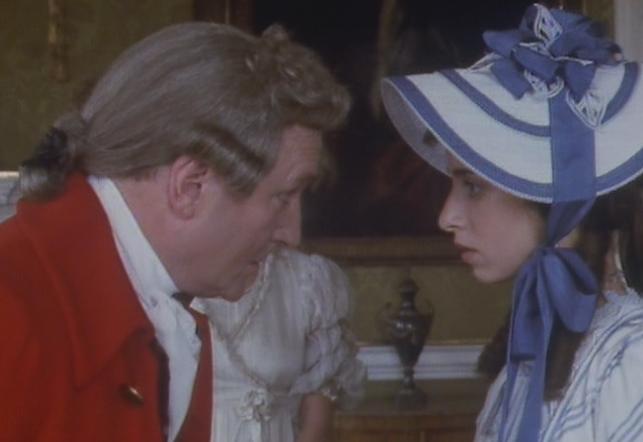
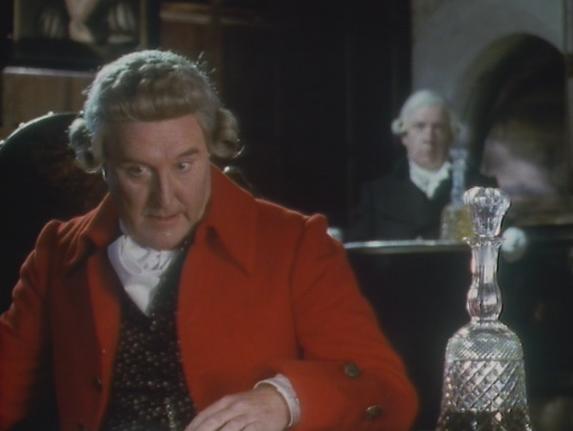
The General meets his unexpected guest

She meets General Tilney (Robert Hardy), who is simply delighted with Catherine and who encourages her to go on an outing with Henry and Eleanor as soon as possible. (The uninitiated will wonder: “why is he so intrigued with this rather simple, uninteresting girl?” Why indeed.) And so Catherine hurries off with the Tilney siblings to … Beechen Cliff ? Why, no! Jane Austen’s chosen spot for discussing the picturesque wasn’t deemed good enough and so the actors were taken to another location.

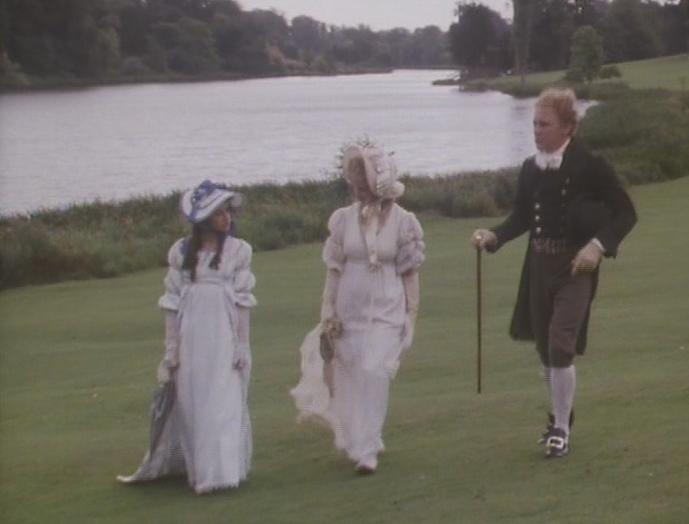
A walk along a sculpted lake instead of Beechen Cliff

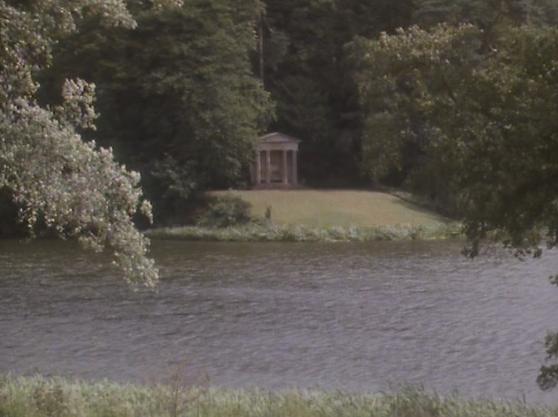
And thus they are filmed walking through a picturesque setting, with a lake and temple folly and weeping willows (so very 18th century refined), to talk about the picturesque.

A lake with temple folly

Instead of gazing at Bath from the heights of Beechen Cliff, the viewers are treated to the sight of Henry rowing the ladies across the waters.

At the end of this important scene (for Henry recognizes Catherine’s natural, unassuming, yet unformed airs), the music crescendos and the viewers hear 31 seconds of neo-jazz/Grecian tragedy music with a greek chorus and New Orleans saxophone.

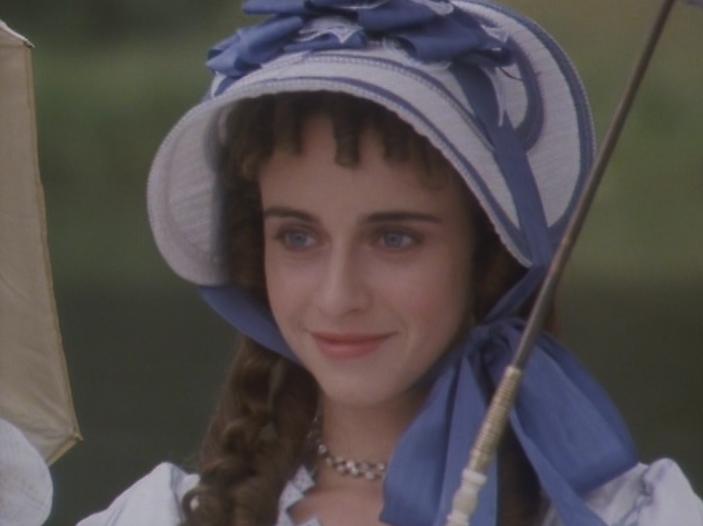
In this image, the description of Catherine rings true: ""Catherine grows quite a good-looking girl-she is almost pretty today."

At this juncture I must share the following comment, just to soften my own harsh critique. Jules, a very well spoken person, had this to say in 2005:

Ilona Sekacz wrote the score for a BBC TV version of ‘Northanger Abbey’ with Peter Firth. The music stood out a mile. A wonderful, haunting voice with a pulsing rhythm that has has stayed with me since I first saw the programme back in the 80s (I think). I could hum it now. I have tried to find this music but it has disappeared into cyberspace. Such a shame, it was so memorable. I bought the video years ago just to get the music. It’s not out on DVD but I transferred my VHS so I’ll never lose it.

I love this woman’s music, it’s unique and inspiring.

Isabella flirts with Captain Tilney and gets her comeuppance

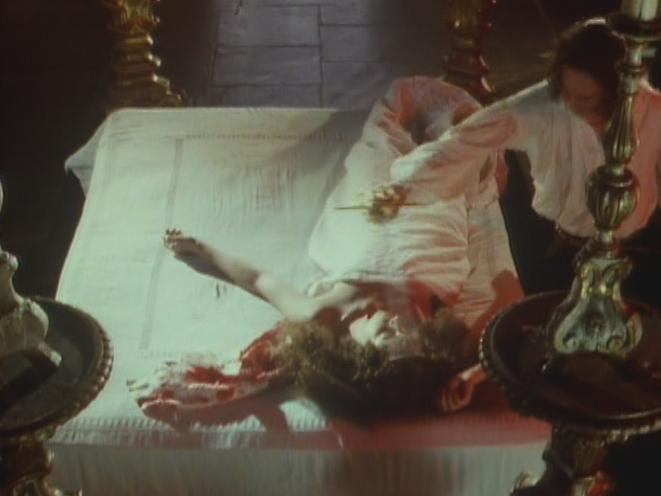
Ok, so to each his own. I’ve gone on long enough about how much I dislike the film. In swift succession, Isabella flirts with Captain Frederick Tilney, prompting James to end their engagement; Catherine visits Northanger Abbey and makes a fool of herself trying to find intrigue and uncover a murder most foul,

Catherine rides with Henry to Northanger Abbey

and General Tilney discovers she’s as poor as a church mouse and casts her out of his house.

The general learns that Catherine is poor

Because time is so compressed in this film, Catherine is cast out of Northanger Abbey without explanation. The uninitiated will have no idea what has transpired, because no explanation was given at first. And because the camera does not follow her on her ride alone back home on a public stage without adequate resources, the uninitiated remain clueless about Catherine’s mature demeanor during that long journey alone and how dastardly the General treated her by forcing her to go unescorted, thereby placing her in harm’s way. Henry Tilney soon discovers he can’t live without her and comes after her on his steed. And because he comes across in this film as a prosy old bore, not a sharp-witted, dashing hero, the uninitiated will wonder what Catherine actually saw in him.

Henry comes for Catherine

Did I find anything of redeeming value in this film? Yes, but those comments shall have to wait for another critique. A production that added a marchioness who provided General Tilney with the latest gossip (and perhaps some sport in his bed), but that prevented Henry Tilney from saying some of his best lines deserves little praise.

Why was the marchioness (Elaine Ives-Cameron)added?

How would Lady Catherine de Bourgh have critiqued the film, I wonder?

“I send no compliments to the director or script writer. They deserve no such attention. I am most seriously displeased.”

I must explain that this film was one of the main reason why I did not read Northanger Abbey until the very last of Jane’s novels. The story as told in this film is quite awful, so you can imagine my delight and surprise when I finally met Jane Austen’s actual characters in print.

Read more on the topic:

Read Full Post »

Copyright @Jane Austen’s World

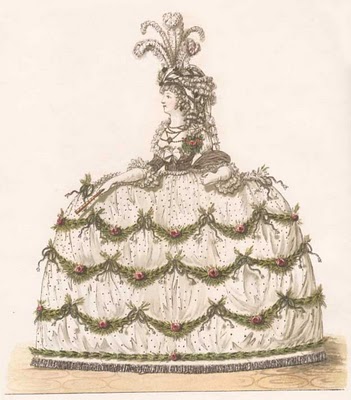
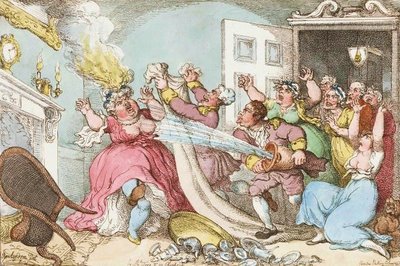
Looking at the images in this post, one can only imagine how difficult it was for a woman in full evening dress (or court dress) to move around. Between taking care of her shawl, reticule, dance card, and fan, she had to walk upright and sedately so that her head feathers did not topple over after an abrupt movement or caught fire under chandeliers ablaze with candles.

1794-95 Court Dress

Examining the above image, one can readily see that these costumes were designed for high-ceilinged rooms that were opened by high double doors.

A lady's wig catches fire. Thomas Rowlandson. Image @Yale University

In this dramatic image, Thomas Rowlandson catches a moment of real danger both for the lady whose wig (and feathers) caught fire, and for the guests, who might have been trapped in a house fire, for water to put out flames was not easily obtained.  In the late 18th century The London Times reported on several more incidents in which ladies found ways to accommodate their head feathers, or in which the feathers (and mother nature) got the best of them.

Lady Godina's Rout

At all elegant Assemblies there is a room set apart for the lady visitants to put their feathers on, as it is impossible to wear them in any carriage with a top to it. The lustres are also removed upon this account, and the doors are carried up to the height of the ceiling. A well-dressed Lady who nods with dexterity can give a friend a little tap upon the shoulder across the room without incommoding the dancers. The Ladies feathers are now generally carried in the sword case at the back of the carriage.  – Times,  Dec 29, 1795.

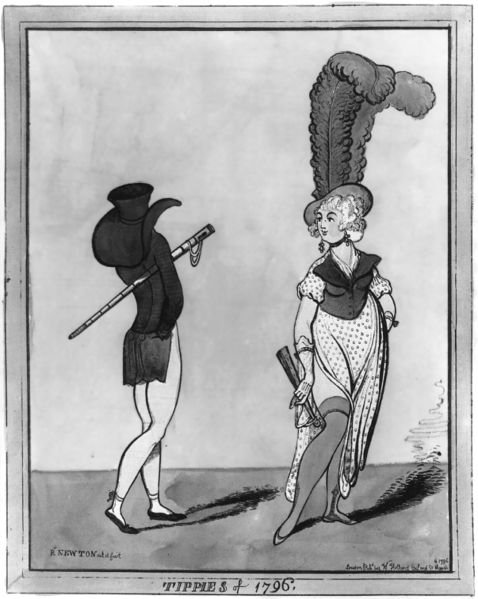
Tippies of Newton, 1796 caricature by Richard Newton. Image @Wikimedia Commons

A young lady only ten feet high was overset in one of the late gales of wind in Portland Place, and the upper mast of her feather blown upon Hampstead Hill.  “The maroon fever has been succeeded by a very odd kind of light-headedness, which the physicians call ptereo mania, or feather folly.” The Ladies now wear feathers exactly of their own length, so that a woman of fashion is twice as long upon her feet as in her bed. –  Times, Dec 30, 1795.

1796, High Change in Bond Street, Gillray

We saw a feather in Drury Lane Theatre yesterday evening that cost ten guinea. We should have thought the whole goose not worth the money.  – Times, Jan 6, 1796.

A Modern Belle Going to the Rooms at Bath, James Gillray, 1796. Image @Wikimedia Commons

Here is a contrivance by which A Modern Belle going to the Rooms or Balls can go fully dressed with her feathers fixed. There is to be seen in Gt Queen Street a Coach upon a new construction. The Ladies set in this well and see between the spokes of the wheels. With this contrivance the fair proprietor is able to go quite dressed to her visits, her feathers being only a yard and a half high. –  Times, Jan 22, 1796.

Vis a vis Ladies Coop, 1776

The Times described predicaments regarding head feathers that were not new. Note how twenty years before, both high wigs AND feathers were accommodated. And, indeed, feathers, whether made from ostrich, emu, goose, or peacock, remained popular as a head dress for years to come.

The headdress, while always including a veil, also required feathers as part of it, although, the number and size of the feathers varied with the Monarchy. At the time of Queen Charlotte, young ladies wore one single towering ostrich feather, but through the years, the number of feathers required increased. By the Edwardian Era, the widespread use of feathers to decorate hats and bonnets began the passage of laws that restricted using certain types of bird’s feathers.*

Queen Victoria hated small feathers, so orders were issued that Her Majesty wanted to see the feathers as the young lady approached. Later in Queen Victoria’s reign, as well as in the court of Edward VII, the mandated headdress was three feathers arranged in a Prince of Wales plume–that is, the center feather was higher than the two on each side of it–and it was worn slightly on the left side of the head. Tiaras were worn by married women, and it was extremely difficult to keep the feathers in place, especially during the curtsy.

More on the topic:

Read Full Post »

« Newer Posts - Older Posts »