Feeds:
Posts
Comments

Archive for the ‘Regency World’ Category

During the 18th and early 19th century, social satire prints were engraved and sold separately in print shops. By 1750, the term ‘caricature’ was applied to almost any comic cartoon or satiric illustration.

The ‘golden age’ when James Gillray (1756-1815), Thomas Rowlandson (1756-1827) and George Cruikshank (1792-1878) were active, occurred between 1780 and 1830. Most satirical prints were produced in London and were sold singly by publishers and booksellers, such as S. W. Fores and William Holland, who also put together collections for clients and even hired them out. A wide range of prices reflected the very different sizes and degrees of sophistication of satirical prints. In 1807 the publisher Thomas Tegg started a business selling cheap, crudely coloured prints aimed at a wide market. – British Museum
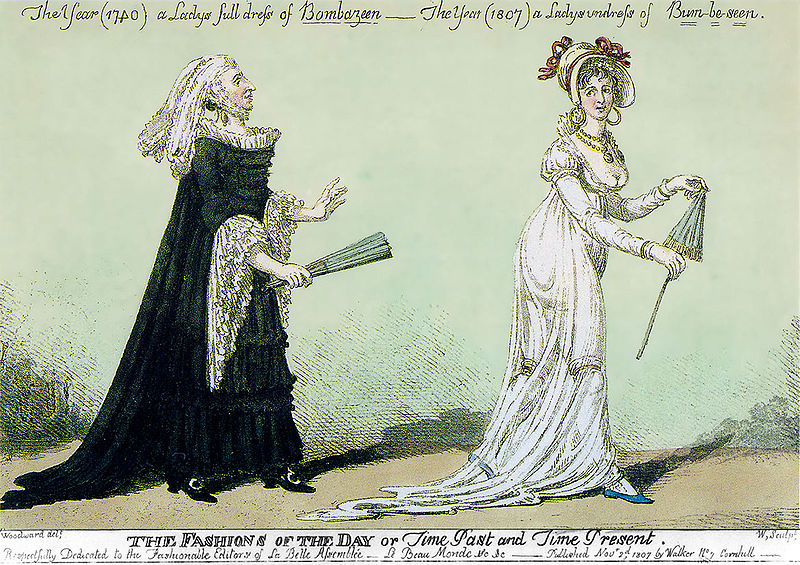
“The Fashions of the Day, or Time Past and Present”, an 1807 caricature engraved by Charles Williams after a drawing by Woodward. It presents a contrast between “The Year 1740: A Lady’s full dress of Bombazeen (i.e. bombazine or bombasine, a heavy corded fabric. Black bombazine was worn by widows during heavy mourning) and “The year 1807: A Lady’s undress of Bum-be-seen.”  There are some fascinating details to observe about the fashionable regency lady, whose decolletage is so low that her breasts are practically popping out of their restraints. One can see her drawers under her thin muslin dress, and her stockings come up over her knee. They were held up by garters. (Click on this link to read a fascinating article about stockings and to see a pair of 1820 stockings and garters.  This link also leads to an article about 18th & 19th century hose.) Regency ladies as a rule did not wear drawers for the first 20 years of the 19th century. Those who did wore a modified version of men’s drawers, which tied at the waist and split in the middle. Chances were that, if she did not wear a petticoat or a chemise, her bum would have shown through the thin fabric!


The following comment about Williams’ caricature is from Wikimedia Commons:

Note that “undress” didn’t mean anything naughty — there’s a definition of it here.[1] In pursuing his goal of satirizing certain features of contemporary 1807 fashions, the caricaturist did not really draw a fair comparison between the styles of 1740 and 1807, since a young Regency fashionable is juxtaposed here to a sedate middle-aged pre-Regency lady (perhaps in mourning), and such features of mid-18th century dress as tight stiff stays with extremely low necklines were not included (also, the “1740” costume actually seems to be somewhat of a pastiche with 17th century styles).
(Women’s fashions of the Empire/Regency weren’t always “sensible”, but their excesses do seem to be more in accord overall with the spirit of the 21st century than the fashion excesses of most other periods between the 16th century and World War I, which tended to go in for such things as huge hoopskirts and tight corsets…)

Read Full Post »

Hems (l - r) 1795, 1800, 1805-1810, 1816

Its all in the details Making a Regency Ballgown is a useful site for people who are interested in studying regency costumes or making a regency ballgown. The site is arranged in year order and makes the evolving styles clear. The evening or ballgowns are arranged by year and described in detail by bodices, sleeves, skirts, hair and hats. The information can also be downloaded as a PDF document. This is the clearest description of the changes in hemline that I have seen on a site. Trains, simple hems and long skirst gave way to fancy hems and skirts that revealed slippers and ankles.

Read Full Post »

Contest Closed: Using a random number generator, the winner is Leslie Ann McCleod. Her quote was:

“Tell me if, when I returned to England in the year eight, with a few thousand pounds, and was posted into the Laconia, if I had then written to you, would you have answered my letter? would you, in short, have renewed the engagement then?”

“Would I!” was all her answer; but the accent was decisive enough. – Persuasion

Thank you all for participating!

Good news! You have an opportunity to win a copy of Fashion in the Time of Jane Austen! All you need to do is leave a comment with your favorite line from a Jane Austen novel. The line can come from any character and be on any topic. The winner will be announced two weeks from today on April 19th. One lucky person will be chosen using a random number creator. Those who live in Canada and the U.S. are eligible to enter the contest.

Read my review of the book

Format: Trade Paperback, 64 pages
Author: Sarah Jane Downing
Price: $12.95
ISBN: 978-0-7478-0767-4 (0-7478-0767-1)

Read Full Post »

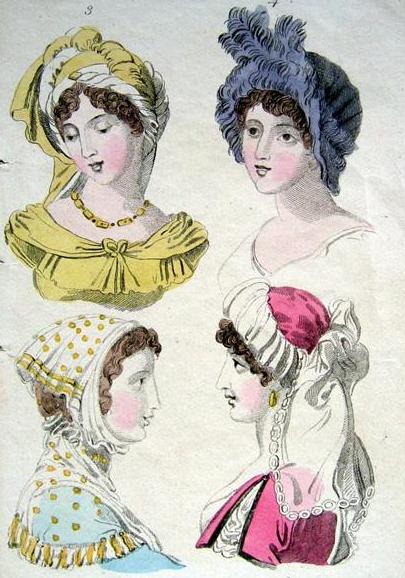
This Easter weekend is a perfect time to reflect on Jane Austen and Easter. Hats and bonnets were prevalent, of course, and so were Easter Fairs and eating hot cross buns.
Ladies' bonnets, 1802

In her book, Jane Austen and the Clergy, Irene Collins writes: Clergymen in Jane Austen’s day were not expected to write original sermons every Sunday. “Henry Crawford, assessing Edmund Bertram’s commitments at Thornton Lacey, judged that ‘a sermon at Christmas and Easter ‘would be’ the sum total of the sacrifice.” Mr. Collins produced only two sermons between his ordination at Easter and his visit to Longbourn in November of the same year.- p. 96.

Jane Austen herself mentions Easter, most notably in Pride and Prejudice:

In this quiet way, the first fortnight of her visit soon passed away. Easter was approaching, and the week preceding it was to bring an addition to the family at Rosings, which in so small a circle must be important. Elizabeth had heard, soon after her arrival, that Mr. Darcy was expected there in the course of a few weeks, and though there were not many of her acquaintance whom she did not prefer, his coming would furnish one comparatively new to look at in their Rosings parties, and she might be amused in seeing how hopeless Miss Bingley’s designs on him were, by his behaviour to his cousin, for whom he was evidently destined by Lady Catherine; who talked of his coming with the greatest satisfaction, spoke of him in terms of the highest admiration, and seemed almost angry to find that he had already been frequently seen by Miss Lucas and herself.

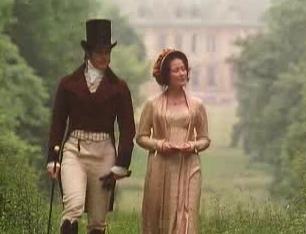
At Rosings with Colonel Fitzwilliam

Colonel Fitzwilliam’s manners were very much admired at the parsonage, and the ladies all felt that he must add considerably to the pleasure of their engagements at Rosings. It was some days, however, before they received any invitation thither, for while there were visitors in the house they could not be necessary; and it was not till Easter-day, almost a week after the gentlemen’s arrival, that they were honoured by such an attention, and then they were merely asked on leaving church to come there in the evening. For the last week they had seen ver little of either Lady Catherine or her daughter. Colonel Fitzwilliam had called at the parsonage more than once during the time, but Mr. Darcy they had only seen at church.

The invitation was accepted of course, and at a proper hour they joined the party in Lady Catherine’s drawing room. Her ladyship received them civilly, but it was plain that their company was by no means so acceptable as when she could get nobody else; and she was, in fact, almost engrossed by her nephews, speaking to them, especially to Darcy, much more than to any other person in the room.

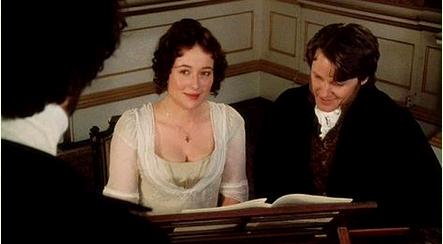
Elizabeth Bennet, Mr. Darcy and Colonel Fitzwilliam at the pianoforte

Ellen Moody noted that dating Sense and Sensibility presented a problem. It was revised several times and as a result the chronology remains inconsistent. Towards the book’s end, Easter is mentioned as occurring on March 31. This would have fallen in 1793, when the first draft of the novel was written. But, there is another reference to Easter in early April, which would have placed the novel in 1798 (the most likely), 1801, 1803, and 1809.

More on the topic:

Jane Austen’s Easter: Jane Austen Centre Online Magazine

Read Full Post »

Gentle readers, Collette from the Serendipity franchise has graciously allowed me to reprint her review of Jane Austen’s Sewing box. I wrote “franchise” because her online presence includes: Serendipity Vintage, Serendipity Handmade, Vintage Life Network, Serendipity Vintage Facebook, and SerendipityVintage on Twitter.

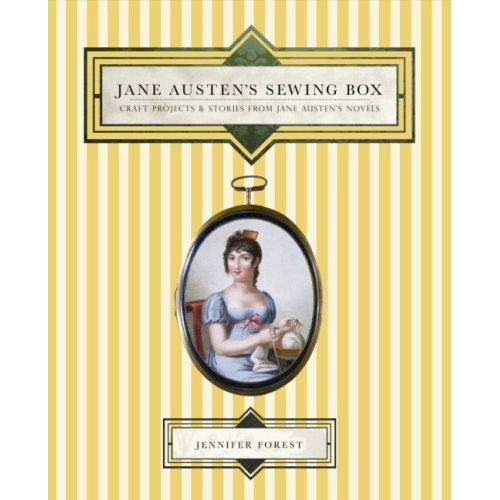
I also now have a copy of the lovely Jane Austen’s Sewing Box: Craft Projects and Stories from Jane Austen’s Novels. You may have seen a review or two on other craft blogs. As I am a Austen aficionado I could not pass it up:

It is a beautiful book, filled with gorgeous color fashion plates of the time that are worth a look. I read it cover-to-cover and enjoyed every moment. However, I would recommend purchasing it only if you enjoy historical Regency costume and /or are a die-hard Regency or Jane Austen fan.

As for the crafts themselves, some are probably of more interest to the costume enthusiast (like the cravat, the bonnet, or the tippet). There is only one photo of each project and even one more photograph of each project would have enhanced this book. Yet one whole page might be devoted to one short quote from one of Austen’s novels, or to a lovely painting from the time period:

The actual instructions for each project were also quite succinct and limited to only one page. If you’ve ever read any of the antique craft books from the early-to-mid 19th century you know that project instructions were usually all text and that diagrams were sparse. The actual descriptions of the the projects were very reminiscent of the actual books of the time. Still, I would like to make this case for embroidery thread:


In the time of the Regency you would store your
embroidery thread on a bone or wood thread winder

Austen mentioned each craft project in one of her novels, and it is fascinating to read the excerpts from the novels and then read Forest’s commentary about the craft as it was practiced at the time. If you are interested in historical craft and want to know more about the role of crafts in the lives of Regency women you will love the historical detail in this book. It’s definitely an informative and charming read!

Photographs from Jane Austen’s Sewing Box, Murdoch Books, or in the public domain. Review reprinted with permission.

Read Full Post »

« Newer Posts - Older Posts »