Feeds:
Posts
Comments

Archive for the ‘Victorian Era’ Category

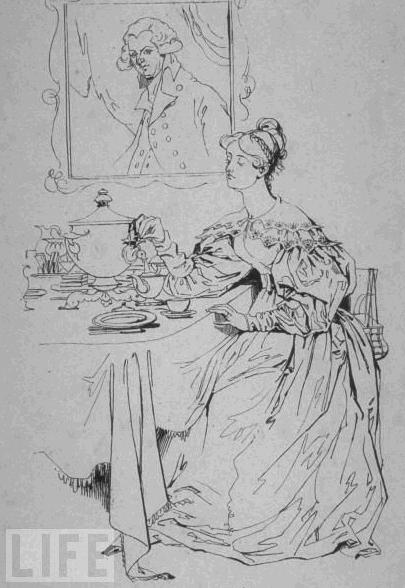
Caroline Norton 1833

Until the mid 1800s, married women in England had no legal rights. By law a husband could prevent his wife from seeing their children. He also had control over all her income, including any earnings she might make. Caroline Norton (1808-1877), who was married to an abusive man and who had been barred from seeing her three sons after they divorced, successfully challenged these laws.

Caroline was the granddaughter of a playwright Richard Brinsley Sheridan and the daughter of novelist Caroline Henrietta Sheridan. Caroline’s father died when she was eight years old, which left the family in financial straits. When Caroline had turned 16, George Norton, a Tory member of parliament for Guildford,  spotted her and asked for her hand in marriage. But she was too young to marry. Though a renowned beauty, Caroline had no dowry. Still, she hesitated to marry George Norton, but her mother eventually supported the match and thus she wed him at 19.

George Norton turned out to be a violent and unfaithful husband. He beat Caroline repeatedly, even in her third trimester of pregnancy. The marriage, though a failure, lasted long enough for Caroline to bear three sons. There were repeated estrangements and reunions, but the marriage finally ended in 1836. Caroline’s travails had just begun. Her reputation was in tatters as a divorced woman, and she was not allowed to see her sons. She was to write:

What I suffered on my children’s account, none will ever know or measure. “The heart knoweth its own bitterness,” and God knew mine! The days and nights of tears and anguish, that grew into the struggle of yearsit is even now a pain to me to look back upon; even now, the hot agony of resentment and grief rises in my mind, when I think of the needless tyranny I endured in this respect. Mr Norton held my children as hostages; he felt that while he had them, he still had a power over me that nothing could control. Baffled in the matter of the trial and damages, he still had the power to do more than punishto torturethe wife who had been so anxious to part from him – Caroline Norton, English Laws for Women in the 19th Century

Caroline’s story is more convoluted and complicated than presented here, and well worth reading. Suffice it to say that Caroline challenged the law that favored men over women, and her writing was instrumental in having The Child Custody Act of 1839 passed. Sadly for Caroline, her husband still denied her access to her children. Her youngest boy fell from a horse and died, and only after this tragedy were her two other boys allowed to live with her.

His cruel carelessness was afterwards proved, on a most miserable occasion. My youngest child, then a boy of eight years old, left without care or overlooking, rode out with a brother but little older than himself, was thrown, carried to the house of a country neighbor, and died there of lock jaw, consequent on the accident. Mr Norton allowed the child to lie ill for a week,–indeed to be at death’s door,–before he sent to inform me. Sir Fitzroy and Lady Kelly were staying with Mr Norton in the country. Lady Kelly (who was an utter stranger to me) met me at the railway station. I said–”I am here,–is my boy better?” “No,” she said–”he is not better,–he is dead.” And I found, instead of my child, a corpse already coffined.
Mr Norton asked my forgiveness then, as he had asked it often before; he sent his elder child to plead for him,–for well he knew what my children were to me; he humbled himself, and grieved for an hour, till he changed into pity the horror and repugnance I had expressed at the idea of seeing him;–and then he buried our child, and forgot both his sorrow and his penitence.
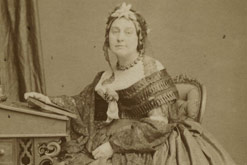
Caroline Norton

When George Norton caught wind that Caroline had been left a small legacy by her friend, Lord Melbourne and a small sum that her mother had left her, he stopped support payments for her and the children. Caroline fought him in court but lost. She campaigned to have the laws changed, and her victory resulted in the Matrimonial Act of 1857. Caroline remarried just months before her death in 1877, but not before two more crucial laws were passed that protected the rights of women and children, the Infant Custody Acts of 1873 (and 1886) and The Married Women’s Property Acts of 1870 (and 1882).

More on the topic:

Read Full Post »

I await each January with joy, knowing that PBS Masterpiece Classic will return. Two years ago PBS concentrated on Jane Austen; last year, two Jane Austen film adaptations were featured; and this year we get to see not only the new adaptation of Emma, but reruns of Persuasion and Northanger Abbey as well. Viewers are also treated to Return to Cranford, the sequel to Cranford, last year’s runaway BBC and PBS hit. Reprising their recurring roles are the stellar actors who represent Cranford’s spinsters and widows and other denizens of this quaint Victorian town. And then we are treated to new characters, each with stories of their own.

Even as I reveled in watching the first new installment of this sequel, I found some of the new stories a tad too familiar and I could not help but shake off a vague sense of disappointment. This feeling was similar to having visited a new vacation spot for the first time. You and your family love the experience so much, you eagerly plan a return. But during the second trip , you feel a slight let down. The wonder and discovery are gone, replaced with  a sense of déjà vu and sameness. You find yourself going over old ground and repeating excursions that somehow don’t seem quite as satisfying as last time.

And so it is with Return of Cranford. All the elements of the original Cranford are still there – the Victorian town ruled by the rigid principles that are followed by a group of widows and spinsters who are set in their old-fashioned ways. The railroad still threatens the town’s placid existence, and the only person barring the line’s completion is Lady Ludlow, whose stubborn resistance is misplaced.

Francesca Annis, pale, gray and achingly beautiful, makes a short but memorable entrance and exit, as does handsome Greg Wise as Sir Charles Maulver, and Claudie Blakley as Martha, Miss Matty’s maid of all work.

New characters replace the old ones who have (sadly) moved on. The viewer is still treated to a story about star-crossed lovers (Tom Hiddleston as William Buxton and Jody Whittaker as Peggy Bell),  and an implacable father (Jonathan Pryce as Mr. Buxton) who stands in the way of their happiness. They must somehow overcome all obstacles to remain together. Part of the mystery of Return to Cranford is how they will achieve this.

Return to Cranford relies heavily on Judi Dench’s Miss Matty to keep the story threads together. While she was a pivotal character in Cranford, it was her sister Miss Deborah Jenkyns (Eileen Atkins), who was the backbone of Cranford’s widow and spinster society. Miss Deborah inspired steadfast loyalty to her unwavering convictions; Miss Matty, on the other hand, is much softer in character and a person that others want to protect. She has had to grow a strong backbone after her sister’s death, but she is still too easy a touch and has difficulty holding the small band of ‘The Amazons’ together. When hoity toity Mrs. Jamieson’s (Barbara Flynn’s) sister-in-law Lady Glenmire (Celia Imrie) comes to visit, Miss Matty and her cohort are given the sort of social snubbing that Miss Deborah would not have brooked for an instant.

Don’t get me wrong. I am still mad about Miss Matty, who is portrayed by the incomparable Judi Dench. And though her character is too weak to rule the town with the iron fist that her sister Deborah used, she’s become the town’s morally upright compass.

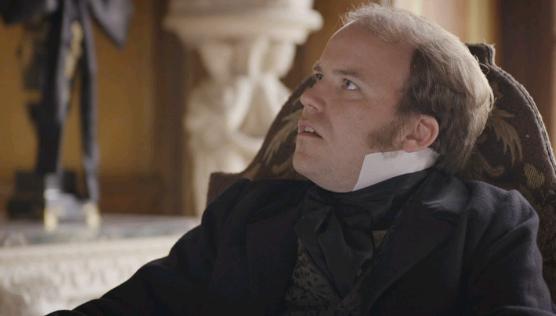
One of the main problems I found with episode one of Return to Cranford is the lack of real tension in the plot. This might be due to the fact that this adaptation was written largely by Heidi Thomas, not by master story teller Elizabeth Gaskell.  A dastardly character is introduced by way of Lady Ludlow’s wastrel son, Septimus (Rory Kinnear), but he is merely an unfeeling cad and shows up only long enough in the film to prove to us that Lady Ludlow had wasted her motherly affection (and money) on an unworthy son. His actions do not produce the tight-as-a-drum-tension that compels a viewer to keep watching a show or a reader to keep turning the pages. The train trip, in which Miss Matty convinces her friends to give the railroad a chance, does not provide much tension either, and the central love story between Peggy Bell and William Buxton seems like something that we have seen before.

Much of the quirky humor I delighted in with the first film is gone, although it was fun to see the ladies get tipsy as they warmed towards Lady Glenmire, and to see Miss Pole get her comeuppance as she makes a bird cage out of a French petticoat hoop frame for her parrot.

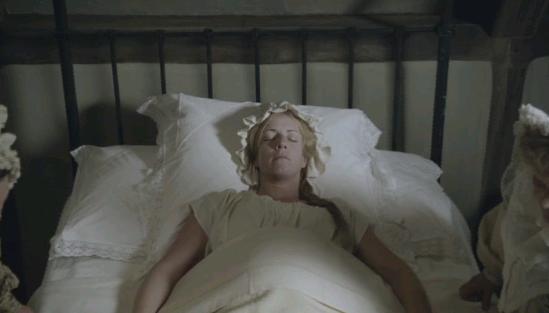
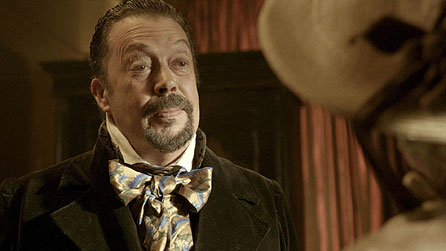
Episode Two gets much better. There’s real tension between Mr. Buxton and his son after William declares his love for Peggy Bell. Rather than honor his father’s wishes to find a more suitable wife, William decides to remain true to Peggy, make his own way in the world and work for the railroad until he has enough money to marry her.  The ladies of Cranford provide a funny backdrop to Lady Glenmire’s romance with Captain Brown. And we follow the fortunes of young Harry, who is torn between two worlds. He does not belong at boarding school and has good reasons for running away. A train accident, which kills poor Mrs Forrester’s cow and puts Harry’s life in danger, provides some true heart-wrenching moments. But all’s well that ends well. Miss Matty finds a satisfying way to unify the town, and the magic act of Senor Brunoni (Tim Curry in a funny role) was a fine (and wonderful) way to end the show and tie up loose story ends.

A friend who watched the show with me (and who did not see Cranford last year), found Return to Cranford delightful. So, I shall attribute my churlishness to a jaded palate and concede that Return is a delightful show, one worthy of viewing and certainly better than anything the competition on commercial television and cable tv have to offer. While my ranking of Cranford was five out of five stars, I rate this sequel a tad lower: four out of five stars.

Read Full Post »

Another book review so soon on this blog? Well, yes. This book from Shire Publications, Victorian and Edwardian Horse Cabs by Trevor May, is short, just 32 pages long, but it  is filled with many facts and rare images of interest to lovers of history. In Jane Austen’s day most people walked to work, town, church, and market square, or to their neighbors. Six miles was not considered an undue distance to travel by foot one way. The gentry were another breed. They either owned their own carriages or hired a public horse cab. These equipages were available as early as the 1620’s.

Hackneys, or public carriages for hire made their first significant appearance in the early 17th century. By 1694, these vehicles had increased to such a number that a body of Hackney Coach Commissioners was established in London. The commissioners dealt out licences, which was a bit of a joke, for a mere four inspectors were responsible for over 1,000 vehicles.

Hackney Coach 1680

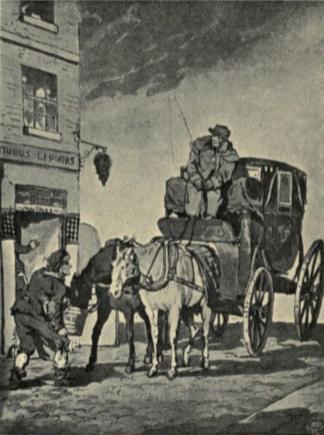
Most of these licensed hackney coaches were purchased second hand. All that an enterprising person needed to establish his own hackney coach business was enough money for a used carriage and three horses, two that worked in rotation, and one that could be used as a replacement in case of injury or illness. The death of a horse could lead to a cab owner’s financial ruin. Another important ingredient was housing for the horses.

Hackney Coach 1800. Image @Wikimedia Commons

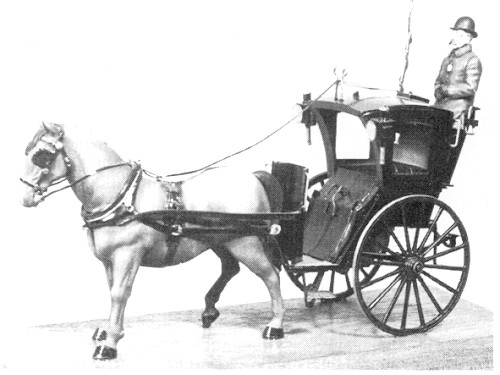
By, 1823, the lighter horse cabs began to replace cumbersome hackney coaches in great quantity, and by the mid 1830’s, the hansom cab set the new standard for modern horse cabs. Aloysius Hansom, an architect, designed the first carriage. When Hansom went bankrupt through poor investments, John Chapman took over, designing an even lighter, more efficient cab, one whose framework did not strike the horses on their backs or sides whenever a carriage ran over an obstacle in the road.

Hansom Cab

Commercial cab firms tended to be small, even as late as 1892. Only one or two proprietors provided a large number or variety of equipages, like Alfred Pargetter, whose concern advertised removal carriages, cabs, and funeral coaches for hire. While cabs were licensed, their drivers were not and the road could present a dangerous obstacle course. The video clip below shows how adroitly horses and carriages managed to avoid each other with seemingly few rules (mostly towards the end of the clip). Notice how some lucky individual horses pulled relatively light loads compared to other horses forced to pull heavy carts.

These two video clips, one from 1903 and the other from 1896 (unbelievable!) show the end of an era, for by 1914, motorized vehicles were rapidly replacing the horse-drawn cart.

I recommend this book to anyone with an insatiable appetite for a pictorial history on a particular topic. Trevor May is an expert on the Victorian era, and he has managed to squeeze more information about horse-drawn cabs in this short book (more a thick pamphlet) than I have read before. The images are simply splendid.

Read Full Post »

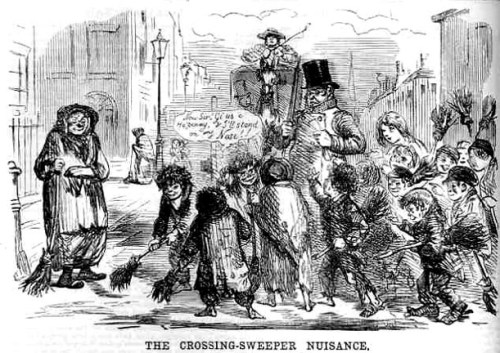
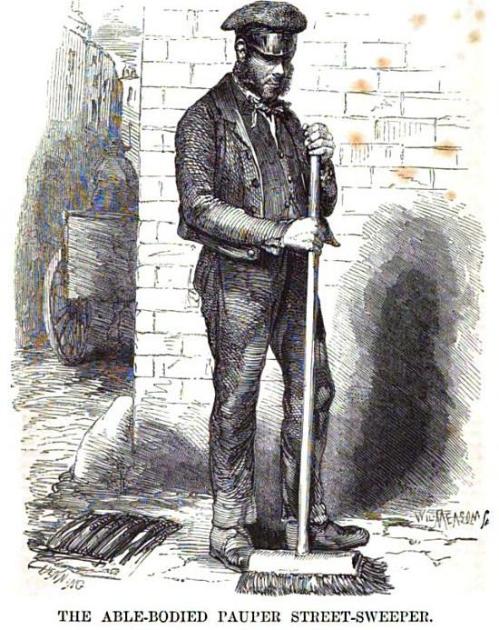
When horses drew every imaginable wagon in London, crossing sweepers were a common sight. In some areas of town they were regarded a nuisance, for often young boys would pester a pedestrian and sweep a clear path whether that person wanted their help or not. The practice of using crossing sweepers to clean the streets of horse manure, dust, and clinging mud lasted into the early 20th century. In the mid-19th century, Henry Mayhew chronicled the lives of working people in a series of volumes entitled London Labour and the London Poor. Mayhew described a system of cleaning streets, introduced by Charles Cochrane in 1843, that instituted a more orderly system than crossing sweepers, and in which former paupers were hired so that they could support themselves.

Crossing Sweepers, 1856

Crossing Sweepers, 1856

The first demonstration or display of the street orderly system took place in Regent street between the Quadrant and the Regent circus and in Oxford street between Vert street and Charles street The streets were thoroughly swept in the morning and then each man or boy provided with a hand broom and dust pan removed any dirt as soon as it was deposited The demonstration was pronounced highly successful and the system effective in the opinion of eighteen influential inhabitants of the locality who acted as a committee and who publicly and with the authority of their names testified their conviction that the most efficient means of keeping streets clean and more especially great thoroughfares was to prevent the accumulation of dirt by removing the manure within a few minutes after it has been deposited by the passing cattle the same having hitherto remained during several days. – London Labour and the London Poor, p. 259

street sweeper

The groups of orderlies not only swept the street and removed dirt in a particular area of London (500 linear yards of a busy street, 2,000 yards of a quieter section, and 9 men in a busy intersection, like Cheapside), but they also acted as “the watchman of house property shop goods, the guardian of reticule,s pocket books, purses and watch pockets, the experienced observer and detector of pickpockets … more, he is always at hand to render assistance to both equestrian and pedestrian.” The report concluded that the street-orderly system would keep the streets of London and Westminster clean in a most satisfactory way. In return, the street-orderlies would earn a wage of 12s. Although this was a lower living wage than other workmen earned, the money lifted them out of their lives of squalor.

The system did not entirely replace the crossing sweepers, many of whom were depicted in caricatures as hounding pedestrians for services rendered. Read my article on Crossing Sweepers at this link.

Read Full Post »

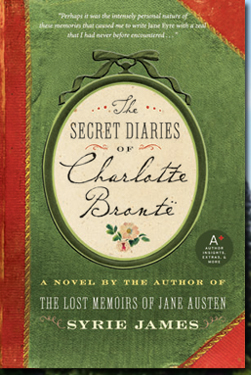
syrie james the secret diariesThe days when I can read a book cover to cover in one or two sittings are gone, but if I’d been able to free up such a large block of time, I would have finished Syrie James’s new book, The Secret Diaries of Charlotte Brontë, a month ago. As it was, the book became a constant companion in my briefcase. I would fish it out at opportune moments to steal a few minutes reading about Charlotte, her sisters Emily and Anne, her brother Branwell, and Arthur Nicholls, the young curate who’s been hired to help out Charlotte’s  father, Reverend Patrick Brontë, and who eventually marries her.

I’ll be the first to admit that my knowledge of the Brontë family was minimal at best. While I count Jane Eyre and Wuthering Heights as among my favorite 19th century novels, I knew very little about the authors, except that Charlotte was no fan of Jane Austen’s writing style. Note that I wrote “was,” for after having finished this book I feel that I have gotten to know the Brontë clan quite well.

Syrie’s modus operandi in writing a fictional biography is to inhabit her character and take on her persona as she writes in the first person. She meticulously researches her subjects and uses original sources as much as possible. The result, in this instance, is a first person account of Charlotte Brontë in a style that is not quite Syrie’s and not quite Charlotte’s, but that is serviceable and believable. When using such a technique, one is always in danger of awkward transitions and a choppy style, but I found the story so compelling that I stopped noticing the transitions and began to read the book out of pure interest and enjoyment. The author illuminates certain facts by adding footnotes that link to the actual historical event, enhancing the richness of this reading experience. She also “shows” and doesn’t “tell”, which demonstrates her maturity as an author. Syrie’s introduction to Mr. Nicholls, the “hero” of this romance, instantly tells us something about his character without hitting us over the head with unnecessary exposition. Keeper, the mastiff at the parsonage, is an aloof and particular dog who can take a fierce dislike to strangers, yet here is his reaction to the new cleric:

“To my astonishment, the fire now instantly dissipated from Keeper’s bull-dog eyes; he descended onto all fours; and, as if a child responding to the Piper of Hamelin’s call, he trotted obediently back to the curate’s feet and calmly settled on his haunches.”

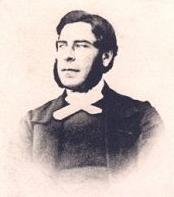
Arthur Bell Nicholls

Arthur Bell Nicholls

Syrie strikes a nice balance between the past and the present, going back in time only to illuminate details about Charlotte’s life that were the inspiration for her novels, and she keeps the flow of the story going with as much suspense as Charlotte’s life offered. I found Syrie’s description of Bramwell’s, Anne’s, and Emily’s deaths not only unutterably sad, but she also depicts a despondent Charlotte who went from living in a house filled with supportive siblings to one that was largely silent and empty in a year. For fans of biographical tales and romance, Syrie’s story of Charlotte offers it all: longing and yearning, struggle and success, the searing pain of immeasurable loss, and the happiness of a love that came unbidden and unsought. I did not want this story to end. Thankfully, the book offers an appendix filled with Charlotte’s letters, Brontë poetry, and an interview with Syrie that explains why and how she wrote the book. I also want to learn more about Charlotte and cannot wait to read Mrs. Gaskell’s account of the author’s life.

Charlotte Bronte

Charlotte Bronte

Additional Links

Read Full Post »

« Newer Posts - Older Posts »