Feeds:
Posts
Comments

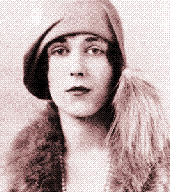
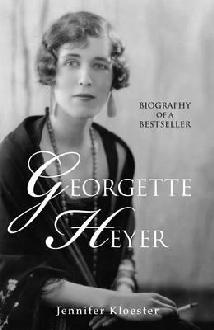
I have reviewed many Georgette Heyer novels for this blog. Here are some images of the author over the years. She had a strong handsome face. Not pretty, but full of character.

Georgette Heyer in 1923 at 21. She had already written her first book.

Looking rather modish

Wearing a rather severe look

The author at her son's wedding

Georgette in 1970, four years before her death

Read this review in the Guardian UK of her latest biography by Jennifer Kloester.
Also, Happy Birthday, Georgette Heyer!

Georgette Heyer

Whenever a reader asks: Which of the Georgette Heyer books ranks among your favorites? Venetia invariably springs from my lips. Mind you, I had not read this book for decades, but I savored its memory. In recent years I began to question my younger self, for while I loved rereading The Grand Sophy last year, I didn’t find it quite as splendid as the 24-year-old Vic had. As I grew older, other GH books made their first appearance on my favorites list, such as The Quiet Gentleman and The Reluctant Widow.

When Sourcebooks sent me a review copy of Venetia I did not choose it for my first critique, for I did not want to spoil my youthful impression. Once I began reading the book, I discovered that the 25-year-old heroine of Undershaw in Yorkshire captivated me all over again.

Amongst the pick of the debutantes at Almack’s she must have attracted attention; in the more restricted society in which she dwelt she was a nonpareil. It was not only the size and brilliance of her eyes which excited admiration, or the glory of her shining guinea-gold hair, or even the enchanting arch of her pretty mouth: there was something very taking in her face which owed nothing to the excellence of her features: an expression of sweetness, a sparkle of irrepressible fun, an unusually open look, quite devoid of self-consciousness.”

Venetia Lanyon is no ordinary heroine. Like Jane Austen’s Emma, she has largely led a protected life, thanks to her reclusive father, and allowed to go only to the dance assemblies in York and as far as the seaside town of Scarborough. Although she might not have been given a Season in London, Venetia is smart, lively, and resourceful. After her father’s death and in her elder brother’s absence, she runs the estate and makes all the important decisions overseeing the house, servants, herself and her young brother, Aubrey.

Waiting for her brother Conway’s return (he is a soldier), Venetia fends off two local suitors, the priggish Edward Yardley, who is as dull as a post, and ardent Oswald Denny, who, too dazzled by Venetia’s unselfconscious beauty and overly influenced by Lord Byron’s romanticism, is unable to recognize that he is much too young for her. Venetia lives a sedate life in her back country neighborhood, whose denizens are all respectable and predictable, except for one – Lord Damerel, a rake and ne’er-do-well, and a blight upon Undershaw’s spotless reputation.

“His family was an old and a distinguished one, but the present holder of the title was considered by the respectable to be the neighborhood’s only blot. It was almost a social solecism to mention his name in polite company.”

Venetia’s uneventful life unexpectedly changes when she encounters Damerel as she picks blackberries on his lands while wearing an old and rumpled gown.

“He was a stranger, but his voice and his habit proclaimed his condition, and it did not take her more than a very few moments to guess that she must be confronting the Wicked Baron. She regarded him with candid interest, unconsciously affording him an excellent view of her enchanting countenance.”

Mistaking her for a trespassing servant maid, he kisses her. And so the fun begins, for we are still at the very start of the novel.

Which brings me to the hero. As a young woman, I preferred dark brooding heroes like Damerel – men whose vices, dissipations and disappointments turn them into cynics; men whose good qualities are awakened by spectacular women like Venetia, men who on the surface are all wrong for the heroine. And so in Damerel I found my perfect unforgettable hero. Now, in my more advanced age (ahem), I find that I am still enamored of him.

Several qualities make Venetia stand head and shoulders above most of GH’s other novels. The plot is intelligent and complex and gets better and better with each page, continually taking us in unexpected directions. In fact, there were three twists that threw me for a loop and that kept this love story fresh and alive until the last page.

Several minor characters stand out from the ordinary. I could read an entire book about Aubrey, Venetia’s physically disabled but fiercely independent and brilliant brother who likes books more than people. Then there’s Mrs. Scorrier, an unforgettable vulgar character in the mode of a Mrs. Elton. Presumptuous, overbearing, and encroaching, she promises to overset Venetia’s and Aubrey’s well ordered lives (and those of the servants). Then there’s the matter of a little mystery, for as the book progressed I kept asking myself, when will we meet Venetia’s brother Conway? So much of the plot revolves around his absence and his anticipated return, that I was keen to meet him.

I am one of the GH readers who luxuriates in her use of Regency cant, and Venetia offers this language in spades:

She made the shocking discovery that he was a member of the dandy-set – indeed the pinkest of Pinks, a swell of the first stare! Not having the least guess that the old lady holds every Bond Street beau in the utmost abhorrence, the silly pigeon rigged himself out as fine as fivepence, and trotted round to Grosvenor Square looking precise to a pin: Inexpressibles of the most delicate shade of primrose, coat by Stulz, Hessians by Hoby, hat – the Bang-up – by Baxter, neckcloth – the Oriental, which is remarkable for its height – by himself.”

There are readers, I found to my surprise, who are put off by Ms. Heyer’s cant (Ten reasons why I can’t read Georgette Heyer) and who could care less about her historical accuracy. This novel is not for them, for it is filled with colorful antiquated language and wonderful tidbits about the Regency era that I found fascinating but that will turn them away.

I rate Venetia five out of five teacups

Did I like Venetia? No, I loved it, and I hope you will too. I give it five out of five Regency tea cups.

Order the book here
ISBN: 9781402238840

Other Georgette Heyer Reviews on this blog:

Laundry, Georgian Style

The script in Thomas Rowlandson’s 1810 cartoon states:

“Ah! My old Friend I wish you had called
at some more convenient time but this is washing
day — I have nothing to give you but cold Fish, cold Tripe
& cold potatoes — you smell soap suds a mile!
Ah Jack, Jack you don’t know these Comforts!
you are a Bachelor!”

In Rowlandson’s image, two well fed men are seen smiling. The host is apologetic, for his guest will not get anything but cold collations, probably leftovers from the previous day. His wife and maid are seen toiling over a bucket, their hands probably raw and red from the effects of harsh lye soap. Neither of them will have the time to look to his comforts or make a hot meal, which is why he is apologizing to his unexpected guest. Since laundering was not considered man’s work, he had to “suffer” the lack of his wife’s and servant’s attentions until the wash was done.

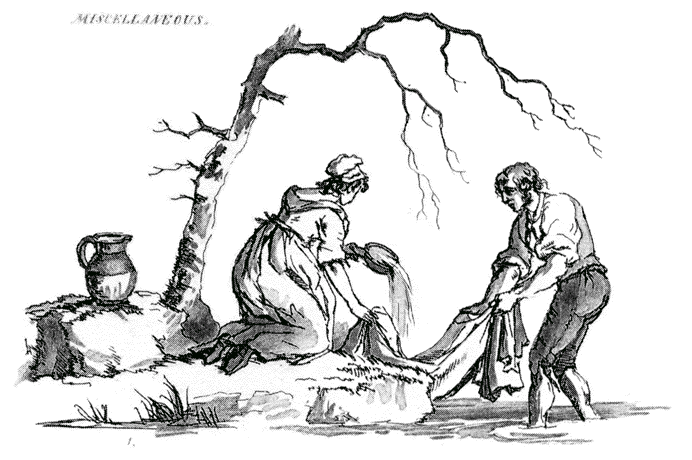
Doing the wash in a stream, 1806

First Boyle all the Cloaths with soap, and then wash them..” – John Harrower, indentured servant, writing to his wife (June 14, 1774)

Doing the wash in the Regency era was no small task, and housewives had to set aside two days to perform this dreaded duty, for it meant hauling water, boiling the cottons and linens, washing them with pungent lye soap, which burnt the skin, rinsing the clothes in clean water, which meant hauling more water from the well or a nearby stream, twisting the cloths to remove as much water as possible, hanging the clothes to dry, and then praying that rain would stay away long enough for the sun to perform its duty as a dryer. If one had to do laundry in a town or city, one had to pray that coal soot would not drift upon the clean clothes in a cramped back yard before they dried.

The Victorian scullery in a fine household included a copper for boiling water, a wringer, press, and ironing board.

Doing laundry was so enormous an undertaking, that unless the household were of a great size and boasted many servants, the mistress of the house and her daughters would frequently pitch in with the servants. There were chemises to be laundered, bed and table linens, towels, shirts, muslin dresses, handkerchiefs, socks, and the like. First the clothes would have to be treated for stains, the muslins and silks most delicately. After the wash had dried, ironing would commence, another laborious task.

Drying damp clothes over chair backs in front of a fireplace. Elizabeth Bennet and Mrs. Gardiner at the Lambton Inn, Pride and Prejudice, 1980

Chemises and shirts, which were worn next to the skin, were purposefully made with sturdier cloth so that these inner garments could withstand rougher treatment and more frequent washing. People tended to own more under garments for this reason. Outer clothes were subject to less frequent laundering because they were made of finer stuff, though one must wonder at the cleanliness of trailing hems, the edges of collars and sleeves, and armpits in the days before daily baths became popular, when air conditioning was just a distant dream, and when sweat must have stained clothes in a most visible manner. Is it no wonder that a majority of the Regency fashions that have survived to this day belonged to the rich, who probably wore their fashionable outfits once or twice before purchasing others?

 For more on the topic:

In 1993 Colin Firth starred opposite Jemma Redgrave (Lady Betram, Mansfield Park) in Chatsky, in which the hero of the play tells the truth and is mistaken for a lunatic.  It is amazing to see the images from that play,  for, since it is set during Regency times, Colin in full costume could easily be mistaken as Mr. Darcy, a role he would play two years later. Jemma played Lady Bertram in 2007′s Mansfield Park. Although the part was written against type (at the end of the film, Lady Bertram energetically unites Fanny with Edmund), her portrayal of that indolent lady was fresh and memorable.

Image @The AFirthionado Archive

To see more pictures of Chatsky and to read about the play, go to: The AFirthionado

Colin in 1993. Image @The AFirthionado Archive

Colin in 1995

Jefferson's neat notations in the margin of "Architecture de Palladio. Image @Washington University Libraries, Department of Special Collections

Most of us have written in the margins of books, especially in our own textbooks when cramming for an exam or writing a paper, but how many of us write notes in expensive hardcovers that we treasure? These days writing inside books is heavily discouraged and frowned upon, but it was once a common practice, one that has pleased many a historian and bibliophile. Imagine coming across a dusty old book at a yard sale and finding the notes and scribblings of a famous person inside of it. Imagine the joy you would feel to come across such a connection!

Sir Isaac Newton's marginalia

Marginalia, or the practice of writing in books, has a rich literary tradition. Samuel Taylor Coleridge’s friends lent their books to him on purpose hoping that he would write along their margins. Chances were that he did, for he was a prolific margin writer. Mark Twain often made comments, giving his opinions or hotly debating with the book’s author.  Other practitioners of margin writing were William Blake, Charles Darwin, and Thomas Jefferson. Even Jane Austen joined this select group, scribbling in her copy of Oliver Goldsmith’s book about her favorite poet, William Cowper (pronounced Cooper.)

Mark Twain's annotation of his publication of Huckleberry Fin. Image @New York Times

In Persuasions Online, Jane Austen scholar Edith Lank writes about her copy of the two-volume Lord Barbourne edition of Jane Austen’s letters, which she found at a sale. This books is filled with

detailed genealogies, marginal comments, explanations and family gossip…The first were Fanny Caroline Lefroy and her sister Mrs. Louisa Lefroy Bellas, both daughters of Jane Austen’s neice (sic) Anna Austen Lefroy. The sisters annotated the book in careful nineteenth-century script and printing.” – List of Annotations in the Bellas Copy of Lord Brabourne’s Letters of Jane Austen

Thomas Jefferson’s scribblings were as elegant and refined as his mind. He sold his book collection to the Library of Congress in 1815, and kept a personal collection of books that he built upon until his death. Those books revealed that he often corrected typographical errors.

Thomas Jefferson's neat handwriting in Greek on a note inside his book.

Marginal scribblings provided a window into the minds of its writers, for they offered an insight into what they thought and revealed personal aspects of their characters. My scribblings in college texts were boring, for they merely summarized the most important points I needed to recall. I rarely left a personal thought in the margins or wrote inside my own books, although I dog eared favorite passages or left scraps of paper between pages that I wanted to reread.

Wild scribblings

The author of an article in the New York Times feared that the advent of eBooks would end the art of marginalia, but the following passage partially assuages that fear. I say partially because part of the charm of marginalia is to see the author’s hand and his/her choice of writing implement, which is something Kindle does not yet offer (who knows what the future will hold?):

Annotations in a Kindle

When I received a Kindle as a gift earlier this year, my habits of marginalia soared to new heights. It became extremely easy to highlight passages and add notes, which are then situated in the text I’m reading but also pulled together into my Kindle account on Amazon where I can, for instance, share them with students in a course, fellow members of a book discussion group, family, and friends…even, in theory, with enemies. I’ll rebut and rebuke them with my rapier marginalia. It’s even possible to add a marginal note on a Kindle and then tweet it.-The margins of MarginaliaBooks From Thomas Jefferson’s Personal Library Rediscovered

Do you write inside books? What’s your opinion about about this literary tradition? And do you think Kindle will rekindle it?

More on the Topic